
Our readers keep the lights on and the weekend projects moving. As an Amazon Associate, I earn from qualifying purchases.
A bench multimeter is the anchor of any serious electronics bench, but choosing one is a battle between chasing digits and trusting the reading. A hand-held meter hunts for transient values; a benchtop unit locks onto the truth of a signal. The difference lives in the spec sheet, the measurement speed, and the price you pay for peace of mind.
I’m Rikta — the co-founder and writer behind FitlyFast. I’ve spent hundreds of hours cross-referencing manufacturer accuracy tables, counting true digits versus noise-limited digits, and weighing measurement speed versus stability across dozens of bench multimeter models to bring you this guide.
Whether you’re validating power supply ripple, matching components for a crossover network, or developing a production test fixture, choosing the right bench multimeter means understanding the gap between advertised counts and usable precision.
How To Choose The Best Bench Multimeter
A bench multimeter isn’t a casual purchase. It’s a tool you will rely on for years of voltage references, current monitoring, and resistance matching. The key is matching the meter’s true digit count, measurement speed, and connectivity to your specific workload, not just the number on the front of the box.
Counts vs. True Digits
A 50,000-count meter displays up to 4.75 digits, while a 2,200,000-count meter offers 6.5 digits of resolution. But the real story is noise floor and stability at the last digit. Many high-count meters only offer a stable reading at the lowest measurement speed setting. If your work requires microvolt-level accuracy, you need a meter whose last digit settles and stays settled.
Measurement Speed and PLC
Power-line cycle (PLC) integration is the unsung spec. At 10 PLC, a meter rejects line noise and gives its best accuracy, but readings per second drop to single digits. At 0.01 PLC you get hundreds of readings per second, but the noise floor rises drastically. A good bench meter lets you adjust PLC for the specific measurement task.
Connectivity and Automation
If you plan to log data, run scripts, or integrate with a test rack, you need a meter with USB or LAN and SCPI command support. Meters without programmable interfaces force manual recording, which defeats the purpose of a benchtop unit for serious lab or production work.
Quick Comparison
On smaller screens, swipe sideways to see the full table.
| Model | Category | Best For | Key Spec | Amazon |
|---|---|---|---|---|
| Siglent SDM3065X | 6½-digit Premium | Lab-grade accuracy and automated testing | 2,200,000-count, 4.3″ TFT | Amazon |
| Rigol DM3068 | 6½-digit Competition | High-resolution benchtop measuring | 2,400,000-count, dual display | Amazon |
| Fluke 289 | Handheld Logging | Industrial field logging and trend capture | 50,000-count, TrendCapture | Amazon |
| Hioki DT4282 | Handheld Precision | Portable lab-grade measurements | 60,000-count, 0.025% basic accuracy | Amazon |
| Siglent SDM3045X | 4½-digit Benchtop | Hobbyist and entry-level lab work | 150 readings/sec, graphing | Amazon |
| Testo 760-3 | Auto-Ranging Handheld | Field service with automatic parameter detection | CAT IV 600V, IP64 rated | Amazon |
| Amprobe 37XR-A | Feature-Rich Handheld | Component and logic testing | 10,000-count, inductance to 40H | Amazon |
| OWON XDM2041 | Benchtop/Portable | Compact bench with dual display | 55,000-count, 65 readings/sec | Amazon |
| OWON XDM1241 | Budget Benchtop | Entry-level bench with PC connectivity | 3.5″ LCD, data recording | Amazon |
In‑Depth Reviews
1. Siglent SDM3065X 6½ Digit Bench Multimeter
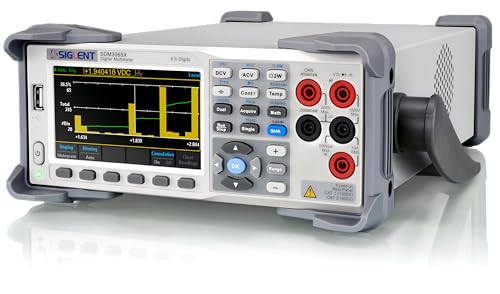
The Siglent SDM3065X delivers genuine 6½-digit measurement resolution with a 2,200,000-count ceiling, putting it in the same performance class as lab standards but without the three-figure service contract. The 4.3-inch TFT-LCD shows dual measurements and trend graphs, and the built-in interfaces (USB Device, USB Host, LAN) make it a natural fit for automated test racks. Users report that understanding the PLC filtering settings is the key to its exceptional stability.
DC voltage range covers 200 mV to 1000 V, and AC True-RMS extends from 200 mV to 750 V. The DC current path handles up to 10 A, and 4-wire resistance measurements benefit from the high count resolution. The included EasyDMM software simplifies control without needing to write SCPI commands, though the documentation has some gaps in the command set.
The single drawback is the shipping experience. Some units have arrived with signs of being previously opened, and one user received a unit that was clearly a refurbished device sold as new by a third-party seller on the platform. Buy from authorized test-equipment resellers to secure the full warranty.
Why it’s great
- True 6½-digit resolution for microvolt-level measurements
- LAN and USB interfaces enable remote automation
- Stable readings after proper PLC configuration
Good to know
- SCPI documentation is incomplete and contains errors
- Verify the seller is an authorized distributor to avoid refurbished stock
2. Rigol DM3068 6½ Digit Benchtop Multimeter

The Rigol DM3068 competes directly with the Siglent SDM3065X, offering a slightly higher count ceiling at 2,400,000 counts. Its dual-display mode lets you monitor voltage and frequency simultaneously, and the built-in trend view captures measurement drift over time without needing a connected PC. The capacitance measurement is a standout feature, spanning from 1 pF to 0.1 farad.
Connectivity includes LAN and USB, with LXI compatibility for network-based control. The “any sensor” function allows direct readout from various temperature probes and transducers without external signal conditioning. Users report that the unit works reliably with custom measurement programs and with sigrok pulseview, though the connection setup can be finicky.
The display is an older LCD design, and the tilt stand is a minor ergonomic annoyance. But for the price, this meter delivers 6½-digit performance, NIST-traceable calibration, and enough features to satisfy audio designers, power supply developers, and embedded engineers who need a high-resolution anchor for their bench.
Why it’s great
- Highest count ceiling at 2,400,000 among its price peers
- Capacitance measurement reads capacitors up to 0.1 farad
- LXI and LAN support for automated testing
Good to know
- Older LCD panel with limited contrast and viewing angle
- Tilt stand design feels flimsy compared to the chassis quality
3. Fluke 289 True-RMS Logging Multimeter
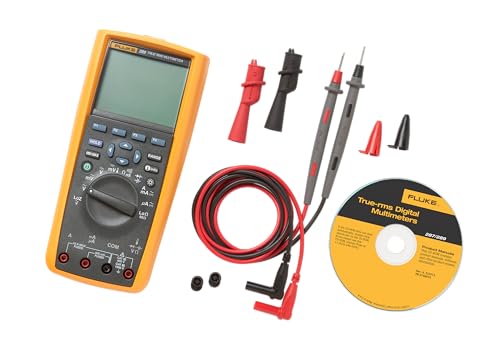
The Fluke 289 is the handheld logging powerhouse that many industrial electricians and field engineers treat as a bench meter simply because its data storage and TrendCapture graph are superior to many benchtop units. With 50,000 counts and a 1/4 VGA display, it logs up to 10,000 readings per session, and the TrendCapture mode graphs the data directly on the meter so you can spot anomalies without a computer.
The low-pass filter is specifically designed for variable-frequency drive measurements, and the LoZ voltage function eliminates ghost voltages caused by capacitive coupling. The selectable AC smoothing mode helps display a steadier reading when measuring noisy signals. The logging interval can be set from seconds to hours, making it ideal for overnight equipment monitoring.
Build quality is the Fluke hallmark, but this generation has some QC issues—rough molding on the yellow case, a non-removable rubber holster, and a screen that can be difficult to read in low light. The TrendCapture data export requires the optional IR3000 wireless connector, which is sold separately. For pure bench work, a dedicated benchtop unit offers better stability and resolution, but the 289 is unmatched for field logging.
Why it’s great
- On-device TrendCapture graphing without a PC
- Low-pass filter for VFD motor drive measurements
- Extremely rugged and field-proven durability
Good to know
- Wireless connectivity requires separate IR3000 adapter purchase
- Some units show molding imperfections on the housing
4. Hioki DT4282 High Precision Digital Multimeter
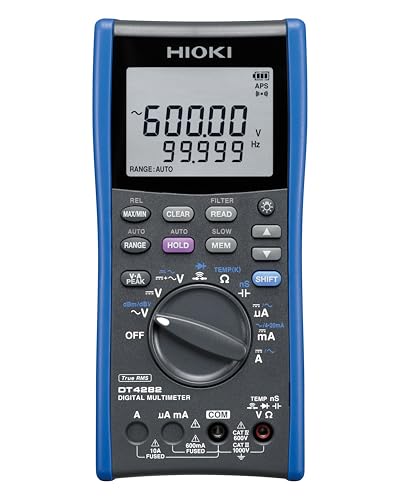
The Hioki DT4282 earns a spot in this bench multimeter guide because its 60,000-count resolution and 0.025% basic DC voltage accuracy rival many benchtop meters while remaining fully handheld. The dual display shows two measurement values concurrently, and the data logging stores up to 400 sets of readings. The low-pass filter eliminates harmonic noise when testing inverters and variable-frequency drives.
Safety is a strong point, with terminal shutters that physically block incorrect test lead insertion and CAT IV 600 V / CAT III 1000 V ratings. The included test leads are high-quality, the backlight is bright and high-contrast, and the compact form factor fits easily into crowded tool bags. Users consistently praise its build quality and find its measurement speed matches or exceeds the Fluke 87V.
The price point is mid-range, and the optional USB communication pack must be purchased separately for data transfer. But for a worker who demands bench-grade accuracy in a portable housing, the DT4282 is hard to beat. The dual display and logging capability eliminate the main reasons to buy a second meter for the bench.
Why it’s great
- 0.025% basic DC accuracy rivals bench-grade performance
- Terminal shutters prevent dangerous lead misinsertion
- Logs 400 data sets internally
Good to know
- USB data transfer requires optional communication pack
- Not a true dedicated benchtop—form factor is handheld
5. Siglent SDM3045X 4½ Digit Bench Multimeter
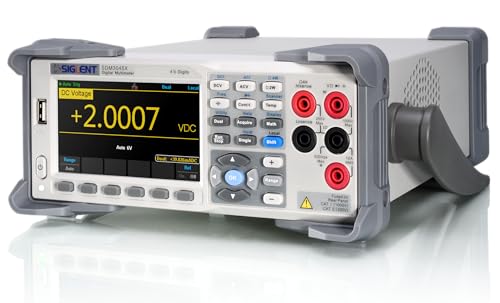
The Siglent SDM3045X is the entry point into real benchtop multimeter territory. With a 4½-digit resolution, 0.1% basic DC accuracy, and true RMS measurement across both voltage and current, it offers a substantial upgrade over a handheld meter for lab work without demanding a premium budget. The dual display shows voltage and frequency or other paired measurements simultaneously.
Measurement speed reaches 150 readings per second, which is fast enough for capturing transient behaviors in switching circuits. The built-in graphing mode shows measurement trends directly on the LCD, and the USB host and device ports allow direct connection to a PC. A calibration certificate is included, which gives confidence in out-of-box accuracy.
The unit lacks a LAN interface, which limits its use in production test racks that rely on network-based control. But for a hobbyist, student lab, or light service bench, the SDM3045X delivers the core benchtop experience—stability, dual display, and SCPI programmability—at a price that makes it an easy upgrade.
Why it’s great
- Calibration certificate included with every unit
- 150 readings/sec captures fast signal changes
- USB connectivity for data logging and remote control
Good to know
- No LAN interface for network-based automation
- 4½-digit resolution limits microvolt-level measurements
6. Testo 760-3 Digital Multimeter
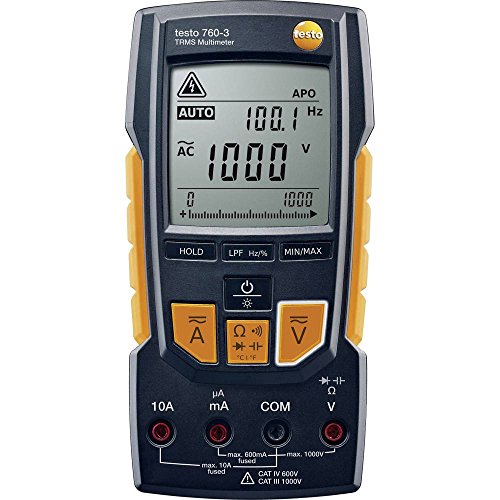
The Testo 760-3 takes a different approach to measurement—automatic parameter detection. Instead of manually selecting voltage, resistance, or continuity, the meter determines what you’re measuring and sets the range accordingly. This makes it exceptionally fast to use in field service situations where speed is more important than menu diving for the right function.
The safety rating is impressive at CAT IV 600 V and CAT III 1000 V, and the IP64 dust and splash rating means it tolerates harsh job site conditions. True RMS measurement and a low-pass filter allow accurate readings on motor drives and other non-sinusoidal waveforms. The included silicone probes are comparable to Fluke’s premium leads.
The trade-off is measurement speed. The auto-ranging algorithms introduce a roughly one-second delay before displaying a stable reading. Some users find this hesitation frustrating when scanning multiple test points. Additionally, the auto-detection can misidentify the measurement type on certain signals, requiring manual override. This is a tool for efficiency, not for raw bench precision.
Why it’s great
- Auto-parameter detection eliminates dial switching
- CAT IV 600V and IP64 rated for tough environments
- High-quality silicone test leads
Good to know
- Slow measurement response—up to 1 second delay
- Auto-detection can misidentify measurement type on unusual signals
7. Amprobe 37XR-A True RMS Multimeter

The Amprobe 37XR-A is a feature-dense handheld meter that feels at home on a bench because it measures components that typical handhelds skip. Inductance up to 40 henries, capacitance up to 400 microfarads, frequency to 40 MHz, and logic testing to 20 MHz make it a one-box solution for mixed-signal and component-level troubleshooting. The 10,000-count display and 0.1% basic accuracy are competitive for its class.
The input warning tone alerts you when test leads are in the wrong jacks, a safety feature that prevents the common mistake of plugging the probes into the current terminals while trying to measure voltage. Fully safety-fused on both the 10 A and mA/μA paths. Users compare its functionality favorably to the Fluke 179 at a significantly lower entry point.
Response time is slightly slower than a Fluke, and the meter runs on a 9V battery rather than rechargeable cells. But for a home lab focused on component characterization, transformer measurement, or logic debugging, the 37XR-A packs more specialized features than any other meter in its price tier.
Why it’s great
- Measures inductance, capacitance, and logic signals
- Input warning tone prevents jack misconnection
- Fully fused current paths for safety
Good to know
- Slower measurement response than Fluke competitors
- Requires 9V battery, no rechargeable option
8. OWON XDM2041 Digital Multimeter

The OWON XDM2041 is a compact bench multimeter that emphasizes portability without sacrificing accuracy. At 55,000 counts and 65 readings per second, it provides resolution and speed suitable for most lab and service applications. The dual-line display simultaneously shows AC voltage and frequency or other paired measurements, and the interface includes USB-C charging.
The measurement set covers DC voltage, AC voltage, DC current, AC current, 2-wire and 4-wire resistance, capacitance, continuity, diode, temperature, and frequency. The 1000-point data logging stores readings internally at intervals from 15 ms to 9999 seconds, and the data exports as a table on a connected PC.
Users note that the continuity response is slow compared to traditional handheld meters, and the included test leads are basic—130 mΩ resistance probes with thick insulation and blunt tips. The default measurement speed is also slow; you need to manually switch to high-speed mode for responsive readings. But for simultaneous measurements in a tight bench space, the dual display and compact chassis are genuine advantages.
Why it’s great
- Dual-line display shows two measurements concurrently
- 1000-point internal logging with adjustable interval
- USB-C charging and compact bench footprint
Good to know
- Slow continuity response compared to handheld meters
- Included test leads are low quality with high resistance
9. OWON XDM1241 Desktop Digital Multimeter
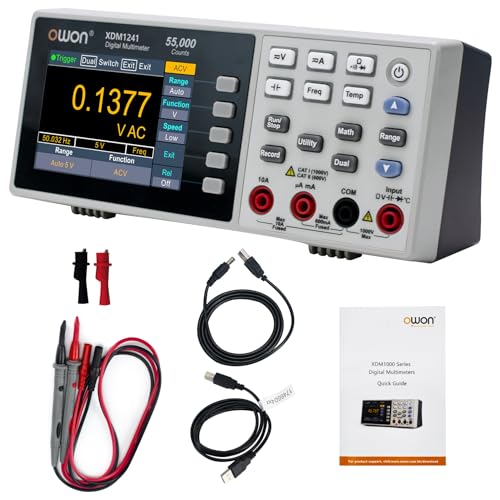
The OWON XDM1241 is the most affordable dedicated bench multimeter in this guide. It features a 3.5-inch LCD display with adjustable backlight, measures AC/DC voltage and current, resistance, capacitance, continuity, diode, frequency, and temperature, and includes manual and auto data recording. The built-in lithium battery provides up to 8 hours of untethered operation.
Accuracy is a strong point at this price. Users confirm that voltage, current, and resistance readings match their expectations across all ranges. The dual display shows two measurement functions simultaneously, which is helpful for monitoring voltage and current through a device under test. PC connectivity is recognized immediately via USB.
The included test leads are mediocre, and the auto-scaling starts at 5 V, meaning you must press a soft key to enter millivolt mode for low-voltage signals. The true RMS accuracy is specified only from 20 Hz to 1 kHz, and the capacitance and diode measurements are less precise than the core voltage and resistance readings. But as a first step into bench metering, the XDM1241 delivers reliable core functionality.
Why it’s great
- Built-in 8-hour lithium battery for portable bench use
- Dual display for simultaneous voltage and current monitoring
- USB PC connectivity for data export
Good to know
- No auto-ranging below 5V—requires manual millivolt mode
- True RMS accuracy limited to 20Hz-1kHz bandwidth
FAQ
What does 6½-digit resolution mean in a bench multimeter?
Can I use a handheld multimeter instead of a bench multimeter?
Why does measurement speed change with PLC settings?
Final Thoughts: The Verdict
For most users, the bench multimeter winner is the Siglent SDM3065X because it delivers genuine 6½-digit lab-grade resolution, LAN and USB connectivity for automation, and a large TFT display at a price that competes with 4½-digit units from traditional brands. If you want a handheld that matches bench accuracy and need a portable field companion, grab the Hioki DT4282 for its 0.025% basic accuracy and dual display. And for an entry-level benchtop that still offers dual display and PC connectivity, nothing beats the OWON XDM2041 as a budget-friendly starter unit.