
Our readers keep the lights on and the weekend projects moving. As an Amazon Associate, I earn from qualifying purchases.
Standing in front of a rusted metal part, you face a simple truth: the wrong abrasive grit wastes hours, clogs your cabinet, and coats your shop in a cloud of hazardous dust. Picking the right blast media is the single variable that determines whether a restoration job takes a weekend or a month. Each material—slag, glass, aluminum oxide, or walnut shell—carries a specific hardness, shape, and reusability profile that either annihilates paint or just bounces off the surface.
I’m Rikta — the co-founder and writer behind FitlyFast. Over many hours of cross-referencing Mohs hardness ratings, mesh sizes, and verified user break-downs across slag, glass, oxide, and organic media, I’ve built this guide to cut through the marketing noise and get you blasting with confidence.
Whether you’re stripping an old truck frame, cleaning brass casings, or etching a glass surface, this guide evaluates the top contenders to help you find the most effective blast media for your specific project.
How To Choose The Best Blast Media
Selecting the right abrasive comes down to three variables: the hardness of the substrate you’re cleaning, the type of coating you need to remove, and the finish you want afterward. A media that works beautifully on thick structural steel might destroy a thin aluminum panel or leave glass with an unacceptable haze.
Match Mohs Hardness to Your Substrate
The Mohs scale measures how resistant a material is to scratching. For reference, talc is a 1, steel is about a 4.5, and diamond is a 10. Aluminum oxide sits near the top at 9, making it aggressive enough to etch glass and mill scale. Walnut shell media (Mohs 4.5) is soft enough to clean wood and fiberglass without eating into the surface. Glass bead and crushed glass media fall in the middle. Choosing a media that is significantly harder than your substrate risks warping, pitting, or even removing base material.
Understand Mesh Size and Cutting Speed
Mesh size refers to the number of holes per linear inch in the screen used to sift the media. A lower mesh number (like 20/40) means larger, heavier particles that cut aggressively but leave a rougher surface. Higher mesh numbers (like 120 or 240) produce finer particles that deliver smoother finishes but take longer to strip heavy coatings. For heavy rust and thick paint on steel, start with 40-60 grit. For light surface rust, paint removal on aluminum, or glass etching, move up to 80-120 grit.
Check Silica Content and Reusability
Traditional silica sand is cheap but carries a major risk: the dust it generates can cause silicosis when inhaled. Many modern media options are classified as low-silica or silica-free. Black Beauty slag contains less than 0.1% free silica, while walnut shells and glass media are naturally silica-free. Reusability also varies dramatically. Aluminum oxide can be recycled up to 10 times in a blast cabinet. Crushed glass and slag break down faster, typically lasting one or two cycles before you need to replace the media.
Quick Comparison
On smaller screens, swipe sideways to see the full table.
| Model | Category | Best For | Key Spec | Amazon |
|---|---|---|---|---|
| #120 Aluminum Oxide – 8 LBS | Premium Oxide | Glass etching & texturing for cerakote | 120 grit / Mohs 9 hardness | Amazon |
| #7 Glass Beads (Medium) 60-80 Mesh | Mid-Range Glass | De-burring automotive parts | 60-80 mesh / 8 lb bag | Amazon |
| 30-60 Grit Crushed Glass – 19 lb | Premium Glass | Heavy rust on thick steel | 30-60 mesh / 19 lb / 559-254 µ | Amazon |
| Aluminum Oxide 80 Grit – 12 LBS | Mid-Range Oxide | General blasting on stainless & wood | 80 grit / 12 lb bucket / Mohs 9 | Amazon |
| BLACK BEAUTY Fine Abrasive 20/40 – 25 LBS | Economy Slag | Aggressive rust & paint removal | 20/40 mesh / low silica (<0.1%) | Amazon |
| Ground Walnut Shell 40-60 Grit – 5 LBS | Organic Fine | Tumbling brass & polishing | 40-60 grit / Mohs 4.5 | Amazon |
| Ground Walnut Shell 12-20 Grit – 4 LB | Budget Organic | Dry-cleaning model train parts | 12-20 grit / 4 lb bag | Amazon |
In‑Depth Reviews
1. #120 Aluminum Oxide – 8 LBS (Interactivia)

This fine 120-grit aluminum oxide from Interactivia is the go-to choice for anyone looking to etch glass or prep gun parts for cerakote without leaving a deep scratch pattern. With a Mohs hardness of 9, it cuts aggressively yet leaves a uniform frosted texture that coatings bond to perfectly. Users running cheap harbor freight blasters reported it performs without a hitch, which speaks to the media’s consistent particle distribution and lack of clumping.
The specific gravity of 3.9 and bulk density between 115-125 lb/ft³ give it a heavy, efficient feel in the cabinet—fewer passes equal faster work. It is also 100% silica-free and the manufacturer claims it lasts up to 10 times longer than silica sand.
One caveat: even the 8-pound bag feels expensive compared to slag or glass when measured by raw weight. But if you factor in its longevity and the quality of finish it delivers on sensitive surfaces like glass and aluminum, the cost-per-blast-hour is lower than any other media on this list. It’s the right pick when surface prep quality matters more than initial upfront cost.
Why it’s great
- Extremely durable—lasts many cycles without breaking down
- Ideal 120-grit for glass etching and cerakote texture
- Completely silica-free for safer shop air
Good to know
- Higher upfront cost per bag than slag or glass
- Too aggressive for thin wood or soft plastics
2. #7 Glass Beads (Medium) 60-80 Mesh – 8 LB (Interactivia)
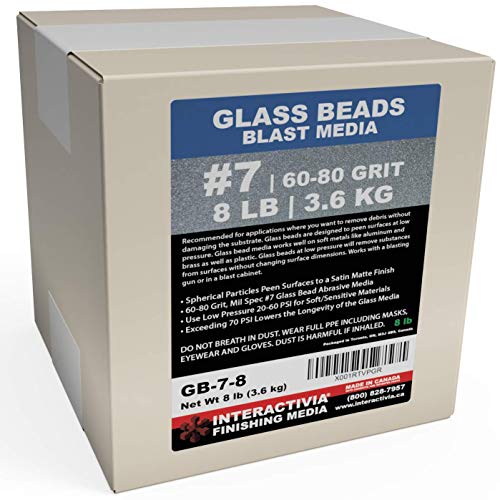
Glass beads in the 60-80 mesh range occupy the sweet spot between cutting speed and surface smoothness. They are aggressive enough to remove old crusty automotive paint and light rust in a cabinet, but they leave a peened, uniform finish that looks almost bead-blasted from the factory. Users report the media is easy to sift and reuse several times before it fully pulverizes, which is a major advantage over crushed glass that tends to cloud up the cabinet quickly.
This 8-pound bag is sized for the hobbyist or small shop that doesn’t need an industrial 80-pound drum. The consistency of granules is praised across verified reviews, with one user noting the beads cleaned dozens of vintage car parts without a single complaint about clogging or inconsistent cut. Because glass beads are round, they also produce less dust than angular media, keeping your cabinet window clear longer during long sessions.
The main trade-off is that glass beads are less aggressive than aluminum oxide on heavy mill scale or deep rust. If your work is primarily cleaning thick steel, you’ll want to step up to crushed glass or oxide. For general restoration of brackets, bolts, and small panels, however, this is the most forgiving media you can put in your cabinet.
Why it’s great
- Produces a clean, peened finish without deep etching
- Reusable over several cycles before breaking down
- Low dust output keeps cabinet visibility high
Good to know
- Not aggressive enough for thick mill scale or heavy rust
- Some users find cheaper alternatives perform similarly
3. 30-60 Grit (#50) Crushed Glass Abrasive – 19 lb (Interactivia)

If your project involves heavy rust scale on a car subframe or thick paint on structural steel, this 30-60 grit crushed glass is the media you want in your pot. With particle sizes ranging from 559 to 254 microns, the angular shards cut fast and bite deep into corrosion. One verified customer used it to blast a complete car subframe, catching and reusing the media under a 4-mil plastic tarp, proving that this 19-pound box offers real value for heavy restoration work.
Crushed glass is silica-free and generally cheaper per pound than aluminum oxide, making it an excellent mid-range choice for large-scale jobs. The 30-60 range is coarse enough to remove thick buildup quickly, but not so coarse that it leaves deep gouges in the base metal. Users running it in standard blast cabinets reported good flow characteristics with no bridging or clogging in the siphon tube.
The downside is that crushed glass does not last as long as harder oxides. It fractures on impact and gradually turns into powder, which clouds your cabinet faster than beads or oxide. Some users noted that the coarser grit (closer to 30) tended to bounce off detailed parts rather than cutting into tight corners. For intricate work, a 100 or 120 grit would serve you better.
Why it’s great
- Fast cutting on thick rust and heavy paint layers
- Great value per pound for large-scale jobs
- Silica-free and safe for open blasting with proper PPE
Good to know
- Breaks down faster than aluminum oxide
- Coarse grit can miss detailed crevices
4. Aluminum Oxide 80 Grit – 12 LBS (HDURCIR)
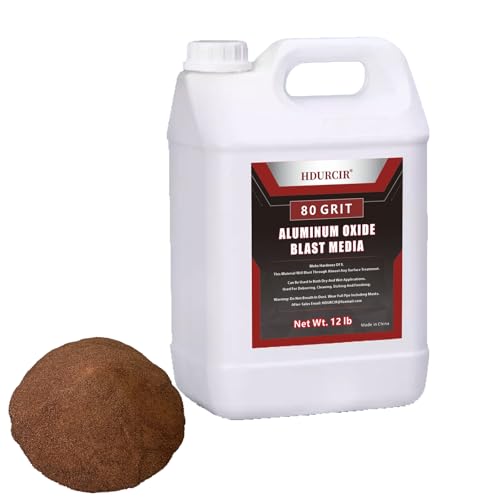
HDURCIR’s 80-grit aluminum oxide offers a solid all-around option for the shop that needs one media for multiple materials. Rated at Mohs 9, it can handle surface prep on stainless steel, aluminum, and wood, and even etch glass when run at lower pressure. The 12-pound plastic bucket packaging is a practical upgrade over bags—you can scoop directly from the bucket and seal it tight to keep moisture out, which matters because aluminum oxide can clump if stored in a damp environment.
Verified users confirmed it works flawlessly in spot blasters and hand-held guns, stripping paint and mill scale without excessive dust. The 80 grit (classified as medium-to-fine) is versatile enough to remove coatings efficiently while leaving a surface that only needs light sanding before a fresh coat of paint. One user noted it’s slightly on the expensive side compared to slag, but the cutting speed and reusability justify the premium.
Where this product falls short of the premium Interactivia offering is particle consistency. A few reviews mentioned some variation in grain size within the bucket, which can lead to an uneven finish on sensitive work. For general repair and maintenance blasting, however, this is the most cost-effective entry point into oxide media.
Why it’s great
- Versatile 80-grit works on metal, wood, and glass
- Sturdy bucket container for easy storage
- Fast cutting on mill scale and paint
Good to know
- Grain size consistency varies between batches
- Higher cost per pound than slag-based media
5. BLACK BEAUTY Fine Abrasive 20/40 Mesh – 25 LBS

BLACK BEAUTY is an industry staple for a reason—it has been the number-one blasting abrasive in the US for nearly 80 years. This 20/40 mesh slag media is designed for heavy structural work: removing thick paint and rust from carbon steel, concrete, and heavy equipment. The fine grit cuts aggressively while maintaining a uniform density that doesn’t clog nozzles. At 20/40 mesh, the particles are larger and heavier than 80 or 120 grit, meaning they transfer more kinetic energy on impact.
What sets this apart from traditional sand is its low free silica content—less than 0.1% compared to sand which can be up to 99% crystalline silica. This makes it significantly safer for open-blast applications when you wear proper respiratory protection. It is also 100% recycled, making it a green choice among industrial abrasives. Users confirm it removes rust and paint from carbon steel quickly, with one noting it was too aggressive for aluminum—a common trait of coarse slag media.
The bag comes in at about 26 pounds net weight, which gives you plenty of material for a weekend project. The main drawback is that slag is not reusable; it fractures on impact and turns to dust after a single use. For small jobs in a cabinet, it creates a lot of dust. But for open blasting on a truck frame or trailer, nothing beats its cost-per-pound efficiency.
Why it’s great
- Extremely low silica content (<0.1%) compared to sand
- Fast aggressive cutting on steel and concrete
- Lowest cost per pound for heavy blasting
Good to know
- Not reusable—fractures to dust after one use
- Too aggressive for aluminum or soft substrates
6. Ground Walnut Shell 40-60 Grit – 5 LBS (GRITSMITH)

GRITSMITH’s 40-60 grit walnut shell media is the ideal choice for anyone who vibratory-tumbles brass casings, polishes delicate jewelry, or deburrs small machined parts. With a Mohs hardness of just 4.5, it is gentle enough to clean without removing base material or peening surfaces. Users who switched from old, clogged media to this 40-60 grit reported that primer holes on their brass no longer get packed with dust, and the cleaning speed increased dramatically.
The 5-pound bucket is a convenient size for a Lyman or Frankford Arsenal tumbler. The particles are all-natural, biodegradable, and completely silica-free. Some users mix this walnut shell with ground corn cob to create a custom blend that balances cleaning aggression with polishing shine. For reloaders who process thousands of rounds, the reusability is excellent—one user noted the media got darker over time but still functioned well, and changing it only became necessary when it stopped cutting cleanly.
Walnut shell media should not be used in pressure blasters for heavy rust removal because the particles are too soft to cut through mill scale or thick paint. Its land is precision cleaning, polishing, and deflashing—not heavy stripping. If you need a soft abrasive for carbon cleaning on engine parts or antique restoration, this is the perfect grade.
Why it’s great
- Gentle on brass and delicate substrates
- Does not clog primer pockets or small holes
- Biodegradable, natural, and silica-free
Good to know
- Too soft for heavy paint or rust removal
- Gets dark over time and eventually needs replacement
7. Ground Walnut Shell 12-20 Grit – 4 LB (Interactivia)

This coarse 12-20 grit walnut shell media from Interactivia is the most aggressive organic option in this roundup, designed for heavy-duty cleaning where you still need substrate safety. With larger particle sizes, it strips paint, carbon, grease, and stubborn buildup from metal, wood, fiberglass, and stone faster than finer walnut shell grinds. One creative user even put it in a small rock tumbler to dry-clean rust from model train parts after a flood, saving significant restoration time.
At 12-20 grit, the particles are noticeably larger than the 40-60 grade, which means they cut faster but leave a slightly rougher surface. This makes them ideal for the first pass on a part that will later be finished with a finer media. The walnut shells are naturally silica-free and biodegradable, so you don’t have to worry about toxic dust clouding your workspace. A few users repurposed this media as filler for homemade warming bags and pin cushions, which speaks to its clean, odor-free composition.
The 4-pound bag is on the smaller side, so if you plan to blast a large project, you’ll need multiple bags. Also, because it’s an organic media, it will not hold up to high-pressure blasting for extended periods—the shells eventually crush into finer dust. For light tumbling, dry-cleaning, or small hobby blasting, however, this is the most affordable entry point into non-toxic media.
Why it’s great
- Coarse 12-20 grit for faster organic stripping
- Biodegradable, silica-free, and low dust
- Versatile—works for blasting, tumbling, and crafts
Good to know
- Small 4 lb bag runs out quickly on large projects
- Not designed for high-pressure continuous blasting
FAQ
Can I use the same blast media for glass etching and rust removal on steel?
How many times can I reuse aluminum oxide in a blast cabinet?
Is it safe to use walnut shell media in a pressure blaster for heavy rust?
What does the 0.1% free silica content in BLACK BEAUTY mean for my health?
Can I mix different blast media together for better results?
Final Thoughts: The Verdict
For most users, the blast media winner is the Interactivia #120 Aluminum Oxide 8 LB because it combines a premium Mohs 9 hardness with fine 120-grit particle size for precision etching and surface prep, plus it outlasts cheaper media many cycles over. If you want aggressive rust removal at a lower per-pound cost, grab the Interactivia 30-60 Crushed Glass 19 lb. And for gentle, eco-friendly brass cleaning and polishing, nothing beats the GRITSMITH Ground Walnut Shell 40-60 Grit 5 LBS.