
Our readers keep the lights on and the weekend projects moving. As an Amazon Associate, I earn from qualifying purchases.
A 3,000 watt power station is the threshold where backup power moves from charging phones to running a refrigerator, a well pump, or an entire RV air conditioner. The difference between a unit that handles a weekend camping trip and one that keeps your home running through a multi-day outage comes down to battery chemistry, inverter quality, and how fast it can refill when the grid is down.
I’m Rikta — the co-founder and writer behind FitlyFast. I’ve spent countless hours analyzing the inverter topologies, battery cycle life ratings, and real-world charging efficiency data across dozens of models to separate the units that truly deliver from those that overpromise on peak wattage.
This buying guide breaks down the critical specs — from LiFePO4 cycle life and UPS transfer speeds to solar input range and expansion capability — so you can confidently select the right 3000 watt power station for your specific energy needs without wasting money on capacity you will not use.
How To Choose The Best 3000 Watt Power Station
Selecting the right power station starts with understanding your actual load. A 3,000-watt inverter paired with a 2,000Wh battery will run a refrigerator for a day, while a 3,000-watt inverter with a 4,000Wh battery can handle that same fridge plus lights and a sump pump for two days. The inverter wattage tells you what you can start — the battery capacity tells you how long you can run it.
Battery Chemistry and Cycle Life
LiFePO4 (LFP) cells are the industry standard at this power level. They deliver 3,000 to 6,000 charge cycles before dropping to 70-80% capacity, compared to roughly 500 cycles for older NMC lithium batteries. LFP cells also tolerate higher temperatures and are inherently safer against thermal runaway. Any power station in this category that uses standard lithium-ion or lead-acid chemistry is already outdated.
Inverter Type and Surge Capacity
A pure sine wave inverter is non-negotiable for sensitive electronics like CPAP machines, refrigerators, and variable-speed motors. The continuous wattage rating (3,000W to 4,000W) must match your running load, but the surge rating — typically 1.5x to 2x continuous — determines whether you can start appliances with induction motors, such as refrigerators and air compressors. A high surge capacity prevents nuisance shutdowns.
Recharge Speed and Solar Input Range
AC recharge time from empty to full should be under three hours for a 3,000Wh-class unit; models that charge in under two hours use higher-voltage inverters or dual charging paths. For solar input, look at both the maximum wattage and the voltage window. A wide voltage range (25V-120V) gives you flexibility to pair with different panel configurations, while a higher wattage limit (1,600W+) means faster daytime refills.
Quick Comparison
On smaller screens, swipe sideways to see the full table.
| Model | Category | Best For | Key Spec | Amazon |
|---|---|---|---|---|
| BLUETTI Elite 200 V2 | Mid-Range | Compact 2kWh backup | 2600W cont. / 3900W peak | Amazon |
| PECRON F3000LFP | Mid-Range | Fast AC recharging | 3072Wh / 3600W output | Amazon |
| Jackery Explorer 2000 Plus | Mid-Range | Expandable home backup | 2042Wh / expandable to 24kWh | Amazon |
| AFERIY 3840Wh | Mid-Range | Large capacity per dollar | 3840Wh / 3600W output | Amazon |
| Jackery HomePower 3000 | Mid-Range | Lightweight 3kWh unit | 3072Wh / 59.5 lbs | Amazon |
| ABOK Ark3600 | Mid-Range | Wheels and easy transport | 3840Wh / 3600W output | Amazon |
| Anker SOLIX F3000 | Premium | Ultra-fast 6000W recharging | 3072Wh / 3600W output | Amazon |
| BLUETTI Apex 300 | Premium | 120/240V output versatility | 2765Wh / 3840W output | Amazon |
| EF ECOFLOW DELTA Pro | Premium | Proven expandable platform | 3600Wh / 3600W output | Amazon |
| GROWATT HELIOS 3600 | Premium | Whole home solar bundle | 3600Wh / 3600W output | Amazon |
| DJI Power 2000 | Budget-Friendly | Compact and quiet operation | 2048Wh / 3000W output | Amazon |
| EF ECOFLOW DELTA Pro 3 | Premium | Highest capacity single unit | 4096Wh / 4000W output | Amazon |
| OSCAL PowerMax 6000 | Premium | Massive 10.8kWh onboard | 10800Wh / 6000W output | Amazon |
In‑Depth Reviews
1. BLUETTI Elite 200 V2

The BLUETTI Elite 200 V2 packs 2073.6Wh of LiFePO4 capacity with a 2600W continuous inverter that can lift to 3900W for high-draw appliances. Its CNAS-certified automotive-grade cells sustain over 6,000 cycles, translating to roughly 17 years of daily use before dropping to 80% capacity. The dual charging path — AC at 1800W plus solar — refills to 80% in under 50 minutes, making it one of the fastest recharge times in its class.
At 53.3 pounds, the Elite 200 V2 is notably heavier than its capacity suggests, but that weight comes from the robust LFP cells and steel-aluminum frame. The three smart charging modes (Turbo, Standard, Silent) let you balance recharge speed against noise level, with Silent mode dropping to 16-30 dB. The UPS transfer time under 15ms keeps computers and network equipment online during grid flickers without interruption.
What holds this unit back from absolute perfection is the absence of a built-in 30A RV outlet, which matters if you plan to plug directly into a travel trailer. The 14 output ports — including USB-C PD, USB-A, and dual AC outlets — cover most home and camping needs, but RV users will need an adapter. For a compact, long-lasting power station that handles a microwave, coffee maker, and air fryer simultaneously, the Elite 200 V2 delivers exceptional value.
Why it’s great
- 3900W power lifting handles surge-heavy appliances
- 6000-cycle LFP battery with 17-year lifespan
- Turbo, Standard, and Silent charging modes
Good to know
- No built-in 30A RV outlet
- Heavy at 53.3 pounds for its capacity
- Solar input limited to 1000W for full recharge
2. PECRON F3000LFP
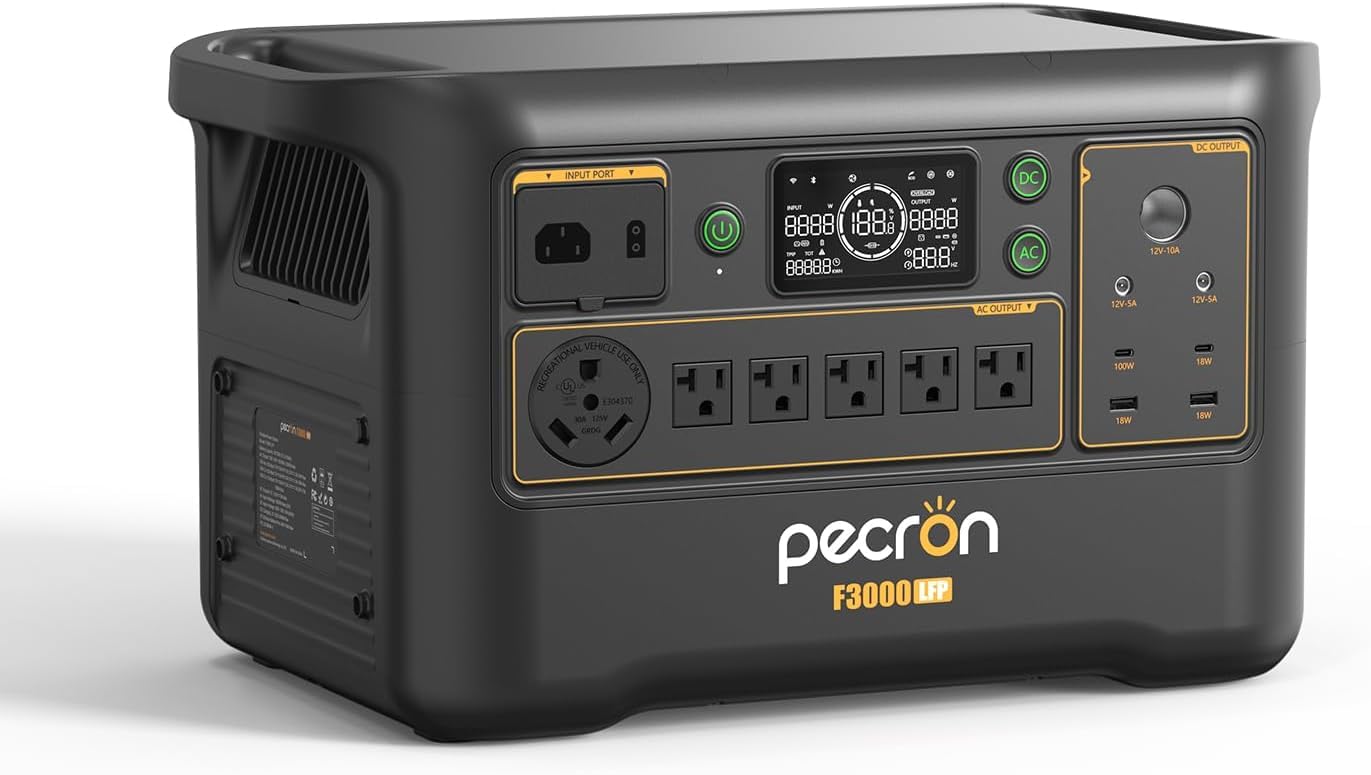
The PECRON F3000LFP offers a 3072Wh LiFePO4 battery paired with a 3600W pure sine wave inverter, supporting 13 simultaneous devices across six AC outlets, two USB-C (100W PD), and two USB-A ports. The standout feature is the 1800W AC input that fully recharges the unit in just 2 hours — roughly 30% faster than comparable models at this capacity. The expandable architecture supports daisy-chaining up to 10752Wh via an additional battery pack, though the cascade cable is sold separately.
Real-world testing shows the F3000LFP draws only 30W per hour when powering loads, and drops to 0W standby when idle — a critical efficiency metric for off-grid users. Solar input accepts up to 1600W across a 25-120V voltage window, giving you flexibility to mix panel configurations. The UPS transfer time of 8-20ms is fast enough to keep a desktop PC or monitor running without a flicker during an outage.
The fan noise during AC charging is audible, described as a low hum rather than a high-pitched whine, and the unit weighs 63.3 pounds without built-in wheels. The app connects via Bluetooth, not WiFi, so remote monitoring requires you to be within range. For users who prioritize fast AC recharge speed and large usable capacity without breaking the premium tier, the F3000LFP is a strong mid-range contender.
Why it’s great
- 2-hour full recharge from AC input
- Expandable to 10752Wh
- 0W standby power consumption when idle
Good to know
- Fan noise noticeable during high-speed charging
- App uses Bluetooth only, no WiFi
- Expansion cable sold separately
3. Jackery Explorer 2000 Plus

The Jackery Explorer 2000 Plus starts with a 2042Wh LiFePO4 battery and a 3000W inverter, but its real strength lies in expansion. You can daisy-chain up to five additional battery packs for a total of 12kWh, or link two Explorer 2000 Plus units in parallel for 24kWh capacity and 6000W output. The 30A RV outlet on the front panel lets you plug directly into a travel trailer without adapters, a feature many competitors reserve for higher-tier models.
ChargeShield fast charging technology extends the LFP cells to 4,000 cycles while retaining 70% capacity, giving roughly 10 years of useful life. The unit recharges fully from AC in about 2 hours, or via solar at up to 1200W with six SolarSaga 200W panels. The app supports both Bluetooth and WiFi for remote monitoring, allowing you to check battery level, adjust charge limits, and view energy flow from anywhere on your property.
At 62 pounds, the Explorer 2000 Plus is lighter than many 2kWh competitors, thanks to Jackery’s integrated design. The retractable handle and built-in wheels make maneuvering manageable despite the weight. The downside is that the expansion battery packs connect via a bulky cable that some users find awkward, and the base unit’s 3000W inverter cannot be expanded beyond the parallel setup — you cannot upgrade the inverter itself.
Why it’s great
- Scalable from 2kWh to 24kWh
- Built-in 30A RV outlet
- Retractable handle and wheels for portability
Good to know
- Expansion battery cable is bulky
- No battery-saving mode for idle storage
- Single-unit inverter limited to 3000W
4. DJI Power 2000
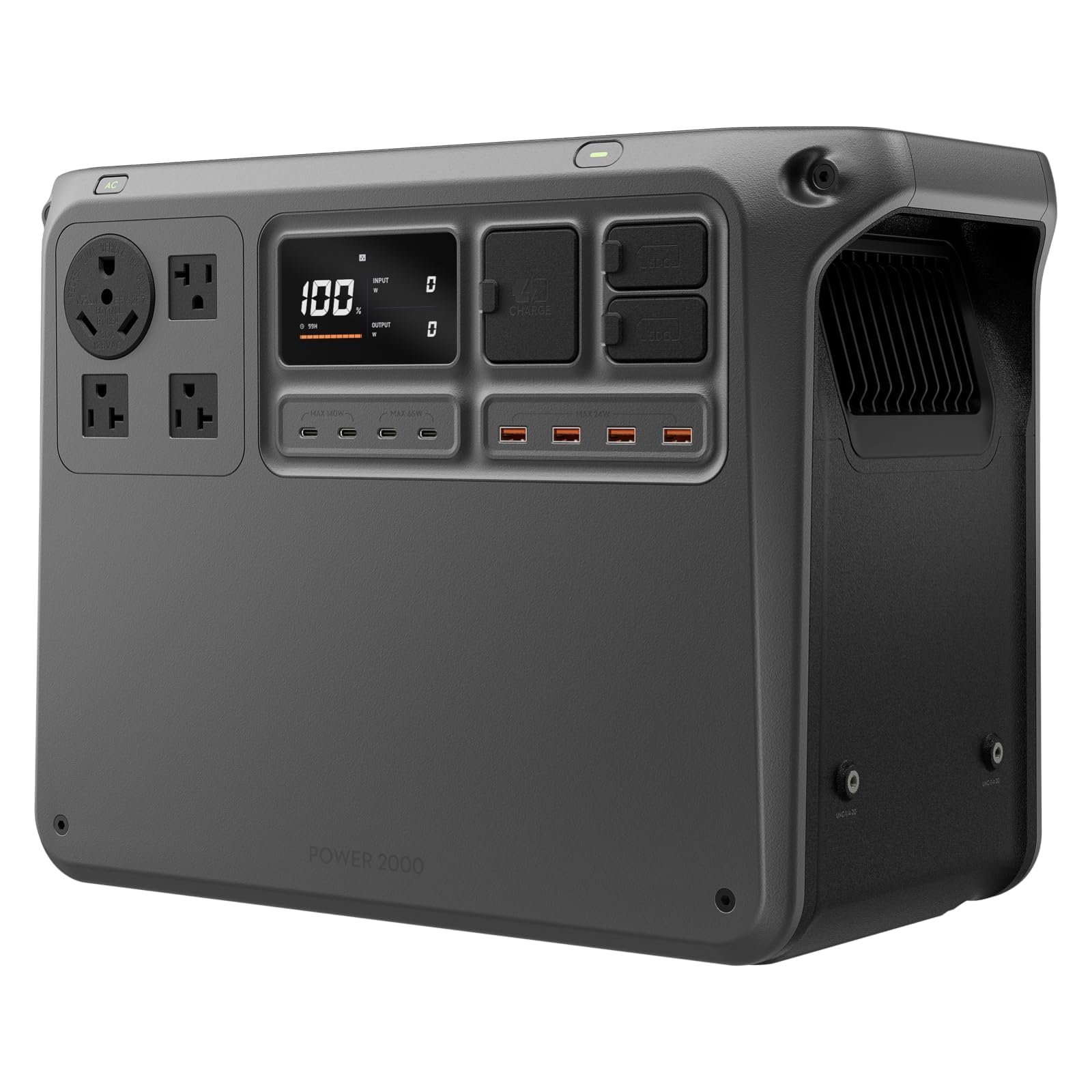
The DJI Power 2000 enters the power station market with a 2048Wh LiFePO4 battery and 3000W continuous output, emphasizing compact size and ultra-quiet operation at just 30 dB. At 47.9 pounds, it is one of the lightest 2kWh-class units available, making it a strong candidate for camping and mobile work where weight matters. The 0-80% recharge in 55 minutes is competitive, and the full 90-minute charge time keeps downtime minimal.
The 15 output ports include dual full SDC ports — proprietary DJI connectors that support high-speed charging for DJI drone batteries and other compatible devices. The UPS transfer time of 10ms is faster than many competitors, ensuring seamless backup for sensitive electronics. DJI offers expansion up to 22.5kWh via additional battery packs, though the company recommends keeping the original packaging during the refund period due to logistics regulations.
The sub-nano coating and flame-retardant housing provide ingress protection for use in damp or dusty conditions, a notable safety feature at this price tier. However, some users reported that units sourced through gray-market channels may arrive configured for 50 Hz instead of 60 Hz, leading to error codes during charging. The app requirement for full functionality and proprietary SDC connectors also limit flexibility compared to more open ecosystems.
Why it’s great
- Lightest 2kWh unit at 47.9 pounds
- Ultra-quiet 30 dB operation
- 10ms UPS transfer with 15 ports
Good to know
- Proprietary SDC connectors limit universal use
- No built-in wheels for transport
- Gray market units may have frequency configuration issues
5. AFERIY 3840Wh

The AFERIY 3840Wh power station delivers a massive 3.8kWh of LiFePO4 capacity from a single unit, with 3600W continuous output and 7200W peak surge. This capacity-to-price ratio is among the best in the mid-range tier, making it a serious contender for home backup scenarios where you need to run a refrigerator, lights, a WiFi router, and a fan for roughly 17 hours on a single charge. The unit is expandable to 11.5kWh with additional battery packs, though the expansion modules are proprietary.
The UPS transfer time of under 10ms is fast enough to keep security cameras, medical freezers, and Zoom calls running through an outage. The 15 output ports include AC outlets, USB-C PD 3.0, USB-A, DC5521, XT60, and a 12V car socket. The adjustable charging-speed levels allow you to balance recharge time against battery longevity, with AC-only charging reaching full in about 1.5 hours under supported input conditions.
At 80.46 pounds with dimensions of 22.99 x 12.63 x 18.26 inches, this unit is large and heavy, though the pull handle and rugged wheels ease transport. Some users reported a display issue where segments darken after first use, but moving the unit often resolves the loose connection. The 7-year support period and UL listing add peace of mind for a product in this price range.
Why it’s great
- 3.8kWh base capacity at a sharp value price
- 7200W peak surge handles motor startups
- Fast 1.5-hour AC recharge
Good to know
- Heavy at 80.5 pounds
- App lacks separate solar/AC input tracking
- Display connection can be intermittent
6. Jackery HomePower 3000
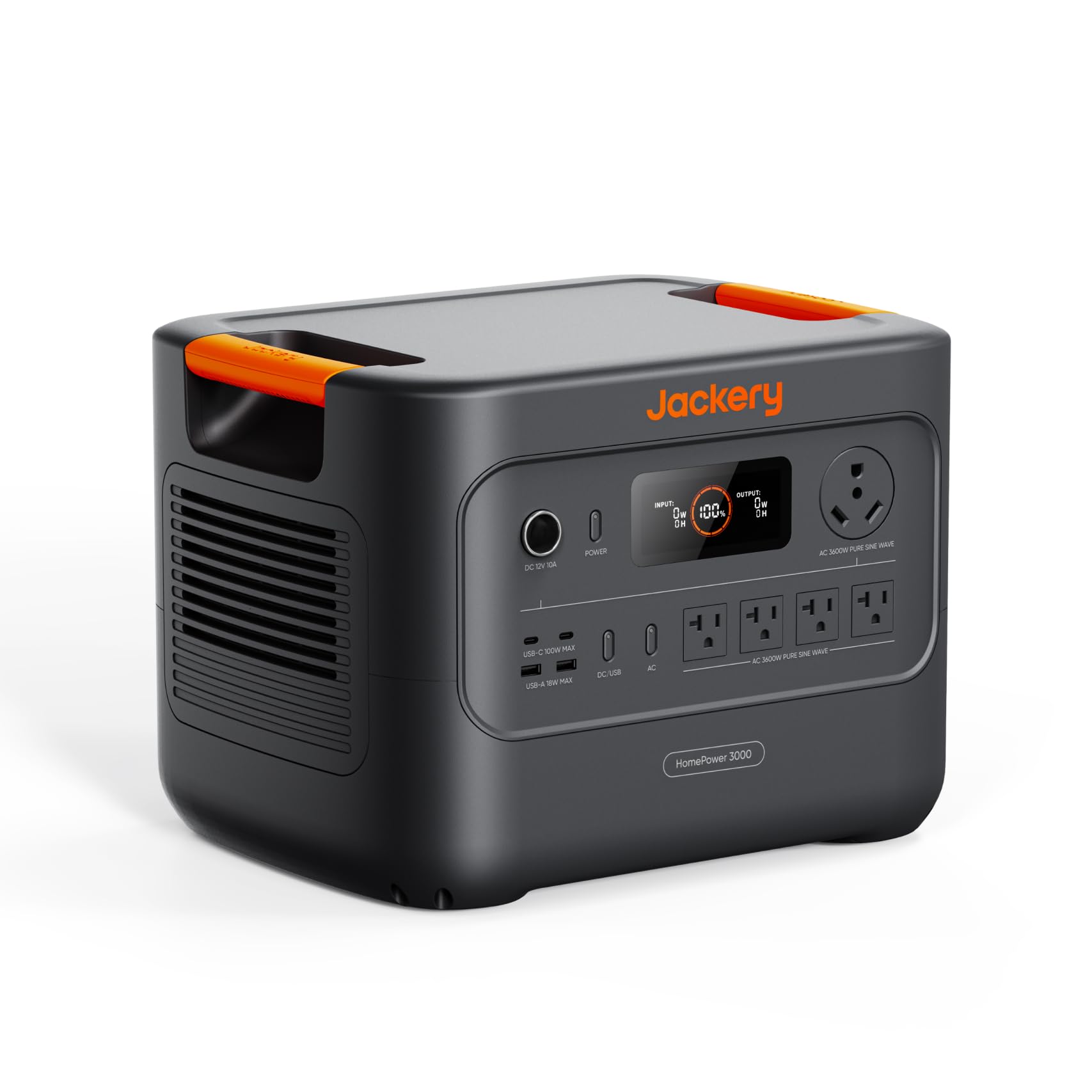
The Jackery HomePower 3000 is the world’s first 3kWh portable power station using CTB (Cell-to-Body) technology, which boosts space efficiency by 14% and reduces weight by 43% compared to similarly sized competitors. At just 59.5 pounds for 3072Wh of LiFePO4 capacity and a 3600W inverter (7200W surge), this unit redefines portability in the 3kWh class. The 7200W surge handles motor-driven appliances like refrigerators and air compressors with ease.
The built-in TT-30 RV port allows direct plug-and-play connection to travel trailers, and the dual 100W PD ports fast-charge phones, tablets, and drones simultaneously. ChargeShield 2.0 with AI algorithms optimizes charging speed while extending battery lifespan to 4,000 cycles at 70% capacity retention. The ≤20ms UPS transfer time is adequate for most home electronics, though not as fast as some competitors’ sub-10ms switching.
The fan noise at 60 dB under moderate load is noticeably louder than the 30 dB claimed by some rivals, which may be an issue for indoor UPS use near sleeping areas. Jackery also enforces a strict warranty policy that requires direct purchase from their website rather than Amazon, which could complicate claims for third-party buyers. For users who need a light, powerful unit for RV travel or home backup without a gas generator, the HomePower 3000 is a compelling option.
Why it’s great
- Lightest 3kWh unit at 59.5 pounds
- 7200W surge capacity
- Built-in TT-30 RV outlet
Good to know
- Fan noise at 60 dB under load
- Warranty only valid for direct purchases
- 20ms UPS slower than some competitors
7. ABOK Ark3600
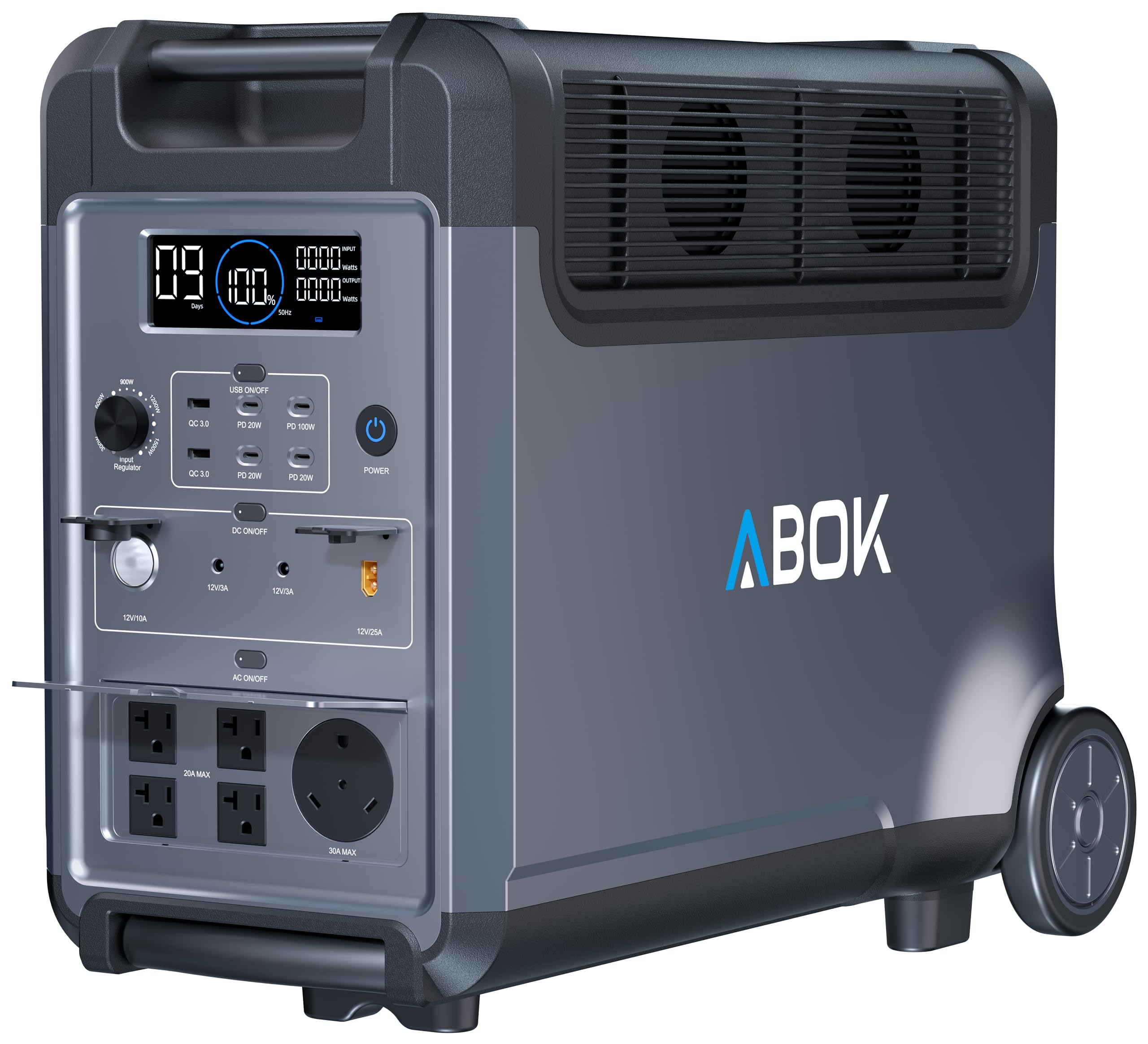
The ABOK Ark3600 packs 3840Wh of LiFePO4 capacity with a 3600W rated output and 4500W peak power, expandable to 11.5kWh via additional battery packs. The unit pairs a telescoping handle with durable wheels, making the 92-pound weight far more manageable than the raw number suggests. The 15 output ports include a dedicated 30A AC outlet alongside four 20A AC outlets, USB-C (100W PD), USB-A QC3.0, DC5521, XT60, and a cigarette lighter port.
Charging is flexible: AC input at 1500W, solar up to 2000W (25-120V input range), and car charging at 120W. Hybrid AC+PV charging can fully refill in just 1.29 hours, while AC-only charging takes about 3 hours. The Bluetooth app allows remote monitoring of power flow, charge limit adjustment, and system status. The EV-grade LFP cells deliver over 4,000 cycles and a 10-year lifespan.
There is a notable caveat: the unit requires an ambient temperature above 32°F to begin charging, and below-freezing conditions may delay charging by 30 minutes to 2 hours. Some users reported defective units that refused to charge or stay on, and the return shipping cost for an 80+ pound item can be substantial. For buyers in moderate climates who value easy transport and a robust port selection, the Ark3600 offers strong value.
Why it’s great
- Telescoping handle and wheels for easy transport
- 3840Wh base capacity with 4500W peak
- Fast 1.29-hour hybrid charging
Good to know
- Does not charge below 32°F
- Bluetooth-only app, no WiFi
- Return shipping for defective units can be costly
8. Anker SOLIX F3000
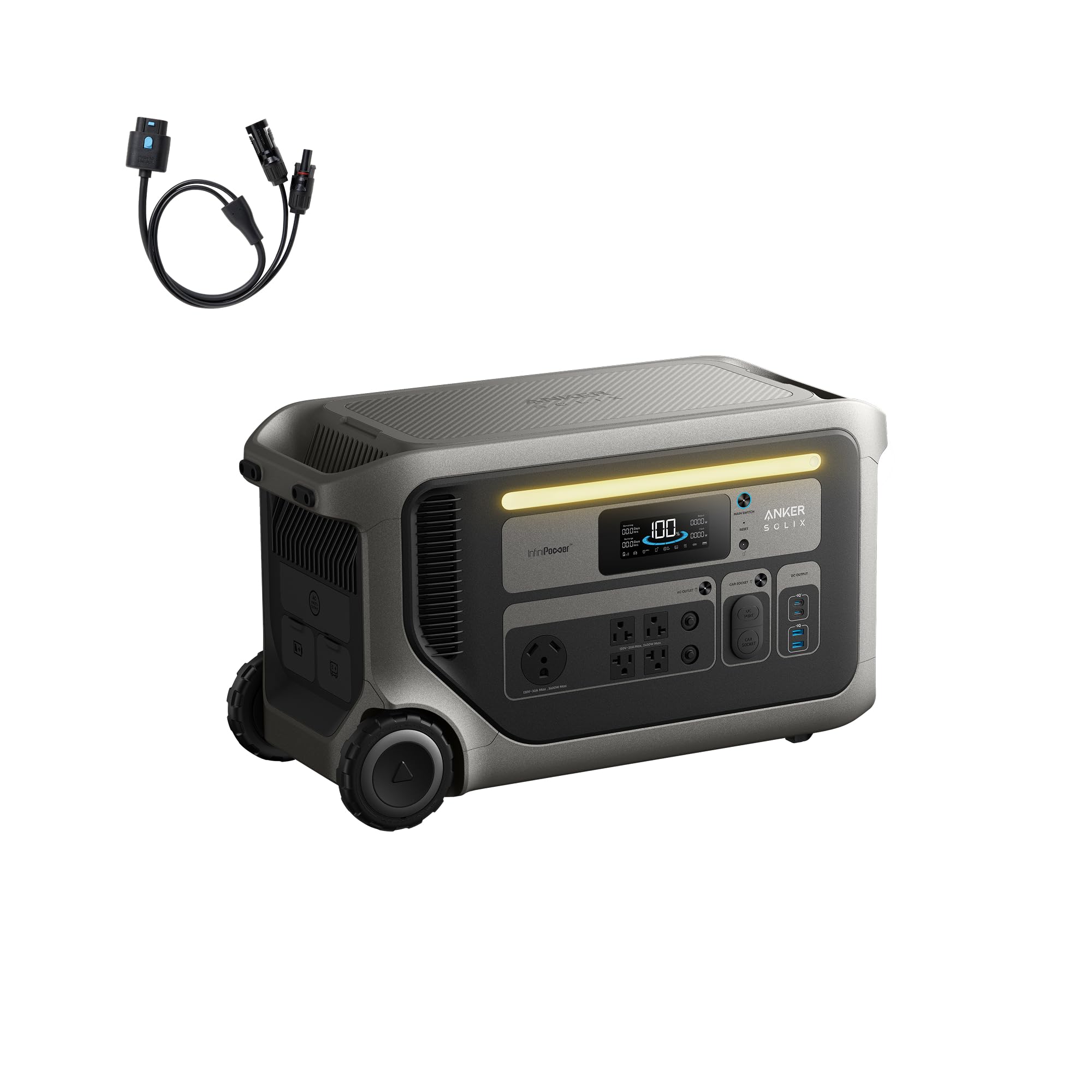
The Anker SOLIX F3000 is designed for emergency scenarios where rapid recharging matters most. Its 6000W combined input — from a fuel generator and solar panels simultaneously — can refill the 3072Wh battery in under an hour, making it one of the fastest-recharging units in its class. The 3600W continuous output supports 99% of household appliances, and the ultra-low idle power consumption allows 125 hours of AC standby time or 42 hours running a 190W refrigerator.
The 120/240V split-phase capability requires pairing two F3000 units, but the single unit at 120V covers most home backup needs. The 2400W solar input (via dual ports: 165V and 60V) gives flexibility for various panel configurations. The app controls port memory, charge limits, and power-saving modes, though the USB ports have a minimum 1W draw that cannot be disabled — a minor inefficiency for some users.
At 91.5 pounds with built-in wheels, the F3000 is heavy but rollable. The 30A Anderson port is controllable through the app, and the overall build quality reflects Anker’s reputation for reliability. The main drawback is the lack of native 240V split-phase from a single unit — a feature that competitors like BLUETTI and EcoFlow now offer. For users who prioritize recharge speed above all else, the SOLIX F3000 is a top performer.
Why it’s great
- 6000W combined input for fastest recharge
- 125 hours AC standby time
- 2400W solar input via dual ports
Good to know
- No single-unit 240V split-phase output
- USB ports have minimum 1W draw
- Heavy at 91.5 pounds
9. BLUETTI Apex 300
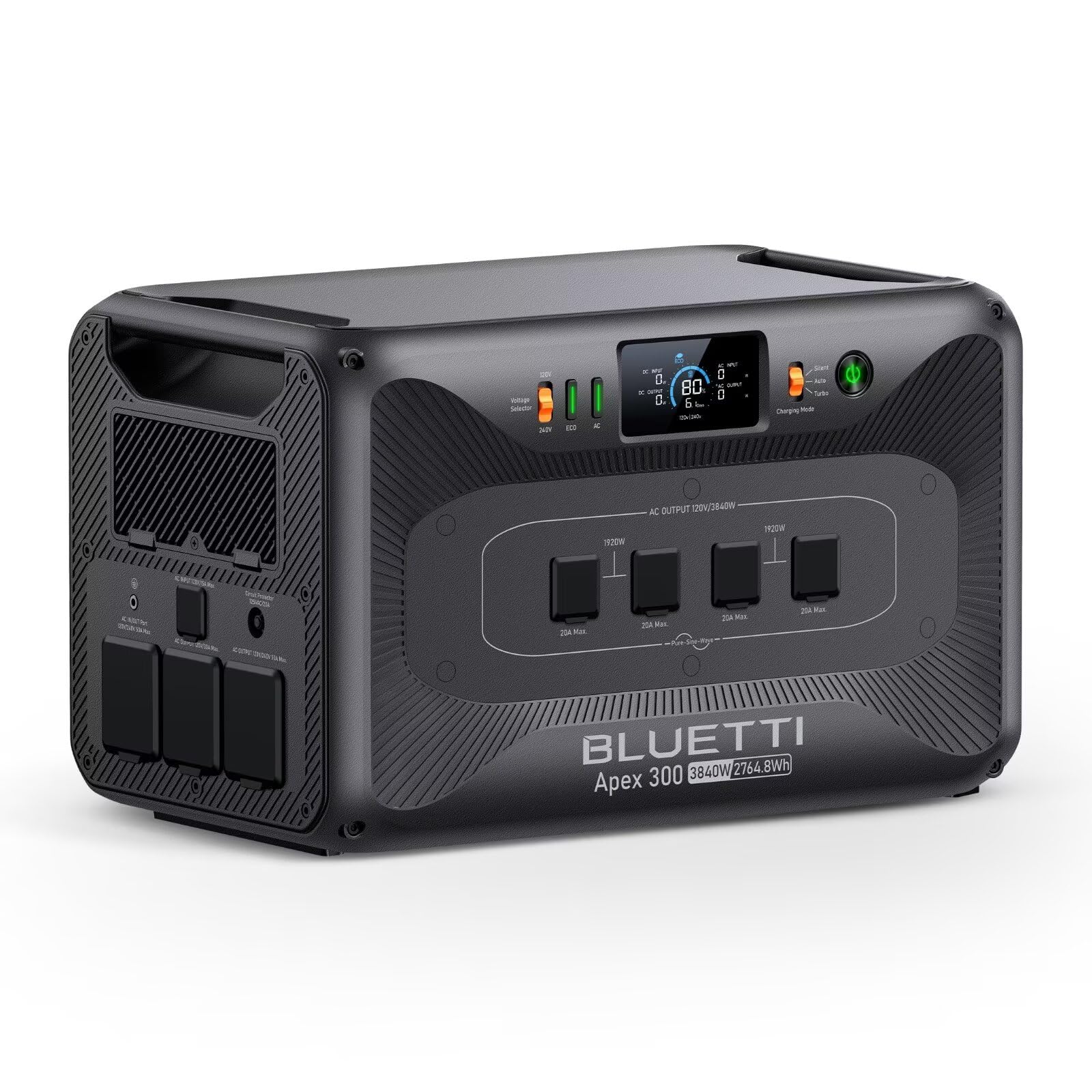
The BLUETTI Apex 300 delivers 2764.8Wh of LFP capacity with a 3840W continuous inverter and 7680W surge, but its defining feature is native 120V and 240V output from a single unit. Switching between voltages via the app or onboard controls means you can power standard household circuits at 120V or run a 240V well pump, water heater, or RV setup without pairing a second unit. The 0ms UPS transfer ensures critical loads never drop during an outage.
The Apex 300 is built for expansion: add B300K or B500K batteries as needed, and pair with BLUETTI’s Hub D1 for RV 12V DC loads or Charger 1/Charger 2 for fast alternator charging. The TurboBoost 2000W charging from AC input refills quickly, and the BLUETOPUS AI-BMS extends cycle life beyond 6,000 cycles. Solar input accepts up to 60Voc, which is a limitation for high-voltage arrays — users with 110Voc panels need a workaround, such as charging via another station’s 120VAC output.
At 66.1 pounds, the Apex 300 is relatively light for a unit with 240V capability, though it lacks the built-in wheels found on some competitors. The 14 output ports cover most needs, but the absence of DC ports keeps the cost down — necessary DC accessories are available as add-on modules. For off-grid cabins and RVs requiring both 120V and 240V from a single power station, the Apex 300 offers a unique value proposition.
Why it’s great
- 120V and 240V output from a single unit
- 0ms UPS transfer for critical loads
- 6000+ cycle LFP with AI-BMS
Good to know
- 60Voc solar input limit incompatible with high-voltage arrays
- No built-in wheels
- No DC ports without add-on modules
10. EF ECOFLOW DELTA Pro
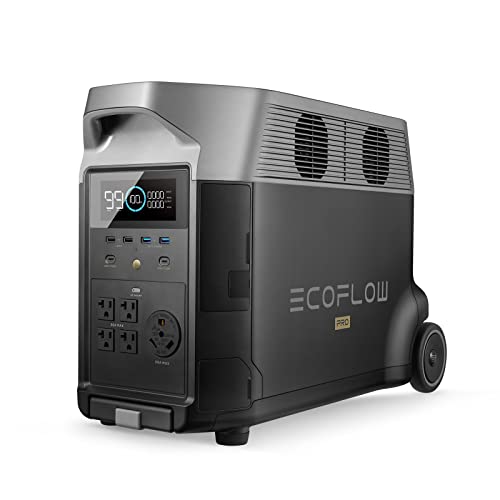
The EcoFlow DELTA Pro is a well-established platform with 3600Wh of LFP capacity and 3600W AC output, expandable via X-Boost to 4500W for heavy loads. Two units can be paired to achieve 7200W at 240V split-phase, covering whole-home backup scenarios. The five AC outlets, two USB-C (100W), two USB-A fast charge, and multiple DC ports provide 15 output methods, making it one of the most versatile units for simultaneous device charging.
X-Stream fast charging refills from AC in 2.7 hours at 1800W, or 1.8 hours with a 240V outlet at 3000W. Solar charging reaches full in 2.8 hours with four 400W panels, thanks to a solar conversion efficiency of up to 23%. The five charging methods — EV station, solar, wall outlet, smart generator, and car outlet — offer unmatched flexibility for recharging in diverse scenarios. The app supports WiFi and Bluetooth for remote monitoring and customization of charge/discharge settings.
At 99 pounds, the DELTA Pro is one of the heaviest units in this class, though the solid build quality and proven reliability justify the weight. The absence of native 240V from a single unit (requiring two units for split-phase) is a limitation compared to newer competitors. For users who want a mature, well-supported ecosystem with extensive accessory compatibility, the DELTA Pro remains a benchmark choice.
Why it’s great
- Mature platform with extensive accessories
- 15 output methods for versatile charging
- 100W PD USB-C and dual AC outlets
Good to know
- Very heavy at 99 pounds
- Requires two units for 240V split-phase
- Older design compared to newer models
11. GROWATT HELIOS 3600
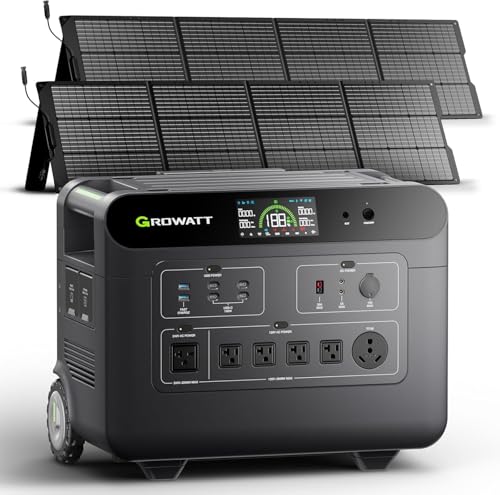
The GROWATT HELIOS 3600 ships as a complete solar generator bundle, including the 3600Wh power station and two 200W solar panels for immediate off-grid operation. The 3600W continuous output powers most household appliances, and two units can be paralleled to reach 7200W at 240V split-phase for whole-home backup. The maximum expandable capacity of 36kWh — using multiple battery packs and parallel units — rivals whole-house battery systems.
The cold start technology allows operation down to -22°F, making this one of the few power stations rated for sub-zero environments. The 15ms EPS power switching is fast enough for most sensitive electronics, and the 2000W solar input ensures rapid daytime recharging. The app supports TOU (Time-of-Use) settings to prioritize solar charging and reduce grid consumption, a feature that can lower electricity bills over time.
The included solar panels use MC4 connectors and are rated at 200W each, providing a turnkey solution for users new to solar. Some users reported Bluetooth connectivity issues with the app and difficulty reading on-screen text. The 149-pound shipping weight (including panels) is substantial, but the unit itself with wheels and handle is manageable. For users who want a complete solar backup system in one box, the HELIOS 3600 represents a strong package.
Why it’s great
- Includes two 200W solar panels out of the box
- Operates down to -22°F
- Expandable to 36kWh for whole-house backup
Good to know
- Bluetooth app connectivity can be spotty
- Heavy shipping weight with panels
- 240V mode disables EPS function
12. EF ECOFLOW DELTA Pro 3

The EcoFlow DELTA Pro 3 raises the bar with 4096Wh of LFP capacity and a 4000W continuous inverter (6000W with X-Boost, scalable to 12000W with two units). The single-unit 120/240V split-phase output powers a 3-ton central AC or a 1 HP water pump without requiring a second unit — a key advantage over the original DELTA Pro. The 48kWh maximum expansion provides 2-4 days of whole-home backup.
The 7000W combined charging (AC at 1800W plus solar at 2600W, plus generator input) delivers the fastest total input in this class, refilling the 4kWh battery in under 2 hours. The IP65-rated CTC battery pack technology provides protection against dust and water ingress, and the X-Quiet technology keeps noise as low as 30 dB. The 10ms UPS transfer protects NAS systems and servers during outages.
At 115 pounds, the DELTA Pro 3 is exceptionally heavy, though the portable handle design helps. The lack of a built-in 12V port is a notable omission that requires an external adapter. Some users reported that the app requires internet access to change critical settings like charge rate and storage cap, which could be problematic during extended outages. For users who need maximum capacity, split-phase output, and fast recharge in a single unit, the DELTA Pro 3 is a premium solution.
Why it’s great
- 4096Wh base capacity with 48kWh max expansion
- Single-unit 120/240V split-phase output
- 7000W combined charging input
Good to know
- Very heavy at 115 pounds
- No built-in 12V port
- App requires internet for critical settings
13. OSCAL PowerMax 6000
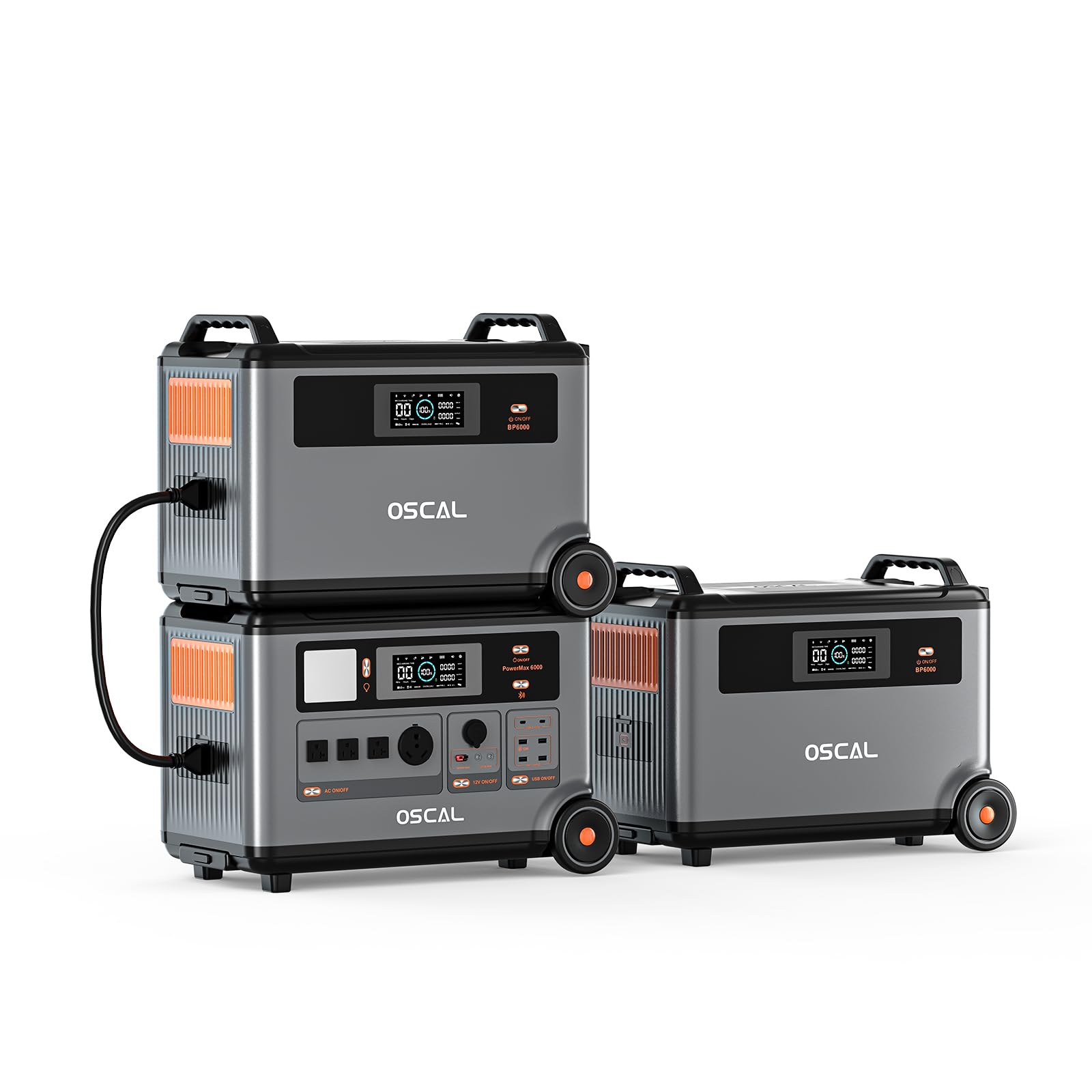
The OSCAL PowerMax 6000 is a 10.8kWh power station with 6000W AC output and 9000W peak surge, operating on 120V/240V split-phase voltage. The three-unit bundle includes two extra batteries, achieving its massive capacity out of the box without requiring future expansion purchases. The 2200W bi-directional inverter refills from 0% to 100% in under 2 hours via AC input, or 1.44 hours with 2200W AC plus 2400W solar combined.
The EPS (UPS) transfer time of 5-8ms is among the fastest available, ensuring uninterrupted power for sensitive electronics. The smart app control allows remote monitoring and scheduling. The LFP battery supports 3,500 cycles with a claimed 25-year service life, though this projection assumes ideal storage conditions and partial cycling. The 14 output ports include four AC outlets, USB-C, USB-A, DC5521, XT60, and a 12V car socket.
At approximately 56 pounds for the main unit plus two extra batteries, the total weight is substantial, but the handle and wheels ease transport. Some users reported lower-than-expected real-world capacity — a single LED bulb dropped the battery from 100% to 85% in 2 hours — suggesting parasitic draw or measurement discrepancies. For buyers who need a massive starting capacity without incremental expansion costs, the PowerMax 6000 is worth considering, but real-world testing is recommended.
Why it’s great
- 10.8kWh base capacity out of the box
- 6000W continuous output with 9000W surge
- 5-8ms UPS transfer time
Good to know
- Real-world capacity may be lower than advertised
- Heavy total weight with extra batteries
- Short AC charging cable length
FAQ
Can a 3000 watt power station run a whole house?
How long will a 3000Wh power station run a refrigerator?
What is the difference between a 3000W inverter and a 3000Wh battery?
Can I charge a 3000 watt power station with solar panels?
Final Thoughts: The Verdict
For most users, the 3000 watt power station winner is the BLUETTI Elite 200 V2 because it balances fast recharge, exceptional 6000-cycle LFP longevity, and a compact footprint that outperforms larger units on value. If you need 120/240V output from a single unit for heavy home or RV loads, grab the BLUETTI Apex 300. And for massive base capacity without incremental expansion costs, nothing beats the OSCAL PowerMax 6000.