
Our readers keep the lights on and the weekend projects moving. As an Amazon Associate, I earn from qualifying purchases.
The promise of 4K video is sharp, detailed footage that rivals professional work. But the trap of a low budget is a camera that overheats in minutes, delivers grainy low-light images, or locks you into a closed ecosystem that limits your creativity. The real challenge is finding a camera that delivers true 4K resolution — not just upscaled 1080p — at a price that leaves you room for lenses or accessories.
I’m Rikta — the co-founder and writer behind FitlyFast. This guide is the result of weeks combing through sensor specifications, stabilization systems, recording limits, and real-world user reports to separate the few honest performers from the many compromises in this narrow price tier.
Whether you’re starting a YouTube channel, vlogging your travels, or capturing family moments, you need a camera that balances video quality with usability and durability. That’s exactly what you’ll find in this curated list of the best budget 4k camera options available today.
How To Choose The Best Budget 4K Camera
Finding an affordable 4K camera means making smart trade-offs. You need to prioritize features that directly impact your footage without paying for gimmicks you’ll never use. Focus on these three categories: sensor performance, stabilization method, and recording capabilities.
Sensor Size and Low-Light Performance
The physical size of the sensor determines how much light it captures. A larger 1-inch or APS-C sensor will produce cleaner, less noisy footage in dim conditions compared to the smaller 1/2.3-inch sensors found in many action cameras. If you shoot indoors or at dusk, prioritize cameras with larger sensors even if that means a slightly higher price within the budget tier.
Frame Rate and Recording Limits
Not all 4K is equal. A camera that records 4K at 60fps offers smoother motion and the ability to create slow-motion clips compared to one limited to 24 or 30fps. Also check for recording time limits — some budget models stop recording after 5 or 10 minutes to prevent overheating, making them useless for interviews or long talks.
Stabilization: Mechanical vs. Electronic
Handheld footage without stabilization looks shaky and amateur. Optical or gimbal-based stabilization (like a 3-axis gimbal) provides smooth results without cropping the image. Electronic image stabilization (EIS) works by cropping the sensor area and can introduce a jello effect in fast motion. For vlogging or walking shots, prioritize mechanical or gimbal stabilization.
Quick Comparison
On smaller screens, swipe sideways to see the full table.
| Model | Category | Best For | Key Spec | Amazon |
|---|---|---|---|---|
| DJI Osmo Action 5 Pro Adventure | Action Camera | All-weather action & battery life | 1/1.3″ sensor / 4K@120fps | Amazon |
| Xtra Muse Pocket Gimbal | Gimbal Camera | Vloggers wanting built-in stabilization | 1″ CMOS / 3-axis gimbal | Amazon |
| Sony ZV-1F | Vlog Camera | Vlogging with professional audio | 1″ sensor / 20mm wide lens | Amazon |
| Canon EOS R100 (Kit) | Mirrorless ILC | Beginners wanting interchangeable lenses | APS-C 24.1MP / Dual Pixel AF | Amazon |
| OM System E-M10 Mark IV | Mirrorless ILC | Portable travel & selfies | MFT 20MP / 5-axis IBIS | Amazon |
| DJI Osmo Nano (128GB) | Action Camera | Magnetic POV & vlogging | 1/1.3″ sensor / 143° FOV | Amazon |
| Insta360 GO 3S (Black) | Ultra-Compact | Creative mounts & pet POV | 1.4oz / 4K@30fps / 140min | Amazon |
| Insta360 GO 3S (White) | Ultra-Compact | Same as black — color preference | 1.4oz / 4K@30fps / 48MP still | Amazon |
| Canon EOS R100 Bundle | Mirrorless ILC (Bundle) | New photographers with accessories | Same specs + bag & SD card | Amazon |
In‑Depth Reviews
1. DJI Osmo Action 5 Pro Adventure Combo

The Action 5 Pro is the strongest all-rounder in this price bracket. Its 1/1.3-inch sensor with 2.4µm pixels delivers extraordinary low-light performance for a camera this size, and the 13.5-stop dynamic range preserves detail in high-contrast scenes like sunrise or shaded forest trails. The 4K/120fps capture gives you true 4x slow-motion without sacrificing resolution — a feature usually reserved for cameras costing twice as much.
What sets it apart is the battery life. A single 1950mAh Extreme Battery Plus provides up to 4 hours of recording, and the included Adventure Combo packs two additional batteries plus a multifunctional charging case. This gives you around 12 hours of total recording for long day trips. The IP68 waterproofing down to 20 meters without a housing means you’ll never miss underwater shots because you forgot a dive case.
The dual OLED touchscreens make framing easy from any angle, and the 360° HorizonSteady stabilization keeps your horizon level even during barrel rolls on a mountain bike. The ability to connect the DJI Mic 2 wirelessly without an external receiver is a huge convenience for vloggers who want quality audio without dongles. The only real drawback is the heat generation during high-res recording, but the built-in overheat protection and Endurance Mode manage this effectively.
Why it’s great
- Class-leading low-light with 1/1.3″ sensor and 13.5-stop dynamic range
- 4K/120fps with 360° HorizonSteady stabilization
- 12-hour total battery with 3 batteries and charging case
- Waterproof to 20m without housing
Good to know
- Generates noticeable heat during extended 4K recording
- Extension rod lacks a shutter button for selfies
2. Xtra Muse Pocket 4K Gimbal Camera

If you want gimbal-smooth video without the bulk of a separate stabilizer, the Xtra Muse is a compelling choice. The 1-inch CMOS sensor captures 4K at 120fps with exceptional detail, and the built-in 3-axis gimbal eliminates shakiness whether you’re walking, running, or climbing stairs. The 10-bit X-Log color profile records a billion colors, giving you serious grading latitude in post-production — a rare find at this price point.
The face and object tracking is surprisingly reliable. Mount it on a tripod and it will keep you centered as you move around the frame. The 2-inch touchscreen is bright enough for outdoor use and allows quick switching between horizontal and vertical orientation for social media content. At just over 4.5 ounces, it’s light enough to carry all day without fatigue.
Battery life runs just over 2.5 hours of continuous recording, which is decent but not class-leading. The good news is that USB-C PD charging lets you extend sessions with a power bank. Reviewers consistently describe it as a budget-friendly alternative to the DJI Pocket 3, with several noting that DJI Pocket 3 accessories are compatible after minor adjustment. The standard bundle includes a carrying bag, wrist strap, and a handle with a 1/4-inch thread.
Why it’s great
- True 3-axis mechanical gimbal built into the body
- 1-inch CMOS with 10-bit X-Log color for pro grading
- Reliable face/object tracking for solo creators
- Compatible with DJI Pocket 3 accessories
Good to know
- Battery life just over 2.5 hours — bring a power bank
- Micro SD storage requires at least UHS Speed Class 3
3. Sony ZV-1F Vlog Camera

The ZV-1F is purpose-built for vloggers. The 20mm ultra-wide lens means your entire face and background fit comfortably in the frame even at arm’s length — no awkward stretching required. The large 1-inch sensor and F2 lens produce natural background defocus that separates you from the background, giving that professional look without needing a second lens. The 3-capsule directional mic with included windscreen captures clear voice while reducing wind noise outdoors.
Sony’s autofocus is industry-leading. Eye-AF locks onto human and animal eyes reliably, and Product Showcase mode instantly racks focus to any object you hold up to the lens — perfect for tech reviews or cooking tutorials. The side-articulating touchscreen lets you monitor framing while recording yourself, and the red recording light on the front is a simple but thoughtful touch for on-camera confidence.
The main limitation is battery life — expect around 45-50 minutes of continuous 4K recording. This is a known trade-off for the compact form factor, and experienced users simply carry two or three spare batteries. The body is also relatively fragile; a drop can affect autofocus calibration. If you prioritize audio and autofocus over ruggedness and long battery life, this is the best vlogging tool in this tier.
Why it’s great
- 20mm ultra-wide lens for easy self-framing
- 1-inch sensor with F2 for natural bokeh
- Best-in-class Eye-AF and tracking autofocus
- Excellent built-in directional mic with windscreen
Good to know
- Battery lasts only ~45 minutes — buy spares
- Body is fragile; a drop can ruin autofocus
4. Canon EOS R100 Mirrorless Camera Kit

The EOS R100 is the gateway to Canon’s RF lens system at a price that undercuts most competitors. The 24.1-megapixel APS-C sensor paired with the DIGIC 8 processor delivers excellent image quality for both stills and 4K video, though 4K is capped at 24fps. The Dual Pixel CMOS AF covers 143 zones with human and animal eye detection, making autofocus fast and reliable even in challenging lighting.
The kit includes the RF-S18-45mm F4.5-6.3 IS STM lens, which provides optical stabilization for smoother handheld footage. At 1.25 pounds with the lens, it’s the lightest mirrorless body in Canon’s EOS R series, making it ideal for travel or extended shooting sessions. The compact size doesn’t compromise grip comfort — the textured body feels secure even with larger lenses. The user interface is beginner-friendly with guided menus and creative auto modes.
Video enthusiasts should note the 4K/24fps limit and the 4K crop factor of about 1.6x, which narrows the field of view. The LP-E17 battery provides roughly 300 shots or about 1.5 hours of video, which is adequate for a day trip. The bundle option with a 64GB SD card and shoulder bag adds practical value for new photographers. For those who want to grow into interchangeable lenses without a big upfront investment, this is the smartest path.
Why it’s great
- Access to Canon RF lens ecosystem
- 24.1MP APS-C sensor with Dual Pixel AF
- Lightest EOS R body for easy travel
- Beginner-friendly interface with guided modes
Good to know
- 4K limited to 24fps with 1.6x crop
- No in-body stabilization — relies on lens IS
5. OM SYSTEM Olympus E-M10 Mark IV

The E-M10 Mark IV packs professional-grade 5-axis in-body image stabilization (IBIS) into a body that’s barely larger than a point-and-shoot. With the kit 14-42mm EZ pancake lens, it slides into a jacket pocket, yet provides up to 4.5 stops of shake compensation — enough to shoot 1-second handheld exposures in low light. The 20-megapixel Micro Four Thirds sensor delivers excellent detail and color, and the 16 Art Filters including Instant Film give a nostalgic look straight out of camera.
The flip-down monitor with dedicated selfie mode makes it one of the few mirrorless cameras genuinely designed for self-portraits. The OLED viewfinder provides a clear eye-level option for composing shots in bright sunlight. The contrast-detection autofocus with 121 points is fast enough for most family and travel scenarios, though it’s not as responsive as phase-detection systems for fast action.
Battery life is good at around 360 shots, and the Micro Four Thirds system offers the widest selection of lightweight lenses of any mirrorless mount. The app-based image transfer is slow and requires WiFi, which is a common complaint, but the 4K video quality at 30fps is solid and the IBIS keeps handheld footage surprisingly smooth. This is the camera for travelers who prioritize portability and stabilization over cutting-edge autofocus speed.
Why it’s great
- 5-axis IBIS for smooth handheld video and long exposures
- Ultra-compact with pancake lens, fits in a jacket pocket
- Flip-down screen with dedicated selfie mode
- Large selection of affordable MFT lenses
Good to know
- No external charger included (uses USB)
- WiFi-based app transfer is slow
6. DJI Osmo Nano Standard Combo (128GB)
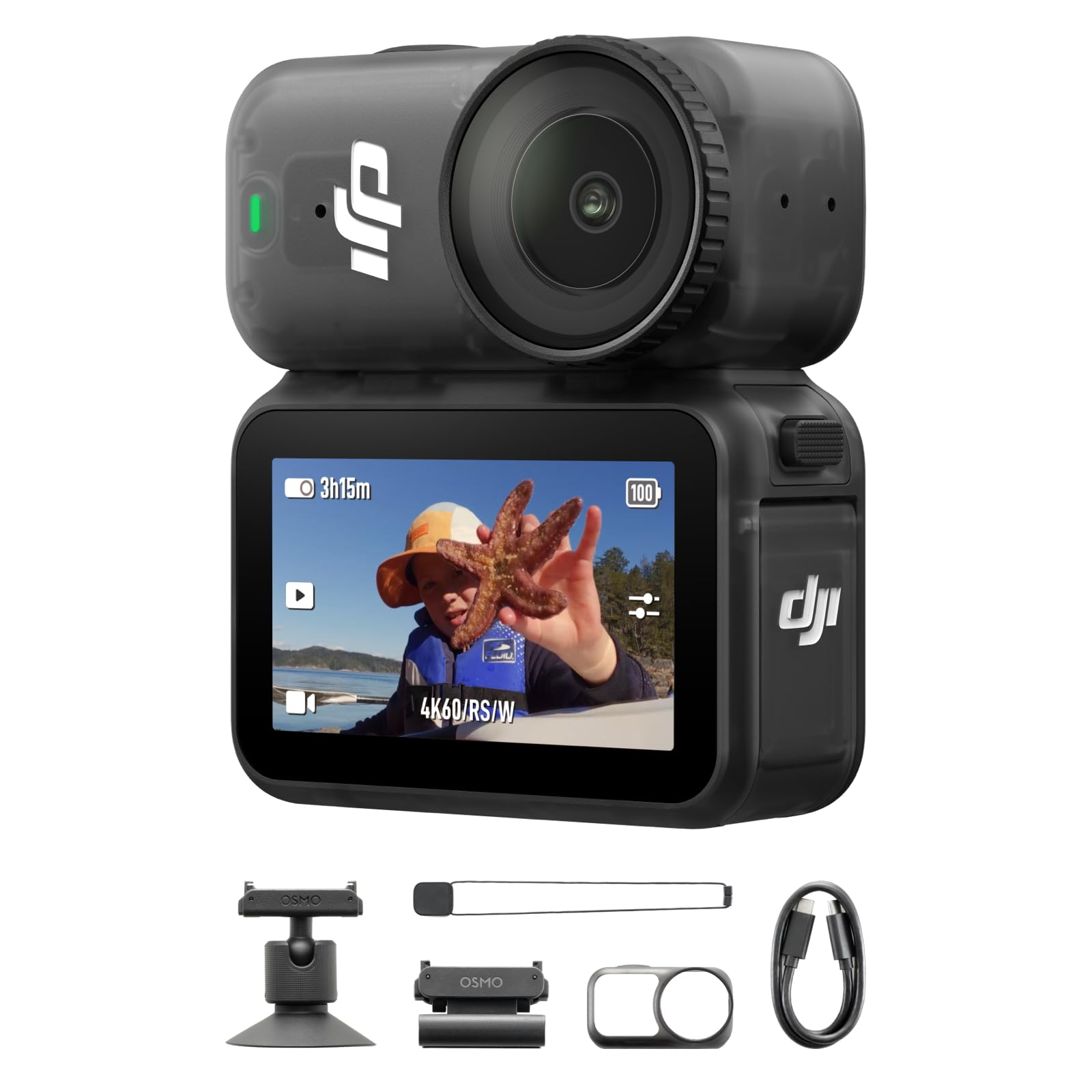
The Osmo Nano is DJI’s answer to the Insta360 GO series, and it arrives with meaningful advantages. The 1/1.3-inch sensor captures more light than the GO 3S’s smaller sensor, resulting in noticeably cleaner 4K/60fps footage. The 143° ultra-wide field of view is genuinely immersive, and the magnetic mounting system with included hat clip, lanyard, and ball-joint adapter makes it incredibly versatile for hands-free POVs. At just over 1 ounce, you’ll forget you’re wearing it.
The 128GB of built-in storage means you can start recording immediately without buying a memory card, and you can expand it with microSD later. The battery life with the Vision Dock reaches up to 3.5 hours, and the dock itself doubles as a remote viewfinder — you can position the camera and frame the shot wirelessly. The 10-bit D-Log M color profile provides 1 billion colors for flexible grading, and the OsmoAudio support lets you connect DJI wireless mics directly without a receiver.
The lack of a built-in screen on the camera itself is a design trade-off — you rely on the Vision Dock or your phone for framing. The dock also tends to drain its internal battery even when powered off, so keep it charged. The overheating notes from some users are consistent with compact action cameras, but enabling Endurance Mode mitigates this for most shooting scenarios. For magnetic versatility and DJI ecosystem integration, this is the best option.
Why it’s great
- 128GB built-in storage, no extra card needed
- 143° ultra-wide FOV with 10-bit D-Log M color
- Magnetic mounting for endless creative angles
- Direct wireless connection to DJI mics
Good to know
- No screen on camera — must use dock or phone
- Vision Dock battery drains even when off
7. Insta360 GO 3S (Black) – 64GB

The GO 3S weighs just 1.4 ounces — the lightest 4K camera in this lineup. Its thumb-sized body and magnetic accessories let you mount it anywhere: on a pet’s collar, a bike helmet, a skateboard, or even on your chest under a shirt. The 4K/30fps video is surprisingly sharp for its size, and the MegaView FOV provides ultra-wide shots with less distortion than previous generations. The FlowState stabilization handles walking and light running without jitter.
The Action Pod provides a 2.2-inch flip screen for framing and remote control, plus a massive 140-minute battery that can also charge the camera while recording. The IPX8 waterproof rating on the camera and IPX4 on the pod means you can take it in the rain or underwater down to 10 meters. The AI Auto Editing feature automatically selects highlights and syncs them to music, which is a real time-saver for social media posting.
The most noticeable limitation is overheating. Multiple reports indicate the camera shuts down after about 20 minutes of continuous 4K recording and won’t restart until it cools down. This makes it unsuitable for long-form content like interviews or live streams. It’s also not a great pet camera — the weight is too heavy for small cats, and the battery life isn’t long enough for extended pet excursions. This camera shines for short, creative clips, not endurance recording.
Why it’s great
- Extremely lightweight at 1.4oz for unlimited mounting options
- Magnetic design with diverse accessories for creative angles
- FlowState stabilization keeps footage smooth
- AI editing saves time on social media export
Good to know
- Overheats and shuts down after ~20 minutes of 4K
- Not practical as a pet camera (too heavy, short battery)
8. Insta360 GO 3S (White) – 64GB

The white version of the GO 3S is mechanically identical to the black model, sharing the same 1.4-ounce body, 4K/30fps video, FlowState stabilization, and 140-minute Action Pod battery. The white finish is a personal choice, but it can be beneficial for vloggers who want a less conspicuous camera or prefer a lighter color that doesn’t show dust as easily. The magnetic pendant included in the box is especially easy to use with the white body for a clean aesthetic.
The technical specs are identical, including the IPX8 waterproof rating and the same overheating behavior that limits continuous 4K recording to around 20 minutes. The 48MP effective still resolution is slightly higher on the white model’s listed spec, although real-world image quality is nearly identical. Both models support the same AI editing, voice control, and gesture control features.
Your choice between black and white comes down to visual preference and how the camera will be used. If you’re mounting it on a white bike helmet or a light-colored jacket, the white version blends in better. The white Action Pod is also slightly more visible, which can help you locate it in a bag. Otherwise, read the black review above — every strength and limitation applies equally here.
Why it’s great
- Same tiny 1.4oz body and 4K capability as black model
- White finish blends with light gear and helmet colors
- Same magnetic mount system and Action Pod battery
Good to know
- Identical overheating issue — not for long takes
- Heavier than ideal for small pet collars
9. Canon EOS R100 Mirrorless Bundle with 64GB Card & Bag
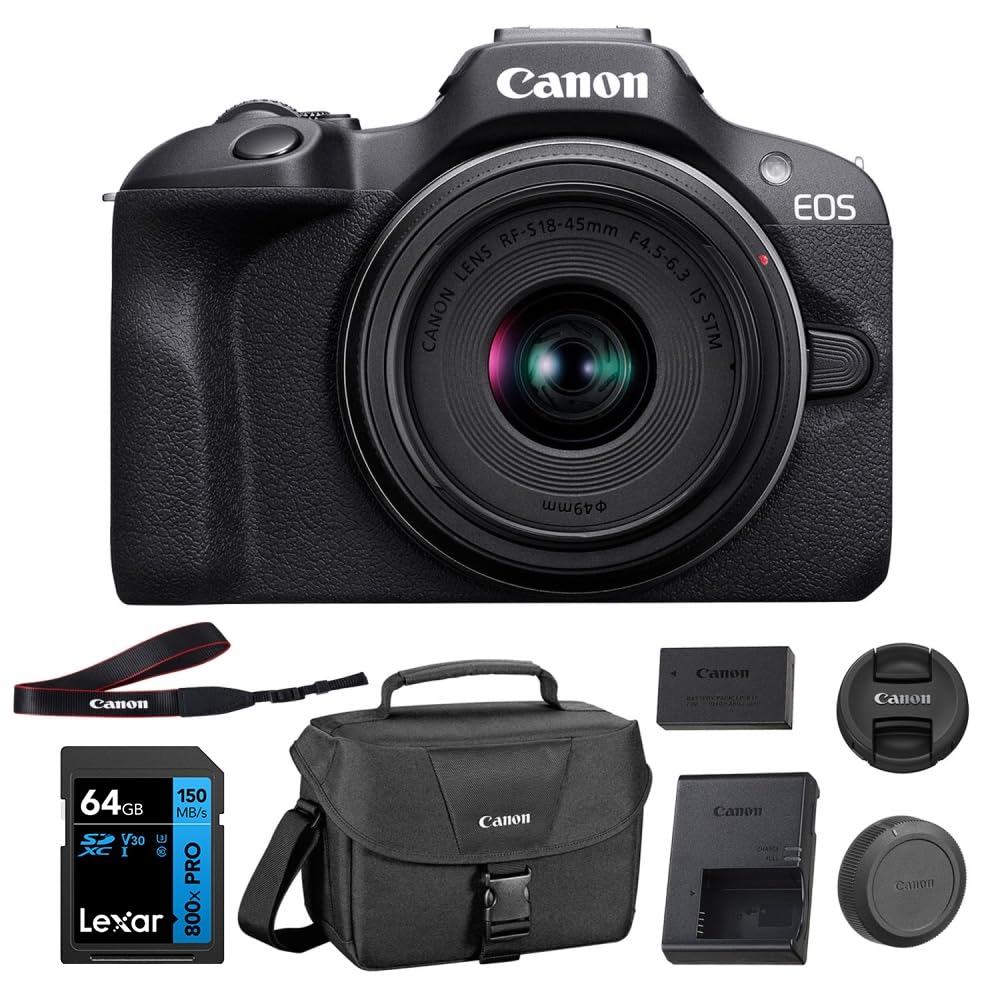
This bundle takes the same excellent EOS R100 camera and adds a 64GB Lexar SD memory card and a Canon EOS 200ES shoulder bag, making it a truly ready-to-go kit for beginners. The camera itself remains the same: a 24.1-megapixel APS-C sensor with DIGIC 8 processor, Dual Pixel CMOS AF with eye and animal detection, and 4K video at 24fps. The RF-S18-45mm kit lens provides optical image stabilization and a versatile zoom range for everyday photography.
The shoulder bag is designed to fit the R100 with the kit lens attached plus room for an extra lens or accessories. The included 64GB SD card is sufficient for about 2,500 JPEG images or roughly 45 minutes of 4K footage. For beginners who don’t already own memory cards and bags, this bundle saves the hassle of buying separately and ensures compatibility from day one.
The same limitations apply: 4K video is capped at 24fps with a 1.6x crop factor, and the battery life is around 300 shots per charge. The bundled card is entry-level UHS-I speed, which is fine for 4K/24fps but may struggle with faster burst shooting. If you’re just starting out and want a complete system without any additional shopping, this bundle delivers everything you need to start shooting immediately.
Why it’s great
- Complete ready-to-shoot kit with bag and memory card
- Same excellent APS-C sensor and Dual Pixel AF as standalone
- Access to Canon RF lens ecosystem for future upgrades
Good to know
- 4K limited to 24fps with 1.6x crop
- Bundled 64GB card is entry-level UHS-I speed
FAQ
Why do some budget 4K cameras have a recording time limit?
What is the 4K crop factor and why does it matter?
Can I use an external microphone with budget 4K cameras?
Final Thoughts: The Verdict
For most users, the best budget 4k camera winner is the DJI Osmo Action 5 Pro Adventure Combo because it delivers the best balance of sensor performance, battery life, stabilization, and durability for a wide range of shooting scenarios. If you want integrated gimbal stabilization for vlogging without the bulk of a separate stabilizer, grab the Xtra Muse Pocket 4K. And for the best audio and autofocus in a traditional vlogging form factor, nothing beats the Sony ZV-1F.