
Our readers keep the lights on and the weekend projects moving. As an Amazon Associate, I earn from qualifying purchases.
Your smartphone takes decent shots in good light, but the moment you try to capture a distant mountain, a quick-moving pet, or a dimly lit street market, the image falls apart into digital noise and zoom blur. A dedicated camera built for travel changes that — giving you an optical zoom lens that reaches without losing detail, a larger sensor that drinks in light, and manual controls that let you shape the shot instead of letting an algorithm guess.
I’m Rikta — the co-founder and writer behind FitlyFast. I’ve spent hundreds of hours analyzing market specs, low-light performance numbers, autofocus systems, and lens ecosystem value to separate the travel cameras that genuinely help a beginner grow from the ones that just add weight to a bag.
The best beginner travel camera balances portability, image quality, and ease of use so you actually want to carry it every day on every trip.
How To Choose The Best Beginner Travel Camera
Picking the right travel camera as a beginner means filtering out the marketing noise and focusing on the specs that actually change how your vacation photos look. Weight, lens versatility, and low-light performance matter far more than the promise of professional video features you may never use.
Sensor Size and Low-Light Performance
A larger sensor — APS-C or Micro Four Thirds — captures significantly more light than the tiny sensors inside point-and-shoot cameras or smartphones. This directly translates to sharper photos in dim interiors, evening street scenes, and twilight landscapes without forcing you to raise the ISO and introduce grain. Beginners often overlook this spec, but it is the single biggest factor separating a crisp travel album from a disappointing one.
Optical Zoom Reach and Lens Versatility
Look at the optical zoom range in millimeters (e.g., 16-50mm or 24-720mm) rather than the marketing term “power zoom.” A wider range means you can shoot a sweeping cathedral interior and then zoom into a decorative detail on the ceiling without swapping a lens. Superzoom bridge cameras offer the longest reach for wildlife or stadium concerts, while interchangeable-lens systems give you the option to upgrade later.
Autofocus Speed and Subject Tracking
Fast-moving travel subjects — kids running through a plaza, birds taking off from a lake, street performers in motion — demand autofocus that keeps up. Phase-detection AF or hybrid systems with eye and animal tracking let a beginner frame and shoot without fighting blurry results. Point-and-shoot cameras often use slower contrast-detection AF, which struggles in low light.
Weight, Portability, and Battery Life
A camera that sits in your bag unused because it’s too heavy or bulky is a waste of money. Travel cameras should be light enough to hang around your neck for a full day of sightseeing. Battery life varies widely — mirrorless bodies typically get a few hundred shots per charge, while some DSLRs can last twice as long. Consider whether the camera charges via USB-C for easy top-ups with a portable power bank.
Quick Comparison
On smaller screens, swipe sideways to see the full table.
| Model | Category | Best For | Key Spec | Amazon |
|---|---|---|---|---|
| Nikon Z50 II (Two-Lens Kit) | Mirrorless | All-day travel with creative presets | 20.9MP APS-C / 4K 60p | Amazon |
| Sony Alpha 6700 | Mirrorless | AI-powered subject tracking | 26MP APS-C / 759 AF points | Amazon |
| Canon EOS R10 + 18-150mm | Mirrorless | Single-lens versatility | 24.2MP APS-C / 4K 60p | Amazon |
| Sony a6400 Deluxe Bundle | Mirrorless | Complete starter kit ecosystem | 24.2MP APS-C / 425 AF points | Amazon |
| Nikon Z 30 + 16-50mm | Mirrorless | Vlogging and lightweight travel | 20.9MP APS-C / 4K oversampled | Amazon |
| Panasonic LUMIX G85 + 12-60mm | Mirrorless | In-body stabilization on a budget | 16MP MFT / 5-axis IBIS | Amazon |
| Canon EOS R100 + 18-45mm | Mirrorless | Smallest mirrorless entry point | 24.1MP APS-C / 4K 24p | Amazon |
| Canon EOS Rebel T7 + 18-55mm | DSLR | Classic learning platform | 24.1MP APS-C / 9 AF points | Amazon |
| Panasonic LUMIX ZS99 (Silver) | Superzoom | Pocket-sized extreme reach | 24-720mm LEICA / 30x zoom | Amazon |
| Panasonic LUMIX TZ/ZS99 (Black) | Superzoom | Budget-friendly long zoom | 24-720mm LEICA / 30x zoom | Amazon |
| Panasonic LUMIX FZ80D | Bridge | Ultra-long 60x zoom on a budget | 20-1200mm / 60x optical zoom | Amazon |
In‑Depth Reviews
1. Nikon Z50 II with Two Lenses

The Nikon Z50 II kit includes the 16-50mm standard zoom and the 50-250mm telephoto zoom, covering wide landscapes and distant wildlife without buying a second lens later. The 20.9-megapixel DX sensor is several times larger than any phone sensor, delivering noticeably cleaner shadows and richer color depth from dawn to dusk. Built-in 31 Picture Control presets let a beginner dial in a specific look — vivid travel, soft portrait, high-contrast monochrome — before pressing the shutter, rather than wrestling with raw files afterward.
Autofocus detects and tracks nine subject types, including birds, dogs, cats, vehicles, and human faces, with dedicated bird and airplane modes that improve accuracy at range. The 4K UHD video at 60p and in-camera Full HD 120p slow motion add creative flexibility for travel clips. The built-in flash and Night Portrait mode produce balanced indoor shots without external gear. Wireless SnapBridge transfers are genuinely fast, so you share images during the trip, not months afterward.
The kit is compact enough for a small day bag, though the twin-lens configuration naturally takes more space than a single superzoom. The menu system has a learning curve for absolute beginners unfamiliar with Nikon’s control layout. For any traveler ready to move past phone photography, the Z50 II’s combination of dual-lens range, subject detection, and instant color presets makes it the strongest overall package on this list.
Why it’s great
- Two-lens kit covers 16-250mm zoom range out of the box.
- 31 built-in Picture Control presets for instant creative looks.
- Reliable autofocus with dedicated bird, animal, and vehicle tracking.
Good to know
- Menu system requires initial learning time for new Nikon users.
- Twin lenses add more bulk than a single all-in-one zoom.
2. Sony Alpha 6700

The Alpha 6700 pairs a 26-megapixel back-illuminated APS-C sensor with a dedicated AI processing chip that elevates subject recognition beyond typical phase-detection systems. It tracks people, animals, birds, insects, cars, and trains with a level of sticky consistency that lets a beginner focus on composition rather than micro-adjusting AF points. The 759-point phase-detection array covers almost the entire frame, making it exceptionally hard to miss focus even when a subject moves unpredictably through the frame.
Video capabilities are equally advanced: 4K at 60p oversampled from 6K gives clean, detailed footage, and 4K 120p allows high-quality slow motion. The 10-bit 4:2:2 internal recording and S-Log gamma provide flexible color grading for anyone who wants to grow into more serious filmmaking. The compact magnesium-alloy body feels dense and premium without being heavy, and the battery life is genuinely impressive for a mirrorless camera — often lasting a full day of moderate shooting.
The menu system remains Sony’s deep, labyrinthine interface, which can be intimidating for someone who just wants to set up quickly before a day of sightseeing. In-body stabilization is decent but not gimbal-level smooth for walkaround handheld video. As a beginner travel camera, it offers serious headroom for skill growth, but its complexity and premium price make it best suited for someone who knows they want to invest in photography long-term.
Why it’s great
- AI processor enables class-leading subject tracking for fast movement.
- 26MP sensor delivers excellent dynamic range and low noise.
- Strong battery life for a compact mirrorless body.
Good to know
- Complex menu system can overwhelm pure beginners.
- In-body stabilization is adequate but not gimbal-level for video.
3. Canon EOS R10 with RF-S 18-150mm
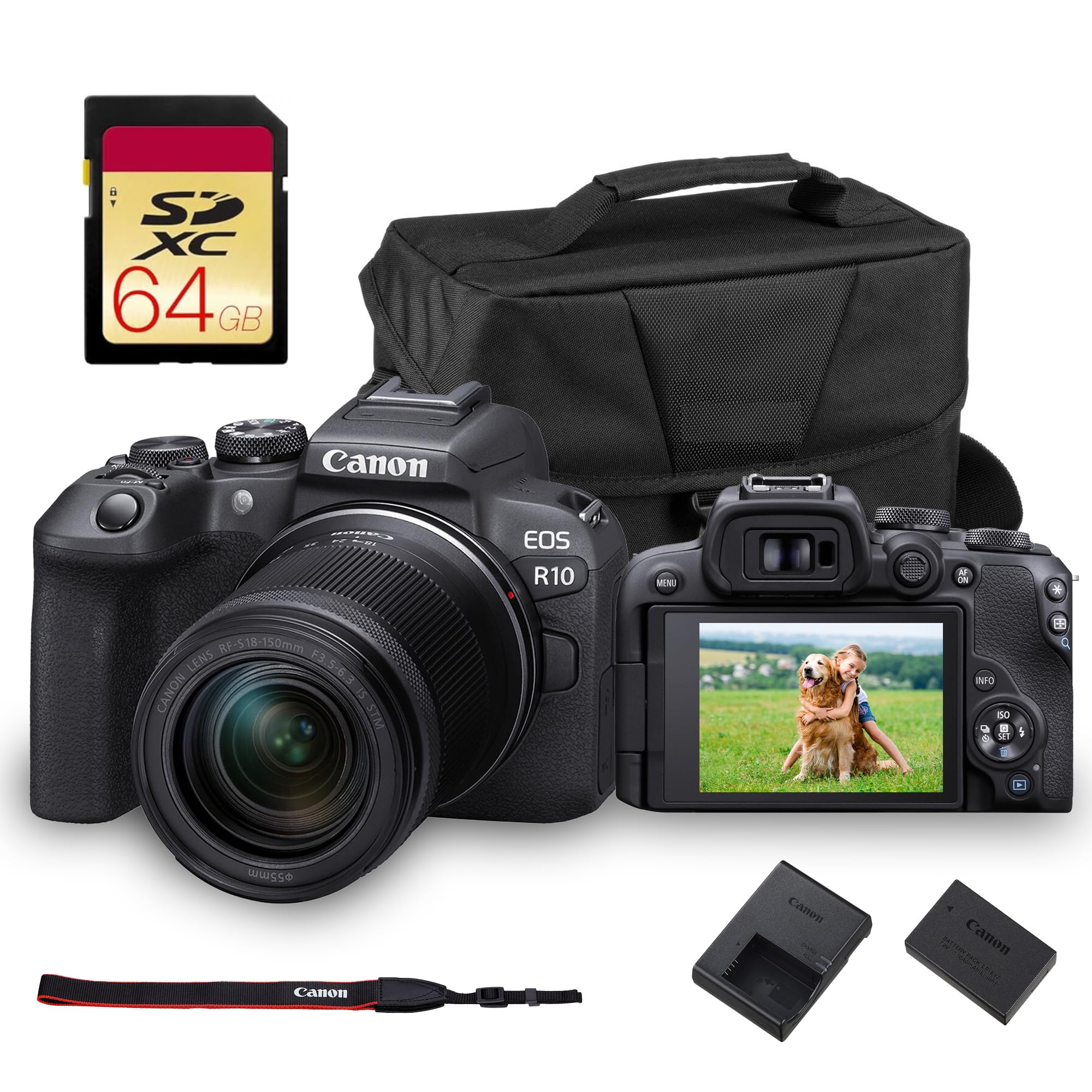
The Canon EOS R10 bundled with the RF-S 18-150mm lens is a nearly ideal single-solution travel camera. The lens covers wide-angle landscapes at 18mm and pulls in distant subjects at 150mm, so you never need to swap glass in the middle of a walking tour. The 24.2-megapixel APS-C sensor paired with Canon’s Dual Pixel CMOS AF II delivers snappy, confident autofocus that tracks human eyes and faces with minimal hunting, even in moderate low light.
It shoots 4K video at 60p oversampled from 6K, which produces noticeably sharper footage than standard 4K. The mechanical shutter fires at 15 frames per second and the electronic shutter hits 23 fps, both with continuous autofocus — fast enough to capture a street performer’s jump or a child’s spontaneous sprint. The body is lightweight and compact, with built-in Wi-Fi and Bluetooth for quick image transfer via the Canon Camera Connect app.
The kit does not include a flash, and the lens has a variable aperture of f/3.5-6.3, which limits low-light performance compared to a dedicated prime lens. The touchscreen is clear but not fully articulating, which matters for overhead or low-angle shots. For a beginner who wants a single, high-quality zoom lens that handles the vast majority of travel situations, this Canon kit reduces decision fatigue and produces consistently sharp results.
Why it’s great
- Single 18-150mm lens covers wide to telephoto without swapping.
- 4K 60p oversampled from 6K for extra-sharp video.
- Fast 23 fps electronic shutter with reliable eye-tracking AF.
Good to know
- No built-in flash included.
- Variable aperture limits low-light performance at telephoto end.
4. Sony a6400 Deluxe Bundle

This Sony a6400 bundle delivers a proven 24.2-megapixel APS-C mirrorless camera alongside a 16-50mm power zoom lens, plus a 64GB SD card, tripod, wide-angle and 2x telephoto adapters, filter kit, hood, grip, spare battery, charger, and video editing software. For a beginner who wants everything in one box before a trip, this bundle removes the guesswork of buying accessories separately. The a6400 body itself is respected for its Real-Time Eye AF and 425 phase-detection AF points, which lock onto human and animal eyes with impressive tenacity.
The 180-degree flip screen faces forward for vlogging and self-portraits, and the 4K UHD recording with full pixel readout produces sharp video without line skipping. The built-in Wi-Fi and NFC make sharing to a smartphone quick. The bundle’s tripod is functional for stable long-exposure night shots, and the spare battery addresses the a6400’s average battery life, which can drain during a full day of shooting.
The included wide-angle and telephoto adapter lenses are low-quality and can cause vignetting, so they are best left unused. The editing software license keys may be dated depending on purchase timing. Despite the accessory trade-offs, the core a6400 camera and kit lens are genuinely strong, making this bundle a solid value for a beginner who wants a complete kit and is willing to replace a few cheap add-ons over time.
Why it’s great
- Excellent Real-Time Eye AF with 425 phase-detection points.
- Comprehensive starter bundle with spare battery and SD card.
- 180-degree flip screen ideal for travel vlogging.
Good to know
- Included adapter lenses cause heavy vignetting.
- Software license keys may be outdated for newer OS versions.
5. Nikon Z 30 with 16-50mm

The Nikon Z 30 is Nikon’s lightest and most compact mirrorless camera, purpose-built for creators who want a camera they can hold in one hand while talking to the lens. The 20.9-megapixel APS-C sensor paired with the 16-50mm kit lens delivers sharp, vibrant stills with pleasing background blur at wider apertures. The flip-out touchscreen faces forward for self-recording, and the built-in stereo microphone with adjustable sensitivity captures decent audio without an external mic — a real advantage for travel vloggers who want to keep gear minimal.
Video quality is a highlight: 4K oversampled from a higher-resolution readout gives clean, detailed footage, and the camera can stream Full HD 60p over USB-C or 4K 30p over HDMI for live content. The autofocus features human and animal eye detection, and the 209-point hybrid AF system tracks subjects reliably during walking shots. The camera charges and powers via USB-C, so you can run it continuously with a power bank — great for long shooting days or live streaming abroad.
The Z 30 has no electronic viewfinder, which means composing shots in bright sunlight can be difficult, and some photographers strongly prefer looking through a viewfinder for stability. The battery life is adequate but not class-leading. For a beginner focused on video and vlogging who wants an ultra-light travel companion, the Z 30 is a specialist tool that prioritizes portability and recording convenience over traditional viewfinder photography.
Why it’s great
- Extremely lightweight and compact for one-handed use.
- 4K oversampled video with good built-in mic and USB-C power.
- Flip-out touchscreen and eye-tracking AF for vlogging.
Good to know
- No electronic viewfinder — composing in bright sun is tricky.
- Battery life is average for a compact mirrorless body.
6. Panasonic LUMIX G85 with 12-60mm

The Panasonic G85 offers in-body 5-axis stabilization that works in tandem with the lens-based Power O.I.S. to produce remarkably steady handheld footage and crisp low-light photos — a feature typically reserved for more expensive bodies. The 16-megapixel Micro Four Thirds sensor omits the low-pass filter, which noticeably sharpens fine detail versus older 16MP sensors. The 12-60mm kit lens provides a useful wide-to-short-telephoto range equivalent to 24-120mm in full-frame terms, covering typical travel needs from architecture to street portraits.
The magnesium-alloy chassis with weather sealing gives the body a robust feel that inspires confidence in humid or dusty environments. The OLED electronic viewfinder is clear and responsive, and the 3-inch touchscreen tilts for flexible framing. 4K video recording at 30fps is standard for its generation, and the 4K Photo mode lets you extract 8-megapixel stills from video clips — handy for capturing fleeting moments where timing matters.
Autofocus can struggle in very low light compared to newer phase-detection systems, and the Micro Four Thirds sensor produces more visible noise at higher ISOs than larger APS-C sensors. The G85 is an older model, so some modern connectivity features are absent. For the beginner who values stabilization above all else and wants a weather-sealed body with excellent ergonomics, the G85 remains a standout value even against newer competitors.
Why it’s great
- 5-axis in-body stabilization works with lens OIS for ultra-steady shots.
- Weather-sealed magnesium-alloy body for tough travel conditions.
- Excellent value for a feature-packed Micro Four Thirds system.
Good to know
- Older contrast-detection AF struggles in very dim light.
- Micro Four Thirds sensor shows more noise at high ISO than APS-C.
7. Canon EOS R100 with 18-45mm

The Canon EOS R100 is the smallest and lightest body in the EOS R series, making it a genuinely pocketable APS-C mirrorless option for travelers who prioritize compactness. The 24.1-megapixel sensor and DIGIC 8 processor deliver Canon’s characteristic image quality — natural color reproduction and good dynamic range for the price. The RF-S 18-45mm kit lens is a collapsible zoom that keeps the overall package tiny when retracted, ideal for slipping into a daypack or even a large jacket pocket.
Autofocus uses Dual Pixel CMOS AF with 143 zones and human face and eye detection, which is a significant step up from the slower contrast-detection AF found in many budget bodies. It shoots 4K video at 24p and Full HD at 60p, and the continuous shooting speed of 6.5 fps with One-Shot AF is enough for casual action shots. The body is compatible with the full Canon RF lens system, giving a clear upgrade path to superior glass as skills improve.
The lack of a touchscreen, articulated LCD, or in-body image stabilization are meaningful omissions for a modern travel camera. The 4K video is limited to 24p and crops the sensor, which reduces the field of view. The built-in flash is present but basic. For a beginner on a tighter budget who wants to enter the Canon mirrorless ecosystem with the smallest possible body, the R100 offers a clean, simple starting point that prioritizes portability and future lens compatibility.
Why it’s great
- Smallest and lightest EOS R body — genuinely pocketable.
- Dual Pixel CMOS AF with face/eye detection for reliable focus.
- Full compatibility with Canon RF lens ecosystem for upgrades.
Good to know
- No touchscreen, articulating LCD, or in-body stabilization.
- 4K video is 24p with a sensor crop factor.
8. Canon EOS Rebel T7 with 18-55mm

The Canon EOS Rebel T7 is the classic DSLR entry point — and for good reason. The optical viewfinder shows a real-time, zero-lag view of the scene, which many beginners prefer for composing shots, especially in bright daylight. The 24.1-megapixel APS-C sensor captures clean, detailed images with Canon’s well-regarded color science, and the included EF-S 18-55mm f/3.5-5.6 IS II lens provides image stabilization for steadier handheld shots.
The Guide Mode built into the menu walks a new photographer through aperture, shutter speed, and ISO adjustments with on-screen explanations, effectively functioning as a built-in photography tutor. Battery life is exceptional for a DSLR — easily lasting a full week of moderate travel shooting on a single charge. Built-in Wi-Fi and NFC allow wireless image transfer to a smartphone for quick social sharing, though the process is slower than modern mirrorless implementations.
The 9-point autofocus system is dated and sparse compared to modern mirrorless cameras, especially for tracking moving subjects in Live View. There is no 4K video (it records Full HD at 30p), and the LCD screen is fixed at a standard resolution. The DSLR body is also noticeably bulkier than mirrorless alternatives. For a beginner on a budget who values an optical viewfinder, exceptional battery life, and a guided learning experience, the T7 remains a proven, long-lasting introduction to interchangeable-lens photography.
Why it’s great
- Optical viewfinder provides zero-lag, bright composition in sunlight.
- Guide Mode teaches aperture, shutter, and ISO step by step.
- Exceptional battery life — lasts a full week of light travel shooting.
Good to know
- 9-point AF system is limited for moving subjects.
- No 4K video, fixed LCD screen, and bulkier body.
9. Panasonic LUMIX ZS99 (Silver)

The Panasonic ZS99 packs a 24-720mm LEICA zoom lens with 30x optical magnification into a body that truly fits in a pants pocket. This zoom range is impossible on any interchangeable-lens system without carrying multiple heavy lenses. The 1,840k-dot tiltable touchscreen helps frame odd-angle shots, and the 5-axis Hybrid O.I.S. stabilization keeps telephoto images reasonably steady despite the long focal length. The dedicated Send Image button and Bluetooth 5.0 make wireless transfer to a phone fast and intuitive.
It records 4K video at 30p and captures 4K Photo bursts for extracting stills from motion. HD high-speed video at 120fps gives smooth slow-motion playback. USB-C charging means you can recharge the battery from a portable power bank during a travel day. For concerts, wildlife, or any scenario where you need extreme reach without attracting attention, this pocket camera is a uniquely powerful tool that no smartphone or mirrorless kit can match in portability per millimeter of zoom.
The small 1/2.3-inch sensor is the primary trade-off — image quality degrades noticeably in low light, and dynamic range is limited compared to APS-C cameras. The camera has a 15-minute limit on 4K recording and a 30-minute limit on 1080p, which can interrupt event coverage. The Micro-USB charging port cover feels flimsy over time. For the beginner who cares above all about maximum optical zoom in an ultralight, shirt-pocket-friendly package, the ZS99 delivers reach that nothing else at this size can touch.
Why it’s great
- 30x optical zoom (24-720mm) in a truly pocketable body.
- USB-C charging and fast Bluetooth image transfer.
- 5-axis stabilization helps keep telephoto shots usable.
Good to know
- Small sensor limits low-light and dynamic range significantly.
- Recording limits of 15 min at 4K and 30 min at 1080p.
10. Panasonic LUMIX TZ/ZS99 (Black)

The black version of the Panasonic ZS99 offers the identical 24-720mm LEICA 30x zoom lens and core feature set as its silver sibling, but at a slightly lower entry price point. This makes it an even stronger choice for the budget-conscious traveler who still demands long optical reach. The compact body slides into a jeans pocket easily, making it a camera you actually bring everywhere rather than leave in a hotel safe. The tiltable touchscreen and Bluetooth 5.0 connectivity mirror the silver model’s convenience.
The auto mode produces well-exposed images with accurate color in good daylight, and the 4K Photo burst function provides a safety net for capturing fast-moving moments. The step zoom feature lets you quickly jump to specific focal lengths, and the Lens Position Resume remembers your last zoom setting when powering on. For family trips, concerts, and general outdoor sightseeing, the ZS99 delivers sharp images at a distance that no phone can approach.
Low-light performance is a weak point — images get soft and noisy past ISO 800, and the autofocus becomes hesitant in dim conditions. Some users report that picture quality in certain automatic modes can be worse than a modern flagship smartphone. The menu system can feel deep and unintuitive for absolute beginners. For the traveler who prioritizes extreme zoom reach and pocketability above all else, the black ZS99 offers the same class-leading lens at a more budget-friendly price point than the silver model.
Why it’s great
- Same 30x LEICA zoom as the silver model at a lower price.
- Compact enough for a jeans pocket — always carry-ready.
- Good daylight image quality and fast Bluetooth sharing.
Good to know
- Poor low-light performance with soft images above ISO 800.
- Menu system can be confusing for a complete beginner.
11. Panasonic LUMIX FZ80D

The Panasonic FZ80D offers a staggering 60x optical zoom with a 20-1200mm equivalent focal range — enough to bring distant wildlife, moon craters, or stadium performers into tight framing. The Power O.I.S. stabilization does a respectable job of counteracting hand shake at extreme telephoto lengths. The 2,360k-dot electronic viewfinder is bright enough to compose shots in direct sunlight, which is important given the long reach where a phone screen would be useless.
The camera records 4K video and features the 4K Photo extraction mode, allowing you to pull 8-megapixel stills from clips. The Post Focus option lets you choose the focus point after taking a shot, which is useful for macro photography of flowers or small details. The body is lightweight for a bridge camera with this much zoom, and it performs well in bright outdoor conditions where its versatility shines.
Image quality degrades noticeably in anything less than good light — images can appear grainy even at modest ISO settings, and the autofocus is slower than mirrorless systems. The menu interface is not particularly intuitive, and there is no built-in Wi-Fi for direct sharing. The battery drains faster when using the zoom motor heavily. For a beginner whose primary need is extreme optical reach on the tightest budget — especially for nature, safari, or daytime sports — the FZ80D is the only camera at this price point that can get you that close.
Why it’s great
- Massive 60x zoom (20-1200mm) unmatched at this price tier.
- Power O.I.S. stabilization helps at extreme telephoto lengths.
- Bright electronic viewfinder for sunny-day composition.
Good to know
- Poor image quality in low light — grainy even at low ISO.
- No Wi-Fi, slow autofocus, and unintuitive menu system.
FAQ
Should a beginner travel photographer choose a DSLR or a mirrorless camera?
How much optical zoom do I really need for general travel photography?
Is image stabilization important for a beginner travel camera?
Can a beginner travel camera shoot good quality video without extra gear?
What is the real difference between a bridge camera and a mirrorless camera for travel?
Final Thoughts: The Verdict
For most users, the best beginner travel camera winner is the Nikon Z50 II because its dual-lens kit covers 16-250mm right out of the box, the built-in Picture Control presets remove the guesswork from editing, and the autofocus reliably tracks subjects so you get sharp shots without frustration. If you want extreme pocket-sized zoom for concerts and wildlife, grab the Panasonic LUMIX ZS99. And for a budget-friendly entry into mirrorless photography with a tiny body that still has a large APS-C sensor, nothing beats the Canon EOS R100.