
Our readers keep the lights on and the weekend projects moving. As an Amazon Associate, I earn from qualifying purchases.
An auto epoxy primer is the non-negotiable foundation between bare metal and a lasting paint job. Skip a true 2K epoxy, and you’re betting your project’s finish against moisture creep, fisheye, and early peeling — a gamble no restorer should take.
I’m Rikta — the co-founder and writer behind FitlyFast. I’ve spent countless hours analyzing the chemical makeup, cure behavior, and real-world adhesion performance of dozens of epoxy systems so you can pick the one that actually bonds to your substrate.
Mixing ratio, pot life, and surface compatibility define whether a primer seals or fails — this guide to the best auto epoxy primer breaks down the specs that separate a corrosion-proof base from a costly do-over.
How To Choose The Best Auto Epoxy Primer
Selecting an auto epoxy primer comes down to matching the chemical system to your surface and application method. The wrong ratio or a hasty cure schedule will compromise adhesion before you ever spray color.
2K vs Single-Stage: The Chemical Crosslink
True epoxy primers are two-component (2K) systems that require a catalyst or activator. This chemical reaction creates a dense, moisture-resistant film that bonds directly to metal, fiberglass, or filler. Single-stage urethane primers lack that crosslink density and won’t stop rust from creeping under the paint line.
Mixing Ratio & Pot Life
Ratios like 1:1, 2:1, or 4:1 determine how much hardener you add. A longer pot life (3–4 hours) gives you time to spray multiple panels, but requires precise mixing. A short pot life forces a fast pace but often means faster cure and earlier sandability.
Surface Compatibility: DTM vs Sealer Mode
Direct-to-metal (DTM) primers bond aggressively to bare steel and aluminum without an etching step. Some systems also function as a sealer over old paint or body filler, allowing you to block-sand the primer then spray basecoat directly. Check whether the product is rated for DTM use or requires an etch primer underneath.
Quick Comparison
On smaller screens, swipe sideways to see the full table.
| Model | Category | Best For | Key Spec | Amazon |
|---|---|---|---|---|
| SprayMax 2K Black | Aerosol | Quick panel repair | 15-min dust-dry | Amazon |
| Eastwood 2K Gray | Aerosol | Small-area pro base | 10–16 sq ft per can | Amazon |
| Eastwood Quart Kit | Liquid | Full-panel sealing | 1:1 mix ratio | Amazon |
| TotalBoat White | Liquid | Marine barrier coat | 56 sq ft per quart | Amazon |
| SprayMax 2-Pack | Aerosol | Multi-panel coverage | Matte black finish | Amazon |
| Custom Shop Black | Liquid | DTM sealer work | 4-hour pot life | Amazon |
| Speedokote Gray | Liquid | High-build sandable | 4:1 mix ratio | Amazon |
In‑Depth Reviews
1. SprayMax 2K Epoxy Primer Black
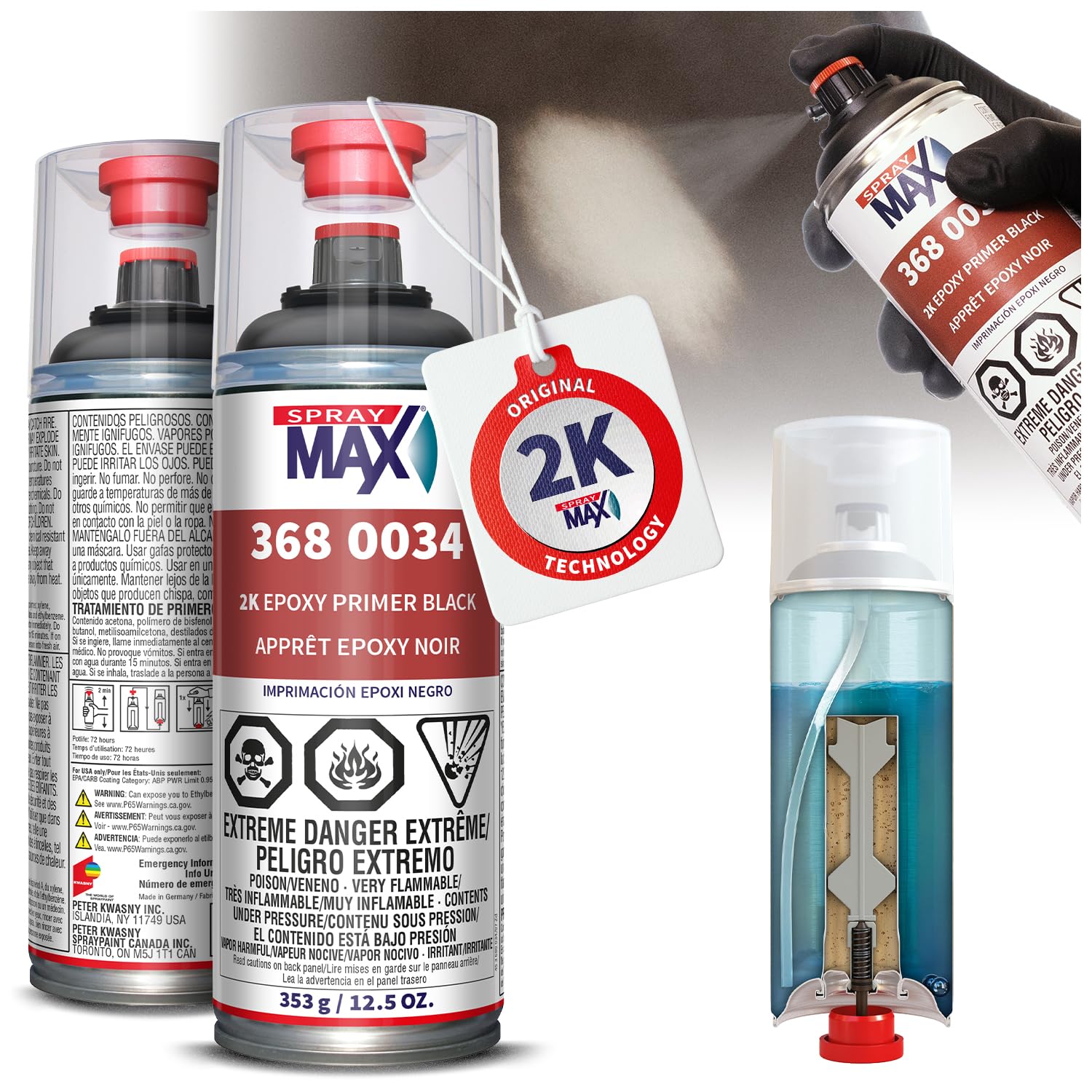
This is the aerosol that body-shop guys grab for small metal panels and motorcycle restorations. The 2K system activates internally when you press the valve, delivering a true catalyzed epoxy without needing a separate spray gun. Users report dust-dry in about 15 minutes and full sandability within hours, which keeps a one-day project from dragging into a weekend. The variable nozzle lets you dial the fan pattern from a narrow bead to a wide spray, making it forgiving for both tight corners and open panels.
Real-world coverage sits around two coats per motorcycle tank plus fenders, so expect three cans for a full set. The corrosion resistance holds up well — one reviewer noted the finish looked perfect after two years on a fiberglass hood scoop. The sputtering on the last few squirts of a can is a minor annoyance, but it never caused clogs or runs during application.
For standalone small repairs, this is the most reliable aerosol epoxy primer on the shelf. The gloss black finish also means you can leave it as a temporary topcoat on hidden surfaces without worrying about flash rust.
Why it’s great
- Fast 15-minute dust-dry time
- Adjustable fan nozzle for precise control
- Proven 2-year adhesion on fiberglass
Good to know
- One can covers only a door plus rocker panel
- May sputter near the end of each can
2. Eastwood 2K Epoxy Gray Primer

Eastwood’s gray 2K aerosol occupies a sweet spot between aerosol convenience and the sort of durability you expect from a gun-applied system. The specially engineered nozzle lays down a wide fan pattern that mimics an HVLP spray pattern, and the 48-hour pot life once activated means you can use the same can across multiple panels without worrying about the catalyst hardening inside the can. The 10–16 square foot coverage per 12-ounce can is realistic for a small hood, two doors, or a motorcycle fairing set.
Users consistently praise the smooth application and the fact that it bonds well to bare steel without an intermediate etch. The included 60-day warranty and lifetime tech support add peace of mind, especially for beginners who might be trying epoxy for the first time. The gray color works well as a guide coat for block-sanding — you can see your highs and lows clearly.
The water-resistant rating is a plus for outdoor-stored vehicles, though proper topcoating is still required for full weather exposure. For anyone who needs a single-can epoxy that sprays like a pro setup, this is the go-to.
Why it’s great
- Wide fan nozzle mimics HVLP gun
- 48-hour pot life for multi-panel use
- Lifetime tech support included
Good to know
- Coverage lower than specified on larger panels
- Some users report less coverage than budget alternatives
3. Eastwood Epoxy Primer Sealer Activator Quart

This is the liquid two-part kit for users who already own a spray gun and want to cover large continuous surfaces. The 1:1 mix ratio with Eastwood’s 50242ZP base epoxy is simple to measure and leaves minimal waste. At a 1mm dry film thickness, one quart covers roughly two full car doors or a single hood with two medium-wet coats. The 5-day full cure time is slower than an aerosol, but the chemical bond to steel, fiberglass, and body filler is correspondingly deeper.
Users report it wet sands cleanly the next day and dry sands well after 48 hours if you need to block-sand. The clear activator component keeps the mixed primer a light gray, so you can guide-coat effectively. Some found the mixed consistency thinner than expected, but that actually helps with self-leveling on vertical panels.
For a full-body restoration where you need consistent film build across multiple panels, this kit delivers pro-level results. Pair it with the corresponding Eastwood base for a fully compatible system.
Why it’s great
- Simple 1:1 mixing with no induction time
- Sands well after 24-hour wet sand
- Good for large-area continuous coverage
Good to know
- Full cure takes 5 days
- Mixed consistency is thinner than some expect
4. TotalBoat TotalProtect Epoxy Barrier Coat

This is a high-build two-part epoxy specifically formulated for marine environments, though it works equally well on automotive steel and aluminum above and below the waterline. At 56 square feet per quart, the coverage is generous for a liquid kit, and the 4-hour pot life gives you enough working time for multiple coats within a single session. The matte finish requires no sanding between coats, though the cured film is very hard — expect to use 80-grit if you need to shape it.
Boat restorers value it for gelcoat blister prevention and barrier-coating bilge areas. The roller application is straightforward, and cleanup requires standard xylene. A few users noted the foam roller can degrade with the chemicals, but a high-quality brush or spray gun solves that issue entirely.
For a project vehicle that will face humid coastal conditions or for a trailer that sits near saltwater, this barrier coat adds a level of moisture protection that standard automotive primers don’t offer. The white tint also works well as a bright base under light-colored topcoats.
Why it’s great
- 225 sq ft per gallon coverage at 7 mils wet
- No sanding required between coats
- Exceptional adhesion to fiberglass and gelcoat
Good to know
- Very hard to sand after cure
- Foam roller may degrade during use
5. SprayMax 2K Epoxy Primer Matte Black 2-Pack

This two-pack of SprayMax’s 13.5-ounce matte black gives you the same 2K catalyzed technology as the single can but at a better per-unit value for larger jobs. The matte finish is ideal for under-hood areas, chassis components, or any surface where you want a non-reflective corrosion barrier. It bonds well to problematic surfaces like anodized aluminum and galvanized sheet steel without requiring a separate adhesion promoter on clean metal.
Real-world users report that two cans are sufficient for a motorcycle tank plus both fenders with two coats each, and the adjustable tip allows you to dial the pattern for the part. The fast-dry characteristic means you can apply two coats within an hour if the ambient temperature is above 60°F. Some users noted one can sputtered near the end, matching the single-can experience.
For anyone starting a full set of custom automotive parts or a small fleet of pieces that need identical finish, the twin-pack eliminates the anxiety of running out mid-session. The matte black also works as an excellent base for satin or flat topcoats.
Why it’s great
- Two cans for extended coverage
- Matte black works well for under-hood use
- Bonds to anodized aluminum and galvanized steel
Good to know
- One can may sputter near the end
- Not waterproof despite epoxy build
6. Custom Shop KEP Black Epoxy Primer/Sealer

The Custom Shop KEP series delivers a true professional-grade, low-VOC 2.1 formula that can go direct-to-metal without an etching step. The 1:1 mix ratio is the simplest of any liquid kit — no induction time needed, and you can spray it immediately. At 4 hours of pot life, you have enough time to lay down two coats on an entire car body from one mixing batch. The gel consistency in the can requires aggressive mixing; users note that the included hard black ball needs manual stirring since a standard paint shaker may not break up the settled solids.
When properly mixed, the primer sprays smooth and lays flat, providing an excellent base for both single-stage urethane and basecoat-clearcoat systems. It can also be used as a sealer by adding half part reducer, allowing topcoat application in as little as 30 minutes. The corrosion resistance comes from a rich blend of anti-corrosive additives, and the semi-gloss finish helps you spot imperfections during sanding.
If you already have a spray gun and want a full-body solution with minimum mixing math, this kit offers pro-level performance at a mid-range investment. Just plan extra time for the mixing step.
Why it’s great
- Simple 1:1 mix with no induction time
- Can be used as a sealer with reducer
- Excellent salt spray resistance rating
Good to know
- Solids settle hard and need manual stirring
- Some cans arrive with dented edges
7. Speedokote Epoxy Fast Dry DTM Primer Gray Gallon

Speedokote’s gallon kit is the volume play for serious restorers who plan to shoot an entire vehicle. The 4:1 mix ratio with optional 5-10% reduction produces a very smooth, self-leveling primer that sands beautifully — users describe the sanding experience as therapeutic. The gray finish works as a high-build layer that can be wet-sanded to 600 grit and still hold a flawless basecoat. Full cure takes about 3 days, but you can sand after 24 hours.
Users consistently praise the flow and leveling properties when sprayed through a standard HVLP gun. A few noticed the can was slightly underfilled on two different orders, leaving leftover hardener due to the 4:1 ratio. One reviewer reported a bonding failure after two-week cure when air blew the primer off bare metal at 28 PSI, though the company resolved the issue and the failure was linked to surface preparation rather than the product.
For large-scale jobs where consistent film build across an entire body is the goal, the Speedokote gallon delivers the volume and smoothness you need. Just verify your measurement markings are accurate for the ratio.
Why it’s great
- Sprays and sands very smooth
- Large gallon volume for full-vehicle jobs
- Compatible with most basecoat brands
Good to know
- Some cans arrive underfilled
- Requires precise 4:1 measurement
FAQ
What does 2K mean in an auto epoxy primer?
Can I spray epoxy primer over old paint or body filler?
How long should I wait before sanding epoxy primer?
Does epoxy primer need a topcoat or can I leave it bare?
How do I clean my spray gun after using epoxy primer?
Final Thoughts: The Verdict
For most users, the best auto epoxy primer winner is the SprayMax 2K Epoxy Primer Black because it delivers true 2K catalyzed protection in a convenient aerosol format with a fast 15-minute dry time and adjustable fan nozzle. If you want a liquid kit for full-body coverage with maximum corrosion resistance, grab the Custom Shop KEP Black Epoxy Primer/Sealer. And for high-build sandable performance on a large-scale restoration, nothing beats the Speedokote Epoxy Fast Dry DTM Primer Gray Gallon.