
Our readers keep the lights on and the weekend projects moving. As an Amazon Associate, I earn from qualifying purchases.
Distributing clean, reliable audio to four separate speakers or zones is the backbone of any serious multi-room or home theater setup. A 4 channel home audio amplifier handles this task by delivering dedicated power to each channel, ensuring consistent volume levels, low distortion, and the flexibility to pair with passive speakers, subwoofers, or even satellite units without relying on a bulky AV receiver’s processing.
I’m Rikta — the co-founder and writer behind FitlyFast. I’ve spent hundreds of hours combing through power ratings, signal-to-noise specifications, impedance tolerances, and connectivity standards across the current amplifier landscape to bring clarity to this crowded category.
Whether you are building a dedicated two-zone listening area or upgrading a media room’s amplification, this guide walks through the critical specs behind the best 4 channel home audio amplifier choices available today.
How To Choose The Best 4 Channel Home Audio Amplifier
Selecting a four-channel amplifier begins with understanding your speaker setup. The amplifier’s continuous power rating, impedance support, and input/output flexibility determine whether your system delivers clean, undistorted sound or struggles under load.
RMS Power vs. Peak Power
Always prioritize the RMS (continuous) power rating over flashy “Max” or “Peak” wattage. RMS tells you how much clean power the amplifier can sustain during normal listening. A 4 channel amp rated at 80W RMS per channel will sound louder and cleaner than a unit claiming 500W peak but delivering only 40W RMS.
Impedance Matching
Most home speakers are rated at 4 or 8 ohms. Check the amplifier’s power output at both impedances. A quality 4 channel amplifier will deliver more watts per channel at 4 ohms than at 8 ohms. If you plan to bridge two channels to power a single subwoofer or center speaker, confirm the bridged power rating at the target impedance.
Connectivity Options
Stick to amplifiers with both RCA and balanced XLR inputs if you are running long cable runs to the source. XLR carries a differential signal that cancels electrical noise, critical for clean sound in whole-home distribution systems. Also confirm whether the amp includes a 12V trigger for automated power-on with your preamp or AV receiver.
Quick Comparison
On smaller screens, swipe sideways to see the full table.
| Model | Category | Best For | Key Spec | Amazon |
|---|---|---|---|---|
| OSD Nero HTA4200 | Class AB | High-power home theater | 200W x 4 (4 ohms) | Amazon |
| WiiM Amp Ultra | Streaming Amp | Hi-fi streaming & TV integration | 100W x 2 (4 ohms) | Amazon |
| OSD Nero Max8 | Multi-Zone | Whole-house audio distribution | 80W x 8 (4 ohms) | Amazon |
| Denon PMA-600NE | Integrated | Pure stereo with turntable | 70W x 2 (4 ohms) | Amazon |
| Onkyo TX-NR7100 | AV Receiver | Immersive home theater | 100W x 9 (8 ohms) | Amazon |
| Yamaha RX-V6A | AV Receiver | Gaming & 8K video | 100W x 7 (8 ohms) | Amazon |
| Alpine S-A32F | Class D | Compact car audio upgrade | 55W x 4 (4 ohms) | Amazon |
| Pioneer GM-A6704 | Class AB | Cost-effective car audio | 60W x 4 (4 ohms) | Amazon |
In‑Depth Reviews
1. OSD Audio Nero HTA4200

The OSD Nero HTA4200 is a true 4-channel Class AB powerhouse delivering 200 watts per channel at 4 ohms, all channels driven simultaneously. That is real headroom for demanding floor-standing speakers or a dedicated home theater setup where dynamics matter. The inclusion of both balanced XLR and standard RCA inputs makes it equally comfortable in a pro-style rack or a living room cabinet.
Bridged mode pushes each paired channel to 300 watts at 8 ohms, giving you the flexibility to drive a center channel or a pair of passive subwoofers with authority. Owners consistently note the amplifier runs cool even under extended high-output sessions, a strong sign of a conservative, well-designed power supply. The 5-year warranty adds further confidence.
At 52 pounds, this is not a piece of equipment you tuck behind a bookshelf; it demands a solid surface or rack mount. The 110 dB signal-to-noise ratio at full power ensures an exceptionally black background, meaning you hear the music, not the amplifier’s electrical noise. For sheer power and build integrity, the Nero HTA4200 sets the standard in its class.
Why it’s great
- High continuous power output
- Balanced XLR and RCA inputs
- Runs cool under heavy load
Good to know
- Very heavy unit
- Bridged terminals spaced only 4 inches apart
2. WiiM Amp Ultra

The WiiM Amp Ultra packs a premium ESS ES9039Q2M DAC and dual TI TPA3255 amplifiers into a compact, touchscreen-equipped chassis that delivers 100 watts per channel at 4 ohms with ultra-low distortion. This is a streaming-first device that handles Spotify, TIDAL, Qobuz, and Roon access natively, while the built-in RoomFit EQ automatically tailors the sound to your room acoustics using the onboard microphone.
Connectivity is well ahead of the field with Wi-Fi 6, Bluetooth 5.3 with LE Audio, and HDMI ARC for seamless TV audio integration. The 3.5-inch glass-covered touchscreen on the unibody aluminum case makes track selection and volume control quick without reaching for a phone. Owners report a noticeable step up in clarity and detail compared to previous top-end streaming amps in the same price range.
The RoomFit EQ is transformative, but it offers no adjustable strength — you either use it as calibrated or bypass it entirely. The amplifier also lacks AirPlay compatibility, which might affect Apple ecosystem users. Despite those limitations, the combination of audiophile-grade components, streaming flexibility, and compact form factor makes this a compelling hub for a modern 2-channel or 4-channel listening space.
Why it’s great
- Audiophile DAC and amplifier chips
- Built-in RoomFit room correction
- HDMI ARC for TV integration
Good to know
- No AirPlay support
- Room correction strength not adjustable
3. OSD Audio Nero Max8

Designed explicitly for whole-house audio, the OSD Nero Max8 provides eight channels of amplification across four independent stereo zones, each outputting 80 watts at 4 ohms. This is not a general-purpose stereo amp; it is engineered for distributed audio systems where zone separation, independent source selection, and remote control are non-negotiable. The OSD Control App for iOS and Android handles volume, grouping, and source switching without walking to a central rack.
Connectivity includes four stereo RCA inputs, two auxiliary inputs, and one optical input, plus an RS232 port for Control4 and other automation systems. A built-in audio sense feature automatically powers each zone on when a signal is detected, which is critical for systems triggered by a Chromecast Audio or similar source. Owners using the amplifier for outdoor speakers or multiple rooms praise its clean sound and flexible input matrix.
The app occasionally requires disabling a VPN to function correctly, and the unit boots in about 30 seconds before accepting commands. Setup is Ethernet-only — there is no Wi-Fi antenna.
Why it’s great
- 4 independent stereo zones
- RS232 automation integration
- Audio sense auto on/off per zone
Good to know
- Setup requires Ethernet cable
- App has some connectivity quirks
4. Denon PMA-600NE

The Denon PMA-600NE is a two-channel integrated amplifier that uses a divided-circuit design to physically isolate the digital and analog sections. Engaging Analog Mode completely disconnects the Bluetooth and digital processing, delivering a pure signal path through the Advanced High Current (AHC) amplifier stage. At 70 watts per channel into 4 ohms, it comfortably drives most bookshelf and floor-standing speakers with a warm, detailed signature that owners describe as reminiscent of classic 1970s receivers.
Built-in support for two optical and one coaxial digital input, plus a dedicated phono stage for a turntable, make this a hub for multiple sources without needing a separate preamp or DAC. The subwoofer output and tone controls add flexibility, though many users find the Pure Direct mode yields the best clarity. The large volume knob and full-featured remote keep operation simple.
The remote’s volume response has a slight lag, and the internal relay clicks can be audible during source switching. Owners also note that the internal DAC, while good, can be improved by an external unit if you chase ultimate resolution. For a compact, musically engaging integrated amplifier with a clean vinyl path, the PMA-600NE punches well above its physical footprint.
Why it’s great
- Analog Mode for pure signal path
- Built-in phono preamp and DAC
- Warm, detailed sound signature
Good to know
- Remote volume response has lag
- Internal DAC is entry-level
5. Onkyo TX-NR7100
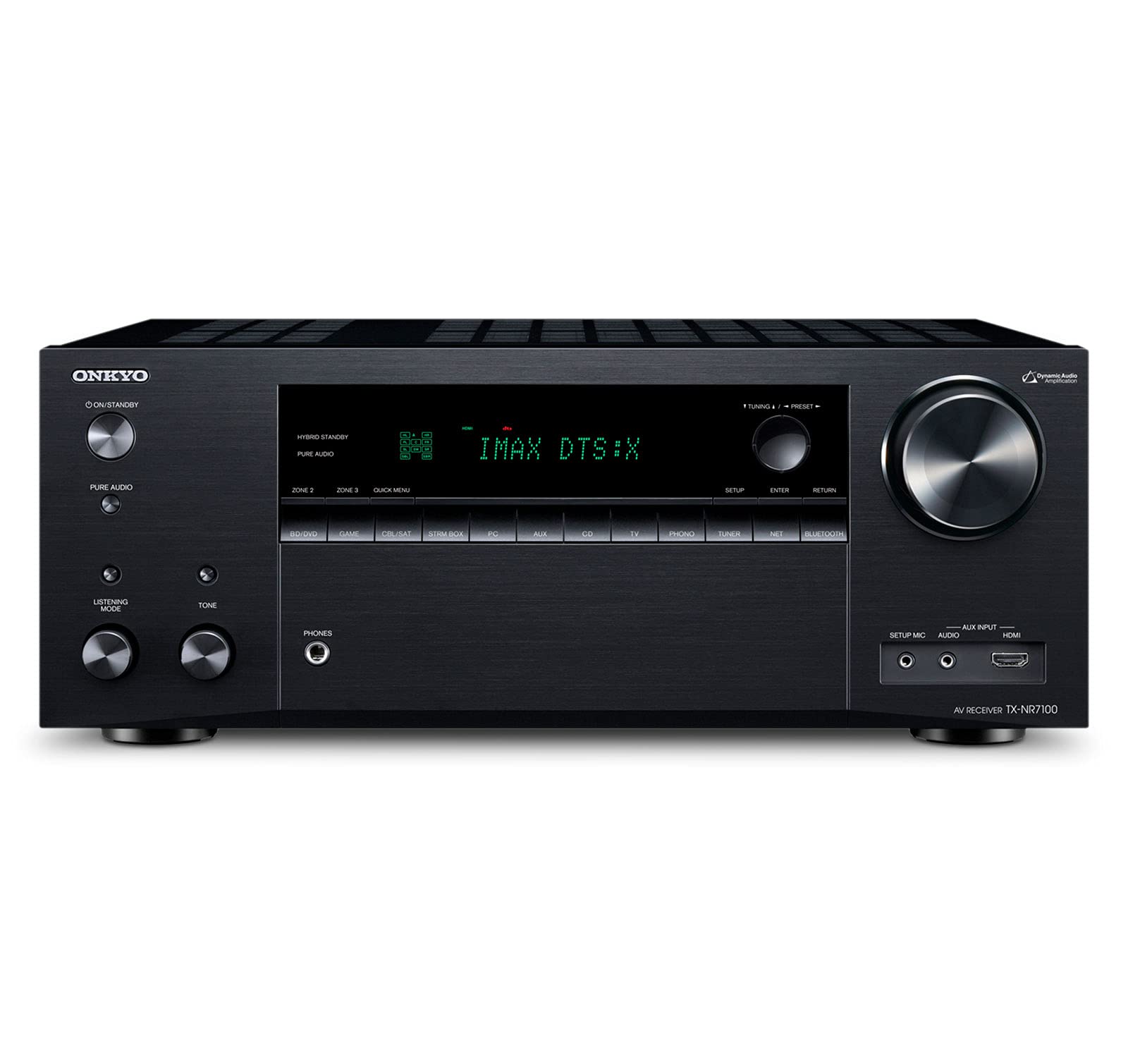
The Onkyo TX-NR7100 is a 9.2-channel AV receiver that brings Dirac Live room correction out of the box, a feature usually reserved for much pricier separates. It delivers 100 watts per channel into 8 ohms, supports Dolby Atmos and DTS:X, and handles a full 5.1.4 speaker configuration. With HDMI 2.1 handling 8K/60 and 4K/120 pass-through, plus VRR and ALLM for gaming, it doubles as both a serious home theater processor and a powerful multi-channel amplifier.
The Dirac Live calibration process, done via the included mic and Onkyo app, filters out room reflections and standing waves with precision that outperforms most built-in room EQ systems. Owners upgrading from budget AV receivers consistently report better soundstage depth and tighter bass after running Dirac. The receiver also supports three independent zones, each capable of playing a different streaming source — ideal for whole-home setups.
The unit runs warm in operation, the remote lacks a backlight, and the initial Dirac setup requires patience. A small percentage of users have reported HDMI handshake glitches or static noise after extended use. If a single-box solution with professional-grade room correction is your priority, the TX-NR7100 delivers that value directly.
Why it’s great
- Dirac Live room correction included
- HDMI 2.1 with 8K support
- Three independent audio zones
Good to know
- Runs warm during operation
- Dirac setup is time-consuming
6. Yamaha RX-V6A

The Yamaha RX-V6A is a 7.2-channel AV receiver that combines clean amplification with HDMI 2.1 connectivity for 8K/60 and 4K/120 pass-through. Each of its seven channels is rated at 100 watts into 8 ohms, which is sufficient to drive a full 5.1.2 Dolby Atmos or DTS:X setup. Yamaha’s MusicCast platform adds multi-room audio streaming from TIDAL, Spotify, Qobuz, and Amazon Music HD, controllable via the MusicCast app or voice assistants.
Video handling includes Dolby Vision, HDR10+, and HLG pass-through, plus advanced gaming features like VRR and ALLM for reduced input lag. The YPAO room optimization (with R.S.C. and multipoint) automatically adjusts speaker distances and equalization, though audiophiles may still prefer manual calibration. Owners upgrading from older receivers note a clear improvement in surround imaging and dialog clarity.
The on-screen menu design feels dated, and the receiver does not auto-power on with the TV via eARC unless the AVR is already the active input source. The initial firmware update is mandatory and can take time. For a balanced combination of multi-channel amplification, modern gaming support, and reliable streaming integration, the RX-V6A remains a strong all-rounder.
Why it’s great
- HDMI 2.1 with 8K/60 and 4K/120
- MusicCast multi-room streaming
- YPAO room optimization
Good to know
- No auto power-on with TV via eARC
- Menu system feels dated
7. Alpine S-A32F

The Alpine S-A32F is a compact 4-channel Class D amplifier delivering 55 watts RMS per channel into 4 ohms, primarily designed for car audio but equally effective in small home system builds where space is tight. Its Class D topology ensures high efficiency — owners report a 40A current draw is more than adequate — and the aluminum chassis dissipates heat effectively enough to mount in confined enclosures without thermal shutdown.
Sound quality is the standout feature here. Multiple owners describe the output as “crystal clear” with zero distortion at high volume and a balanced soundstage that brings out midrange detail. The small set-screw input terminals require pin connectors for a clean install, but the overall build quality reflects Alpine’s reputation for reliability over years of daily use.
This amplifier does not include home-specific connectivity like RCA-to-speaker binding posts out of the box. It also lacks balanced inputs or a 12V trigger, meaning you will need additional adapters and switching gear for a stationary indoor rack. For a straightforward, compact, and sonically clean power source, the S-A32F punches well above its power rating.
Why it’s great
- Compact Class D design
- Clean, distortion-free sound
- Efficient power consumption
Good to know
- Small screw terminals need pin connectors
- Lacks home audio binding posts
8. Pioneer GM-A6704

The Pioneer GM-A6704 is a 4-channel Class AB car amplifier that delivers 60 watts RMS per channel into 4 ohms, with a peak rating of 1000 watts that underscores its dynamic headroom for transient peaks. It has been a reliable budget option in the Pioneer lineup for years, with verified owners reporting three-plus years of daily use without failure. The variable high-pass and low-pass filters allow for flexible system tuning, and the bridging capability lets you combine two channels for 190 watts RMS into a single subwoofer load.
Owners consistently note the amplifier runs cool when gains are set correctly with a voltmeter — improper gain settings are the most common cause of overheating. The build uses a plastic housing, which keeps weight down to just under five pounds but lacks the dampening of a metal chassis. Sound quality is described as “great for the money” with enough adjustability to pair with both full-range speakers and a dedicated sub.
The amplifier is engineered for car installation, so it lacks standard home audio speaker binding posts, a power cord, or any analog input beyond RCA. You will need a dedicated 12V power supply and adapters for indoor use. For the price, the GM-A6704 offers genuine power and longevity if you can integrate it into a home system with some extra wiring work.
Why it’s great
- Reliable budget build
- Cool operation with correct gain setting
- High-pass and low-pass filters
Good to know
- No home audio speaker terminals
- Plastic housing less rigid
FAQ
What is the difference between a stereo amp and a 4 channel amplifier?
Can I use a 4 channel car amplifier for my home system?
What does bridging a 4 channel amplifier do?
Final Thoughts: The Verdict
For most users, the 4 channel home audio amplifier winner is the OSD Audio Nero HTA4200 because it delivers genuine high-wattage power across all four channels with balanced XLR connectivity and a bulletproof build. If you want a compact streaming solution with room correction built in, grab the WiiM Amp Ultra. And for whole-house multi-zone distribution without a separate preamp, nothing beats the OSD Audio Nero Max8.