
Our readers keep the lights on and the weekend projects moving. As an Amazon Associate, I earn from qualifying purchases.
True 5.1 surround sound separates a flat desktop from a gaming or movie cave where you can place footsteps, helicopters, and dialogue with pinpoint accuracy. But most “surround” PC speakers are stereo pairs with a subwoofer—not a genuine 5.1-channel layout with dedicated rear satellites and a center channel. That lack of separation kills immersion, especially in competitive shooters and cinema mixes.
I’m Rikta — the co-founder and writer behind FitlyFast. I’ve spent hundreds of hours researching signal routing, driver sizes, and amplifier topologies to separate marketing claims from real multichannel hardware in the PC audio space.
Whether you are building a dedicated gaming desk or a dorm-room theater, finding the best 5.1 pc speakers means verifying that each channel receives independent audio rather than a duplicated stereo signal.
How To Choose The Best 5.1 PC Speakers
Navigating the 5.1 PC speaker market requires you to ignore wattage hype and focus on three hardware realities: channel independence, driver material, and subwoofer enclosure design. Here is what to check before buying.
True 5.1 Inputs vs. Upmixed Stereo
A genuine 5.1 system accepts six discrete RCA channels or a multichannel USB/optical signal. If your PC outputs only a stereo 3.5mm jack, a 5.1-labeled system that “converts” stereo to surround is simply doubling the front channels to the rears. Look for either six RCA inputs, a USB audio class 2.0 connection, or an optical (S/PDIF) input that carries Dolby Digital Live or DTS Connect.
Subwoofer Driver Size and Amplifier Power
The subwoofer handles everything below 80–200 Hz, and its physical driver diameter directly dictates how much air it moves. An 8-inch driver with a 60-watt RMS amplifier delivers distinctly deeper and tighter bass than a 5.25-inch driver at the same power. Check the RMS rating—not the inflated peak wattage—and look for a ported or downward-firing design that couples well with your room’s floor surface.
Satellite Driver Composition
Front, center, and rear satellites reproduce mid-range frequencies (vocals, footsteps) and high-frequency detail. Silk dome tweeters give smoother, less fatiguing highs than metal dome tweeters, while woven or organic-fiber woofers in the satellites improve mid-range clarity. A 3-inch full-range driver in a tiny plastic enclosure will sound thin; a 2-way satellite with a dedicated tweeter and woofer delivers far better imaging.
Quick Comparison
On smaller screens, swipe sideways to see the full table.
| Model | Category | Best For | Key Spec | Amazon |
|---|---|---|---|---|
| SteelSeries Arena 9 | Premium | Gaming immersion | USB 5.1 w/ wireless rears | Amazon |
| Polk Monitor XT70 | Tower | Home theater build | 2x 6.5″ woofers + 8″ radiator | Amazon |
| Mackie CR3.5 | Studio Monitor | Desktop nearfield clarity | 3.5″ woven woofer + silk tweeter | Amazon |
| Monoprice 5.1 | Satellite Set | Budget 5.1 setup | 8″ 60W RMS powered sub | Amazon |
| Bobtot 5.1 | All-in-One | Value surround | 700W peak / 5.25″ sub | Amazon |
| Acoustic Audio AA5210 | Bluetooth 5.1 | Budget with light show | 600W peak / 6.25″ sub | Amazon |
| Rockville Rock Shaker 8 | Subwoofer Only | Bass upgrade | 8″ 200W RMS driver | Amazon |
| ULTIMEA Poseidon D50 | Soundbar System | PC & TV hybrid | Wired rears / 320W peak | Amazon |
| Turtlebox Gen 3 | Portable Mono | Outdoor party audio | IP67 / 120dB peak | Amazon |
In‑Depth Reviews
1. SteelSeries Arena 9

The SteelSeries Arena 9 is the only dedicated PC 5.1 system in this lineup that delivers true multichannel audio over a single USB cable. Its four 2-way satellites use separate silk dome tweeters and organic-fiber woofers, and the 6.5-inch subwoofer produces clean, articulate bass that integrates well with the satellites. The wireless rear speakers eliminate cable runs across the room, attaching magnetically to wall mounts or floor stands.
The control pod offers quick switching between USB, optical, and Bluetooth sources, and the 5.1 Upmix feature intelligently expands stereo content, though purists may prefer the discrete channel feed. PrismSync RGB on the front satellites reacts to in-game events, and the bidirectional headphone jack auto-mutes the speakers when a headset is plugged in.
Some users report that the subwoofer lacks the visceral slam of larger 8-inch units for music playback, and the five-meter Bluetooth range is shorter than typical PC peripherals. The missing speaker grilles expose the drivers to dust and accidental pokes. For gamers who want true 5.1 without an AV receiver, this is the most polished turnkey solution available.
Why it’s great
- True USB 5.1 with no external sound card needed
- Wireless rear satellites reduce desk clutter
- Control pod with input switching and headphone mute
Good to know
- Subwoofer is mild for heavy bass music
- No grilles on satellite drivers
- Bluetooth range is only 5 meters
2. Polk Monitor XT70

The Polk Monitor XT70 is a single tower speaker, not a complete 5.1 bundle, but it belongs here because it anchors a high-end PC surround system when paired with an AV receiver. It uses dual 6.5-inch Dynamically Balanced woofers and dual 8-inch passive radiators behind a 1-inch silk dome tweeter, achieving a sensitivity of 90 dB and a frequency response that digs into the low 30 Hz range without a subwoofer.
Build quality is solid MDF with a black vinyl wrap, though the grille frame feels less robust than the cabinet. The dual gold-plated 5-way binding posts accept banana plugs or bare wire, and the timbre-matched design means you can seamlessly add Polk’s MXT20 bookshelf speakers and MXT35 center to complete a 5.1 layout. The sound signature is neutral with a slight warmth, and the passive radiators deliver percussive bass that plays cleanly at 80 watts per channel.
The tower size is substantial—nearly 40 inches tall—so it requires floor space near your desk or entertainment center. It is passive, meaning you must supply an external amplifier or receiver. For desktop listeners who also use their PC as a home theater hub, the XT70 provides a foundation that outperforms any all-in-one satellite system in dynamic range and staging.
Why it’s great
- Excellent low-end from dual passive radiators
- High 90dB sensitivity for easy amplifier pairing
- Timbre-matched for seamless surround expansion
Good to know
- Single speaker only; requires receiver and additional speakers
- Grille frame is flimsy
- Very large for standard desks
3. Mackie CR3.5

The Mackie CR3.5 is a stereo pair of powered studio monitors that delivers flatter, more accurate sound than any gaming-branded 2.1 system at this tier. Its 3.5-inch woven woofer and 1-inch silk dome tweeter reproduce mid-range details such as vocal sibilance and string attack with transparency, and the built-in tone knob lets you add bass and treble sparkle without muddying the mids. The front-panel volume knob and headphone output make desktop integration seamless.
The CR3.5 lacks a center channel and subwoofer out-of-the-box, but the optional CR8SBT subwoofer can extend the system to 2.1, and the location switch optimizes the crossover for desktop versus bookshelf placement. Reviewers consistently praise the balanced frequency response, noting that the 3.5-inch drivers produce surprising bass extension for their size. The vinyl-wrapped MDF cabinet is rigid and damped, reducing coloration at higher volumes.
These monitors are not a true 5.1 solution, but for PC users who prioritize audio accuracy for content creation, competitive gaming (where positional audio comes from software), or critical music listening, the CR3.5 outperforms almost every bundled 5.1 system in clarity. The trade-off is that you will need a separate multichannel DAC and multiple monitor pairs to reach surround sound.
Why it’s great
- Flat, accurate frequency response for content creation
- Silk dome tweeter reduces listening fatigue
- Desk/bookshelf location switch optimizes bass response
Good to know
- Stereo only; no center or surround channels
- Requires external sub for deep bass extension
- Limited to nearfield listening distances
4. Monoprice 5.1

The Monoprice 5.1-channel satellite system delivers genuine 5.1 sound at a price that undercuts most competition by a wide margin. Each satellite uses a 3-inch cone with a 0.5-inch dome tweeter, and the center channel uses dual 3-inch cones for dialogue clarity. The powered 8-inch subwoofer is rated at 60 watts RMS, and its downward-firing design produces tactile bass down to about 40 Hz in small to medium rooms. The system includes wall-mount brackets for all four satellites.
Sound quality after a break-in period is surprisingly neutral and detailed for the price point, with reviewers noting it competes with sets costing three to four times more. The subwoofer requires a mono-to-stereo RCA adapter to achieve full output, and the spring-loaded speaker connectors can be fussy with thicker gauge wire. The satellites are 8-ohm and rated at 125 watts peak, so a capable AV receiver with at least 50–80 watts per channel is necessary for proper volume headroom.
The main drawbacks are the weak center channel output and the fact that the subwoofer’s crossover has limited adjustability. Some users reported fragile dust cover clips on the satellites, and the supplied RCA cable caused interference with some displays. For budget-conscious builders who already own a receiver, this set offers the best raw channel separation available at this price.
Why it’s great
- True 5.1 at an entry-level price point
- 8-inch sub delivers tactile low-end extension
- Wall-mount brackets included for all satellites
Good to know
- Requires an external AV receiver or amplifier
- Sub needs mono-to-stereo adapter for full power
- Spring-clip terminals limit thick wire use
5. Bobtot 5.1
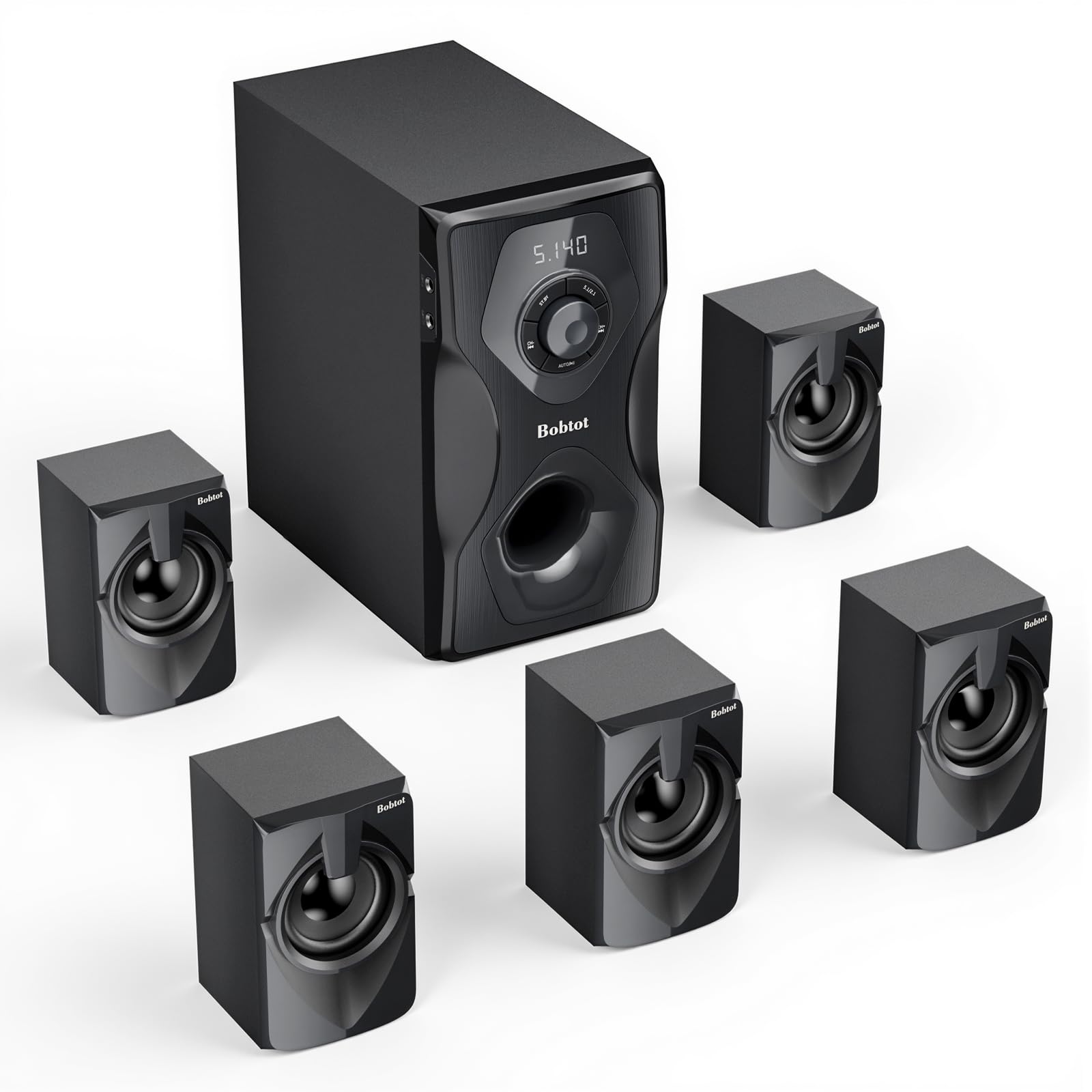
The Bobtot 5.1 system packs a 700-watt peak amplifier, a 5.25-inch subwoofer, and five satellite speakers into a single box that connects via ARC, optical, coaxial, USB, or Bluetooth. The subwoofer is the central hub, housing the amplifier and all connections, and the satellites wire to the sub with included cables. The system also includes FM radio and a microphone input for karaoke, making it unusually versatile for a PC peripheral.
Sound quality is loud and clear at moderate volumes, with the 5.25-inch sub providing enough warmth for movie explosions and game soundtracks in a 15×15-foot room. The five sound modes (Jazz, Country, Classic, Pop, Rock) let you tailor the EQ, but the system operates as a stereo downmix when fed from a regular 3.5mm source—you need an optical or ARC source carrying Dolby Digital to get true 5.1 separation.
Several reviewers noted that the included RCA cables are short (around 13 feet), which may require extensions for rear speaker placement in larger rooms. A minority reported missing features or a loose screw in the packaging. For users who want a single-box solution that also improves TV sound and adds karaoke, the Bobtot delivers good value, though the 5.1 input implementation has caveats.
Why it’s great
- ARC and optical inputs for easy TV/PC connection
- Microphone input adds karaoke functionality
- Multiple preset EQ modes for different content
Good to know
- Short RCA cables may limit rear placement
- True 5.1 requires Dolby Digital source
- Some units have missing features or loose parts
6. Acoustic Audio AA5210

The Acoustic Audio AA5210 is a budget 5.1 system that includes Bluetooth streaming, an LED light show on the subwoofer, and a peak power rating of 600 watts. The powered 6.25-inch subwoofer handles the low end, while five passive satellites reproduce mids and highs. The front panel includes USB and SD card inputs for standalone playback, making it usable without a PC.
Reviewers report that the sound quality is excellent for the price, with immersive directional audio in games and movies. The LED lights are multicolored and flash to the beat, adding a visual element that gaming setups often crave. However, the remote control is unintuitive—volume adjustments must be made per speaker channel rather than globally, which is a significant usability annoyance.
Durability is a concern: a small number of units have failed with smoke or a loud hum within three months, and the return window is limited. The remote range is only about 10 feet, and connecting to a PC for true 5.1 requires a sound card with six RCA outputs or a digital-to-analog converter with PCM output. For users who prioritize low cost and a flashy appearance, the AA5210 is a functional entry point.
Why it’s great
- LED light show adds visual atmosphere
- Bluetooth and USB/SD playback included
- Very low entry price for a 5.1 system
Good to know
- No global volume control on remote
- Documented failure rate on some units
- True 5.1 requires six RCA outputs from PC
7. Rockville Rock Shaker 8

The Rockville Rock Shaker 8 is a powered 8-inch subwoofer designed to add deep, controlled bass to an existing stereo or surround system. Its Class-D amplifier delivers 200 watts RMS and 400 watts peak, driving a high-excursion driver with a Y30 magnet and a 1.5-inch 4-layer voice coil. The MDF cabinet is compact at 11.8 x 15 x 13.8 inches, and the black finish blends into most setups.
Connectivity includes both RCA line-level and speaker-level inputs and outputs, so it works with receivers that lack a dedicated subwoofer output. Reviewers consistently note that the bass is tight and clean rather than boomy, especially after replacing the stock power cord with a shielded one. The crossover knob is unmarked, which makes dialing in the perfect blend point a bit of trial and error.
This sub is ideal for upgrading a 2.0 or 2.1 PC setup that lacks low-end extension. If you already own a pair of quality monitors or bookshelf speakers, adding the Rock Shaker 8 will deliver noticeably deeper, more tactile bass for games and movies. Just note that it is a standalone subwoofer, not a full 5.1 system, so you will need to supply the speakers and amplifier separately.
Why it’s great
- Class-D amp gives clean, tight bass response
- RCA and speaker-level inputs for broad compatibility
- Compact MDF cabinet fits small spaces
Good to know
- Unmarked crossover knob requires manual tuning
- Stock power cord can cause boomy bass
- Only a subwoofer; no satellites included
8. ULTIMEA Poseidon D50

The ULTIMEA Poseidon D50 is a 5.1-channel soundbar system that includes a main soundbar, a wireless subwoofer, and two wired rear speakers connected via 19.6-foot cables. It uses SurroundX technology to upmix stereo PCM to 5.1, and the 320W peak power rating provides enough headroom for small to medium rooms. The system supports HDMI ARC, optical, Bluetooth, and AUX inputs, making it compatible with PCs, TVs, and consoles alike.
The companion app offers 121 preset EQ matrices across four styles and a 10-band customizable equalizer, giving you granular control over the sound signature. Reviewers praise the clear dialogue reproduction and the surprisingly clean bass from the subwoofer, with no distortion at maximum volume. The rear speakers add genuine spatial separation for movies and games when fed a 5.1 source.
The soundbar’s width is over 30 inches, which may overhang smaller monitors, and the remote is basic. Some users reported that the system does not accept volume commands from universal remotes or Nvidia Shield remotes, requiring the included remote or app for adjustments. For PC users who want a clean, all-in-one 5.1 solution that improves TV and movie sound equally, the Poseidon D50 is a strong contender.
Why it’s great
- HDMI ARC for easy PC/TV connection
- Comprehensive app EQ with 121 presets
- Long 19.6-foot rear speaker cables
Good to know
- Soundbar width may overhang small monitors
- No universal remote CEC compatibility
- Surround upmix adds reverb; not true 5.1
9. Turtlebox Gen 3
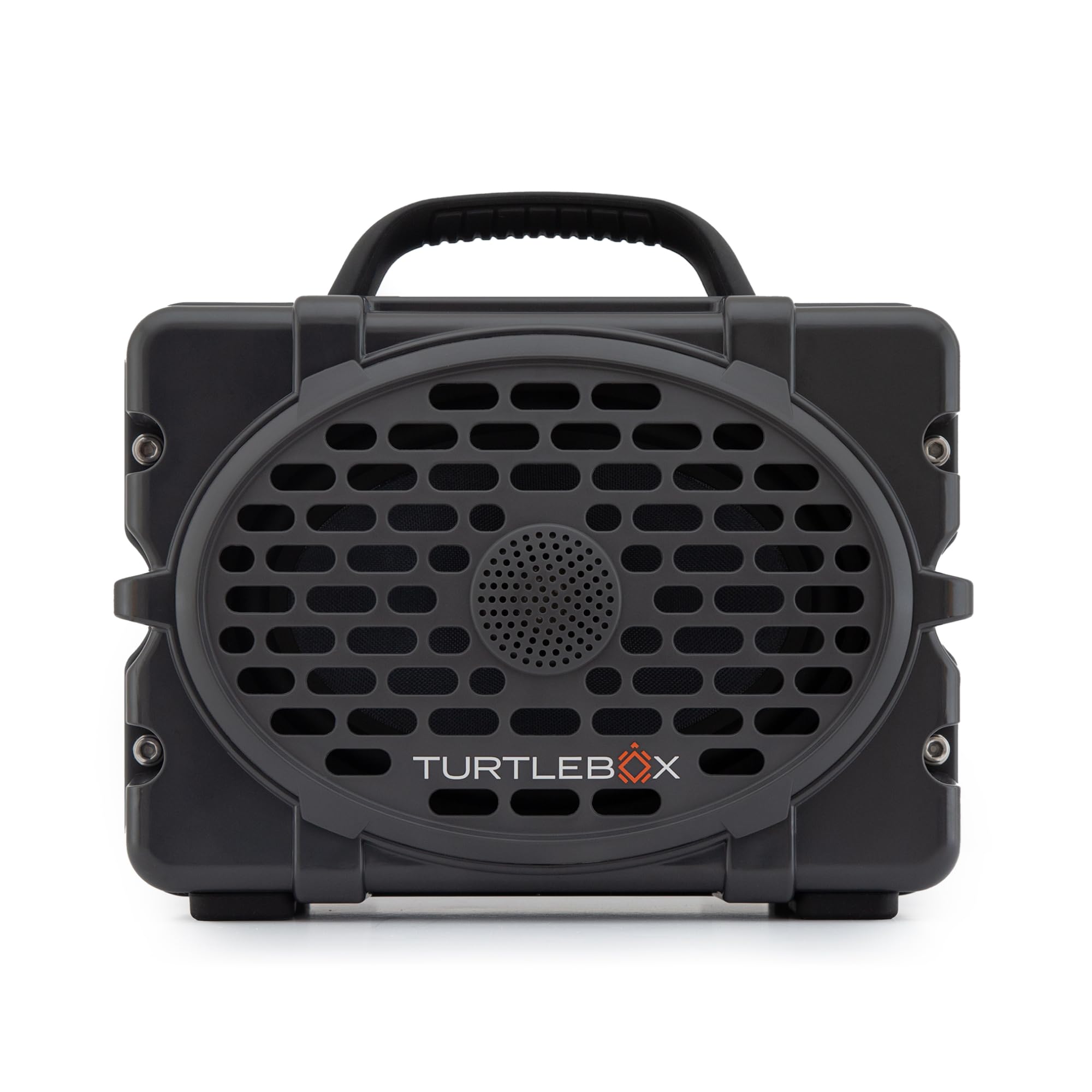
The Turtlebox Gen 3 is a portable Bluetooth speaker that reaches 120 dB SPL and achieves IP67 waterproofing, meaning it survives submersion and dust exposure. Its 6×9-inch woofer and 1-inch titanium tweeter produce loud, clear sound that cuts through outdoor ambient noise, and the 85Wh lithium-ion battery delivers up to 72 hours of playback. Party Mode allows pairing an unlimited number of Turtlebox units for stereo or surround coverage.
While not a PC 5.1 speaker in the traditional sense—it is a single mono/stereo unit—it earns a place here for users who want a rugged, portable audio solution that doubles as a desktop party speaker or outdoor gaming companion. The sound is detailed even at low volumes, and the build quality is drop-proof and crush-proof. Reviewers consistently praise its ability to fill a campsite or boat deck with distortion-free audio.
It lacks multichannel inputs, a subwoofer output, or any 5.1 capability, so it does not replace a dedicated surround system. At this price, it competes with premium studio monitors and mid-range 5.1 bundles. For the niche of outdoor enthusiasts who need one speaker that works both at a desk and on a boat, the Turtlebox delivers unmatched durability and loudness.
Why it’s great
- 120 dB peak output for outdoor use
- Fully IP67 waterproof and dustproof
- 72-hour battery life on a single charge
Good to know
- No multichannel or 5.1 support
- Very expensive for a single portable speaker
- Heavy at roughly 10 pounds
FAQ
Do I need a separate sound card for 5.1 PC speakers?
Can I use a soundbar as 5.1 PC speakers?
Final Thoughts: The Verdict
For most users, the best 5.1 pc speakers winner is the SteelSeries Arena 9 because it provides genuine USB 5.1 with wireless rear satellites and a clean control pod that fits a modern gaming desk. If you want tower-grade fidelity for a custom home theater build, grab the Polk Monitor XT70 as a starting point. And for budget-conscious builders who need true channel separation, nothing beats the raw value of the Monoprice 5.1 satellite system.