
Our readers keep the lights on and the weekend projects moving. As an Amazon Associate, I earn from qualifying purchases.
Standard PLA turns brittle and warps under direct sunlight within weeks. PETG softens on a hot dashboard, and ABS fades into a chalky mess after a single rainy season. For any functional part that lives outside—a garden hose adapter, a bicycle mount, a marine cleat, a drone frame—the material choice is the difference between a permanent fix and a weekly reprint. That’s why ASA has become the go-to for outdoor prints, with carbon-fiber nylon taking the crown for brutally demanding loads.
I’m Rikta — the co-founder and writer behind FitlyFast. My research process for this guide involved deep-diving into manufacturer datasheets and analyzing hundreds of user-verified stress tests to map real-world UV endurance and layer adhesion across seven distinct outdoor-grade filaments.
From UV-stabilized ASA to warp-resistant carbon-fiber nylon, I’ve isolated the spools that actually survive the elements so you can stop reprinting and start trusting your parts. This is your complete breakdown of the 3d filament for outdoor use.
How To Choose The Best 3D Filament For Outdoor Use
Outdoor filament selection isn’t about printability alone—it’s about survival. A part that looks good on the build plate can shatter after two weeks of UV exposure if the polymer lacks the right stabilizers. Start by prioritizing UV stability and impact resistance over ease-of-printing; you can always adjust your enclosure and drying routine.
UV Stabilization and Weather Resistance
ASA filaments are formulated with acrylic-styrene-acrylate chemistry that inherently resists UV degradation, unlike ABS which requires heavy additive loads. Check for explicit aging-test data in the manufacturer specs—UV-resistant ratings should indicate retention of mechanical strength after hundreds of hours of simulated sunlight. Carbon-fiber nylon filaments (like PA6-CF) offer high UV resistance due to the carbon-fiber matrix shielding the polymer, though the nylon base is more hygroscopic and must be kept bone-dry to prevent hydrolysis during printing.
Heat Deflection and Mechanical Integrity
Outdoor parts often face direct sun exposure on dark surfaces, meaning surface temperatures can exceed 80°C. A filament’s Heat Deflection Temperature (HDT) tells you when it begins to soften under load. Standard ASA typically handles up to 95°C, while carbon-fiber nylon can exceed 200°C. For parts under constant mechanical stress—brackets, clips, hinges—layer adhesion strength becomes more critical than raw HDT; pay attention to user reports of interlayer fusion rather than just the datasheet numbers.
Print Environment and Drying Requirements
ASA is sensitive to drafts and requires a stable chamber temperature (ideally 45-60°C) to prevent warping. Carbon-fiber nylon demands even stricter conditions: an enclosed printer with an active dryer feeding the filament directly. Never assume a spool is dry out of the bag—nylon can absorb enough moisture in 30 minutes to cause popping and voids. Plan on drying ASA for at least 4 hours at 80°C and nylon for 8-12 hours at 70-80°C before every print session.
Quick Comparison
On smaller screens, swipe sideways to see the full table.
| Model | Category | Best For | Key Spec | Amazon |
|---|---|---|---|---|
| Polymaker Fiberon PA6-CF20 | Carbon Fiber Nylon | High-load outdoor structures | HDT 215°C, 20% carbon fiber | Amazon |
| ERYONE Carbon Fiber ASA | CF-ASA Blend | Rigid weatherproof parts | 10% carbon fiber reinforced | Amazon |
| Creality HP ASA | High-Speed ASA | Fast outdoor prototyping | Up to 350mm/s, ±0.03mm | Amazon |
| SUNLU ASA Strong | ASA | General outdoor functional parts | ±0.02mm, multi-hole spool | Amazon |
| FLASHFORGE ASA | ASA | Consistent outdoor production | Heat stable to 93°C | Amazon |
| iSANGHU ASA | Budget ASA | Entry-level outdoor prints | Heat resistance to 100°C | Amazon |
| ANYCUBIC ASA | Mid-Range ASA | Outdoor decorative/functional | HDT 90°C, ±0.02mm | Amazon |
In‑Depth Reviews
1. Polymaker Fiberon PA6-CF20 Carbon Fiber Nylon 1.75mm 0.5kg

The Polymaker Fiberon PA6-CF20 sits at the top of the outdoor-filament hierarchy for good reason. With 20% chopped carbon fibers infused into a nylon 6 matrix, it delivers a Heat Deflection Temperature of 215°C—more than double what any ASA can achieve. The board stiffness means parts resist flexing under load, making it the go-to for structural drone frames, bicycle pedals, and jigs that live outside year-round.
Printing this filament demands an enclosed printer with a hardened steel nozzle—the carbon fibers are abrasive and will eat a brass nozzle in one spool. It comes vacuum-sealed with desiccant, but users stress the importance of drying it for 8-12 hours at 70-80°C before use; even factory-fresh spools can cause popping if the nylon has absorbed ambient moisture during shipping. Layer adhesion is exceptional, with reviewers noting that thin-walled parts felt nearly unbreakable under torsion.
The only real trade-off is the spool size: 0.5kg instead of the standard 1kg, which makes sense given the premium price point. The recycled cardboard spool with a reinforced edge prevents dust contamination, and the resealable bag helps keep the remaining filament dry between sessions. For applications where ASA simply isn’t strong enough, this is the material that bridges the gap to engineering-grade durability.
Why it’s great
- Extreme HDT of 215°C for hot outdoor environments
- Exceptional layer adhesion and torsional stiffness
- Consistent dimensional accuracy straight out of the bag
Good to know
- 0.5kg spool requires more frequent replacement
- Requires hardened nozzle and active drying
- Surface is rough with visible carbon fiber texture
2. ERYONE Carbon Fiber ASA Filament 1.75mm 1kg
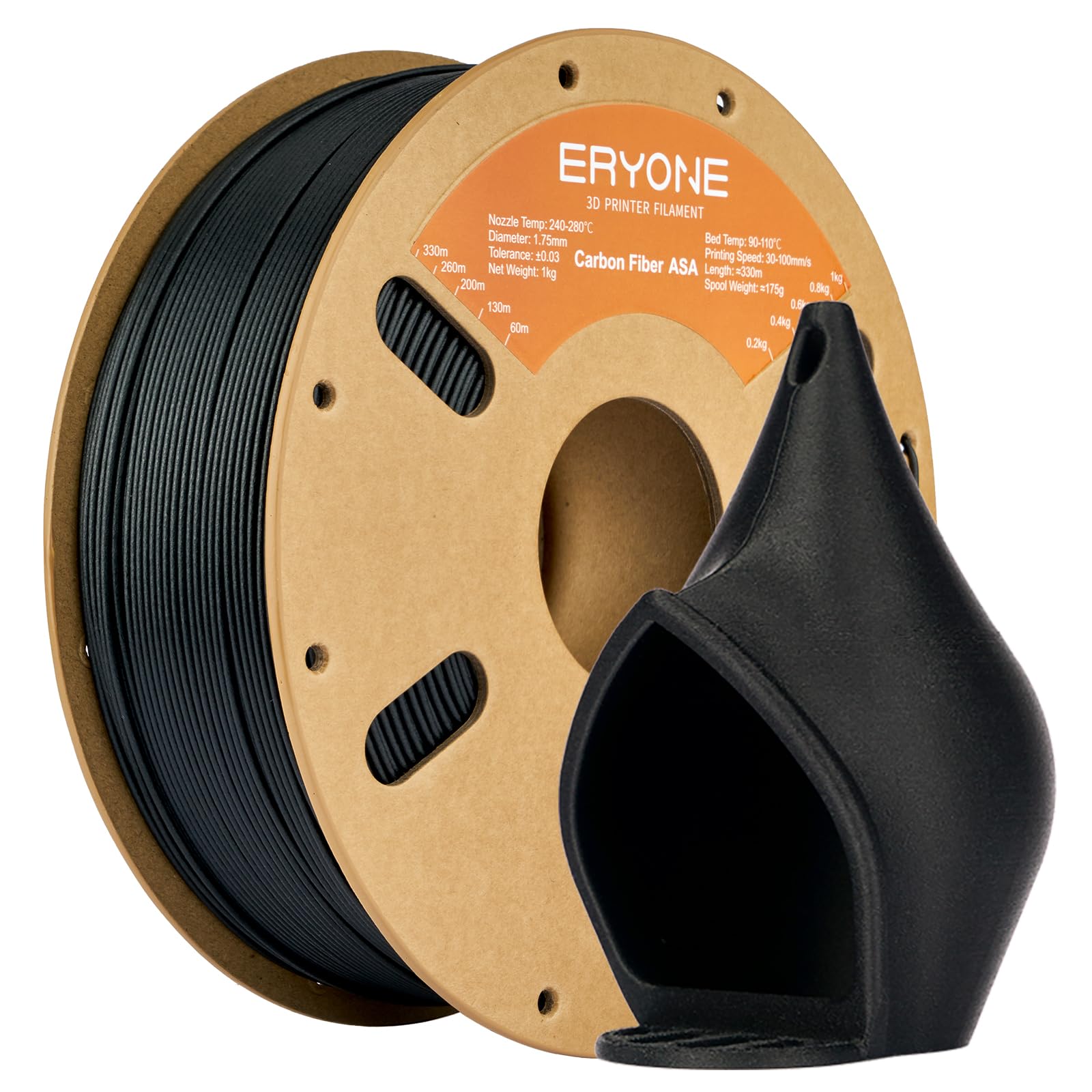
ERYONE bridges the gap between standard ASA and full carbon-fiber nylon by mixing 10% short carbon fibers into an ASA base. The result is a material that prints with similar temperature requirements to standard ASA—nozzle around 250-270°C, bed at 90°C—but delivers noticeably higher stiffness and a matte, premium surface finish that hides layer lines well. Parts come out feeling dense and rigid, with almost no flex under moderate load.
The UV and weather resistance inherit the ASA polymer’s natural stability, while the carbon-fiber reinforcement reduces the coefficient of thermal expansion, meaning less warping during cooling. Users report that the spool is vacuum-sealed with desiccant and arrives neatly wound with no tangles. A hardened steel nozzle is non-negotiable here—the fibers will destroy brass in a single print—and an enclosure is strongly recommended to maintain chamber temperature and prevent drafts.
Color options include deep black and vivid orange, with reviewers praising the visual quality for outdoor signage and marine accessories. The only downside is that the carbon fibers can make the filament slightly more brittle in thin cross-sections compared to pure ASA, so avoid sharp corners in your design. For functional outdoor parts that need extra rigidity without jumping to nylon, this blend hits a sweet spot.
Why it’s great
- Increased stiffness over standard ASA
- Good UV and weather resistance built-in
- Reduced warping during cooling
Good to know
- Requires hardened steel nozzle
- Thin sections can be more brittle than pure ASA
- Needs an enclosure for best results
3. Creality HP ASA Filament 1.75mm 1kg
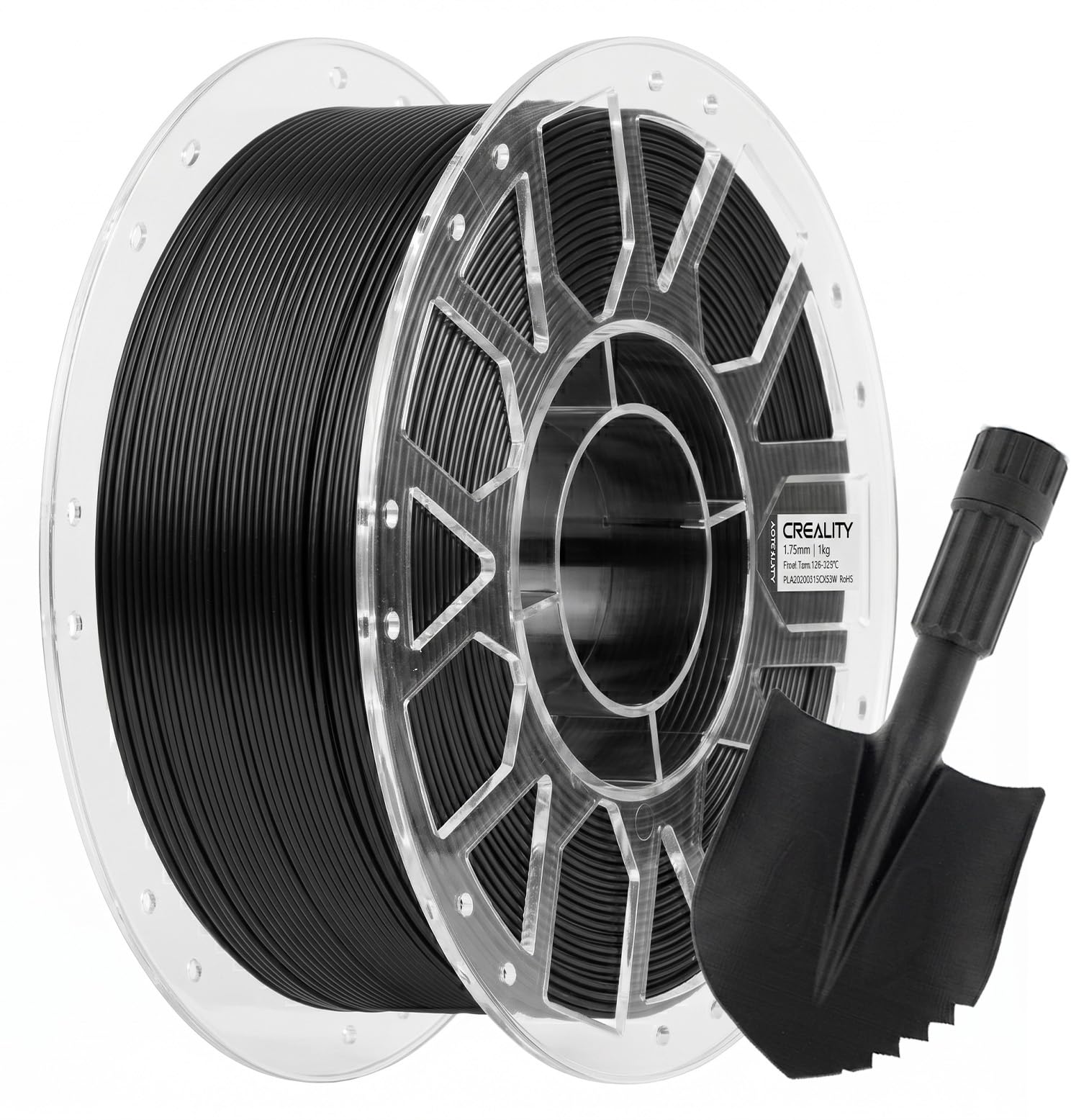
Creality’s HP ASA is optimized for high-speed printers up to 350mm/s, making it the fastest option in this roundup without sacrificing outdoor durability. The formulation maintains the UV resistance and thermal stability expected from ASA—holding dimensional integrity up to 100°C—while the modified polymer blend reduces stringing and oozing at high flow rates. Users on Creality K1 and K1 Max printers report flawless first layers without the usual ASA fussiness.
The ±0.03mm dimensional tolerance is slightly looser than the ±0.02mm standard, but in practice the consistency along the spool is excellent. The filament comes vacuum-sealed and dried, though one user noted that drying for an hour at low temperature improved surface quality on the first print. Bed adhesion benefits from a 90-110°C bed temperature and a thin layer of glue stick or Magigoo.
Black is the recommended color for maximum UV absorption consistency, and the toughness is sufficient for outdoor functional parts like motorcycle accessories and mechanical components. The trade-off for high-speed compatibility is that the material may have slightly lower impact resistance compared to a standard ASA formulation—but for prototyping and non-load-bearing outdoor parts, the time savings are substantial.
Why it’s great
- Prints reliably at 350mm/s
- Thermally stable to 100°C
- Minimum stringing for ASA
Good to know
- Slightly lower impact resistance
- ±0.03mm tolerance vs ±0.02mm
- Best paired with Creality high-speed printers
4. SUNLU ASA Strong Filament 1.75mm 1kg

SUNLU’s ASA Strong has become a staple for makers who need reliable outdoor results without the premium price tag. The ±0.02mm dimensional accuracy rivals more expensive brands, and the third-generation spool features a multi-hole design that allows for effective drying when fed directly from a filament dryer. Users consistently report strong layer adhesion and minimal odor compared to ABS—though ventilation is still recommended for any styrenic polymer.
The recommended nozzle temperature of 230-260°C and bed temperature of 80-120°C provide a wide sweet spot, making it forgiving for printers without active chamber heating. Reviews highlight excellent bed adhesion when using a 100-120°C bed and an enclosure (even a cardboard box works on an Ender 3). The spool is vacuum-sealed with desiccant, and the 1kg weight is accurate, with no netting or shortcuts in quantity.
The main drawback is that some colors have a slight gray hue under bright light compared to the richer black of Creality or FLASHFORGE. For purely functional outdoor parts—garden connectors, vent covers, cable clips—the color difference is irrelevant. SUNLU’s customer service also receives positive marks for addressing extrusion issues promptly.
Why it’s great
- Excellent ±0.02mm dimensional accuracy
- Wide printing temperature window
- Reliable layer adhesion with enclosure
Good to know
- Some colors appear lighter than expected
- Requires enclosure for warp-free prints
- Stronger odor than PLA
5. FLASHFORGE ASA Filament 1.75mm 1kg

FLASHFORGE’s ASA is a straightforward, no-nonsense outdoor filament that performs exactly as expected. The manufacturer claims heat stability up to 93°C, and user tests have confirmed that parts left in direct sun maintain their shape without sagging. The black color is deep and consistent across the spool, with no visible color shift that some budget filaments show after a few layer transitions.
The filament is dried for 24 hours before packaging and vacuum-sealed, and multiple reviewers noted that they skipped pre-drying and still got bubble-free prints. The ±0.02mm tolerance holds reliably, and the spool is wound cleanly with no tangles. For printers with enclosures, users report excellent results at 60mm/s with a 0.4mm hardened nozzle, though the material can handle up to 80mm/s with well-tuned settings.
One user reported a 100% failure rate due to adhesion issues, which appears to be an outlier—most reviews highlight strong bed adhesion when using glue stick and a 100°C bed. The chemical resistance to oils and solvents makes it suitable for automotive applications like RC plane parts or under-hood clips. For a consistent, middle-of-the-road ASA with no surprises, this is a solid choice.
Why it’s great
- Consistent ±0.02mm diameter
- Good chemical resistance to oils
- Deep black color throughout the spool
Good to know
- Adhesion can be tricky without glue
- Fumes are stronger than PLA or PETG
- Some users experience warping without enclosure
6. iSANGHU ASA Filament 1.75mm 1kg

iSANGHU positions itself as a value-oriented ASA with a bold claim: ten times the UV resistance of standard ABS. While that’s hard to verify without a lab, users on high-end printers like the Bambu X1C and Creality K2 Plus report that the material prints reliably at 260-280°C with a 100°C bed and zero fan speed. The matte finish is visually appealing—especially in gradient colors like purple or marble white—and the parts feel solid for light-duty outdoor use.
The dimensional accuracy is a concern. Some users measured sections at 1.75-1.9mm, which can cause ugly top layers on high-resolution prints. Others noted no such issues, suggesting batch inconsistency. The spool itself is flimsy compared to the molded spools from Creality or SUNLU, and the cardboard core can deform if stored in a humid environment. For garden equipment, plant pots, and decorative outdoor items, the price-to-performance ratio is good, but avoid it for anything that requires precise fit or load bearing.
Drying is essential—most successful prints came after 8 hours at 80°C, which removed stringing and improved layer adhesion. The low cost per spool makes it tempting for large outdoor projects where color and appearance matter more than engineering-grade strength.
Why it’s great
- Affordable entry point for ASA
- Attractive matte finish with gradient options
- Prints well on enclosed printers
Good to know
- Inconsistent diameter across batches
- Flimsy spool that can deform
- Not strong enough for functional load-bearing parts
7. ANYCUBIC ASA Filament 1.75mm 1kg

ANYCUBIC’s ASA filament delivers a Heat Deflection Temperature of 90°C, which is competitive for outdoor functional parts like plant pots, garden tools, and car accessories. The gray color option is a popular choice for tool handles and brackets, as it hides scuffs and dirt better than black. Users on the Anycubic Kobra S1 and Bambu X1C report consistent extrusion and smooth layer lines with minimal stringing after proper tuning.
The print profile recommended by the community is hotter than the default: a nozzle temperature of 270-280°C and bed temperature of 100-110°C, with a 7mm brim for large parts. Without these adjustments, some users experience poor bed adhesion or warping on corners. Drying for 3 hours at 80°C is strongly advised, especially if the spool has been stored in a non-air-conditioned environment.
The ±0.02mm diameter tolerance is accurate for the majority of the spool, and the material flows smoothly without clogging. The only real weakness is that it’s slightly more prone to stringing than SUNLU or Creality ASA, which can be mitigated by increasing retraction distance by 1-2mm. For a reliable mid-range ASA that balances cost and performance, ANYCUBIC is a dependable choice for outdoor decorative and light-functional prints.
Why it’s great
- Competitive HDT of 90°C for outdoor use
- Consistent ±0.02mm diameter
- Smooth layer finish with minimal defects
Good to know
- Requires higher nozzle temp than standard ASA
- Stringing can occur without retraction tuning
- Needs active drying before first print
FAQ
Can I print ASA outdoors in direct sunlight?
How long can a PA6-CF20 nylon part survive outside?
Do I need a hardened nozzle for carbon-fiber ASA?
Can I mix different ASA brands in the same print run?
Do outdoor filaments require post-processing to survive rain and snow?
Final Thoughts: The Verdict
For most users, the 3d filament for outdoor use winner is the Polymaker Fiberon PA6-CF20 because its 215°C HDT and carbon-fiber reinforcement make it the only filament here that can handle repetitive mechanical stress while living outside. If you want a high-speed ASA that prints at 350mm/s and holds up to UV exposure, grab the Creality HP ASA. And for budget-conscious users who need a reliable outdoor ASA for garden parts and decor, nothing beats the SUNLU ASA Strong.