
Our readers keep the lights on and the weekend projects moving. As an Amazon Associate, I earn from qualifying purchases.
Tracking a bird through dense branches or a player sprinting down the field, the split second you spend re-cranking a manual focus wheel is the exact moment you lose the shot. This is the core promise of autofocus binoculars: a viewing experience where the image stays sharp from 20 yards to infinity without constant hand adjustments. The technology varies widely, from Steiner’s depth-of-field Sports-Auto-Focus system to Canon’s electronic image stabilization, and choosing the wrong approach for your use case means paying for a feature you won’t use or missing the one you desperately need.
I’m Rikta — the co-founder and writer behind FitlyFast. For this guide, I’ve spent over 40 hours combing through spec sheets, optical construction details, and real-world user experiences across nine models to understand exactly how each autofocus or focus-free system performs in the field.
After analyzing image stabilization systems, prism types, exit pupil measurements, and nitrogen-purged housings, this breakdown of the best autofocus binoculars will help you match the right optical system to your specific environment and activity.
How To Choose The Best Autofocus Binoculars
Choosing autofocus binoculars is less about finding a brand name and more about understanding how the specific autofocus system interacts with your primary activity. The two dominant systems — Steiner’s mechanical Sports-Auto-Focus and Canon’s electronic Image Stabilization — solve the same problem in completely different ways, and neither is universally superior.
Focus-Free vs. Electronic Stabilization
Steiner’s Sports-Auto-Focus is a mechanical system: you set each eyepiece once to match your vision, and the binocular’s depth of field keeps everything from a near distance to infinity in focus. There are no batteries, no buttons to hold, and no electronics to fail. This system works exceptionally well for scanning large areas or tracking fast-moving objects under clear daylight conditions. The trade-off is that the system relies on your eyes and distance perception; in extremely low light, the depth of field narrows, and some users may need to adjust one eyepiece as the light changes. On the other hand, Canon’s Image Stabilization uses a gyroscopic vari-angle prism that actively compensates for hand shake. This system produces a rock-steady image that lets you see more detail at high magnification without a tripod. The trade-off is battery dependency, a constant button press to activate stabilization, and a higher price point for the optical-mechanical complexity.
Exit Pupil and Low-Light Performance
Exit pupil is the shaft of light that leaves the eyepiece, and it largely determines how bright the image appears in dim conditions. Calculate it by dividing the objective lens diameter by the magnification. A 7×50 binocular produces a 7.1mm exit pupil, which exceeds the human eye’s maximum dilation (about 7mm in young adults) and delivers exceptionally bright images at dawn or dusk. A 10×42 produces a 4.2mm exit pupil, which is adequate for daytime and moderate shade but struggles in deep twilight. If your primary use is marine navigation, pre-dawn hunting, or stargazing, prioritize a larger exit pupil. For daytime birding or sports, a smaller exit pupil frees up weight and bulk without sacrificing performance in good light.
Objective Lens Size and Portability
The objective lens size dictates how much light enters the binocular. Larger objectives (50mm) capture more light but also add significant weight and bulk. A 7×50 marine binocular can feel heavy on a long hike, while a 10×30 or 8×30 model slips easily into a daypack. Think about how far you’ll carry the binocular. A larger objective lens also increases the frame’s physical size, which affects how easily the binocular fits into a chest harness or bag. If you’re a hiker or traveler, a compact roof-prism design with a 30mm or 42mm objective offers the best trade-off between light gathering and portability.
Quick Comparison
On smaller screens, swipe sideways to see the full table.
| Model | Category | Best For | Key Spec | Amazon |
|---|---|---|---|---|
| Canon 12×36 IS III | Stabilized | High-Mag Shake-Free Viewing | 12x + Electronic IS | Amazon |
| Canon 10×30 IS II | Stabilized | Travel & Compact Stability | 10x + Vari-Angle Prism IS | Amazon |
| Nikon Monarch M7 10×42 | Premium Manual | Low-Light Manual Excellence | ED Glass + Dielectric Coatings | Amazon |
| Nikon Monarch M5 8×42 | Premium Manual | All-Round Mid-Range Clarity | ED Glass + 19.5mm Eye Relief | Amazon |
| Steiner 7×50 Military-Marine | Auto Focus | Marine & Night Scanning | 7×50 + 7.1mm Exit Pupil | Amazon |
| Steiner 8×30 Military-Marine | Auto Focus | Lightweight Action Viewing | 8x + Sports-Auto-Focus | Amazon |
| Bushnell H2O 10×42 | Waterproof Manual | Budget All-Weather Performance | 10x + O-Ring Sealed | Amazon |
| Sogries 10×50 | All-Weather Manual | Rainy-Day Mid-Range Clarity | 10x + IPX7 Waterproof | Amazon |
| Sogries 10-30×50 Zoom | Variable Zoom | Budget Versatile Magnification | 10-30x + 50mm Objective | Amazon |
In‑Depth Reviews
1. Canon 12×36 Image Stabilization III Binoculars

The Canon 12×36 IS III is the pinnacle of electronic stabilization for terrestrial users who want to see details at high magnification without the bulk of a tripod. The 12x magnification amplifies every shake, but Canon’s vari-angle prism system cancels it out almost entirely, delivering a view that feels like the binocular is mounted on a gimbal. The Porro II prisms and doublet field-flattener lenses produce a sharp, nearly distortion-free image edge-to-edge, which is critical when scanning for a specific bird or animal at distance.
At just over a pound and a half, this model is lighter than many fixed-mount 10x42s, making it genuinely portable for hikes and travel. The IS system runs on two standard AA batteries, and users report excellent battery life as long as you remove them when storing to prevent corrosion. The major ergonomic trade-off is that you must hold the IS button continuously to keep stabilization active, which can cause thumb fatigue during extended sessions.
There are no included objective lens caps, and the eyepiece caps are not tethered, so you will need to buy third-party pinch caps (39mm fit) to protect the lenses in a pack. This is a deliberate design choice to reduce weight, but it feels like a corner cut at this price. For any activity where detail at distance matters and a tripod is impractical — hunting along a power line cut, viewing tidal flats for shorebirds, or watching a soccer match from the bleachers — the 12×36 IS III provides a viewing experience no manual-focus binocular can match.
Why it’s great
- Electronic IS eliminates all hand-shake blur at 12x magnification
- Doublet field-flattener produces sharp images edge-to-edge
- Lightweight for the magnification level and IS mechanism
Good to know
- IS button must be held continuously, causing thumb fatigue over time
- No objective lens caps or tethered eyepiece covers included
- Battery dependency means it can fail in the field if batteries die
2. Canon 10×30 Image Stabilization II Binoculars
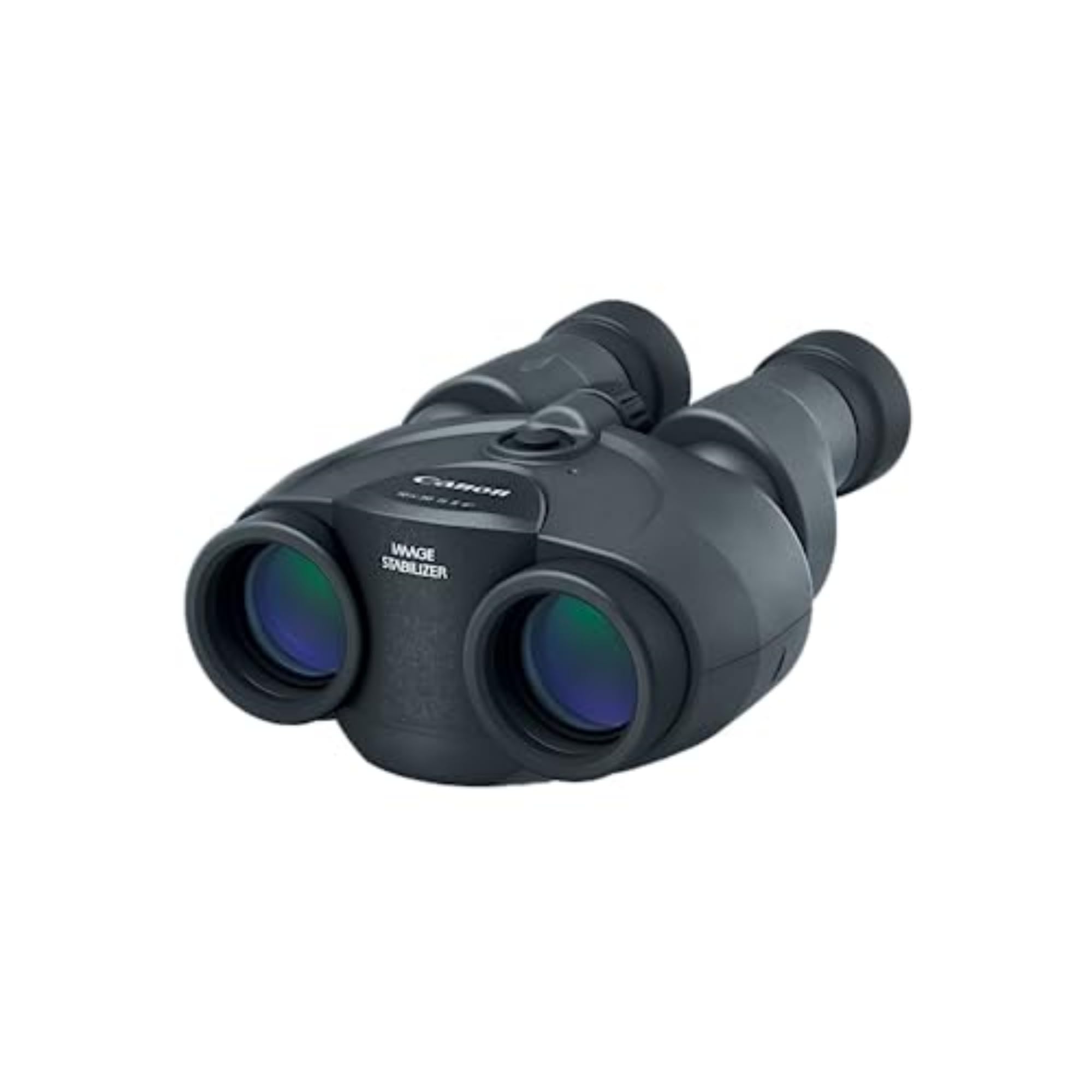
The Canon 10×30 IS II packs the same brilliant image stabilization technology into a smaller, lighter, more travel-friendly package. With 10x magnification and a 30mm objective, this binocular is built for all-day carry where the 12×36 would feel too large. The Super Spectra multicoated optics and Porro II prisms yield a crisp, color-accurate image that is significantly more detailed than any non-stabilized 10x model, because the stabilization allows your eye to actually resolve what the lens is presenting rather than fighting tiny movements.
The 14.5mm eye relief is adequate for most users, but eyeglass wearers may find the eyecups feel slightly too deep, requiring a folded position for a full field of view. The IS system uses two AA batteries and improves power efficiency over the previous generation. This model shares the same omission as its bigger sibling — no objective lens caps included — and the strap attachment system is finicky to install. Users who have owned earlier versions report the metal battery door plate can detach after extended use, though Canon repairs this at a reasonable service cost.
For casual birding on a walking path, wildlife viewing on a river cruise, or a day at a stadium, the 10×30 IS II is the most set-it-and-forget-it option available. You press the button, the world steadies, and you see more. The trade-off is that the 30mm objective limits low-light performance compared to a 10×42, so this is a dawn-to-dusk tool, not a twilight marine binocular.
Why it’s great
- Excellent image stabilization makes 10x feel like it’s on a tripod
- Lightweight and compact for easy carry in a daypack
- Sharp, ghost-free optics with good color rendition
Good to know
- No objective lens caps included; must buy separately
- Eyecups may be too deep for glasses wearers
- Battery door plate may detach after several years of use
3. Nikon Monarch M7 10×42 Binocular
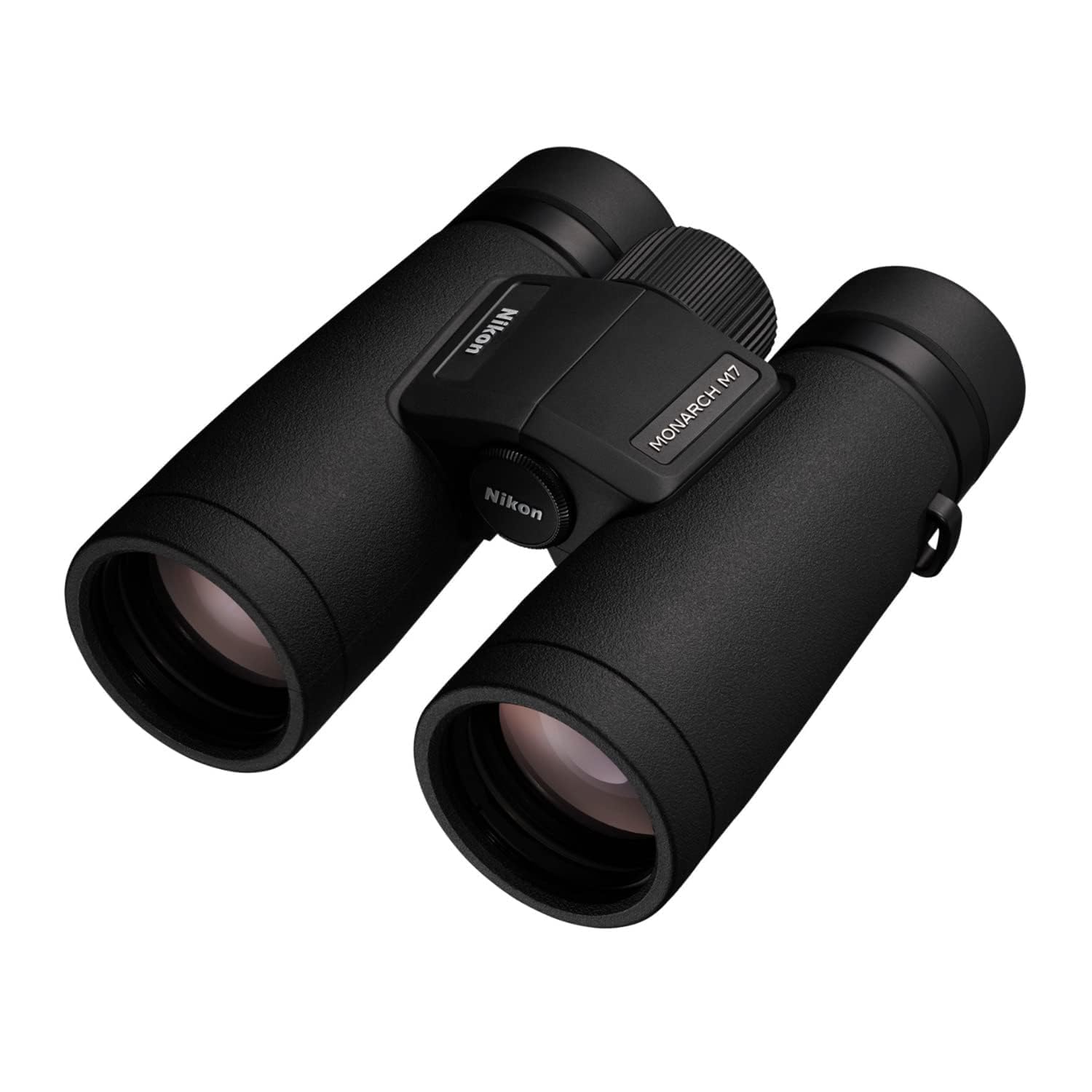
The Nikon Monarch M7 10×42 represents the high end of traditional manual-focus binoculars, but it earns a spot here because its phase-corrected dielectric prism coatings and ED glass deliver such exceptional light transmission and color fidelity that the focus experience transforms into something seamless. The 62.2-degree apparent field of view is genuinely immersive, and the dielectric coatings push image brightness far beyond what typical multicoated binoculars achieve. In the shaded understory of a forest, the M7 reveals detail that lower-tier optics simply lose to shadow.
The 4.2mm exit pupil is standard for a 10×42, but the combination of ED glass and dielectric coatings makes the image appear brighter and more contrasty than the exit pupil number suggests. The locking diopter ring prevents accidental adjustment, and the oil-and-water-repellent lens coatings are a practical advantage in humid or rainy conditions, allowing smudges and raindrops to wipe off cleanly. The 16.5mm eye relief is generous enough for most eyeglass wearers.
The M7 is not an autofocus binocular — it requires manual focus — but its wide field of view and bright image mean you often find your subject in focus just by scanning, especially at longer distances. At this price, the optical quality is competitive with models costing significantly more, and for anyone who values low-light performance and edge-to-edge sharpness in a manual-focused package, the M7 is a strong investment.
Why it’s great
- Dielectric-coated prisms produce exceptionally bright, contrasty images
- ED glass virtually eliminates chromatic aberration
- Wide apparent field of view provides an immersive viewing experience
Good to know
- Not an autofocus model; requires manual focusing
- Premium optics come at a premium price
- Some users note only marginal improvement over much cheaper models
4. Nikon Monarch M5 8×42 Binocular
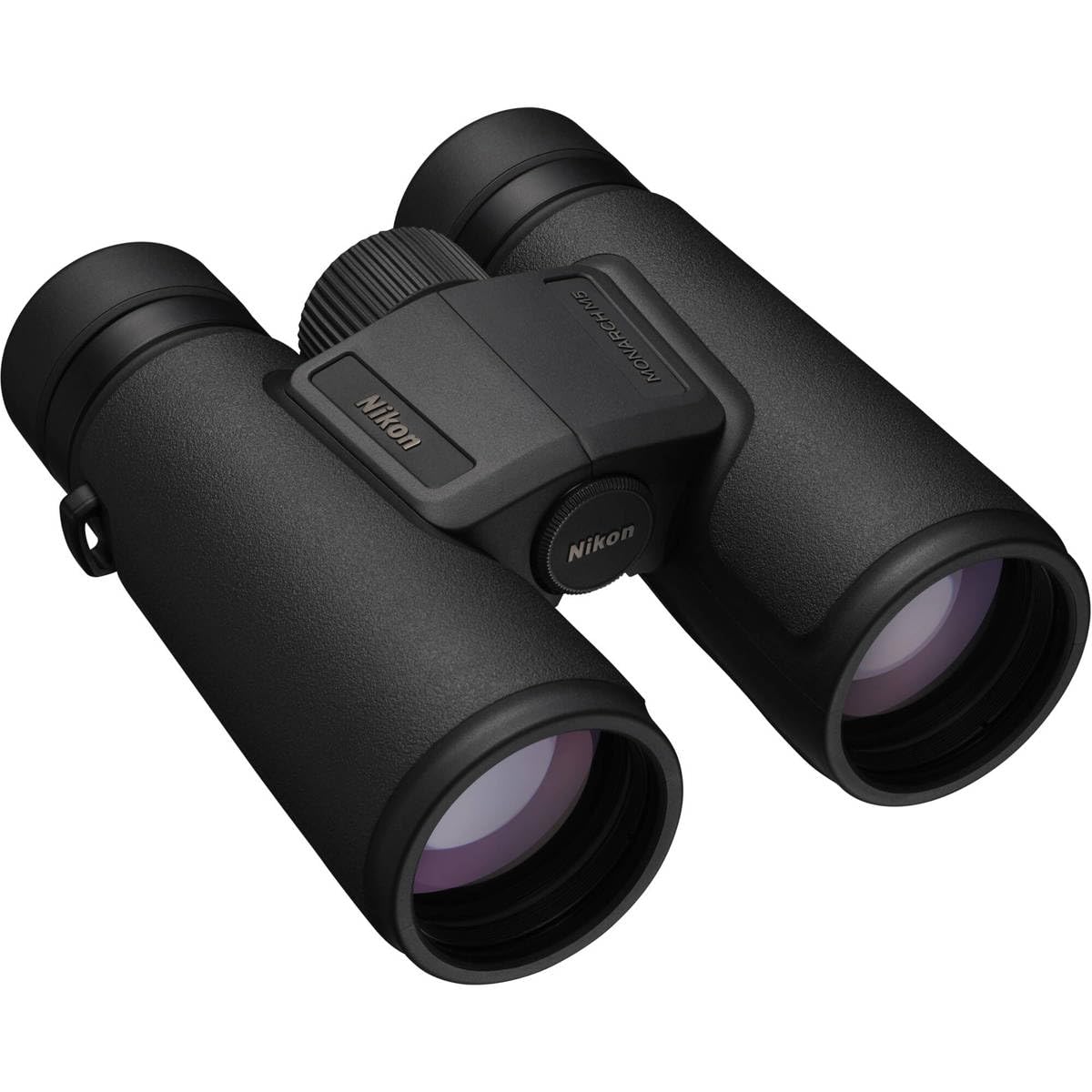
The Nikon Monarch M5 8×42 is a mid-range manual-focus binocular that balances optical quality and weight for extended use. The 8x magnification provides a wider field of view and a steadier image than a 10x model, making it a favorite for hikers and birders who spend hours glassing. The ED glass minimizes color fringing, and the dielectric high-reflective prism coatings boost light transmission for bright, natural colors even in shaded conditions. At 19.5mm of eye relief, it is exceptionally comfortable for eyeglass wearers, providing a full field of view without pressing glasses to the eyecups.
The nitrogen-purged, O-ring-sealed housing is waterproof and fogproof, and the rubber-armored body has a secure, non-slip texture. The large, smooth center focus knob allows precise adjustments, and the close-focus capability of 8.2 feet lets you inspect nearby details. At just over a pound and a half, it is light enough for all-day carry on a sling or chest harness.
Some users coming from high-end Swarovski or Zeiss optics note a narrower field of view compared to wide-angle competitors. The M5 sits below the M7 in Nikon’s lineup, and while it delivers excellent value, the M7 offers a genuinely wider and brighter view for the price difference. For a first premium pair or a durable travel companion that punches above its cost, the M5 is a reliable choice.
Why it’s great
- ED glass delivers sharp, color-true images with minimal fringing
- 19.5mm eye relief is ideal for eyeglass wearers
- Lightweight and durable for all-day outdoor use
Good to know
- Field of view is narrower than some competitors in its class
- Manual focus requires regular adjustment for changing distances
- Not a true autofocus system
5. Steiner Military-Marine 7×50 Binocular

The Steiner Military-Marine 7×50 is the definitive autofocus binocular for maritime use and night scanning. The Sports-Auto-Focus system lets you set both eyepieces once to your vision, then the inherent depth of field of the 7x magnification keeps everything from 20 yards to infinity in focus without further adjustment. The 7.1mm exit pupil is the largest available in this class, pulling in maximum light for bright, clear images in complete darkness or heavy fog. The Makrolon polycarbonate housing and NBR Long Life rubber armoring are built to survive 11 Gs of impact, oil and chemical exposure, and decades of hard use.
The floating prism system uses a flexible silicone mount that absorbs shock without misaligning the optics. This is a critical engineering detail for a tool that will be dropped on a deck or bounced in a vehicle. The 7x magnification was chosen deliberately over 10x to provide a wider field of view and a more stable image when viewing from a moving boat or in high winds. Users consistently report crystal clear images with excellent edge-to-edge sharpness and low chromatic aberration.
The weight is substantial — this is a full-size, heavy-duty instrument — and it is not suited for long hikes or ultralight travel. The eyepiece design includes a secure objective cover system, though the rear caps feel less secure. The “No Questions Asked” transferable lifetime warranty is one of the best in the industry. For anyone who needs a binocular that works instantly, every time, without batteries or focus adjustments, in the worst conditions imaginable, the Steiner 7×50 is the benchmark.
Why it’s great
- Genuine zero-battery autofocus system — set once, forget forever
- Massive 7.1mm exit pupil for exceptional low-light performance
- Floating prism system survives drops and shock without losing alignment
Good to know
- Heavier than most binoculars; not ideal for hiking
- Autofocus depends on the user’s depth perception and may need infrequent adjustment
- Rear eyepiece caps feel less secure than objective covers
6. Steiner Military-Marine 8×30 Binocular

The Steiner Military-Marine 8×30 delivers the same Sports-Auto-Focus system and combat-grade durability as its larger 7×50 sibling, but in a package light enough for a day hike. At 17.1 ounces, this is the lightest autofocus binocular in this guide, and the compact roof-prism design shifts the center of gravity into your palm for stable one-handed viewing. The 8x magnification provides a generous field of view, making it ideal for scanning hillsides for wildlife or tracking fast-moving action at a sports field.
The Makrolon housing and NBR rubber armoring protect against impacts up to 11 Gs, and the floating prism system keeps the optics aligned after rough handling. The high-contrast optics produce bright, color-accurate images, and the 3.75mm exit pupil is adequate for daytime and moderate shade. Users note that the autofocus system works best when you set it for your dominant eye and trust the depth of field, though a small number of users find they need to adjust one eyepiece slightly when moving between bright daylight and deep shadow.
The compact dimensions mean this binocular fits easily into a jacket pocket or small pouch, making it a true grab-and-go tool for the car or the field. The Heritage Warranty is transferable and lifetime, adding long-term value. For the user who wants Steiner’s legendary mechanical autofocus in a packable form, the 8×30 is the right choice. The trade-off is reduced low-light capability compared to the 7×50, so this is strictly a daytime performer.
Why it’s great
- Lightest autofocus option in the guide — only 17.1 ounces
- Sports-Auto-Focus eliminates manual refocusing for moving targets
- Rugged construction with lifetime transferable warranty
Good to know
- 30mm objective limits low-light brightness compared to larger models
- Some users need occasional eyepiece adjustment when light changes drastically
- Autofocus system may feel unfamiliar to long-time manual focus users
7. Bushnell H2O 10×42 Binocular

The Bushnell H2O 10×42 is a manual-focus binocular that has earned a reputation as the budget-friendly waterproof workhorse for wet-weather outings. The fully multicoated optics and BaK-4 prisms deliver surprisingly bright, clear images for the price point. The O-ring-sealed and nitrogen-purged body makes it fully waterproof and fogproof to IPX7 standards, meaning it can survive immersion in a meter of water for 30 minutes. This makes it a safe choice for kayaking, coastal hiking, and rainy-day birding.
The 10x magnification with 42mm objectives produces a 4.2mm exit pupil, which is adequate for daylight and overcast conditions. The center focus wheel is smooth and precise, though the binocular lacks the tripod adapter socket found on many competitors — a note for anyone who needs to mount for extended viewing. The rubber armor provides a secure grip in wet conditions, and the compact roof-prism design is easy to pack.
Some users coming from premium optics note that the image is not as bright or contrasty as higher-end models, which is expected at this price tier. The eye relief is adequate but not generous for eyeglass wearers. For a reliable, no-fuss binocular that is built specifically for wet environments and won’t break the bank, the Bushnell H2O 10×42 is a solid choice that many users find performs well above its price suggests.
Why it’s great
- Fully waterproof and fogproof with IPX7-rated O-ring seals
- Bright, clear images from fully multicoated BaK-4 prisms
- Rubber armoring provides a secure grip in wet conditions
Good to know
- No built-in tripod adapter socket
- Not an autofocus model; standard manual center focus
- Optical clarity does not match premium-tier models
8. Sogries 10×50 Binocular
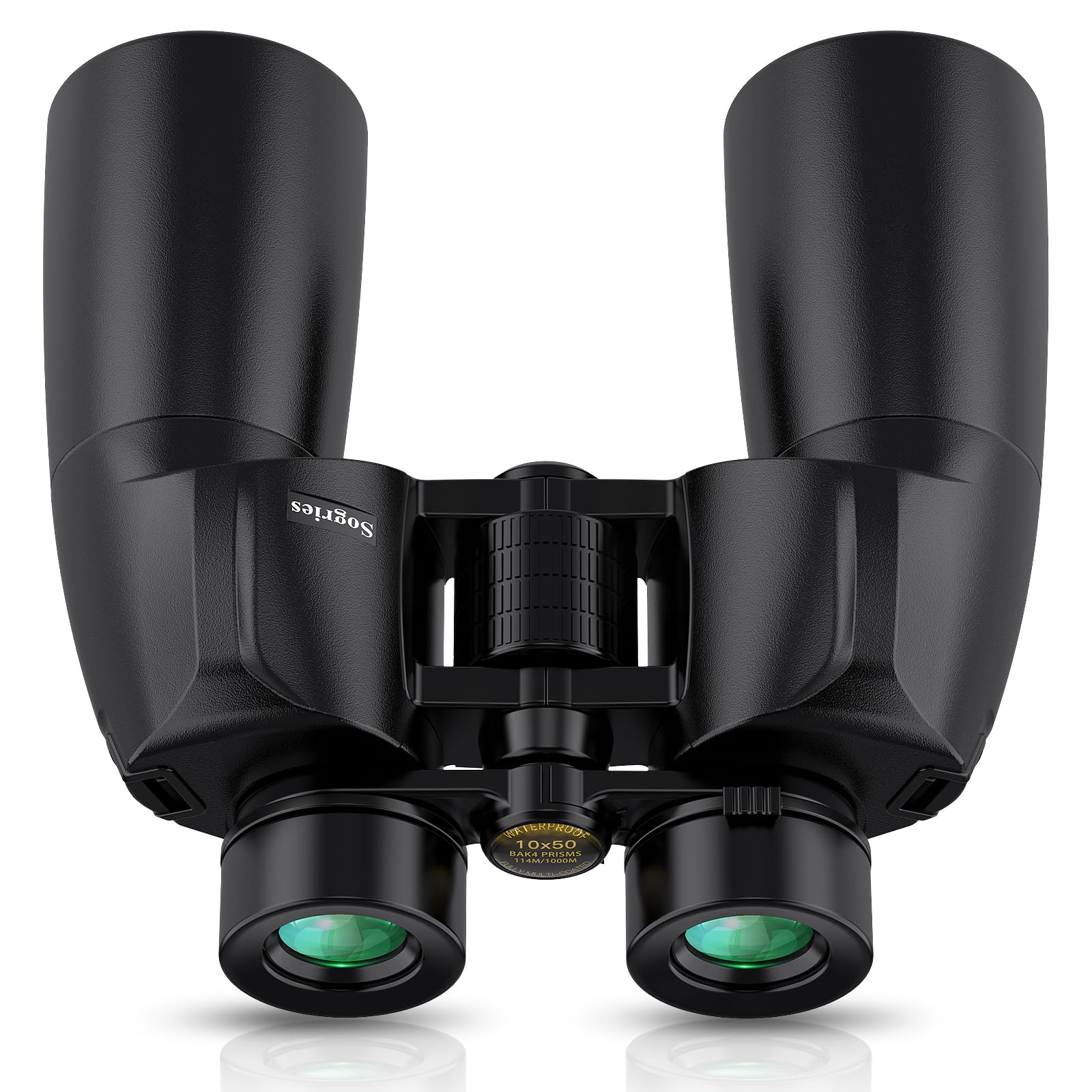
The Sogries 10×50 is a manual-focus binocular that emphasizes environmental resilience at a mid-range price. The IPX7 waterproof rating means it can handle immersion, and the nitrogen-filled optics prevent internal fogging during rapid temperature changes. The 50mm objective lenses with fully multicoated BaK-4 prisms produce a bright image with good color fidelity, and the 5mm exit pupil is generous for a 10x model, making it suitable for low-light conditions like dawn and dusk viewing.
The 22mm eye relief is among the longest in this guide, which is excellent for eyeglass wearers. The binocular includes a tripod adapter, a phone mount, and a dedicated carrying case, adding significant kit value. The twist-down eyecups allow a full field of view for glasses users, and the focus wheel is smooth and responsive. Users consistently describe the image quality as crisp and bright, comparable to binoculars costing more.
The objective lens caps are loose and not tethered, which is a common complaint at this price level. This is a relatively heavy binocular due to the 50mm objectives, and it is best used with a tripod or chest harness for extended sessions. For anyone who needs a waterproof, fogproof 10×50 for all-weather birding or hunting without spending on premium brands, the Sogries 10×50 provides excellent value and reliable performance.
Why it’s great
- IPX7 waterproof and nitrogen-filled for fog-free performance
- Long 22mm eye relief is ideal for eyeglass wearers
- Includes tripod adapter and phone mount for added versatility
Good to know
- Heavy for long hikes; best used with a tripod
- Objective lens caps are loose and not tethered
- Standard manual focus — not an autofocus system
9. Sogries 10-30×50 Zoom Binocular
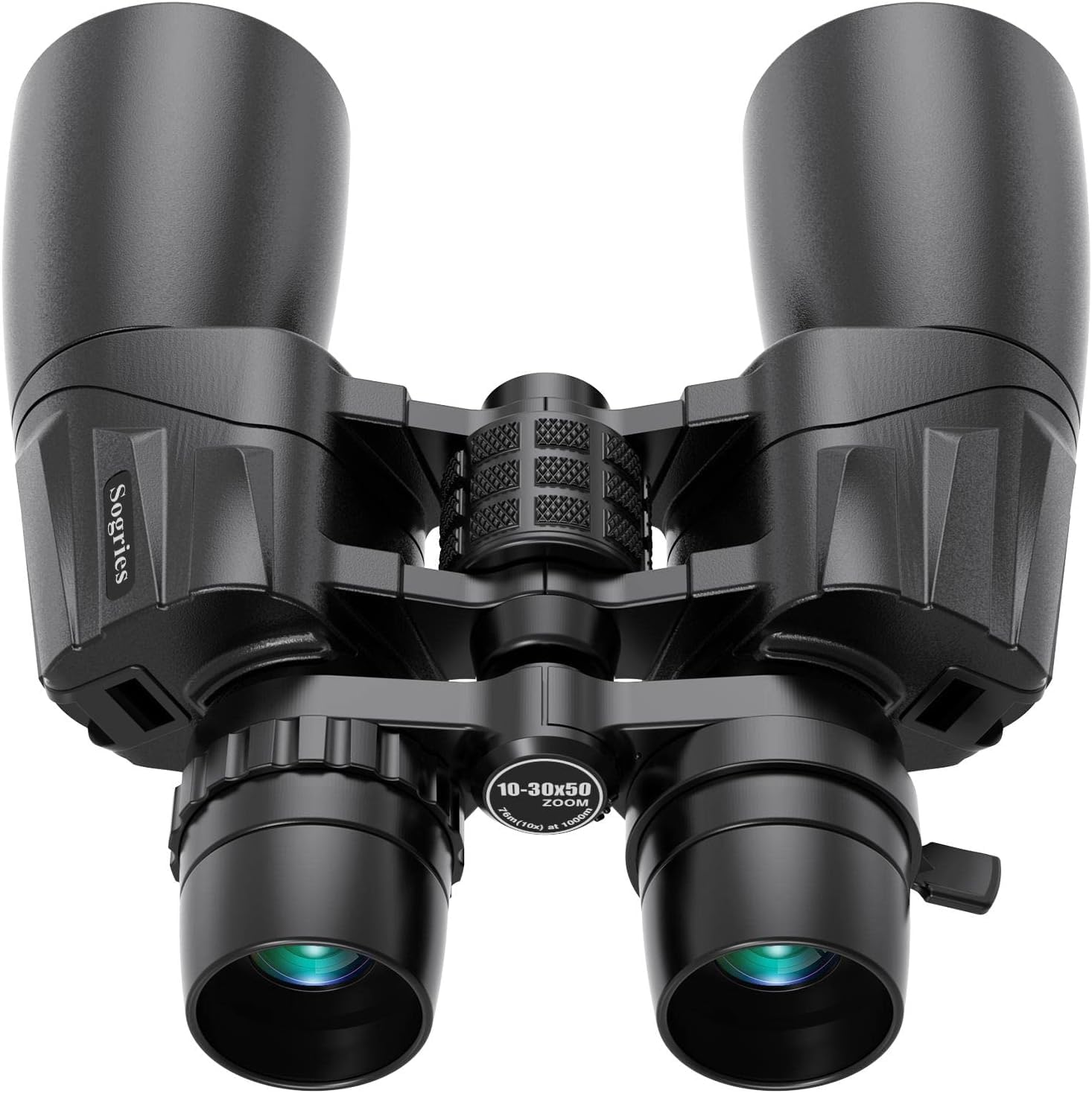
The Sogries 10-30×50 Zoom binocular is a variable-magnification manual-focus model that offers a wide range of viewing power in a single unit. The 10x to 30x range allows you to zoom in on distant details without swapping binoculars, and the 50mm objective lens provides ample light for the higher magnification settings. The BAK-4 prisms and FMC multicoated optics produce bright, color-accurate images with good light transmission, though the image naturally appears dimmer at 30x due to the exit pupil shrinking to 1.67mm.
The zoom control is a smooth joystick mechanism, and the center focus wheel provides precise adjustment at any magnification. The 22mm eye relief is generous, and the twist-up eyecups accommodate glasses wearers. The binocular is waterproof with O-ring seals and features a rubber armor coating with fingerprint-resistant texture. At 30x, a tripod is essential for stable viewing, and the manufacturer explicitly recommends one for high-power use.
The weight is significant, and the zoom mechanism adds complexity that may not hold up to rough field use as well as a fixed-power binocular. Some users report that at the highest magnification, the image is slightly less sharp than fixed-magnification models of similar cost. For a budget-minded user who wants the flexibility to spot birds at 10x and then zoom in for a close-up at 30x without carrying two instruments, this zoom binocular fills a specific niche.
Why it’s great
- Variable 10-30x magnification provides flexibility in a single unit
- Long 22mm eye relief works well with glasses
- Waterproof and O-ring sealed for weather protection
Good to know
- High magnification requires a tripod for steady viewing
- Heavy and bulky compared to fixed-power binoculars
- Zoom mechanism adds complexity that may reduce long-term durability
FAQ
Does Steiner’s Sports-Auto-Focus work in complete darkness?
Can I use Canon IS binoculars while wearing glasses?
Are autofocus binoculars better than manual focus for bird watching?
Final Thoughts: The Verdict
For most users, the best autofocus binoculars winner is the Canon 12×36 IS III because its electronic image stabilization transforms high-magnification hand-held viewing into a tripod-quality experience, making it the most versatile tool for both terrestrial and limited astronomical use. If you want a zero-battery, mechanically reliable autofocus system that works in any weather condition, grab the Steiner Military-Marine 7×50. And for a compact, lightweight autofocus solution for all-day hiking and travel, nothing beats the Steiner Military-Marine 8×30.