
Our readers keep the lights on and the weekend projects moving. As an Amazon Associate, I earn from qualifying purchases.
A boom mic sitting inches above an actor’s head should deliver dialogue so crisp you forget a microphone exists. But the wrong polar pattern, a weak preamp, or phantom power incompatibility turns a film set’s best take into a hissy, roomy mess that no amount of post-production can fully fix. Every filmmaker discovers this the hard way — usually right after wrapping a scene they thought was gold.
I’m Rikta — the co-founder and writer behind FitlyFast. I have spent hundreds of hours analyzing frequency response charts, self-noise figures, and polar pattern tests across the filmmaking audio category to separate studio hype from on-set performance.
This guide breaks down seven of the most capable options available today so you can confidently choose the right boom mic for filmmaking without blowing your budget on specs you won’t ever need.
How To Choose The Best Boom Mic For Filmmaking
Selecting a boom mic for filmmaking is not about picking the most expensive capsule on the shelf. It is about matching polar pattern, power delivery, and physical length to your shooting environment — controlled interiors, unpredictable exteriors, or run-and-gun documentary setups.
Polar Pattern and Rejection
A shotgun mic’s interference tube creates a focused pickup zone. Supercardioid patterns offer tighter rear and side rejection than standard cardioid, which is critical when booming above a subject indoors — less room reflection, more voice. Line-plus-gradient patterns (common on premium mics like the MKH 416) give even narrower acceptance angles for long-distance pickup on narrative sets.
Power Requirements and Connectivity
Condenser boom mics require 48V phantom power from an audio recorder, mixer, or camera interface. Some mics — notably the Rode NTG-2 — also accept a standard AA battery, which is a lifesaver when your recorder’s phantom supply runs low or you are feeding a consumer DSLR via a 3.5mm adapter. XLR is the professional standard; 3.5mm outputs are common on compact, on-camera options.
Self-Noise and Frequency Response
Self-noise, measured in dBA, tells you how much hiss the microphone itself introduces. For dialogue-heavy filmmaking, look for mics with self-noise at or below 16 dBA — every decibel of self-noise is noise you have to mask with dialogue or room tone in the edit. Frequency response should reach at least 20 Hz to 20 kHz to capture the full weight of a human voice without rolling off low-end warmth.
Quick Comparison
On smaller screens, swipe sideways to see the full table.
| Model | Category | Best For | Key Spec | Amazon |
|---|---|---|---|---|
| Sennheiser MKH 416-P48U3 | Premium Shotgun | Professional narrative & broadcast | Self-noise 13 dBA, RF condenser design | Amazon |
| Rode NTG5 | Premium Shotgun Kit | Location recording with full kit | Self-noise 10 dBA, supercardioid, 76g | Amazon |
| Rode NTG-2 | Mid-Range Shotgun | Dual-power flexibility (battery or phantom) | Frequency response 20 Hz – 20 kHz, AA battery option | Amazon |
| Audio-Technica AT875R | Mid-Range Shotgun | Short-length boom for compact cameras | Length under 7 inches, line+gradient polar pattern | Amazon |
| Samson C02 Pair | Pencil Condenser Pair | Stereo ambience & interior foley | Matched pair ±0.5dB, 134dB SPL handling | Amazon |
| Rode VideoMic GO II Helix | Compact On-Camera | Ultra-light run-and-gun with USB output | 57g weight, 3.5mm + USB-C output | Amazon |
| COMICA VM20 | Entry-Level Kit | Budget-conscious interviews & vlogging | OLED battery display, 60-hour standby | Amazon |
In‑Depth Reviews
1. Sennheiser MKH 416-P48U3

The Sennheiser MKH 416 has been a fixture on professional film sets for decades, and its RF condenser architecture is the reason. Rather than relying on a conventional DC-biased capsule, the 416 uses radio-frequency technology that makes it highly immune to humidity — a real advantage when booming exteriors, morning shoots, or any location with moisture in the air. Self-noise sits at an impressively low 13 dBA, meaning your dialogue track comes in clean with minimal hiss that would otherwise need noise-reduction plugins.
The interference tube delivers tight rear and side rejection — the line-plus-gradient pattern allows the boom operator to stay further off-axis while still capturing crisp, articulate dialogue. The transformerless balanced output ensures a clean signal path even over long XLR runs to the recorder. At just over a pound, it feels substantial without being fatiguing on a pole during a full shooting day.
This mic is not cheap, but it is an investment that holds resale value and performs at a level that matches rental-house standards. If you are shooting narrative shorts, documentaries with unpredictable environments, or broadcast-style interviews, the 416 is the reference against which everything else gets measured.
Why it’s great
- RF condenser design resists humidity and condensation on location
- Industry-standard dialogue sound with excellent off-axis rejection
- Transformerless output delivers clean signal over long cable runs
Good to know
- Premium price point puts it beyond entry-level budgets
- Requires 48V phantom power; no battery option
- Narrow sweet spot means careful boom positioning is mandatory
2. Rode NTG5

The Rode NTG5 redefines what a lightweight location shotgun can deliver. At just 76 grams and 203 millimeters long, it is easier to mount on compact boom poles and less tiring during extended handheld shots. Acoustically, its revolutionary internal design eliminates the rear cavity found in traditional shotguns, yielding a natural, uncolored frequency response that preserves the low-end weight of a voice without artificial sibilance.
Self-noise drops to an almost inaudible 10 dBA, which is class-leading at its price tier. The supercardioid polar pattern provides narrow focus while maintaining smooth off-axis response — meaning if the boom swings a few degrees off the subject, the tonal shift is gradual rather than abrupt. The RF-bias technology and conformal coating protect the capsule against humidity, making it a reliable partner for exterior shooting days.
The kit includes the PG2-R pistol grip shock mount, WS10 windshield, and a protective pouch, which eliminates the need to buy accessories separately. For filmmakers who want a premium boom mic that does not weigh down the kit bag or the boom pole, the NTG5 is a standout choice.
Why it’s great
- Extremely low self-noise suitable for quiet dialogue scenes
- Lightweight design reduces fatigue on long boom takes
- Complete location recording kit included out of the box
Good to know
- Plastic enclosure feels less rugged than all-metal alternatives
- Pistol grip mount uses 3/8″ thread, not standard 5/8″
- Requires phantom power; no internal battery option
3. Rode NTG-2
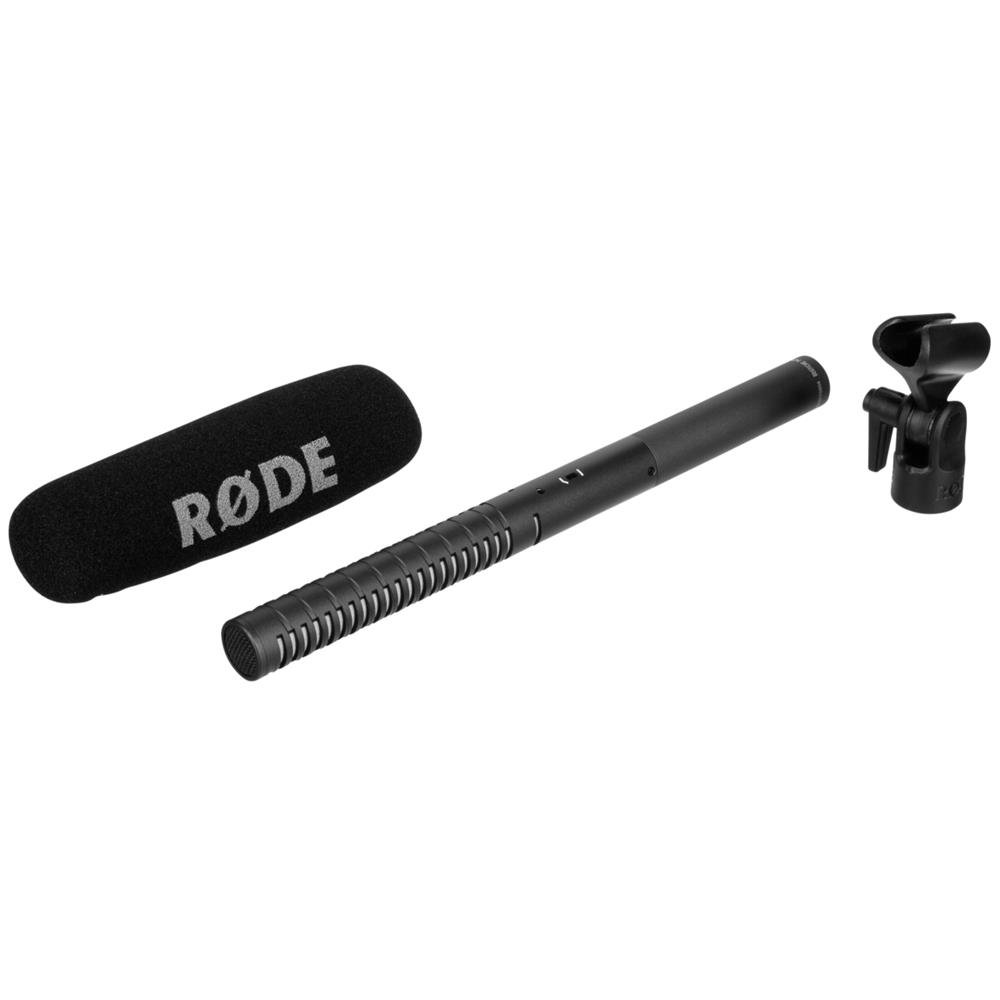
The Rode NTG-2 occupies a sweet spot in the mid-range boom market because it works when your recorder does not supply phantom power. The AA battery compartment gives you the freedom to use this shotgun with consumer-grade DSLRs and camcorders that lack 48V — a real advantage for run-and-gun documentary work or interview setups where you are feeding a 3.5mm input via an XLR adapter.
Frequency response covers 20 Hz to 20 kHz, and the integrated 80 Hz high-pass filter helps cut low-end rumble from handling noise, wind, or HVAC systems on location. The supercardioid pattern provides good rejection, though it is not as tight as the NTG5 or MKH 416. The metal body feels solid and roadworthy for its weight class.
Reviews consistently note that the self-noise is higher than premium options, so you will want to keep the mic close to the sound source and avoid boosting gain excessively in post. But for the price, the NTG-2 delivers professional-grade dialogue that easily outclasses anything built into a camera body.
Why it’s great
- Operates on phantom power or a single AA battery
- 80Hz high-pass filter reduces low-end rumble effectively
- Industry-standard Rode quality with wide accessory compatibility
Good to know
- Self-noise is higher than premium shotgun mics
- No on/off switch — battery drains if left connected
- Clip is very tight; requires care when mounting
4. Audio-Technica AT875R

At under seven inches in length, the Audio-Technica AT875R is built for compact camera rigs where a standard-length shotgun would extend past the lens or bump into a cage. The short interference tube still delivers a line-plus-gradient pattern that provides narrow front pickup and respectable rear/side rejection — impressive given its size. This makes it ideal for booming on small sets, interview environments, or gimbal-mounted cameras where space is tight.
Frequency response is tailored to reduce handling noise and camera vibration, and the overall sound profile leans rich in the mids with a clear top end that cuts through without sounding brittle. Users consistently describe it as a “pro-grade” sounding mic at a mid-range budget, though the self-noise is slightly higher than full-length shotguns. The metal barrel feels robust, and the included stand adapter and pouch add value.
One important consideration: the AT875R does not feature a low-cut filter or a pad switch, so you will need to manage excessive wind or loud sources with external windscreens and careful gain staging. For filmmakers building a compact location sound kit, this is a smart, space-saving foundation.
Why it’s great
- Exceptionally short body ideal for small camera rigs and gimbals
- Line+gradient polar pattern offers strong off-axis rejection
- Rich mid-range and clear top end for dialogue intelligibility
Good to know
- No low-cut filter or pad switch on board
- Requires quality shock mount to minimize handling noise
- Self-noise is higher than full-length premium shotguns
5. SAMSON C02 Pair
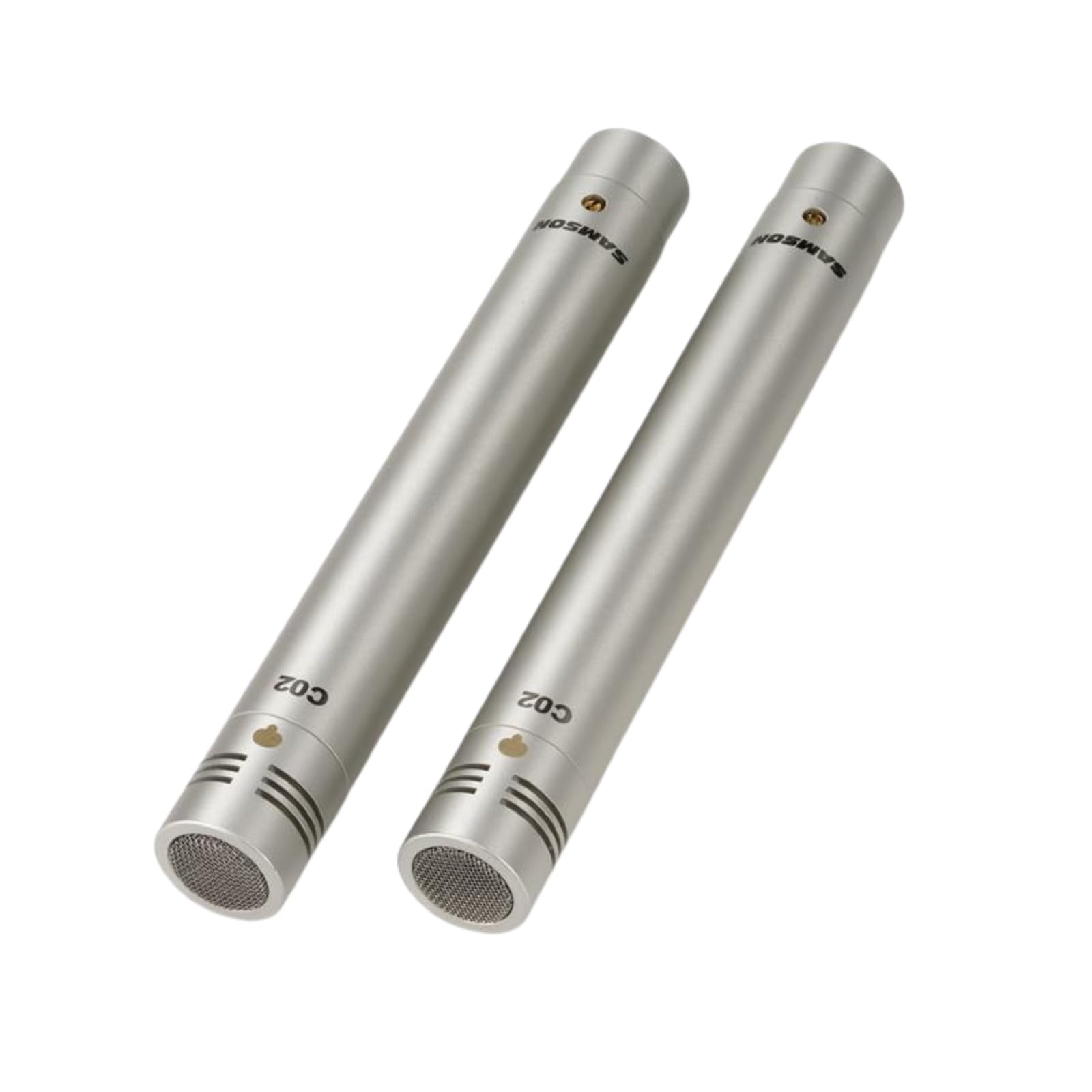
The Samson C02 pair is not a traditional boom mic, but it earns its place in this guide because serious filmmakers need room tone and ambient stereo capture just as much as dialogue. These small-diaphragm pencil condensers are matched within ±0.5 dB of each other, giving you a true stereo pair that can be positioned overhead for foley, hung above a dining table for a conversation scene, or placed wide for atmospheric texture on a nature shoot.
The cardioid pattern is forgiving — less focused than a shotgun, but that is exactly the point when you want to capture the natural reverb of a space rather than reject it. With a maximum SPL handling of 134 dB, you can place them surprisingly close to acoustic instruments or loud sound effects without distortion. The gold-plated XLR connectors ensure corrosion-resistant signal integrity over time.
The pair comes with isolating mic clips and foam windscreens in a hard-shell carrying case. They require phantom power, so factor that into your recorder’s channel count. For filmmakers who value layered, immersive audio, the C02 pair is a cost-effective way to add stereo depth to your post-production toolbox.
Why it’s great
- Matched pair provides true stereo imaging for ambience and foley
- 134dB SPL handling means no distortion near loud sources
- Compact pencil form factor fits into tight overhead rigs
Good to know
- Not a shotgun — poor for focused dialogue pickup at distance
- Requires phantom power; no battery option
- Windscreen inner layer may muffle sound without modification
6. Rode VideoMic GO II Helix

The third-generation Rode VideoMic GO II Helix weighs a mere 57 grams and measures just under six inches, making it the lightest entry in this list. Its defining feature is the dual-output design — a 3.5mm TRS jack for traditional camera input and a USB-C port for direct connection to smartphones, tablets, or computers. This makes it uniquely suited for independent filmmakers who also create content for mobile platforms or need a quick-record backup on a phone without an extra audio interface.
The HELIX isolation mount system is noticeably effective at decoupling the mic from handling noise and camera vibrations. The included deluxe windshield tames wind and plosive bursts without muffling the high end. Frequency response reaches 20 kHz on the top end, and the shotgun design provides surprising off-axis rejection for its size. No battery is required — the mic draws power from the 3.5mm plug-in power or USB bus.
Compatibility with Rode Connect and Rode Central software unlocks a high-pass filter and high-frequency boost, giving you tonal control that typical on-camera mics lack. For filmmakers who prioritize portability, mobile-recording flexibility, and quick setup, this is a remarkably capable tool.
Why it’s great
- Ultra-light 57g build is ideal for gimbals and travel
- Dual 3.5mm and USB-C output works with cameras and phones
- HELIX mount effectively cancels handling and vibration noise
Good to know
- Plastic enclosure feels less durable than metal alternatives
- Requires plug-in power or USB bus; no battery on board
- Off-axis rejection is good for its class but not pro-shotgun level
7. COMICA VM20

The COMICA VM20 proves that entry-level budget does not have to mean bare-bones. The integrated OLED screen shows real-time battery status — a feature typically reserved for premium pro-sumer gear — so you never guess whether the mic is about to die mid-take. The built-in 300mAh rechargeable battery delivers up to 60 hours of standby time, and the USB-C port allows pass-through charging during use, which is a practical advantage on marathon shoot days.
The supercardioid capsule provides decent side and rear rejection for its price tier, and the ten-level gain adjustment (from -43 dB to -23 dB sensitivity) gives you fine control over input level directly on the mic. The 75 Hz and 150 Hz low-cut filters are useful for cleaning up rumbles from air conditioning or traffic rumble without requiring post-processing. The Rycote-style shock mount effectively isolates the capsule from cable vibration and handling bumps.
Build quality leans plastic, and the included windshield is better suited to indoor use — outdoor wind will require a separate furry deadcat. But for the price, the feature set (OLED, adjustable gain, dual low-cut, rechargeable battery) is unmatched. If your filmmaking budget is tight, the VM20 lets you allocate more money to lighting or lenses without sacrificing intelligible dialogue.
Why it’s great
- OLED screen provides clear battery level visibility at a glance
- Built-in rechargeable battery with 60-hour standby and USB-C charging
- Ten-level gain adjustment and dual low-cut filters
Good to know
- Plastic body feels less robust than metal competitors
- Stock windshield is inadequate for exterior wind conditions
- Battery failure reports suggest quality control can vary
FAQ
Why can’t I just use a dynamic microphone on a boom?
Should I buy a phantom-powered mic or one with a battery?
Does mic length affect sound quality on a boom?
Final Thoughts: The Verdict
For most users, the boom mic for filmmaking winner is the Sennheiser MKH 416-P48U3 because its RF condenser design and tight line-plus-gradient pattern deliver the industry-standard dialogue sound that post-production editors trust without extra noise removal. If you want extreme low self-noise and a lightweight kit that includes premium accessories, grab the Rode NTG5. And for budget-conscious filmmakers who refuse to compromise on adjustable gain and battery awareness, nothing beats the COMICA VM20.