
Our readers keep the lights on and the weekend projects moving. As an Amazon Associate, I earn from qualifying purchases.
Watching a freshly installed piece of exterior stone veneer separate from the wall is a gut punch — all that work, precision, and expense, undone by the wrong bond. The difference between a lifetime installation and a costly repair job often comes down to one decision: which adhesive you choose to bridge the gap between the stone and the substrate.
I’m Rikta — the co-founder and writer behind FitlyFast. This guide is built on hundreds of hours spent analyzing chemical formulations, tensile strength data, weather-resistance test results, and real-world application feedback to find the adhesives that truly hold stone veneer against the elements.
From flexible MS polymers that absorb structural movement to high-strength epoxies that bond to damp concrete, here is the definitive breakdown of the best adhesive for exterior stone veneer available today, ranked by real-world performance.
How To Choose The Best Adhesive For Exterior Stone Veneer
Picking an adhesive for exterior stone veneer isn’t the same as selecting a general-purpose construction glue. The bond must withstand direct rain, sub-zero temperatures, intense UV exposure, and the constant micro-movements of the structure beneath. Three key factors separate the adhesives that last from those that fail silently behind a beautiful stone face.
Flexibility vs. Rigidity — The Freeze-Thaw Decider
Stone veneer and the wall behind it expand and contract at different rates when temperatures swing. A rigid adhesive that dries rock-hard will eventually crack under this stress, creating a gap where water seeps in and destroys the bond. Flexible adhesives — typically MS polymers or polyurethane formulations — absorb that movement without breaking, making them the safer choice for exterior applications in climates with seasonal temperature changes.
Water Resistance and UV Stability
Rain, snow, and direct sunlight are the three enemies of any exterior bond. Adhesives that lack true waterproofing will degrade within months when exposed to moisture. UV stability matters because sunlight can break down certain polymer chains over time, causing yellowing, brittleness, and loss of adhesion. Look for formulations explicitly labeled for exterior use with demonstrated resistance to both water and prolonged UV exposure.
Application Temperature and Open Time
Exterior work doesn’t happen in a climate-controlled shop. Some adhesives require the surface temperature to be above 40°F to cure properly, which limits your working season. Others can be applied to wet or frozen lumber. Open time — how long you have to position the stone before the adhesive starts setting — is equally critical. A fast-setting adhesive gives you less than 10 minutes to make adjustments, while slower formulations offer 20-30 minutes of workability. Match the open time to your installation pace.
Quick Comparison
On smaller screens, swipe sideways to see the full table.
| Model | Category | Best For | Key Spec | Amazon |
|---|---|---|---|---|
| ROMAN PRO-515 Ultra | MS Polymer | Direct veneer bonding | Low-VOC, flexible, UV-resistant | Amazon |
| Loctite PL 500 Landscape | Construction | Cap stone & block walls | Gunnable at 0°F, fills gaps | Amazon |
| Gorilla Max Strength | Hybrid | Small repairs, clear finish | 2x stronger than standard, clear | Amazon |
| PC Products PC-Masonry Epoxy | Epoxy Paste | Structural masonry repair | Non-sag, overhead use, 35-115°F range | Amazon |
| WEICON Natural Stone Adhesive | Stone-Specific | Natural stone & marble | -40°F to +194°F, sandable | Amazon |
| Loctite PL Premium Polyurethane | Polyurethane | High-strength, all-weather | 3x stronger, sets in 30 min | Amazon |
| McKinnon Stone Bond Epoxy | Resin Epoxy | Pebble & gravel resurfacing | UV stable, permeable surface | Amazon |
In‑Depth Reviews
1. ROMAN PRO-515 Ultra MS Polymer Adhesive
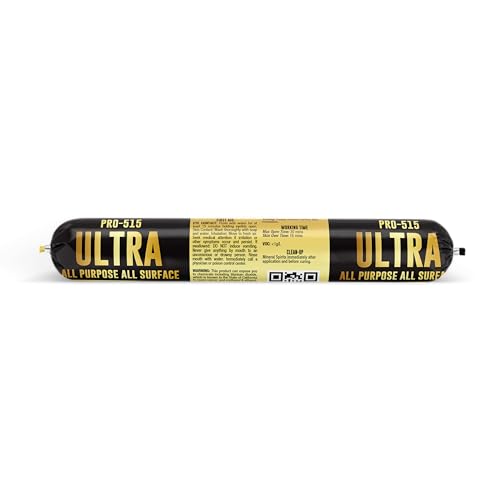
This single-component, solvent-free MS polymer adhesive is purpose-built for bonding stone veneer to vertical surfaces. Users report it works “MUCH better than any other product” for putting up stone veneer — a testament to its high grab and superior adhesion across brick, concrete, glass, and metal. The low viscosity allows it to wet out the surface thoroughly, creating a bond that doesn’t rely on mechanical fasteners.
With a VOC content below 1 g/L and UV-resistant properties, the PRO-515 Ultra is engineered for exterior conditions where sunlight and air quality regulations matter. The 20.2-ounce sausage pack delivers enough material for medium-scale projects, and the flexible joint it creates absorbs the structural movement that would crack rigid adhesives during freeze-thaw cycles. It remains paintable and waterproof after full cure.
The one practical consideration is the sausage-style cartridge. You’ll need a 22:1 thrust ratio caulk gun to extrude it properly — not a standard skeleton gun. Workability is excellent, with enough open time to position stones before the adhesive grabs. For a direct, dependable bond on exterior stone veneer, this is the benchmark.
Why it’s great
- Exceptional initial grab on vertical stone surfaces
- UV-resistant and waterproof for long exterior life
- Flexible bond handles structural movement
- Low-VOC formulation for sensitive applications
Good to know
- Requires a high-thrust sausage caulk gun
- 30-minute open time may feel tight on large panels
2. Loctite PL 500 Landscape Block & Stone Adhesive
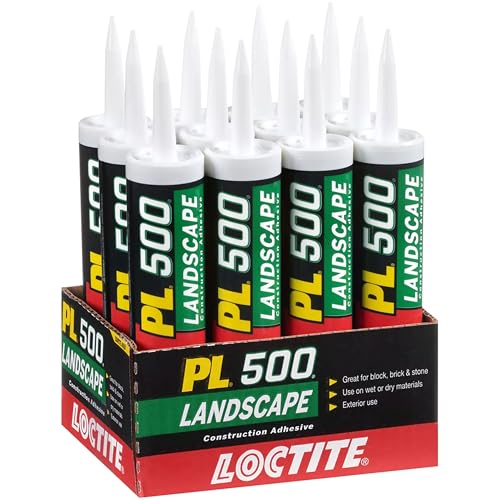
Formulated specifically for outdoor landscaping projects, the PL 500 is engineered to bond cap stones, cement pavers, and block walls even when conditions are less than ideal. It can be gunned directly onto wet and frozen lumber without rolling up — a rare capability that extends your working season into colder months. Users note it holds block walls together firmly and is “much better” than general construction adhesives for stone-specific applications.
The waterproof formulation resists weather from sub-freezing temperatures at 0°F up to 100°F, and its gap-filling properties are particularly effective on irregular stone surfaces where a perfect mating face doesn’t exist. The adhesive bridges gaps between surfaces without losing bond strength. It bonds to brick, stone, concrete, metal, wood, and treated lumber, making it versatile beyond just veneer work.
The 12-pack provides good value for large-scale projects, and the 10-ounce cartridges fit standard caulking guns. The one trade-off is that this is a paste-grade product, so it doesn’t flow as readily into tight crevices as thinner adhesives. For securing veneer stones where surface contact is decent, this is a rugged, dependable choice.
Why it’s great
- Gunnable on wet and frozen lumber
- Effective gap-filling for irregular stone backs
- Wide temperature tolerance (-0°F to 100°F)
- Bonds to multiple exterior substrates
Good to know
- Thicker paste may not penetrate thin cracks
- Best for landscape block rather than thin veneer
3. Gorilla Max Strength Construction Adhesive
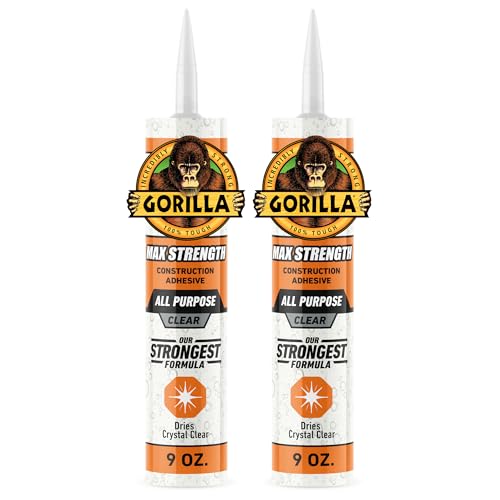
Gorilla claims this is 2x stronger than their own Heavy Duty Construction Adhesive, and customer feedback confirms the bond is “very strong” and has held signs on painted surfaces for extended periods. The clear formula is a distinct advantage for stone veneer — squeeze-out won’t discolor lighter stone or be visible at the edges of joints. It bonds to ceramic, fiberglass, glass, stone, and wood, covering the materials you’ll encounter in a typical veneer installation.
The hybrid material type cures within 24 hours and creates a waterproof, paintable joint. One user successfully used it to repair a heavy granite table by securing 2×2 supports underneath — the bond held the weight without failure. The gap-filling properties make it useful when the back of your veneer stone has an uneven surface that needs bridging.
The downside is that some users report the tube design wastes roughly 2 inches of product, and one unit in a two-pack arrived cracked. It also requires heavy application for solid hold on rougher surfaces. For small repairs, accent pieces, or projects where an invisible bond line matters, the clear finish is a genuine benefit.
Why it’s great
- Dries crystal clear — no visible squeeze-out on stone
- 2x stronger than standard Gorilla adhesive
- Waterproof and paintable after 24-hour cure
- Effective gap filler for uneven stone backs
Good to know
- Some tubes arrive damaged from shipping
- Needs liberal application for maximum holding power
4. PC Products PC-Masonry Epoxy Adhesive Paste

When you’re not just attaching veneer but rebuilding missing sections of masonry, this two-part epoxy paste is the right tool. It replaces missing concrete and fills cracks on deteriorating masonry surfaces, and because it’s a non-sagging paste, it can be used horizontally or overhead without dripping. One user repaired a broken brick staircase and reattached a wrought-iron rail with 1/4″ bolts — the bond exceeded the strength of the original brickwork.
The epoxy resists moisture and applies to both wet and dry surfaces within a temperature range of 35°F to 115°F. After full cure, it can be painted, stained, or machined. Multiple reviewers confirm it hardens into a “rock-like monolith” that doesn’t crumble — ideal for large structural rebuilds where an adhesive must fill centimeter-deep voids and bear significant weight.
Mixing Part A and Part B requires care — you must achieve a uniform gray color before application. The 15-minute working time is short, so you need to prepare all materials beforehand. For pure stone-to-stone bonding on a flat surface, a construction adhesive is simpler. But for structural masonry repair where concrete replacement is part of the job, this epoxy is unmatched.
Why it’s great
- Non-sag paste works on vertical and overhead surfaces
- Cures harder than the surrounding concrete
- Resists moisture on wet surfaces
- Can be drilled and painted after cure
Good to know
- 15-minute working time requires fast work
- Not ideal for thin veneer attachment
5. WEICON Natural Stone Adhesive
This German-formulated adhesive is designed explicitly for natural stone, marble, and granite — not a general-purpose construction adhesive adapted for stone use. Its single-component composition delivers high initial adhesion on both smooth and rough vertical surfaces. Users report it bonded stone tiles to terrace steps so firmly that the assembly survived winter weather and held perfectly after six months.
The temperature resistance spans -40°F to +194°F, and the adhesive is silicone-free, solvent-free, elastic, sandable, and UV-resistant — an unusual combination that covers every exterior failure mode. It also adheres to metal, wood, ceramics, and glass, meaning it’s effective for bonding stone veneer to a variety of backup surfaces including concrete block, plywood sheathing, or metal lath.
The 10-minute open time is shorter than most construction adhesives, so you need to position stones quickly. At a premium price point, this is best suited for high-end natural stone installations where the adhesive’s specific compatibility with marble and granite prevents chemical reactions that could stain or discolor the stone. For luxury veneer projects, the investment is justified.
Why it’s great
- Formulated specifically for natural stone, marble, and granite
- Extreme temperature range (-40°F to +194°F)
- Elastic bond prevents stress cracking
- UV-resistant and sandable after cure
Good to know
- 10-minute open time is short for large stones
- Premium cost compared to general adhesives
6. Loctite PL Premium Polyurethane Construction Adhesive

This polyurethane-based adhesive claims to be 3 times stronger than ordinary construction adhesives, and customer reviews back it up. It bonds furring strips to concrete walls so effectively that users describe the cured product as a “hard type of plastic that resists bending.” It works on wood, OSB, drywall, brick, concrete, masonry, stone, foam insulation, metal, ceramic, and PVC — covering virtually every substrate you’d encounter in a stone veneer installation.
The waterproof formulation sets in 30 minutes and fully cures in 24 hours. It can be applied directly to wet or frozen surfaces without shrinking, making it suitable for exterior work year-round. The lack of strong solvent odor is a practical advantage for occupied spaces. The 12-pack provides sufficient material for large veneer projects at a competitive per-unit cost.
The main consideration is that polyurethane adhesives expand as they cure. This means squeeze-out can be more pronounced, and you’ll want to clean excess before it fully hardens. It’s also extremely sticky during application — one mistaken placement is hard to reverse. For high-strength, all-weather bonding where the adhesive’s expansion helps fill gaps, this is a top-tier option.
Why it’s great
- 3x stronger than standard construction adhesives
- Sets in 30 minutes, cures in 24 hours
- Bonds to wet and frozen surfaces
- Versatile across wood, concrete, stone, and metal
Good to know
- Expands during cure — squeeze-out needs cleanup
- Extremely sticky, difficult to reposition stones
7. McKinnon Stone Bond Resin Bound Surfacing Epoxy
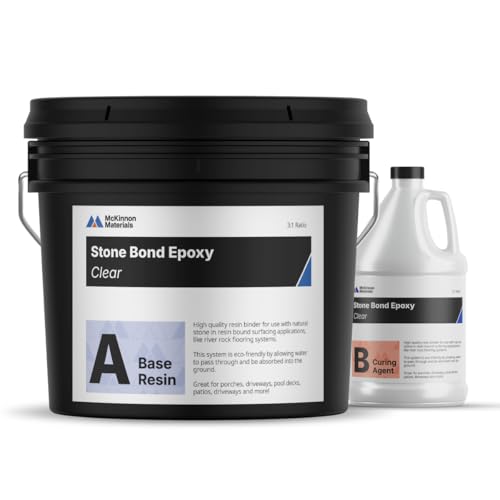
This is a different category of product — a two-part epoxy designed to bind loose pebble and gravel into a solid, permeable surface rather than attaching manufactured veneer stones to a wall. It creates a seamless, upscale finish for driveways, patios, pool decks, and walkways. The cured surface resists yellowing from UV exposure, maintaining a clean natural appearance that many construction adhesives cannot match.
The permeability is a standout feature — water drains through the bound stone surface instead of pooling, reducing runoff and preventing the freeze-thaw damage that would destroy a solid slab. Users report excellent results on old pebble flooring and pool areas, noting it “outperformed the last epoxy mix” they had used. The manufacturer, McKinnon Materials in Tampa, Florida, brings decades of industrial coating experience to this formulation.
The limiting factor is that this is not designed for bonding pre-formed veneer stones to walls. It’s a surface binder for loose aggregate applications. You’ll also need to wash and thoroughly dry your pea gravel before application — moisture inhibits epoxy cure. For its intended use of resurfacing horizontal stone surfaces, it delivers exceptional results.
Why it’s great
- UV-stable — resists yellowing in direct sunlight
- Permeable surface prevents water pooling
- DIY-friendly with straightforward mixing
- Made in the USA with industrial-grade quality
Good to know
- Not for bonding veneer stones to vertical walls
- Requires clean, dry aggregate for proper adhesion
FAQ
Can I use construction adhesive for exterior stone veneer?
How long does stone veneer adhesive take to cure before it’s weatherproof?
What’s the difference between MS polymer and polyurethane for stone?
Do I need to prime the stone or wall before applying adhesive?
Final Thoughts: The Verdict
For most users, the best adhesive for exterior stone veneer winner is the ROMAN PRO-515 Ultra because its MS polymer formulation delivers the ideal combination of flexibility, UV resistance, weatherproofing, and high initial grab that stone veneer needs to stay bonded through freeze-thaw cycles and direct sunlight. If you want a cold-weather workhorse that lets you install in freezing conditions, grab the Loctite PL 500. And for high-end natural stone projects where chemical compatibility with marble or granite is non-negotiable, nothing beats the WEICON Natural Stone Adhesive.