
Our readers keep the lights on and the weekend projects moving. As an Amazon Associate, I earn from qualifying purchases.
Selecting a new television means deciding between competing panel technologies that each handle light, motion, and color differently. Mini-LED arrays deliver the brightness needed for sunlit living rooms, while OLED pixels produce perfect black levels that transform dark-room movie nights. The refresh rate determines whether fast-paced sports and console games appear fluid or blurry, and the processor determines how well lower-resolution content gets upscaled to fill a 4K screen. Every spec on the spec sheet directly impacts what you see.
I’m Rikta — the co-founder and writer behind FitlyFast. This guide is the result of many hours spent analyzing technical specifications and real-world user experiences across a wide price spectrum, from value-focused mid-range sets to premium OLED and weatherproof outdoor models.
Whether you prioritize gaming fluidity, cinematic contrast, or all-weather durability, finding the right model means matching key specs to your specific viewing environment. This is the best 4k tv research you need before making a purchase.
How To Choose The Best 4K TV
Three factors define your viewing experience more than any others: panel technology, native refresh rate, and HDR format support. Understanding these will help you filter the options.
Panel Technology
QLED uses a quantum dot layer over an LED backlight to achieve high brightness and vibrant colors, making it ideal for bright rooms and extended use without burn-in risk. OLED employs self-emissive pixels that turn off individually, producing perfect black levels and infinite contrast ratio, but peak brightness is lower and static elements can cause image retention over time. Mini-LED is a refinement of traditional LED that uses thousands of tiny backlight zones to improve contrast and reduce blooming, offering a middle ground between QLED and OLED performance.
Refresh Rate and Gaming Features
A native 120Hz or 144Hz panel allows content at 24, 30, or 60 frames per second to be displayed with accurate motion cadence, and it unlocks 4K at 120Hz for modern consoles and PC gaming. Variable Refresh Rate (VRR) and Auto Low Latency Mode (ALLM) eliminate screen tearing and reduce input lag, which is critical for competitive shooters and fast-paced racing games. Without at least 120Hz, the TV will double or triple frames, introducing noticeable judder during panning shots.
HDR Format Support
Dolby Vision is a dynamic metadata format that optimizes brightness, contrast, and color scene-by-scene, and is widely supported across major streaming services like Netflix, Disney+, and Apple TV+. HDR10+ serves a similar function but is less common in streaming libraries. HLG is the broadcast standard used by live sports and news channels. A TV that supports all three formats provides maximum compatibility, though for streaming the most important format is Dolby Vision due to its prevalence in premium content.
Quick Comparison
On smaller screens, swipe sideways to see the full table.
| Model | Category | Best For | Key Spec | Amazon |
|---|---|---|---|---|
| Samsung OLED S90F | Premium OLED | Cinematic contrast & gaming | QD-OLED, NQ4 AI Gen3, 144Hz | Amazon |
| LG OLED evo C5 | Premium OLED | Home theater & Dolby Vision | Alpha 9 AI Gen8, 120Hz | Amazon |
| Samsung QLED Q8F | Premium QLED | Large screen bright room living | 100% Color Volume, 144Hz | Amazon |
| Hisense U7 Mini-LED | Premium Mini-LED | Anti-glare gaming & HDR | 165Hz, 3000 nits peak | Amazon |
| Roku Plus Series | Mid-Range QLED | Easy Roku OS & simplicity | Mini-LED, Dolby Vision | Amazon |
| Sony BRAVIA 2 II 75″ | Mid-Range LED | PS5 integration & upscaling | 4K Processor X1, 60Hz | Amazon |
| Sony BRAVIA 2 II 55″ | Mid-Range LED | PS5 integration & upscaling | 4K Processor X1, 60Hz | Amazon |
| TCL T7 QLED | Value QLED | High refresh gaming on budget | 144Hz, AIPQ Pro | Amazon |
| SYLVOX Deck Pro 3.0 | Outdoor | Shaded outdoor spaces | 1000 nits, IP56 | Amazon |
| SYLVOX Pool Pro 3.0 | Outdoor Full Sun | Direct sunlight outdoor use | 2000 nits, IP56 | Amazon |
| INSIGNIA F50 | Budget | Entry-level large screen | Fire TV, HDR10 | Amazon |
In‑Depth Reviews
1. Samsung 65-Inch Class OLED S90F

The Samsung S90F pairs a QD-OLED panel with the NQ4 AI Gen3 processor, which uses 128 neural networks to upscale content and enhance HDR in real time. The self-emissive pixels deliver perfect black levels while quantum dots push color volume beyond what standard WOLED panels achieve. Measured peak brightness exceeds 1000 nits in small highlights, making HDR speculars like sun reflections or explosion flashes visibly impactful.
Motion resolution remains clean at 144Hz, and support for AMD FreeSync Premium Pro and Nvidia G-Sync Compatible ensures tear-free gameplay across both console and PC. The 4K 120Hz input lag measures under 6ms, which is competitive with dedicated gaming monitors.
Audio quality from the built-in down-firing speakers is adequate for dialogue but lacks bass extension below 100Hz. Pairing a Samsung soundbar enables Q-Symphony, which uses the TV speakers as additional channels for a wider soundstage. The solar-powered remote is minimal but functional, though its button count is frustrating for users who need direct input switching or a mute toggle.
Why it’s great
- QD-OLED produces unmatched color volume and contrast.
- 144Hz native refresh with full VRR support.
- AI upscaling noticeably improves HD streaming sources.
Good to know
- Remote lacks a dedicated mute button and backlight.
- Anti-reflective coating is fragile and easily scratched during cleaning.
- Brightness falls short of high-end QLED in direct sunlight.
2. LG 77-Inch Class OLED evo C5

The LG C5 uses the OLED evo panel with a deuterium compound that boosts light output without increasing power consumption. The result is a measurable brightness gain of roughly 30% over standard OLED panels, reaching around 800 nits in full-screen white and over 900 nits in small highlights. The Alpha 9 AI Gen8 processor applies AI Super Upscaling that sharpens 1080p streams with minimal oversharpening artifacts.
Dolby Vision IQ works with the TV’s built-in light sensor to adjust tone mapping based on ambient brightness, which is useful for rooms with changing daylight. Filmmaker Mode disables all motion smoothing and defaults to D65 white point, offering a reference-quality picture straight out of the box. The 120Hz panel supports both Nvidia G-Sync Compatible and AMD FreeSync Premium, with input lag at 4K 120Hz measuring under 7ms.
The LG Magic Remote uses a pointer-based cursor that feels imprecise for rapid navigation and lacks a dedicated mute button — holding the volume button to mute is a common complaint. HDMI 2.1 bandwidth is full 48Gbps across all four ports, enabling simultaneous 4K 120Hz with 12-bit color on multiple sources. WebOS is responsive but shows occasional ads on the home screen that require a few extra clicks to bypass.
Why it’s great
- OLED evo panel is noticeably brighter than standard OLED.
- Four full-bandwidth HDMI 2.1 ports for multi-device setups.
- Dolby Vision IQ adapts tone mapping to room lighting.
Good to know
- Magic Remote pointer navigation is less precise than directional pads.
- Home screen displays intrusive ad tiles.
- Burn-in risk exists if static menus are displayed for hours daily.
3. Samsung 85-Inch Class QLED Q8F

The Q8F is a large-format QLED television that leverages quantum dots to sustain 100% Color Volume across brightness levels up to roughly 1500 nits peak. Unlike OLED, the backlight remains fully lit in bright scenes, so specular highlights do not compress, and the screen stays legible even when sunlight lands directly on the panel. The AirSlim chassis is under 1 inch deep, which makes wall-mounting flush against the wall straightforward.
The Q4 AI Processor handles upscaling and object-based sound optimization, and the Samsung Gaming Hub provides cloud gaming access without a console. Motion Xcelerator Turbo Pro enables 4K 144Hz input with VRR, and the input lag at 4K 60Hz is around 10ms. The anti-reflective layer on the Q8F uses a matte finish that diffuses overhead light, reducing hotspot reflections compared to glossy panels.
The Samsung remote is rechargeable via USB-C and small solar panel on its rear, but the reduced button count makes accessing picture settings cumbersome — switching from Standard to Filmmaker Mode requires diving three menus deep. Samsung TV Plus offers over 400 free channels built in, which reduces reliance on external streaming devices for casual viewing. The 85-inch size demands a sturdy entertainment stand or a correctly anchored wall mount rated for over 100 lbs.
Why it’s great
- 100% Color Volume maintains vibrancy at any brightness level.
- Ultra-slim design simplifies flush wall mounting.
- Samsung Gaming Hub enables cloud gaming without a console.
Good to know
- No Dolby Vision support — relies on HDR10+.
- Remote requires deep menu navigation to change picture modes.
- Heat output is noticeable in smaller rooms during extended use.
4. Hisense 55″ U7 Mini-LED ULED
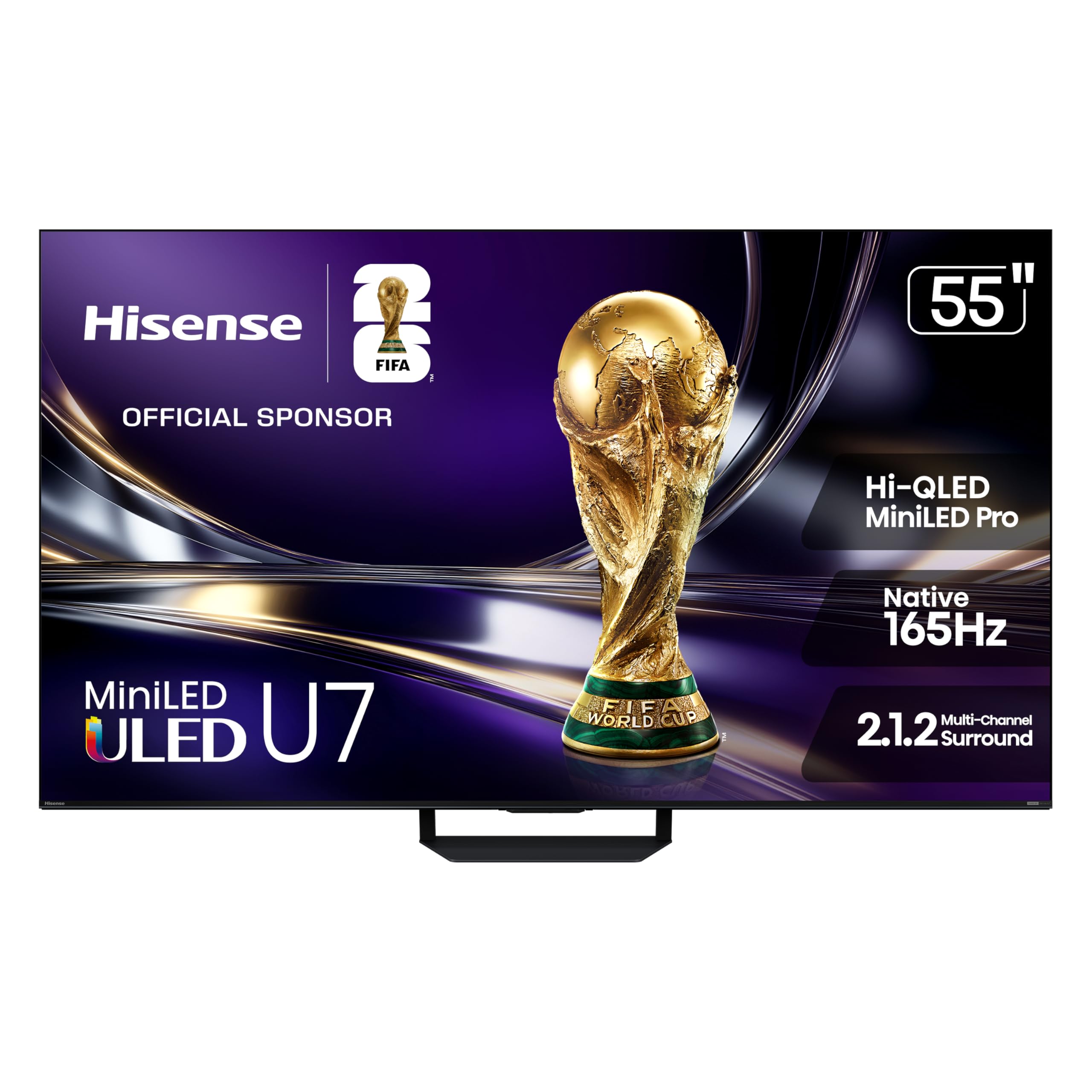
The Hisense U7U series uses a Mini-LED backlight with up to 3000 local dimming zones in the 65-inch configuration, though the 55-inch model uses a lower zone count. The Hi-QLED MiniLED Pro layer combines quantum dot color with high zone density, producing measured peak brightness of around 3000 nits in the brightest window. The native 165Hz panel is the highest refresh rate in this price class, capable of accepting a 4K 165Hz signal from a compatible GPU.
The anti-reflection layer is genuinely effective — dual-layer treatment eliminates mirror-like reflections, making the TV usable in rooms with large windows. The Hi-View AI Engine Pro adjusts color temperature and contrast dynamically based on content metadata, and it supports Dolby Vision IQ, HDR10+, and IMAX Enhanced formats. Filmmaker Mode preserves the director’s intent without forced motion interpolation, though the standard mode defaults to aggressive sharpening that needs to be dialed back.
Google TV interface is fluid and integrates with Google Home for voice commands via the remote. The 2.1.2 channel speaker system includes up-firing drivers, producing a wider soundstage than typical down-firing setups, though a separate soundbar still improves dialogue clarity. The remote is ergonomic and includes dedicated buttons for Netflix, YouTube, Prime Video, and Disney+.
Why it’s great
- Native 165Hz refresh rate exceeds most gaming monitors.
- Effective anti-glare coat works in bright rooms.
- Supports Dolby Vision, HDR10+, and IMAX Enhanced.
Good to know
- Standard picture mode needs calibration — default sharpening is too high.
- Local dimming zone count varies between screen sizes.
- Upscaling of 480p content shows noticeable artifacts.
5. Roku Smart TV 75-Inch Plus Series
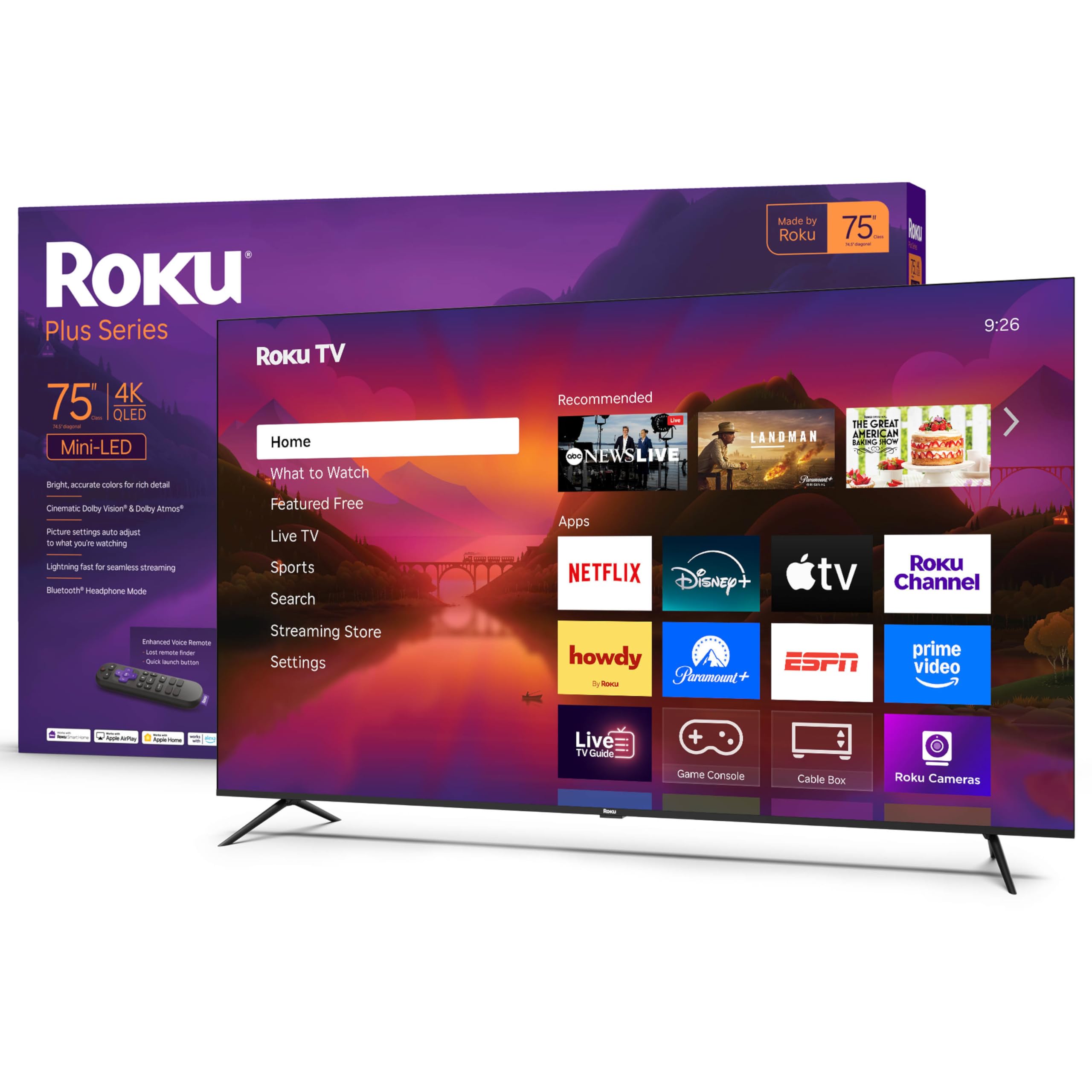
Roku’s Plus Series combines Mini-LED backlighting with QLED color to deliver high contrast and bright highlights without the complexity of competing operating systems. The Roku OS is widely praised for its simplicity — app rows are laid out cleanly, software updates never break compatibility, and the home screen avoids ad clutter compared to Google TV or WebOS. Dolby Vision and Dolby Atmos are both supported, and Roku Smart Picture Max uses AI to dynamically adjust settings per scene.
The built-in sound system includes a subwoofer, which produces more bass impact than typical TV speakers. Dialogue at low volume remains intelligible, and the Virtual Surround mode widens the soundstage without introducing echo. Bluetooth Headphone Mode pairs wireless earbuds directly to the TV for private listening — a genuinely useful feature for late-night viewing.
The Enhanced Voice Remote includes a lost remote finder, which triggers a tone from the remote when activated. Wi-Fi 6 support ensures reliable streaming even in households with multiple connected devices, and the Ethernet port provides an alternative for hardwired setups. The picture settings menu is intentionally basic — users who need fine-grained white balance adjustments or gamma tweaks may find the customization options insufficient.
Why it’s great
- Roku OS is fast, simple, and ad-light.
- Built-in subwoofer provides real bass response.
- Bluetooth Headphone Mode enables private late-night listening.
- Lost remote finder is a practical convenience.
Good to know
- Picture settings lack deeper calibration controls.
- No USB port on some configurations.
- Remote is not backlit.
6. Sony BRAVIA 2 II 75 Inch

The 75-inch BRAVIA 2 II is an LED set built around Sony’s 4K Processor X1, which analyzes image data and applies real-time corrections to brightness, color, and sharpness. The motion handling uses Motionflow XR to insert black frames and reduce blur during fast camera pans, though the native panel is 60Hz, so 24fps content requires 3:2 pulldown that some viewers detect as stutter. The upscaling engine is one of the best in the mid-range class, recovering texture detail from 720p and 1080p sources.
Exclusive PlayStation 5 features include Auto HDR Tone Mapping, which adjusts the TV’s tone curve to match the PS5’s output, and Auto Genre Picture Mode, which automatically switches to Game Mode when a controller is active. The Game Menu aggregates all gaming-related picture settings — VRR toggle, black equalizer, crosshair overlay — in one quick-access panel. Input lag in Game Mode at 4K 60Hz measures under 15ms.
Sony Pictures CORE offers a selection of free Sony movie titles redeemable with the TV purchase. Google TV integration provides access to over 10,000 apps, and the remote includes a dedicated Netflix button alongside the Google Assistant microphone. The thin remote lacks ergonomic grip, and users with larger hands report accidental button presses. The 75-inch size at this price offers strong value for PS5 owners who prioritize brand compatibility over raw panel specifications.
Why it’s great
- PS5-specific Auto HDR Tone Mapping optimizes HGr fully.
- 4K Processor X1 upscales lower-resolution content effectively.
- Game Menu centralizes gaming settings in one place.
Good to know
- 60Hz panel cannot accept 4K 120Hz signals.
- Built-in speakers lack low-end bass presence.
- Remote is slim and can be hard to hold securely.
7. Sony BRAVIA 2 II 55 Inch
The 55-inch variant shares the same 4K Processor X1, Motionflow XR, and PS5-specific features as its larger sibling. In a smaller screen size, the 4K XR-Reality PRO upscaling is even more noticeable because lower-resolution content is scaled by a smaller factor, preserving more apparent detail. The panel reaches approximately 400 nits peak brightness, which is adequate for dimmer rooms but struggles against direct window light.
Build quality is identical — the chassis uses a brushed metal frame that adds rigidity at this size, and the stand has a narrow footprint that fits on media consoles as shallow as 11 inches. The 2.0 channel speaker system outputs clear dialogue but lacks any subwoofer, so explosions and score sound thin. The ECO Dashboard summarizes power consumption per viewing mode and can automatically dim the panel based on ambient light to reduce energy use.
Price-wise this sits firmly in the mid-range tier, offering Sony’s image processing and PS5 gaming features at a more accessible point than the X90L or A80L OLED series. The 60Hz panel limitation is the most significant trade-off for gamers who want 4K 120Hz from a PS5 or Xbox Series X. For mixed use focused on streaming and occasional gaming, the processor quality compensates for the lower refresh rate.
Why it’s great
- Sony’s X1 processor delivers excellent upscaling at this price.
- PS5 Auto HDR Tone Mapping works seamlessly.
- Compact stand fits on shallow furniture.
Good to know
- 60Hz panel does not support 4K 120Hz gaming.
- Peak brightness is limited compared to QLED options.
- No Dolby Atmos decoding — only passthrough via eARC.
8. TCL Amazon Exclusive 65 Inch T7 Series

The TCL T7 is a QLED television with quantum dot color coverage approaching 95% of the DCI-P3 space, and a native 144Hz panel that accepts up to 288Hz VRR at lower resolutions. The TCL AIPQ Pro Processor handles the motion processing and upscaling, producing sharp 4K from 1080p content but occasionally introducing halos around high-contrast edges. The FullView 360 bezel-less design gives the front a clean glass-to-edge look.
Motion Rate 480 combined with MEMC frame insertion ensures sports and action sequences appear smooth, though some users notice the soap-opera effect in standard mode. The 4 HDMI inputs include one with eARC, and Google TV provides hands-free voice control via the far-field microphone built into the TV. Chromecast built-in and Apple AirPlay 2 allow mobile device casting without dongles.
The included Alexa Voice Remote features dedicated buttons for Prime Video, Netflix, and Amazon Music, plus a channel guide button. The TV’s feet are height-adjustable, allowing clearance for a soundbar placed in front of the screen. Some users report that the Google TV setup process requires a Google account and internet connection before any HDMI input can be used, which is a minor inconvenience for those connecting only a PC or game console.
Why it’s great
- Native 144Hz QLED panel at a budget-friendly price point.
- Bezel-less design looks premium from the front.
- Height-adjustable feet accommodate soundbar placement.
Good to know
- Upscaling can create halos around high-contrast edges.
- Google TV setup requires internet connection before HDMI use.
- Speakers are acceptable but lack dedicated subwoofer.
9. SYLVOX Outdoor TV Deck Pro 3.0 65 Inch
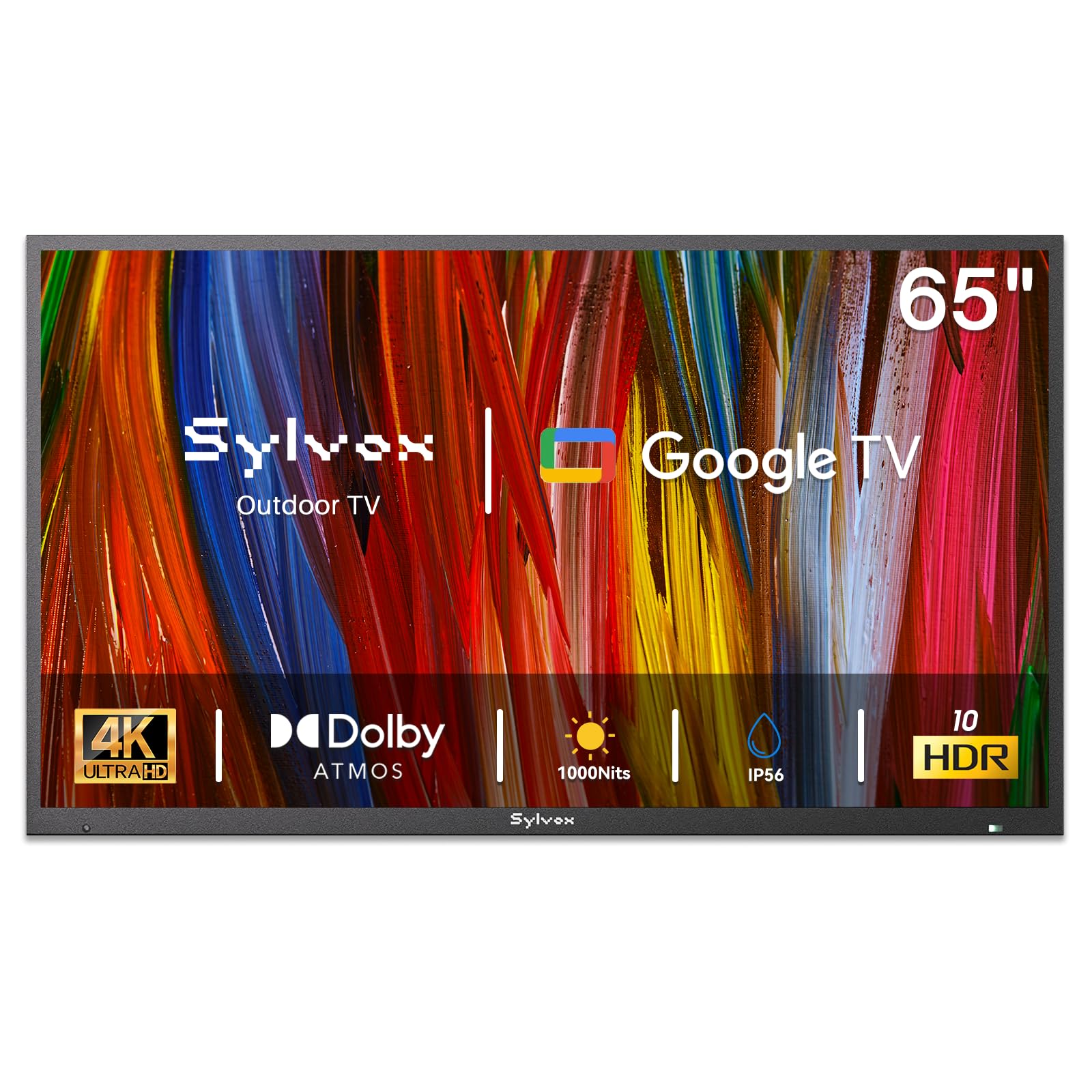
The SYLVOX Deck Pro 3.0 is engineered specifically for shaded outdoor environments like covered patios, screened porches, and gazebos. Its panel hits 1000 nits peak brightness — about triple a standard indoor TV — which compensates for ambient light bouncing off surfaces. The IP56 rating means it withstands rain, dust, and temperature swings from -22°F to 122°F.
The anti-glare coating on this model uses a multi-layer treatment that reduces reflection by roughly 85% compared to glossy indoor panels. While 1000 nits is sufficient for shaded areas, direct sunlight will still wash out the image noticeably. The internal cooling fan runs continuously during operation to dissipate heat from the metal housing, and its noise level is noticeable in quiet environments but masked by outdoor background noise.
Google TV runs the smart interface with support for Chromecast and Google Assistant. The sound system outputs adequate volume for outdoor spaces but lacks low-end presence, and most users will want an outdoor-rated soundbar for movie watching. The remote has a weather-resistant coating, but it is not waterproof — keep it stored indoors or in a dry case when not in use.
Why it’s great
- IP56 rating handles rain, dust, and extreme temperatures.
- 1000 nits brightness is effective in shaded outdoor spaces.
- Multi-layer anti-glare reduces reflections significantly.
Good to know
- Full sunlight still overwhelms the image — shade is required.
- Internal cooling fan emits audible noise.
- Remote is splash-resistant but not fully waterproof.
10. SYLVOX Outdoor TV Pool Pro 3.0 75 Inch
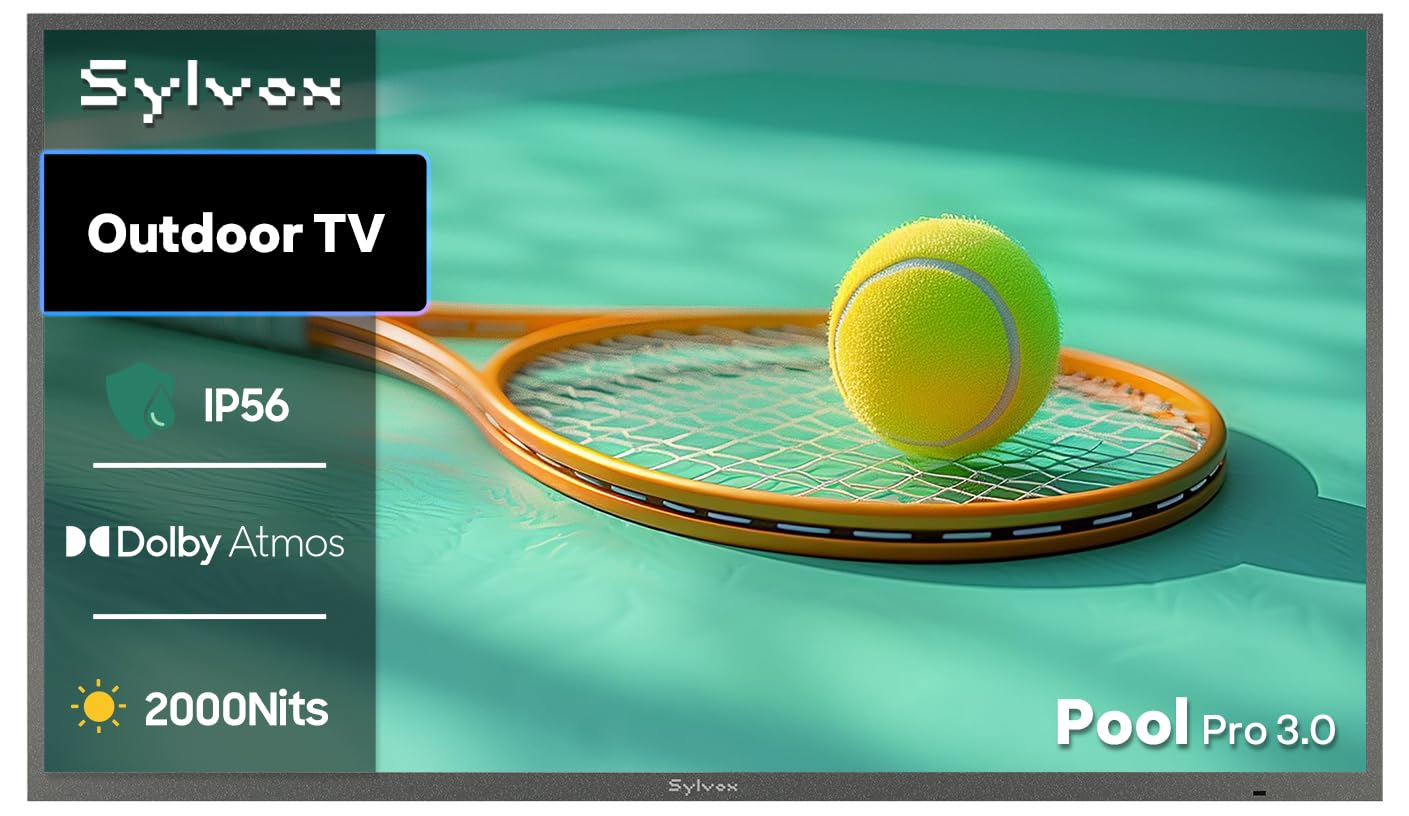
The Pool Pro 3.0 is the direct-sunlight solution, delivering 2000 nits peak brightness — roughly five times a standard indoor TV. This output is high enough to overcome direct sunlight, making the screen watchable even at midday on an unshaded patio or poolside. The panel uses a direct LED backlight with a high-contrast ratio to compensate for the increased brightness, though black levels are not as deep as Mini-LED or OLED.
Build materials include scratch-resistant aluminum and a fully sealed all-metal chassis. The TV is rated for continuous 7-16 hour commercial daily use in venues like restaurants and sports bars. The internal components are potted and gasketed against moisture ingress, and the unit has been tested for mold resistance — though one reported case of internal mold between screen layers after a year suggests the seal can degrade over time in very humid climates.
Dolby Atmos audio processing is included, but the built-in speakers are tuned for outdoor environments and prioritize volume over fidelity. Multiple HDMI, USB, and VGA ports provide flexibility for cable boxes, streaming sticks, or media players. The remote is basic and requires a clear line of sight to the IR sensor, which can be problematic if the TV is mounted high on a wall.
Why it’s great
- 2000 nits brightness is viewable in direct, unshaded sunlight.
- Scratch-resistant aluminum housing is durable for commercial use.
- IP56 rating with gasketed seals resists weather.
Good to know
- Reported mold case suggests seal durability varies by climate.
- Direct LED panel means black levels are not as deep as Mini-LED.
- Remote requires line-of-sight IR which is restrictive for high mounts.
11. INSIGNIA 75-inch Class F50 Series

The INSIGNIA F50 is an entry-level 4K LED TV designed for buyers who prioritize size over panel sophistication. The Fire TV platform is built-in, offering the same Alexa voice control and app ecosystem as Amazon’s Fire TV Stick. HDR10 support is included but peak brightness hovers around 250-300 nits, so HDR effect is subtle — specular highlights do not punch, and shadow detail crushes in dark scenes.
The DTS Virtual-X audio processing attempts to simulate surround sound from the dual downward-firing speakers. The effect widens the soundstage slightly but cannot replace physical separation. The 60Hz panel with a standard 60Hz refresh rate shows judder during fast camera pans, and motion interpolation is not available to smooth it out. The remote runs on AAA batteries and features dedicated buttons for Prime Video, Netflix, Hulu, and Disney+.
Customer feedback is polarized: many report the picture quality exceeds expectations at the price, while others describe software instability including update loops and app freezes. The user interface can feel sluggish compared to a separate Fire TV Stick 4K Max, and the TV lacks the processing power to run the Fire OS smoothly when multiple apps are open. This is a functional large-screen option for casual viewing but carries reliability risk for daily use.
Why it’s great
- 75-inch screen at the most accessible price point.
- Fire TV platform with Alexa voice control built in.
- DTS Virtual-X widens the soundstage for movies.
Good to know
- Peak brightness around 250 nits limits HDR impact.
- Software stability issues reported with update loops and app freezes.
- 60Hz panel shows judder during fast motion.
FAQ
What size 4K TV should I buy for my room?
Is Dolby Vision support essential for streaming?
Can I use a 60Hz 4K TV for gaming on a PS5?
What panel type is best for a bright living room?
Final Thoughts: The Verdict
For most users, the best 4k tv winner is the Samsung S90F because its QD-OLED panel combines deep blacks, high color volume, and 144Hz gaming in one package. If you want Dolby Vision IQ support and four full-bandwidth HDMI 2.1 ports, grab the LG C5. And for a bright outdoor space without shade, nothing beats the SYLVOX Pool Pro 3.0 with its 2000 nits full-sun brightness.