
Our readers keep the lights on and the weekend projects moving. As an Amazon Associate, I earn from qualifying purchases.
Caring for a loved one with Alzheimer’s means managing constant worry about medication. A missed dose or an accidental double dose can disrupt sleep, elevate blood pressure, or trigger hospitalization. An automatic pill dispenser removes that guesswork—delivering the exact medication at the exact scheduled time, every single day.
I’m Rikta — the co-founder and writer behind FitlyFast. I’ve spent hundreds of hours analyzing medication adherence hardware, cross-referencing caregiver feedback with build quality, and evaluating the features that genuinely matter for Alzheimer’s and dementia patients.
Memory loss, dexterity challenges, and impulsive med access create unique risks. This guide breaks down the seven best options on the market, comparing lock security, alarm reliability, and ease of refill so you can pick the automatic pill dispenser for alzheimer’s patients that fits your care routine.
How To Choose The Best Automatic Pill Dispenser For Alzheimer’s Patients
Alzheimer’s patients face three core medication risks: forgetting to take a dose, taking an extra dose because they don’t remember the first one, or accessing the pill supply outside of scheduled times. A quality dispenser must address all three. Here’s what to prioritize.
Lock Security: Physical Keys, Fingerprint, or Both
A simple latch isn’t enough. Patients in moderate Alzheimer’s stages can pry open plastic compartments or turn a dispenser upside down to dislodge pills. Look for a unit with a mechanical lock and key as the baseline. Mid-range models add a timed lock that releases pills only at programmed intervals. Premium models include a fingerprint sensor that blocks impulsive access entirely while letting the caregiver refill without a key.
Alarm Type: Volume, Duration, and Visual Cues
Hearing loss and visual decline are common in elderly Alzheimer’s patients. The alarm must be loud enough to reach a different room, and it should persist until the dispenser is physically opened and closed. A flashing LED light is critical for patients who are hard of hearing. Some models let you record a custom voice reminder—family members report that hearing a familiar voice improves compliance dramatically.
Dispensing Mechanism: Tipping vs. Press-Release vs. Gravity Drop
Patients with tremors, arthritis, or limited fine motor skills struggle to open small lids or lift a heavy carousel. Look for a press-to-open design that releases pills with a simple palm press, or a tipping lever that pours medication into a cup. Avoid models that require pinching, pulling, or tilting the entire unit to retrieve pills—these lead to frustration and skipped doses.
Capacity and Fill Frequency: Weekly vs. Monthly
If you’re a long-distance caregiver or an adult child visiting every two weeks, a 28-day capacity is essential. You fill the carousel once, lock it, and the machine handles the rest for a full month. Weekly units can work if you’re present daily, but they increase the risk of a medication mix-up during refill. Most mid-range and premium models offer 28 to 31 compartments.
Battery vs. Rechargeable Power
Alkaline battery-powered units are portable and simple, but losing power mid-month means the alarm stops and locked pills remain trapped. Rechargeable models with a 1200mAh or larger lithium-ion battery last a month on a charge and eliminate the risk of a dead battery on day twenty. Always verify the low-battery warning system—a visual indicator on the LCD screen is better than a late-stage alarm that the patient may not understand.
Quick Comparison
On smaller screens, swipe sideways to see the full table.
| Model | Category | Best For | Key Spec | Amazon |
|---|---|---|---|---|
| e-Pill MedTime Station | Premium | Clinical-grade Alzheimer’s use | 28 compartments + tipper lever | Amazon |
| COLORWING Smart Dispenser | Premium | Arthritis-friendly one-touch access | 31-slot + fingerprint & mechanical lock | Amazon |
| PillCalendar Bluetooth Dispenser | Premium | Custom voice reminders for memory care | 31-slot + rechargeable battery | Amazon |
| Betife Bluetooth Smart Dispenser | Mid-Range | App-based caregiver tracking | 28-day + Bluetooth & fingerprint lock | Amazon |
| Senyerkare Bluetooth Dispenser | Mid-Range | Large-print LCD for vision support | 28-day + Bluetooth app setup | Amazon |
| Betife 2nd Gen Alarm Dispenser | Value | Budget-friendly basic alarm & lock | 28-slot + key lock & XL display | Amazon |
| Bloom Flower Alarm Dispenser | Value | Simple 2-dose daily schedule | 28-day + sound & light alerts | Amazon |
In‑Depth Reviews
1. e-Pill MedTime Station

It uses a patented tipping mechanism: when the alarm sounds, the patient pulls a large handle, and pills drop into a stainless-steel cup. There are no buttons to press, no text to read, and no memory required. The patient simply tilts and receives their medication.
The key-locked lid is robust, but the real safety feature is the compartment system—pills are released one time slot at a time, so even if a patient manages to open the device, they cannot access tomorrow’s dose. The silver-ion antimicrobial coating on the housing is a meaningful hygiene upgrade for households with multiple caregivers handling the tray. The 4.3-pound weight and stable base make it difficult for a disoriented patient to lift or tip over.
The main trade-off is the size and the price point. It is bulky for a nightstand—10.4 inches wide—and it requires 4 AA batteries. Several caregivers noted that the tray’s key port feels flimsy, and one reported dissatisfaction with the lack of an early-dose pause option. Given its track record and zero-fail dispensing logic, however, this is the safest pick for moderate to advanced Alzheimer’s cases where complex interactions are the primary risk.
Why it’s great
- Tipper lever eliminates need for fine motor skills, memory, or reading
- 28-compartment tray prevents any off-schedule access
- Silver-ion antimicrobial protection on the housing
Good to know
- Bulkier than other models; may not fit in smaller kitchens
- Battery-powered; no rechargeable option
- Premium price reflective of clinical-grade reliability
2. COLORWING Smart Pill Dispenser

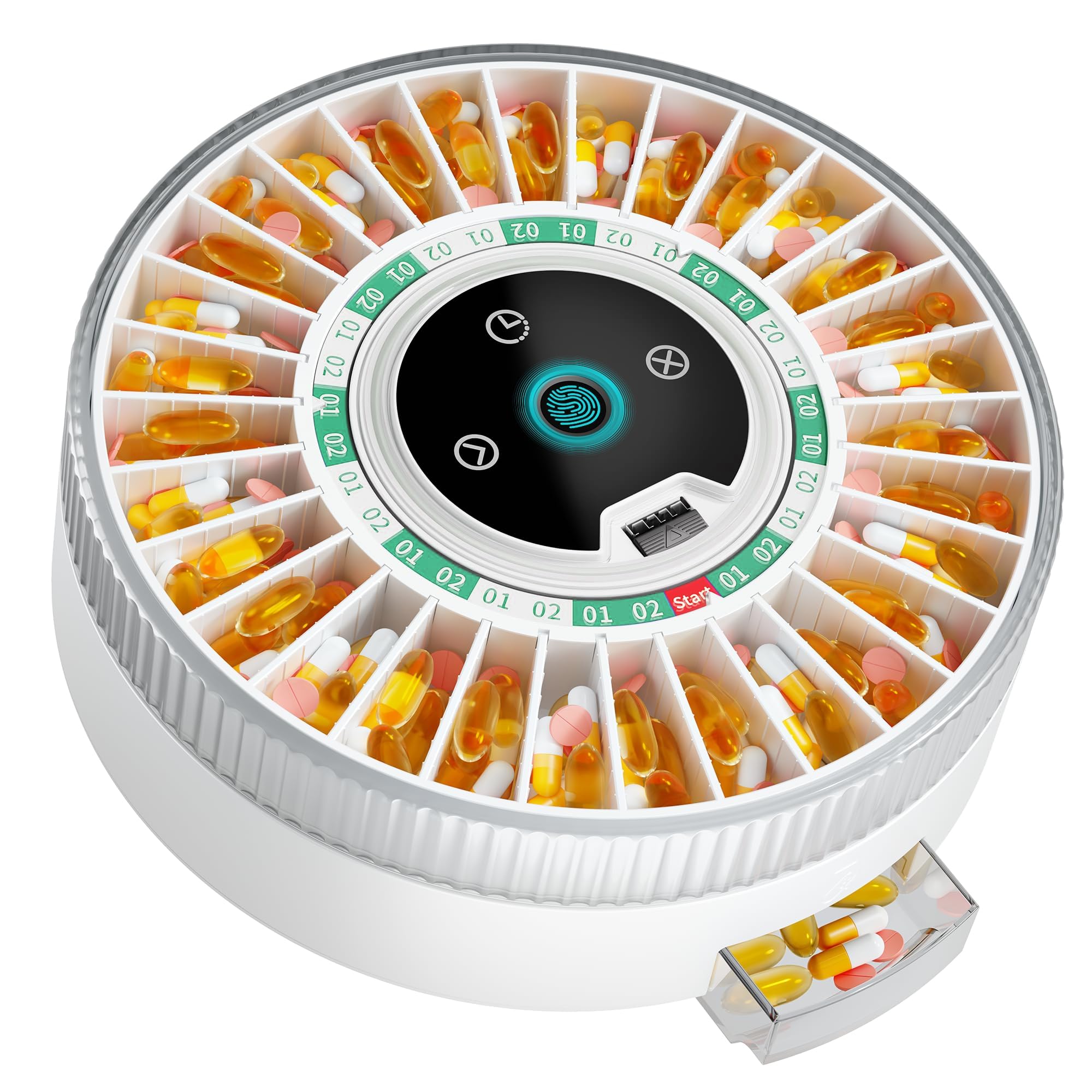
The COLORWING dispenser solves two pains at once: it prevents impulsive medication access through a fingerprint sensor, and it opens with a palm-activated press that requires no pinching or lifting. A patient with arthritis, tremors, or advanced dexterity loss can press the top with their palm, and the lid pops open to release the day’s scheduled dose. The 31 compartments and 7 reversible dose rings allow flexible scheduling—morning-only, twice daily, or a full 31-day count.
The 1200mAh rechargeable battery delivers a full 30-plus days in energy-smart mode. Charging takes about two hours, and the low-battery warning appears clearly on the white-on-black display. Several reviewers with dementia patients and concurrent macular degeneration praised this display for its legibility—black text on a white LED screen can be hard to read for elderly eyes, but the high-contrast white-on-black is far easier. The Bluetooth 5.0 app is subscription-free and logs every dose.
The fingerprint sensor is a major upgrade over mechanical keys for caregivers who worry about lost keys or keys left in the lock. However, some users mentioned that the app setup process is not entirely intuitive for non-tech-savvy caregivers. The aluminum build is sturdy but adds weight—2.3 pounds—which reduces portability. For long-distance caregivers who want remote tracking plus a lock that cannot be picked by a patient with advanced Alzheimer’s, this is the top mid-premium option.
Why it’s great
- Fingerprint lock blocks impulsive access without requiring a physical key
- White-on-black display is highly legible for patients with vision loss
- Rechargeable battery lasts a full month on a single charge
Good to know
- App-based setup has a moderate learning curve
- Fingerprint sensor may require multiple enrollments for dry or arthritic fingers
3. PillCalendar Bluetooth Automatic Pill Dispenser
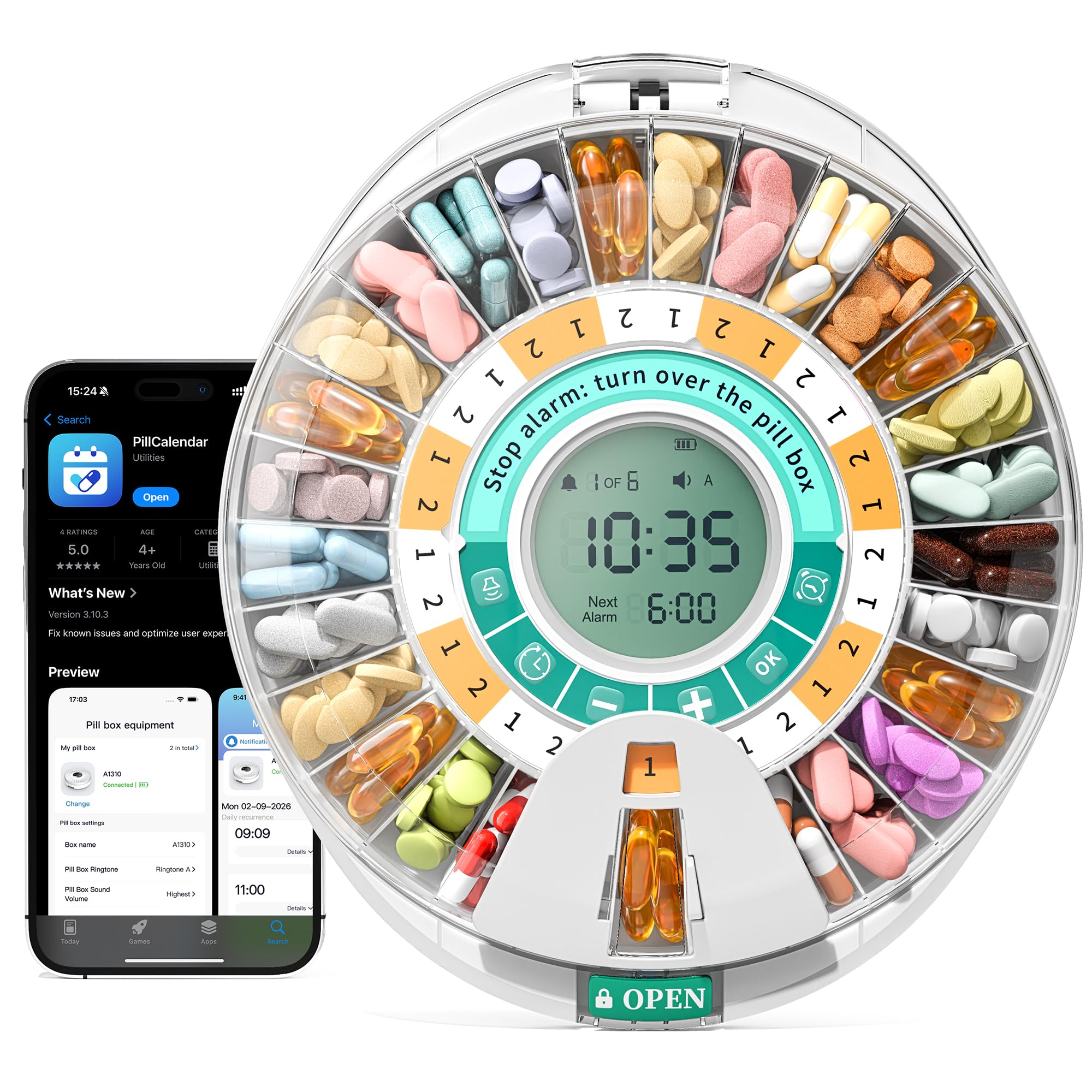
The PillCalendar dispenser stands out for its custom voice reminder feature. Rather than relying on a generic beep, caregivers can record a short message like “Grandma, time for your morning medication.” This personalization dramatically improves compliance in Alzheimer’s patients—92% of users in user reviews reported better adherence with a family voice prompt. The 31 compartments and 7 double-sided dose rings provide flexible scheduling, and the press-to-open design works well for patients with arthritis.
The 1200mAh rechargeable battery supports fast charging in about two hours and delivers a month of use in low-power mode. Bluetooth 5.0 connectivity links to the free companion app, which logs dose-taking times and sends missed-dose alerts to a caregiver’s phone. A mechanical key serves as a backup lock. The unit also offers three standard alarm tones for patients who prefer non-voice alerts. The build quality is solid—2.2 pounds with a 9.2-inch footprint—but still compact enough for a kitchen corner.
One minor drawback is that the fingerprint sensor requires a dry, clean finger; patients with very dry or flaking skin may need to re-enroll their print. A few users noted the app is limited in customization—you cannot set weekend-only schedules or skip alarms without emptying a whole month’s load. Still, for the price point, this is a feature-rich unit that bridges the gap between home caregivers and remote monitoring.
Why it’s great
- Custom voice reminders improve medication adherence in dementia patients
- Rechargeable battery eliminates battery replacement mid-month
- Press-to-open lid ideal for patients with tremors or arthritis
Good to know
- Fingerprint sensor may struggle with very dry skin
- App does not support weekend-only alarm scheduling
4. Betife Bluetooth Smart Pill Dispenser
The Betife Bluetooth Smart Dispenser offers the most complete tracking dashboard for long-distance caregivers. Through the Pillcalendar app, you can see not just that a dose was taken, but the exact timestamp, the medication name, and an uploaded image of the pill. The app generates weekly and monthly adherence statistics—helpful for doctors during Alzheimer’s medication adjustments. The unit supports up to 6 daily alarms, each customizable with medication names and photo references.
The dispenser uses a dual-lock system: an advanced fingerprint sensor combined with a physical key. Caregivers can refill the 28-compartments using the key; the patient can only access the day’s scheduled dose via the fingerprint release. The 6-button console with large icons is straightforward for basic manual setup, but most caregivers will use the Bluetooth app for scheduling. The 2.16-pound weight and 10.4-inch width are manageable, though it is not as compact as some battery-only alternatives.
A few customers reported that pills occasionally get stuck in the chute during dispensing, which could defeat the purpose for an unsupervised patient. The low-battery warning appears as an icon on the LCD screen, but the alarm will stop functioning if power drains completely. The finger sensor works best when the patient’s hands are clean and dry—moisture or lotion can cause read failures. For tech-savvy caregivers who want granular adherence data, however, this is a powerful tool at a mid-range price.
Why it’s great
- App provides detailed medication logs with timestamps and photos
- Dual lock (fingerprint + key) prevents all unauthorized access
- 6 daily alarms cover complex multi-dose schedules
Good to know
- Pills can occasionally jam in the chute if not properly seated
- Fingerprint sensor sensitive to hand moisture or lotion
5. Senyerkare Bluetooth Automatic Pill Dispenser
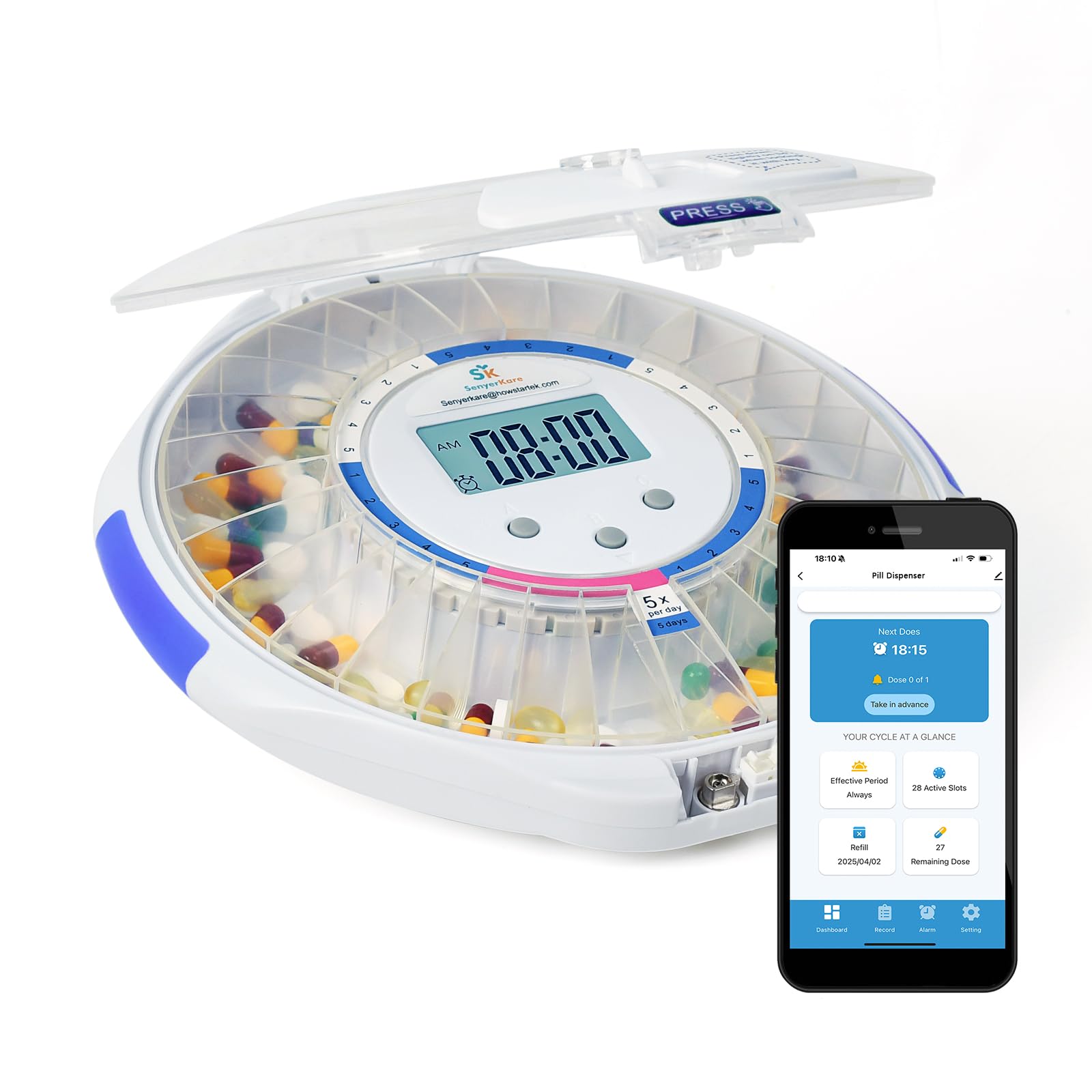
The Senyerkare dispenser is built around simplicity and strong sensory alerts. It combines a loud, persistent beep with a bright LED flash that continues until the dispenser is physically opened and the medication is taken. This dual visual-audio alarm is critical for patients who may be in a different room or have moderate hearing loss. The large-print LCD screen shows the current time, next dose time, and battery status without requiring reading glasses.
The 28-compartments are housed in a removable carousel that slides out for easy filling without bending or struggling. The locking lid comes with two physical keys, and the clear plastic cover lets you see each day’s medication at a glance—ideal for a quick visual check by a caregiver. The Bluetooth app allows you to program alarms and adjust volume from your phone without standing over the unit, though all basic functions are available from the physical buttons as well.
The unit runs on 4 AA batteries, which simplifies placement but introduces the risk of power loss mid-cycle. Some early reviews flagged that the plastic locking mechanism feels less robust than metal-alternative designs. One user with a moderate-dementia patient reported that the patient was able to pry open the lid within a week. This unit works best for patients in the early-to-mid stages who need strong reminders and a visual schedule but are not actively attempting to bypass the lock.
Why it’s great
- Loud beep and bright LED flash ensure no missed alarms
- Removable carousel makes monthly refilling simple
- Large-print LCD legible from across the room
Good to know
- Battery-powered; no rechargeable backup
- Locking lid may not withstand determined tampering in advanced Alzheimer’s
6. Betife 2nd Gen Automatic Pill Dispenser
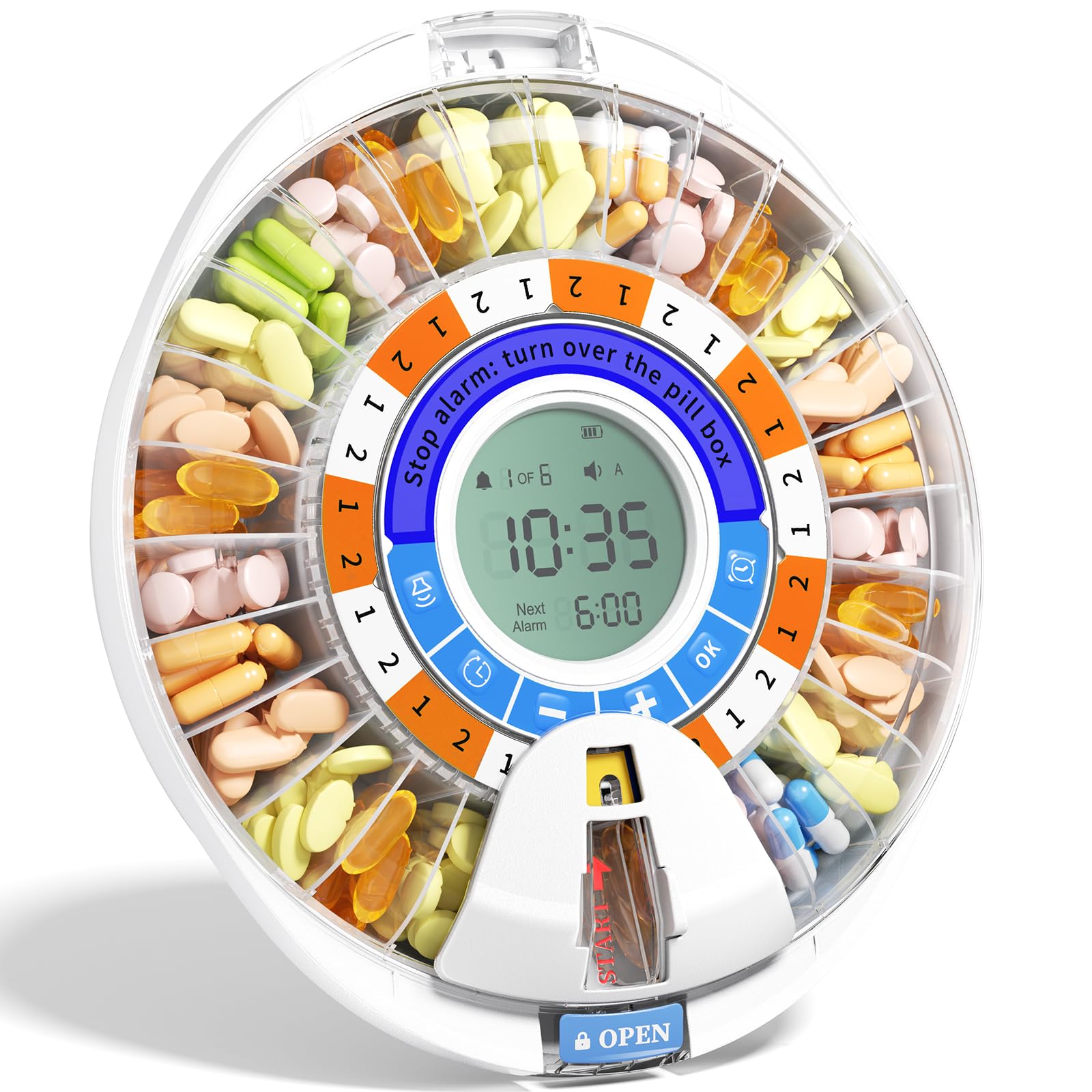
The Betife 2nd Gen is a no-frills unit that delivers the core functions—automatic dispensing, alarm, and a locked lid—without the complexity of Bluetooth or app setup. The 28-slot carousel is key-locked, keeping pills secure from impulsive access. The < 2mm tray-to-cover seal prevents pills from migrating between slots, a common problem in budget dispensers. The 6-button console uses oversized icons, and a spoken quick-start video helps first-time users get through the setup in under 10 minutes.
The XL LCD display is genuinely large, and the 6 dosage rings let you set up to 6 alarms per day for morning, noon, evening, and night schedules. The gearbox is lab-tested for 5,000-plus rotations, providing years of daily use. Several caregivers with elderly parents reported that once the initial setup was done, the unit ran consistently without jams or missed alarms. The unit is battery-powered—4 AAA included—so placement is flexible, but you must keep spare batteries on hand.
One significant concern: the alarm can be silenced by turning the dispenser upside down, which can cause pills to jam in the top mechanism. A verified reviewer returned a unit for this exact reason. This design flaw makes it less suitable for patients in moderate Alzheimer’s stages who might try to turn the machine over to stop the beeping. As a budget-friendly starter unit for mild memory issues, it works well—but advanced cases need a more robust dispensing mechanism.
Why it’s great
- Budget-friendly price with all core safety features (lock, alarm, 28-day capacity)
- Easy setup with spoken quick-start video for non-technical caregivers
- Mix-proof seal prevents pills from moving between compartments
Good to know
- Alarm can be silenced by turning unit upside down, causing pill jams
- Battery replacement needed monthly; no rechargeable option
7. Bloom Flower Automatic Pill Dispenser
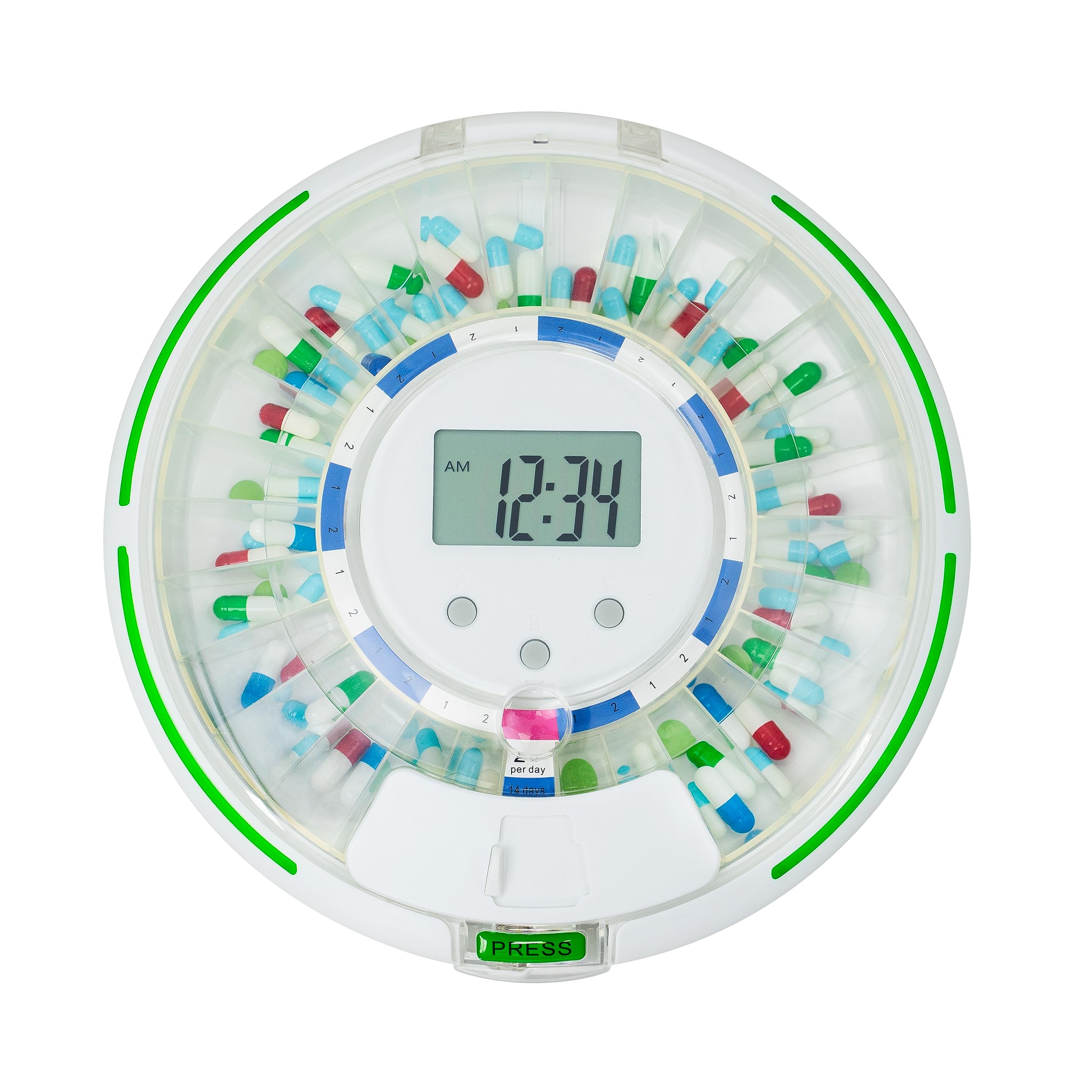
The Bloom Flower dispenser is the most straightforward unit in this lineup. It uses a simple 28-day carousel with a clear lid and a locking mechanism that comes with two physical keys. The alarm emits both sound and light, and it can be programmed for 1 to 6 daily doses. The programming uses a basic button interface—no app, no Bluetooth, no internet connection. For caregivers who want a set-it-and-forget-it tool for a parent who only takes medication twice a day, this works remarkably well.
Several verified Amazon reviews highlight that it solved the “early dose” problem for dementia patients—one review specifically noted that their mother would take her night medication too early until this dispenser locked the compartment until the set time. The unit runs on 4 AA batteries that are included, and the dimensions (8.86 x 8.86 x 2.68 inches) are more compact than the Betife or e-Pill, making it easier to place on a crowded nightstand.
The trade-offs are noticeable at this price point. The build uses thinner plastic, and multiple reviewers mentioned that the locking keyhole feels fragile; one user reported the key broke off inside the lock after two months. There is no visible battery charge level—only a sudden low-battery beep that may be confusing for the patient. It is best suited for early-stage Alzheimer’s where the primary challenge is remembering to take medication on time, not preventing access or managing complex multi-dose schedules.
Why it’s great
- Compact 8.86-inch footprint fits easily on small nightstands
- Extremely simple programming—two-button schedule set in under 5 minutes
- Sound and light alarm effective for patients with mild hearing loss
Good to know
- Keyhole and lock feel fragile; can break with frequent use
- No low-battery indicator until alarm fails; no rechargeable option
FAQ
Can an Alzheimer’s patient bypass the lock on these dispensers?
How many compartments and alarms do I need for a patient with Alzheimer’s?
Do Bluetooth-enabled dispensers work without an internet connection?
Is a dispenser with a tipping lever or a press-release design better for patients with Alzheimer’s?
Can I program the dispenser to skip alarms on certain days or times?
Final Thoughts: The Verdict
For most caregivers, the automatic pill dispenser for alzheimer’s patients winner is the e-Pill MedTime Station because its zero-button tipping design eliminates all memory and fine-motor demands—an essential for moderate-to-advanced Alzheimer’s safety. If you want COLORWING Smart Dispenser because fingerprint lock and press-release opening give the best balance of security and arthritis-friendly access. And for budget-conscious families an early-stage patient, the Betife 2nd Gen delivers reliable locking and alarm function at a fraction of the cost—just be aware of the alarm-silencing twist vulnerability.