
Our readers keep the lights on and the weekend projects moving. As an Amazon Associate, I earn from qualifying purchases.
That first moment you lift a pair of binoculars to your eyes on a trail — and instead of a crisp feather detail, you get a wobbly, dim image that leaves you squinting — is the exact moment most new birders wonder if they made a mistake. The right pair erases that struggle entirely, turning a blurry mess into an instant, rock-steady view of a warbler thirty yards away.
I’m Rikta — the co-founder and writer behind FitlyFast. I’ve spent months studying optical specifications, comparing lens coatings, and analyzing how build materials affect the real-world experience for someone just getting started in birding.
This guide breaks down what magnification, objective lens size, prism type, and waterproofing actually mean when you’re holding the binoculars in your hands, so you can confidently pick the right tool for your first season in the field. We have curated a list of the best birding binoculars for beginners.
How To Choose The Best Birding Binoculars For Beginners
A beginner binocular is a compromise between optical quality, weight, durability, and cost. The right choice makes birding enjoyable from day one; the wrong choice leads to eye strain, shaky views, and a quick return to Amazon. Here are the three most important decisions you will make.
Magnification and Objective Lens Size
The two numbers on every binocular — for example, 8×42 — tell you everything about its basic character. The first number (8x) means objects appear eight times closer than they do with the naked eye. The second number (42mm) is the diameter of the front objective lens, which determines how much light enters. For beginners, 8×42 is the gold standard: 8x magnification is steady enough to hold without a tripod, and the 42mm objective gathers enough light for dawn and dusk viewing. A 10×42 offers more reach but magnifies hand shake, making it harder to hold steady without practice.
Prism Type and Lens Coatings
Almost all modern birding binoculars use roof prisms, which allow a straight, compact body shape. Within roof prisms, the glass type matters: BAK4 prisms deliver a round, bright exit pupil, while cheaper BK7 prisms produce a square, dimmer image. Lens coatings are equally critical. Fully multi-coated (FMC) optics apply multiple anti-reflective layers to every glass surface, increasing light transmission and reducing glare. Premium models add phase-correction and dielectric coatings on the prisms to maximize resolution and color accuracy.
Weight, Waterproofing, and Eye Relief
A beginner will carry binoculars around their neck for hours. Weight above 1.5 pounds becomes fatiguing quickly. Look for models under 1.3 pounds if possible. Waterproofing and fog-proofing (via nitrogen or argon purging) are essential if you bird in rain, near water, or during temperature changes. Eye relief — the distance your eye can be from the eyepiece while still seeing the full field — matters especially if you wear glasses. An eye relief of 15mm or more is comfortable for eyeglass users.
Quick Comparison
On smaller screens, swipe sideways to see the full table.
| Model | Category | Best For | Key Spec | Amazon |
|---|---|---|---|---|
| Nikon PROSTAFF P7 10×42 | Premium | Bright, crisp optics with dielectric coating | Dielectric high-reflective prism coating | Amazon |
| PEIKETAO ED HD 8×42 | Premium | Extra-low dispersion glass for color accuracy | ED glass, magnesium alloy body | Amazon |
| Bushnell H2O Xtreme 10×42 | Premium | Rugged waterproof build for wet conditions | Fully multi-coated, BAK4 prisms | Amazon |
| Vortex Triumph HD 10×42 | Mid-Range | Unconditional lifetime warranty and HD optics | HD optical system, fully multi-coated | Amazon |
| Gosky 8×42 Roof Prism | Mid-Range | Complete kit with phone adapter and tripod | IPX7 waterproof, BAK4 prism, FMC | Amazon |
| CronyOptics 8×42 | Budget | Lightweight entry-level all-weather binocular | Waterproof, shockproof, 1.2 pounds | Amazon |
| Sogries 10-30×50 Zoom | Budget | Variable zoom for distant and wide-angle views | Zoom 10-30x, 50mm objective, BAK4 | Amazon |
In‑Depth Reviews
1. Nikon 10×42 PROSTAFF P7

The Nikon PROSTAFF P7 sits at the top of the list because it delivers the kind of image quality that makes a beginner feel like a pro — bright, sharp, and color-accurate across the entire field. The dielectric high-reflective multilayer prism coating maximizes light transmission, so early-morning warblers and late-evening thrushes pop with detail even in low light. The fiberglass-reinforced polycarbonate body with rubber armor keeps the weight low while absorbing drops and bumps on a trail.
The 10×42 configuration gives a bit more reach than the standard 8x, which can be useful for spotting birds perched high in canopy or across a field. The locking diopter ring holds your focus setting securely, preventing accidental drift during a walk. The turn-and-slide eyecups provide 15.7mm of eye relief, which works comfortably for most eyeglass wearers. The included case and neck strap are functional, but the real value is in the optical performance that rivals much more expensive glass.
For a beginner who wants a pair that will still feel capable after years of birding, the PROSTAFF P7 is the smartest investment. It avoids the common trap of outgrowing a cheaper model within months, yet it stays within a reasonable budget for a serious first binocular.
Why it’s great
- Exceptional brightness from dielectric prism coating
- Lightweight body with rugged rubber armor
- Locking diopter prevents accidental adjustment
Good to know
- 10x magnification can exaggerate hand shake for new users
- Eye relief of 15.7mm may be tight for some eyeglass wearers
2. PEIKETAO ED HD 8×42
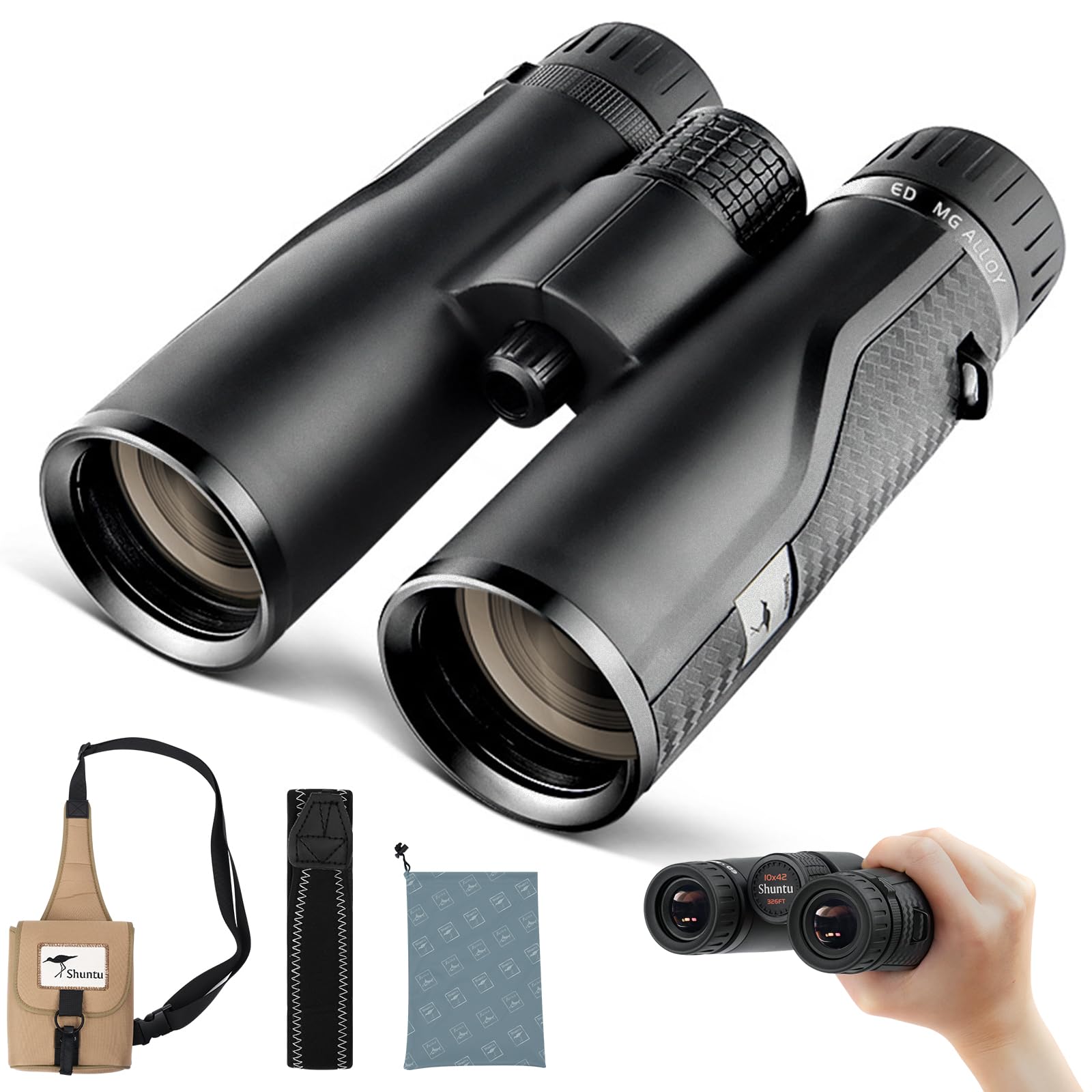
The PEIKETAO ED HD 8×42 stands out for its use of Extra-low Dispersion (ED) glass, a feature usually reserved for binoculars costing two to three times as much. ED glass virtually eliminates chromatic aberration — that purple or green fringe you sometimes see around high-contrast edges like a bird against a bright sky. The result is a clean, color-true image that makes feather details pop. Phase-coated BAK4 prisms with dielectric coating push light transmission to over 98 percent, giving you a bright view even in shaded forest understory.
The magnesium alloy body is a significant upgrade over standard polycarbonate or aluminum — it is lighter and more thermally stable, so the binoculars stay comfortable during a long morning walk and resist fogging in temperature swings. At 1.5 pounds, it is slightly heavier than the lightest models, but the balance feels good in the hands. The large 24mm eyepieces offer a generous field of view (393 feet at 1000 yards), which helps track fast-moving birds like swallows or flycatchers.
Argon purging (instead of nitrogen) gives the PEIKETAO a wider operating temperature range, a detail that matters if you bird in cold climates. The twist-up eyecups with 18mm of eye relief are comfortable for glasses wearers. This is a premium-tier optic at a mid-range price, making it a standout choice for a beginner who values optical purity.
Why it’s great
- ED glass eliminates color fringing
- Magnesium body is lightweight and durable
- Argon purging for extreme temperature performance
Good to know
- Edge softness visible in peripheral vision
- Carrying case is snug, strap is basic
3. Bushnell H2O Xtreme 10×42

Bushnell has been a staple in outdoor optics for over 70 years, and the H2O Xtreme 10×42 continues that reputation with a design focused on wet-weather reliability. The O-ring sealed, nitrogen-purged body is fully waterproof and fog proof, so you can bird in steady rain or near a misty marsh without worrying about internal fogging. The rubber armor provides a secure grip even with wet hands, and the BAK4 prisms paired with fully multi-coated optics deliver a clear, bright image that outperforms its price point.
The 10×42 configuration offers strong magnification for scanning distant tree lines or shorebirds, and the field of view is wide enough to track moving targets. The included case and padded neck strap are solid, and the tethered lens covers are a nice touch for quick access. One important caveat: this model (181042C) does not have a tripod adapter socket, so if you plan to mount the binoculars for extended glassing, you will need to look at a different model or use an aftermarket adapter.
For a beginner who birds in variable weather — coastal wetlands, rainy forests, or boat trips — the H2O Xtreme is a durable, trustworthy companion. The optical quality is good enough to enjoy the hobby without frustration, and the price leaves room in the budget for other gear.
Why it’s great
- Fully waterproof and fog-proof for wet conditions
- BAK4 prisms with fully multi-coated lenses
- Secure rubber grip even when wet
Good to know
- No tripod adapter socket
- Neck strap can feel uncomfortable over long periods
4. Vortex Triumph HD 10×42

Vortex has built a loyal following among outdoor enthusiasts largely because of its VIP Warranty — an unlimited, unconditional, lifetime promise to repair or replace your binoculars if they are damaged or defective. For a beginner, that kind of guarantee removes the fear of a costly mistake, especially when learning how to handle and store optics. The Triumph HD 10×42 is a full-size binocular with an HD optical system and fully multi-coated lenses that deliver excellent resolution, reduced chromatic aberration, and good color fidelity for the price.
The polycarbonate chassis with full rubber armor is shockproof and provides a firm grip. Nitrogen purging makes it waterproof and fog-proof. The adjustable rubber eyecups with 17mm of eye relief work well for most users, and the adjustable diopter allows you to fine-tune the focus to your eyes. The kit includes a neck strap and a GlassPak harness, which distributes weight across your shoulders for more comfortable carrying during long hikes.
While the 10×42 configuration is versatile, the image is not quite as bright or edge-to-edge sharp as the Nikon PROSTAFF P7 or the Bushnell H2O Xtreme. But for a beginner who wants absolute peace of mind with their purchase, the Vortex Triumph HD is a very strong choice. The warranty alone makes it worth considering.
Why it’s great
- Unlimited, unconditional lifetime warranty
- HD optics with fully multi-coated lenses
- Includes GlassPak harness for comfortable carry
Good to know
- Image quality is good but not best-in-class
- Harness can feel cumbersome for quick use
5. Gosky 8×42 Roof Prism Binoculars

The Gosky 8×42 is a thoughtfully packaged kit that includes everything a beginner needs to start birding and sharing their sightings: binoculars, a universal smartphone adapter, a tripod, a tripod adapter, a carrying bag, and a lens cloth. For someone just entering the hobby, this eliminates the need to hunt down accessories separately. The binoculars themselves use BAK4 prisms and fully multi-coated optics to produce a solid image with high contrast and resolution, especially in good daylight.
The IPX7 waterproof rating means the binoculars can survive submersion in up to 1 meter of water for 30 minutes, a reassuring spec for rainy days. The body is lightweight at just 1.25 pounds, and the rubber armor provides a secure grip. The long eye relief of 15mm combined with large eyepieces makes them comfortable for eyeglass wearers. The twist-up eyecups allow you to adjust for the best eye placement.
The phone adapter works well for capturing digiscoped photos, though getting a perfectly clear shot requires some practice due to digital zoom noise. The tripod included is basic and functional but not a heavy-duty unit. For a beginner who wants to share their birding moments on social media or a personal journal, the Gosky kit is the most practical all-in-one solution.
Why it’s great
- Includes phone adapter and tripod for easy digiscoping
- IPX7 waterproof for wet conditions
- Lightweight and comfortable for long sessions
Good to know
- Phone photos can be tricky to get sharp
- Tripod adapter screw may require extra pressure to attach
6. CronyOptics 8×42 Binoculars
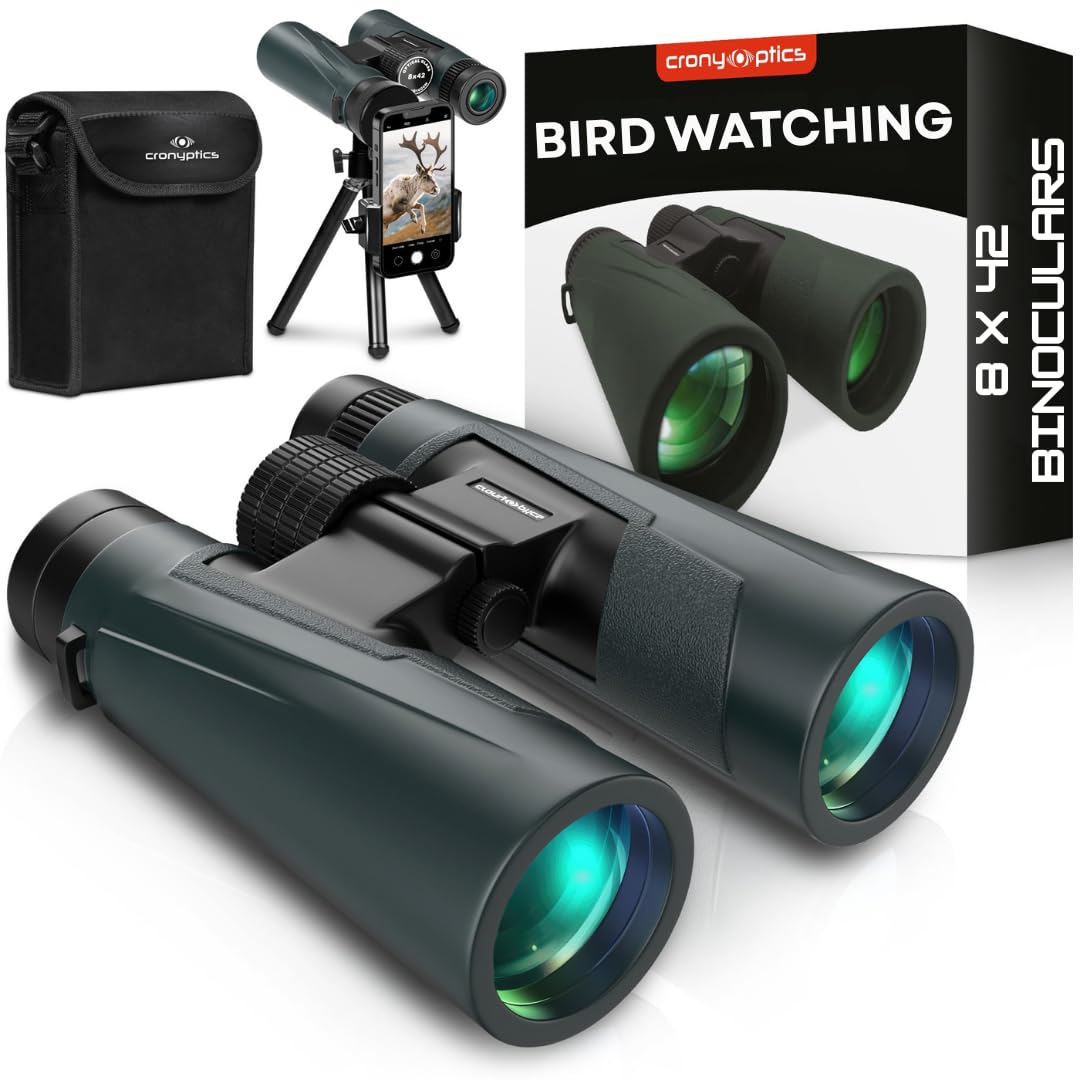
The CronyOptics 8×42 is built around the idea that a beginner binocular should be easy to carry and comfortable to hold for hours. At just 1.2 pounds, it is one of the lightest full-size birding binoculars available, and the roof prism design allows one-handed use when you need to take notes or consult a field guide. The 8x magnification and 42mm objective lenses provide a steady, bright view that is forgiving of hand shake, making it an ideal choice for someone just learning to hold binoculars steady.
The binoculars are waterproof, shockproof, and fog-proof, so they can handle accidental drops and sudden rain showers. The anti-reflective coating on the lenses helps reduce glare and improve contrast in bright conditions. The twist-up eyecups accommodate eyeglass wearers, and the 18mm of eye relief provides a comfortable full-field view. The included kit comes with protective eyecups, a cleaning cloth, and a carry-on bag.
The optical quality is good for the price, but it does not match the brightness or resolution of the higher-tier options like the PEIKETAO or Nikon. The field of view is slightly narrower than some competitors, and the close focus distance is about 15 feet, which may limit butterfly or feeder viewing. For a budget-conscious beginner who prioritizes weight and durability, the CronyOptics is a dependable starting point.
Why it’s great
- Very lightweight at 1.2 pounds
- Waterproof, shockproof, and fog-proof
- 18mm eye relief for eyeglass comfort
Good to know
- Optics are decent but not premium
- Field of view is narrower than some rivals
7. Sogries 10-30×50 Zoom Binoculars
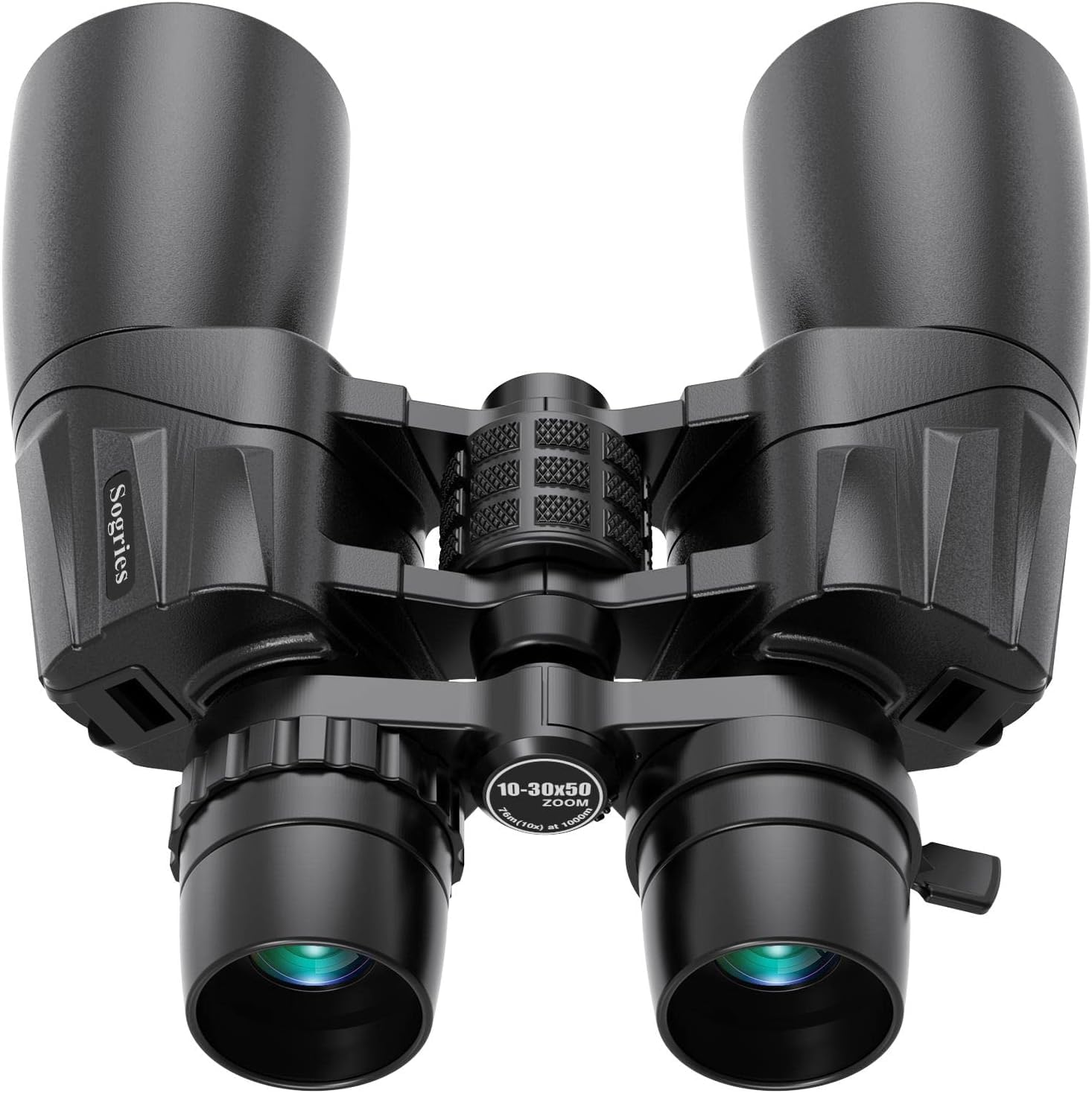
The Sogries 10-30×50 Zoom binoculars offer something unique in this list: variable magnification that lets you zoom from 10x to 30x with a smooth joystick control. This flexibility is useful for birders who want to switch between scanning a wide area at 10x and zeroing in on a distant bird at 30x. The BAK4 prisms and fully multi-coated (FMC) green film lenses provide up to 99.5 percent light transmittance, producing bright, sharp images with good color reproduction in daylight and low-light conditions like twilight.
The 50mm objective lenses gather significant light, which helps with low-light performance, but the trade-off is size and weight — this is a larger, heavier binocular that benefits from tripod use. The manufacturer recommends a tripod for stability at higher magnifications, and the binoculars are tripod-mountable. The rubber armor coating is unscented and provides a non-slip grip. The O-ring sealed, anti-fog coating keeps moisture and dust out.
Variable zoom binoculars are a niche choice for beginners because they introduce moving parts that can fail over time, and the field of view narrows significantly at higher magnification. For a beginner who plans to use the binoculars for multiple activities — birding, concerts, sporting events, stargazing — the Sogries offers versatility that fixed-magnification binoculars cannot match. Just be aware that the weight and the need for a tripod make it less suited for long walking sessions.
Why it’s great
- Variable 10-30x zoom for versatile use
- BAK4 prisms with FMC lenses for bright images
- Waterproof and fog-proof construction
Good to know
- Large and heavy; a tripod is recommended
- Field of view narrows at higher magnification
FAQ
Is 8×42 or 10×42 better for a beginner birder?
What does BAK4 prism mean and why does it matter?
Do I need waterproof binoculars for birding?
Final Thoughts: The Verdict
For most users, the birding binoculars for beginners winner is the Nikon PROSTAFF P7 10×42 because it combines exceptional brightness from its dielectric prism coating with a lightweight, durable build and a reputation for reliability that will last years beyond the beginner stage. If you want the purest optical image quality with ED glass and a magnesium body, grab the PEIKETAO ED HD 8×42. And for a beginner who needs a complete digiscoping kit and a rock-solid waterproof build, nothing beats the Gosky 8×42 with Phone Adapter and Tripod.