
Our readers keep the lights on and the weekend projects moving. As an Amazon Associate, I earn from qualifying purchases.
A 10×42 binocular is the birder’s standard tool—10x magnification brings distant warblers into clear view while the 42mm objective lens gathers enough light for the crucial dawn and dusk feeding hours. The problem is separating genuine optical quality from marketing hype when every spec sheet reads the same. This guide cuts through the noise to find the models that deliver phase-corrected BaK-4 prisms, robust waterproofing, and the kind of edge-to-edge sharpness that makes a kingfisher’s plumage pop.
I’m Rikta — the co-founder and writer behind FitlyFast. I’ve spent hundreds of hours dissecting binocular specifications, cross-referencing real-world user experiences with lab-style lay descriptions of prism coatings, lens elements, and field-flattener designs.
Whether you are upgrading from a budget pair or buying your first serious glass, these picks represent the best of what the market offers right now. I reviewed nine models across every price tier to find the 10×42 binoculars for bird watching that truly reward your investment.
How To Choose The Best 10×42 Binoculars For Bird Watching
Choosing a 10×42 binocular means balancing optical resolution, build quality, and weight for a device you may carry for miles on a trail. The following factors are the most critical for a birder’s specific needs.
Prism Glass and Phase Correction
BaK-4 (Barium Crown) glass is the standard for high-end roof-prism binoculars because its higher refractive index delivers a rounder, brighter exit pupil than the cheaper BK-7 alternative. However, roof prisms require phase-correction coating to prevent light interference that degrades contrast and resolution. Any binocular on this list that skips phase-correction simply cannot deliver the sharp, high-contrast image a birder needs to distinguish a least flycatcher from a willow flycatcher.
Lens Coatings and Light Transmission
Fully multi-coated (FMC) optics apply multiple anti-reflective layers to every air-to-glass surface, pushing light transmission above 90%. At the premium end, dielectric coatings on the prism surfaces reflect over 99% of incoming light, dramatically improving brightness and color fidelity—critical when a tanager is half-hidden in dense canopy shade. The most advanced models use ED (Extra-Low Dispersion) glass to virtually eliminate color fringing on high-contrast edges like a white egret against a dark marsh.
Waterproofing and Fog-Proof Construction
A 10×42 binocular used in the field will face rain, humidity, and temperature swings. O-ring sealed bodies prevent moisture ingress, while internal purging with nitrogen or argon gas eliminates fogging. Argon has a lower thermal conductivity than nitrogen, offering better protection during rapid temperature changes—say, stepping from an air-conditioned car into a humid forest. IPX7-rated models can be submerged in a meter of water for 30 minutes, which is overkill but gives absolute peace of mind.
Eye Relief and Eyecup Design
Birder who wears glasses needs at least 15-17mm of eye relief to see the full field of view without vignetting. Multi-stop twist-up eyecups let you dial in the exact distance from your eye, and models with 17mm+ eye relief generally accommodate most prescription spectacle frames. The wrong eyecup design causes you to constantly readjust or miss the image entirely.
Quick Comparison
On smaller screens, swipe sideways to see the full table.
| Model | Category | Best For | Key Spec | Amazon |
|---|---|---|---|---|
| Nikon MONARCH M7 10×42 | Premium | Low-light birding and long-range detail | ED glass, 62.2° Apparent FOV | Amazon |
| ZEISS Terra ED 10×42 | Premium | Premium build at an approachable price | 88% light transmission, 18mm eye relief | Amazon |
| Leupold BX-4 Pro Guide HD 10×42 | Premium | Rugged, low-light performance with Guard-ion coating | 7.2° FOV, 25 oz weight | Amazon |
| Vortex Diamondback 10×42 | Mid-Range | Bright, wide field with argon purging | 362 ft FOV @ 1000 yds | Amazon |
| Celestron Nature DX ED 10×42 | Mid-Range | ED glass at a mid-range price point | ED lenses, 309 ft FOV | Amazon |
| PEIKETAO ED HD 10×42 | Mid-Range | Magnesium body with ED glass and argon purge | ED glass, 17.5mm eye relief | Amazon |
| Nocs Provisions Field Issue 10×42 | Mid-Range | Compact travel-friendly birding | 6.2° FOV, 1.3 lbs | Amazon |
| OPMOD Vortex Diamondback HD 10×42 | Mid-Range | Entry-level HD optics with warranty | HD Optical System, Dielectric Coating | Amazon |
| Bushnell H2O Xtreme 10×42 | Budget | Reliable waterproof/ fogproof at low cost | Fully Multi-Coated, 17mm eye relief | Amazon |
In‑Depth Reviews
1. Nikon MONARCH M7 10×42
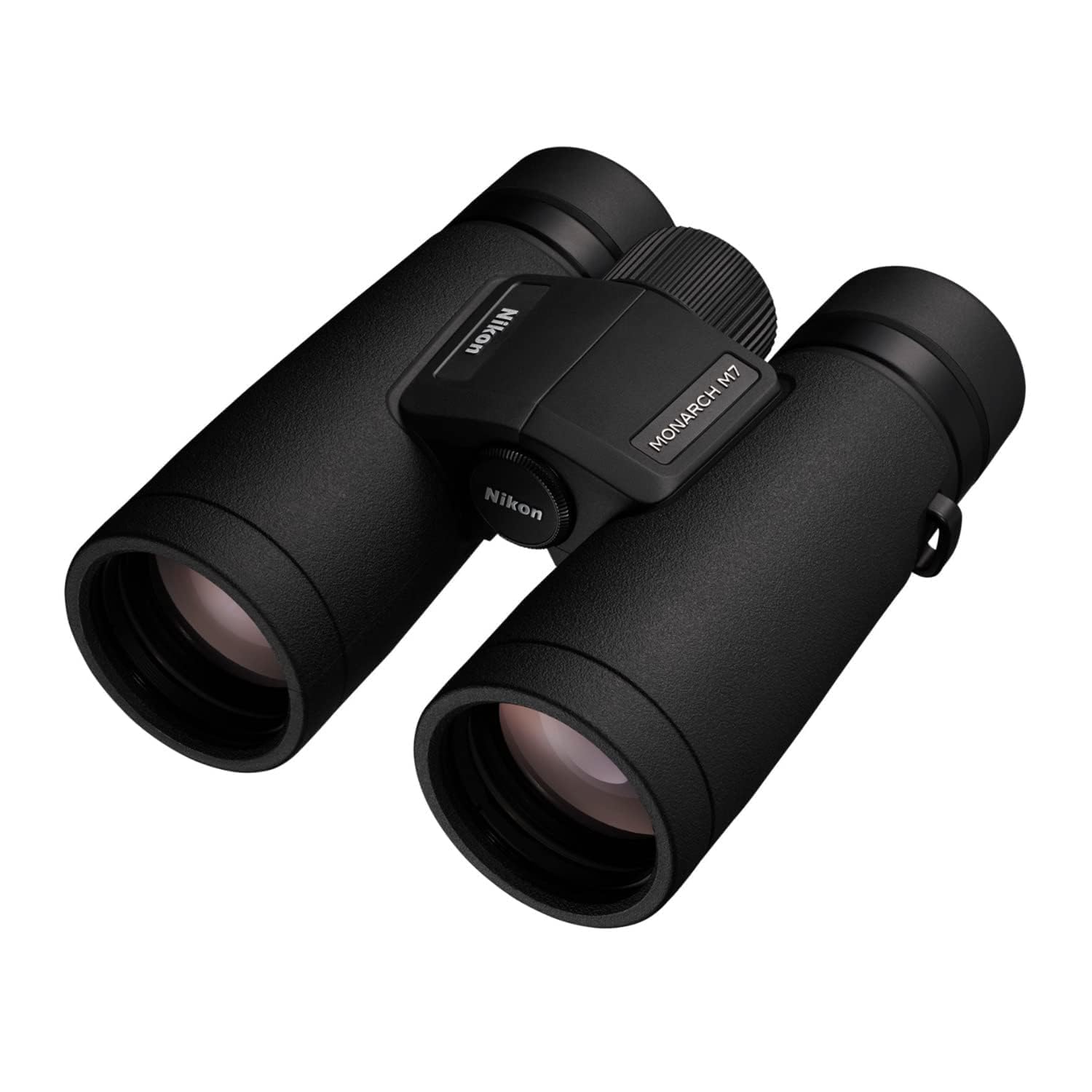
The MONARCH M7 sets the benchmark for what a serious birder should expect from a premium 10×42. Nikon’s ED glass elements virtually eliminate chromatic aberration, delivering edge-to-edge sharpness that reveals the subtle feather layering on a Cooper’s hawk at 200 yards. The apparent field of view is an immersive 62.2°, making it feel far wider than its 362-foot spec suggests—ideal for tracking fast-moving songbirds through dense foliage.
Build quality is excellent: the closed-bridge design with a metal chassis wrapped in rubber armor feels solid yet weighs surprisingly little for extended neck carry. The turn-and-slide click-stop eyecups offer 16.5mm of eye relief, accommodating most eyeglass frames without vignetting. Phase-corrected dielectric-coated prisms ensure light transmission stays high even in the flat light of overcast mornings.
Some users note slight lateral chromatic aberration in harsh midday sun when panning across high-contrast scenes, but this is negligible compared to the overall clarity. The locking diopter is a welcome feature—no accidental readjustment when pulling the binoculars from a case. This is the reference-grade glass that justifies its position as top pick.
Why it’s great
- Superb ED glass with industry-leading chromatic aberration control
- Wide 62.2° apparent field of view for immersive birding
- Locking diopter eliminates accidental adjustments
Good to know
- Premium price point places it at the high end of the range
- May still show minor fringing in extreme midday contrast
2. ZEISS Terra ED 10×42
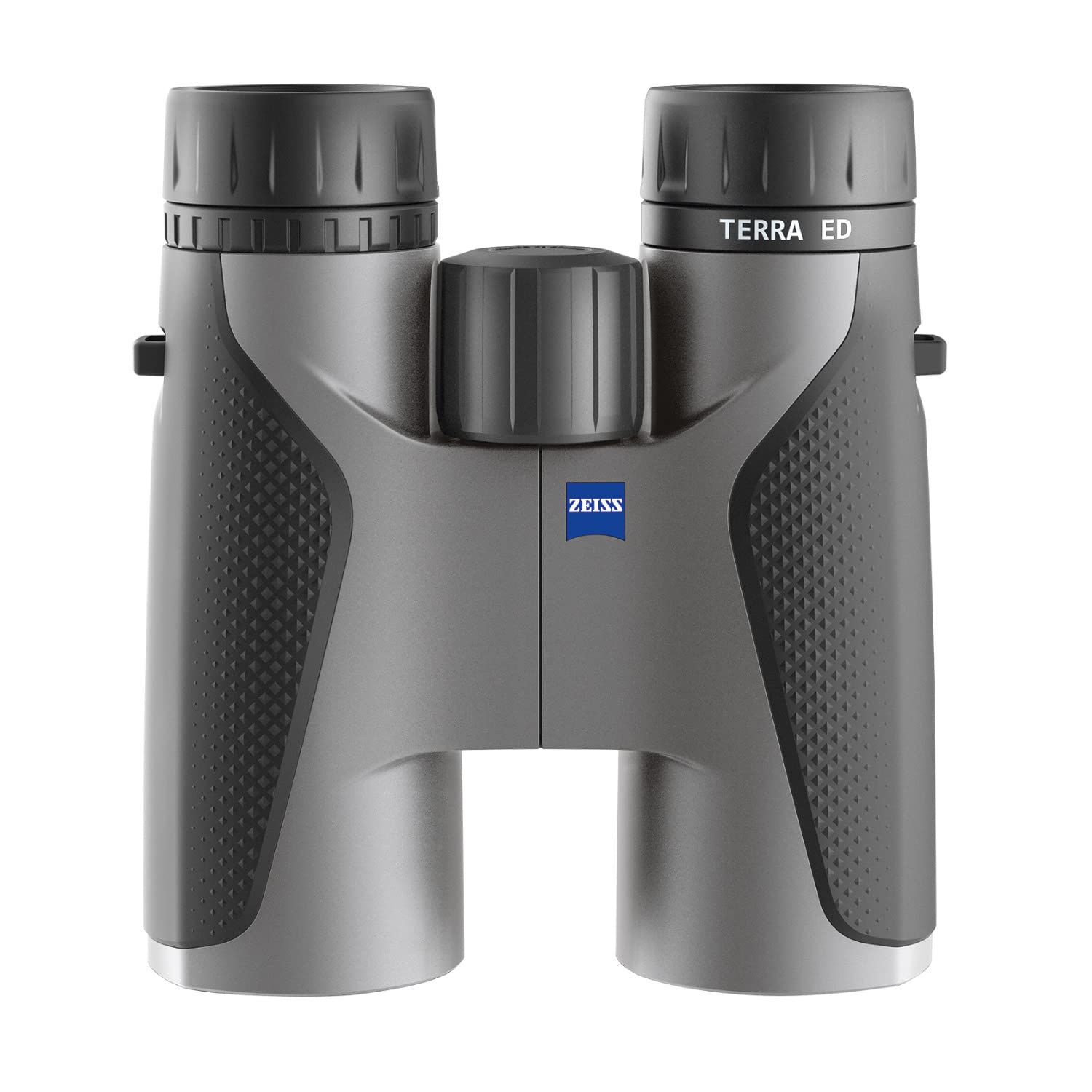
ZEISS Terra ED brings German optical engineering into a range where more birders can realistically reach it. The 88% light transmission figure—achieved through Schmidt-Pechan ED prisms with a proprietary hydrophobic multi-coating—means this binocular stays bright and contrasty even in rain or fog when lesser optics fog internally. The fiberglass-reinforced casing is remarkably tough for its 5.6-inch profile, shrugging off trail bumps that would dent an alloy body.
The focus wheel is the standout ergonomic feature: large, knurled, and positioned exactly where the index finger naturally lands. This fast-focus design lets you snap from a perched blue jay at 30 feet to a circling vulture at 500 feet in a single smooth rotation. At 18mm, the eye relief is the longest in this roundup, making the Terra ED exceptionally eyeglass-friendly—full field of view, no dark rings.
The included neoprene strap and hard case are noticeably nicer than what comes with most mid-range competitors. Some users may find the 60° apparent field of view slightly less immersive than a wider-angle design, but the sheer optical clarity and weather resistance make this the best premium entry point for birders ready to step up to ZEISS quality.
Why it’s great
- Exceptional 88% light transmission with ED glass
- Fast, ergonomic focus wheel for quick bird acquisition
- Best-in-class 18mm eye relief for eyeglass wearers
Good to know
- Apparent field of view is narrower than some competitors
- Premium tier pricing requires a significant investment
3. Leupold BX-4 Pro Guide HD 10×42
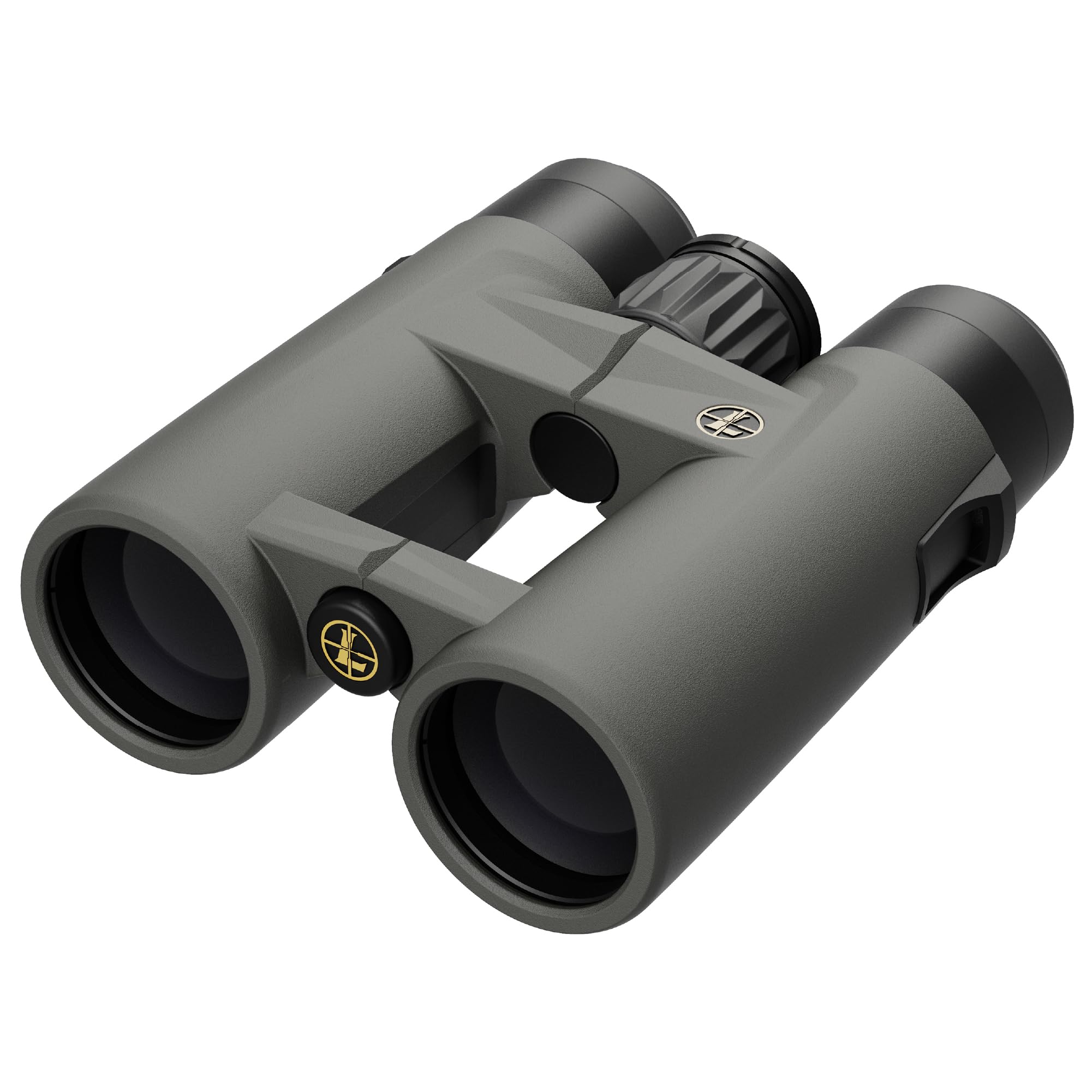
The BX-4 Pro Guide HD is built for birders who treat their gear hard. Leupold’s open-bridge, dual-hinge design cuts weight to just 25 ounces while maintaining a comfortable grip, and the Shadow Gray rubber armor sheds mud and moisture effectively. The heart of this binocular is the Elite Optical System: a combination of fully multi-coated lenses, phase-corrected BaK-4 prisms, and DiamondCoat 2 lens coatings that deliver exceptional resolution and glare reduction in flat, shadowy light.
What sets the BX-4 apart is the Guard-ion lens coating, a hydrophobic layer that causes water to bead up and roll off instantly—no more wiping fogged or rained-on lenses when a bird appears during a downpour. The 7.2° field of view is generous for a 10×42, providing 377 feet at 1000 yards, and the 4.2mm exit pupil ensures you see full brightness even in dawn light. The generous diopter adjustment range accommodates significant prescription differences between eyes.
Made in Japan (confirmed on production units), the build quality is exceptionally tight with zero slop in the focus mechanism. Some birders may prefer a wider apparent FOV, and the included case, while padded, is not as premium as the glass deserves. However, for someone who needs a binocular that works as well in a coastal salt marsh as in a dusty trail, the BX-4 is a top-tier companion.
Why it’s great
- Guard-ion coating repels water, dirt, and fingerprints effectively
- Lightweight 25-ounce open-bridge design
- Exceptional low-light performance with glare reduction
Good to know
- Apparent field of view could be wider for the class
- Case quality does not match the optics build
4. Vortex Optics Diamondback 10×42

The Vortex Diamondback is the workhorse that punches well above its price class. Its dielectric, fully multi-coated lenses transmit light efficiently enough to deliver bright, color-accurate images that rival models costing twice as much. The 362-foot field of view at 1000 yards is among the widest in its segment, making scanning creek edges for herons remarkably quick.
Argon purging is the hidden advantage here: argon’s lower thermal conductivity compared to nitrogen means the Diamondback resists internal fogging during rapid temperature shifts better than many nitrogen-filled competitors. The rubber armor with thumb indents provides a secure grip even in wet conditions, and the multi-position eyecups offer adjustable eye relief that accommodates most users. The included custom-molded carry case is a nice touch, with firm foam protection.
Some users report a mild fishbowl effect when panning quickly, and chromatic aberration is visible on high-contrast edges like tree branches against a bright sky. However, the lifetime VIP warranty—no-fault, transferable—removes all risk from the purchase. For a birder who needs reliable, bright optics without stretching into premium territory, the Diamondback is an outstanding choice.
Why it’s great
- Argon purging offers superior fog protection
- Wide 362-foot field of view for fast scanning
- Lifetime no-fault VIP warranty
Good to know
- Noticeable chromatic aberration in bright daylight
- Some rolling ball effect when panning
5. Celestron Nature DX ED 10×42

The Nature DX ED is the budget-conscious birder’s gateway to Extra-Low Dispersion glass. Celestron’s implementation of ED objectives virtually eliminates chromatic aberration, so a bright cardinal against green foliage stays razor-sharp without the purple fringe that plagues cheaper optics. The phase-coated BaK-4 prisms ensure that contrast remains high, letting you differentiate subtle plumage differences between similar sparrow species.
The rubber-armored polycarbonate housing is lightweight at just under 1.5 pounds, making it comfortable for all-day hikes. Nitrogen purging keeps the interior fog-free, and the tripod adapter socket adds versatility for extended monitoring sessions at a feeder station. Focus is smooth with a moderate throw—not as fast as some higher-end models but precise enough for deliberate bird identification.
The bundled accessories—lens cloth, objective caps, rainguard, and a padded case—are functional if not luxurious. Some users find the 14.3mm eye relief a touch tight for thick prescription glasses, requiring precise eyecup positioning. But for the price, you are getting ED-class optics that out-resolve many non-ED binoculars in the same tier. This is the smartest value play in the category for birders on a budget.
Why it’s great
- ED glass virtually eliminates chromatic aberration
- Excellent contrast from phase-coated BaK-4 prisms
- Lightweight and includes tripod adapter socket
Good to know
- 14.3mm eye relief may be tight for thick eyeglass frames
- Focus wheel is not as fast as premium models
6. PEIKETAO Premium ED HD 10×42

PEIKETAO’s ED HD binocular packs a spec sheet that reads like a much pricier model: magnesium alloy chassis, Extra-Low Dispersion glass, ESP dielectric prism coating, and argon gas purging. The magnesium body is both lighter and more rigid than polycarbonate alternatives, reducing hand fatigue during long birding sessions while providing a premium feel. The SMC (Super Multi-Coated) lenses claim higher light transmittance than standard fully multi-coated designs, and the subjective brightness bears this out in early-morning woodland conditions.
The 24mm large eyepieces are a noticeable comfort advantage—they provide a generous eyebox that makes it easy to find and hold the full image, even with glasses on. At 17.5mm, the eye relief is ample, and the twist-up eyecups click into three distinct positions. The 393-foot field of view at 1000 yards is broad enough for scanning open marshland, while the 7.5° apparent angle gives a spacious viewing experience.
The unlimited unconditional lifetime warranty matches the confidence of much more established brands. Some users note that the included neck strap and case are utilitarian rather than premium, but the optical performance—particularly the absence of color fringing—rivals models in a higher tier. This is a dark horse that deserves serious consideration for the feature-conscious birder.
Why it’s great
- Magnesium alloy body for light weight and stiffness
- Argon purging with ED glass and dielectric coatings
- Generous 24mm eyepieces for easy eyebox alignment
Good to know
- Accessories are functional but not premium
- Newer brand with less established long-term reputation
7. Nocs Provisions Field Issue 10×42
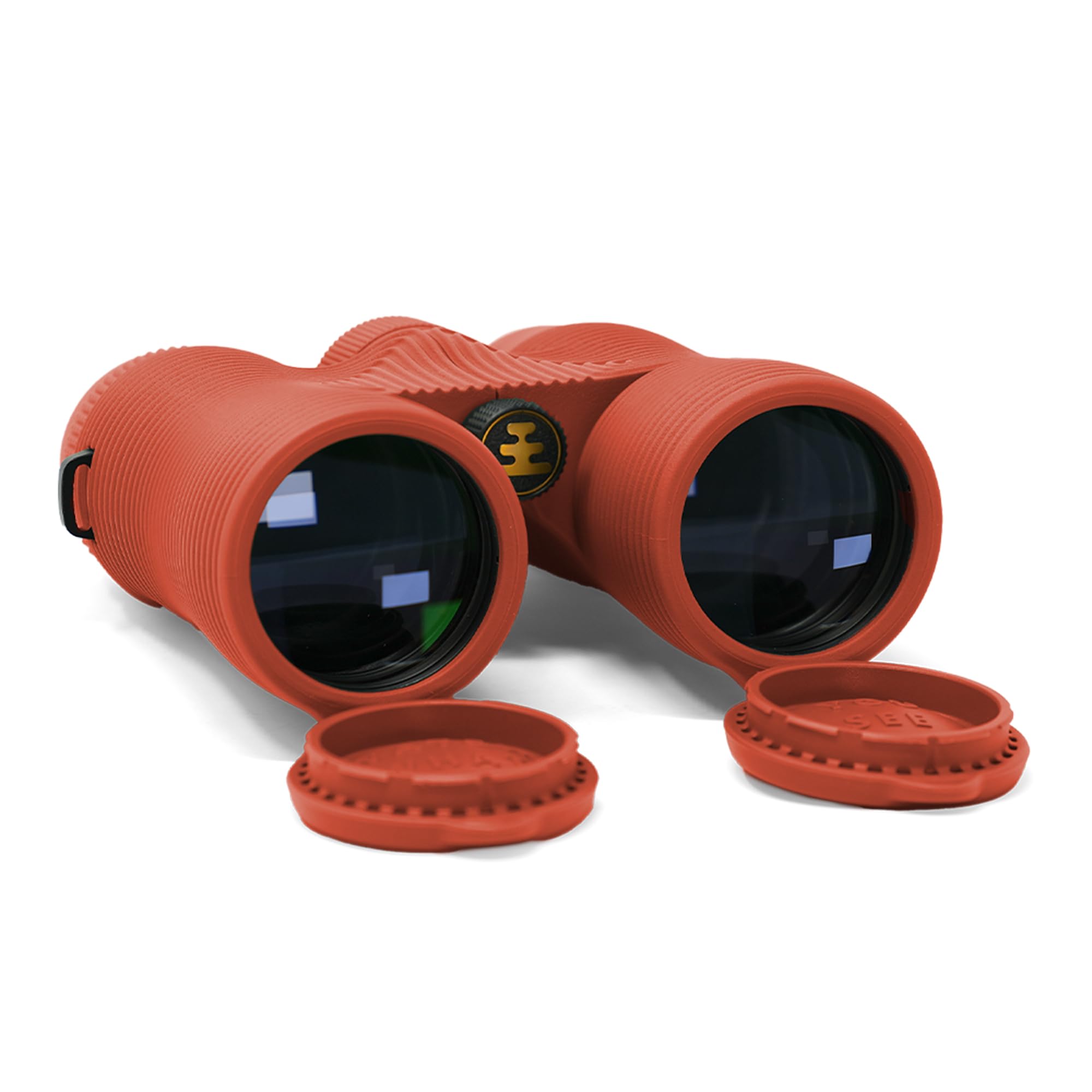
The Nocs Field Issue 10×42 is built for the birder who prioritizes portability without sacrificing optical quality. Weighing just 1.3 pounds with a compact mid-size form factor, it slips easily into a daypack or carry-on for travel birding. Swiss-designed BaK-4 prisms with fully multi-coated optics deliver a clean, color-accurate image with 10x magnification that resolves feather detail on perched warblers at 80 yards.
The IPX7 waterproof rating means this binocular can survive a full submersion—not that you will test it, but it guarantees rock-solid protection against rain and accidental splashes. Nitrogen-sealed chambers prevent fogging, and the Rugged Wave Grip housing delivers a no-slip hold in sweaty or wet conditions. The multi-stop eyecups offer three distinct positions, though the 14.9mm eye relief is at the lower end for eyeglass users—you may need to press in slightly to see the full field.
The “No-Matter-What” lifetime warranty backs the build with real confidence, and Nocs’ commitment to environmental causes (1% For the Planet) adds feel-good value. Some birders note that the close-focus distance of 6.6 feet is better than standard for the class, making it useful for backyard feeders as well as long-range viewing. The case and strap are basic, but the optical performance and rugged build make this a strong mid-range contender.
Why it’s great
- Compact, lightweight 1.3-pound travel-friendly design
- IPX7 waterproof and nitrogen-sealed fog proofing
- Close focus of 6.6 feet for backyard birding
Good to know
- 14.9mm eye relief is on the shorter side for eyeglass users
- Case and strap quality are basic compared to optics
8. OPMOD Vortex Diamondback HD 10×42

The OPMOD variant of the Vortex Diamondback HD brings the reputable HD optical system and dielectric prism coatings into a lower tier. The HD—short for High Density—glass elements improve resolution and cut chromatic aberration compared to the standard Diamondback, making this a legit upgrade for birders who want better color fidelity and sharpness without jumping to the premium bracket. The fully multi-coated lenses and phase correction on the roof prisms work together to produce a bright, contrasty image that handles woodland shade well.
The rubber armor provides a comfortable, non-slip grip, and the O-ring sealed construction keeps moisture and dust out reliably. The included accessories—a comfort neck strap, soft side carry case, rainguard, and tethered objective covers—cover the essentials without extra weight. The short hinge design with a slim profile makes this binocular easy to grip with average-sized hands.
Some users report that while the HD system is a step up, it still shows some chromatic aberration in high-contrast situations compared to true ED glass models. The diopter adjustment is functional but not locking, so it can shift if bumped against a chest harness. Despite these minor quibbles, the Diamondback HD delivers a noticeable improvement in clarity over the standard version, and the Vortex VIP warranty applies here as well. For the price, this is a smart step-up entry point into high-definition optics.
Why it’s great
- HD optical system improves resolution and color accuracy
- Dielectric coatings boost light transmission
- Vortex VIP warranty provides lifetime protection
Good to know
- Non-locking diopter can shift during active use
- Minor chromatic aberration on high-contrast edges
9. Bushnell H2O Xtreme 10×42

The Bushnell H2O Xtreme is the affordability anchor that refuses to compromise on the essentials. Built for wet environments—hence the name—this 10×42 features an O-ring sealed, nitrogen-purged construction that meets IPX7 standards for waterproofing. The fully multi-coated optics and BaK-4 prisms produce a bright, clear image that holds its own against models costing significantly more, as verified by multiple user reports comparing it favorably to pricier options.
The rugged rubber design with soft grips ensures a non-slip hold even when your hands are wet from morning dew or rain. Weighing in at a compact size, it carries easily on a neck strap during a full-day birding outing. The 17mm eye relief is generous for the price tier, accommodating most eyeglass wearers without vignetting. The center focus wheel is smooth with good tension, and the diopter ring holds its position well.
The one notable omission is the lack of a tripod adapter socket—so if you plan to mount for extended feeder watching, this model will not accommodate that. Some users also find the neck strap uncomfortable, but that is easily replaced. For the birder who needs a reliable, waterproof 10×42 on a tight budget, the H2O Xtreme delivers genuinely impressive optical value without the sticker shock.
Why it’s great
- Excellent waterproof/fogproof build at a budget price
- Fully multi-coated BaK-4 optics for bright images
- 17mm eye relief accommodates most eyeglass users
Good to know
- No tripod adapter socket for stable mounting
- Neck strap is basic; may need replacement for comfort
FAQ
Why do some 10×42 binoculars show a purple fringe on bright edges and how can I avoid it?
Is a 10×42 binocular too shaky for handheld birding compared to an 8×42?
What does the VIP lifetime warranty from Vortex cover and does it transfer to a new owner?
Is argon gas purging better than nitrogen for fog-proofing binoculars?
Final Thoughts: The Verdict
For most users, the 10×42 binoculars for bird watching winner is the Nikon MONARCH M7 10×42 because it combines ED glass, a wide immersive field of view, and robust build quality into a package that professional birders and serious amateurs alike can trust for years. If you want the best optical clarity at a more accessible price point, grab the Celestron Nature DX ED 10×42. And for a compact, adventure-ready travel companion with IPX7 waterproofing, nothing beats the Nocs Provisions Field Issue 10×42.