
Our readers keep the lights on and the weekend projects moving. As an Amazon Associate, I earn from qualifying purchases.
The 35mm focal length is the visual equivalent of “just right” — wide enough to tell a story with context, tight enough to isolate a subject without distortion. But the market is flooded with options ranging from plastic-mount budget primes to L-series monsters, and picking the one that actually fits your camera system, shooting style, and image-quality expectations is a decision that sits at the intersection of mount compatibility, aperture speed, and optical design philosophy.
I’m Rikta — the co-founder and writer behind FitlyFast. I have spent hundreds of hours analyzing optical MTF charts, customer durability reports, autofocus motor types, and real-world sample galleries to build this guide as a transparent comparison of what each 35mm prime actually delivers for its intended system.
The best 35mm lens for you depends entirely on whether you need weather sealing for outdoor documentary work, a macro-capable short prime for product and food shots, or a fast f/1.4 aperture for dreamy bokeh in low light — and this guide breaks down the exact strengths of each option without the marketing fluff.
How To Choose The Best 35mm Lens
Buying a 35mm prime means committing to a single angle of view. Before you click “add to cart”, you need to match the lens’s physical mount, sensor coverage, and speed to the scenes you actually shoot most often.
Mount Compatibility Is Non-Negotiable
A Canon RF lens cannot physically mount on a Nikon Z body, and a Sony E-mount lens won’t click onto a Fujifilm X body without an adapter that often sacrifices autofocus speed. Check your camera’s exact mount type — Nikon F, Z, Canon EF, RF, Sony E, Fujifilm X, Pentax K — before considering anything else. Using the wrong mount results in a paperweight.
Aperture Speed: f/1.4 vs f/1.8 vs f/2
A wider aperture like f/1.4 gathers more light (roughly two-thirds of a stop brighter than f/1.8), which gives you faster shutter speeds in dark interiors and shallower depth of field for smoother background separation. The trade-off is size, weight, and cost. F/1.8 and f/2 lenses are often lighter, smaller, and more affordable, making them better for travel and walkaround use, but they force you to raise ISO sooner in dim conditions.
Optical Coatings and Flare Resistance
A lens is only as good as its ability to maintain contrast when the sun is in the frame. Multi-coated elements — Nano-GI, Super Multi-Layer, Air Sphere — reduce internal reflections that cause ghosting and veiling flare. If you shoot into the sun often (street, landscape, environmental portraits), prioritise lenses with advanced coating technology over bare glass.
Quick Comparison
On smaller screens, swipe sideways to see the full table.
| Model | Category | Best For | Key Spec | Amazon |
|---|---|---|---|---|
| Canon RF 35mm f/1.8 IS Macro STM | Mid-Range | Hybrid photo & video, macro detail | 0.5x magnification, 5-stop IS | Amazon |
| Nikon NIKKOR Z 35mm f/1.4 | Premium | Painterly bokeh, low-light portraits | f/1.4 max aperture, 9-blade iris | Amazon |
| Sony FE 35mm f/1.8 | Premium | Compact travel, gimbal video work | Linear-motor AF, 280g weight | Amazon |
| Sigma 35mm F1.4 DG DN Art (Sony E) | Premium | Maximum optical sharpness, pros | 13 elements, 2 SLD, 2 aspherical | Amazon |
| Canon RF 35mm F1.4 L VCM | Premium | Professional hybrid photo/video | Iris ring, VCM rear focus | Amazon |
| VILTROX 35mm F1.8 II EVO FE APO (Sony E) | Mid-Range | Budget full-frame, sharp detail | APO design, 2 ED elements | Amazon |
| Fujinon XF35mmF2 R WR | Mid-Range | Weather-sealed, silent AF | 8 sealing points, 0.08s AF | Amazon |
| YONGNUO YN35mm F2N (Nikon F) | Budget | Learning 35mm, full-frame entry | f/2 aperture, USB firmware upgrade | Amazon |
| Pentax SMC DA 35mmF2.4 AL | Budget | Lightweight Pentax walkaround | 124g weight, 45mm length | Amazon |
In‑Depth Reviews
1. Canon RF 35mm F1.8 IS Macro STM Lens

This lens packs a 5-stop optical image stabilizer into a compact barrel, making it the most versatile walkaround prime in Canon’s RF lineup. The 0.5x macro capability is a genuine bonus — you can capture detailed product shots or food close-ups without swapping glass. The STM autofocus is quiet and smooth enough for video, though not lightning-fast like a Nano USM.
At f/1.8 it’s bright enough for indoor portraits and low-light street scenes, but the real star is the stabilizer, which lets you handhold down to shutter speeds that would normally require a tripod. The control ring on the barrel can be customised to adjust ISO, aperture, or exposure compensation without diving into menus.
The lens exhibits minor barrel distortion and some vignetting wide open, but Lightroom profiles correct these instantly. It’s not weather-sealed, so keep it dry in rain or dust. For anyone shooting Canon EOS R series at any stage, this is the 35mm that does the most things well with the fewest compromises.
Why it’s great
- Built-in 5-stop IS stabiliser for low-light handholding
- 0.5x macro magnification for close-up versatility
- Compact size balances beautifully on R bodies
Good to know
- Noticeable barrel distortion before software correction
- No weather sealing on the barrel
2. Nikon NIKKOR Z 35mm f/1.4 Lens

Nikon’s Z 35mm f/1.4 is built for photographers who prioritise rendering character over clinical perfection. Wide open at f/1.4 it produces smooth, painterly bokeh with soft contrast that flatters skin tones in portraits, and the 9-blade aperture keeps background highlights circular even when stopping down slightly.
The lens is compact enough for gimbal work, with a silent STM motor that minimises operational noise and suppresses focus breathing during video. On a Z6II or Z8 it balances naturally, and the close-focus distance of 10.6 inches lets you grab detail shots that feel intimate.
There is noticeable chromatic aberration wide open — green and magenta fringing on high-contrast edges — which you will need to correct in post. It also lacks the weather sealing found on Nikon’s S-line lenses. If you enjoy lenses with a bit of old-school character rather than sterile sharpness, this is your pick.
Why it’s great
- Beautiful f/1.4 bokeh with smooth fall-off
- Silent STM drive and suppressed focus breathing for video
- Compact and light for a fast prime
Good to know
- Noticeable chromatic aberration wide open
- No weather sealing compared to S-line siblings
3. Sony FE 35mm f/1.8 Lens

At just 280 grams, this 35mm prime is almost unnoticeable in a small camera bag, making it the best choice for Sony shooters who prioritise portability without sacrificing image quality. The linear-motor autofocus is fast, precise, and nearly silent — it locks onto eyes in real-time tracking with no hunting, even on fast-moving children or pets.
The f/1.8 maximum aperture delivers solid low-light performance and pleasing background blur, though the 9-blade circular aperture ensures bokeh stays smooth rather than nervous. Minimum focus distance of 8.66 inches gives you a 0.24x maximum magnification, which is useful for tabletop shots and detail captures on the street.
Build quality is good but not pro-level — the barrel is metal but the weather sealing is minimal. There is no optical image stabilisation, but if your Sony body has IBIS, the two work together smoothly. This lens is sharp wide open and only improves when stopped down, making it a reliable everyday companion.
Why it’s great
- Extremely lightweight and compact for E-mount
- Fast, silent linear-motor autofocus with eye-tracking
- Sharp from f/1.8 with smooth bokeh
Good to know
- No built-in optical stabilisation
- Weather sealing is modest for demanding conditions
4. Sigma 35mm F1.4 DG DN Art (Sony E)

Sigma’s Art series has a reputation for beating native lenses on optical performance, and this 35mm F1.4 DG DN continues that tradition. It uses two SLD (Special Low Dispersion) elements and two aspherical elements to suppress chromatic aberration and distortion to near-zero levels, delivering edge-to-edge sharpness even wide open at f/1.4.
The autofocus is driven by a stepping motor that is fast and quiet, suitable for both stills and video. The manual focus ring is damped and precise, with a smooth rotation that makes pulling focus intuitive. The lens body is metal with a textured finish that feels premium in hand, though the 454-gram weight means it is not the lightest prime for hiking all day.
The included lens hood is deep and locks securely. The only real downside is the lack of weather sealing, which is surprising for a lens at this tier. For Sony shooters who demand the highest resolution and contrast from a 35mm, this Art lens is a professional-grade tool that outresolves most camera sensors.
Why it’s great
- Exceptional sharpness and contrast, edge-to-edge
- Almost zero chromatic aberration even wide open
- Premium metal construction and smooth focus ring
Good to know
- No weather sealing on the barrel
- Heavier than the Sony FE f/1.8 option
5. Canon RF35mm F1.4 L VCM Lens

Canon’s first L-series 35mm for the RF mount is a hybrid powerhouse designed to serve both photographers and videographers equally. The dual focus system uses a Nano USM for the floating group and a Voice Coil Motor (VCM) for the rear group, enabling quiet, independent actuation that virtually eliminates focus breathing — a huge advantage for video.
The iris ring on the barrel allows manual aperture control during video capture, with a de-click mechanism that is smooth for pulls. Air Sphere Coating (ASC) aggressively suppresses ghosting and flare, even with backlight sources inside the frame. The build is rugged with extensive weather sealing, rated to operate in harsh environments.
Image quality is L-series through and through: sharp wide open with minimal distortion, true colour reproduction, and minimal CA. The 1.4-pound weight is noticeable but well-balanced on R3 and R5 bodies. It is expensive, but for working professionals who need one lens for weddings, documentaries, and commercial work, this is the definitive RF 35mm.
Why it’s great
- Near-zero focus breathing for stable video footage
- Durable weather sealing for field use
- Iris ring with de-click switch for video pulls
Good to know
- High weight compared to the f/1.8 IS version
- Premium investment that is overkill for casual shooters
6. VILTROX 35mm F1.8 II EVO FE APO (Sony E)
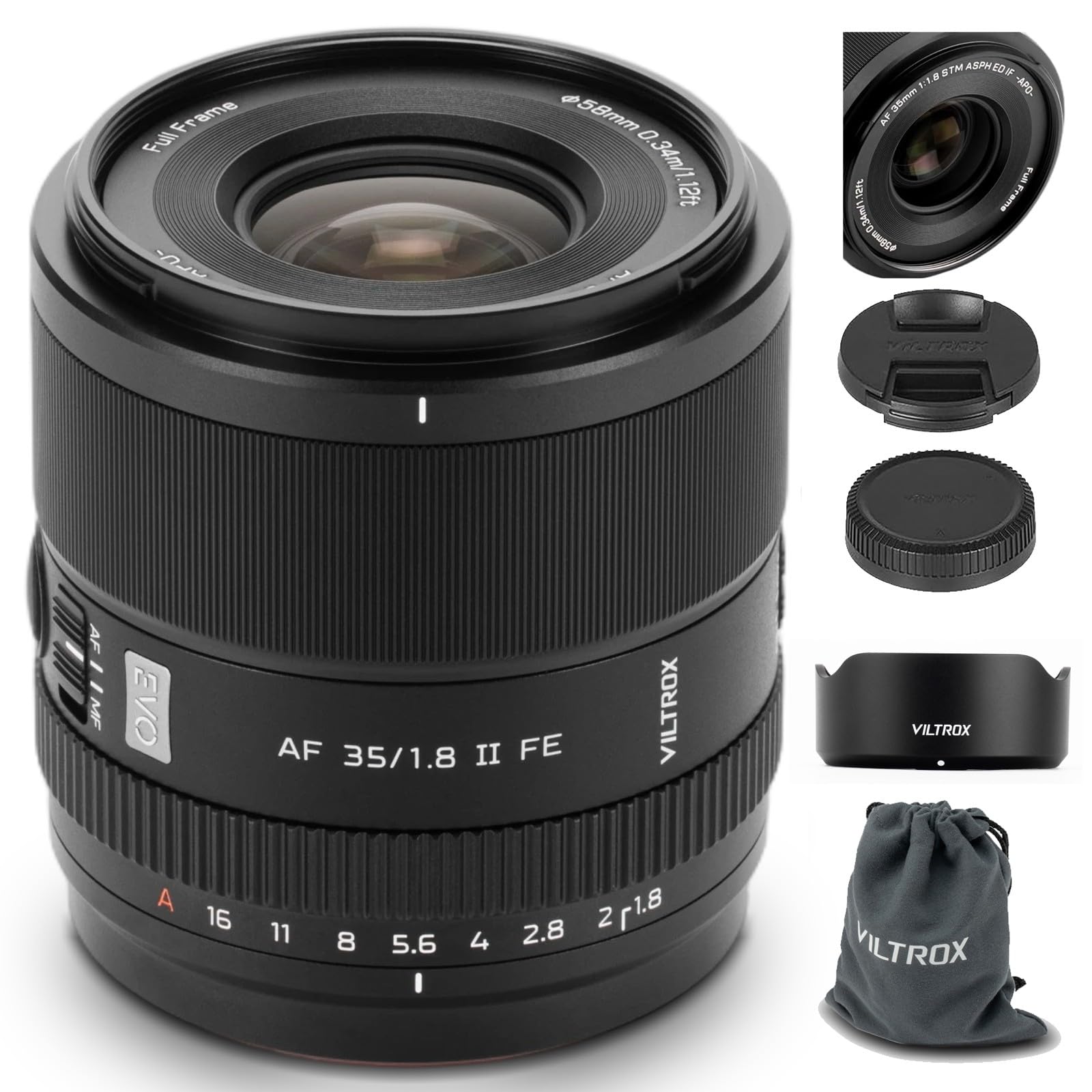
VILTROX has stepped up its lens design with the APO (Apochromatic) designation on this 35mm f/1.8, using two ED elements alongside three HR and one UA element to deliver colour purity and sharpness that rivals lenses costing twice as much. The metal barrel feels solid in hand, and the included lens hood clicks on securely with no wobble.
Autofocus uses an STM stepping motor that is responsive in good light but can hunt in very low contrast scenarios. There is an AF/MF switch and a customisable Fn button on the barrel, along with a CLICK switch that de-clicks the aperture ring for video. The minimum focus distance of 0.34 metres is useful for semi-macro work.
Wide open at f/1.8 the lens is sharp in the center with good contrast, though extreme corners show slight softness. Flare resistance is decent but not class-leading. For Sony full-frame shooters who want APO-grade colour correction without paying Sony or Sigma prices, this is a compelling mid-range option.
Why it’s great
- APO design gives clean colour correction and high contrast
- Metal barrel with de-click aperture ring for video
- Sharp center performance at f/1.8
Good to know
- Corner softness at f/1.8
- Autofocus may hunt in low contrast conditions
7. Fujinon XF35mmF2 R WR

For Fujifilm X-series users, this 35mm f/2 is the sweet spot between size, speed, and weather resistance. The equivalent field of view is 53mm (full-frame), making it a normal-angle lens ideal for street, documentary, and everyday carry. The 8 sealing points protect against dust and moisture, and the lens operates down to 14°F.
The 0.08-second autofocus is driven by an inner focus system that is nearly silent, which matters for candid street shots where you do not want to announce your presence. The 9-blade aperture creates smooth, circular bokeh at f/2, and the Nano-GI coating reduces ghosting and flare when shooting into the sun.
Build quality is all metal with a smooth aperture ring that clicks with satisfying precision. The included lens hood is small but effective. The only real trade-off is the f/2 maximum aperture — you lose about two-thirds of a stop compared to the f/1.4 version, but in exchange you get a lighter, faster-focusing, weather-sealed package that handles rain and snow without hesitation.
Why it’s great
- Weather sealing with 8 gaskets for all-conditions use
- Blazing fast and silent autofocus
- Compact metal build with smooth aperture ring
Good to know
- f/2 is slower than the f/1.4 alternative
- Gaps in the manual ring can trap fine dust
8. YONGNUO YN35mm F2N (Nikon F)

The YONGNUO 35mm f/2 is the budget gateway into full-frame 35mm photography for Nikon DSLR users. The metal bayonet mount feels reassuringly durable for the price, and the 7-blade aperture produces reasonably circular bokeh when stopped down slightly. It supports both autofocus and manual focus, plus live view focusing for precise manual work.
Image quality is decent at f/2.8 and sharpest around f/3.2 to f/5.6, but wide open at f/2 the lens is noticeably soft with lower contrast. Autofocus is audible and slower than Nikon’s native options, but it locks reliably in good light. The USB firmware upgrade port is a thoughtful inclusion for a lens at this tier.
The glass uses multi-coating that cuts down flare somewhat, but you will still see ghosting with strong backlight. Close-focus ability is good for near-macro shots. This lens is not for professionals, but for a beginner learning on a D3500 or a seasoned shooter needing a cheap full-frame backup, it is a surprisingly capable tool.
Why it’s great
- Very affordable entry into full-frame 35mm
- Metal bayonet mount for durability
- USB port for firmware updates
Good to know
- Soft and low contrast at f/2
- Audible and slow autofocus motor
9. Pentax SMC DA 35mmF2.4 AL

Pentax’s “plastic fantastic” 35mm f/2.4 is one of the lightest primes on the market at just 124 grams, making it a nearly weightless addition to any K-series camera. The hybrid aspherical lens element corrects spherical aberration well, delivering sharp center details with good contrast from f/2.8 onward, while the Super Protect (SP) coating on the front element repels dust and grease.
Autofocus uses the screw-drive from the camera body, which is loud but very fast — Pentax’s in-body shake reduction works with any K-mount lens, so you get stabilisation without needing it in the glass. The 49mm filter thread keeps accessory costs low, and the compact 45mm length means it fits in a jacket pocket easily.
The biggest drawbacks are the plastic construction (though it feels solid enough) and the 6-blade aperture that produces hexagonal bokeh highlights when stopped down past f/2.4. Wide open at f/2.4 the edges are soft, but the center is respectable. For Pentax shooters who want an everyday normal-angle prime without adding bulk, this is the most logical choice in the system.
Why it’s great
- Extremely lightweight and pocketable
- Fast screw-drive autofocus from camera body
- SP coating resists dust and grease on front element
Good to know
- Hexagonal bokeh at apertures smaller than f/2.4
- Plastic construction and filter threads
FAQ
What does 35mm mean on a lens?
Is a 35mm lens good for portraits?
Can I use a 35mm lens on a crop sensor?
Why are some 35mm lenses so expensive?
Final Thoughts: The Verdict
For most users, the best 35mm lens winner is the Canon RF 35mm F1.8 IS Macro STM because it combines built-in stabilisation, macro capability, and a practical f/1.8 aperture in a compact package that handles any shooting scenario. If you want f/1.4 bokeh and character for portraits, grab the Nikon NIKKOR Z 35mm f/1.4. And for professional hybrid work demanding zero focus breathing and L-series build, nothing beats the Canon RF 35mm F1.4 L VCM.