
Our readers keep the lights on and the weekend projects moving. As an Amazon Associate, I earn from qualifying purchases.
Clay soil behaves like concrete when dry and toothpaste when wet, making aeration a battle of physics. Standard spike aerators often push soil deeper, worsening compaction, while cheap core pullers snap under the pressure of dense, sticky clay. You need serious hardware that can extract real soil plugs from this demanding ground.
I’m Rikta — the co-founder and writer behind FitlyFast. I’ve spent hundreds of hours analyzing soil mechanics, tine material science, and the weight-to-penetration ratios that define whether an aerator actually lifts clay instead of just scraping it.
This guide breaks down the core specs that matter — from hollow tine diameter to ballast capacity — so you can confidently choose the best aerator for clay soil that matches your yard size and your tolerance for physical labor.
How To Choose The Best Aerator For Clay Soil
Clay soil requires more downward force and sharper cutting edges than loam or sand. Choosing an aerator without understanding these demands leads to bent tines, wasted effort, and a lawn that stays compacted. Focus on the mechanics that overcome clay’s specific resistance.
Hollow Tines vs. Solid Spikes
Solid spikes displace soil sideways, which worsens compaction in clay by pressing particles tighter together. Hollow tines cut a clean core and physically remove a plug of soil from the ground, creating a permanent channel for air, water, and roots. For clay, only hollow tine designs should be on your shortlist.
Material Strength and Rust Resistance
Clay soil contains fine, abrasive particles that wear down soft steel quickly. Look for tines made from stainless steel or heat-treated galvanized steel. These materials resist bending when you hit a dry patch of clay and won’t rust out after a few seasons of use in damp conditions.
Ballast Capacity for Penetration
Weight is the single most important factor for aerating clay. Tow-behind units should feature a weight tray that can hold at least 100 pounds of ballast. Manual and rolling aerators depend on their own heft — look for models weighing at least 30 pounds bare, with the ability to add more weight for tougher ground.
Working Width and Yard Size Fit
Manual step aerators work for patches under 2,000 square feet. Rolling drum aerators handle small to medium lawns up to 5,000 square feet. Tow-behind units with a 40-inch working width are the only realistic option for larger properties, especially when covering an acre or more of clay-heavy ground.
Quick Comparison
On smaller screens, swipe sideways to see the full table.
| Model | Category | Best For | Key Spec | Amazon |
|---|---|---|---|---|
| Landzie AeroCore Rolling Aerator | Rolling Core | Quality over effort ratio | 7 stainless steel hollow tines | Amazon |
| Brinly Combo Aerator Spreader | Tow-Behind Combo | Dual-task efficiency | 132 tine tips, 75 lbs weight tray | Amazon |
| Craftsman 40-Inch Tow Plug Aerator | Tow-Behind Plug | Large clay yards | 24 galvanized coring points, 140 lbs tray | Amazon |
| Brinly Tow Behind Plug Aerator | Tow-Behind Plug | Deep clay penetration | 3-inch plug spoons, 150 lbs tray | Amazon |
| Suchtale 40-Inch Tow Plug Aerator | Tow-Behind Plug | Mid-size clay properties | 24 heat-treated plugs, 125 lbs tray | Amazon |
| VEVOR Tow Behind Plug Aerator | Tow-Behind Spike | Budget tow option | 40-inch width, 120 lbs weight tray | Amazon |
| Senvert Rolling Lawn Aerator | Rolling Spike | Small clay lawns | 55 lbs max weight, spike drum | Amazon |
| Landzie Original Hollow Tine Aerator | Manual Step | Targeted small patches | 3 stainless steel hollow tines | Amazon |
| TAZZ 2-in-1 Tiller/Cultivator | Gas Tiller | Breaking new clay beds | 79cc Viper engine, forged steel tines | Amazon |
In‑Depth Reviews
1. Landzie AeroCore Rolling Lawn Aerator
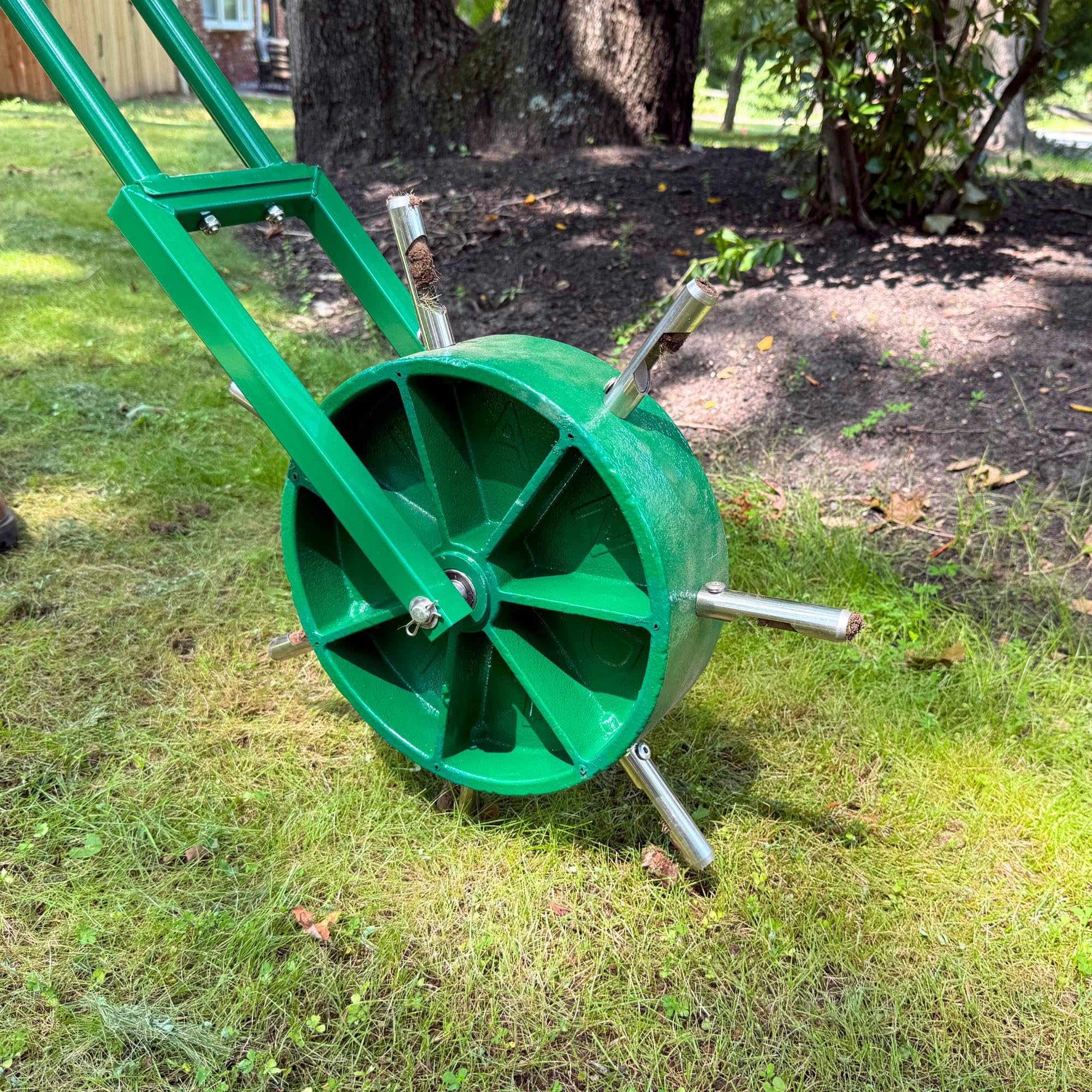
The Landzie AeroCore hits the sweet spot between manual control and mechanical efficiency. Its seven stainless steel hollow tines cut through clay without bending, and the drum’s bare weight of 50.8 pounds drives those tines deep without needing extra sand or stones. The chamfered tine edges eject soil cores cleanly, reducing the clogging that plagues cheaper rolling aerators on sticky clay.
Users report covering a 4,500-square-foot lawn in roughly two hours, which is impressive for a manual push unit. The effort is real — reviewers consistently describe it as a solid workout — but the trade-off is zero engine maintenance, no rental fees, and the ability to aerate on your own schedule whenever soil moisture is right. The build quality draws consistent praise, with the powder-coated steel frame holding up after repeated sessions on compacted ground.
Assembly is straightforward, taking around 30 minutes out of the box. A few users noted the tine screws loosened after extended use; applying thread locker during assembly solves that. For small to medium lawns with clay soil, this rolling corer delivers professional-grade results without needing a tractor.
Why it’s great
- 7 stainless steel hollow tines extract cores, not compress soil
- Heavy 50.8-pound drum penetrates clay without extra ballast
- Non-clogging chamfered tine design for continuous work
Good to know
- Physically demanding; expect a workout on any lawn over 3,000 sq ft
- Tine screws may loosen without thread locker application
2. Brinly Tow Behind Combination Aerator Spreader

The Brinly AS2-40BH-P combines a spike-style drum aerator with a 100-pound capacity steel hopper, letting you drop seed or fertilizer while aerating in a single pass. That efficiency is a major time saver for anyone managing a larger clay lawn, and the integrated weight tray accepts up to 75 pounds of ballast to push the 132 tine tips deep into hard ground.
Brinly uses patent-pending 3-D galvanized steel tines that resist bending and rust far better than standard flat stock. Reviewers consistently report solid penetration even in compacted clay, with the pneumatic transport wheels making it easy to move between sections without tearing up the turf. The assembly time is roughly 45 minutes, which is reasonable for a tow-behind unit with so many tine stars.
The flow control mechanism on the spreader can be finicky — one reviewer noted the wing nut vibrates loose, requiring a c-clamp to hold the setting. But the dual-function design eliminates the need for separate seeding passes, which is a genuine advantage when your aeration window is short. For users who want to overseed immediately after aerating, this combo saves a full day of work.
Why it’s great
- Two-in-one aerator and spreader saves a full work day
- 3-D galvanized tines resist bending in abrasive clay
- Pneumatic transport wheels protect turf during transit
Good to know
- Flow control lever can vibrate loose without a c-clamp
- Not a true core aerator; spikes perforate rather than extract plugs
3. Craftsman 40 Inch Tow Behind Lawn Plug Aerator

The Craftsman CMXGZBF7124213 is built for serious acreage, offering 24 galvanized steel coring points that pull plugs up to 3 inches deep. The wide weight tray supports up to 140 pounds of ballast, which is critical for driving those coring spoons through dry or compacted clay layers that resist lighter units. Flat-free tires eliminate the worry of punctures while towing across rough terrain.
Assembly takes around 2 to 3 hours, a common complaint among owners, but the payoff is a heavy-duty frame that withstands the torque of working large properties. Reviewers who previously broke cheaper aerators on rocky clay soil report that this Craftsman holds up season after season. The lift-handle release system lets you raise the tines for transport across driveways without disconnecting.
A few users note that the coring knives arrive uninstalled, requiring careful handling during setup. Once assembled, the unit performs reliably even on inclines, and the 40-inch working width covers ground efficiently. For anyone with an acre or more of clay-heavy lawn, this is a durable workhorse that justifies the assembly investment.
Why it’s great
- 24 galvanized coring points extract plugs up to 3 inches deep
- 140-pound weight tray provides serious ballast for clay penetration
- Flat-free tires eliminate puncture worries on rough ground
Good to know
- Assembly is time-intensive, often taking 2-3 hours
- Coring knives arrive uninstalled; handle carefully to avoid injury
4. Brinly Tow Behind Plug Aerator

The Brinly PA-403BH-A3 goes deeper than most in its class, with 24 heat-treated steel plug spoons designed to pull 3-inch cores from compacted soil. The spoons are narrower than typical designs and feature sharpened leading edges, which reduces the weight required for penetration — an engineering choice that matters when your soil is dense clay. The fully enclosed weight tray holds up to 150 pounds for even deeper bite.
Three independently rotating tine sections minimize turf damage during turns and maintain consistent penetration on uneven ground. The single-pin universal hitch attaches to most lawn tractors and ZTRs, and the transport lever lifts the spoons for crossing hard surfaces. Assembly runs about 1 to 2.5 hours depending on experience, but the instructions are clear and extra hardware is included.
Reviewers consistently report pulling clean 2.5- to 3-inch plugs on moist clay soil. The all-steel construction feels solid, and the unit stores upright against a wall with a tire block. If your priority is maximum depth in heavy clay without the weight of cast-iron equipment, this Brinly model hits that target.
Why it’s great
- Sharpened narrow spoons reduce required ballast for clay penetration
- Three independent tine sections prevent turf damage on turns
- 150-pound weight tray enables deep plug extraction
Good to know
- Assembly can take over 2 hours for first-time builders
- Instructions can be confusing for two bolt size options
5. Suchtale 40-Inch Tow Behind Plug Aerator

The Suchtale LTA-005A brings alloy steel construction and 24 heat-treated plug spoons to the mid-range tow-behind market. Its 6 mm thick steel adjust handle is thicker than the typical 4 mm found on cheaper competitors, addressing a common failure point. The weight tray accepts up to 125 pounds of ballast, which is sufficient for most clay conditions when paired with proper soil moisture.
Assembly takes one to two hours, with hardware bagged by step for clarity. The universal pin-style hitch connects to riding mowers and ATVs, and the transport handle lets you raise the plugs for crossing pavement. Users report good results on clayish soil after a quarter-inch of rain, with four to five cinder blocks providing enough weight for full plug depth.
Durability reviews are mixed: most owners describe it as heavy-duty and well-built for the cost, but a smaller group reports the tine assembly failing after repeated use on very compacted ground. The bearings on the wheels handle load well, making the unit easy to tow even with added weight. For mid-size clay lawns where budget matters, this is a solid mid-range option.
Why it’s great
- Thicker 6 mm steel handle resists bending under load
- 125-pound weight tray and 24 heat-treated spoons handle clay well
- Bagged hardware by step simplifies assembly process
Good to know
- Some reports of tine assembly failure on extremely hard ground
- Working with very heavy ballast on hills requires caution
6. VEVOR Tow Behind Plug Aerator
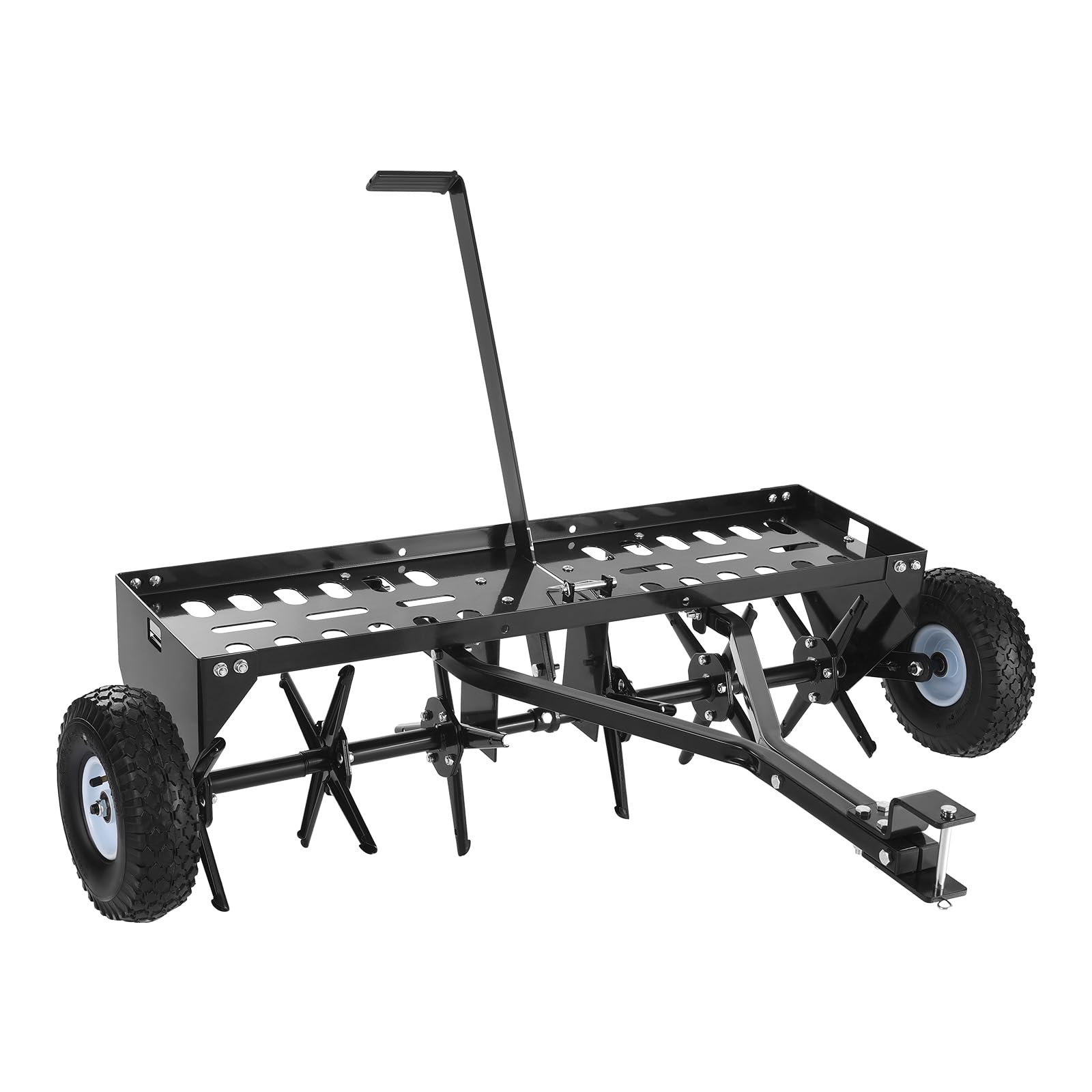
The VEVOR TI-039 is the entry point for tow-behind aeration, offering a 40-inch working width and a weight tray that supports up to 120 pounds. The high-strength steel coring tines penetrate up to 3 inches deep on paper, though real-world performance on clay depends heavily on adding ballast. The fully welded frame and reinforced hardware feel sturdier than the price suggests.
Assembly takes about an hour, with clear instructions and pre-attached tines reducing frustration. The 10.6-inch pneumatic tires roll smoothly over wet grass and moderate slopes. Users have successfully used concrete blocks secured with bungee cords as ballast, reporting good plug formation on both their yards and neighbors’.
The main trade-off is that this is a spike aerator, not a true core puller — its tines are designed to penetrate rather than extract soil plugs. For very compacted clay, this means it can increase compaction around each hole. Buyers who understand that limitation will find it a capable budget unit for maintaining already healthy soil, but it won’t fix severe compaction issues.
Why it’s great
- Low cost entry point for tow-behind aeration on larger properties
- Sturdy welded steel frame exceeds expectations for the price
- 120-pound weight tray allows concrete block ballast for deeper penetration
Good to know
- Spike design can worsen compaction in dense clay by pushing soil sideways
- Requires significant added weight to penetrate dry clay soil
7. Senvert Rolling Lawn Aerator
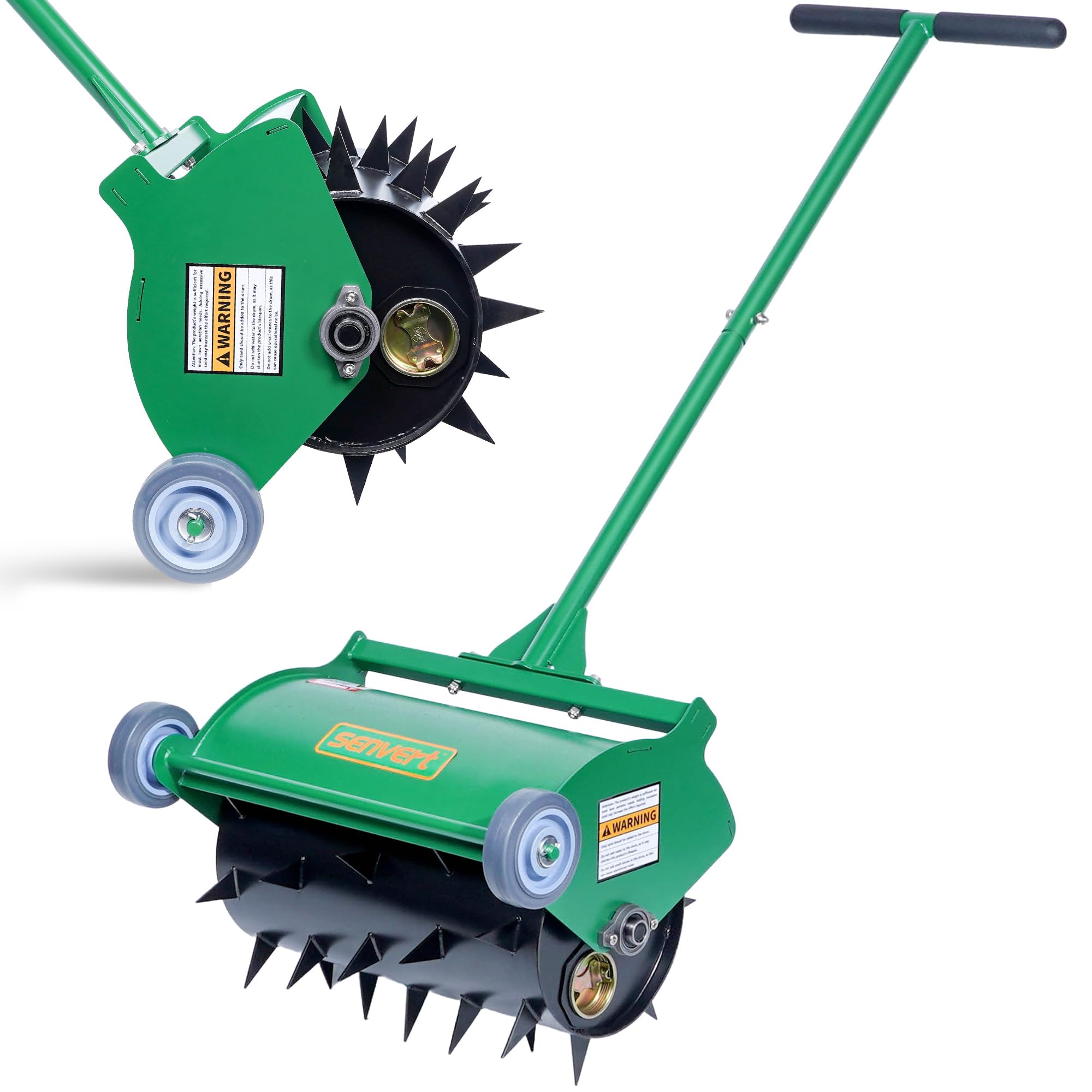
The Senvert JX-002 is a manual drum aerator that weighs 32 pounds bare and can be filled with sand or stones up to 55 pounds. The spiral-spiked tread pattern rolls smoother than straight-spike drums, making direction changes easier on small lawns. Rubber auxiliary wheels let you roll the unit across driveways without damaging surfaces — a thoughtful detail for suburban yards.
Assembly is fast, taking just a few minutes to attach the handle since the drum comes pre-built. Users on clay report mixed results: the drum works well on soft ground with grass, but penetrating dry clay requires rocking the unit back and forth. The sand-filled drum is quieter than rocks, but the extra weight makes pushing across a medium lawn noticeably harder.
This is a spike aerator, not a corer, so it won’t extract soil plugs. On clay, that limitation is significant — spikes can compact the soil walls around each hole. It works best as a maintenance tool for already healthy loamy or sandy soil with some clay content. If your yard is mostly clay, consider this a secondary tool for light aeration between core aeration sessions.
Why it’s great
- Fast assembly with pre-built drum saves setup time
- Auxiliary rubber wheels protect driveway surfaces
- Weight adjustable up to 55 pounds for varying soil conditions
Good to know
- Spike design compacts clay rather than removing plugs
- Struggles to penetrate dry clay without rocking the drum
8. Landzie Original Hollow Tine Lawn Aerator
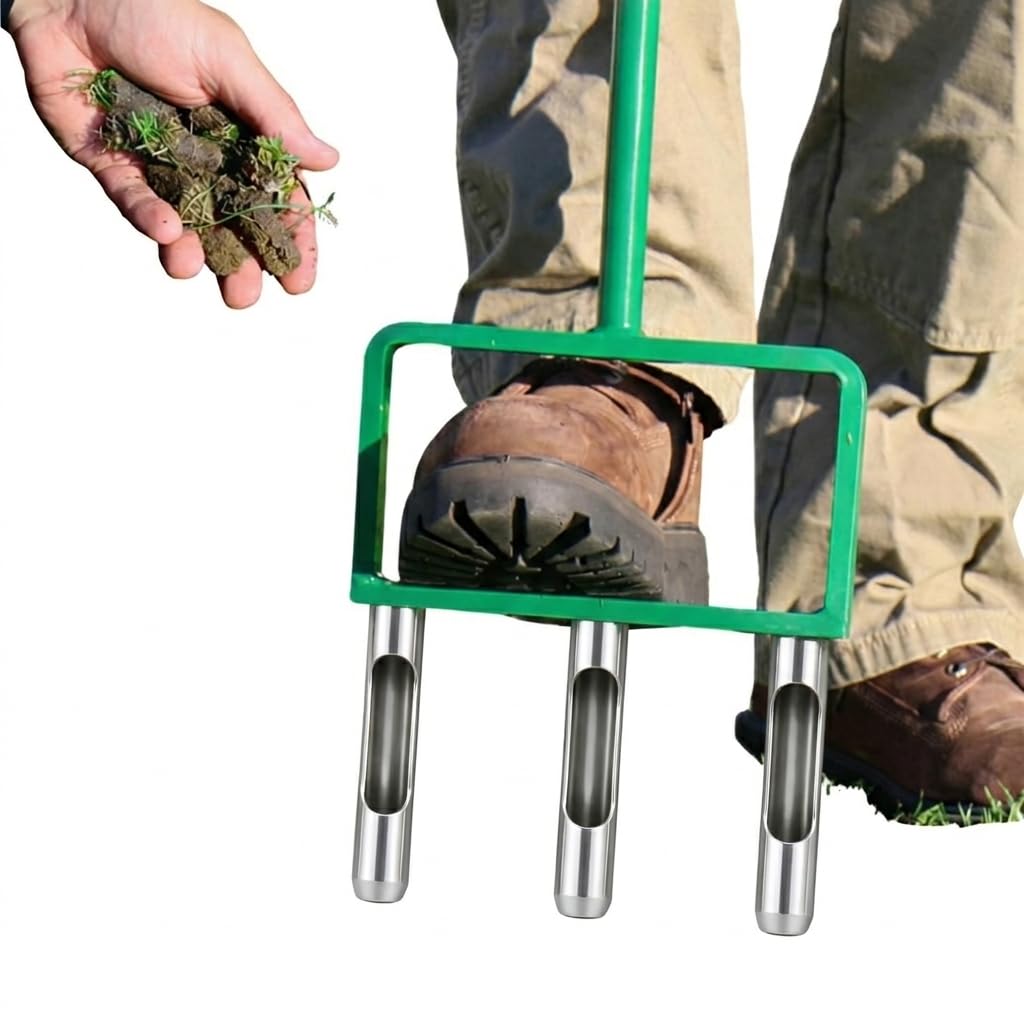
The Landzie Fork is the simplest hollow tine aerator on this list — three stainless steel tines on a 42-inch steel frame, ready to use out of the box with zero assembly. The beveled tine design pushes soil cores up and out of the tool each time you press it into the ground, eliminating the need to manually unclog compacted clay from the tines. At 5.6 pounds, it’s lightweight but relies entirely on your body weight for penetration.
Users consistently emphasize that damp soil is non-negotiable with this tool. On properly watered clay, the tines sink to full depth and self-clean. On dry or extremely compacted clay, the tool bounces off the surface. Reviewers report covering 1,000 to 2,200 square feet in 30 minutes to 4 hours, depending on fitness and soil conditions. The physically demanding nature means it works best for small patches or as a spot treatment tool between mechanical aeration sessions.
Build quality is excellent — multiple users report no breakage after a full season of regular use. The replaceable tines extend the tool’s lifespan considerably. For targeting compacted areas around the yard without renting a machine, this manual step aerator is a durable, low-cost solution that genuinely extracts cores from clay soil.
Why it’s great
- Zero assembly required; ready to use straight from the box
- Self-cleaning beveled tines prevent clay buildup during use
- Replaceable stainless steel tines for long-term durability
Good to know
- Extremely physically demanding for anything over 1,000 square feet
- Requires soil to be damp; ineffective on dry compacted clay
9. TAZZ 2-in-1 Front Tine Tiller/Cultivator
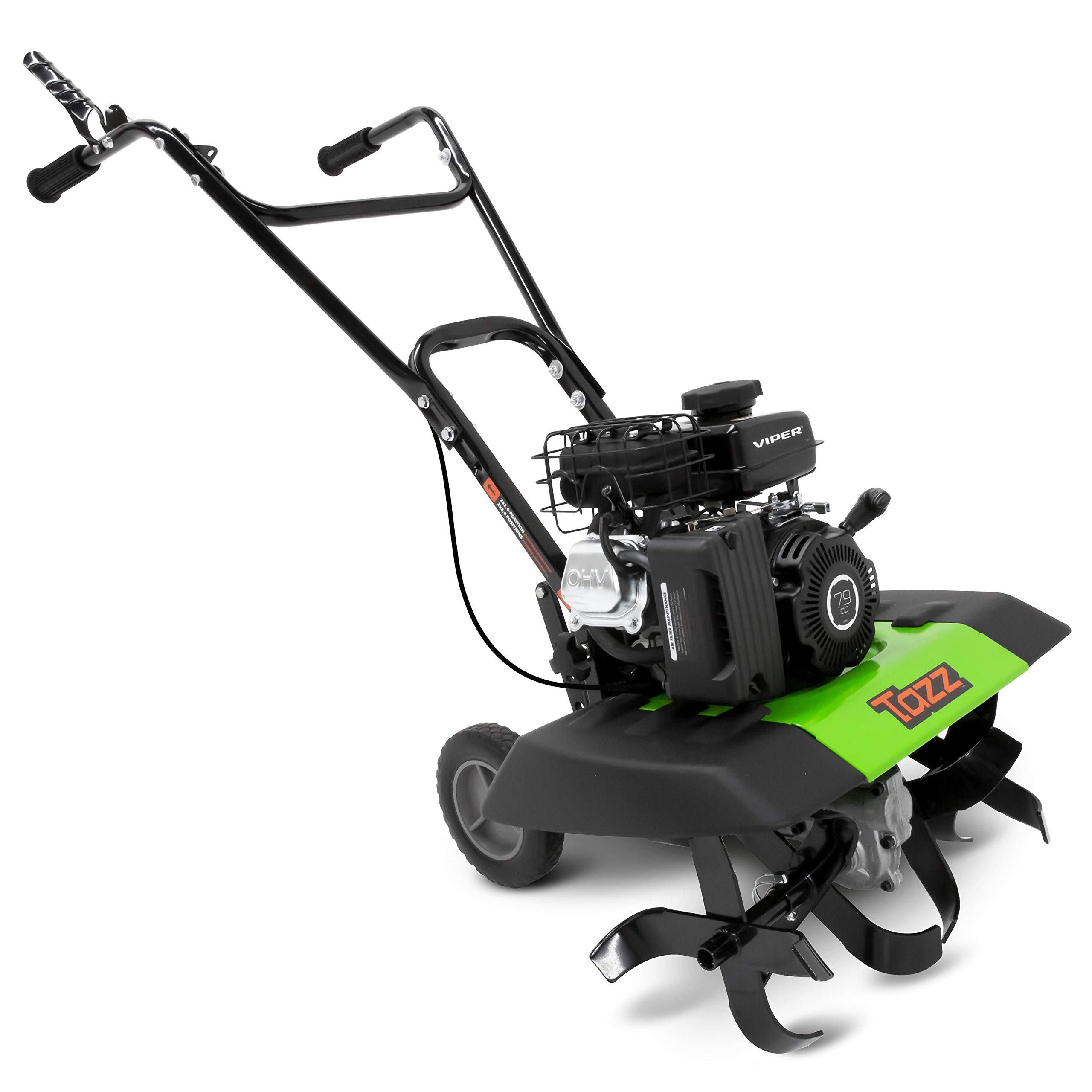
The TAZZ 35310 is a gas-powered front tine tiller that doubles as a cultivator, making it a versatile choice for breaking up compacted clay in garden beds rather than lawns. Its 79cc Viper four-cycle engine starts reliably and delivers enough torque to pull forged steel tines through hard-packed soil. The gear drive transmission with bronze components handles the shock loads that would strip cheaper plastic gears.
Tool-less removal of the outer tines and side shields converts the 21-inch tiller width down to 16 or 11 inches for cultivating between rows. The multi-position drag stake controls tilling depth up to 11 inches without tools. Users report that the tiller easily handles rocks up to 4 inches in diameter without tine damage, and the engine starts on the first pull with ethanol-free fuel.
This is not a lawn aerator — it’s a tiller that aerates by mechanically churning soil rather than pulling plugs. For establishing new garden beds in clay, it’s excellent. For lawn aeration, the churning action destroys grass and root structure. Use this only for breaking up clay in areas where turf is not a concern, such as vegetable gardens, flower beds, or new lawn preparation.
Why it’s great
- 79cc engine provides serious torque for breaking hard clay
- Forged steel tines resist bending even when hitting rocks
- Tool-less width adjustment from 21 down to 11 inches
Good to know
- Gas-powered; requires engine maintenance and fuel storage
- Destroys turf; unsuitable for established lawn aeration
FAQ
Can I use a spike aerator on clay soil?
How wet should clay soil be before aerating?
How often should I aerate clay soil?
Is a manual step aerator effective for clay?
Final Thoughts: The Verdict
For most users, the aerator for clay soil winner is the Landzie AeroCore Rolling Lawn Aerator because it pairs stainless steel hollow tines with enough drum weight to penetrate clay without a tractor. If you manage over an acre and want machine-free operation, grab the Craftsman 40-Inch Tow Plug Aerator for its 140-pound ballast capacity and galvanized coring points. And for multitaskers who need to aerate and overseed in one pass, nothing beats the Brinly Combination Aerator Spreader for saving time on large properties.