
Our readers keep the lights on and the weekend projects moving. As an Amazon Associate, I earn from qualifying purchases.
Choosing a 60-inch class television means deciding how seriously you take your viewing environment. At this screen size, the difference between a budget Mini-LED panel and a premium OLED display is measured not just in dollars, but in how deep your blacks go, how bright your highlights peak, and whether motion blur ruins your sports or gaming session.
I’m Rikta — the co-founder and writer behind FitlyFast. For this guide, I spent hours analyzing real specification sheets, customer test results, and panel performance data to separate marketing promises from measurable picture quality in the 60-inch TV category.
The goal is simple: help you identify the best 60 inch tv for your specific room brightness, content preferences, and budget without burying you in jargon.
How To Choose The Best 60 Inch TV
A 60-inch class TV is a significant investment in your living room or media space. The wrong choice leads to washed-out blacks in a dark room, stuttering motion during sports, or missing features for your gaming console. Focus on the three factors that actually determine long-term satisfaction: panel technology, refresh rate, and connectivity.
Mini-LED vs OLED vs QLED: Which Panel Fits Your Room?
Mini-LED uses thousands of tiny LEDs for local dimming, delivering high brightness and strong contrast without the burn-in risk of OLED. OLED offers perfect blacks and infinite contrast but struggles in bright rooms with ambient light. QLED is essentially a standard LED panel with a quantum dot layer — it boosts color volume but cannot match Mini-LED or OLED for black depth. If your room has direct sunlight, prioritize Mini-LED with anti-glare coating. If you watch primarily in a dark room, OLED is your path to cinematic black levels.
Refresh Rate: 60Hz, 120Hz, 144Hz, or 165Hz?
The native refresh rate determines how smooth motion appears during fast-paced content. A standard 60Hz panel is fine for news and dramas but will show noticeable judder during sports and competitive gaming. 120Hz is the baseline for smooth motion. 144Hz native panels, like those from TCL and Hisense, provide a visible upgrade for PC gaming and reduce blur during live broadcasts. The 165Hz panels are overkill for most users unless you are a competitive gamer with a high-end graphics card.
HDMI 2.1 Ports: The Gateway to True 4K Gaming
If you own a PlayStation 5 or Xbox Series X, the number of HDMI 2.1 ports directly dictates your setup flexibility. A single HDMI 2.1 port forces you to choose between the console and a soundbar eARC connection. Two or more HDMI 2.1 ports allow you to connect both a console and a streaming device or PC at full 4K 120Hz bandwidth. Sony’s BRAVIA 5 only includes two HDMI 2.1 ports, while the LG OLED C5 offers four — a meaningful difference for multi-device households.
Quick Comparison
On smaller screens, swipe sideways to see the full table.
| Model | Category | Best For | Key Spec | Amazon |
|---|---|---|---|---|
| Samsung The Frame Pro | Neo QLED | Art display & living room decor | Neo QLED with Glare Free matte finish | Amazon |
| LG OLED evo G4 | OLED evo | Dark room cinematic viewing | α11 AI Processor, Brightness Booster Max | Amazon |
| Sony BRAVIA XR8B OLED | OLED | PS5 gaming & studio-accurate picture | XR Processor, XR OLED Motion | Amazon |
| Hisense U7 Mini-LED | Mini-LED ULED | Premium gaming & high-brightness rooms | Native 165Hz, 3000 nits peak brightness | Amazon |
| Hisense U6 Pro Mini-LED | Mini-LED ULED | Mid-range value with built-in subwoofer | Native 144Hz, Motion Rate 480 | Amazon |
| Toshiba Z670R Mini-LED | Mini-LED QLED | Japanese-engineered picture accuracy | REGZA Engine ZRi Gen3, Bass Woofer | Amazon |
| TCL QM6K Mini-LED | QD-Mini LED | Budget-friendly high refresh rate gaming | Native 144Hz, Onkyo Audio System | Amazon |
| Roku Plus Series Mini-LED | Mini-LED QLED | Roku OS simplicity & free streaming | Mini-LED backlight, Dolby Vision | Amazon |
| Samsung S90F | QD-OLED | Vibrant color & gaming performance | NQ4 AI Gen3 Processor, Motion Xcelerator 144Hz | Amazon |
| LG OLED C5 | OLED evo | All-around OLED with 4 HDMI 2.1 ports | α9 AI Processor Gen7, Game Optimizer | Amazon |
| Sony BRAVIA 5 Mini-LED | Mini-LED | AI-powered upscaling & PS5 integration | XR Processor, XR Backlight Master Drive | Amazon |
In‑Depth Reviews
1. LG OLED evo G4

The LG G4 is the benchmark for what an OLED should look like at a 65-inch size. The Brightness Booster Max technology pushes each pixel harder than previous generations, making it one of the few OLEDs that remains watchable in a moderately lit room without losing the infinite contrast that defines the category. The α11 AI Processor handles upscaling of lower-resolution content with noticeable sharpness improvement, and the One Wall Design leaves virtually no gap when mounted.
Gamers benefit from four HDMI 2.1 ports, NVIDIA G-Sync and AMD FreeSync Premium support, and a 120Hz panel that pairs perfectly with PlayStation 5 and Xbox Series X. The webOS Re:New Program promises five years of software updates, addressing a common complaint about smart TV platforms becoming obsolete. The bundled wall mount and surge adapter in this version add practical value out of the box.
The trade-off is that OLED burn-in remains a theoretical risk if you watch 24/7 news channels with static logos, and the G4’s peak brightness still falls short of the best Mini-LEDs in direct sunlight. For a dedicated home theater or dark-room setup, however, nothing in this price tier delivers deeper blacks or more accurate colors.
Why it’s great
- Infinite contrast ratio with perfect black levels
- Brightness Booster Max improves daytime viewing
- Four HDMI 2.1 ports for multi-device setups
- Five-year software update commitment
Good to know
- Wall mount included, but stand must be purchased separately
- Not as bright as premium Mini-LED panels in very bright rooms
- WebOS interface less intuitive than some competitors
2. Samsung The Frame Pro
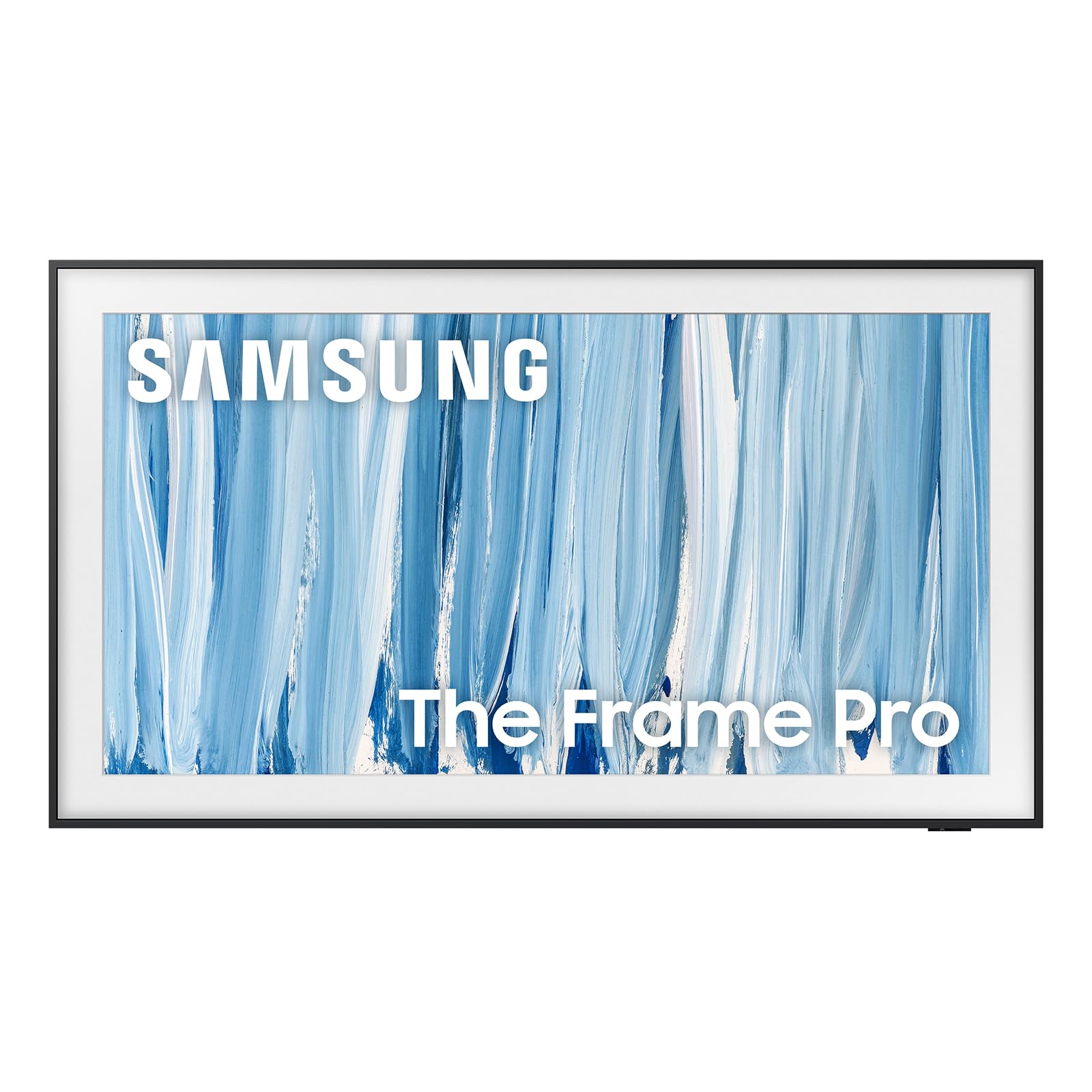
The Frame Pro solves a specific problem: making a large TV disappear into your room when not in use. The Glare Free matte finish is genuinely effective — reflections are diffused rather than bounced, making the screen look like a canvas print rather than a glossy monitor. The Neo QLED Mini-LED backlight provides enough brightness and contrast for HDR movies while keeping power consumption reasonable for a set that might stay on in Art Mode all day.
The Wireless One Connect box is the standout feature for anyone who hates cable management. All HDMI and USB connections go into a separate hub that communicates wirelessly with the panel, leaving only a single near-invisible power cord. The Slim Fit Wall Mount is included and holds the panel flush against the wall. Pantone Validated ArtfulColor ensures that the 5,000+ artworks available through the Art Store look museum-accurate.
Performance-wise, the 120Hz panel is adequate for casual gaming but not class-leading — competitive players will want the higher refresh rates found on the Hisense or TCL options. The interface is cluttered with Samsung’s Tizen platform, and Bixby voice recognition lags behind Alexa and Google Assistant in reliability. If you prioritize aesthetics and clean installation over raw gaming specs, this is the most innovative TV in the list.
Why it’s great
- Glare Free matte finish eliminates reflections
- Wireless One Connect box hides all cables
- Slim Fit Wall Mount included for flush mounting
- Pantone Validated color for art display
Good to know
- Art Store requires subscription for full access
- Interface is cluttered with ads and Bixby prompts
- 120Hz panel limits high-refresh-rate gaming potential
3. Sony BRAVIA XR8B OLED

The Sony XR8B is built around the XR Processor, which uses AI to analyze each scene in real time and adjust color, contrast, and clarity. The result is peerless upscaling — 1080p and 1440p content looks nearly native 4K, which matters if your streaming library still includes older shows or if you game at lower resolutions. The OLED panel delivers the pure blacks Sony is known for, and XR OLED Motion keeps fast pans blur-free without the soap-opera effect that plagues cheaper motion interpolation.
PS5 integration is the deepest in this list. Auto HDR Tone Mapping and Auto Genre Picture Mode mean the console and TV negotiate the best settings automatically. The Game Menu centralizes all gaming picture adjustments without leaving the game. Studio Calibrated modes for Netflix and Prime Video ensure what you watch matches the creator’s intent, a feature that home theater enthusiasts will appreciate.
The downside is that only two of the four HDMI ports support HDMI 2.1 bandwidth, limiting 4K 120Hz to two devices. The built-in Acoustic Surface Audio+ is creative — the screen itself vibrates to produce sound — but lacks the bass and volume of a dedicated soundbar. For PS5 owners who want the most seamless console experience, this is the best choice.
Why it’s great
- AI-powered XR Processor delivers best-in-class upscaling
- Deep PS5 integration with Auto HDR Tone Mapping
- Perfect black levels and blur-free OLED motion
- Studio Calibrated modes for Netflix and Prime Video
Good to know
- Only two HDMI 2.1 ports
- Built-in audio lacks bass range
- Premium price tier for OLED performance
4. Hisense U7 Mini-LED
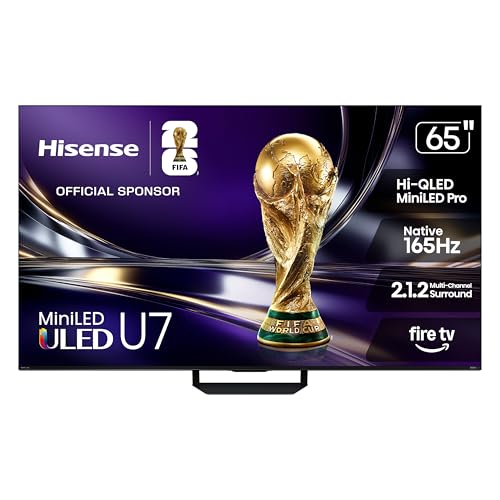
The Hisense U7 is the most aggressively spec’d Mini-LED in the mid-premium bracket. Up to 3000 local dimming zones and 3000 nits peak brightness put it in the conversation with televisions costing twice as much. The native 165Hz refresh rate with VRR up to 330Hz is overkill for standard content but provides headroom for future-proof PC gaming. The Hi-View AI Engine Pro constantly adjusts the picture based on scene analysis, and the anti-reflection layer handles bright rooms effectively.
The 2.1.2 multi-channel surround system tuned by Devialet is a genuine differentiator — the soundstage has width and a dedicated subwoofer channel that produces real bass, reducing the pressure to buy a soundbar immediately for most users. Game Booster 330 with Enhanced Game Bar lets you monitor FPS and VRR status in real time without alt-tabbing. The Fire TV platform with Alexa+ built-in is fast and integrates well with smart home ecosystems.
Reliability concerns are the main hesitation. Some units exhibit light leakage around the edges in dark scenes, and the built-in speakers, while good, don’t match a proper 2.1 soundbar system. The price also dropped shortly after launch for some buyers, which creates frustration if you buy early. For raw brightness and gaming fluidity, though, the U7 is the value king.
Why it’s great
- 3000 nits peak brightness and 3000 dimming zones
- Native 165Hz with VRR up to 330Hz
- Devialet-tuned 2.1.2 sound system
- Excellent anti-glare for bright rooms
Good to know
- Potential light leakage in dark scenes
- Built-in sound good but not soundbar-level
- Price volatility after launch
5. Hisense U6 Pro Mini-LED
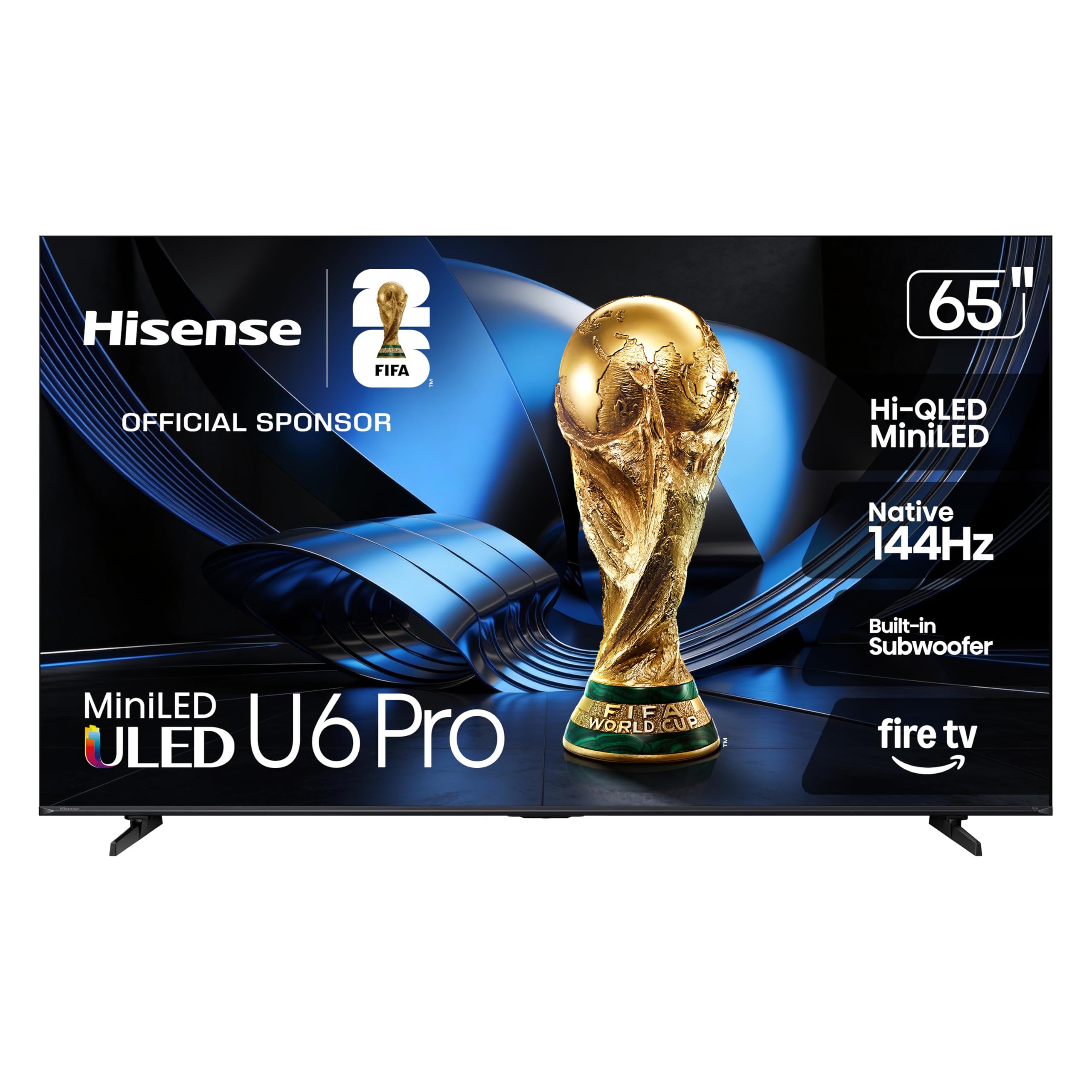
The U6 Pro brings Mini-LED backlighting and a native 144Hz panel to a price point where most competitors are still using standard LED. The Hi-QLED technology delivers vibrant, Pantone-validated colors that look natural across sports, animation, and cinematic content. The Motion Rate 480, combined with the 144Hz native refresh, keeps fast-moving action fluid without the motion smoothing artifacts that plague 60Hz panels.
The built-in subwoofer is a legitimate surprise — it produces enough low-end to make action movies feel immersive without needing an external soundbar for casual viewers. The anti-reflection and glare-free display works well in rooms with windows or overhead lights, maintaining image integrity even during daytime viewing. The Hi-View AI Engine adjusts picture settings automatically based on content, and the Fire TV interface with Alexa+ is responsive and feature-rich.
The trade-off for the aggressive pricing is a lower overall build quality compared to premium OLEDs — the remote feels cheap, and the low-bitrate upscaling for 480p and 720p content shows visible artifacts. For streaming 4K content and modern gaming, however, the U6 Pro delivers picture quality that rivals televisions from the previous generation at nearly double the cost.
Why it’s great
- Mini-LED with Hi-QLED for vibrant, accurate colors
- Native 144Hz refresh rate for smooth motion
- Built-in subwoofer adds real bass presence
- Excellent anti-glare for bright room viewing
Good to know
- Upscaling of very low-resolution content is weak
- Build quality feels budget in hand
- Cheap remote with limited ergonomics
6. Toshiba Z670R Mini-LED

Toshiba’s Z670R is engineered by REGZA, Toshiba’s Japanese R&D division, and the focus is on picture accuracy rather than raw brightness numbers. The REGZA Engine ZRi Gen3 processes every scene to optimize clarity and contrast without over-saturating colors or crushing blacks. The result is a natural-looking image that excels for movie watching and broadcast content where skin tones and shadow detail matter.
Mini-LED combined with Full Array Local Dimming provides deeper blacks and brighter highlights than traditional LED panels, though it doesn’t match OLED for pure black performance. Native 144Hz with Game Mode Pro and AMD FreeSync Premium makes it capable for gaming, with low input lag and smooth frame pacing. The REGZA Power Audio Pro system with a built-in Bass Woofer delivers room-filling sound that handles dialogue clarity well, though the bass is more rumble than punch.
The Fire TV OS is responsive and Alexa integration works reliably for voice commands. The AI Light Sensor Pro adjusts brightness and color balance based on ambient room light, reducing eye strain during long viewing sessions. Toshiba’s brand presence in the premium TV space is smaller than Sony or LG, but the Z670R competes effectively on picture fidelity and value, especially for buyers who prioritize accurate color over gaming-specific features.
Why it’s great
- REGZA Engine ZRi delivers accurate, natural colors
- Mini-LED with Full Array Local Dimming
- Built-in Bass Woofer for better audio
- AI Light Sensor Pro reduces eye strain
Good to know
- Not as bright as competing Hisense or TCL models
- Bass Woofer lacks deep sub-bass extension
- Smaller brand presence may affect resale value
7. TCL QM6K Mini-LED

TCL’s QM6K proves that Mini-LED and high refresh rates are no longer exclusive to premium pricing. The QD-Mini LED technology combines quantum dots for color volume with Mini-LED backlighting for contrast, resulting in a picture that outshines traditional QLED panels in the same price bracket. The TCL Halo Control System manages local dimming well enough to keep blooming minimal — a common problem in budget Mini-LED sets.
The native 144Hz panel with Motion Rate 480 is the standout feature at this price. Sports look smooth, and gaming at 144Hz on PC or 120Hz on consoles is responsive with low input lag. The Onkyo audio system provides clean sound with decent separation, though the lack of a dedicated subwoofer means bass is underwhelming for action movies. Google TV interface is fast and intuitive, and the remote includes a backlight — a rare and welcome feature in this tier.
Peak brightness is lower than the Hisense U6 Pro, and the panel doesn’t handle extremely dark room viewing as well as OLED alternatives. But for a living room with moderate ambient light, the QM6K delivers 90% of the experience of televisions costing significantly more. It is the smartest choice for budget-conscious buyers who refuse to compromise on refresh rate.
Why it’s great
- QD-Mini LED with strong contrast and color volume
- Native 144Hz with Motion Rate 480
- Backlit remote included
- Google TV interface is fast and user-friendly
Good to know
- Peak brightness lower than competitors
- No built-in subwoofer for deep bass
- Blooming visible on extreme contrast scenes
8. Roku Plus Series Mini-LED
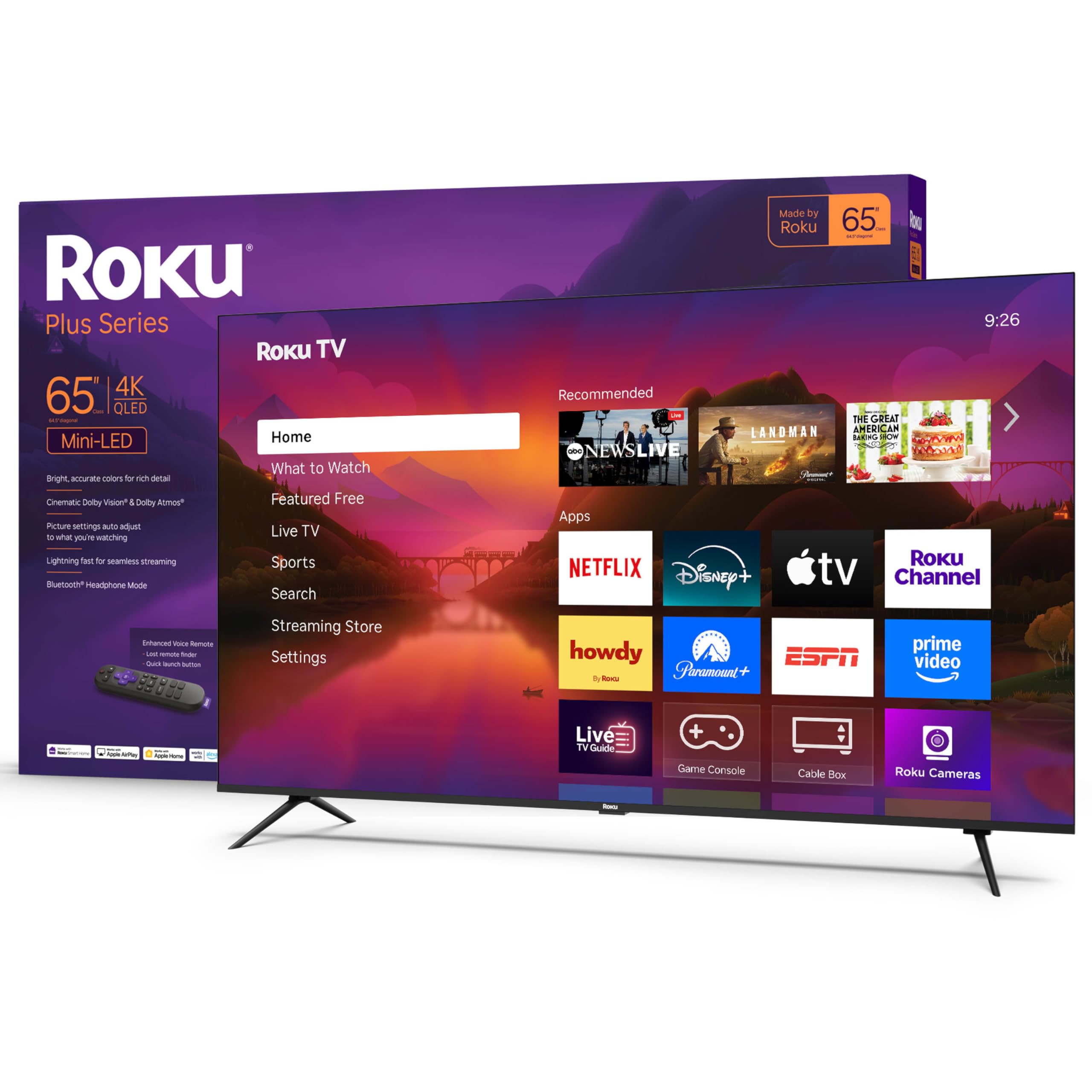
The Roku Plus Series is the best choice for viewers who value simplicity and free content over raw gaming specs. The Roku OS is the most intuitive smart TV platform on the market — no bloatware, no complicated menus, just a clean grid of apps and a search that actually finds what you want. The Enhanced Voice Remote includes a lost remote finder, which is a small but genuinely useful touch that other manufacturers ignore.
The Mini-LED backlighting and QLED panel deliver vibrant colors and solid contrast, though it lacks the precision local dimming of higher-end sets. Dolby Vision support ensures HDR content looks correct, and the Roku Smart Picture Max feature uses AI to clean up incoming signals and adjust sharpness. Dolby Atmos support through the built-in speakers provides a wide soundstage, and the Bluetooth Headphone Mode is a killer feature for late-night viewing without disturbing others.
The refresh rate is standard 60Hz, which makes this a poor choice for sports enthusiasts and competitive gamers who need smooth motion. The lack of a USB port — only USB-C — is an odd omission that limits media playback from external drives. If your priority is a clean, frustration-free streaming experience with access to 500+ free Roku channels, this is the most user-friendly television in the lineup.
Why it’s great
- Best-in-class Roku OS simplicity and app selection
- Enhanced Voice Remote with lost finder
- Bluetooth Headphone Mode for private listening
- AI-powered picture optimization
Good to know
- 60Hz panel limits motion clarity for sports and gaming
- No standard USB port, only USB-C
- Picture quality not competitive with premium Mini-LEDs
9. Samsung S90F

The Samsung S90F uses QD-OLED technology — a hybrid panel that combines quantum dots with an OLED base layer. This gives it the perfect blacks and infinite contrast of OLED with significantly higher color volume and brightness than traditional WOLED panels. The NQ4 AI Gen3 processor, powered by 128 neural networks, upscales content to 4K with impressive sharpness and handles motion clarity through Motion Xcelerator 144Hz.
For gaming, the S90F supports 4K 144Hz VRR with both NVIDIA G-Sync and AMD FreeSync Premium Pro compatibility. Input lag is among the lowest in this list, and the fast response time eliminates ghosting in fast-paced titles. The AI processor also smooths fast-moving objects like balls in sports broadcasts, reducing blur without the artificial look of standard motion smoothing.
The anti-reflective coating is fragile — customers report damage from routine cleaning — and the minimalist remote lacks a backlight, which is frustrating in dark rooms. The operating system is Samsung’s Tizen, which is fast but pushes ads and Samsung TV Plus channels aggressively. For pure picture quality in a QD-OLED package, however, the S90F is a top-tier performer that rivals Sony’s OLEDs at a lower price.
Why it’s great
- QD-OLED delivers perfect blacks with high color volume
- 4K 144Hz with G-Sync and FreeSync Premium Pro
- AI upscaling with 128 neural networks
- Excellent motion handling for sports and games
Good to know
- Anti-reflective coating is fragile and easily scratched
- Remote lacks backlight and has minimal buttons
- Tizen interface pushes ads aggressively
10. LG OLED C5

The LG C5 is the successor to the industry-standard C-series, and it refines the formula without reinventing it. The α9 AI Processor Gen7 handles upscaling and motion processing with authority, and the OLED evo panel provides a meaningful brightness bump over older C-series models. Dolby Vision and Dolby Atmos support are baked in, and Filmmaker Mode allows you to watch content without unnecessary processing — crucial for home theater purists.
Gaming is a strong suit thanks to four HDMI 2.1 ports, 4K 120Hz support, and both NVIDIA G-Sync and AMD FreeSync Premium compatibility. The Game Optimizer dashboard puts all gaming settings — VRR, input lag, black stabilizer — in one accessible menu. The webOS 25 interface is fast and includes the Re:New program for five years of software updates. The bundled 26-month extended protection, wall mount, HDMI cables, and surge adapter in this package add significant real-world value.
The stand is notoriously difficult to install alone, and the panel is thin and fragile during setup — some customers received the wrong model (G5 instead of C5). The built-in speakers are mediocre for a television at this price, and most users will want a separate soundbar. If you want the most versatile OLED with the best warranty protection, this bundle is hard to beat.
Why it’s great
- Four HDMI 2.1 ports for full multi-device gaming
- OLED evo panel with improved brightness
- Five-year webOS Re:New software commitment
- Excellent bundle includes extended protection and accessories
Good to know
- Stand is difficult to install without assistance
- Built-in speakers are underwhelming
- Risk of receiving wrong model in bundle
11. Sony BRAVIA 5 Mini-LED

The Sony BRAVIA 5 is the Mini-LED alternative to the XR8B OLED, designed for buyers who want Sony’s superior image processing without the brightness limitations of OLED. The XR Backlight Master Drive controls thousands of Mini-LEDs individually, producing impressive brightness and contrast that handles HDR highlights with authority. The XR Processor with AI technology upscales HD content to 4K better than any competitor — DVDs and 1080p streams look cleaner and more detailed than on any other Mini-LED in this list.
PS5 integration mirrors the XR8B with Auto HDR Tone Mapping and Auto Genre Picture Mode. The Game Menu puts all gaming settings in one overlay. Dolby Vision and Dolby Atmos are supported, and the IMAX Enhanced certification adds another HDR format option. Google TV with Google Assistant is the best smart TV platform for users who want deep integration with Google services and voice control that actually works.
The limitation is that only two of four HDMI ports support HDMI 2.1, which is restrictive for a premium set in 2025. The built-in speakers are decent but lack the bass of competing models with dedicated subwoofers. The remote not having backlighting is a strange omission at this price point. If you prioritize upscaling quality above all else — especially if your viewing diet includes older media or standard HD broadcasts — the BRAVIA 5 is the Mini-LED to buy.
Why it’s great
- Best-in-class AI upscaling for HD and low-res content
- XR Backlight Master Drive delivers precise Mini-LED control
- Deep PS5 integration and Game Menu overlay
- Google TV with reliable Google Assistant
Good to know
- Only two HDMI 2.1 ports
- Built-in speakers lack bass extension
- Remote has no backlight
FAQ
Is a 60-inch TV too big for a small living room?
What is the difference between Mini-LED and QLED at this size?
Do I need a TV with a 144Hz refresh rate for watching movies?
How many HDMI 2.1 ports do I need for a gaming setup?
Does OLED burn-in still happen on modern 60-inch TVs?
Final Thoughts: The Verdict
For most users, the best 60 inch tv winner is the LG OLED evo G4 because it combines infinite contrast, excellent brightness for an OLED, and four HDMI 2.1 ports with a five-year software commitment — making it the most complete package for both movie lovers and gamers. If you want a brighter panel that handles glare better and still delivers strong gaming performance, grab the Hisense U7 Mini-LED. And for the best value at a lower entry point, nothing beats the TCL QM6K Mini-LED for its native 144Hz refresh rate and strong picture quality at a budget-friendly price.