
Our readers keep the lights on and the weekend projects moving. As an Amazon Associate, I earn from qualifying purchases.
A weak cellular signal turns a fast data plan into a frustrating buffer wheel. Whether you are working remotely in a rural valley or relying on a fixed wireless gateway in a city fringe, the antenna you choose directly determines your download speeds, latency, and connection stability. The difference between a poorly aimed 2×2 panel and a properly installed 4×4 MIMO directional antenna can be a shift from unusable 3G handoff to reliable 5G streaming.
I’m Rikta — the co-founder and writer behind FitlyFast. I spent weeks cross-referencing frequency band coverage, gain curves, cable loss specs, and real-world user reports to isolate the antennas that consistently outperform in the field.
This guide breaks down seven top-performing models across different price tiers, installation styles, and MIMO configurations to help you find the right best 4×4 mimo antenna for your specific location and equipment.
How To Choose The Best 4×4 MIMO Antenna
Selecting the right antenna goes beyond picking the highest gain number. A 30 dBi parabolic dish is useless if you cannot aim it within a fraction of a degree, while a 7 dBi omni may serve you better in a rolling landscape. You need to match the antenna type to your specific terrain, distance from the tower, and the MIMO capability of your router.
Directional vs. Omnidirectional Patterns
A directional antenna concentrates its energy in a narrow beam, which provides higher gain and better rejection of noise coming from behind. This is ideal for fixed installations where you can aim at a single known tower. An omnidirectional antenna radiates equally in all directions, which suits locations where towers exist in multiple directions but offers lower gain and less isolation from interference.
Gain, Beamwidth, and Real-World Aiming
Gain figures (measured in dBi) describe how much the antenna concentrates power compared to an isotropic radiator. High gain narrows the beamwidth, making the antenna harder to aim but providing more signal reach. A panel antenna with 10 dBi has a beamwidth around 75 degrees, forgiving for amateur installers, while a 30 dBi parabolic dish has a beamwidth of only a few degrees, requiring a compass, a cell tower map, and fine adjustments.
4×4 MIMO and Router Compatibility
A true 4×4 MIMO antenna uses four physically separate radiating elements and requires four coaxial cables to your router. Your router must have four antenna ports to take advantage. Many modern 5G gateways like the T-Mobile Nokia 5G21 or the Waveform-compatible Arcadyan KVD21 support 4×4 MIMO, but some only handle 2×2. Verify your device before buying a quad-cable kit.
Cable Loss and Connector Types
The best antenna gain in the world is wasted if your cable run is too long or uses high-loss RG58 at high frequencies. At 3.5 GHz, LMR240 cable loses significantly less per foot than RG58. Also check connector types: SMA, TS9, N-type. Most outdoor antennas ship with N-type female connectors for weather sealing and require a pigtail adapter to match your router. Factor this into your installation plan.
Quick Comparison
On smaller screens, swipe sideways to see the full table.
| Model | Category | Best For | Key Spec | Amazon |
|---|---|---|---|---|
| Waveform QuadPro 4×4 MIMO Panel | Premium Kit | Full 4×4 MIMO with easy DIY install | 9.1 dBi gain, 600-6000 MHz | Amazon |
| Proxicast Pro-Gain ANT-127-05P | Omni | Multiple tower directions | 7 dBi peak, 360° coverage | Amazon |
| SIGNALPLUS Parabolic Grid | Extreme Range | Long distance, clear line of sight | 30 dBi gain, 698-6000 MHz | Amazon |
| weBoost High Gain LPDA | Premium LPDA | Boosters and extreme distances | LPDA design, 700-2700 MHz | Amazon |
| Proxicast ANT-129-001 Panel | Panel | Versatile directional 70° beamwidth | 7-10 dBi, 600-6000 MHz | Amazon |
| MOPHAMP Log Periodic Kit | Full Kit | Hotspot users wanting a complete setup | 15 dBi gain, 698-3800 MHz | Amazon |
| Eifagur 11 dBi Directional | Budget | Entry-level upgrade for hotspots | 11 dBi gain, 698-2700 MHz | Amazon |
In-Depth Reviews
1. Waveform QuadPro 4×4 MIMO Signal Boosting Panel Antenna Kit

The Waveform QuadPro is the most complete 4×4 MIMO solution on this list. It ships as a true all-in-one kit: a white panel antenna with 9.1 dBi gain covering every 4G and 5G band from 600 to 6000 MHz, a window entry cable that eliminates the need to drill through your wall, the FlexMount bracket, weatherproofing boots, and adapter cables for SMA and U.FL connectors. The panel design gives a broad enough beamwidth for forgiving aiming while still offering solid directionality that rejects noise from behind.
Real-world performance across three major carriers is outstanding. Users pairing it with T-Mobile Home Internet gateways report jumping from 50/10 Mbps speeds with frequent drops to a stable 300/20 Mbps connection. The documentation is the best in the industry, with separate installation guides for the Arcadyan KVD21, Nokia 5G21, G4AR/G4SE, and Verizon and AT&T hardware. The included UltraFlex-Quad cable runs 20 feet with low loss at 5G frequencies, which keeps signal degradation minimal.
The biggest drawback is installation complexity if you need to open your gateway to connect internal U.FL pigtails. This is unavoidable for most modern 5G gateways, but Waveform includes clear instructions and customer support is responsive. At a higher price point, it justifies that cost with the most carefully engineered mounting hardware, the best cable, and a 3-year warranty. For anyone who wants the fastest possible speeds from a fixed wireless connection, this is the reference design.
Why it’s great
- Genuine 4×4 MIMO with four independent elements for maximum throughput
- Complete kit with window-entry cable and no-drill mounting
- Excellent documentation and responsive customer support
Good to know
- Requires gateway disassembly for internal U.FL connections
- Higher investment than simpler 2×2 options
2. Proxicast Pro-Gain 4G / 5G MIMO Antenna ANT-127-05P

The Proxicast Pro-Gain is the premier omnidirectional MIMO antenna in this lineup. It measures 30 inches tall and includes two cross-polarized radiating elements inside a rugged UV-stable radome, delivering 7 dBi peak gain with a full 360-degree horizontal beamwidth. This makes it the top pick for locations where cell towers exist in multiple directions or where terrain makes precise aiming impossible. It covers the entire 600-6000 MHz range, so it handles every current 4G and 5G band including T-Mobile n71 and Verizon n77.
Reports from the field confirm its value. One user switching from a Panorama antenna on a Cradlepoint IBR600 saw their speeds jump from 10/0.1 Mbps to 22 up and 8 down. A pair of these units used as a 4×4 MIMO array on a Verizon 5G Cradlepoint R1900 delivered 350 Mbps down and 150 up. The build quality is heavy duty — the unit weighs 4 pounds and requires a sturdy mast mount. All connections use dual female N-type connectors, so you will need two coax extension cables and possible pigtails for your router.
The trade-off with omni directionality is reduced raw gain compared to a directional panel. At 7 dBi, it cannot punch through extreme distances like a parabolic dish, but it avoids the aiming curse entirely. The Pro-Gain is also one of the more expensive antennas here, reflecting its premium materials and multi-band support. For a fixed installation where you must cover multiple tower sectors without a motorized rotator, this is the antenna that just works.
Why it’s great
- True 360-degree coverage eliminates aiming difficulty
- Rugged build with corrosion-resistant materials for outdoor longevity
- Handles all 4G/5G bands including C-band n77
Good to know
- Lower gain than directional alternatives may limit extreme range
- Requires separate coax extension cables (not included)
3. SIGNALPLUS Parabolic Grid 2×2 MIMO 30 dBi

The SIGNALPLUS Parabolic Grid antenna offers the highest gain on this list at a claimed 30 dBi. This is a 2×2 MIMO system that uses two separate grid dishes, each with its own feed horn, creating a very narrow beamwidth that can reach towers 15 miles or more away. The included cables are 15 meters of LMR240, which is a reasonable low-loss choice for that length. It supports the full 698-6000 MHz range, covering all North American 4G and 5G bands.
User results are dramatic but conditional. One person went from 20-30 Mbps down to 120-140 Mbps at a distance of around 6-7 miles. Another user noted that the antenna required 360-degree rotation testing to pinpoint the exact direction, and once locked, the signal strength was transformative. The ultra-narrow beamwidth is both the feature and the flaw: you need solid line of sight, a clear view of the tower, and a very stable mount that will not shift in the wind.
The assembly hardware is functional but not premium — some users noted that brackets could be sturdier and the included mounting screws are basic. The grid dishes themselves are lightweight yet rigid, so wind load is manageable. This antenna is not for beginners. It requires patience, a cell tower locator app, and ideally a helper to rotate the mast while you watch signal readings. If your goal is to pull a signal from maximum distance and you can dedicate time to fine-tuning aim, nothing else here matches its raw reach.
Why it’s great
- Highest gain in this roundup for extreme long-range reception
- Includes 15-meter LMR240 cables for flexible installation
- Lightweight grid design reduces wind load
Good to know
- Extremely narrow beamwidth makes aiming very difficult
- Mounting hardware quality is middling for the price
4. weBoost Wilson Electronics High Gain LPDA Antenna 311228

The weBoost LPDA is a dedicated antenna designed to pair with WilsonPro cellular boosters rather than directly with modems. It uses a Log Periodic Dipole Array (LPDA) design that provides wide frequency coverage from 700 to 2700 MHz with higher gain and more precise directionality than the standard yagi antennas that ship with most weBoost kits. The included tilt/swivel bracket fits 1.5 to 2-inch masts and allows fine angular adjustment.
Real-world results are impressive for extreme distances. One user hit a Verizon tower 37 miles away without direct line of sight and pulled a steady 8-15 Mbps, compared to a noisy and unreliable connection with the stock antenna. Another saw download speeds jump from 30 Mbps to 40-50 Mbps after swapping out the kit antenna. The LPDA is more directional than a standard broadband yagi, requiring careful peaking — one degree off can make a meaningful difference in signal quality.
A few caveats matter. First, it requires the Wilson 971128 adapter for residential weBoost systems, so budget for that. Second, it is a single-port antenna (not MIMO), so it is not a candidate for building a 4×4 MIMO array itself. Third, some users at moderate distances (around 7 miles) saw no improvement over a standard yagi, suggesting that the LPDA advantage is most pronounced at extreme range or in challenging terrain with heavy foliage. Build quality is excellent with a 2-year warranty.
Why it’s great
- Exceptional range with verified 37-mile tower connection
- Higher gain and better directionality than stock weBoost yagi
- Rugged waterproof construction for permanent outdoor install
Good to know
- Requires adapter for residential weBoost systems
- Single-port design, not suitable for MIMO arrays
5. Proxicast 4G / LTE / 5G Cross-Polarized Panel ANT-129-001

The Proxicast ANT-129-001 is a cross-polarized directional panel antenna that hits a sweet spot of gain, beamwidth, and price. It delivers 7-10 dBi of gain across 600-6000 MHz with a 75-degree horizontal beamwidth, which is forgiving enough that a rough visual aim will still yield solid results. It includes dual female N-type pigtails and is designed to work with a wide range of MIMO routers from Cradlepoint, MoFi, Netgear, and Pepwave. Using two panels at different angles creates a true 4×4 MIMO array.
Field reports confirm strong performance in challenging conditions. One user mounted it 25 feet up on a pole about a mile from an AT&T tower and saw download speeds more than double. Another, in a rural log house with a metal roof and no line of sight due to trees, improved their signal from -110 dBm to -95 dBm and jumped from 10 Mbps to 45-50 Mbps down. The RSRP and RSRQ improvements are consistently reported across multiple reviews, showing that this antenna effectively lowers noise floor while boosting signal.
The main limitation is that it requires separate coax extension cables, which adds cost and complexity if you have a long cable run. The included pigtails are short at 12 inches, so the antenna needs to be close to where the cables enter the building. It is also a 2×2 MIMO panel by itself — to reach 4×4, you need to buy two panels and mount one vertically and one at 45 degrees. This makes the total cost heavier for those seeking quad-stream performance.
Why it’s great
- Broad 75-degree beamwidth makes aiming easier than parabolic options
- Proven RSRP and RSRQ improvements in real-world installations
- Can be combined with a second panel for 4×4 MIMO
Good to know
- Requires separate coax extension cables for mounting
- Single panel provides 2×2 MIMO only
6. MOPHAMP Log Periodic Antenna 2×2 MIMO Full Kit
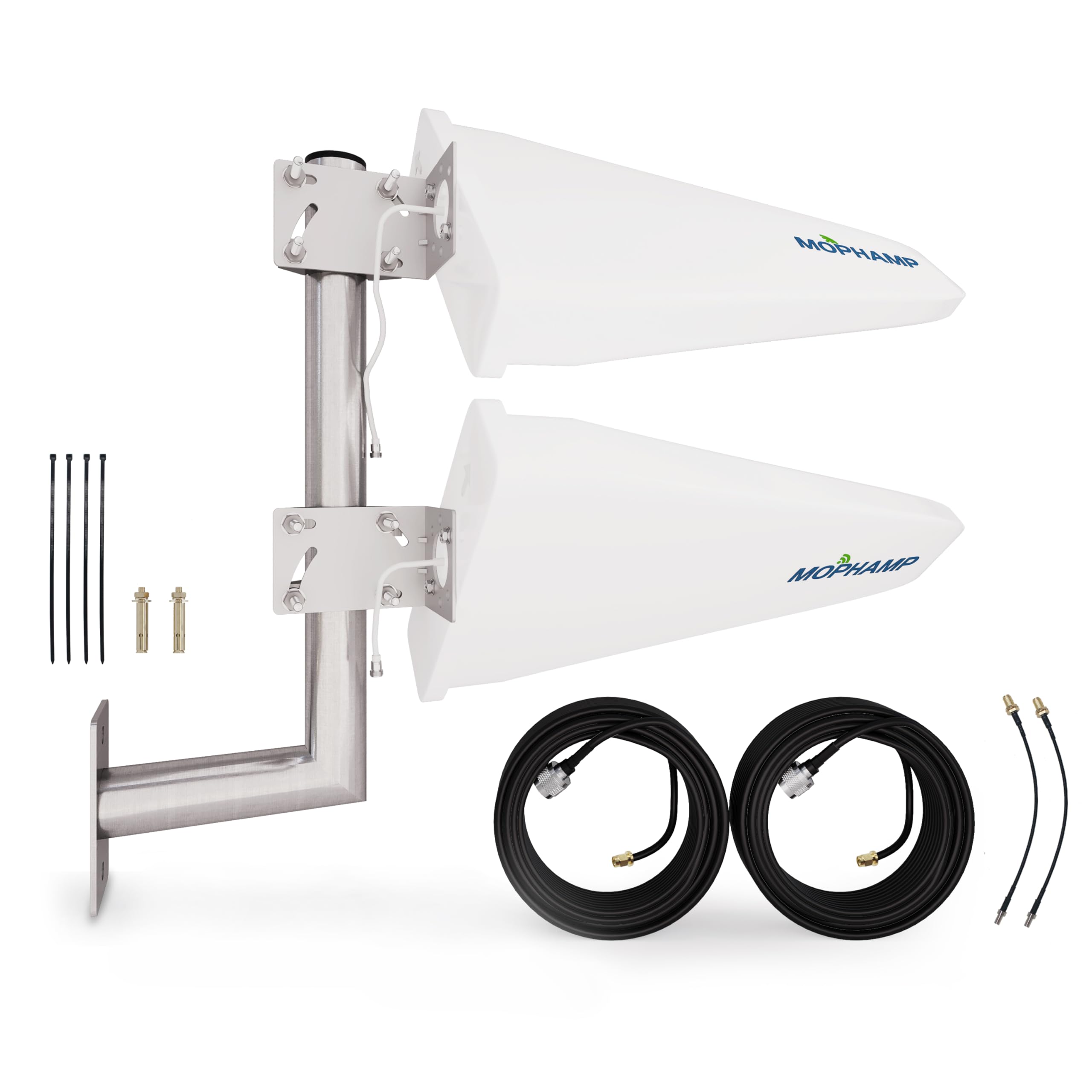
The MOPHAMP Kit bundles two log periodic antennas, two 32-foot low-loss coaxial cables, two TS9 adapters, a solid L-mount, anchor kits, and cable ties into one package. The antennas themselves claim 15 dBi gain across 698-3800 MHz, covering all 4G bands and most 5G FR1 bands including n71. The full kit approach is aimed at hotspot users who want a turnkey solution without sourcing cable and adapters separately.
Results are impressive for hotspot owners. One user with a Netgear Nighthawk MR6500 was getting below 1 Mbps indoors before installation. After mounting the kit on a tripod near a window aimed at the nearest tower, speeds jumped to around 300 Mbps down and 20 Mbps up. The dual 32-foot cables give you flexibility to place the antenna well away from the building while keeping the hotspot inside. The cables themselves use minimal-loss construction that preserves signal at higher frequencies.
The major concern reported by multiple users is the L-mount base plate. Several reviews describe the welds as weak — three tiny tack welds that can snap in windy conditions, risking damage to the antenna and property. Some owners have replaced the mount with strut channel and conduit clamps. The antennas and cables are well-regarded, but the mounting hardware undermines the overall reliability. If you buy this kit, plan to reinforce or replace the mount with a beefier solution.
Why it’s great
- Complete kit includes cables, adapters, and mounting hardware
- Demonstrated ability to turn <1 Mbps hotspot to ~300 Mbps
- Low-loss 32-foot cables preserve gain at 5G frequencies
Good to know
- Included L-mount has weak welds prone to failure
- Mount replacement adds cost and effort
7. Eifagur 11 dBi High Gain Directional MIMO Antenna

The Eifagur antenna offers an entry-level path into directional MIMO without a major investment. It is a single-piece directional panel with dual SMA male connectors and includes adapter cables for TS9. It claims 11 dBi gain over the 698-2700 MHz range, which covers all 4G LTE bands and slower 5G NR FR1 bands but not the higher 3.5 GHz C-band frequencies used by mid-band 5G. It comes with two U-bolt brackets for mounting to a 1.5 to 2-inch mast.
User experiences are mixed but instructive. Several users saw transformative results: one rural household went from 0-10 Mbps to 80-100 Mbps after installing and enabling the antenna ports on their modem. Another used it to revive a legacy alarm system in a location without any cell reception. The antenna requires careful aiming using a cell tower locator app, and its moderate gain makes it usable for distances up to roughly 10 miles with clear line of sight.
However, a significant minority report that the antenna performed worse than a smaller, cheaper omnidirectional option. One user noted that the larger Eifagur unit failed to outperform a Waveform quadmini and suggested variability in unit quality. The mounting bracket is described as janky and installation is finicky. The limited frequency range also means it will not support the fastest 5G bands from AT&T or Verizon. It works well when it works, but there is a real quality-control lottery at play.
Why it’s great
- Lowest cost directional MIMO option on this list
- Can dramatically boost speeds from 0-10 to 80-100 Mbps in good conditions
- Includes both SMA and TS9 adapters for broad router compatibility
Good to know
- Frequency range limited to 2700 MHz, no C-band 5G support
- Inconsistent user results suggest possible quality variation
FAQ
Can I use a 4×4 MIMO antenna with a 2×2 router?
How do I find the direction of the nearest cell tower?
Do I need a lightning arrestor for an outdoor antenna?
Will a higher gain antenna always give me better speed?
Final Thoughts: The Verdict
For most users, the winner for the best 4×4 mimo antenna is the Waveform QuadPro because it delivers a true 4×4 MIMO solution with the most complete installation kit on the market, including a window-entry cable and top-tier documentation. If you need 360-degree coverage and cannot aim at a single tower, grab the Proxicast Pro-Gain ANT-127-05P. And for long-distance rural connections where line of sight is achievable, nothing beats the SIGNALPLUS Parabolic Grid for raw reach.