
Our readers keep the lights on and the weekend projects moving. As an Amazon Associate, I earn from qualifying purchases.
Every time you buy a case of bottled water, you are paying a premium for something that flows freely from your tap. The real issue isn’t the water itself — it is the contaminants, the taste, and the plastic waste. The right filtration system removes those concerns, turning tap water into a cleaner, better-tasting, and far more sustainable option without the recurring cost and environmental toll of single-use bottles.
I’m Rikta — the co-founder and writer behind FitlyFast. This guide is built on hundreds of hours spent analyzing lab test results, filtration certifications, filter longevity data, and real-user feedback to find the most effective systems for replacing bottled water at home.
Whether you want a simple countertop pitcher or a permanent under-sink installation, the right alternative to bottled water will save you money and deliver consistently clean, great-tasting water.
How To Choose The Best Alternative To Bottled Water
Switching away from bottled water means selecting a filtration method that fits your tap water quality, your kitchen setup, and your daily consumption. Three main categories — pitchers, under-sink systems, and countertop units — each solve different problems. Here is what to look for in each.
Filtration Stage Count vs. Real Contaminant Reduction
A 5-stage or 8-stage label sounds impressive, but what matters is what each stage actually removes. Basic carbon filters handle chlorine taste and odor. Advanced systems add ion exchange for heavy metals and sediment membranes for particulate matter. If your tap water has high TDS (total dissolved solids), a standard carbon filter will not lower it — only reverse osmosis or ion exchange technology will. Always check the NSF certification standard (42 for taste/odor, 53 for health contaminants, 372 for lead-free materials) rather than counting stages.
Filter Longevity and Cost Per Gallon
The cheapest pitcher is not the most affordable over time — filter replacement costs determine your true expense. A filter rated for 40 gallons that lasts two months costs less upfront but may cost more annually than a higher-capacity filter rated for 100 or 20,000 gallons. Under-sink systems with 12-month filters offer the lowest cost per gallon, but require permanent installation. Pitchers are portable and require no tools, but their smaller filters mean more frequent cartridge swaps.
Installation Requirements and Space Constraints
Pitchers need only refrigerator or counter space. Countertop systems connect directly to your faucet with included adapters and require no drilling, making them ideal for renters. Under-sink systems are hidden away but need cabinet space and a cold water line connection. Measure your available space before buying — a slim under-sink filter (12 inches tall) fits most cabinets, while a large 22-cup dispenser may not fit in a crowded fridge door.
Quick Comparison
On smaller screens, swipe sideways to see the full table.
| Model | Category | Best For | Key Spec | Amazon |
|---|---|---|---|---|
| ZeroWater 22-Cup Dispenser | Dispenser | High TDS tap water | TDS reduction to 0 ppm | Amazon |
| Clearly Filtered Pitcher | Pitcher | 365+ contaminant removal | NSF certified, 100-gal filter | Amazon |
| SimPure V7 Under-Sink | Under-Sink | Long-term cost savings | 20,000-gal, 0.5 micron | Amazon |
| Frizzlife DS99 Countertop | Countertop | No-drill permanent setup | 2 GPM flow rate | Amazon |
| Brita Large 10-Cup Pitcher | Pitcher | Everyday chlorine reduction | 10-cup, 2-month filter | Amazon |
| Hydros 64 oz Pitcher | Pitcher | Fast filtration speed | 5x faster flow, NSF 42 | Amazon |
| AQUAPHOR 12 Cup Opal | Pitcher | Compact fridge-friendly fit | 12-cup, BPA-free | Amazon |
In‑Depth Reviews
1. ZeroWater 22-Cup 5-Stage Water Filter Dispenser

The ZeroWater dispenser uses a 5-stage filtration system with ion exchange technology that drops total dissolved solids to zero — verified by the included instant-read TDS meter. For households with hard water measuring 300–500 ppm TDS, this is the only pitcher-style option that actually removes dissolved minerals rather than just masking taste. The 22-cup capacity is the largest in its class, making it ideal for families who go through multiple gallons per day.
Users report that water from high-TDS sources (Arizona at 500 ppm) reduces to 3 ppm or lower, producing a clean, almost sweet taste. The sliding hatch design prevents spills and makes dispensing easy. However, the dense filter media slows down filtration — expect several minutes to refill the full reservoir. Filters last roughly 2.5 to 3 months for a two-person household, though users with extremely hard water (300+ ppm) report replacements every 2.5 weeks, driving annual filter costs potentially above 300 dollars.
The dispenser is BPA-free and IAPMO certified to reduce lead, chromium, mercury, and PFOA/PFOS. For anyone serious about removing virtually all contaminants — including fluoride — this is the most effective pitcher-based solution available, with the caveat that removing all minerals may leave water tasting flat for some users. Adding trace mineral drops is a common fix.
Why it’s great
- Reduces TDS to 0 ppm — unmatched by standard carbon pitchers
- Built-in TDS meter gives real-time water quality feedback
- 22-cup capacity reduces refill frequency for large families
Good to know
- Filter replacement cost can be high with very hard tap water
- Slow filtration speed compared to carbon-only pitchers
- Removes beneficial minerals along with contaminants
2. Clearly Filtered 80 oz Filtered Water Pitcher
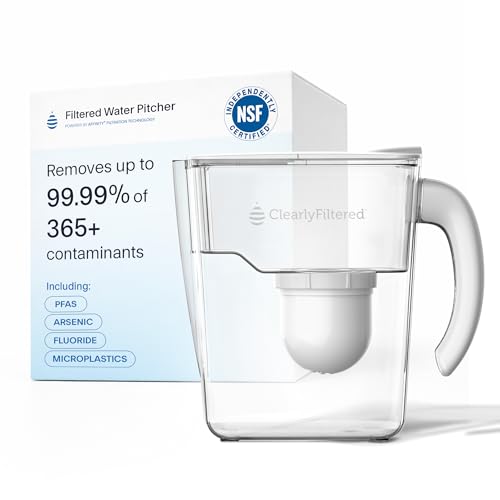
Clearly Filtered targets an extraordinary 365+ contaminants with its proprietary Affinity Filtration Technology, using ionic binding to capture fluoride, lead, PFAS/PFOA, arsenic, microplastics, and chlorine while preserving beneficial minerals. NSF certified to standards 42 and 372, this pitcher is independently lab-verified to remove up to 99.99% of contaminants — a claim most pitchers cannot back with third-party testing. The 80-ounce (10-cup) capacity fits standard refrigerator shelves and uses medical-grade Tritan plastic, which is BPA-free, BPS-free, and non-leaching.
Users consistently confirm dramatic taste improvement and the removal of chemical aftertastes that other filters leave behind. Lab testing from a verified buyer showed fluoride levels dropping from 0.71 ppm to undetectable after filtration. The redesigned reservoir eliminates swiveling issues from earlier versions, and the ergonomic handle improves pouring control. Each filter lasts up to 100 gallons (roughly 4 months), making replacement less frequent than most pitcher filters.
At a higher upfront cost, this pitcher is a serious investment for health-conscious buyers who want the broadest contaminant protection without moving to an under-sink system. A small number of users reported mold growth inside the pitcher after extended use, and the company’s customer service response has drawn mixed reviews. Regular cleaning and filter changes mitigate this risk.
Why it’s great
- Targets 365+ contaminants with independent NSF certification
- 100-gallon filter life reduces replacement frequency
- Medical-grade Tritan construction is BPA/BPS-free
Good to know
- Higher upfront cost than standard pitchers
- Some users report internal mold issues with prolonged use
- Slower filtration compared to basic carbon models
3. SimPure V7 Under Sink Water Filter System

The SimPure V7 is a permanent under-sink solution built from food-grade 304 stainless steel — a significant durability upgrade over plastic housings that can crack or degrade over time. Its 5-stage filtration includes double-sediment membranes, KDF-55, and double-activated carbon blocks for 0.5-micron accuracy, reducing lead, chlorine, bad tastes, and odors while retaining beneficial minerals. The 20,000-gallon filter life is extraordinary — one cartridge lasts up to 12 months, making the cost per gallon the lowest of any option here.
Installation takes roughly 5 to 10 minutes with no drilling required, using the included 3/8-inch to 1/2-inch converter fittings. The compact 3.6-inch by 12-inch profile leaves most cabinet space free for storage. Flow rate reaches 1.6 gallons per minute, filling an 8-ounce glass in about 3 seconds. Users consistently praise the solid metal construction and the immediate taste improvement, noting that even their pets prefer the filtered water.
This system does not lower TDS — it filters sediment and chemical contaminants but preserves dissolved minerals. If you need TDS reduction, you would need a reverse osmosis system instead. Some users report the filter lasting closer to 4 months for two people rather than the full year, especially with higher sediment loads. Customer service from the Seattle-based company is responsive, with replacement units sent promptly when issues arise.
Why it’s great
- 20,000-gallon filter life delivers lowest long-term cost per glass
- 304 stainless steel housing outlasts plastic alternatives
- Tool-free installation in under 10 minutes
Good to know
- Does not reduce TDS or remove dissolved minerals
- Filter life may be shorter with high-sediment water
- Requires under-sink cabinet space for installation
4. Frizzlife DS99 Countertop Water Filter System
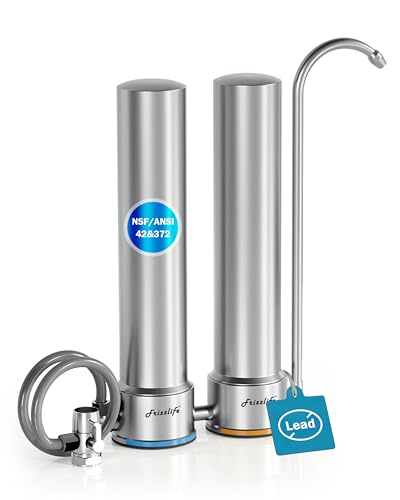
The Frizzlife DS99 sits directly on your counter and connects to your existing faucet with zero drilling or permanent modification — perfect for renters or anyone who moves frequently. Its 8-stage filtration system uses a PP membrane, activated coconut shell carbon block blended with KDF, and a second 0.5-micron carbon block to reduce lead, chlorine, fluoride, heavy metals, VOCs, and bad tastes while preserving essential minerals. The 2-gallon-per-minute flow rate is the fastest among filtered water systems, filling an 8-ounce cup in 2 to 3 seconds.
The unit is built from food-grade 304 stainless steel with 1-millimeter thickened housings, tested for 100,000 water hammer cycles and 10,000 pulse tests. Six included faucet adapters cover most American standard and non-standard thread sizes. The first-stage filter lasts up to 8 months, and the second stage lasts up to 12 months or 8,000 gallons — only the inner core cartridges need replacement, reducing plastic waste. Users note that initial setup may produce a brief hissing sound and black carbon particles, which clear within the first gallon.
This is the best choice for anyone who wants a durable, high-flow countertop system without cabinet modifications. It produces zero wastewater and requires no electricity. The main consideration is faucet compatibility — the included adapters fit most but not all faucets, and the company provides additional adapters on request for non-standard sizes. A small drip after shutoff is mentioned by some users but does not affect normal operation.
Why it’s great
- 2 GPM flow rate — fastest in its class, no waiting for water
- No-drill installation works for renters and temporary setups
- Stainless steel construction with 1mm thickened housing
Good to know
- Faucet adapter compatibility varies; may need additional adapters
- Initial setup may produce temporary black carbon particles
- Countertop footprint requires dedicated space near sink
5. Brita Large 10-Cup Water Filter Pitcher
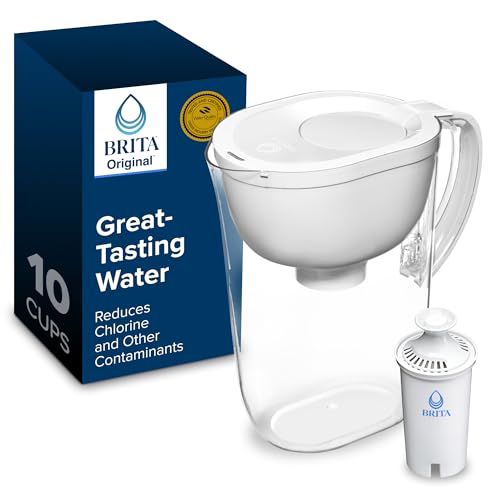
The Brita Large 10-Cup Pitcher is the entry-level standard for good reason. It is WQA and NSF/ANSI certified to reduce chlorine taste and odor, as well as zinc, copper, mercury, and cadmium. The BPA-free design fits most refrigerator shelves at 10.1 inches tall, and the easy-fill locking lid simplifies refilling. Each standard filter lasts 40 gallons (roughly 2 months), and switching to a Brita Longlast filter extends that to 120 gallons (6 months), making it one of the more flexible budget options.
Users consistently report a clear improvement in tap water taste, with many noting better-tasting coffee and tea after switching. The 10-cup capacity fills three 24-ounce reusable bottles per cycle. The redesigned inset reservoir cap fixes earlier leak issues during pouring. At this price point, the Brita delivers reliable chlorine reduction and basic heavy metal filtration without any complex installation. The compact dimensions work well in standard refrigerators.
The trade-offs are clear: this is a basic carbon filter that does not address TDS, fluoride, PFAS, or microplastics. The 40-gallon filter life on the standard cartridge means frequent replacements for heavy users. The plastic construction, while BPA-free, is less durable than stainless steel or Tritan alternatives. For anyone with relatively clean tap water who simply wants to remove chlorine taste at the lowest possible entry cost, this remains a solid choice.
Why it’s great
- WQA/NSF certified for chlorine, zinc, copper, and mercury reduction
- Fits most refrigerator shelves at just over 10 inches tall
- Compatible with both standard and Longlast filter options
Good to know
- Does not reduce TDS, fluoride, PFAS, or microplastics
- Standard filter needs replacement every 40 gallons
- Plastic construction is less durable than metal or Tritan models
6. Hydros 64 Ounce Water Filter Pitcher

The Hydros pitcher differentiates itself with patented Fast Flo technology that filters water five times faster than comparable pitchers. The filters are made from natural coconut shell carbon with a BPA-free lining, and the entire filter is recyclable — a meaningful environmental step beyond most disposable cartridges. Rated NSF 42/Class 1, the system removes 99% of sediment and 90% of chlorine, along with fluorine and other chemicals that affect taste.
The 64-ounce (8-cup) design has a sturdy rubber base and ergonomic handle for extra grip, and the pitcher is dishwasher safe for easy cleaning. Users consistently praise the compact profile and the speed of filtration — the reservoir fills significantly faster than Brita or ZeroWater units. The design is visually clean and modern, and the single filter size fits across the entire Hydros product line, simplifying replacements.
Some users report an odd plastic-like taste after the water sits for more than 48 hours, even after following priming instructions. The small filling basin at the top requires a slow trickle from the faucet to avoid overflow, which can be inconvenient for impatient users. The filter does not address TDS or heavy metals beyond what standard carbon can manage. For fast, convenient chlorine and sediment reduction in a compact package, the Hydros is a strong contender, but the taste consistency is occasionally unpredictable.
Why it’s great
- 5x faster filtration than competitors — fills quickly
- Recyclable coconut shell carbon filters reduce waste
- Compact, dishwasher-safe design with rubber base for grip
Good to know
- Some users report plastic taste developing after 48 hours
- Small top basin requires slow water flow to fill
- Limited to chlorine and sediment reduction — no heavy metal or TDS removal
7. AQUAPHOR 12 Cup Opal Water Filter Pitcher
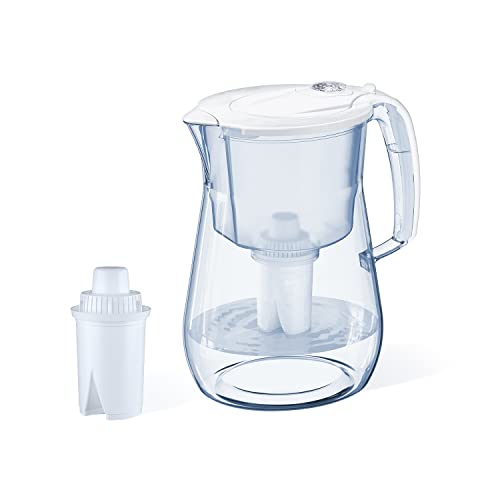
The AQUAPHOR 12 Cup Opal pitcher delivers a spacious 12-cup (10-cup filtered) capacity in a fridge-friendly footprint measuring 9.84 inches by 4.53 inches — narrow enough to fit most refrigerator door shelves. The B15 filter reduces chlorine taste and odor along with heavy metals, and the pitcher body is dishwasher safe for effortless cleaning. The secure-fit lid prevents spills during pouring, and the compact design makes it a strong option for smaller kitchens or apartment living.
Users highlight the thicker, more robust plastic build compared to Brita, with a more ergonomic handle feel. The filtration speed is noticeably faster than the ZeroWater dispenser, delivering clean water without extended wait times. At 12 cups, it holds enough water to fill a standard coffee maker twice or refill a 40-ounce bottle twice daily. The filter requires a 10-minute soak in water before first use — a simple but essential step that some users miss initially.
The lid is reported as flimsy by several users, requiring careful handling to avoid cracking. The pitcher does not fit inside most refrigerator doors — tested units confirm it is better suited for countertop use despite its compact depth. The included B15 filter lasts approximately 2 to 3 months, and replacement filters are inexpensive and widely available. For an affordable mid-range option with better build quality than entry-level pitchers, the AQUAPHOR is a reliable value pick.
Why it’s great
- 12-cup capacity in a narrow, fridge-friendly footprint
- Thicker, more durable plastic than comparable Brita pitchers
- Dishwasher safe body for easy maintenance
Good to know
- Lid is prone to cracking with rough handling
- Does not fit inside most refrigerator door shelves
- Filter requires 10-minute pre-soak before first use
FAQ
Is a water filter pitcher cheaper than buying bottled water?
What is the difference between a countertop filter and an under-sink filter?
Will a carbon filter remove fluoride from my tap water?
How do I know when to replace my water filter?
Can a water filter remove microplastics?
Final Thoughts: The Verdict
For most users, the alternative to bottled water winner is the SimPure V7 Under Sink Water Filter System because it delivers the lowest long-term cost per gallon, a durable stainless steel build, and simple installation that hides away under the cabinet. If you want the most comprehensive contaminant removal in a portable pitcher, grab the Clearly Filtered Pitcher for its NSF-certified 365+ contaminant coverage and medical-grade materials. And for high-TDS tap water where you need to see the proof, nothing beats the ZeroWater 22-Cup Dispenser with its built-in TDS meter and ion exchange technology.