
Our readers keep the lights on and the weekend projects moving. As an Amazon Associate, I earn from qualifying purchases.
A stuffy attic with stagnant heat pushes your cooling costs up and shortens your roof’s lifespan. The right ventilation fan works against radiant heat buildup, using measured CFM (Cubic Feet per Minute) to pull hot air out and keep your home’s climate truly balanced. Choosing a model that matches your attic’s cubic footage is the single most important decision you’ll make here.
I’m Rikta — the co-founder and writer behind FitlyFast. I’ve spent countless hours analyzing the airflow specs, motor types, and real installation requirements across the attic fan market to separate effective ventilation from noisy, underpowered setups that waste your time.
A reliable system depends on matching fan capacity to space volume, which is exactly where this guide to the best attic ventilation fan helps you make the right call the first time.
How To Choose The Best Attic Ventilation Fan
Attic fans are not one-size-fits-all. You need to match the fan’s output to your attic’s total cubic feet, select a motor type that fits your electrical setup, and decide if smart controls will save you from manual operation. Below are the three key factors to evaluate.
Match CFM to Your Attic Volume
Calculate your attic’s volume (length x width x height) and divide by 60 to find the minimum CFM needed for one air exchange per minute. A 1,500 sq. ft. attic with an 8-foot peak average height (about 12,000 cubic feet) requires at least 200 CFM. Oversizing slightly is acceptable, but an undersized fan will struggle to move heat effectively.
Choose Between EC and AC Motors
EC (Electronically Commutated) motors are more energy-efficient and quieter than traditional AC motors. They consume less power at partial speeds and are ideal for continuous or timer-based operation. AC motors are cheaper upfront but draw more power and generate more noise, making them better suited for high-CFM occasional use in workshops or garages.
Evaluate Control Options: Smart, Thermostat, or Manual
Thermostat-controlled fans start automatically when attic air reaches a set temperature, which is essential for unattended cooling. Humidity controls add another layer, activating when moisture levels climb above a safe threshold. Smart app control lets you monitor and adjust settings remotely, but requires a stable connection near the fan. Entry-level models rely on manual switches, which demand regular attention to work effectively.
Quick Comparison
On smaller screens, swipe sideways to see the full table.
| Model | Category | Best For | Key Spec | Amazon |
|---|---|---|---|---|
| AC Infinity AIRLIFT T14 | Premium/EC | Smart home integration | 1513 CFM / WiFi & App | Amazon |
| iLIVING 20″ | Premium/AC | Large attics & shops | 3368 CFM / Thermostat | Amazon |
| Quietcool AFG SMT PRO-2.0 | Smart/EC | Gable vent installation | 1945 CFM / 2-Speed | Amazon |
| InoKraft 16″ | Mid-Range/EC | Medium attics & greenhouses | 2800 CFM / Wireless Remote | Amazon |
| AC Infinity AIRTITAN T3 | Mid-Range/EC | Crawl spaces & small attics | 120 CFM / App Control | Amazon |
| iLIVING 14″ | Mid-Range/EC | Garages & workshops | 1200 CFM / Humidistat | Amazon |
| addlon 14″ | Budget/EC | Plug-and-play setup | 1400 CFM / 8 Speeds | Amazon |
| VEVOR 24″ | Budget/AC | High-volume airflow | 3320 CFM / Basic | Amazon |
| KEN BROWN 20″ | Budget/AC | Industrial & large shops | 3500 CFM / No Controller | Amazon |
In‑Depth Reviews
1. AC Infinity AIRLIFT T14

The AC Infinity AIRLIFT T14 is the most intelligent option in this lineup. Its 14-inch frame houses a 1513 CFM EC motor that pairs with a WiFi-enabled controller, giving you full visibility into attic temperature and humidity from your phone. The IP-44 rating ensures resistance to dust and moisture, a critical factor for long-term attic reliability.
Setup is straightforward: mount the fan, plug it in, and connect to the app. Users consistently report that the fan cycles on automatically based on temperature or humidity triggers, effectively pulling heat out before it radiates into living spaces. The dual ball bearings and variable speed control keep noise at a manageable 68 dBA even at higher settings.
What sets the AIRLIFT T14 apart is its scheduling and minimum speed features. You can program the fan to run at a low speed continuously during summer months and ramp up when the attic hits a set threshold. This level of automation makes it a smart investment for homeowners who want a hands-off solution that actively protects the home’s structure.
Why it’s great
- Intuitive WiFi app with real-time climate data
- Variable speed EC motor for energy savings
- Automatic shutters block pests and drafts
Good to know
- Connectivity range can drop near metal framing
- Full speed is noticeably loud at close range
2. iLIVING 20″ Wall Mounted Shutter Exhaust Fan

The iLIVING 20-inch model is a workhorse for large spaces, delivering a massive 3368 CFM at 980 RPM from a UL-certified AC motor. The Thermospeed controller includes a temperature dial (32°F to 130°F) and a variable speed knob, giving you precise control over how aggressively the fan evacuates heat. The automatic aluminum shutters seal tightly when the fan is off, keeping out wind and debris.
Owners of large garages and workshops praise this unit for its raw airflow. In a 12,500 cubic foot space, the iLIVING dropped the temperature from 94°F to 83°F in about 45 minutes, running at peak draw of 253W. The noise level sits around 65 dB at a meter, which is acceptable for a fan of this capacity.
The industrial-grade galvanized steel frame and aluminum blades resist corrosion well, but the gravity shutters may allow slight water intrusion during extreme wind gusts if not flashed properly. Installation requires cutting a 20-inch square opening, and the fan ships fully assembled — just mount, plug, and set your target temperature.
Why it’s great
- Very high CFM for large volume spaces
- Integrated thermostat with variable speed dial
- Durable all-metal construction with OSHA guards
Good to know
- Shutters can rattle at higher speeds
- Requires a dedicated 15A circuit for peak output
3. Quietcool AFG SMT PRO-2.0

The Quietcool AFG SMT PRO-2.0 is purpose-built for gable vent installations and comes with a two-speed PSC motor that delivers up to 1945 CFM at just 120W. Its integrated smart hub connects to the QuietCool app, where you can set temperature and humidity thresholds, receive alerts, and monitor attic conditions remotely. The fire safety sense shut-off adds peace of mind for homeowners concerned about smoke backdraft.
Installation is plug-and-play — the 20-foot power cord simplifies routing in finished attics, and the included vent covers make for a clean gable mount. Users note that sealing the fan frame with tape and sealant further improves performance by eliminating air gaps. The Bluetooth app setup is straightforward, though the connection range can be limited if your phone is far from the fan.
At high speed, the fan operates noticeably quieter than conventional metal-shutter models. The dual thermostat and humidistat controls allow the fan to respond to both temperature spikes and moisture buildup, which is crucial for preventing mold in humid climates. It’s a strong choice for homeowners who prioritize low noise and mobile control.
Why it’s great
- Very quiet operation for its airflow class
- Smart app with temp & humidity thresholds
- 20-foot cord simplifies difficult attic runs
Good to know
- Bluetooth range may be limited in larger homes
- Only two speeds, no variable control
4. InoKraft 16″ Shutter Exhaust Fan
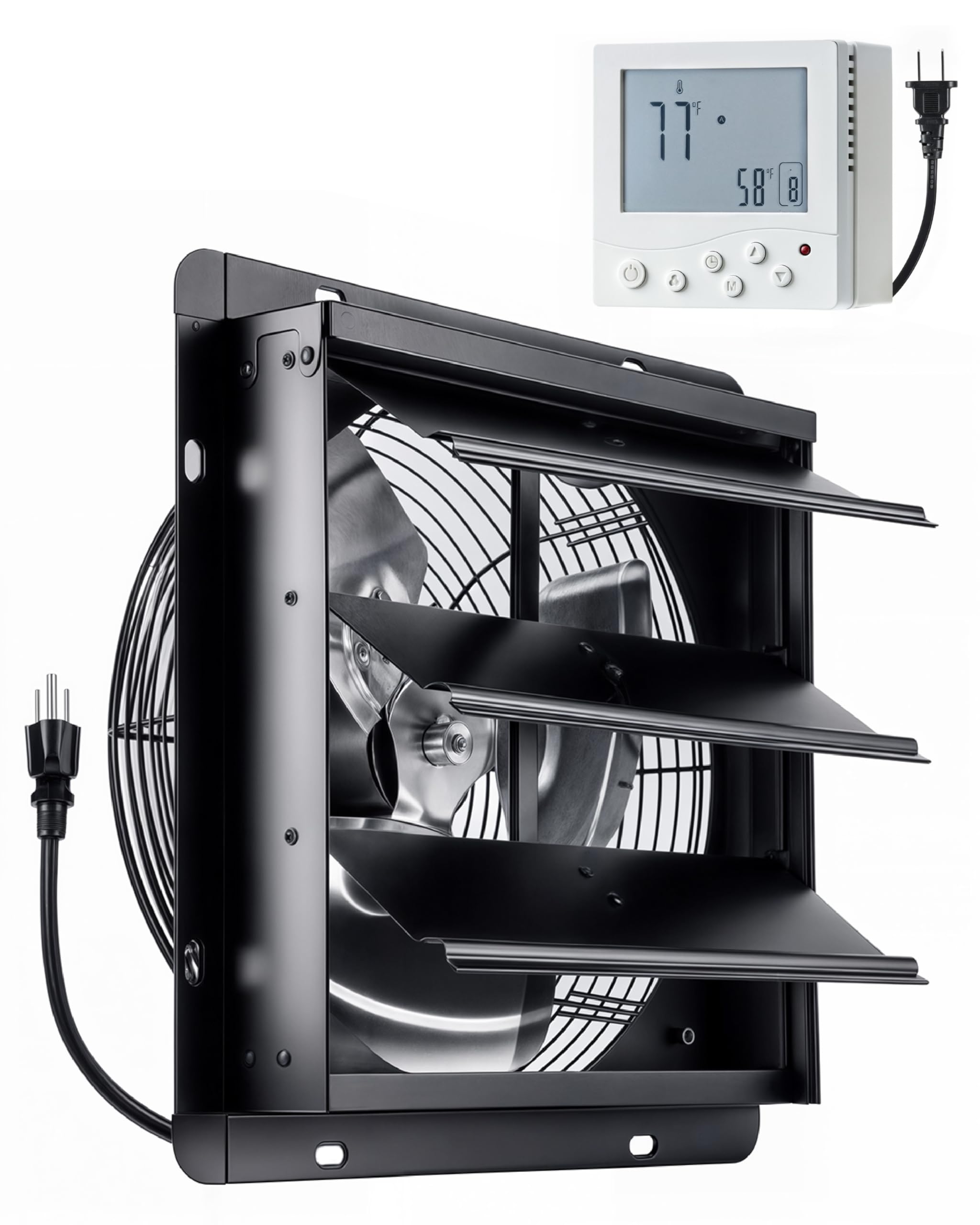
The InoKraft 16-inch model uses an ETL-certified EC motor to push 2800 CFM with eight speed settings and a 24-hour timer. Its wireless remote control panel can be wall-mounted up to 33 feet away, provided there is an unobstructed line of sight. The thermostat range (32°F to 140°F) allows the fan to automatically adjust speed based on temperature, which is ideal for greenhouses and workshops where climate swings are common.
Construction focuses on weather resistance: a heavy-duty steel frame with powder coating and coated aluminum shutters that seal against rain and insects. The included wall-cutting template simplifies the installation process for DIYers, and the plug-and-play power connections mean no hardwiring is needed. Reviewers highlight its quiet performance even at speed 8, noting it blends into background noise.
One limitation is the lack of a remote temperature sensor — the controller reads temperature at the fan location, not at the opposite end of the attic. For gable-mount installations where the fan sits far from the hottest point, this means using manual mode to achieve the desired cooling effect. Still, at this CFM output with an EC motor, It offers excellent value.
Why it’s great
- EC motor with 8 variable speeds
- Wireless remote panel for convenient control
- Weather-sealed shutters block elements
Good to know
- No remote temperature sensor for gable mounts
- Signal may not pass through solid walls
5. VEVOR 24″ Exhaust Fan

The VEVOR 24-inch fan is a high-capacity, budget-friendly option that delivers 3320 CFM at 1300 RPM from a 190W AC motor. Its all-metal construction features a galvanized steel frame and aluminum blades and shutters, making it resistant to rust and weather damage. The automatic gravity shutters close when the fan stops, keeping out bugs, leaves, and cold drafts.
This unit ships as a bare fan — no speed control switch or power plug is included, so you will need to wire a plug and a separate thermostat or switch to make it operational. That makes it better suited for buyers comfortable with basic electrical work. Users mounting it in greenhouses report significant temperature drops on extreme summer days, and the noise level is described as moderate for the amount of air it moves.
The short factory pigtail is a common complaint, as it adds to the wiring requirement. However, the overall build quality and fan performance justify the extra effort for those who want maximum airflow on a tight budget.
Why it’s great
- High CFM for large volume spaces
- Durable all-metal weather-resistant construction
- Low power draw for the airflow delivered
Good to know
- No plug or speed control included
- Very short power pigtail requires extra wiring
6. KEN BROWN 20″ Shutter Exhaust Fan

The KEN BROWN 20-inch fan punches above its price class with a maximum airflow rating of 3500 CFM at 1309 RPM. It uses a basic AC motor with aluminum blades and automatic aluminum shutters that open and close with the fan. The 5.4-foot power cord allows plug-and-play operation, which is a significant convenience compared to similar-capacity fans that require wiring.
Owners report that this fan is effective for cooling large shops, warehouses, and second-story open beam spaces. The shutters take a few days to fully seat, after which they close reliably and block wind noise effectively. Some users run it through a wireless outlet switch to control it from a distance without a dedicated controller.
The main trade-off is noise — the AC motor runs louder than EC-powered alternatives, and there is no variable speed control to dial it down for continuous use. It also lacks any built-in thermostat, making manual or switch-based operation necessary.
Why it’s great
- Excellent CFM per dollar ratio
- Simple plug-and-play installation
- Durable aluminum shutters and frame
Good to know
- Loud compared to EC motor options
- No speed control or thermostat included
7. iLIVING 14″ Wall Mounted Shutter Exhaust Fan

The iLIVING 14-inch fan packs smart programming into a compact frame. Its EC motor delivers 1200 CFM at 1600 RPM with up to 12 adjustable speeds, and the digital controller accepts temperature (50°F to 99°F) and humidity set points. The 24-hour timer lets you schedule ventilation windows, which is particularly useful for greenhouses and chicken coops that need consistent air exchange.
The galvanized steel frame and aluminum blades are standard for this class, but the wire guards are OSHA-compliant for safety. The controller can be extended using a standard USB-A cable, giving you flexibility in where you mount the interface. Users appreciate the ability to set it and walk away, with the fan responding automatically to changes in the environment.
One drawback is that the controller loses its temperature settings when power is interrupted or if the fan is unplugged. This can be frustrating in areas with frequent outages. The noise level is moderate — noticeable but not disruptive, especially at lower speeds.
Why it’s great
- 12-speed EC motor for precise airflow
- Humidity and temperature auto-control
- USB-A extension for flexible controller placement
Good to know
- Settings reset on power loss
- Sharp edges on frame during installation
8. AC Infinity AIRTITAN T3

The AC Infinity AIRTITAN T3 is a specialized 6-inch inline fan designed more for crawl spaces and small rooms than full attic ventilation, but its app-controlled temperature and humidity programming makes it adaptable. With a 120 CFM output from an EC motor, it is best suited for targeted moisture control in smaller enclosed areas rather than large-volume attic cooling.
The fan features a heavy-duty anodized aluminum frame with an IP-55 rating, making it highly resistant to dust and liquid ingress. It connects to the AC Infinity WiFi app, where you can set dynamic triggers for temperature, humidity, and VPD cycles. Users report that it runs quietly and maintains stable conditions when set to auto mode, though the initial controller setup takes about an hour.
The main limitation for attic use is the 6-inch duct connection and relatively low CFM. It works well for exhausting hot air from a small attic pantry or a sealed-off section, but it cannot replace a full-size shutter fan for whole-attic ventilation.
Why it’s great
- IP-55 weatherproof build
- App with advanced climate triggers
- Very quiet operation
Good to know
- Low CFM limits it to small spaces
- Controller programming has a learning curve
9. addlon 14″ Shutter Exhaust Fan
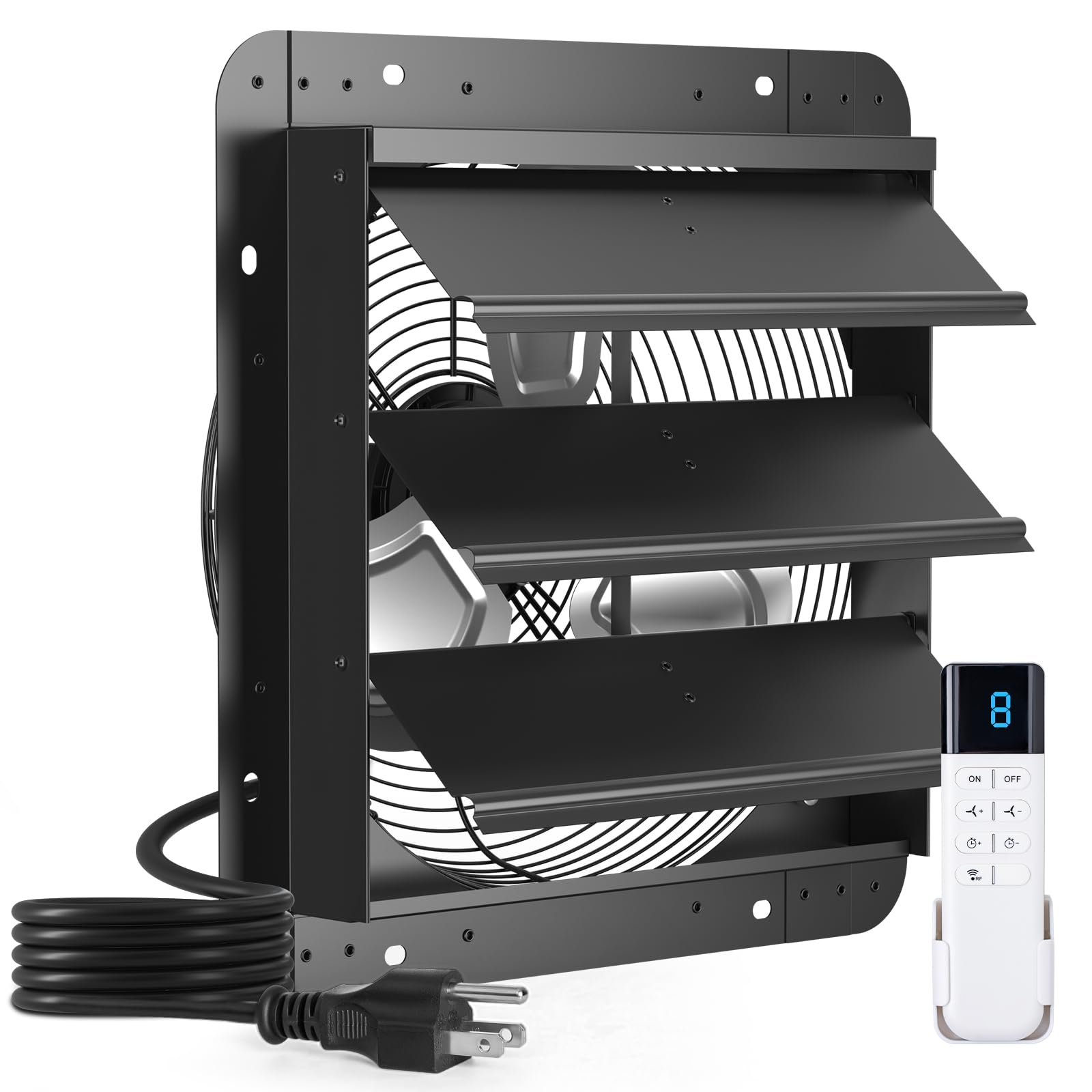
The addlon 14-inch shutter fan brings a 1400 CFM EC motor and eight variable speeds to an entry-level price point. Its plug-and-play setup — complete with a standard power cord and a hole-cutting template — makes it one of the easiest fans here to install. The included remote control handles speed, timer (1 to 8 hours), and on/off from across the room.
The galvanized steel frame and rust-proof aluminum blades are paired with gravity shutters that seal tightly when the fan is off. Owners report that the shutters effectively block drafts and insects, though there is a small gap at the sides that could allow minor light leakage. At 55 dB, it runs noticeably quieter than many AC-motor fans in the same airflow class.
The addlon lacks a thermostat or humidistat, so it requires manual or timer-based operation for climate control. It is best suited for garages, workshops, and smaller rooms where direct switch control is acceptable.
Why it’s great
- Very quiet 55 dB operation
- 8-speed remote with 8-hour timer
- True plug-and-play installation
Good to know
- No automatic thermostat or humidistat
- Small gaps around shutters may allow light in
FAQ
Can an attic fan replace a whole-house fan?
How do I calculate the right CFM for my attic?
Is a smart app-controlled fan worth the extra cost?
Do attic fans work with solar power?
How loud is a typical attic ventilation fan?
Final Thoughts: The Verdict
For most users, the best attic ventilation fan winner is the AC Infinity AIRLIFT T14 because it combines efficient EC motor performance with a fully featured WiFi app that gives you direct control over temperature and humidity triggers from anywhere. If you need massive airflow for a very large attic or workshop, grab the iLIVING 20-inch for its 3368 CFM output and integrated thermostat. And for a quiet, Bluetooth-controlled gable mount solution, nothing beats the Quietcool AFG SMT PRO-2.0.