
Our readers keep the lights on and the weekend projects moving. As an Amazon Associate, I earn from qualifying purchases.
The difference between a night that fizzles and one your friends still talk about months later is often just the right box on the table. A great board game turns passive watchers into engaged players, sparks genuine laughter over plastic trinkets, and creates a shared experience that no streaming queue can match. Whether you are corralling a chaotic party crowd or settling in for a tight strategic duel, the game you choose defines the entire mood of the evening.
I’m Rikta — the co-founder and writer behind FitlyFast. I have spent hundreds of hours digging through player counts, mechanic types, playtime statistics, and real owner feedback to separate the games that actually deliver from those that just look good on a shelf.
This guide cuts through the clutter and focuses on the seven boxes that earn their spot on your table, giving you a clear look at the best picks across different styles and group sizes. This is the definitive guide to the very best board games for every kind of game night.
How To Choose The Best Board Games
Picking the right board game is less about the cover art and more about the group sitting around your table. The wrong pick can lead to a half-finished round and scattered attention spans. Focus on these three factors to ensure every game hits.
Player Count and Playtime
This is the single most overlooked spec. A game designed for 4 players often falls apart at 5 or drags at 3. Check the supported range and stick to it. A 15-minute card game like Exploding Kittens works for a quick warm-up, while a 60-minute strategy game like CATAN requires a real commitment. Knowing how much time and how many people you actually have on hand eliminates the most common source of game night disappointment.
Mechanics: Competitive vs. Cooperative vs. Party
Cooperative games like Pandemic force everyone to work as a team against the board itself, which is ideal for groups that dislike direct conflict. Competitive games like CATAN and HEAT reward individual strategy and a bit of negotiation. Party games like Telestrations and Decrypto thrive on social interaction and laughter. Do not mix them up—a serious strategy group will feel insulted by a drawing game, while a casual party crowd may find a resource management game tedious.
Quick Comparison
On smaller screens, swipe sideways to see the full table.
| Model | Category | Best For | Key Spec | Amazon |
|---|---|---|---|---|
| CATAN (6th Edition) | Strategy | Classic resource management | 60-90 min, 3-4 players | Amazon |
| Pandemic | Cooperative | Team-based problem solving | 45-60 min, 2-4 players | Amazon |
| HEAT: Pedal to the Metal | Racing | High-octane strategic racing | 60 min, 1-6 players | Amazon |
| Harmonies | Tile-Placement | Relaxing solo or family play | 30 min, 1-4 players | Amazon |
| Telestrations | Party | Hilarious group drawing game | 20-30 min, 4-8 players | Amazon |
| Exploding Kittens Party Pack | Card Game | Fast, chaotic filler | 15 min, 2-10 players | Amazon |
| Decrypto | Deduction | Word association challenge | 15-30 min, 3-8 players | Amazon |
In‑Depth Reviews
1. CATAN (6th Edition)

CATAN remains the benchmark for gateway strategy games because it perfectly balances negotiation, luck, and long-term planning. The 6th Edition introduces built-in card trays and chunkier wooden player pieces that improve the tactile experience significantly. Every hex tile layout creates a different economic puzzle, so no two matches play the same way even among experienced groups.
The core loop of rolling for resources, building roads and settlements, and trading with opponents feels just as fresh now as it did when the game first appeared. The modular board keeps the replay value enormous, and the 60 to 90 minute playtime fits comfortably into a standard game night slot. The new rulebook clarifies the “robber” and resource production rules better than previous editions, lowering the barrier for new players.
Competition for the longest road and largest army titles forces players to read the board state and adapt their strategies in real time. This edition is the definitive version for anyone looking to own a single strategy game that works for both new and veteran hobbyists. It earns its place as the top pick because it has the highest ratio of depth to accessibility in the entire category.
Why it’s great
- Infinite replayability from the hex tile randomization
- Quality-of-life upgrades in the 6th Edition improve handling
- Teaches resource management and negotiation organically
Good to know
- Can induce analysis paralysis with 4 players
- The robber mechanic can feel punishing to unlucky players
2. Pandemic

Pandemic flips the competitive table entirely by pitting all players against the game itself. Each player assumes a specialist role—Medic, Scientist, Researcher, Operations Expert—with unique abilities that force genuine teamwork and coordinated decision making. The goal is to discover cures for four deadly diseases before outbreaks cascade out of control across the world map.
The adjustable difficulty via the number of Epidemic cards in the deck gives groups control over challenge level. A game with four Epidemic cards runs tight and tense, while six Epidemic cards pushes the group into near-certain loss scenarios that demand perfect coordination. The 45 to 60 minute playtime keeps the pressure high without overstaying its welcome.
This game works best for groups that prefer solving puzzles over competing directly. It teaches forward planning and resource pooling in a way that few other games manage. The high replayability comes from the random distribution of player roles and starting infection cards, which changes the optimal strategy every session. Pandemic is the gold standard for cooperative board games.
Why it’s great
- True cooperative gameplay eliminates quarterbacking through role specialization
- Adjustable difficulty keeps the challenge fresh
- Strong strategic depth without convoluted rules
Good to know
- One dominant player can steer the group if not careful
- Can feel stressful for players who dislike time pressure
3. HEAT: Pedal to the Metal

HEAT delivers the most authentic racing experience you can get on a tabletop. The central mechanic revolves around card-based hand management and a “heat” system that simulates engine temperature. Pushing your car into a higher gear gives you more speed cards but also generates heat cards that clog your draw pile and limit future actions. Managing this balance is the core strategic puzzle.
The game includes four double-sided track boards, a championship system for multi-race seasons, weather tokens, road condition tokens, and an entire garage upgrade module. The Legends AI module lets solo players race against simulated opponents that behave convincingly. The 60 minute playtime includes setup and feels brisk because turns move quickly once everyone understands the gear-shifting rhythm.
HEAT supports up to six players, which is rare for a game with this level of mechanical depth. The slipstream mechanic adds positional strategy by letting trailing cars draft off leaders. The modular expansions included in the box push the replayability into the dozens of sessions before it feels familiar. This is the premium pick for anyone who wants a thematic, fast, and deeply strategic racing game.
Why it’s great
- Brilliant heat management mechanic mirrors real racing tension
- Supports up to 6 players without slowing down
- Multiple expansion modules included in the base box
Good to know
- Car components and player dashboards feel slightly thin for the price
- No collision mechanic; house rules may be needed
4. Harmonies

Harmonies is a tile-placement game where you build a 3D landscape from wooden tokens and populate it with animal cubes that follow specific scoring patterns. The tactile quality of stacking tokens into layered terrain and watching animals appear on matching habitats is deeply satisfying. The rulebook is just four pages, yet the scoring system rewards forward planning and efficient use of limited space.
The solo mode is a standout feature—it offers a tight puzzle that plays in about 30 minutes with no opponent downtime. The game includes 120 wooden tokens, 79 animal cubes, and 42 beautifully illustrated cards. The lack of direct player interaction means you focus entirely on your own board, which makes Harmonies a relaxing option for players who find negotiation games stressful.
The three difficulty levels for the nature spirit cards give veterans a real challenge without adding complexity. For families, the art and tactile pieces draw in younger players, while the scoring depth keeps adults engaged. Harmonies is the ideal pick for quiet evenings, solo sessions, or as a palette cleanser between heavier games.
Why it’s great
- Beautiful 3D wooden components create a satisfying visual payoff
- Excellent solo mode with scalable difficulty
- Simple rules with substantial strategic depth
Good to know
- Very little player interaction; each person plays alone
- Game can end abruptly when the last card is drawn
5. Telestrations (2nd Edition)
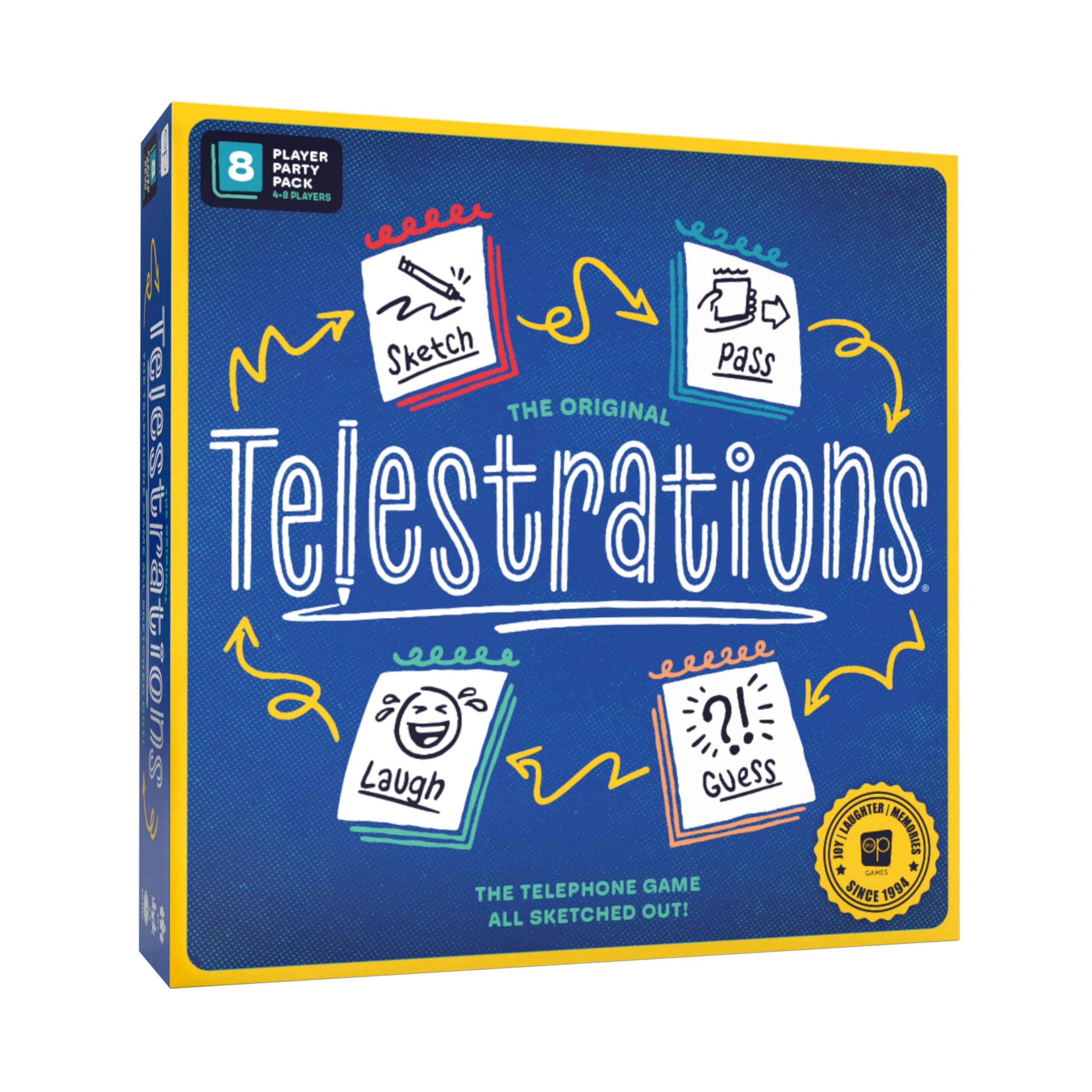
Telestrations combines Pictionary with the telephone game to create the most consistent laughter generator in board gaming. Each player draws a prompt, passes the sketchbook to the next person who guesses what the drawing represents, passes the guess to the next person who draws that guess, and so on. The chain of misinterpretation produces results that are genuinely hilarious regardless of artistic talent.
The 2nd Edition includes over 2,000 prompts spread across 130 cards, split between new phrases and classic favorites. The dry-erase sketchbooks and markers are high quality and survive repeated use without ghosting. The game supports 4 to 8 players and plays in 20 to 30 minutes per round, making it perfect for large parties or as a warm-up activity.
The best feature is that poor drawing skills actually improve the experience—the worse the sketch, the funnier the misinterpretation chain. Telestrations has no complex rules and no scoring track that requires explanation. It is the ultimate icebreaker and the safest bet for mixed groups where not everyone is a dedicated gamer.
Why it’s great
- Zero artistic skill required; bad drawings make it better
- Huge prompt variety ensures long-term replayability
- Works well for non-gamers and all age groups
Good to know
- Requires at least 4 players to function properly
- Some prompts may feel repetitive after many sessions
6. Exploding Kittens Party Pack

Exploding Kittens is the quintessential filler game—a 15-minute card game where players draw from a deck hoping not to hit a hidden “exploding kitten” card that eliminates them. The Party Pack version expands the player count to 10 and includes the Imploding Kittens expansion deck plus 10 exclusive new cards. The 120-card count makes the box feel substantial for its compact size.
The game relies on a mix of luck and simple tactical choices: playing defuse cards, skipping turns, peeking at the deck, or forcing other players to draw extra cards. The absurd illustrations from The Oatmeal give the game a distinct personality that fans of internet humor will appreciate. The instructions are straightforward and include a QR code linking to a how-to-play video.
The Party Pack handles groups from 2 to 10 players without changing the core rules, which is rare for a card game. It works best as an opening round or a between-games breather. The short playtime and simple decisions make it accessible to anyone who can hold cards, including younger children and casual players who have no interest in heavy strategy.
Why it’s great
- Extremely fast setup and playtime fits any schedule
- Scales seamlessly from 2 to 10 players
- Hilarious art adds to the social atmosphere
Good to know
- Elimination mechanic leaves some players sitting out early
- Low strategic depth; the outcome is heavily luck-driven
7. Decrypto

Decrypto is a team-based word association game where each team tries to transmit secret code words to their teammates without letting the opposing team intercept the messages. Players give a series of one-word clues for their keyword, and their teammates must guess the correct code sequence. The opposing team also hears the same clues and tries to decode your team’s secret word.
The anaglyph screen and code cards use a color-filter mechanic that hides the codes from non-team members. The 110 keyword cards provide enough variety to keep the game fresh through dozens of sessions. The playtime per round is around 15 minutes, but the addictive “one more round” feeling makes sessions stretch naturally to 45 minutes or more.
This game rewards players who can think laterally and make creative connections. The tension of hearing the opposing team discuss your clues adds a layer of psychological play. Decrypto compares favorably to Codenames but adds the extra strategic dimension of having to choose clues that are helpful to your team yet opaque to the opponents. It is a smart, high-interaction game for groups that enjoy mental challenges.
Why it’s great
- High interaction with no downtime between turns
- Creative word association fosters genuine team communication
- Excellent production quality with the anaglyph decoder screen
Good to know
- Requires at least 4 players (2 teams of 2)
- Can be difficult for non-native English speakers or younger players
FAQ
What is the difference between cooperative and competitive board games?
What does the player count number really mean?
Final Thoughts: The Verdict
For most users, the board games winner is the CATAN 6th Edition because it offers the best balance of strategic depth, social negotiation, and timeless replayability for a wide range of group sizes. If you want a cooperative challenge that forces genuine teamwork, grab the Pandemic. And for a high-energy, thematic racing experience that supports a solo mode, nothing beats the HEAT: Pedal to the Metal.