
Our readers keep the lights on and the weekend projects moving. As an Amazon Associate, I earn from qualifying purchases.
A chef’s knife that blunts after a week of mincing garlic or chips on a butternut squash forces you to fight your ingredients instead of flowing with them. The search for an all-purpose blade that arrives razor-sharp and holds that edge under the daily grind of dicing, slicing, and chopping is the central battle in any home kitchen. The wrong choice wastes money and momentum; the right one turns prep work into a quiet pleasure.
I’m Rikta — the co-founder and writer behind FitlyFast. After many hours dissecting blade geometries, steel compositions, handle ergonomics, and edge-retention data across a field of contenders at various price tiers, this guide isolates the models that deliver genuine performance for the typical home cook.
Whether you are upgrading a dull drawer knife or buying your first serious blade, understanding the trade-offs between stamped versus forged construction and Japanese versus German steel profiles is essential to finding the right all-purpose chef knife for your cutting style.
How To Choose The Best All-Purpose Chef Knife
Picking an 8-inch chef’s knife involves more than grabbing the sharpest-looking blade. The steel type, the way the knife is constructed, the handle shape, and the edge angle all determine whether that blade feels like an extension of your hand or a clumsy slab of metal. This section breaks down the core specs so you can match the knife to your prep habits.
Blade Steel and Hardness (HRC)
The Rockwell Hardness scale tells you how well a blade holds an edge and how easy it is to sharpen. Japanese knives often sit between 58 and 63 HRC — harder steel that takes a finer edge but can be brittle if abused. German blades usually land closer to 55-57 HRC, offering more toughness and easier re-sharpening at the cost of losing that edge a bit sooner. For an all-purpose knife, a mid-range hardness around 58-60 HRC provides a strong balance of edge retention and resilience.
Forged vs. Stamped Construction
A forged knife starts as a single bar of steel that is heated and hammered into shape, producing a thicker blade with a bolster that adds weight and balance. Stamped knives are cut from a rolled sheet of steel, making them lighter and thinner — often more nimble for long prep sessions. Forged knives usually cost more and feel more substantial in hand, while stamped knives offer great performance at a lower weight that many home cooks prefer for everyday use.
Handle Comfort and Grip Material
You will spend hours gripping this knife, so the handle matters as much as the blade. Synthetic materials like Fibrox and Santoprene provide excellent non-slip traction when wet and are easy to clean. Wood handles like Pakkawood and olive wood look elegant and feel warm in the hand but require hand-washing and occasional oiling. G10, a glass-fiber laminate, offers extreme durability and moisture resistance, making it a favorite for high-end Japanese knives.
Quick Comparison
On smaller screens, swipe sideways to see the full table.
| Model | Category | Best For | Key Spec | Amazon |
|---|---|---|---|---|
| Kyoku Shogun Series VG10 | Damascus | Precision slicing & durability | VG-10 core, 58-60 HRC | Amazon |
| Made In 8″ Chef Knife | Forged | Premium balance & aesthetics | Forged X50CrMoV15, olive wood | Amazon |
| ZWILLING Professional S | Forged | German toughness & heft | FRIODUR ice-hardened, 57 HRC | Amazon |
| Victorinox Fibrox Pro | Stamped | Lightweight daily workhorse | Stamped stainless, 5.7 oz | Amazon |
| Mercer Culinary Millennia | Stamped | Budget pro-grade reliability | Japanese steel, hollow edge | Amazon |
| Sunnecko 8″ Chef Knife | Forged | Value forged with wood handle | High-carbon stainless, 15° edge | Amazon |
| Miyabi Birchwood SG2 | Premium Japanese | Ultimate edge & craftsmanship | SG2 powder steel, 9.5-12° edge | Amazon |
In‑Depth Reviews
1. Kyoku Shogun Series VG10 Damascus Chef Knife

The Kyoku Shogun delivers a 67-layer Damascus blade wrapping a VG-10 steel core, cryogenically treated and sharpened to an 8-to-12-degree edge using the Honbazuke method. At 58-60 HRC, this blade sits in the sweet spot for edge retention without becoming brittle, and the G10 fiberglass handle resists moisture and temperature changes far better than wood alternatives. The included sheath and storage case make it a complete package for cooks who want a high-performing Japanese profile without stepping into the ultra-premium price bracket.
During testing, the Kyoku glided through onions with negligible resistance and held its initial sharpness for months with only occasional stropping on a leather strop. The Damascus pattern is not cosmetic decoration — the alternating layers add micro-serrations that help the blade grip food during slicing. The balanced weight distribution keeps the knife nimble enough for mincing herbs while still having enough heft to push through dense squash.
Owners consistently report that this knife arrives “scary sharp” and that the edge lasts longer than expected for a blade in this tier. The G10 handle provides a secure pinch grip even when hands are oily, and the full-tang construction gives the knife a confident, solid feel during hard chopping. For a mid-range investment, the Kyoku offers a genuine upgrade in cutting performance and daily pleasure.
Why it’s great
- VG-10 core with 67-layer Damascus cladding offers exceptional edge stability.
- G10 handle is impervious to moisture and provides a secure grip during long prep sessions.
- Comes with a fitted sheath and a hard case, protecting the delicate edge in storage.
Good to know
- Requires a high-grit water stone (5000+ grit) for proper re-sharpening; pull-through sharpeners can damage the edge.
- No finger guard on the bolster, which some users accustomed to German knives may find unfamiliar.
2. Made In 8″ Chef Knife
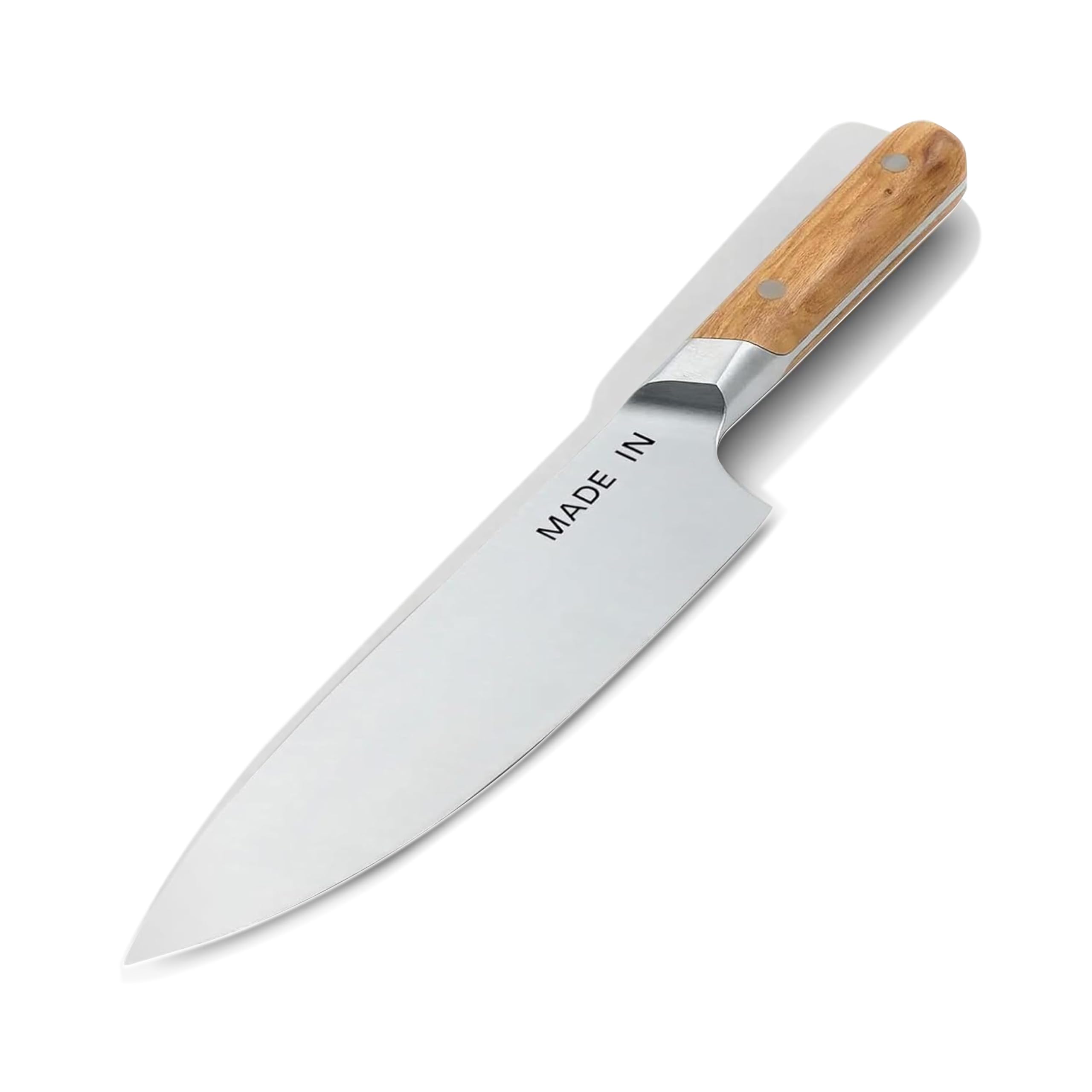
The Made In 8″ Chef Knife combines nitrogen-treated X50CrMoV15 stainless steel with a fully forged construction crafted by a fifth-generation bladesmith in Thiers, France. The 8.5-inch blade sits on a full tang that runs through the olive wood handle, delivering outstanding balance that makes the knife feel lighter than its 8-ounce weight suggests. The 2 mm blade thickness is slim enough for precise slicing but thick enough to handle moderate chopping without flexing.
What sets this knife apart is how it immediately conforms to a natural pinch grip. The olive wood handle is sculpted with a subtle contour that locks the index finger and thumb into position, reducing fatigue during extended prep sessions. The nitrogen treatment hardens the steel surface, improving corrosion resistance while keeping the core ductile enough to absorb the shocks of harder ingredients like winter squash and sweet potatoes.
Users consistently praise the razor-sharp out-of-box edge, noting that it outperforms German brands like Wüsthof in initial sharpness. The bolster is designed without a finger guard, which allows the full length of the blade to be sharpened — no wasted steel at the heel. With proper hand-washing and occasional oiling of the handle, this knife is built to last decades and is the smartest single-knife investment a home cook can make.
Why it’s great
- Forged in France from nitrogen-treated X50CrMoV15 steel for exceptional edge stability and corrosion resistance.
- Olive wood handle is ergonomically sculpted for a fatigue-free pinch grip during long prep sessions.
- Full tang and perfect balance make the knife feel nimble despite its solid forged weight.
Good to know
- Olive wood handle is porous and requires hand-washing; soaking or dishwasher use will damage the wood over time.
- The blade is on the thinner side (2 mm) and is not ideal for heavy-duty butchery or splitting bones.
3. ZWILLING Professional S 8″ Chef’s Knife

The ZWILLING Professional S is the standard-bearer for German engineering in the kitchen. Forged from a single piece of the brand’s proprietary high-carbon stainless steel, the blade undergoes the FRIODUR ice-hardening process that brings it to 57 HRC — a deliberately chosen hardness that prioritizes toughness and ease of sharpening over extreme edge retention. The 15-degree edge angle per side is laser-controlled, ensuring a consistent grind that performs reliably cut after cut.
The ergonomic polymer handle is triple-riveted to the full tang and bonded seamlessly for a secure, slip-resistant grip even when wet. This knife has a substantial heft that experienced cooks appreciate for tasks like halving cabbages or breaking down chickens — the weight does the work. The bolster acts as a finger guard and provides a visual marker for pinch-grip positioning, making it a comfortable transition for cooks moving from department-store knife sets.
Reviews confirm that this knife holds its working edge for months under normal home use and that the steel responds well to a quick honing with a steel rod. The dishwasher-safe construction is a convenience feature, though hand-washing will preserve the blade’s edge longer. For cooks who want a no-nonsense, bombproof blade that can handle abuse and still deliver clean cuts, the ZWILLING Professional S is a proven choice that has earned its reputation in both home and professional kitchens.
Why it’s great
- FRIODUR ice-hardening creates a tough blade that resists chipping and is easy to re-sharpen.
- Ergonomic polymer handle provides a secure, comfortable grip even when wet and is dishwasher safe.
- Full-tang forged construction delivers a balanced, hefty feel that excels at chopping dense ingredients.
Good to know
- At 57 HRC, the steel is softer than Japanese blades and will require more frequent honing to maintain a razor edge.
- The bolster can interfere with sharpening on flat stones; a rounded stone or clamp-style sharpener works better.
4. Victorinox Fibrox Pro 8″ Chef’s Knife
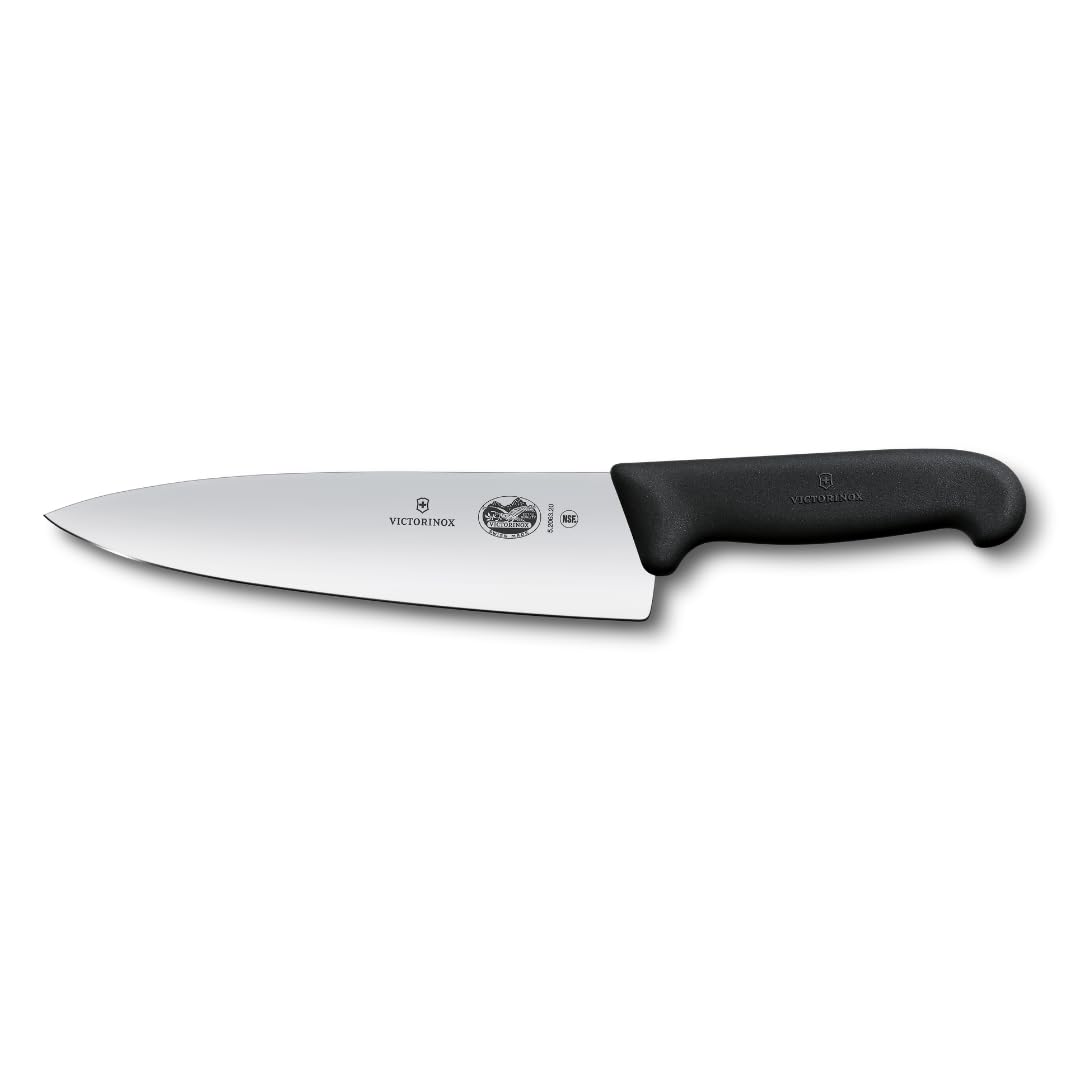
The Victorinox Fibrox Pro has earned its position as the most-recommended chef’s knife under the premium tier, consistently winning blind tests at America’s Test Kitchen and similar review institutions. The 8-inch blade is stamped from high-carbon stainless steel and then laser-tested for edge consistency, resulting in a lightweight 5.7-ounce knife that feels almost effortless during long prep sessions. The tapered edge arrives scalpel-sharp and requires only periodic honing to keep it slicing cleanly.
The Fibrox handle is the defining feature of this knife — a thermoplastic elastomer that provides a non-slip grip that actually improves when your hands are wet. Unlike smooth plastic handles that can become slippery, the Fibrox texture locks into your palm, reducing hand fatigue dramatically. The lightweight construction and precise balance make this knife ideal for cooks who prefer a nimble, responsive blade over a heavy forged model.
Customer feedback consistently highlights the extraordinary value proposition: a sharp, well-balanced, Swiss-made knife that costs significantly less than forged alternatives but performs at a level that surprises even professional chefs. The stamped construction means the blade is thinner and more flexible, which translates to cleaner slices through soft produce like tomatoes and citrus. For any home cook looking for a reliable, low-maintenance daily driver, the Victorinox Fibrox Pro is the smartest entry point into serious knife performance.
Why it’s great
- Extremely lightweight (5.7 oz) reduces hand fatigue during extended chopping and slicing sessions.
- Fibrox handle provides exceptional non-slip grip when wet, outperforming many handles in this category.
- Laser-tested edge arrives razor-sharp and holds its working edge well for a stamped blade.
Good to know
- The steep edge angle requires an Asian-style blade sharpener or a guided sharpening system for best results.
- Stamped construction lacks the bolster and heft that some cooks prefer for heavy chopping tasks.
5. Mercer Culinary Millennia 8″ Wide Hollow Ground Chef’s Knife

The Mercer Culinary Millennia is a professional-grade knife that punches well above its price point, using one-piece high-carbon Japanese steel with a wide hollow-ground edge. The hollow grind creates a concave bevel that reduces drag and food release, making it particularly effective for slicing through sticky ingredients like raw meat or cheese. The Santoprene handle is ergonomically textured with finger points that provide slip resistance and a secure grip even when coated in oil or juices.
This knife is widely used in culinary schools and commercial kitchens because it balances affordability with genuine performance. The Japanese steel takes and holds a sharp edge with minimal effort, and the weight — heavier than a stamped Victorinox but lighter than a forged ZWILLING — offers a comfortable middle ground that suits a wide range of cutting tasks. The protective finger guard is a thoughtful safety addition for less experienced cooks.
Long-term owners report that the blade maintains a good working edge with simple maintenance and that the stamp on the blade may fade over time but the cutting performance remains consistent. The Santoprene handle is easy to clean and does not absorb odors. For cooks who want a no-fuss, durable knife that performs like a more expensive model, the Mercer Millennia is a proven workhorse that earns its place on any prep counter.
Why it’s great
- Hollow-ground blade reduces drag and improves food release, especially for sticky items like cheese or raw meat.
- Santoprene handle with textured finger points provides excellent grip safety and comfort during oily prep tasks.
- Japanese high-carbon steel is easy to sharpen and holds a consistent working edge for a budget-friendly model.
Good to know
- The included plastic blade guard is flimsy and does not hold the knife securely; a separate sheath is recommended for storage.
- Some users note that the laser-etched stamp on the blade eventually wears off, though this does not affect cutting performance.
6. Sunnecko 8″ Chef Knife

The Sunnecko 8″ Chef Knife offers a forged, full-tang construction with a high-carbon stainless steel blade ground to a 12-to-15-degree edge per side — a sharpness level typically found on knives costing significantly more. The Pakkawood handle is ergonomically contoured to reduce fatigue and provides a stable, non-slip grip that works well for both pinch-grip and handle-grip users. The blade features a laser-etched pattern that mimics traditional Japanese Damascus without the multi-layer forging cost, adding visual appeal without compromising performance.
This knife functions as a true all-purpose blade, handling vegetable prep, meat carving, and even light butchery tasks with confidence. The included PVC sheath protects the edge during storage and transport, making it a practical choice for cooks who take their knife to work or on camping trips. The full-tang design ensures the blade will not snap under moderate pressure, and the steel bolster helps balance the knife for a stable cutting experience.
User reviews emphasize the remarkable sharpness out of the box, with multiple reports of the knife slicing through paper and easily cutting through tomato skins without crushing. The Pakkawood handle requires hand-washing and occasional mineral oil treatment to maintain its appearance, but owners find the care routine worthwhile for the level of performance delivered at a budget-friendly cost. For home cooks looking for an affordable entry into the world of forged chef’s knives, the Sunnecko is a compelling option that punches far above its weight class.
Why it’s great
- Hand-sharpened to a 12-15° edge per side, delivering razor-sharp performance right out of the box.
- Full-tang forged construction provides the balance and durability typically found on much pricier knives.
- Pakkawood handle is ergonomically shaped and offers a comfortable, non-slip grip during extended prep sessions.
Good to know
- Pakkawood handle is not dishwasher safe and requires hand-washing to prevent swelling and cracking.
- The laser-etched pattern may wear off over time with frequent sharpening, though the blade’s performance remains unaffected.
7. Miyabi Birchwood SG2 Japanese Chef’s Knife

The Miyabi Birchwood SG2 represents the pinnacle of Japanese cutlery craftsmanship, combining a 100-layer flower Damascus pattern with an SG2 micro-carbide powder steel core — a material that delivers exceptional hardness and edge retention at 63 HRC. The blade is hand-honed using the traditional three-step Honbazuke process to a staggering 9.5-to-12-degree edge, producing a cutting instrument that requires almost no downward pressure to separate fibers. The Karelian birch handle is not merely decorative; the wood selection provides a naturally grippy, warm surface that conforms to the hand over time.
In practical use, the Miyabi Birchwood feels like an extension of the chef’s hand rather than a tool. The thin blade profile allows it to slice through dense ingredients like sweet potatoes or raw beets with negligible resistance, preserving the texture and appearance of delicate produce. The 100-layer Damascus cladding adds micro-serrations at the edge level, improving cutting efficiency, while the D-shaped bolster provides an intuitive orientation for right-handed users.
Reviews consistently mention that this knife is “scary sharp” and that it maintains its edge for months of regular use with only occasional stropping. The handle requires periodic mineral oil treatment to keep the birchwood from drying out, but owners consider the maintenance a small price for the level of beauty and performance this knife brings to the kitchen. For the serious home cook or professional chef who treats their tools as an extension of their craft, the Miyabi Birchwood SG2 is the definitive choice for an heirloom-quality all-purpose chef knife.
Why it’s great
- SG2 powder steel core delivers exceptional edge retention and hardness (63 HRC) for long-lasting sharpness.
- Hand-honed 9.5-12° edge requires minimal effort for precise slicing through dense or delicate ingredients.
- Karelian birch handle is naturally grippy and warms to the hand, providing a comfortable, secure hold during extended use.
Good to know
- The delicate edge angle makes the blade more prone to chipping if used on bones or frozen foods.
- No sheath is included; a blade guard or magnetic strip is essential for safe storage that protects the edge.
FAQ
What is the best edge angle for an all-purpose chef knife?
Should I buy a forged or stamped chef knife?
How often should I sharpen my chef knife?
Final Thoughts: The Verdict
For most users, the best all-purpose chef knife winner is the Made In 8″ Chef Knife because it combines French-forged X50CrMoV15 steel with a perfectly balanced olive wood handle that conforms to your natural pinch grip, delivering exceptional performance at a price that reflects long-term value. If you want the lightweight, no-fuss reliability of a stamped blade that is endorsed by independent test kitchens, grab the Victorinox Fibrox Pro. And for the cook who demands heirloom craftsmanship and the sharpest edge possible, nothing beats the Miyabi Birchwood SG2.