
Our readers keep the lights on and the weekend projects moving. As an Amazon Associate, I earn from qualifying purchases.
Filmmaking on a budget used to mean sacrificing image quality, dynamic range, or the ability to shoot in low light. The gap between pro cinema cameras and consumer camcorders has collapsed, and the current crop of affordable mirrorless bodies and pocket cameras now deliver 4K resolution, log profiles, and reliable autofocus that were unthinkable at these price points just a few years ago.
I’m Rikta — the co-founder and writer behind FitlyFast. I’ve spent hundreds of hours analyzing sensor performance, stabilization systems, and codec support across dozens of sub- cameras to find the ones that actually serve a filmmaker’s workflow.
Whether you’re shooting a short film, a commercial project, or your first narrative work, finding a capable cheap camera for filmmaking that doesn’t compromise on essential pro features is the difference between a hobby clip and a real production tool.
How To Choose The Best Cheap Camera For Filmmaking
Picking a filmmaking camera under means trading off between sensor size, codec quality, IBIS, and lens ecosystem. The right choice depends on whether you need gimbal-free smoothness, shallow depth of field, or raw recording capability for color grading in post.
Sensor Size and Low-Light Performance
APS-C and Micro Four Thirds sensors dominate this price bracket. A larger APS-C sensor (Sony ZV-E10, Canon R50) gives you shallower depth of field and better low-light performance, while a Micro Four Thirds sensor (Panasonic G85, Blackmagic Pocket 4K) provides a deeper depth of field and access to a huge library of compact, affordable lenses. For narrative work where you want a cinematic look, prioritize a large sensor or a fast lens to compensate.
Stabilization: IBIS vs. Gimbal vs. Digital
In-body image stabilization (IBIS) is a game-changer for handheld shooting. The Panasonic G85 and OM SYSTEM E-M10 Mark IV offer 5-axis IBIS that smooths out walking shots without a gimbal. Pocket cameras like the Xtra Muse pack a 3-axis gimbal into the body itself, which is ideal for run-and-gun but adds a small footprint. If you’re shooting locked-down interviews, any camera will work — but for dynamic movement, prioritize a camera with effective stabilization.
Codec and Color Depth
10-bit 4:2:2 internal recording gives you far more latitude in color grading than 8-bit footage. The Blackmagic Pocket 4K leads this category with Blackmagic RAW and ProRes support at its price point. Most other budget cameras record 8-bit internally, though some (like the Sony ZV-E10) offer S-Log profiles that expand dynamic range. If you plan to grade your footage heavily, a camera with a log profile or raw output is non-negotiable.
Quick Comparison
On smaller screens, swipe sideways to see the full table.
| Model | Category | Best For | Key Spec | Amazon |
|---|---|---|---|---|
| Xtra Muse Pocket Gimbal | Pocket 4K | Run-and-gun vlogging & travel filmmaking | 1-inch CMOS / 3-Axis Gimbal | Amazon |
| Canon EOS R100 | Entry Mirrorless | Beginner photography + occasional 4K | 24.1MP APS-C / 4K 24fps | Amazon |
| OBSBOT Tail Air | PTZ Streaming | Live streaming & event recording | 4K 30fps / AI Tracking | Amazon |
| Panasonic LUMIX G85 | Mirrorless MFT | Handheld narrative work with IBIS | 16MP MFT / 5-Axis IBIS | Amazon |
| Nikon Z 30 | Vlogger Mirrorless | Streaming & vlogging with Nikon glass | 20.9MP APS-C / 4K 30fps | Amazon |
| Sony ZV-E10 | APS-C Vlog | Content creation with fast AF | 24.2MP APS-C / 4K 30fps | Amazon |
| OM SYSTEM E-M10 Mark IV | Compact MFT | Travel filmmaking with IBIS | 20MP MFT / 5-Axis IBIS | Amazon |
| Sony Alpha 6100 | APS-C Mirrorless | General hybrid photo/video | 24.2MP APS-C / 4K 30fps | Amazon |
| Canon EOS R50 | Creator Mirrorless | Content creation with Dual Pixel AF | 24.2MP APS-C / Oversampled 4K | Amazon |
| Blackmagic Pocket 4K | Cinema Camera | Professional short films & indie projects | MFT Sensor / RAW & ProRes | Amazon |
| Nikon D850 | Full-Frame DSLR | Still-dominant hybrid photography | 45.7MP FF / 4K 30fps | Amazon |
In‑Depth Reviews
1. Xtra Muse Pocket Gimbal Camera

The Xtra Muse packs a 1-inch CMOS sensor and a 3-axis gimbal into a body that fits in a jacket pocket. It shoots 4K at up to 120fps, giving you smooth slow-motion without the premium of a standalone gimbal rig. The 10-bit X-Log color mode captures over a billion colors, which gives you serious grading flexibility in post-production — a feature typically found on cinema cameras costing three times as much.
The 2-inch touchscreen simplifies framing adjustments, and the Master Follow mode locks face tracking even during fast movement. Battery life sits at around 160 minutes, which is solid for a compact camera. The bundle includes a carrying bag, wrist strap, and a handle with a 1/4-inch thread for tripod mounting, so you’re ready to shoot out of the box.
Beginners will appreciate the fast autofocus and straightforward setup, while experienced shooters will value the 10-bit log recording and the ability to attach DJI Pocket 3 accessories. The only trade-off is the small sensor size compared to APS-C bodies, but the built-in stabilization and portability more than compensate for narrative and vlog work.
Why it’s great
- Built-in 3-axis gimbal eliminates need for external stabilizer
- 10-bit X-Log color for professional-grade grading
- Compact enough for one-handed run-and-gun shooting
Good to know
- 1-inch sensor limits shallow depth of field vs. APS-C
- Battery life drops to ~2 hours with continuous 4K recording
2. Panasonic LUMIX G85

The Panasonic G85 remains a benchmark for budget filmmaking because it gives you a magnesium-alloy body, weather sealing, and class-leading 5-axis in-body stabilization. The 16MP Micro Four Thirds sensor omits a low-pass filter, which resolves roughly 10 percent more detail than the previous generation. The 12-60mm Power O.I.S. kit lens pairs with the IBIS to produce steady handheld footage even while walking.
4K QFHD recording (3840 x 2160) is standard, and the G85 also includes 4K Photo and Post Focus modes that let you extract 8MP still frames from video and adjust focus after capture. The eye-level OLED viewfinder (2360K dots) and the 3-inch articulating touchscreen give you two reliable framing options. A built-in microphone jack is present, though there is no headphone jack for monitoring.
The autofocus system is contrast-detect with 49 points, which works well in good light but struggles in low light or with 4K continuous AF. Battery life is average at around 330 shots per charge. For narrative filmmakers who prioritize stabilization over blazing AF performance, the G85 offers the best shake-free shooting in its class.
Why it’s great
- 5-axis IBIS provides gimbal-like smoothness for handheld shots
- Weather-sealed magnesium-alloy build
- No low-pass filter for extra fine detail
Good to know
- Contrast-detect AF hunts in low-light and 4K
- No headphone jack for audio monitoring
3. Blackmagic Pocket Cinema Camera 4K

The Blackmagic Pocket 4K is the gold standard for indie filmmakers who need raw recording at an accessible price. The MFT sensor delivers 13 stops of dynamic range and a dual native ISO up to 25,600, which keeps noise minimal even in challenging lighting. The 5-inch bright LCD eliminates the need for an external monitor, and the carbon fiber polycarbonate body keeps the weight manageable at less than 3 pounds with the battery.
Recording options include Blackmagic RAW and Apple ProRes at resolutions up to 4K DCI, and you can capture footage to SD/UHS-II cards, CFast 2.0 cards, or an external SSD via USB-C. The included DaVinci Resolve Studio activation key turns the camera into a complete post-production package. The power bundle adds two extra LP-E6 batteries and a dual charger, which is essential since the standard battery life is short.
The active MFT lens mount accepts a wide range of glass, from native Panasonic and Olympus lenses to adapters for Canon EF lenses. The trade-offs are a relatively short battery life (around 45 minutes of recording) and the need for high-speed media. If your goal is a cinematic short film with serious grading room, this is the tool.
Why it’s great
- 13 stops of dynamic range for extreme grading flexibility
- Internal Blackmagic RAW and ProRes recording
- Active MFT mount with extensive lens adapter options
Good to know
- Battery life is short; external power is recommended
- Requires fast CFast or UHS-II media for high bitrate recording
4. OBSBOT Tail Air

The OBSBOT Tail Air is a compact PTZ camera that brings AI-powered tracking to a sub- form factor. It rotates 320 degrees horizontally and 180 degrees vertically, and the AI director can track humans, animals, or objects with gesture recognition. The 4K resolution at 30fps (or 1080p at 60fps) is solid for live streaming, church services, or event coverage.
Connectivity is extensive: USB-C, Micro HDMI, Ethernet, and wireless options are all on board. The NDI support (with an additional license key) lets you stream over a local network without long HDMI runs. The OBSBOT Start companion app gives you full control over ISO, shutter speed, white balance, and preset positions, so you can set up a multi-camera broadcast with multiple Tail Air units.
The 23mm f/1.8 lens provides a wide field of view, and the digital zoom goes up to 4x. Body weight is just 344 grams, making it easy to mount on a tripod or ceiling bracket. Battery life is around 2.5 hours, and it can run on USB-C power for all-day use. A small number of users reported battery degradation over a year, so a wired power solution is advisable for permanent installations.
Why it’s great
- AI tracking works with humans, animals, and objects
- NDI-capable for multi-camera broadcast setups
- Extremely light and compact (344g)
Good to know
- NDI license key sold separately
- Reported battery degradation after 12+ months
5. Sony ZV-E10

The Sony ZV-E10 pairs a 24.2MP APS-C Exmor sensor with the BIONZ X processor, oversampling 6K footage down to 4K for sharp, artifact-free video. The Product Showcase Setting automatically transitions focus from your face to an object you hold up, which is a huge time-saver for review-style content. The Background Defocus button instantly toggles between a shallow depth of field and a fully stopped-down aperture.
The 425-point phase-detection autofocus with real-time eye tracking is among the fastest in this class. The camera lacks IBIS, so you will need a gimbal or rely on post-production stabilization (which introduces a crop). S-Log and HLG profiles are built-in, giving you latitude for color grading. The flip-out touchscreen and built-in stereo mic with adjustable sensitivity make it a complete vlogging package.
The main caveats are severe rolling shutter in 4K and a small LCD that benefits from an external monitor. Battery life in 4K recording hovers around 25 minutes, so spare batteries or external USB-C power are essential. For creators who prioritize fast AF, S-Log, and a huge E-mount lens ecosystem, the ZV-E10 is a strong contender.
Why it’s great
- Industry-leading autofocus with Real-time Eye Tracking
- S-Log and HLG profiles for color grading
- Product Showcase feature simplifies hands-on reviews
Good to know
- No IBIS; significant rolling shutter issue
- Short battery life in 4K; requires external power
6. Nikon Z 30

The Nikon Z 30 is the lightest and most compact APS-C mirrorless camera aimed at vloggers and streamers. At roughly 405 grams with the kit lens, it is genuinely pocketable. The 20.9MP CMOS sensor and EXPEED 6 processor produce crisp 4K video without overheating, and the on-sensor phase-detection autofocus tracks eyes for people and pets reliably.
The flip-out touchscreen selfie monitor makes solo shooting easy, and the built-in stereo microphone has adjustable sensitivity. USB-C connectivity allows plug-and-play webcam operation for Full HD at 60fps or 4K at 30fps via HDMI. The camera can run on continuous USB-C power, which eliminates battery anxiety during long streaming sessions.
The kit includes the NIKKOR Z DX 16-50mm f/3.5-6.3 VR lens, which provides decent stabilization for handheld use. The Z 30 lacks an electronic viewfinder, which is a compromise for stills but irrelevant for video work. Nikon’s entire Z lens lineup is compatible, giving you a future upgrade path. This is a solid option for filmmakers who also want a hassle-free streaming setup.
Why it’s great
- Unlimited 4K recording with no overheating reports
- USB-C power and video for all-day streaming
- Flip-out selfie screen with eye-detection AF
Good to know
- No electronic viewfinder
- Kit lens is slow (f/3.5-6.3) for low-light shooting
7. OM SYSTEM E-M10 Mark IV

The OM SYSTEM E-M10 Mark IV offers a 20MP Live MOS sensor and 5-axis in-body image stabilization that delivers 4.5 stops of compensation — among the best in the Micro Four Thirds system. The flip-down monitor enables a dedicated selfie mode that automatically triggers when the screen is tilted down, making it one of the easiest cameras for solo work.
4K video recording is standard, and the 16 Art Filters (including Instant Film) give you creative looks straight out of camera. The camera is lightweight enough with the compact 14-42mm EZ pancake lens to fit in a jacket pocket, which is rare for an interchangeable-lens camera with IBIS. The Bluetooth and OI Share app provide always-on connectivity for remote control and file transfer.
The 121 contrast-detect autofocus points work well in good light, but the system lacks phase-detection AF, so continuous tracking in video can hunt. The battery is rated for about 320 shots, and there is no external charger included (USB charging only). For travel filmmakers who value portability and rock-steady handheld footage, the E-M10 Mark IV is a compact powerhouse.
Why it’s great
- 5-axis IBIS with 4.5 stops of compensation
- Compact enough for jacket-pocket carry with pancake lens
- Dedicated selfie mode with flip-down screen
Good to know
- Contrast-detect AF hunts during video tracking
- No external charger included; USB charging only
8. Canon EOS R50
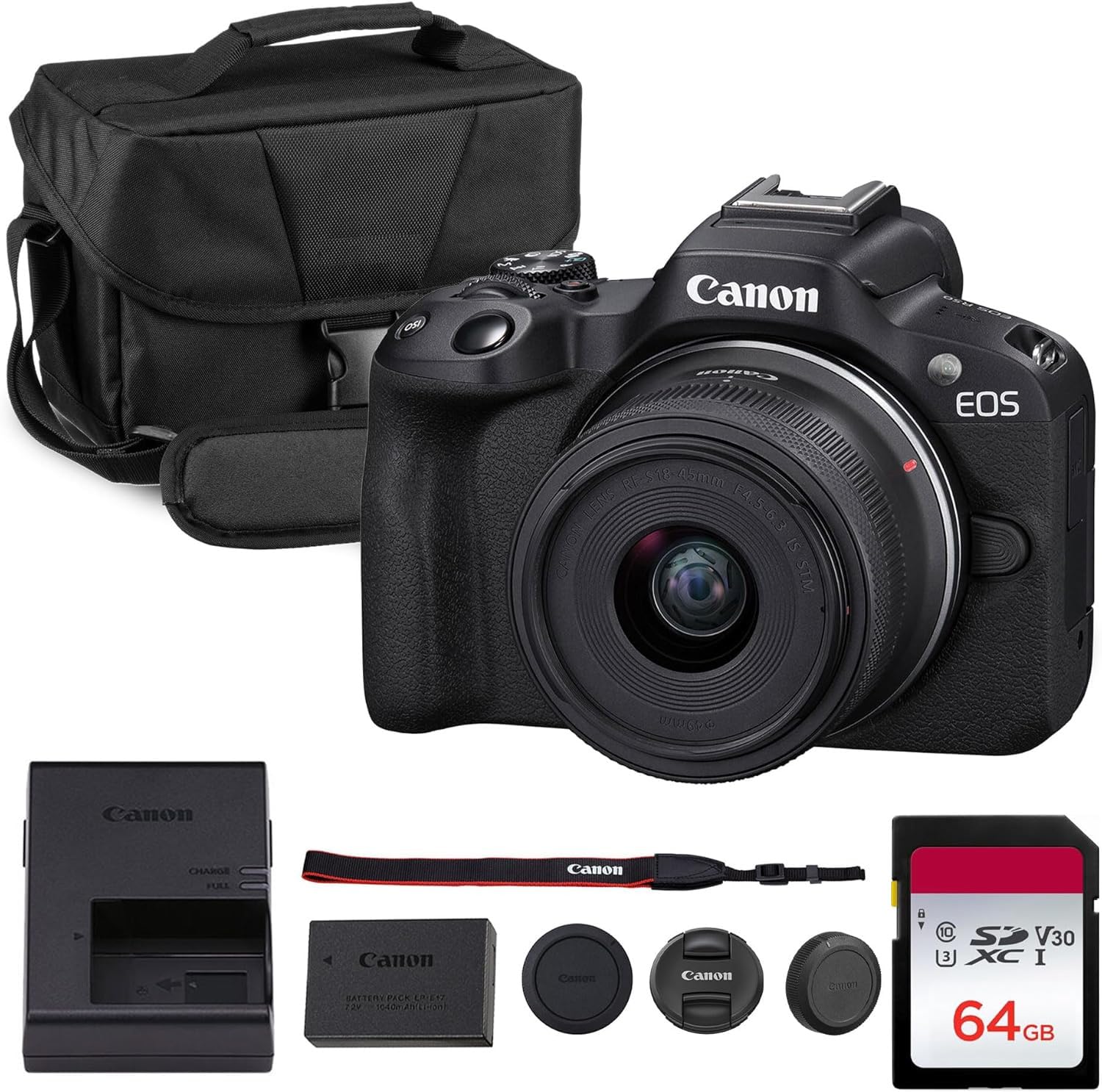
The Canon EOS R50 brings Dual Pixel CMOS AF II to the budget bracket, offering reliable face and eye detection with human, animal, and vehicle tracking. The 24.2MP APS-C sensor oversamples 4K footage for extra sharpness, and the DIGIC X processor handles up to 11 fps continuous shooting with AF tracking. The vari-angle touchscreen flips out for selfie framing and vertical video shooting.
The kit includes the RF-S 18-45mm f/4.5-6.3 IS STM lens, which has built-in optical stabilization to pair with the electronic IS. Creative Assist mode gives beginners guided controls. The R50 is compatible with Canon’s growing RF lens lineup, including fast primes for shallower depth of field. The camera body alone is among the lightest in the EOS R system.
Video limitations include a crop in 4K 30fps and no 4K 60fps option. The battery is the same LP-E17 found in older Canon cameras, delivering around 370 shots. For vloggers and beginners who want Canon’s user-friendly ecosystem and reliable AF, the R50 is a strong entry point into RF-mount filmmaking.
Why it’s great
- Dual Pixel CMOS AF II with excellent eye tracking
- Oversampled 4K for sharp footage
- Vari-angle screen for selfie framing
Good to know
- No 4K 60fps; 4K 30fps has a crop
- Kit lens is slow (f/4.5-6.3)
9. Sony Alpha 6100

The Sony Alpha 6100 (a6100) delivers 0.02-second autofocus with Real-time Eye Tracking for both humans and animals. The 24.2MP APS-C Exmor sensor and BIONZ X processor provide 4K video oversampled from a 6K readout, which yields excellent detail with no pixel binning. The 180-degree tiltable 3-inch touchscreen is useful for selfie work, though the limited LCD resolution makes critical focus checking difficult.
Continuous shooting at 11 fps with AF/AE tracking is fast enough for action scenes. The camera lacks in-body stabilization, so a stabilized lens or gimbal is necessary for smooth handheld footage. The kit includes the E PZ 16-50mm f/3.5-5.6 OSS II lens, which adds optical stabilization. S-Log and HLG are absent, so you get standard 8-bit recording without log profiles.
Battery life is rated at around 420 shots, which is above average for this class. The a6100 uses Sony’s older menu system, which can be slow to navigate. For filmmakers who prioritize speed and accuracy over log profiles, the a6100 is a capable performer with access to Sony’s massive lens library.
Why it’s great
- Blazing-fast 0.02-sec autofocus
- Oversampled 4K from 6K readout
- 11 fps continuous shooting with AF tracking
Good to know
- No IBIS; requires stabilized lenses or gimbal
- No S-Log or HLG profiles for color grading
10. Canon EOS R100

The Canon EOS R100 is the smallest and lightest body in the EOS R series, weighing just over 350 grams. The 24.1MP APS-C CMOS sensor and DIGIC 8 processor offer 4K video at 24fps, Full HD at 60fps, and HD at 120fps for slow motion. Dual Pixel CMOS AF covers 143 zones with face and eye detection, and the 6.5 fps continuous shooting is fine for casual action.
The kit includes the RF-S 18-45mm f/4.5-6.3 IS STM lens, which has optical stabilization. The camera features a basic 3-inch fixed LCD (not touch-enabled) and an eye-level viewfinder. The lack of a vari-angle touchscreen limits framing for selfie shooting, and the 8-bit internal recording lacks log profiles for expansive grading. The 4K mode also has a significant crop factor.
The R100 supports Wi-Fi and Bluetooth for easy sharing, and the battery is rated for about 400 shots. For a beginner who wants to learn the RF ecosystem and occasionally shoot 4K, the R100 is a functional starting point. For dedicated filmmaking, the limited video features and fixed screen make it a less versatile choice than other options on this list.
Why it’s great
- Lightest EOS R body; easy to carry
- Dual Pixel CMOS AF with face and eye detection
- HD 120fps slow-motion capture
Good to know
- Fixed non-touch LCD; no vari-angle
- 4K is cropped and limited to 24fps
11. Nikon D850

The Nikon D850 is a full-frame DSLR with a backside-illuminated 45.7MP sensor that delivers extraordinary resolution, dynamic range, and no risk of moiré thanks to the omitted optical low-pass filter. It shoots 4K Ultra HD video at 30fps and 1080p slow motion at up to 120fps. The tilting touchscreen, illuminated buttons, and weather-sealed body make it comfortable for long handheld sessions.
The 153-point phase-detection autofocus system is among the best ever put in a DSLR, and the 9 fps continuous shooting with full AF performance captures fast action. The focus shift shooting mode is useful for time-lapse and macro work. The D850 also creates 4K and 8K time-lapse movies in-camera. The XQD card slot is extremely fast but requires expensive media.
Video autofocus is contrast-detect and significantly weaker than the stills AF. The D850 is heavy (around 1015 grams with battery) and lacks the portability of mirrorless alternatives. For filmmakers who also shoot high-end photography and want a single do-everything body, the D850 remains a benchmark — but for dedicated filmmaking, a modern mirrorless camera offers better AF and codecs.
Why it’s great
- 45.7MP BSI sensor with industry-leading dynamic range
- 153-point AF with 9 fps continuous shooting
- Built-in 4K/8K time-lapse creation
Good to know
- Contrast-detect video AF is poor for tracking
- Heavy and large; not ideal for run-and-gun
FAQ
Can a cheap camera produce professional-looking cinematic footage?
Do I need IBIS (in-body image stabilization) for filmmaking?
Final Thoughts: The Verdict
For most users, the cheap camera for filmmaking winner is the Xtra Muse Pocket Gimbal Camera because it combines a 1-inch CMOS, 10-bit X-Log recording, and a built-in 3-axis gimbal in a pocketable body — eliminating the need for an expensive separate stabilizer. If you need raw recording and maximum grading flexibility, grab the Blackmagic Pocket 4K. And for handheld narrative work on a tight budget where stabilization is paramount, nothing beats the Panasonic LUMIX G85.