
Our readers keep the lights on and the weekend projects moving. As an Amazon Associate, I earn from qualifying purchases.
A battery can read a healthy 12.6 volts at rest and still fail to start your engine on a cold morning. Static voltage checks alone are deceptive—they don’t measure the internal resistance or the ability to deliver cranking amps under demand. The only way to know a battery’s true condition is with a dedicated tester that applies a load or uses conductance analysis to measure state of health and cold cranking capability.
I’m Rikta — the co-founder and writer behind FitlyFast. I’ve spent countless hours analyzing the engineering behind each unit, from the four-wire Kelvin connection accuracy of digital analyzers to the internal coil gauge of analog load testers.
Whether you need a simple pass/fail check or a full diagnostic readout of your charging and starting systems, the right tool prevents being stranded. This guide breaks down the best 12 volt battery tester options across every serious use case.
How To Choose The Best 12 Volt Battery Tester
Selecting the right 12 volt battery tester comes down to understanding how you plan to use it. A home mechanic who wants a quick health check has different needs from a professional who needs precise data for alternator and starter diagnostics. The key differentiators are test methodology, CCA range coverage, and display quality.
Conductance Testing vs. Load Testing
Conductance testers send a small AC signal through the battery to measure internal resistance. They are fast, non-destructive, and do not heat the battery, making them ideal for routine checks. Load testers, by contrast, draw a high current (typically 100 to 130 amps) to simulate starting demand. While more stressful on the battery, they offer a definitive pass/fail result. Many modern digital units are conductance-based and deliver professional-level accuracy in seconds.
CCA and Battery Type Compatibility
The Cold Cranking Amps rating indicates how much current a battery can deliver at freezing temperatures. A good tester should support a CCA range that matches your vehicles—most car batteries fall between 400 and 1000 CCA. Ensure the unit also handles the specific battery chemistry you test: flooded lead-acid, AGM flat plate, AGM spiral, GEL, and EFB types are the most common.
Display and Data Features
A clear, readable display makes all the difference when working under a hood. Look for backlit LCD or color screens that show State of Health (SOH), State of Charge (SOC), internal resistance, and CCA. Some testers also include waveform graphs for cranking and charging system analysis, which help diagnose weak alternators or starter draws.
Quick Comparison
On smaller screens, swipe sideways to see the full table.
| Model | Category | Best For | Key Spec | Amazon |
|---|---|---|---|---|
| FOXWELL BT301 | Premium | Professional diagnostics | 2.8″ color display, 6.5ft cable | Amazon |
| OTC 3181 | Premium | Heavy-duty load testing | 130-amp carbon pile, analog dial | Amazon |
| KONNWEI KW600 | Mid-Range | Graphing & software updates | 2.4″ color screen, waveform display | Amazon |
| TOPDON BT50 | Mid-Range | Compact & fast diagnostics | Spark-free, IP67, 8-16V range | Amazon |
| Clore BA9 | Mid-Range | Simple, reliable conductance | 40-1200 CCA, 4-line LCD | Amazon |
| Battery Tender 026-0020 | Budget | Analog load testing | 100A/12V, 50A/6V, color-coded dial | Amazon |
| Quicklynks BM2 | Budget | Bluetooth remote monitoring | Bluetooth 4.0, 30-day data log | Amazon |
In‑Depth Reviews
1. FOXWELL BT301 12V Battery Tester
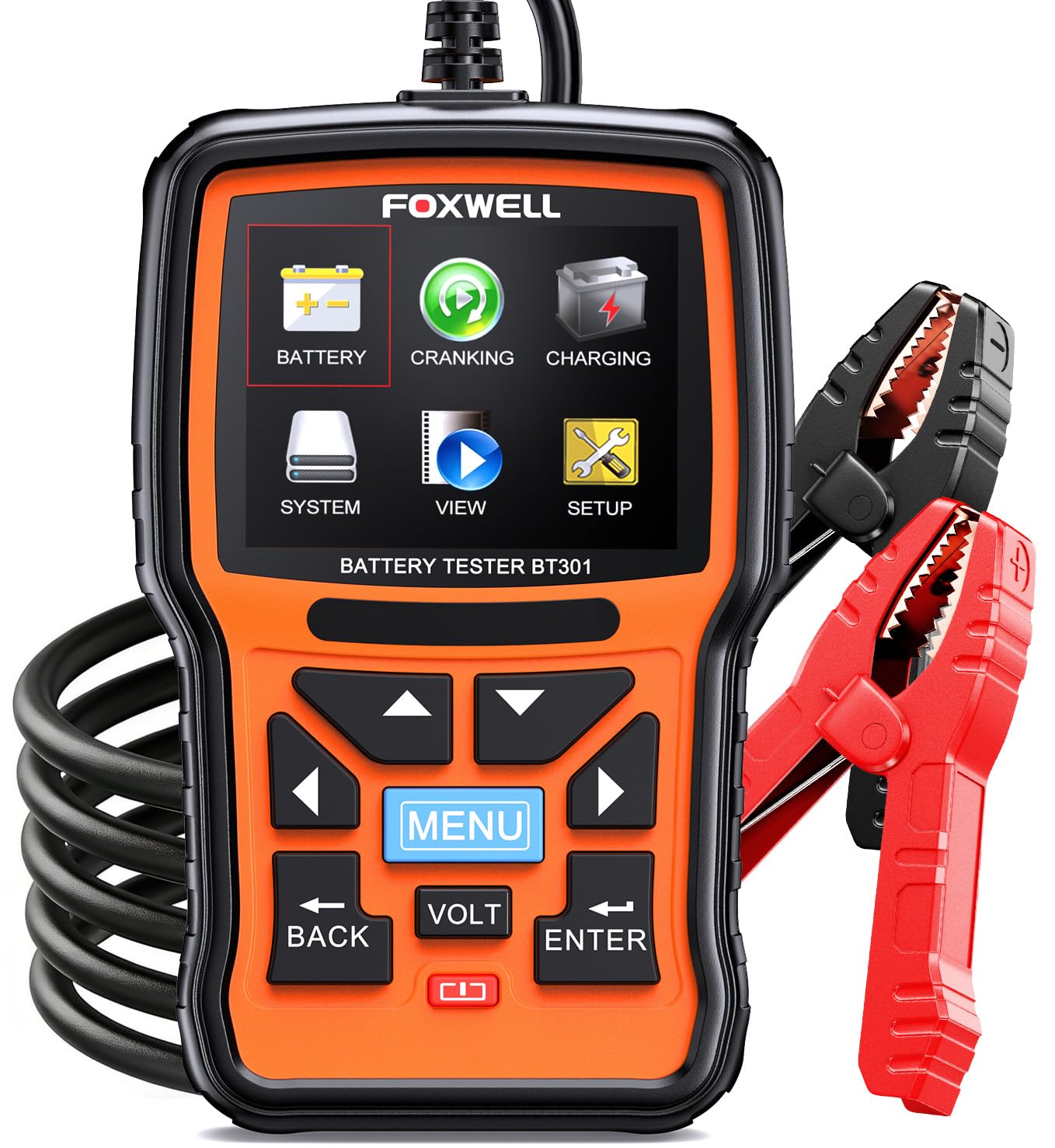
The FOXWELL BT301 is the upgraded version of their popular BT100, bringing a 2.8-inch color display and a 6.5-foot test cable. The longer cable means you can sit in the driver’s seat and connect the tester to the battery without needing a helper to operate the unit. It supports all standard 12V lead-acid types: flooded, AGM flat and spiral, EFB, and GEL.
Accuracy is rated at 99.9 percent thanks to an intelligent chip and optimized conductance algorithm. The unit displays SOH, SOC, CCA, and internal resistance along with dedicated cranking and charging system tests. Reviewers report CCA readings within 5 amps of professional shop equipment, and the voltage measurement matched a Fluke multimeter exactly.
Build quality includes heavy-duty copper clamps with reverse polarity protection and a durable ABS housing. The BT301 is powered directly by the battery under test, so no internal batteries or external power supplies are needed. It comes with a carrying bag and a user manual, making it a complete kit for the home mechanic.
Why it’s great
- Color screen readable in direct sunlight
- 6.5ft cable allows testing from driver’s seat
- Highly accurate conductance diagnostics
Good to know
- Touchpad has a red button not described in manual
- Must connect directly to battery posts for accurate readings
2. KONNWEI KW600 Car Battery Tester

The KONNWEI KW600 stands out as the only conductance tester in this class with a built-in waveform graph for cranking and charging system analysis. The 2.4-inch intelligent LCD screen displays test results in both text and real-time voltage waveform formats, allowing you to see the starter draw and alternator ripple on screen. It uses a top-level STM-32 main chip for fast processing.
This unit covers a CCA range of 100 to 2000 and works with flooded, AGM flat plate, AGM spiral, GEL, and EFB batteries. Testing two car batteries in a real-world review showed accurate SOH readings: a 2019 AGM battery at 100 percent SOH and a 16-year-old battery at 82 percent SOH. The KW600 also identified four seven-year-old UPS batteries with only 2 percent SOH, confirming its sensitivity to internal resistance.
Connectivity includes a Mini-USB port for lifetime software updates, keeping the unit current as battery technologies evolve. The cables are long and fitted with heavy-duty clips. The display is bright indoors but can be harder to read in direct sunlight, making this tester best suited for garage or shop use.
Why it’s great
- Waveform display for start and charge analysis
- Firmware updatable via USB
- Professional-grade accuracy with quick results
Good to know
- Screen difficult to read in bright sunlight
- No internal battery powers the tester
3. TOPDON BT50 Battery Load Tester

The TOPDON BT50 is a compact, industrial-grade unit that prioritizes safety with spark-free technology and reverse polarity protection. Its updated conductivity algorithm delivers lab-grade accuracy in seconds, making it a fast option for pre-road-trip checks or routine battery health monitoring. The bright LCD display and one-button operation keep the interface simple and accessible.
This tester supports 12V lead-acid batteries with a CCA range of 100 to 2000. It includes a data review feature that stores historical test results, allowing you to track battery degradation trends over time. Reviewers appreciate the 10-second test time and note that readings matched expected CCA values for batteries of various ages.
Potential drawbacks include a relatively short test cable—some users found the clips needed better grip and the cord could be longer for easier use in tight engine bays. The unit also runs six language options. It comes with a one-year warranty and lifetime technical support from TOPDON.
Why it’s great
- Spark-free and reverse polarity safe
- IP67 rating for dust and moisture resistance
- Fast, one-button operation
Good to know
- Short test cables limit reach
- Clip grip could be more secure
4. Clore SOLAR BA9 Digital Tester

The Clore SOLAR BA9 is a no-fuss conductance tester trusted by mechanics who need a quick, accurate read without navigating complex menus. It tests a broad CCA range of 40 to 1200 and works with flooded, AGM, spiral, and GEL cell batteries. The four-line LCD clearly shows SOH, SOC, CCA, and internal resistance, plus it performs alternator and starter tests.
Reviewers in hot climates use the BA9 at every oil change to predict battery failure before symptoms appear. One user in Phoenix caught a failing battery in a 2020 Subaru before it stranded the driver. The tester correctly identified a 750 CCA battery as delivering 695 CCA, right in the expected degradation curve.
The display is backlit for low-light use, though the manual is small and can be hard to read in windy or dirty conditions. The unit is made in Taiwan and backed by the Clore Automotive reputation for robust shop tools. It does not require an internal battery and draws power from the battery under test.
Why it’s great
- Simple interface with essential data
- Reliable for proactive battery replacement
- Lightweight and compact
Good to know
- Small manual hard to read in field conditions
- Display could benefit from on-screen guidance
5. OTC 3181 130 Amp Load Tester

The OTC 3181 is a traditional carbon-pile load tester that applies a full 130-amp load to 12V batteries and tests 6V batteries at an appropriate lower draw. This is the definitive test for batteries that might have a dry cell or high internal resistance—a battery that sits at 13V static can drop into the “bad” zone under this real load. The analog dial is large and clear, with a 0-16 volt range and zero adjust.
This unit is built for heavy-duty shop use. The clamps are designed to grip both top and side post batteries securely, and the carrying handle is rubber-insulated for safety. Side tabs offer on-tool clamp storage, and back brackets allow wall or toolbox mounting. Reviewers report quickly identifying a bad battery that had a dead cell and saved themselves from buying four marine batteries that actually tested fine.
The main consideration with a carbon-pile tester is duty cycle: after a 10-second load test, the internal coil needs a cooldown period before the next test. There are no digital failsafes to protect the coil from overheating, so the user must follow the run/cool times in the manual. The OTC 3181 is also heavier than digital units, but it provides the most conclusive pass/fail result possible.
Why it’s great
- Definitive 130-amp real-world load test
- Robust clamps for top and side posts
- Durable for professional shop environments
Good to know
- Requires cooldown between tests
- Short cables can limit placement
6. Battery Tender 026-0020 Load Tester
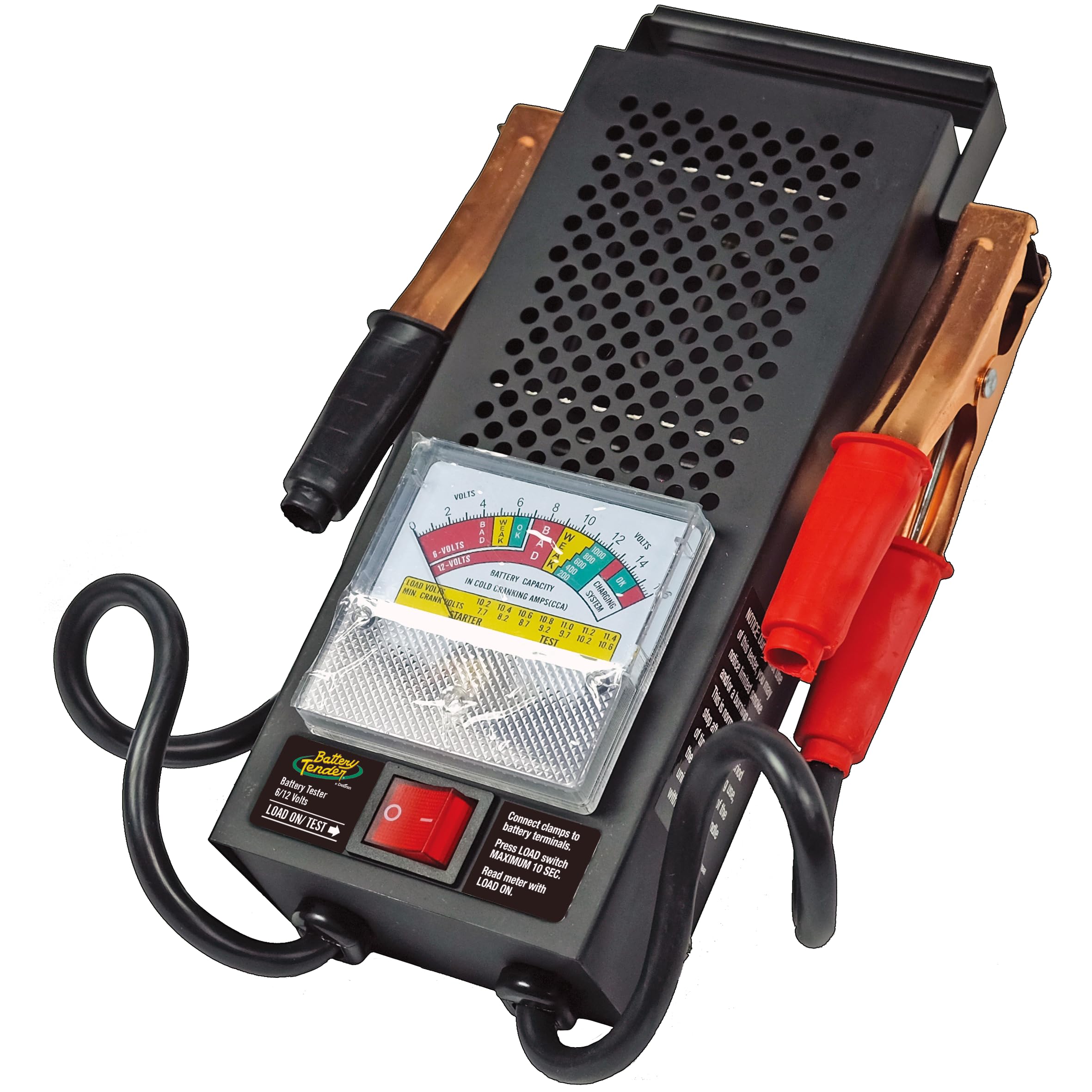
The Battery Tender 026-0020 is an analog load tester that delivers 100 amps for 12V batteries and 50 amps for 6V batteries. It is a classic design with a single toggle switch and a color-coded display that quickly tells you if the battery is good, marginal, or bad. The rubber-insulated handle and heavy-duty alligator clamps add a layer of safety and durability.
Reviewers highlight that this unit removes all doubt about battery performance. A static voltage check does not reveal capacity, but applying a 100-amp load immediately shows whether the battery can deliver its rated power. One user found it handy for diagnosing a neighbor’s battery that needed replacement. Another described it as an old-school tester that simply works.
The trade-off is that this is a basic tool with no digital readout or data logging. You interpret the needle position against the color zones. The internal coil can emit a mild smell when running, which is normal for carbon-pile testers. It is best suited for budget-conscious users who want direct load testing without extra features.
Why it’s great
- Affordable analog load test
- Color-coded display for instant results
- Strong clamps and thick wiring
Good to know
- No digital accuracy or data logging
- Mild odor from internal coil during use
7. Quicklynks BM2 Bluetooth Monitor

The Quicklynks BM2 is a permanently installed Bluetooth monitor rather than a handheld tester. It clips directly to the battery terminals and communicates with a free app on iOS or Android via Bluetooth 4.0. It records voltage at one-minute intervals and stores up to 30 days of data, showing charge status, cranking performance, and alternator output on historical graphs.
This unit is ideal for vehicles that sit unused for extended periods, such as classic cars, RVs, or seasonal boats. The low-voltage alarm sends a notification to your phone when the battery drops below a set threshold. One reviewer successfully uses it to monitor a hybrid car to determine when a booster charge is needed. It also works for 12V solar power systems.
Bluetooth range is roughly 20 feet through a window, but metal hoods and vehicle frames can reduce this significantly—you may need to be close to the car to connect. The app only pairs to one phone at a time, and alarms are percentage-based rather than voltage-specific, which some users find limiting. The BM2 is not a load tester; it passively monitors voltage.
Why it’s great
- Continuous voltage tracking with app
- 30-day data log showing trends
- Low-voltage alarm prevents dead batteries
Good to know
- Bluetooth range limited by vehicle body
- Permanent installation; not a handheld tester
FAQ
What is the difference between a conductance tester and a load tester?
Can I use a 12 volt battery tester on a 6 volt battery?
Why does my battery show 12.6 volts but the tester says it’s bad?
Do I need to disconnect the battery before testing?
What does State of Health (SOH) mean on a battery tester?
Final Thoughts: The Verdict
For most users, the best 12 volt battery tester winner is the FOXWELL BT301 because it combines a high-contrast color display, a long 6.5-foot cable for flexible placement, and professional-grade conductance accuracy that covers all standard battery types. If you want definitive real-world load testing, grab the OTC 3181 for its 130-amp carbon-pile test that leaves no doubt about a battery’s capacity. And for remote monitoring of a vehicle you only drive occasionally, nothing beats the Quicklynks BM2 with its Bluetooth alerts and 30-day voltage history.