
Our readers keep the lights on and the weekend projects moving. As an Amazon Associate, I earn from qualifying purchases.
Finding a pair of headphones that deliver a satisfying, room-shaking low end without pushing your budget past its limit is a genuine challenge. Many affordable models either sound thin and hollow or rely on muddy, bloated bass that ruins the rest of the mix. The real trick is knowing which drivers and tuning deliver a clean, powerful thump for the money.
I’m Rikta — the co-founder and writer behind FitlyFast. I’ve spent countless hours digging through customer feedback and spec sheets on bass-focused headphones to separate the true performers from the ones that just look good on paper.
This guide breaks down the top models that prove you don’t need to spend a fortune for a rich, punchy low-end. Here is my analysis of the best affordable bass headphones on the market right now.
How To Choose The Best Affordable Bass Headphones
Selecting a bass-forward headphone on a budget requires looking past marketing claims like “extra bass” and focusing on the hardware that actually produces it. The goal is a low-end that feels powerful and tactile, not one that distorts or bleeds into the midrange. Here are the key factors that separate a great value from a disappointing purchase.
Driver Size and Material Matters
The driver is the engine of the bass. In this price range, look for larger 50mm dynamic drivers made with neodymium magnets. The larger surface area moves more air, which is necessary for generating deep sub-bass frequencies below 40Hz. A 40mm driver can still produce punch, but it often struggles with the lowest, most tactile rumbles found in EDM, hip-hop, and modern pop.
Closed-Back Design for Isolation
An open-back design inherently leaks sound and sacrifices low-end impact. For affordable bass headphones, a closed-back, circumaural design is non-negotiable. The sealed ear cups create a contained environment that allows the driver’s pressure to build, resulting in a tighter, more impactful bass response. They also serve as passive noise isolation, helping you hear the sub-frequencies even in a noisy room.
Frequency Response and Impedance
Check the low end of the frequency response spec. A headphone that claims a bottom range of 20Hz or lower is physically capable of producing sub-bass. Higher impedance models (32 ohms or more) usually have better control over the driver, resulting in cleaner bass that doesn’t distort at higher volumes when paired with a dedicated amp or audio interface.
Quick Comparison
On smaller screens, swipe sideways to see the full table.
| Model | Category | Best For | Key Spec | Amazon |
|---|---|---|---|---|
| Sony MDRXB800 | Wired Monitor | Deep, immersive sub-bass | 50mm driver; 3-28Hz response | Amazon |
| Audio-Technica ATH-M20x | Studio Monitor | Controlled bass for mixing | 40mm driver; CC AW voice coil | Amazon |
| PreSonus HD9 | Studio Monitor | High-power handling & accuracy | 45mm driver; 1,800mW power | Amazon |
| Soundcore Q20i | Wireless ANC | Wireless bass on the go | 40mm driver; BassUp EQ | Amazon |
| JBL Tune 720BT | Wireless | Long battery & JBL bass signature | 40mm driver; 76hr battery | Amazon |
| MAONO MH700 | Studio Monitor | Balanced bass for recording | 50mm driver; detachable cables | Amazon |
| Mackie MC-100 | Studio Monitor | Entry-level monitoring | Dynamic driver; 15Hz-22kHz | Amazon |
In‑Depth Reviews
1. Sony MDRXB800 Extra Bass

The Sony MDRXB800 is the definitive choice for buyers who want the most exaggerated, room-rattling bass possible at a reasonable cost. Its massive 50mm diaphragms are tuned specifically for a frequency response that bottoms out at 3Hz, which is essentially subwoofer territory. The Direct Vibe Structure physically transfers the driver’s vibration through the ear cup housing, a design detail that creates a tactile, almost physical sensation—ideal listeners report it can vibrate your fillings loose during heavy bass drops.
This is not a neutral or analytical headphone. The mids and highs are intentionally recessed to emphasize the low end, making it perfect for bassists, EDM producers, or anyone listening to trap and modern hip-hop where the kick drum and 808s are the main event. The pressure-relieving foam ear pads are comfortable for long sessions, and the dual folding design makes it surprisingly portable for a 50mm driver model.
The Y-type tangle-proof cord is a practical bonus for daily carry, though some users find the flat wire a bit flimsy compared to the rest of the build. Sony’s engineering here proves that a wired, bass-focused design can deliver a genuinely thrilling low-end experience without the distortion that plagues many budget competitors.
Why it’s great
- Massive 50mm drivers produce sub-bass down to 3Hz.
- Direct Vibe Structure adds physical bass sensation.
- Comfortable for long listening sessions.
Good to know
- Mids and highs are recessed, not for critical mixing.
- Flat Y-type cord feels less durable than the headphones.
- Bulky design, not the most portable.
2. Audio-Technica ATH-M20x

The Audio-Technica ATH-M20x is the entry point into the legendary M-Series line, bringing professional studio tuning to a price that undercuts most competitors. It uses 40mm drivers with copper-clad aluminum wire (CC AW) voice coils and rare earth magnets, a combination designed for accurate low-frequency reproduction rather than bloat. The sound signature is tuned for enhanced low-frequency performance, which means the bass is present, tight, and controlled—perfect for tracking vocals or instruments without the bass overwhelming the mix.
The circumaural design seals around the ears to provide excellent passive isolation, a critical feature for monitoring in noisier environments. While it lacks the sub-bass extension of the Sony MDRXB800, its bass response is significantly more accurate and less likely to mask mistakes during mixing. The single-side cable exit with a sturdy, tangle-free cord is a thoughtful touch for studio patching.
You are sacrificing a carrying case, detachable cables, and a premium colorway to hit this price. The clamping force is notable—users with glasses should budget for a break-in period or may find the pressure uncomfortable after 30 minutes. For the price, it is an incredible gateway into proper studio monitoring with a bass signature that prioritizes clarity over brute force.
Why it’s great
- Industry-standard studio tuning with a bass boost.
- Excellent passive isolation for loud spaces.
- Durable, single-side cable for studio use.
Good to know
- Not designed for deep sub-bass rumble.
- Strong clamping force, uncomfortable with glasses.
- Non-detachable cable.
3. PreSonus HD9

The PreSonus HD9 is a professional monitoring tool that delivers serious low-end accuracy without the harsh treble peak common in other budget studio cans. Its 45mm neodymium drivers, paired with a high-power handling of 1,800mW, allow the headphones to produce a clear and controlled bass response even at high gain levels from an audio interface. The tailored frequency response from 10Hz to 26kHz ensures that the low end remains tight and natural, making it a reliable tool for mixing genres that rely on a clean kick drum and sub-bass lines.
Many users report that the HD9 outperforms the more expensive Audio-Technica ATH-M50x in terms of bass accuracy, calling the low end “tight, natural, and non-boomy.” The 180-degree cup rotation and foldable design make it easy to pack in the included storage bag for sessions or remote recording. The 10-foot single-sided cable with a gold-plated adapter is generous enough for any studio setup.
The closed-back, circumaural design provides excellent isolation, though some users note that the ear pads can feel a bit warm over extended mixing sessions. It lacks the flashy features of consumer Bluetooth cans, but for a budget-conscious producer or musician who needs a reliable, accurate bass response for mixing, the HD9 is an outstanding value.
Why it’s great
- Extremely accurate, tight bass response.
- High power handling for use with pro gear.
- Includes storage bag and 10ft cable.
Good to know
- Ear pads can get warm during long sessions.
- Not for consumers wanting a boosted consumer bass.
- No detachable cable.
4. Soundcore by Anker Q20i

For those who prioritize wireless convenience and active noise cancellation, the Soundcore Q20i is the most compelling option on this list for punchy, satisfying bass. The BassUp technology is a digital EQ boost that adds significant low-end weight to the 40mm dynamic drivers, making electronic and pop music feel lively and full. The hybrid ANC system, featuring four built-in microphones, effectively filters out ambient drone, which allows the bass frequencies to stand out more clearly without needing to crank the volume to dangerous levels.
The battery life is a standout spec: 40 hours with ANC on and 60 hours in normal Bluetooth mode, plus a 5-minute quick charge that provides 4 hours of playback. The Multipoint Connection feature lets you stay paired to your laptop and phone simultaneously, automatically switching audio to whichever device rings or plays. The free Soundcore app also lets you toggle between ANC, Transparency, and Normal modes, as well as adjust the EQ to your personal bass preference.
The ear pads are comfortable and soft, though the head adjustment slider can pinch fingers if not handled carefully. The Transparency Mode is a standard implementation—functional, but not on the level of high-end premium ANC models. For the price, the combination of hybrid ANC, deep bass via BassUp, and incredible battery life makes it the top choice for commuting and daily wireless use.
Why it’s great
- BassUp provides significant, clean bass boost.
- Exceptional 40-60 hour battery life.
- Effective hybrid ANC for the price.
Good to know
- Bass is from digital EQ, not driver size.
- Transparency mode is just okay.
- Headband adjustment can pinch.
5. JBL Tune 720BT

The JBL Tune 720BT leverages the brand’s legendary Pure Bass sound, a tuning philosophy that has powered live venues globally. The result is a bass-forward wireless headphone that delivers a punchy, musical low-end without the aggressive sub-bass boost that can cause distortion in cheaper models. The 40mm dynamic drivers produce a sound signature that is immediately recognizable as JBL, with a wide soundstage and a “smile” EQ curve that emphasizes the lows and highs for an exciting listening experience.
The battery life is phenomenal, offering up to 76 hours of playback on a single charge, which means you can go weeks between charges with normal daily use. The Bluetooth 5.3 technology ensures a stable connection with low latency, and the Voice Aware feature makes hands-free calling practical by letting you hear your own voice to avoid shouting. The foldable, lightweight design at just 150 grams makes it easy to throw in a bag for travel.
The fit can feel more like an on-ear headphone rather than a deep over-ear for those with larger ears, which might reduce bass isolation and comfort over long sessions. There is no active noise cancellation, relying instead on the passive isolation from the cushioned ear pads. For the price, the JBL Tune 720BT is a stylish, long-lasting wireless option with a bass signature that is designed for pure enjoyment.
Why it’s great
- Classic JBL Pure Bass tuning.
- Unmatched 76-hour battery life.
- Extremely lightweight and foldable.
Good to know
- Fit can be snug, more on-ear than over-ear.
- No active noise cancellation.
- No included carrying case.
6. MAONO MH700

The MAONO MH700 is a revelation in the budget studio space, offering a near-flat frequency response with a slight mid-bass emphasis that makes it a “giant killer” compared to the Shure SRH840A. The 50mm dynamic drivers deliver a balanced sound profile that reveals clean highs and natural mids, while the low-end is present enough to feel the rhythm section without introducing the muddiness that plagues many lower-tier monitoring headphones. Users report that these require zero EQ out of the box for a balanced listening experience.
The build quality is exceptional for its starting price, featuring fully articulating ear cups with 180-degree rotation, a lightweight metal headband, and two detachable cables—one 1.2-meter straight 3.5mm cable and one 3-meter coiled cable with a 6.35mm adapter. The inclusion of a storage bag is a welcome bonus that is often missing from models costing twice as much. The closed-back design provides decent noise isolation, making it suitable for tracking vocals, podcasting, or gaming in a shared space.
The compromise is in the headband padding, which some find could be more generous, and the cable connector’s “plug-in lock” design, while stable, can be fiddly to detach. The MH700 also lacks the extreme sub-bass of a pure consumer headphone like the Sony MDRXB800, opting for accuracy over spectacle. For the money, it is hard to beat for anyone needing a professional-grade monitor with a balanced, bass-aware tuning.
Why it’s great
- Near-flat response with a slight, clean bass bump.
- Robust build with metal headband and articulating cups.
- Comes with two detachable cables and storage bag.
Good to know
- Headband padding could be more plush.
- Not for extreme bass-heads who want rumble.
- Cable lock mechanism takes getting used to.
7. Mackie MC-100
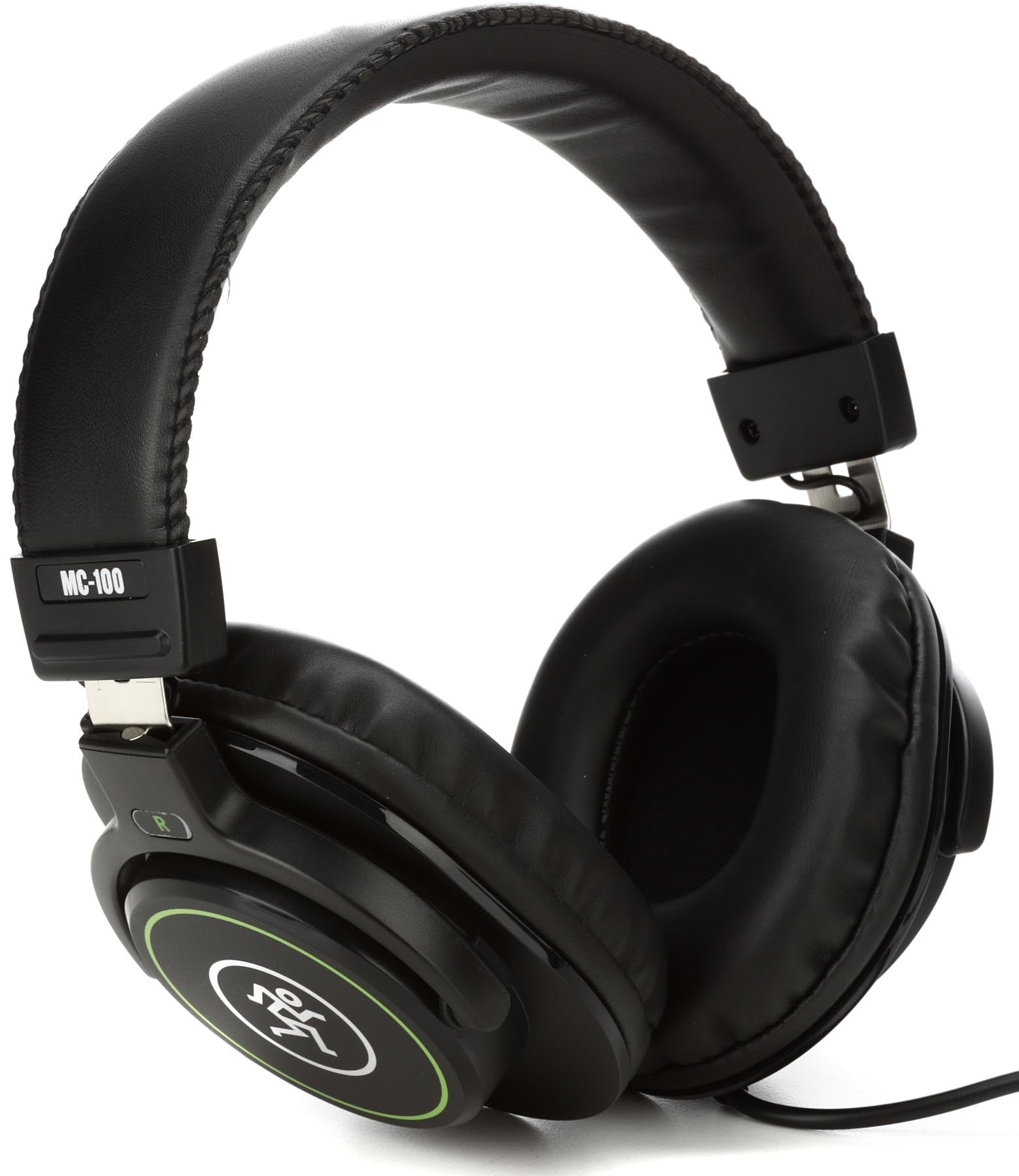
The Mackie MC-100 is the most affordable entry on this list, yet it punches well above its weight class in terms of sound quality. It delivers a warm, balanced sound signature with a pleasant low-end emphasis that avoids the shrill or piercing treble that can fatigue the ears during long sessions. The dynamic drivers offer a wide frequency response from 15Hz to 22kHz, which ensures you get a decent representation of sub-bass frequencies, even if they lack the raw power of a 50mm driver like the Sony MDRXB800.
Designed for home recording, podcasting, and personal listening, the MC-100 features soft padded ear cups and an adjustable headband that make it comfortable enough to sleep in. The circumaural design provides excellent passive noise isolation, which helps the bass frequencies feel more present than they would in an open-back design. Many users compare its sound positively to the Audio-Technica M40x, calling it “incredible sound for the money.”
The trade-offs are in the finer details: the detachable cable is reportedly weak at the connector point, and the foam padding is less luxurious than on models from MAONO or PreSonus. It also distorts at higher volumes, so it is not a headphone for head-banging at full gain. For the absolute lowest entry point into a quality closed-back monitor with a warm, bass-friendly sound, the MC-100 is a fantastic starter.
Why it’s great
- Warm, non-fatiguing sound with good bass.
- Extremely low entry price for a studio monitor.
- Comfortable for extended wear.
Good to know
- Detachable cable connector can be fragile.
- Distorts at very high volume levels.
- Foam pads are less plush than competitors.
FAQ
Are 50mm drivers always better for bass than 40mm drivers?
Why do some cheap headphones have muddy bass?
Can wireless Bluetooth headphones deliver true deep bass?
Final Thoughts: The Verdict
For most users, the affordable bass headphones winner is the Sony MDRXB800 because its massive 50mm drivers and Direct Vibe Structure deliver the most thrilling, tactile sub-bass experience at this price point. If you need a professional monitor for mixing with a tight and accurate low-end, grab the PreSonus HD9. And for wireless convenience with a bass boost that actually works, nothing beats the Soundcore Q20i.