
Our readers keep the lights on and the weekend projects moving. As an Amazon Associate, I earn from qualifying purchases.
Crunching across fiberglass batts, balancing on ceiling joists, and hoping you don’t put a foot through the drywall below — that’s the reality of an unfinished attic. Traditional plywood sheets trap moisture, sag under load, and require measuring, cutting, and heavy lifting in a space you can barely stand in. The right attic flooring system changes that entirely: lightweight, modular panels that snap together on top of your joists, creating a stable walking surface without choking your insulation.
I’m Rikta — the co-founder and writer behind FitlyFast. I’ve spent hundreds of hours analyzing the technical specs, load limits, ventilation designs, and real-world durability reports across the attic flooring category to find the systems that genuinely work in tight, irregular, and unconditioned spaces.
Whether you’re storing holiday decorations or creating a walkway to your HVAC unit, this guide helps you choose the strongest, most breathable best attic flooring that won’t compromise your home’s thermal envelope or structural integrity.
How To Choose The Best Attic Flooring
Attic flooring is not the same as garage or basement flooring. The space is unheated, often humid in summer and freezing in winter, and your insulation’s R-value depends on air movement. A bad flooring choice can crush your insulation, trap moisture against your roof deck, and add structural stress to joists that were never designed for heavy dead loads. Here’s what to check before you buy.
Load Capacity and Joist Spacing
The best attic panels are engineered for 250 pounds per tile — enough for a person plus stored items. But that rating only holds if your joists are 16 inches on-center. If your attic has 24-inch spacing, the panel will flex between joists, creating a bouncy or unsafe surface. Dedicated attic systems often include pre-drilled screw holes aligned to standard joist patterns, so you can fasten the panel directly to the framing. Garage-style interlocking tiles, by contrast, sit on the subfloor and rely on friction and edge connections rather than structural fastening to the joists underneath.
Ventilation and Airflow
Attic insulation needs to breathe. Solid plywood or OSB sheets block air movement, trapping moisture against the underside of your roof deck and potentially causing rot or mold. The best attic flooring panels feature raised ribs, vented grid patterns, or open channels that allow air to circulate beneath the panel. This keeps your insulation dry and your attic space properly ventilated. Products that also feature self-draining channels are ideal if your attic has any history of condensation or minor roof leaks.
Material Composition for Temperature Extremes
Attics can swing from over 140°F in summer to below freezing in winter. Polypropylene (PP) and ABS plastic panels handle these extremes without warping, cracking, or off-gassing. Avoid particle board or MDF panels — they absorb moisture, swell, and disintegrate over time in an unconditioned attic. Look for virgin polypropylene or high-density polyethylene (HDPE) construction, which maintains its structural integrity across temperature ranges without becoming brittle in the cold or soft in the heat.
Installation Ease in Tight Spaces
Attics are cramped, poorly lit, and full of obstacles. You cannot carry a 4×8 sheet of plywood up an attic ladder and maneuver it around trusses. Lightweight modular panels that can be carried up in stacks and snapped together on site are the only practical solution. Look for systems that claim a 15-minute installation time and require minimal cutting (just a hacksaw or handsaw for perimeter tiles). Pre-drilled screw holes and integrated wire notches save you additional trips back down to the workshop.
Quick Comparison
On smaller screens, swipe sideways to see the full table.
| Model | Category | Best For | Key Spec | Amazon |
|---|---|---|---|---|
| Attic Dek Flooring System | Walkway Panels | Attic walkways on 16″ joists | 1.13″ thick, 250 lb capacity | Amazon |
| USA Sealing Attic Dek | Walkway Panels | 24″ joist spacing support | 1.13″ thick, 250 lb capacity | Amazon |
| SafeRacks Ribbed Garage Tiles | Interlocking Tile | Large garage or basement floors | 0.71″ thick, 8000 lb roll load | Amazon |
| RaceDeck Free-Flow Tiles | Interlocking Tile | Workshop areas with drainage | 0.5″ thick, 80,000 lb roll load | Amazon |
| VEVOR Garage Floor Tiles | Interlocking Tile | High-load vehicle parking areas | 0.53″ thick, 5500 lb capacity | Amazon |
| XyVoltic 10-Pack Pallets | Storage Platforms | Raising items off attic floor | 1.18″ tall, HDPE plastic | Amazon |
| XyVoltic 8-Pack Pallets | Storage Platforms | Small budget attic storage | 1.18″ tall, HDPE plastic | Amazon |
In‑Depth Reviews
1. Attic Dek Flooring Storage System

The Attic Dek system is the closest thing to a turnkey solution for unfinished attic spaces. Each 24 x 16 x 1.13-inch panel is made from a blend of ABS plastic and polycarbonate, giving it stiffness without the weight of plywood. The tapered ribs on the underside are designed to sit between joists, and the pre-drilled screw holes let you lock each panel into the framing without measuring or marking. With a 250-pound rated capacity per tile, it handles a person plus a stack of totes without flexing, assuming your joists are on 16-inch centers.
The panels include integrated wire notches on each side, so you can route electrical cables or low-voltage wiring alongside the flooring rather than drilling holes through it. The raised underside allows air to circulate beneath the panel, so your fiberglass or cellulose insulation retains its R-value. Installation is genuinely 15 minutes per panel — screw it down and move to the next. The panels are lightweight enough to carry up a folding attic ladder in one hand, and cutting them to fit around trusses requires only a basic hacksaw.
Where the system falls short is on 24-inch joist spacing. Multiple users report noticeable bounce and flex when the joists are wider than 16 inches on-center. The included screws are adequate but not excellent; swapping them for a box of GRK or Spax cabinet screws improves the hold significantly. If your attic has irregular joist spacing or wide spans, the Attic Dek panels alone may not feel stable enough for frequent foot traffic.
Why it’s great
- Tool-free installation with pre-drilled screw holes aligned to standard 16-inch joist spacing
- Integrated wire notches for clean cable routing alongside the flooring
- Lightweight ABS/polycarbonate construction for easy attic entry and positioning
Good to know
- Feels bouncy and unstable on 24-inch joist spacing; best suited for 16-inch centers
- Supplied screws are low quality — budget for aftermarket fasteners
- Expensive on a per-square-foot basis compared to plywood
2. USA Sealing Attic Dek Flooring
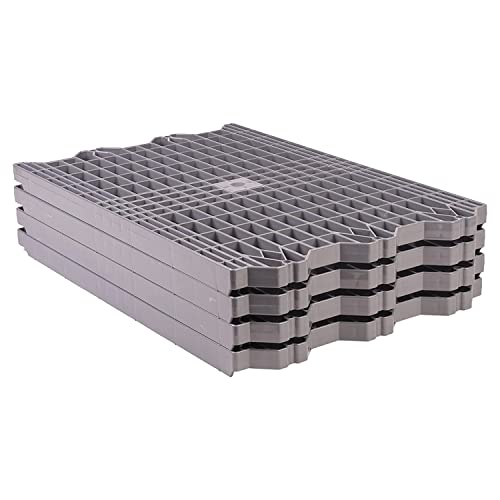
The USA Sealing version of the Attic Dek is functionally identical to the branded Attic Dek system — same dimensions (24 x 16 x 1.13 inches), same ABS/polycarbonate material blend, and the same 250-pound load rating. The key distinction is that users consistently report this variant performs better on 24-inch joist spacing. The panels remain stable under load, with only a slight bend at extreme weights near 220 pounds, making it the safer choice for older homes with wider joist layouts.
The gray color offers a cleaner look in a finished attic than the black panels, and the pre-drilled holes follow the same joist-aligned pattern. The included screws are again the weak point — multiple customers note they strip easily under impact driver torque. Plan on replacing them with your own supply, ideally a #8 or #10 self-tapping screw with a pancake head. The panels themselves are structurally sound, with crisp edges that interlock smoothly for continuous coverage across a run.
Ventilation is excellent. The raised grid pattern channels air beneath the panel, and the material won’t absorb moisture like wood. Users praise the ability to create a functional storage area in an attic that previously had zero usable floor space. The main criticism is the price — at roughly three times the cost of OSB per square foot, it is not a budget solution. But for small attics where carrying full plywood sheets up a ladder isn’t feasible, it is the most practical option available.
Why it’s great
- Holds steady on 24-inch joist spacing with minimal flex under body weight
- Rigid ABS/polycarbonate build resists moisture, temperature swings, and sagging
- Interlocking panel edges for continuous coverage without exposed gaps
Good to know
- Included screws strip easily — plan to buy aftermarket fasteners separately
- Premium per-panel cost; better suited for small walkways than whole-attic coverage
- No integrated wire notches like the black Attic Dek version
3. SafeRacks Ribbed Interlocking Garage Floor Tiles

SafeRacks shifts the conversation from attic-specific walkways to garage-grade interlocking tiles. Each tile measures roughly 1.72 square feet — 72 percent larger than standard 12-inch tiles — and at 0.71 inches thick, they are the thickest interlocking tile in this comparison. The heavy-duty polypropylene construction handles rolling loads up to four metric tons, making this a viable option for attics that double as workshop or storage spaces with heavy totes.
The open-air channels under each tile provide effective water drainage and ventilation, similar in concept to the Attic Dek systems. The ribbed surface texture gives excellent traction even when dust or debris accumulates. Installation is a pure snap-together process — no screws, no adhesive, no tools. The larger tile format means fewer pieces to install for the same coverage area, and the 48-pack covers over 82 square feet. Users report that the tiles look uniform and professional, and the diamond-plate aesthetic works as well in an attic as it does in a garage.
The catch: these tiles are not designed to be screwed down to joists. They work best on a solid, level subfloor. In an attic with exposed joists and insulation between them, you would need to install a plywood base layer first, which defeats the purpose of a lightweight modular system. The split locking tabs are also a minor frustration — they bend easily during installation and require careful alignment. For attics that already have a subfloor, however, this is a durable and attractive top layer.
Why it’s great
- Thickest tile at 0.71 inches with an 8,000 lb rolling load rating for heavy storage
- 1.72 sq ft per tile reduces install time by covering more area per piece
- Ribbed surface and open-air channels for drainage, traction, and air circulation
Good to know
- Requires a solid subfloor underneath — cannot bridge open joist bays like Attic Dek
- Split locking tabs bend easily and need careful alignment to close fully
- Not designed for direct screw-down attachment to attic framing
4. Big Floors RaceDeck Free-Flow Garage Tiles

RaceDeck’s Free-Flow tiles are the gold standard for garage flooring, and their open-rib design translates surprisingly well to attic applications where you need a surface that drains and breathes. The 12×12-inch tiles are made from high-impact polypropylene and support rolling loads up to 80,000 pounds — more than enough for any attic storage scenario. The patented free-flow structure allows debris, dust, and any moisture to fall through to the level below, keeping the walking surface clean and dry.
Installation is genuinely tool-free. The interlocking tabs snap together with a satisfying click, and you can install a full 12-tile pack in under two hours. The anti-fatigue understructure adds a slight cushion underfoot, which is a welcome bonus if you are standing in the attic sorting through boxes. The tiles are also non-toxic and odor-free, important in an enclosed attic space where fumes could linger. The 0.5-inch thickness is thinner than the SafeRacks tiles, but the polypropylene composition handles temperature swings without cracking.
The drawbacks are the same as with any interlocking tile on an open-joist attic: these tiles need a flat, solid base. They cannot span the gaps between joists. They also hurt bare feet — the open grid edges are not comfortable to walk on without shoes. And while the tiles are heavy-duty, jacks or jack stands can leave permanent wear marks. For an attic with an existing plywood subfloor, these tiles add a durable, easy-to-clean top layer that outperforms any garage-grade epoxy.
Why it’s great
- Free-flow open-rib design allows dirt and water to fall through, staying clean on top
- Polypropylene construction handles 80,000 lb rolling loads without cracking
- Snap-together installation requires no tools, adhesives, or cutting for full-coverage areas
Good to know
- Requires a solid subfloor — cannot be used directly over exposed joists and insulation
- Open grid edges are uncomfortable on bare feet; best used with footwear
- Wears under point loads like jack stands or heavy machinery feet
5. VEVOR Garage Floor Tiles 50 Pack

VEVOR’s 50-pack of 12×12-inch interlocking tiles delivers an impressive 5,500-pound static load capacity at a thickness of 0.53 inches. The 3D diamond-textured surface provides serious grip, and the upgraded six-loop interlocking system ensures edges stay tight without protruding tabs that catch on shoe soles. This is a serious floor protection system for attics used as light workshops or storage rooms with heavy equipment.
The double-sided texture means you can flip the tiles and use either side, doubling the usable life. The polypropylene material handles the temperature swings of an unconditioned attic without warping, and the raised rhombic grid bottom layer allows some airflow beneath the tile. Installation is straightforward click-lock assembly, and cutting perimeter tiles with a hand saw or circular saw is manageable — a utility knife will not cut through these rigid tiles. Users report that the tiles hold up well under vehicle weight when installed in garages, giving confidence for attic storage applications where load capacity is a concern.
The thermal expansion issue is the main concern for attic use. Direct sunlight through a roof vent or skylight can heat the tiles, causing them to expand and buckle at the edges. Several users in garage installations reported tiles lifting at the seams on hot days, even with a 1/4-inch expansion gap left around the perimeter. In an attic that reaches 140°F regularly, this could cause the floor surface to become uneven. The tiles also sound hollow when walked on, which is a minor annoyance in a quiet home.
Why it’s great
- 5,500 lb load capacity in a 0.53-inch thick tile for heavy workshop storage
- Double-sided diamond texture allows flipping for extended service life
- Upgraded 6-loop interlocking system for gap-free edge connections
Good to know
- Can buckle and lift in high heat; requires careful expansion gap management in attics
- Rigid polypropylene is difficult to cut — a utility knife won’t work
- Sounds hollow underfoot, which may be distracting in rooms below the attic
6. XyVoltic Lightweight Plastic Pallets 10-Pack
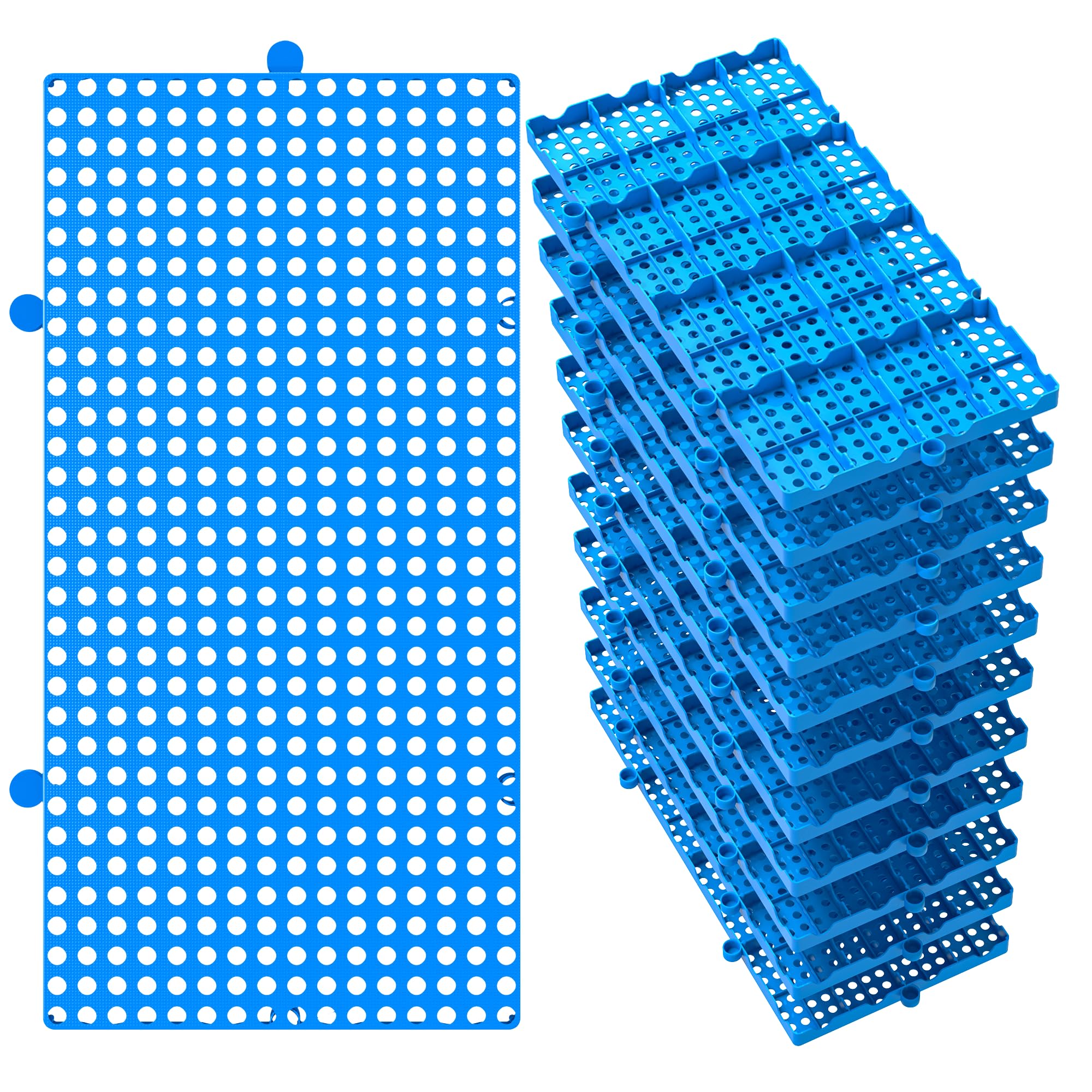
XyVoltic’s plastic pallets take a different approach to attic flooring: instead of covering the whole space, these 23.6 x 11.8 x 1.18-inch platforms act as portable decking that raises items off the attic floor. Made from high-density polyethylene, each pallet weighs just over a pound but claims a 1,000-pound static load capacity. The ventilated grid base ensures airflow underneath your stored boxes, preventing condensation from wicking into cardboard or fabric items.
The interlocking design lets you link multiple pallets together into a larger platform, so you can create a custom storage island in the middle of your attic. The 1.18-inch height is just enough to clear minor irregularities in the floor and allow air movement, but low enough that you don’t lose headroom. Users specifically praise these for placing pet crates and storage totes in garages and basements to avoid moisture damage. The pallets are also easy to clean — hose them off or wipe them down — making them reusable if you reorganize the space.
The trade-off is that these are not walkable flooring panels. The pallets snap together but do not lock with the same rigidity as dedicated attic panels. They can separate under lateral force or if you step on the edge of a single pallet. The thin plastic walls (they weigh only 500 grams each) mean the structural confidence is lower than solid panel systems. They work best as a base layer for boxes and totes, not as a walking surface. For pure storage protection against damp attic floors, they are effective and affordable.
Why it’s great
- Vented grid base promotes airflow and prevents moisture wicking into stored items
- Lightweight HDPE construction at just over 1 lb per pallet for easy repositioning
- Interlocking edges allow custom platform sizing for different attic layouts
Good to know
- Not designed as a walking surface — pallets can separate under foot pressure
- Thin plastic walls limit confidence in the stated structural weight capacity
- Price per pallet is relatively high compared to the thin material gauge
7. XyVoltic Lightweight Plastic Pallets 8-Pack

The 8-pack version of the XyVoltic plastic pallet system offers the same HDPE construction and 23.6 x 11.8 x 1.18-inch dimensions as the 10-pack, but at a lower entry point for smaller attic spaces. Each pallet still features the vented grid base for drainage and airflow, and the interlocking tabs allow you to expand coverage area over time by adding more packs. For a seasonal storage attic where you are only placing a few holiday decoration totes, this is an efficient way to keep boxes off the insulation without committing to a full flooring system.
The pallets are genuinely lightweight — each weighs only about 500 grams — so you can carry an entire pack up into the attic in one trip. The 1.18-inch height lifts items high enough to avoid water damage from a minor roof leak or condensation drip. The interlocking mechanism uses slip-together tabs rather than snap-lock connectors; this makes the pallets easier to separate and reconfigure but also means they don’t stay connected under lateral stress. A single pallet moved across the floor may separate from its neighbors.
Durability feedback is mixed. The plastic feels thin to the touch, and several users note the price feels high given the material gauge. However, the pallets hold up well under static loads like stacked boxes, and the ability to rinse them clean with a hose makes them a good choice for basement or garage storage that occasionally floods. For homeowners looking for the lowest cost way to protect items from a damp attic floor, this 8-pack delivers functional value at a minimal investment.
Why it’s great
- Low entry cost for basic moisture protection in small attic storage areas
- Lightweight and modular for easy one-person transport up attic ladders
- Vented grid base allows drainage and airflow underneath stored items
Good to know
- Thin plastic construction may not hold up under heavy point loads over time
- Slip-together design does not lock securely — pallets separate under lateral force
- Not suitable as a walking surface or general attic flooring replacement
FAQ
Can I use interlocking garage tiles directly on open attic joists?
Will plastic attic flooring crush my insulation and lower its R-value?
How do I cut attic panels to fit around trusses and obstacles?
What is the difference between plastic pallets and attic walkway panels?
Final Thoughts: The Verdict
For most users, the best attic flooring winner is the Attic Dek Flooring Storage System because it combines lightweight installation, integrated wire notches, and proper ventilation in a panel designed specifically for the exposed-joist attic environment. If you need to work with 24-inch joist spacing, grab the USA Sealing Attic Dek for its proven stability on wider spans. And for turning an existing attic subfloor into a durable, easy-to-clean working surface, nothing beats the coverage and thickness of the SafeRacks Ribbed Interlocking Tiles.