
Our readers keep the lights on and the weekend projects moving. As an Amazon Associate, I earn from qualifying purchases.
A clogged nozzle doesn’t just waste filament — it kills hours of print time and forces you to rebuild your entire hotend assembly. The real pain isn’t the jam itself; it’s the uncertainty of whether your next swap will cause under‑extrusion, stringing, or a glob of plastic that takes an hour to clean.
I’m Rikta — the co‑founder and writer behind FitlyFast. I’ve dug into the thermal conductivity numbers, bore tolerances, and real‑world wear data across hardened steel, copper‑alloy, and diamond‑tip nozzle designs to sort which ones actually deliver reliable prints over the long haul.
Whether you print PLA on a budget machine or feed carbon‑fiber through a high‑speed Core XY, the 3d printer nozzle you choose dictates layer adhesion, flow consistency, and how often you stop to clear a jam.
How To Choose The Best 3D Printer Nozzle
Picking a nozzle isn’t about grabbing the cheapest brass pack or the fanciest diamond tip. The right choice depends on three factors: the filaments you actually print, your printer’s hotend design, and the level of maintenance you’re willing to accept. A mismatch here means poor layer adhesion, constant clogging, or wasted money on a nozzle your printer can’t properly heat.
Material Matters — Thermal Conductivity vs. Wear Resistance
Brass offers the best thermal conductivity, meaning it heats up fast and maintains even temperatures across the nozzle tip — ideal for PLA and PETG. The trade‑off is softness: abrasive filaments like carbon‑fiber or glow‑in‑the‑dark will erode a brass bore within a few spools. Hardened steel, by contrast, wears far longer but has roughly half the thermal conductivity of brass, requiring you to bump print temperatures by 10–15°C to compensate. Copper‑alloy cores with hardened steel tips try to bridge that gap, while solid polycrystalline diamond (PCD) tips deliver near‑brass thermal performance with extreme hardness — at a steep price.
Bore Finish — The Spec Most Buyers Miss
Surface roughness inside the nozzle bore is measured in Ra (micrometers). A value below 0.4 Ra means the filament slides through smoothly with minimal resistance. Rougher bores create turbulence that traps melted plastic, leading to partial clogs that appear as random under‑extrusion or inconsistent layer quality. Cheap nozzles often skip this finishing step entirely, which is why two “identical” 0.4 mm nozzles can behave completely differently on the same printer.
Compatibility and Hotend Format
Modern printers from Creality, Bambu Lab, and Flashforge use proprietary hotend assemblies — an MK8 threaded nozzle won’t fit a Bambu Lab X2D or A1 Mini without an adapter. Some brands use all‑integrated quick‑swap units that include the heatbreak and heater block, while others stick to a standard threaded nozzle. Confirm the exact printer model and hotend generation before ordering, and note whether the nozzle uses a separate silicone sock or has a built‑in insulator.
Quick Comparison
On smaller screens, swipe sideways to see the full table.
| Model | Category | Best For | Key Spec | Amazon |
|---|---|---|---|---|
| Diamondback 0.4mm | Diamond Tip | Abrasive & all‑filament printing | Solid PCD tip, 300°C max | Amazon |
| Bambu Lab P1S/P1P Kit | Complete Assembly | Drop‑in replacement, minimal downtime | ±0.008mm tolerance, 300°C | Amazon |
| UniTak3D A1/A1 Mini 3‑Pack | Integrated Hotend | Bambu A1 series, multi‑size set | ≤0.02mm bore tolerance | Amazon |
| FLASHFORGE AD5M Nozzle | Quick‑Release | Flashforge AD5M / AD5M Pro | 32mm³/s flow rate | Amazon |
| Creality K2 Plus Nozzle | Quick‑Swap | Creality K2 Plus, Hi Combo | Ra<0.4 bore finish | Amazon |
| SAHVAIM H2/X2D/P2S 4‑Pack | Hardened Steel Set | Bambu H2‑series, multi‑size | Ra 0.4 throat & nozzle | Amazon |
| Creality Hardened Steel MK8 8‑Pack | Hardened Steel | Creality Ender‑3 / CR‑10 series | 450°C max temp | Amazon |
In‑Depth Reviews
1. Diamondback 0.4mm Prusa Nextruder Nozzle

The Diamondback uses a solid polycrystalline diamond tip — not a coating — bonded to a steel body. This gives it the thermal conductivity close to brass while being harder than any abrasive filament on the market. Users report printing carbon‑fiber, iron‑filled PETG, and standard PLA on the same nozzle without swapping, and the diamond surface resists carbon buildup that typically fouls steel after extended use.
Print quality equals or exceeds brass in layer adhesion tests, and the low friction coefficient means filament flows freely even at slightly lower extrusion temperatures. The Prusa Nextruder variant fits MK4S, MK4, Mini+, and XL machines, though the 0.4 mm bore is not a high‑flow design — users of the MMU3 saw no speed improvement over standard nozzles, just less purge waste.
The + price tag is the obvious barrier. But if you regularly print abrasive composites or want a single nozzle that outlasts dozens of brass replacements, the Diamondback pays for itself in reduced downtime and eliminated nozzle changes.
Why it’s great
- Solid diamond tip outlasts every other nozzle material by 2–8×
- Near‑brass thermal conductivity eliminates temperature guesswork
- Works with any filament — no need to swap for abrasives
Good to know
- Premium price is a hard swallow for PLA‑only users
- Not a high‑flow design; no speed gain over standard nozzles
2. Bambu Lab P1P/P1S Hotend Complete Kit
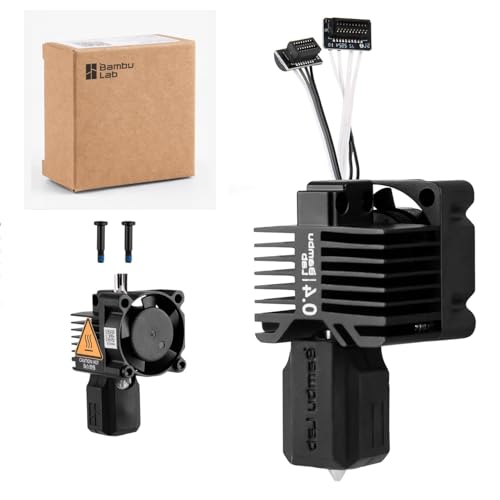
This is a fully pre‑assembled hotend unit with the hardened steel nozzle, ceramic heater, thermistor, cooling fan, and heating block already wired. If you’ve ever struggled to clear a clog on a P1S or P1P, this drop‑in swap gets you printing in under 90 seconds with zero calibration required — factory thermal settings carry over intact.
The copper‑alloy heatbreak prevents oozing during long PETG prints, and the ±0.008 mm bore tolerance means extrusion consistency is industry‑leading. Users who replaced clogged or fan‑failed units report immediate restoration of print quality, and many keep a spare on hand specifically for emergency swaps.
The price is higher than buying just a nozzle, but you’re paying for the convenience of a fully assembled, tested unit. If you’re comfortable rebuilding your own hotend, you can save money — but for reliability and speed, this kit is hard to beat for Bambu P‑series owners.
Why it’s great
- Calibration‑free swap — factory thermal profile retained
- Leak‑proof copper‑alloy heatbreak prevents oozing
- ±0.008mm bore tolerance for consistent extrusion
Good to know
- Price includes the fan, heater, and block — not just a nozzle
- Only for P1P/P1S; does not fit X‑series or A‑series
3. UniTak3D A1/A1 Mini Hotend 3‑Pack

This three‑pack gives Bambu Lab A1 and A1 Mini owners a 0.2 mm, 0.4 mm, and 0.6 mm hardened steel hotend in one purchase. Each unit uses an all‑metal integrated design with the heatbreak and heating block fused together — no loose components to lose or misalign. The fit is magnetic, so swapping sizes takes about 30 seconds once the hotend cools.
The bore tolerance holds below 0.02 mm with a burr‑free chamfered entrance, which dramatically reduces clog risk compared to unbranded nozzles. Users confirm prints are indistinguishable from OEM Bambu parts for PLA, PETG, and TPU. The 0.2 mm is more finicky — fine detail work depends heavily on slicer settings — but the 0.4 and 0.6 perform reliably out of the box.
Some reviewers noted minor stringing at default Bambu profiles, which is typical for hardened steel and easily corrected with a small temperature bump or retraction adjustment. For the price of a single OEM hotend, you get three sizes — making this a strong value pick for A‑series owners who print varied layer heights.
Why it’s great
- Three nozzle sizes for the cost of one OEM unit
- ≤0.02mm bore tolerance minimizes clogs
- Magnetic quick‑swap — no tools needed
Good to know
- 0.2mm nozzle requires careful slicer tuning
- Some users report stringing at default temperature profiles
4. FLASHFORGE Adventurer 5M Nozzle

Designed specifically for the Flashforge Adventurer 5M and 5M Pro, this copper‑steel nozzle assembly hits a peak flow of 32 mm³/s — enough to keep up with the printer’s 600 mm/s travel speed without starving the extrusion path. The 35‑second heat‑up to 200°C is genuinely fast for a complete hotend assembly, and the 3‑second quick‑release mechanism makes nozzle swaps nearly instant.
The bi‑metal construction uses a copper alloy for the heat zone and hardened steel at the tip, giving you the thermal efficiency of brass at the melt zone with the wear resistance of steel at the orifice. Print quality matches the factory nozzle, and users running PLA, PETG, and TPU report no adhesion or clog issues.
One limitation: the included 0.4 mm bore is the default, and while 0.25, 0.6, and 0.8 mm options exist separately, this pack only ships the standard size. For users who want finer details or faster volumetric flow, buying the additional sizes means extra trips to checkout.
Why it’s great
- 32mm³/s high flow keeps pace with 600mm/s travel
- Bi‑metal design combines heat efficiency with tip durability
- 3‑second quick‑release for fast swaps
Good to know
- Only ships with 0.4mm — alternate sizes sold separately
- Strictly for Flashforge AD5M / AD5M Pro printers only
5. Creality K2 Plus Nozzle 0.4mm 4‑Pack
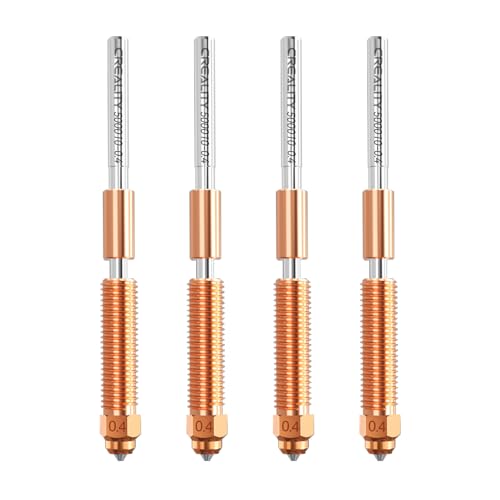
Creality’s official K2 Plus nozzle uses a copper‑alloy core with a hardened steel tip, a titanium‑alloy heatbreak, and a polished inner bore rated Ra < 0.4. The result is a 66% flow improvement over older Creality nozzles — reaching 40 mm³/s with ABS at 280°C — while still handling abrasive filaments up to 350°C.
The integrated quick‑swap design screws in as a single unit, so there’s no loose heatbreak or separate heater block to align. Users report cleaner prints than with third‑party alternatives, and the fitment on K2 Plus and Hi Combo machines is exact — no leaks or misalignment. The four‑pack gives you spares for continuous high‑speed production runs.
The main downside is compatibility: these nozzles only fit the K2, K2 Plus, and Creality Hi printers. Owners of older Ender or CR‑10 models will need the MK8 form factor instead. For K2 users, however, this is the nozzle that unlocks the printer’s full speed potential.
Why it’s great
- 40mm³/s flow at 280°C — 66% better than older Creality nozzles
- Ra<0.4 bore finish reduces clog risk
- Titanium heatbreak minimizes heat creep
Good to know
- Only compatible with K2 Plus, K2, and Hi Combo printers
- Four‑pack is generous but only 0.4mm bore included
6. SAHVAIM H2/X2D/P2S Hotend 4‑Pack
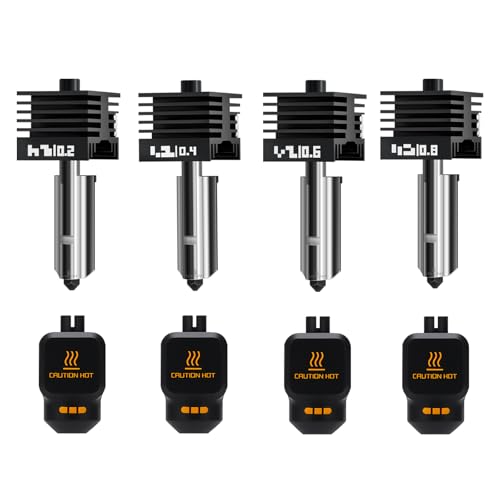
This four‑pack covers 0.2, 0.4, 0.6, and 0.8 mm hardened steel nozzles for Bambu Lab H2D, H2S, H2C, X2D, and P2S printers. The throat tube and nozzle both boast a Ra 0.4 finish, and the titanium‑alloy throat wall is just 0.25 mm thick — thin enough to shed heat quickly and reduce filament oozing during retractions.
Users report flawless prints with PLA, PETG, and TPU right out of the box. The 0.2 mm bore can be finicky — fine detail extrusion demands well‑tuned slicer profiles — but the 0.4, 0.6, and 0.8 sizes deliver consistent flow without jams. The price per nozzle is well below Bambu OEM equivalents, and the fitment is exact.
One note: the magnets on these nozzles have reverse polarity compared to genuine Bambu parts, so storing them in a magnetic tray requires flipping orientation. Also, the hardened steel may not be as durable as Bambu’s proprietary blend for extreme abrasives — several users recommend keeping an eye on bore wear after heavy carbon‑fiber use.
Why it’s great
- Four bore sizes in one kit — great for experimentation
- Ra 0.4 bore finish matches OEM smoothness
- Titanium throat minimizes heat creep
Good to know
- Magnet polarity reversed vs Bambu originals
- Hardened steel may not stand up to heavy abrasive use
7. Creality Hardened Steel MK8 Nozzles 8‑Pack

This eight‑pack of Creality MK8 hardened steel nozzles covers 0.4 mm exclusively — ideal for Ender‑3, Ender‑3 V2, Ender‑3 Pro, Ender‑5, CR‑10, and CR‑10S series printers. The hardened steel construction handles temperatures up to 450°C, making it one of the highest‑temp options in this roundup and suitable for engineering filaments like polycarbonate and nylon.
The practical reality is more mixed. Multiple users report that some nozzles in the pack have inconsistent bore sizes — two separate 0.4 mm nozzles caused severe under‑extrusion, suggesting quality control lapses. Others note that hardened steel simply produces lower print quality than brass: you lose bed adhesion, layer adhesion, and overhang performance even after compensating with a 10°C temperature increase.
At the price per nozzle, this pack is a budget‑friendly starting point for Ender owners who want to experiment with abrasive materials. But the inconsistency and inherent print‑quality trade‑off of hardened steel make it a better fit for rough‑and‑ready prototyping than for finish‑critical parts.
Why it’s great
- Eight nozzles for a very low per‑unit cost
- 450°C max temp handles high‑temp engineering filaments
- Fits wide range of Creality MK8 hotends
Good to know
- Quality control issues — some nozzles have incorrect bore size
- Hardened steel requires 10°C+ temp bump and still prints worse than brass
FAQ
Can I use a hardened steel nozzle for regular PLA and PETG?
How do I know if a nozzle fits my printer without checking the thread size?
What causes a brand‑new nozzle to clog immediately?
Is a diamond tip nozzle worth the money for someone who only prints PLA?
How often should I replace my 3D printer nozzle?
Final Thoughts: The Verdict
For most users, the 3d printer nozzle winner is the Diamondback 0.4mm because it eliminates the material trade‑off between thermal conductivity and wear resistance — one nozzle handles every filament you throw at it with zero quality compromise. If you want a complete drop‑in replacement that gets you printing in 90 seconds, grab the Bambu Lab P1S/P1P Hotend Kit. And for budget‑minded Bambu A‑series owners who need multiple bore sizes, nothing beats the value of the UniTak3D A1/A1 Mini 3‑Pack.