
Our readers keep the lights on and the weekend projects moving. As an Amazon Associate, I earn from qualifying purchases.
Dialogue buried in a muddy mix, action sequences that lack punch, or a system that never feels fully immersive—these are the frustrations that drive home cinema enthusiasts to upgrade their AV receiver. The right unit doesn’t just amplify sound; it decodes the latest object-based formats, manages multiple HDMI 2.1 sources, and calibrates the audio to your specific room’s acoustics. Choosing a model with the correct channel count, room correction software, and HDMI bandwidth is the difference between a forgettable movie night and a genuine theatrical experience at home.
I’m Rikta — the co-founder and writer behind FitlyFast. For this guide, I’ve analyzed technical datasheets and real user feedback across eleven distinct models to pinpoint which features actually matter when building a dedicated home cinema system.
Whether you are wiring a dedicated theater room or upgrading a living room setup, this deep-dive will help you navigate power ratings, codec support, and calibration systems to find the av receiver for home cinema that matches your space and your ears.
How To Choose The Best AV Receiver For Home Cinema
The sheer number of channel configurations, HDMI standards, and room correction suites can overwhelm even seasoned buyers. Focus on three pillars: your speaker layout, your video source demands, and your tolerance for manual setup. A receiver that matches your physical speaker count will perform better than a higher-wattage model with mismatched channels.
Channel Count and Object-Based Audio
A 7.2-channel receiver supports a traditional 7.1 setup or a 5.1.2 layout with two height channels for Dolby Atmos. If you plan to install four overhead speakers for a 5.1.4 or 7.1.4 configuration, you need a 9.2-channel or 11.2-channel processor. DTS:X and Auro-3D place similar demands on channel count, so decide on your ceiling speaker layout before purchasing.
HDMI 2.1 Bandwidth and Gaming Features
All modern receivers support 4K/60Hz, but 4K/120Hz and 8K/60Hz require HDMI 2.1 inputs with at least 40 Gbps of bandwidth. Look for models that explicitly support Variable Refresh Rate (VRR), Auto Low Latency Mode (ALLM), and Quick Frame Transport (QFT) if you connect a PlayStation 5 or Xbox Series X. Some early HDMI 2.1 chipsets had bandwidth issues, so confirm the unit uses a fully compliant implementation.
Room Correction and Calibration
Basic calibration systems adjust speaker distance and level. Advanced systems like Dirac Live, Audyssey MultEQ XT32, and YPAO R.S.C. with 3D measure multiple positions in the room to correct frequency response and time alignment. Dirac Live offers the most granular control for enthusiasts, while Audyssey provides a more automated experience. A receiver with robust room correction will dramatically improve sound quality in imperfect spaces.
Quick Comparison
On smaller screens, swipe sideways to see the full table.
| Model | Category | Best For | Key Spec | Amazon |
|---|---|---|---|---|
| Onkyo TX-RZ50 | 9.2-Channel | Room Calibration Enthusiasts | Dirac Live Included | Amazon |
| Yamaha RX-A4A | 7.2-Channel | Surround:AI Processing | Surround:AI Auto | Amazon |
| Sony STR-AZ1000ES | 7.2-Channel | 360 Spatial Sound Mapping | 360 SSM Processing | Amazon |
| Marantz Cinema 60 | 7.2-Channel | HDAM Circuitry & Musicality | Audyssey MultEQ XT32 | Amazon |
| Sony STR-AN1000 | 7.2-Channel | Immersive Audio & Sonos Integration | 360 Spatial Sound Mapping | Amazon |
| Denon AVR-S970H | 7.2-Channel | Gaming & 8K Passthrough | 90W x 7 Channels | Amazon |
| JBL MA710 | 7.2-Channel | Turntable Integration | Moving Magnet Phono Input | Amazon |
| Onkyo TX-NR6100 | 7.2-Channel | THX Certified Value | THX Select Certification | Amazon |
| Denon AVR-S770H | 7.2-Channel | Ease of Setup | 75W x 7 Channels | Amazon |
| YAMAHA RX-V6A | 7.2-Channel | MusicCast Multi-Room | YPAO R.S.C. Calibration | Amazon |
| Pioneer VSX-935 | 7.2-Channel | Entry-Level Atmos | 7.2-Channel Surround | Amazon |
In‑Depth Reviews
1. Onkyo TX-RZ50 9.2-Channel AV Receiver

The TX-RZ50 marks a turning point in the mid-range market by bundling Dirac Live room correction straight out of the box. This 9.2-channel unit delivers 120 watts per channel and supports 11.2-channel processing when you add an external amplifier, making it a flexible foundation for a 7.1.4 system. The THX Select certification ensures it meets rigorous standards for distortion and noise in medium-sized rooms.
HDMI 2.1 inputs handle 8K/60Hz and 4K/120Hz with full 40 Gbps bandwidth, and the Klipsch Optimize mode automatically sets crossover points for compatible speakers. Users consistently praise the clarity and headroom, with several noting that Dirac Live transforms the soundstage in rooms with challenging acoustics. The unit also features a phono input and discrete Zone 2 HDMI switching for independent video in a second room.
Some owners report HDMI handshake issues with certain TV brands, and the Onkyo app is less polished than competitors. The included calibration microphone works with a smartphone, but a third-party USB mic is recommended for the full Dirac Live PC experience. Overall, the TX-RZ50 offers the best balance of processing power, calibration depth, and channel expansion for home cinema builders.
Why it’s great
- Dirac Live included for precise room correction
- THX Select certification ensures reliable performance
- 11.2-channel processing with external amp support
Good to know
- HDMI handshake issues reported with some TVs
- Onkyo app lacks refinement
- Rear surrounds require external amp in 7.1.4 mode
2. Yamaha RX-A4A AVENTAGE 7.2-Channel AV Receiver

The RX-A4A sits in Yamaha’s AVENTAGE line, which emphasizes build quality with a rigid chassis and anti-vibration heat sink. Its 7.2-channel output powers a 5.1.2 Dolby Atmos setup, and the Surround:AI engine analyzes sound scenes in real time to adjust frequency response and spatial effects. The YPAO R.S.C. with 3D calibration uses multipoint measurement to optimize the sound field, including low-frequency mode for subwoofer integration.
All seven HDMI inputs support 8K/60Hz and 4K/120Hz at 40 Gbps, with eARC, VRR, and ALLM for gaming. The MusicCast platform enables multi-room audio and integrates with Amazon Alexa, Google Assistant, and Siri. A built-in phono stage and Roon Tested certification make it a strong choice for music lovers building a hybrid system. Users describe the sound as accurate and expansive, with the AI mode adding subtle but effective enhancements to film soundtracks.
Setup is more involved than entry-level models, with firmware updates requiring a USB drive and a lengthy on-screen process. The remote is functional but not backlit, and the lack of a front HDMI input can be inconvenient for quick connections. Once dialed in, the RX-A4A delivers a refined, detailed sound that justifies its premium placement in the AVENTAGE lineup.
Why it’s great
- Surround:AI adapts audio in real time
- YPAO R.S.C. 3D calibration with low-frequency mode
- Roon Tested and phono input for music systems
Good to know
- Firmware update process requires USB drive
- Setup menu is extensive and time-consuming
- No front HDMI input
3. Sony STR-AZ1000ES Premium ES 7.2 CH 8K A/V Receiver

The STR-AZ1000ES is Sony’s entry into the ES (Elevated Standard) series, designed for custom installers and serious home theater fans. It outputs 100 watts per channel across 7.2 channels and uses Digital Cinema Auto Calibration IX with 360 Spatial Sound Mapping to create phantom height and surround channels. The result is a remarkably wide soundstage even from a 5.1.2 physical speaker layout, with many users reporting it sounds like a 7.1.4 system.
HDMI 2.1 inputs support 8K and 4K/120 passthrough with Dolby Vision and IMAX Enhanced. The unit integrates with Sonos systems and supports Chromecast, AirPlay 2, and Google Assistant. A backlit remote and front cover plate add a tactile, premium feel. Users upgrading from older Sony or Pioneer receivers note a significant jump in dialogue clarity and bass control, especially after running the auto-calibration with manual distance verification.
The receiver runs hot, and many owners recommend an external cooling fan for enclosed cabinets. It lacks HDR10+ support, which may affect compatibility with some streaming platforms. The remote, while backlit, is still considered basic for this price tier. For those prioritizing spatial audio immersion and Sony’s calibration ecosystem, the STR-AZ1000ES is a compelling choice.
Why it’s great
- 360 Spatial Sound Mapping creates immersive phantom channels
- Digital Cinema Auto Calibration IX with manual override
- Backlit remote and custom installer integration
Good to know
- Runs hot; cooling fan recommended in cabinets
- No HDR10+ support
- Remote is functional but not premium-feeling
4. Marantz Cinema 60 7.2-Ch Receiver (100W X 7)

Marantz brings its signature HDAM (Hyper Dynamic Amplifier Module) circuitry to the Cinema 60, delivering a warm, detailed tonality that music enthusiasts often prefer over more analytical receivers. This 7.2-channel unit delivers 100 watts per channel and supports Dolby Atmos and DTS:X with Dolby Height Virtualization. The Audyssey MultEQ XT32 room correction system is one of the most advanced automated solutions available, measuring up to eight positions for precise frequency and time-domain adjustments.
HDMI 2.1 ports support 8K/60Hz and 4K/120Hz with VRR and ALLM for gaming. The HEOS multi-room platform provides reliable streaming from Spotify, TIDAL, and Pandora. Build quality is excellent, with a metal front face and a remote that feels substantial. Users consistently describe the sound as “musical” and “immersive,” particularly praising how HDAM circuitry handles complex soundtracks without harshness.
Firmware updates must be applied sequentially to avoid setup issues, and the initial configuration can be confusing for newcomers. The unit is also physically large, so measure your rack space before purchasing. The price tag places it firmly in the premium tier, but for those who value sonic warmth and top-tier room correction, the Cinema 60 is a worthy investment.
Why it’s great
- HDAM circuitry delivers warm, detailed sound
- Audyssey MultEQ XT32 for precise room calibration
- Excellent build quality and remote design
Good to know
- Firmware requires sequential updates
- Large chassis needs ample cabinet space
- Premium pricing limits accessibility
5. Sony STR-AN1000 7.2 CH Surround Sound Home Theater 8K A/V Receiver

The STR-AN1000 brings Sony’s 360 Spatial Sound Mapping technology to a more accessible price point than the ES series. This 7.2-channel receiver outputs 165 watts (6 ohms, 1 kHz, 1ch) and supports Dolby Atmos, DTS:X, and IMAX Enhanced. Its calibration system, Digital Cinema Auto Calibration IX, measures multiple positions and creates phantom height channels that make 5.1.2 setups feel larger than their physical speaker count.
Connectivity includes six HDMI 2.1 inputs (two outputs) with 8K and 4K/120 support, plus built-in Chromecast, AirPlay 2, and Spotify Connect. A standout feature is “Works with Sonos,” allowing the receiver to integrate into an existing Sonos ecosystem using a Sonos Port. Users upgrading from previous Sony receivers report markedly improved immersion and dialogue clarity, with the S-Center sync feature reinforcing center channel audio through compatible Sony TVs.
Some users note the front display is too small for easy reading from a seating position, and there is no phono input for turntables. Dolby Vision passthrough to Apple TV 4K has been reported as inconsistent by some owners. Despite these quirks, the STR-AN1000 offers exceptional spatial processing and Sonos compatibility at a mid-range price.
Why it’s great
- 360 Spatial Sound Mapping enhances immersion
- Works with Sonos for multi-room integration
- S-Center sync improves dialogue clarity
Good to know
- No phono input for turntables
- Front display is small and hard to read
- Dolby Vision passthrough can be inconsistent
6. Denon AVR-S970H 8K Ultra HD 7.2 Channel (90W X 7) AV Home Audio Receiver

The AVR-S970H sits above Denon’s S-series entry level, offering 90 watts per channel across seven channels with full HDMI 2.1 support for 8K/60Hz and 4K/120Hz passthrough. It includes Variable Refresh Rate (VRR), Quick Frame Transport (QFT), and Auto Low Latency Mode (ALLM), making it a strong match for the PlayStation 5 and Xbox Series X. The HEOS platform enables multi-room audio streaming via Wi-Fi, Bluetooth, or AirPlay 2.
Eight HDMI ports (six inputs, two outputs) provide ample connectivity, and the phono input accommodates turntable enthusiasts. The on-screen setup menu is guided with video tutorials, and the Audyssey MultEQ room correction handles basic calibration effectively. Users upgrading from older Denon or Onkyo units consistently report a cooler running temperature and noticeably cleaner sound, especially in the midrange and treble.
Zone 2 operation forces the unit into a 5.2-channel mode if powered speakers are used, which limits flexibility for whole-home setups. The remote lacks a dedicated TV power button, and the HEOS app, while functional, is not as polished as competitors. For a dedicated home cinema receiver that prioritizes gaming features and modern HDMI standards, the S970H delivers reliable performance.
Why it’s great
- Full HDMI 2.1 gaming support (VRR, ALLM, QFT)
- Phono input for turntables
- Cooler running temperature than comparable models
Good to know
- Zone 2 operation reduces main channels to 5.2
- Remote lacks dedicated TV power button
- HEOS app could be more intuitive
7. JBL MA710 7.2 Channel (110 Watt x 7) 8K AV Receiver

The JBL MA710 is a relatively new entrant that combines 110 watts per channel across 7.2 channels with a built-in moving magnet phono input, making it a natural fit for vinyl enthusiasts building a home cinema. It supports Dolby Atmos and DTS:X with 5.1.2 or 7.1 configurations, and all six HDMI inputs handle 8K/60Hz passthrough with eARC. The unit’s shallow chassis depth—just 13.7 inches—is a practical advantage for tight media consoles.
Wireless streaming covers Apple AirPlay 2, Google Chromecast, and Bluetooth, though the list of native streaming apps is more limited than rivals. Users driving Polk or Athena towers report impressive power and clarity, with many noting the soundstage is wide and articulate for both movies and music. The initial setup requires a firmware update that can be confusing, but once complete, the automatic input switching and HDMI ARC work reliably.
The remote is not backlit, which owners find frustrating in dark theater rooms, and the bright front display can be distracting during viewing. A notable limitation is that the MA710 does not down-mix DTS-HD Master Audio to 2.1 channels, which may affect users with stereo-only setups. For those who need a phono input and a slim form factor, the MA710 provides strong value.
Why it’s great
- Integrated moving magnet phono input
- Shallow chassis fits tight cabinets
- 110W per channel with clean amplification
Good to know
- Remote lacks backlighting
- No DTS-HD down-mix for 2.1 setups
- Limited native streaming app support
8. Onkyo TX-NR6100 7.2 Channel THX Certified Network AV Receiver
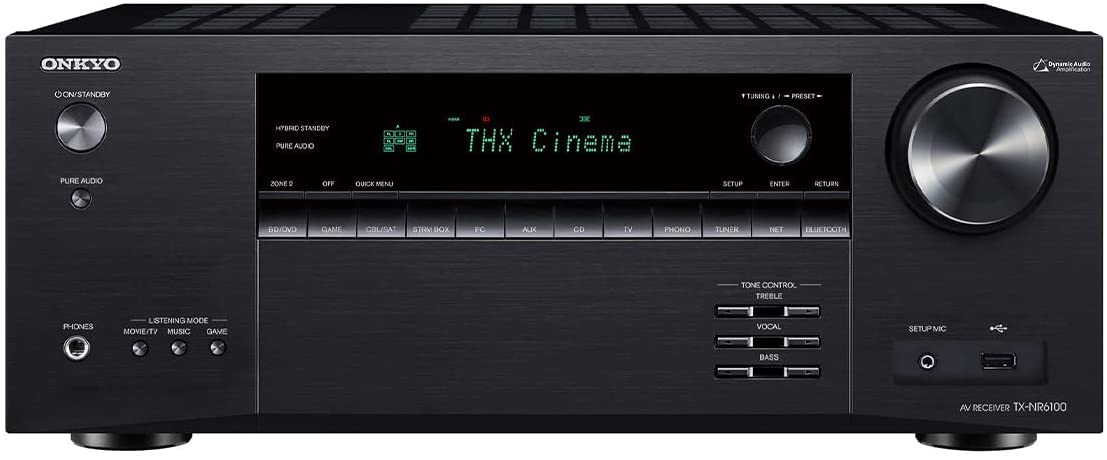
The TX-NR6100 is THX Select certified, meaning it meets strict standards for accurate playback in medium-sized rooms. Its dynamic amplification system rates at 210 watts per channel, and the receiver handles 5.2.2-channel Dolby Atmos and DTS:X. With three HDMI 2.1 inputs capable of 40 Gbps, it supports 8K/60Hz and 4K/120Hz for gaming consoles, along with VRR and ALLM.
Owners pairing the TX-NR6100 with Klipsch or Polk systems consistently praise its headroom and clarity, with several noting it runs cooler than their previous Denon or Yamaha units. The eight HDMI inputs (including one front) and discrete Zone 2 audio and video switching provide excellent flexibility. The automatic speaker tuning via AccuEQ offers decent results for a basic calibration.
Reliability concerns surface in longer-term reviews, with some units developing audible fan noise or HDMI 2.1 processor issues after a year or two. The remote is not backlit, and the lack of Dirac Live support means room correction is less advanced than the TX-RZ50. For buyers who want THX certification and ample connectivity at a mid-range price, the TX-NR6100 is a strong contender, but careful consideration of long-term durability is warranted.
Why it’s great
- THX Select certification for accurate playback
- High dynamic power with 210W/Ch rating
- Eight HDMI inputs with front accessibility
Good to know
- Long-term reliability concerns reported
- No Dirac Live room correction
- Remote is not backlit
9. Denon AVR-S770H 7.2 Ch Home Theater Receiver (75W X 7)

The AVR-S770H is Denon’s most affordable 8K-ready receiver, delivering 75 watts per channel across seven channels. It supports Dolby TrueHD, DTS Neural:X, and Dolby Height Virtualization for creating overhead effects without physical height speakers. The guided setup assistant makes it one of the easiest receivers to configure for first-time home cinema builders.
HDMI 2.1 ports support 8K/60Hz and 4K/120Hz passthrough with HDR10+, Dolby Vision, and Dynamic HDR. The HEOS platform enables multi-room music streaming, and the unit is compatible with Alexa for hands-free control. Users report excellent sound quality that often exceeds expectations, with several mentioning they have owned more expensive Marantz or Onkyo units that did not sound as engaging. The Audyssey MultEQ calibration provides a solid baseline for most rooms.
Some users have encountered severe firmware issues, including random volume drops and picture loss on startup that required multiple updates to mitigate. The remote layout takes time to learn, and the Zone 2 functionality is limited compared to higher-end Denon models. For those seeking an entry point into 8K home cinema with minimal setup friction, the S770H offers compelling value.
Why it’s great
- Guided setup makes configuration beginner-friendly
- Dolby Height Virtualization for Atmos without ceiling speakers
- Full HDMI 2.1 support at an accessible price
Good to know
- Firmware stability varies between units
- Remote has a learning curve
- Limited Zone 2 functionality
10. YAMAHA RX-V6A 7.2-Channel AV Receiver with MusicCast

The RX-V6A is a 7.2-channel receiver that anchors the Yamaha MusicCast ecosystem, allowing multi-room audio distribution to compatible speakers and devices. It outputs 100 watts per channel and supports Dolby Atmos with Height Virtualization, DTS:X, and YPAO R.S.C. multipoint calibration. Three of its seven HDMI inputs support 8K/60Hz and 4K/120Hz at 40 Gbps, with eARC for simplified TV connectivity.
Streaming covers AirPlay 2, Spotify Connect, TIDAL, Deezer, Qobuz, and Amazon Music HD, all controllable through the MusicCast app. Users consistently praise the sound quality, noting clear dialogue and dynamic action scenes that rival more expensive receivers. The unit is also capable of driving 4-ohm speakers, making it a flexible partner for a range of speaker brands.
Some users report that the receiver does not auto-power on with TV eARC, requiring manual power-on each time. The eARC setup process can be complex, and the app, while functional, is not as polished as HEOS or Sony’s offerings. For buyers invested in the Yamaha ecosystem or those who need reliable multi-room streaming, the RX-V6A is a well-rounded choice.
Why it’s great
- MusicCast enables seamless multi-room audio
- Drives 4-ohm speakers without issues
- Clear dialogue and dynamic soundstage
Good to know
- Does not auto-power on with eARC from TV
- eARC setup can be complex
- MusicCast app lags behind competitors
11. Pioneer VSX-935 7.2 Channel Surround Sound Network Receiver
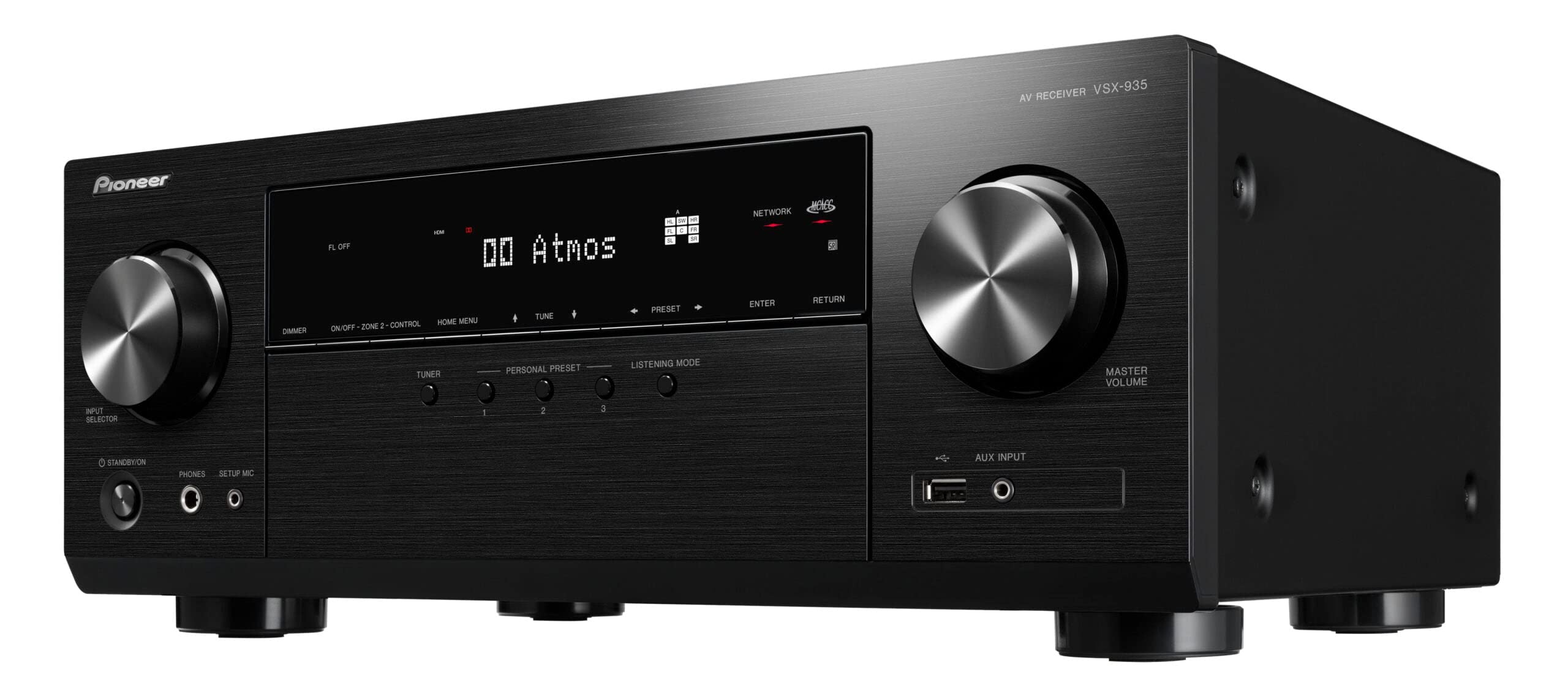
The VSX-935 is Pioneer’s gateway into Dolby Atmos, offering 7.2 channels of amplification with HDMI 2.1 support for 8K/60Hz and 4K/120Hz passthrough. Dolby Atmos Height Virtualization creates overhead effects from traditional speaker layouts, making it possible to experience immersive audio without installing ceiling speakers. The unit also includes dual-zone output and Bluetooth streaming.
Users report excellent sound quality for the price, describing it as crisp, clear, and loud, with good movie sound effects. The RF remote provides reliable control from a distance, and the clear display includes a dimmer for dark rooms. Setup is straightforward for basic configurations, though manual adjustments are recommended for optimal sound tuning.
Reliability is a concern, with multiple users reporting units arriving dead on arrival or developing display failures. The Bluetooth implementation is described as unreliable, with difficult pairing and no dedicated button. The on-screen interface feels dated, and the firmware needs improvement. For budget-conscious buyers who prioritize basic Atmos playback and HDMI 2.1 connectivity, the VSX-935 is a functional entry point, but it carries notable quality-control risk.
Why it’s great
- Dolby Atmos Height Virtualization for overhead effects
- HDMI 2.1 with 8K and 4K/120 passthrough
- RF remote with clear, dimmable display
Good to know
- Quality control issues with DOA units
- Bluetooth function is unreliable
- On-screen interface is dated
FAQ
Do I need a 9.2-channel receiver for a 5.1.4 Dolby Atmos setup?
What is the difference between Dolby Atmos Height Virtualization and physical height speakers?
Can I use a AV Receiver for Home Cinema with a 2.1 stereo system?
Final Thoughts: The Verdict
For most users, the av receiver for home cinema winner is the Onkyo TX-RZ50 because it includes Dirac Live room correction out of the box, offers 9.2 channels for 5.1.4 setups, and provides robust HDMI 2.1 connectivity at a reasonable price. If you want the precision of Surround:AI processing and premium build quality, grab the Yamaha RX-A4A. And for immersive spatial audio with Sony’s 360 Spatial Sound Mapping, nothing beats the Sony STR-AZ1000ES.