
Our readers keep the lights on and the weekend projects moving. As an Amazon Associate, I earn from qualifying purchases.
That first oscilloscope purchase feels like a gamble. You are staring at bandwidth numbers, sampling rates, and channel counts, trying to decode which spec actually matters for learning how circuits behave. Pick wrong, and you end up with a device that misses glitches, aliases your signals, or sits unused because the menus are too frustrating to navigate.
I’m Rikta — the co-founder and writer behind FitlyFast. I spent over 60 hours combing through real user benchmarks, teardown photos, and side-by-side waveform captures to find which beginner scopes actually deliver clean traces and reliable measurements at a fair price.
This guide cuts through the noise to give you a clear, feature-matched recommendation for the best beginner oscilloscope that fits your project needs and budget reality.
How To Choose The Best Beginner Oscilloscope
Selecting your first oscilloscope means balancing raw specs against ease of use and portability. Beginners often over-prioritize bandwidth while ignoring sampling rate, or buy a handheld unit when a benchtop model would serve them better. Below are the main decision points to lock in before you click add to cart.
Bandwidth
Bandwidth determines the highest frequency sine wave the scope can accurately measure before the signal amplitude drops by 30 percent. As a rule of thumb, you need bandwidth at least five times the highest frequency you plan to measure. A 50 MHz scope covers most audio, power supply, and microcontroller work. Go for 100 MHz or more if you plan to look at fast digital edges or RF signals.
Sampling Rate
Sampling rate is how many points per second the scope captures. A rate of at least 2.5 times the bandwidth (Nyquist) is the absolute floor, but 5x to 10x is better for reconstructing pulses and transients. Look for 250 MSa/s on a 50 MHz scope or 1 GSa/s on a 100 MHz model. Low sampling rates cause aliasing, where high-frequency content appears as false low-frequency signals on screen.
Memory Depth
Memory depth (record length) governs how long you can capture a signal at full sampling rate. Shallow memory, around 1 kpts to 8 kpts, forces the scope to reduce the sample rate as you increase the timebase. Deeper memory, 24 Mpts or more, lets you zoom into a long recording without losing detail—vital for debugging serial protocols like I2C or SPI.
Form Factor
Handheld scopes with built-in multimeters are ideal for field work, automotive diagnostics, and bench setups where space is tight. Benchtop oscilloscopes offer larger screens, deeper memory, dedicated knobs per channel, and higher overall performance. If you are learning at a desk, a benchtop unit gives you a better interface for less money.
Extra Tools
A built-in signal generator, sometimes called a DDS function generator, saves cost and bench space by letting you inject test signals without a separate device. Some scope models also include serial decode for UART, I2C, and SPI, which is a huge help when learning embedded systems.
Quick Comparison
On smaller screens, swipe sideways to see the full table.
| Model | Category | Best For | Key Spec | Amazon |
|---|---|---|---|---|
| Rigol DS1054Z | Benchtop | All-round learning & serial decode | 24 Mpts memory depth | Amazon |
| Siglent SDS1052DL+ | Benchtop | College labs & basic bench work | 50 MHz bandwidth | Amazon |
| Hantek DSO2D15 | Benchtop | High bandwidth with built-in generator | 150 MHz bandwidth | Amazon |
| FNIRSI 1014D | Benchtop | 100 MHz budget bench scope | 1 GSa/s sampling rate | Amazon |
| PicoScope 2204A | USB PC | Ultra-portable debugging | 10 MHz bandwidth | Amazon |
| OWON HDS272S | Handheld | Automotive & field diagnostics | 70 MHz bandwidth | Amazon |
| HANMATEK HO52 | Handheld | Portable 2-in-1 for service work | 50 MHz bandwidth | Amazon |
| Hantek 1008B | USB PC | 8-channel automotive diagnostics | 8 channels | Amazon |
| FNIRSI 2C53T | Handheld | Budget 3-in-1 scopemeter | 50 MHz bandwidth | Amazon |
In‑Depth Reviews
1. Rigol Digital Oscilloscope DS1054Z
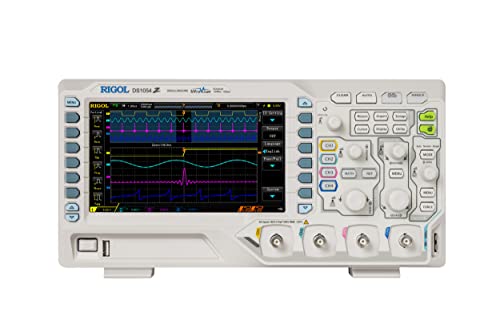
The Rigol DS1054Z is the scope that hobbyists and educators consistently recommend as the gold standard for learning. It packs four analog channels, 50 MHz bandwidth, and a 1 GSa/s sampling rate into a compact benchtop chassis with a crisp 7-inch display. The 24 Mpts of memory depth is a standout feature at this tier, allowing you to capture long serial protocol frames and then zoom into individual bit transitions without losing sample rate.
The UltraVision engine delivers a 30,000 wfms/s update rate, which makes intermittent glitches visible on the intensity-graded display. Real user reports confirm the well-known software hack permanently unlocks 100 MHz bandwidth, advanced triggers, and serial decode for I2C, SPI, and UART out of the box. The physical controls use rotary encoders that feel slightly mushy, but the layout is logical and mirrors professional scopes.
In the lab, this scope handles everything from audio amplifier frequency response to Arduino logic analysis. The 60,000-frame waveform recording and playback feature is a hidden gem for capturing rare events overnight. The included passive probes are adequate, though many users swap them for higher-quality units later. For a beginner who wants room to grow without immediately needing an upgrade, the DS1054Z is the anchor pick.
Why it’s great
- 4 channels with deep 24 Mpts memory
- Unlockable bandwidth and serial decode via software hack
- 30,000 wfms/s update rate catches glitches
Good to know
- Rotary encoders feel slightly mushy
- Included probes are entry-level
- Cooling fan is audible in a quiet room
2. Siglent Technologies SDS1052DL+
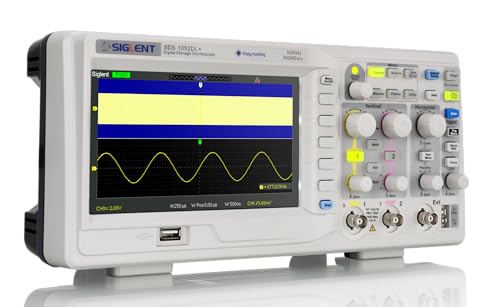
The Siglent SDS1052DL+ is a no-nonsense 50 MHz, two-channel benchtop oscilloscope that focuses on core functionality without gimmicks. Its 7-inch display offers a higher resolution than many budget scopes, making the waveform grid and measurement readouts easy to read from across the bench. The built-in frequency counter and automatic measurement suite cover voltage, time, and frequency parameters without needing to count divisions manually.
Experienced users who migrated from Tek/Agilent labs note the intuitive control layout — dedicated vertical, horizontal, and trigger sections mirror professional workflows. The inclusion of USB and LAN interfaces on this model is a step up from earlier revisions, allowing direct screenshot saves and remote operation. The FFT function is usable for basic harmonic analysis, though the resolution is limited compared to deeper-memory scopes.
Customer feedback spanning eight months of daily use highlights the prompt customer service response when a probe needed replacement. The scope is light enough to move between home and school labs. The main trade-off is the relatively modest memory depth, which limits how much you can zoom into long captures. For straight-ahead analog and digital debugging on a tight budget, this Siglent stays a reliable workhorse.
Why it’s great
- Clean control layout mimics pro scopes
- USB and LAN connectivity for data export
- Responsive customer support from Siglent
Good to know
- Memory depth is shallow for long captures
- FFT resolution is basic
- Two channels only
3. Hantek DSO2D15 Digital Storage Lab Oscilloscope

The Hantek DSO2D15 brings 150 MHz bandwidth and a 1 GSa/s sampling rate to the beginner market at a price that undercuts most mid-range scopes. The two-channel benchtop unit includes a dedicated one-channel waveform generator capable of arbitrary waveform output up to 25 MHz, which is a powerful combo for injecting test signals and observing the response on the same screen. The 8 Mpts memory depth is generous for the class.
Real users confirm the internal signal generator produces rock-stable sine, square, and arbitrary waves with adjustable frequency, amplitude, and offset. The scope also supports five serial protocol triggers and decodes (I2C, SPI, UART, CAN, LIN) out of the box, which normally requires paid options on larger brands. The build quality feels solid, and the probe calibration square wave output is tuned for the included 10:1 probe.
Some users reported a learning curve with the menu system, and the Auto Set function can be unreliable above 5 MHz, requiring manual adjustment to lock onto signals. Firmware updates released after launch fixed initial instability issues on certain firmware versions. The included manual is sparse, but online community forums fill the gaps. For anyone needing 150 MHz headroom without a premium price tag, this Hantek delivers.
Why it’s great
- 150 MHz bandwidth beats most beginner scopes
- Built-in 25 MHz arbitrary waveform generator
- Serial decode included at no extra cost
Good to know
- Auto Set is unreliable above 5 MHz
- Manual is sparse
- Initial firmware had instability issues
4. FNIRSI 1014D Oscilloscope 2 in 1
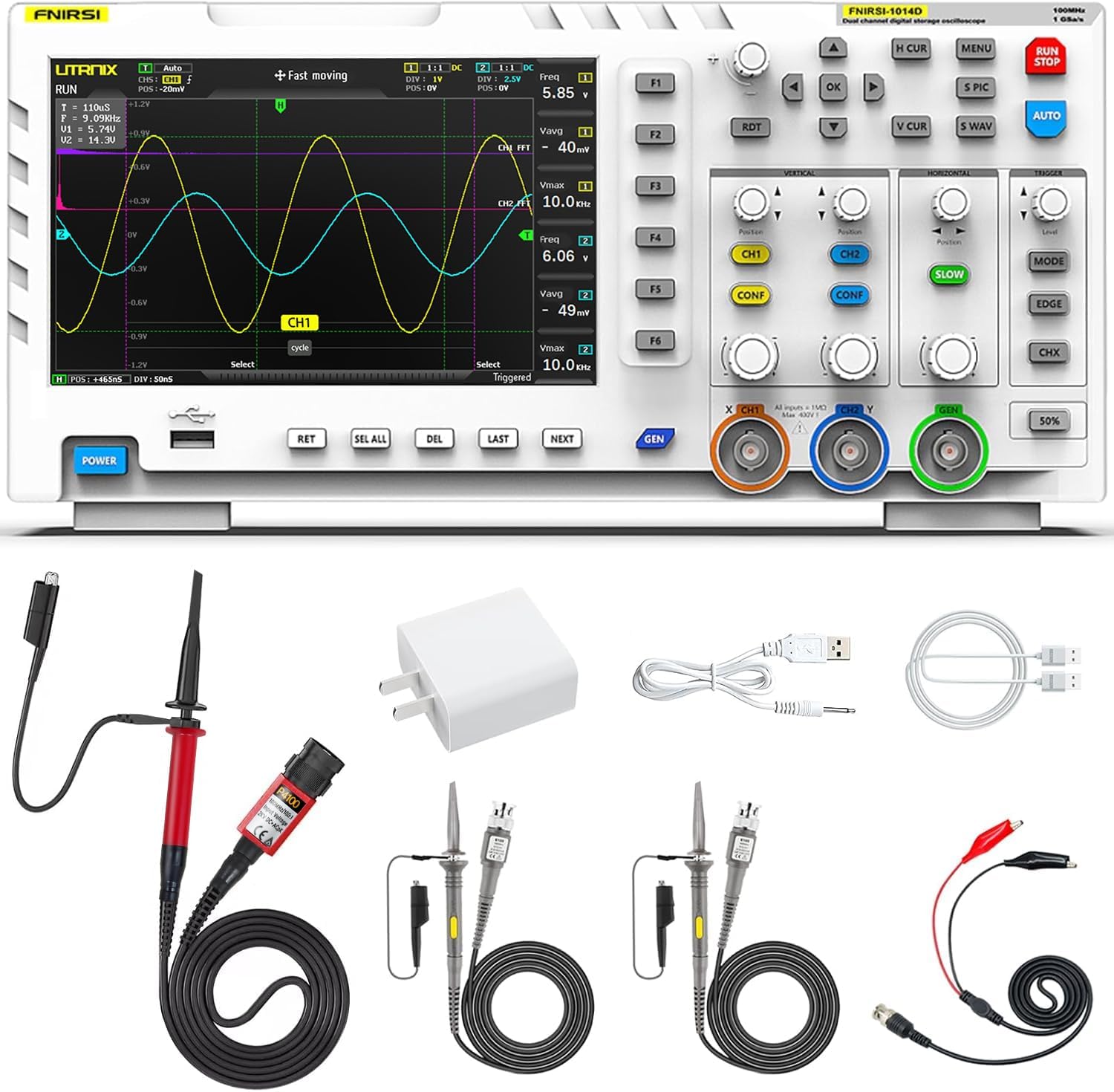
The FNIRSI 1014D is a two-channel benchtop oscilloscope that pairs 100 MHz bandwidth with a real-time sampling rate of 1 GSa/s, putting it ahead of many 50 MHz entry-level models. The 7-inch 800×480 LCD screen provides a clear view of waveforms, and the inclusion of a DDS signal generator with 14 function waveforms and a customizable arbitrary mode adds significant value. The scope also supports XY mode for Lissajous patterns and FFT for frequency-domain inspection.
User feedback highlights the intuitive, menu-driven interface that requires minimal setup to get a stable trace. The one-button AUTO function works reliably for most periodic signals, quickly scaling the vertical and horizontal settings. The 100X high-voltage probe included in the box is a rare addition at this price, enabling safe measurement of higher-voltage circuits like switching power supplies.
A known caveat is that the included USB power supply introduces noticeable noise into the measurements; switching to a clean iPad-style charger resolves the issue. Voltage readout accuracy tends to run 5 to 10 percent high, and signals above 30 MHz see increasing amplitude error. Reports of defective units out of the box appear in the review stream, suggesting quality control is inconsistent. Still, for pure feature density at this price, the 1014D is hard to beat.
Why it’s great
- 100 MHz bandwidth with 1 GSa/s sampling
- Built-in DDS signal generator with arbitrary mode
- Includes a 100X high-voltage probe
Good to know
- Included USB charger introduces noise
- Voltage readout runs 5-10% high
- Quality control appears inconsistent
5. Pico Technology PicoScope 2204A

The PicoScope 2204A takes a different approach — it is a USB-powered PC oscilloscope that uses your computer screen as the display and runs the powerful PicoScope 7 software. The hardware offers 10 MHz bandwidth and 100 MS/s sampling rate across two channels, plus a built-in arbitrary waveform generator. The ultra-compact enclosure weighs only 5 ounces and fits inside a laptop bag pocket, making it the most portable option on this list.
The software suite is the main draw here. PicoScope 7 includes advanced math channels, mask limit testing, spectrum analysis, and decode for over 30 serial protocols as standard features — no paid unlock needed. The software runs on Windows, Linux, and Mac, which is rare for USB scopes. Enthusiasts confirm the probes and cables included are of good quality, and the unit can be powered entirely through the USB cable.
The key limitation is the 10 MHz bandwidth, which is fine for audio, sensor, and slow digital work but not adequate for high-speed microcontroller edges or RF. The 8 kS capture memory also restricts how long you can sample at full rate. Some users experienced initial software glitches on beta Linux builds, though these resolved with updates. For a beginner who already owns a laptop and values portability above raw bandwidth, this Pico is a clean entry point.
Why it’s great
- Extremely portable USB-powered design
- Feature-rich PicoScope 7 software with 30 protocol decodes
- Works on Windows, Linux, and Mac
Good to know
- 10 MHz bandwidth limited to low-speed signals
- 8 kS capture memory is shallow
- Requires a computer to function
6. OWON HDS272S Handheld Oscilloscope

The OWON HDS272S combines a 70 MHz two-channel oscilloscope, a 20,000-count True RMS multimeter, and a built-in waveform generator into a single handheld instrument. The 3.5-inch color display is bright enough for indoor bench use, though direct sunlight washout is a known limitation. The oscilloscope delivers a 250 MSa/s sampling rate and an 8 kpts record length, adequate for most automotive and embedded field tasks.
Field technicians praise the swappable 18650 battery design, letting you carry a spare cell for all-day diagnostics without hunting for a power outlet. The multimeter section is accurate when compared against calibrated Fluke meters, and the fused ammeter input adds a safety layer that cheaper meters omit. The built-in signal generator outputs sine waves up to 25 MHz and supports square, ramp, and arbitrary waveforms for circuit stimulation.
A critical shared-ground issue exists between the scope input and the USB port, meaning you cannot simultaneously charge the unit and measure a live circuit without risk of ground loops or damage. The auto-set function takes one to two seconds to lock onto a signal, which is slow for fast-moving diagnostics. Despite these quirks, the HDS272S remains a strong contender for automotive, HVAC, and field service work where a benchtop unit is impractical.
Why it’s great
- Swappable 18650 battery for all-day field use
- Accurate True RMS multimeter with fused ammeter
- Built-in 25 MHz signal generator
Good to know
- Shared ground between scope and USB port is a safety risk
- Auto-set is slow at 1-2 seconds
- Display is hard to read in direct sunlight
7. HANMATEK Handheld Digital Oscilloscope HO52

The HANMATEK HO52 is a handheld 2-in-1 oscilloscope and multimeter that targets service technicians and hobbyists who need a portable solution without sacrificing measurement quality. The oscilloscope side offers 50 MHz bandwidth with a 250 MSa/s real-time sampling rate and an 8 kpts record length. The 3.5-inch TFT backlit screen shows waveforms with an illuminated grid that remains legible under workshop lighting.
The multimeter section handles standard voltage, current, resistance, capacitance, diode, and continuity checks with a 4.5-digit true RMS readout. The isolated ground design is a standout safety feature, allowing you to float the scope input for mains-referenced measurements without blowing a fuse or damaging the device. The USB Type-C interface supports both charging and PC data transfer, and the scope can run off a standard power bank for extended use.
Users note a moderate learning curve because the control interface does not mirror analog scope conventions — expect to spend time with the manual to memorize button sequences for common tasks. The capacitor measurement mode has a known bug where it displays microfarad values as millifarads on screen, though the underlying reading is correct. Battery life sits around five hours of mixed use, and the included probes are decent for the price tier. For portable, floating measurements, the HO52 holds its own.
Why it’s great
- Isolated ground design for safe floating measurements
- Runs off standard power banks via USB Type-C
- Accurate 4.5-digit true RMS multimeter
Good to know
- Non-traditional control layout has a learning curve
- Capacitance display shows mF instead of µF
- No channel math or advanced math functions
8. Hantek 1008B 8 Channels Automotive Diagnostic Oscilloscope

The Hantek 1008B is a specialized USB PC oscilloscope designed primarily for automotive diagnostics, with eight input channels that allow simultaneous monitoring of multiple sensors, injectors, and ignition signals. The included PC software supports over 80 automotive diagnostic functions, including ignition analysis, sensor waveform checks, and CAN bus decoding. The video help feature provides on-screen guidance for common diagnostic procedures.
The unit also functions as an 8-channel programmable waveform generator, making it useful for simulating camshaft and crankshaft signals during component testing. Data recording supports long-duration captures, and the diagnostic software can generate printed reports or screenshots with a single keystroke. The hardware connects via USB to a Windows PC, and the software runs on Windows 7 through 10.
The main drawback surfaced in customer reviews: the sampling speed and memory buffer are limited, and users report needing at least three signal cycles to produce usable waveforms. Some owners recommend third-party software like Hscope to work around the memory limitations. The 8-channel count is excellent for system-level automotive work, but the per-channel performance is lower than a dedicated 2-channel scope. For a beginner focused on car electronics, this fills a niche that standard scopes miss.
Why it’s great
- 8 channels allow multi-sensor simultaneous capture
- Built-in automotive diagnostic functions and video help
- Can generate diagnostic reports with screenshots
Good to know
- Limited memory buffer requires multiple signal cycles
- Per-channel sampling rate is lower than dedicated scopes
- Windows-only software
9. FNIRSI 2C53T Upgraded Handheld Oscilloscope
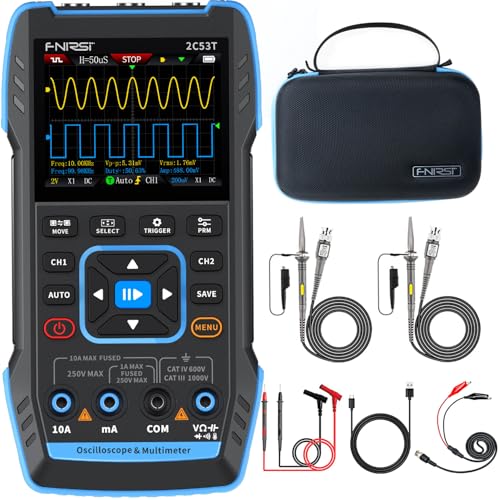
The FNIRSI 2C53T is a budget-friendly 3-in-1 handheld device that combines a 50 MHz two-channel oscilloscope, a 4.5-digit 19999-count multimeter, and a DDS signal generator in a compact form factor. The FPGA+MCU+ADC hardware architecture keeps the unit responsive, and the 2.8-inch LCD display is bright enough for indoor use. The 250 MSa/s sampling rate and 1 kpts record length are basic but sufficient for audio, power supply ripple, and low-speed digital signals.
The multimeter section measures AC/DC voltage up to 1000 V, current up to 10 A, resistance, capacitance, and continuity. The signal generator outputs 13 waveform types up to 50 kHz with 1 Hz step resolution — adequate for stimulating audio amplifiers and filter circuits. The built-in 3000 mAh battery provides up to six hours of standby time, and the Type-C interface supports data transfer and charging from standard 5V adapters.
The primary limitation is the shallow 1 kpts memory depth, which prevents you from zooming in on long-duration captures. The UI defaults to Chinese on first boot, requiring a trip into system settings to switch to English. The manual has an English section but the translation is rough. The included probes (10X scope probe, crocodile clip, multimeter probes) are functional but feel inexpensive. For the absolute lowest entry cost into a functional scopemeter, the 2C53T offers a full toolkit in one package.
Why it’s great
- 3-in-1 design saves bench space and cost
- 3000 mAh battery lasts through extended sessions
- Includes full probe set in a storage case
Good to know
- 1 kpts memory depth is very shallow
- UI defaults to Chinese and manual translation is rough
- Build quality reflects the entry-level price
FAQ
How much bandwidth do I actually need as a beginner?
Should I buy a handheld oscilloscope or a benchtop model?
What does the sampling rate specification mean for single-shot capture?
Final Thoughts: The Verdict
For most users, the best beginner oscilloscope winner is the Rigol DS1054Z because it balances four channels, deep 24 Mpts memory, and unlockable bandwidth and serial decode in a proven educational platform. If you want a portable field tool with a swappable battery and a built-in signal generator, grab the OWON HDS272S. And for a compact USB-powered scope that turns your laptop into a powerful analysis station, nothing beats the PicoScope 2204A.