
Our readers keep the lights on and the weekend projects moving. As an Amazon Associate, I earn from qualifying purchases.
That buffering wheel in the back bedroom or the dropped zoom call in the home office isn’t your internet plan’s fault—it’s the signal fading before it reaches you. A WiFi signal booster acts as a smart relay, catching that weak signal from your router and rebroadcasting it at full strength, killing dead zones without needing to run new cables.
I’m Rikta — the co-founder and writer behind FitlyFast. I spend hundreds of hours cross-referencing wireless specifications, analyzing real customer throughput data, and comparing mesh vs. extender architectures so you get hardware that actually performs in your specific layout.
This guide cuts through the noise to help you find the best wifi signal booster for your home, whether you need outdoor coverage for security cameras, affordable whole-home mesh, or lightning-fast WiFi 7 for a packed device household.
How To Choose The Best WiFi Signal Booster
Choosing between a simple extender and a full mesh system comes down to your home’s layout, the number of devices, and whether you want a single network name or don’t mind switching manually. Understanding a few key specifications will make the decision straightforward.
Mesh vs. Extender: The Core Decision
A traditional extender creates a separate WiFi network that you may need to switch to manually, and it typically halves your bandwidth by nature of its operation. A mesh system, like the TP-Link Deco series, uses multiple nodes that talk to each other over a dedicated backhaul frequency, creating a single seamless network that your device roams between without dropping connection. For homes over 2,000 square feet or spaces with multiple floors, mesh is almost always the better long-term investment.
WiFi Generation and Device Load
WiFi 6 (AX) brings significant improvements in handling multiple devices simultaneously—it uses OFDMA and MU-MIMO to service up to four times more devices per channel than WiFi 5. WiFi 7 (BE) takes this further with 320 MHz channels and Multi-Link Operation (MLO), but it remains premium-priced. If you have a smart home with 30+ connected gadgets, prioritize a WiFi 6 mesh even if your phone is older—the router’s ability to juggle traffic is what stops the buffering.
Coverage Claims vs. Real World Walls
Manufacturers often quote coverage figures in “open air” conditions with no obstructions. Every wall—especially brick, concrete, or those with metal studs/lath—drops signal by 10-30%. A system rated for 5,000 sq. ft is realistically ideal for a 2,500 sq. ft home with standard drywall construction. For outdoor coverage or outbuildings, look for units with external antennas and higher gain (dBi) ratings, like the WAVLINK outdoor mesh extender.
Quick Comparison
On smaller screens, swipe sideways to see the full table.
| Model | Category | Best For | Key Spec | Amazon |
|---|---|---|---|---|
| TP-Link Deco X50 AX3000 | Premium Mesh | Ultra-fast, expandable PoE mesh | 2x 2.5G ports per node | Amazon |
| NETGEAR Orbi 770 (RBE773) | Flagship Mesh | Largest home coverage, tri-band WiFi 7 | 11 Gbps aggregate speed | Amazon |
| NETGEAR Orbi 370 (RBE373) | Mid-Range Mesh | Entry-level WiFi 7 mesh | 2.5G WAN + LAN ports | Amazon |
| TP-Link Deco X15 AX1500 | Value Mesh | Affordable whole-home WiFi 6 | 5,600 sq. ft., 120 devices | Amazon |
| Amazon eero 6 | Value Mesh | Alexa/ Zigbee smart home hub | 4,500 sq. ft. 3-pack | Amazon |
| WAVLINK AC1200 Outdoor | Outdoor Specialty | Outdoor/barn coverage, 300m range | 4x 7dBi omni antennas | Amazon |
| ROQRL AC1200 Extender | Budget Extender | Simple, low-cost dead zone fix | 1,200 Mbps, 10k sq. ft. | Amazon |
In‑Depth Reviews
1. TP-Link Deco X50 AX3000 Mesh (3-Pack)

This is the sweet spot for anyone wanting premium performance without chasing the absolute newest WiFi 7 tax. The Deco X50 delivers AX3000 Wi-Fi 6 speeds—up to 2.4 Gbps on the 5GHz band—over a massive 6,500 sq. ft. area and can handle up to 150 devices. The standout feature is its 2.5 Gigabit Ethernet ports on every node: they break through the 1 Gbps bottleneck that plagues most mesh systems, so if you have multi-gig fiber internet, you’ll actually see those speeds.
The PoE+ (Power over Ethernet) capability is a hidden gem for clean installations. You can mount the nodes on a ceiling or wall where they best capture signal, then run a single Ethernet cable that carries both data and power from a PoE+ switch. This completely eliminates the need for a power outlet near each node. Pairing them with a TP-Link TL-SG1005P switch creates an ultra-stable wired backhaul that eliminates any wireless speed penalty.
Real-world users consistently report excellent coverage across multi-story homes and easy setup through the Deco app. The AI-driven mesh technology optimizes roaming so your phone hops between nodes without dropping a video call. The only recurring note is that upgrading from an older Deco network can fail—a fresh install is the reliable path—and advanced users may miss custom VLAN support.
Why it’s great
- Two 2.5G Ethernet ports per node enable true multi-gig performance
- PoE+ support allows ceiling/wall mounting without nearby outlets
- Covers 6,500 sq. ft. and handles 150 devices smoothly
Good to know
- Lacks advanced VLAN customization for network segmentation
- Upgrade path from older Deco units may require a fresh install
2. NETGEAR Orbi 770 Tri-Band WiFi 7 (RBE773)

If you have a home over 5,000 square feet, more than 80 connected devices, or you’re future-proofing for the next five years, the Orbi 770 is the ceiling. It delivers up to 11 Gbps aggregate speed using tri-band WiFi 7, including a dedicated 6 GHz backhaul that keeps the data highway between nodes wide open. The result is that your farthest satellite can still deliver near-router speeds, not the halved throughput of a standard extender.
The physical hardware matches the ambition. Each unit packs 2.5 Gigabit Ethernet ports, and the tri-band design with enhanced backhaul ensures simultaneous streaming, gaming, and video conferencing across every corner of an 8,000 sq. ft. property. Users with over 100 devices—including multiple gaming consoles, IoT sensors, and 4K security cams—report the system handles the load without breaking a sweat.
Setup is straightforward via the Orbi app, though some users note that satellites can take a few minutes to sync wirelessly. A small frustration is that the satellites only have two Ethernet ports, and there’s no dedicated power switch, so rebooting requires unplugging. But for raw, rule-the-world coverage and WiFi 7 performance, this system is rock-solid and future-proof.
Why it’s great
- Tri-band WiFi 7 with dedicated 6 GHz backhaul for full-speed satellites
- Covers 8,000 sq. ft. and supports 100+ devices
- 2.5G Ethernet ports on all nodes
Good to know
- Satellites limited to two Ethernet ports each
- No hardware power switch—must unplug to restart
3. NETGEAR Orbi 370 Dual-Band WiFi 7 (RBE373)

The Orbi 370 is an accessible entry point into WiFi 7, trading the tri-band design for a more affordable dual-band setup that still hits 5 Gbps aggregate speed. It covers 6,000 sq. ft. and supports up to 70 devices, making it a great fit for medium-to-large homes that don’t have a massive device army. The 2.5 Gigabit ports on the router and each satellite mean wired backhaul or a fast gaming PC are well-served.
Being dual-band, this system uses the 5 GHz band for both client traffic and backhaul, which is efficient for most homes but can see performance drop at longer ranges compared to tri-band systems that have a dedicated backhaul channel. Users report that setup via the Orbi app is simple, and the system provides a massive upgrade over older Google or ISP mesh setups. The improved signal strength and seamless roaming eliminate dead zones without needing to switch networks.
A few owners have experienced satellite dropout issues that required a manual resync, and the satellites only have one Ethernet port each, so wired expansions are limited. However, for a homes wanting to step into WiFi 7 without the full premium, this Orbi delivers solid, consistent coverage and multi-gig wired ports at a much lower investment than the tri-band 770.
Why it’s great
- WiFi 7 speeds up to 5 Gbps at an accessible tier
- 2.5G WAN and LAN ports on every unit
- Strong signal upgrade over WiFi 5/6 mesh systems
Good to know
- Dual-band lacks dedicated backhaul; range performance drops at distance
- Satellite disconnections reported; manual resync may be needed
4. TP-Link Deco X15 AX1500 Mesh (3-Pack)
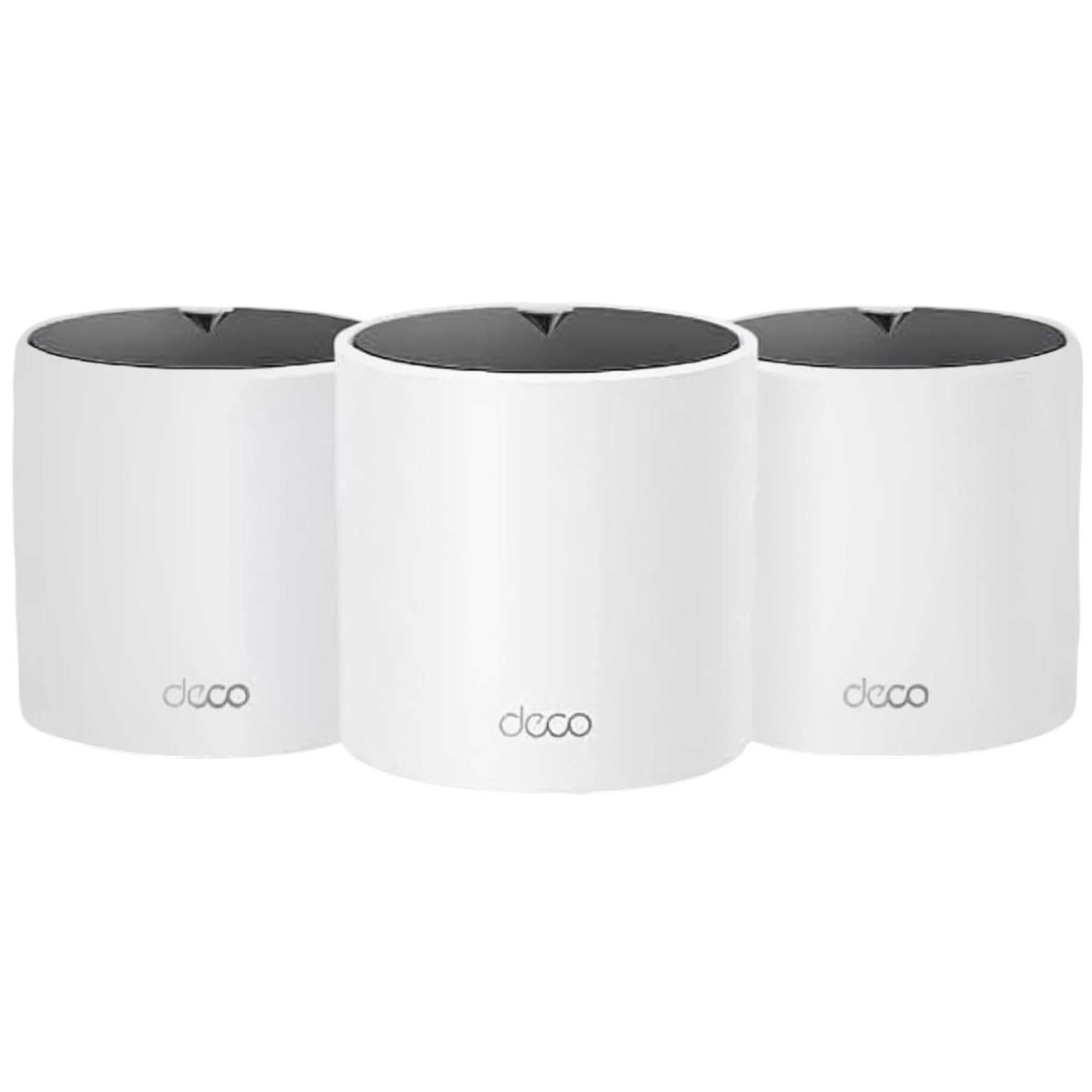
The Deco X15 is the most balanced mesh system for typical family homes. It covers up to 5,600 sq. ft. with 3 nodes, supports up to 120 devices, and runs on WiFi 6 (AX1500) which is more than enough for 4K streaming, remote work, and online schooling. The AI-driven mesh technology learns your network load patterns and optimizes device handoff, so you don’t get that stutter when walking from the living room to the kitchen.
Each node has two Gigabit Ethernet ports, and the system supports wired Ethernet backhaul—meaning if you have coax or Ethernet in the walls, you can hardwire the nodes for even better performance. The Deco app is among the easiest mesh controllers on the market, walking you through setup in minutes and letting you manage guest networks, parental controls, and QoS from anywhere. Voice control with Alexa and Google Assistant adds a convenient hands-free layer.
Users consistently report fast, stable connections across multi-story homes and praise the compact design that fits discreetly on a shelf. A major caveat to check before buying: TP-Link has stopped offering firmware security updates for this specific model. The hardware works great out-of-box and will continue to function, but you won’t receive future security patches, making it a risk for security-conscious users.
Why it’s great
- Excellent 5,600 sq. ft. coverage for medium-large homes
- AI-driven mesh optimizes handoff for seamless roaming
- Simple Deco app with robust parental controls and QoS
Good to know
- No future firmware security updates from TP-Link
- AX1500 speeds are entry-level WiFi 6, not the fastest
5. Amazon eero 6 Mesh (3-Pack)

The eero 6 is the ideal mesh system for households deeply invested in the Amazon ecosystem. It covers up to 4,500 sq. ft. across a router and two extenders, supports WiFi 6 speeds up to 500 Mbps, and handles up to 75+ devices. The standout integration is the built-in Zigbee smart home hub, which lets you connect and control compatible smart bulbs, locks, and sensors directly through the eero without needing a separate hub.
Setup is effortless through the eero app—users consistently describe it as “plug and play.” The mesh technology creates a single unified network, so your device roams between nodes without dropping. The system automatically downloads security updates to stay protected. For homes with Comcast or Spectrum plans under 500 Mbps, this system maximizes your existing bandwidth without any configuration headaches.
Users upgrading from rented ISP routers report a huge increase in range and stability, especially in homes around 3,000-4,000 sq. ft. The one Ethernet port on the extender nodes is limiting, and video call reliability can occasionally stutter under heavy load, but for an affordable, dead-simple mesh with smart home perks, the eero 6 is a strong contender.
Why it’s great
- Built-in Zigbee hub eliminates a separate smart home bridge
- Incredibly easy setup and automatic security updates
- Seamless mesh roaming with no network switching
Good to know
- Extender nodes have only one Ethernet port
- Speeds capped at 500 Mbps—not for multi-gig internet plans
6. WAVLINK AC1200 Outdoor Mesh Extender

If your dead zones are outside—in the backyard, in a garage, or across a farm—this is the booster you need. The WAVLINK Wing 12HP is an IP65-rated outdoor unit with 4x 7dBi omnidirectional antennas that can push signal up to 300 meters per unit (line-of-sight). It’s purpose-built to blanket outdoor areas, running security cameras, smart irrigation, or providing WiFi to outbuildings like barns and stables.
The unit runs on passive/active PoE (Power over Ethernet), so you run a single Ethernet cable from an indoor PoE switch to power it, avoiding risky outdoor electrical wiring. It supports Fat AP mode for standalone operation and Fit AP mode for centralized management when using multiple WAVLINK units. The dual-band speeds (867 Mbps on 5 GHz + 300 Mbps on 2.4 GHz) are modest by indoor standards, but the rugged build and high-gain antennas make it exceptional for tough environments.
Users with large properties and solar-powered cameras report it successfully spans over 10 acres. Setup requires a bit of networking knowledge—accessing the 192.168.10.1 admin page and configuring settings—and the interface module is vulnerable to moisture if the RJ45 seal isn’t sealed tightly. However, for creating a reliable outdoor long-range WiFi link, this unit delivers performance that no indoor mesh can match.
Why it’s great
- IP65 weatherproof with 4x 7dBi antennas for 300m+ range
- PoE-powered eliminates need for outdoor outlets
- Fat/Fit AP modes for standalone or centralized management
Good to know
- Setup requires accessing admin interface; not plug-and-play
- RJ45 seal must be sealed tightly to prevent moisture damage
7. ROQRL AC1200 WiFi Extender

For under thirty dollars, the ROQRL AC1200 extender solves basic dead zone problems without any commitment. It delivers up to 1200 Mbps dual-band speed (300 Mbps on 2.4 GHz + 867 Mbps on 5.8 GHz) and claims coverage up to 10,000 sq. ft. with its four high-performance antennas. In practice, expect to reliably cover a single floor or a far room that the main router struggles to reach.
Setup is straightforward via the WPS button, though the QR code in the manual leads to a product page rather than a setup guide—a quick YouTube search solves it easily. Once configured, users report turning a one-bar “nothing loads” zone into a full-signal area for phones, laptops, and smart TVs. The inclusion of an Ethernet port means you can also use it as a wired access point or hardwire a gaming console or streaming box for a more stable connection.
This is a classic extender: it creates a separate network (like “ROQRL_EXT” vs. your main network), and it will cut your throughput roughly in half because of the store-and-forward relay method. For a small apartment, a single problem room, or a budget-sensitive need, this is a solid, functional fix. It supports WPA/WPA2 security and is compatible with any standard router.
Why it’s great
- Extremely low cost for solving a single dead zone
- Includes Ethernet port for wired AP mode or console connection
- Easy WPS push-button setup
Good to know
- Creates a separate network SSID—no seamless roaming
- Throughput is cut roughly in half due to extender architecture
FAQ
Will a WiFi booster work with any router?
What is the difference between a WiFi extender and a mesh system?
Does a WiFi booster reduce internet speed?
How far can an outdoor WiFi booster reach?
Final Thoughts: The Verdict
For most users, the best wifi signal booster winner is the TP-Link Deco X50 AX3000 because it delivers premium WiFi 6 mesh performance, 2.5G ports, and flexible PoE ceiling mounting at a price that stops well short of premium WiFi 7 systems. If you want maximum outdoor coverage for a large property or farm, grab the WAVLINK AC1200 Outdoor. And for the biggest home with the most devices and a need for absolute future-proof WiFi 7 performance, nothing beats the NETGEAR Orbi 770 Tri-Band.