
Our readers keep the lights on and the weekend projects moving. As an Amazon Associate, I earn from qualifying purchases.
Whether you’re capturing a podcast, recording a lecture, or documenting a live music performance, the single most frustrating moment is hitting playback and discovering your audio is either clipped into distortion or too quiet to salvage. Every recorder promises clean sound, but the gap between a usable file and a ruined take often comes down to how well the hardware handles dynamic range and noise floor.
I’m Rikta — the co-founder and writer behind FitlyFast. I’ve spent hundreds of hours dissecting the microphone capsule sizes, bit depths, preamp quality, and file format flexibility across dozens of models to build a guide that cuts through the marketing fog.
This guide walks through the pros, cons, and real-world performance of seven serious contenders to help you find the best audio recorder for your specific recording scenario and budget.
How To Choose The Best Audio Recorder
Picking the right recorder means matching its core specifications to where and how you record. A journalist capturing courtroom testimony has different needs than a musician tracking a live duo. Before you browse, understand the three pillars: recording format and bit depth, microphone configuration, and connectivity.
Recording Format and Bit Depth
WAV files at 24-bit or 32-bit float preserve the maximum dynamic range and headroom, making them the standard for professional work. MP3 is fine for dictation but compresses away the subtle details you need for music or critical dialogue. The biggest recent shift is 32-bit float — this format captures such a wide dynamic range that you can record without setting gain at all, then normalize the volume in post without introducing noise or clipping. That alone is worth the upgrade for anyone who records unpredictable sound sources.
Microphone Configuration and Capsule Size
Built-in microphones vary wildly. An X/Y stereo pair (two capsules crossed at 90 degrees) gives you a true stereo image and is common on handheld recorders. Omnidirectional mics capture sound equally from all directions, which helps in conference rooms but picks up more room echo. Larger microphone capsules, such as the 19.4mm elements on the Zoom H4 Essential, capture richer low-end detail and handle higher sound pressure levels without distortion. If you primarily use external microphones, the quality of the recorder’s preamps and the availability of XLR inputs with phantom power matter far more than the built-in mics.
Connectivity and Power Flexibility
XLR inputs with locking connectors give you reliable connections to professional microphones. A USB-C port that doubles as an audio interface lets you record straight into a computer or tablet without extra gear. For power, devices that run on standard AA batteries offer the peace of mind of swapping fresh cells anywhere in the world, while built-in Li-Ion packs require access to a charging cable. Bluetooth control is a convenience feature that lets you start and stop recording remotely from a phone, useful when the recorder is placed far from your listening position.
Quick Comparison
On smaller screens, swipe sideways to see the full table.
| Model | Category | Best For | Key Spec | Amazon |
|---|---|---|---|---|
| Zoom H4 Essential | Handheld Recorder | Multi-track music & pro field recording | 4-track / 192kHz / 32-bit float | Amazon |
| Zoom H1 XLR | Field Recorder | Podcasters needing XLR inputs on a budget | 2 XLR/TRS / 32-bit float / 1TB SD | Amazon |
| TASCAM DR-05XP | Portable Recorder | Versatile field recording & USB-C interface | 32-bit float / 96kHz / USB-C audio interface | Amazon |
| Roland R-07 | Compact Recorder | Discreet high-res recording with Bluetooth | 96kHz/24-bit / aptX playback / Bluetooth | Amazon |
| iFLYTEK Offline Recorder | AI Recorder | Business users needing offline transcription | 6-mic array / 5-language AI transcription | Amazon |
| OM System WS-882 | Voice Recorder | Lectures and interviews with long battery life | Linear PCM / 68-hour battery / USB direct | Amazon |
| EVISTR L357 | Voice Recorder | Budget-friendly lecture capture with large storage | 128GB / 360° mic / voice activation | Amazon |
In‑Depth Reviews
1. Zoom H4 Essential

The Zoom H4 Essential sets a new standard for handheld recorders with its massive 19.4mm X/Y microphone capsule — the largest found on any portable unit. This translates to noticeably richer low-frequency response and higher SPL handling before any distortion creeps in. The 32-bit float recording at up to 192kHz means you can walk into a room, press record, and completely ignore gain staging. Even if a guitarist strums hard right next to a whispered interview, both signals are captured cleanly and can be balanced perfectly in post.
Dedicated gain knobs for each of the two XLR/TRS combo inputs give you tactile control when you want it, while the ability to record four simultaneous tracks opens up real multi-mic scenarios. The interface is straightforward, with a power-saving mode that stretches the AA battery life to around 20 hours of continuous operation. It is slightly too bulky for a pants pocket, but it fits comfortably in a camera bag or jacket.
A few users report handling noise being more noticeable than on older Zoom models, and the onboard mics are susceptible to wind rumble without an external windscreen. The documentation is sparse, so expect to spend time with YouTube tutorials to unlock the deeper menu features. For anyone serious about field recording, music capture, or podcasting with multiple mics, this is the current benchmark in its category.
Why it’s great
- 19.4mm X/Y capsule delivers studio-grade low-end and detail
- 32-bit float recording at 192kHz eliminates gain worries entirely
- Four-track recording with two XLR/TRS inputs for multi-mic setups
Good to know
- Onboard mics prone to handling noise without careful technique
- Bulkier than pocket-sized recorders like the Roland R-07
- Manual is thin; learning curve for advanced features
2. Zoom H1 XLR

Zoom packed two locking XLR/TRS combo inputs and 32-bit float recording into a chassis that weighs only 6.4 ounces, making the H1 XLR one of the most portable pro-grade recorders available. The OLED waveform display gives you real-time visual confirmation that your levels are healthy, though with 32-bit float, you rarely need to look at it. It supports SDXC cards up to 1TB, so even multi-day recording sessions won’t force you to dump files.
As a 2-in/2-out USB-C audio interface, it connects directly to a laptop for podcast recording or live streaming without extra hardware. The build is plastic and feels light, which users praise for travel but note that a drop could be catastrophic. The battery life sits around 10 hours on two AAs, which is adequate but well below the endurance of the competition in this list.
The internal microphones are not the selling point here — the H1 XLR is built for users who already own XLR mics and want a portable recorder that does not compromise on bit depth or input quality. It automatically switches between battery and USB power, a thoughtful detail for studio use. If you need professional XLR connectivity at the lowest possible entry point, this is the clear choice.
Why it’s great
- Two locking XLR/TRS inputs with 32-bit float at a very low price
- OLED waveform display for monitoring levels at a glance
- Functions as a USB-C audio interface for direct computer recording
Good to know
- Plastic build feels less rugged than metal-bodied recorders
- Battery life of 10 hours is shorter than mid-range competitors
- Built-in microphones are basic; best used with external mics
3. TASCAM DR-05XP

The TASCAM DR-05XP brings 32-bit float recording to a form factor that prioritizes simplicity and battery endurance. Running on two AA alkalines, it delivers up to 17.5 hours of continuous operation — enough to cover a full conference day without hunting for a power outlet. The omnidirectional condenser microphones can handle sound pressure levels up to 125dB SPL, so placing it near a loudspeaker or drum kit won’t cause distortion.
Switching between 32-bit float, 24-bit, 16-bit, and MP3 recording gives you flexibility depending on the task. The 2-in/2-out USB-C audio interface works plug-and-play with most computers, making it a capable field recorder that doubles as a desktop mic interface. Users consistently describe the operation as intuitive, with three button presses being enough to start a high-quality recording after the initial setup.
A vocal minority notes that the built-in microphones produce minimal left-right channel separation in stereo mode, effectively sounding mono. This is a limitation if you need true stereo imaging for music or ambient recording. The plastic chassis feels sturdy but not premium. For podcasters, journalists, and students who want 32-bit float safety without the complexity or price of a multi-track recorder, the DR-05XP is a strong mid-range pick.
Why it’s great
- 17.5-hour battery life on two AA batteries outlasts most competitors
- 32-bit float recording plus flexible bit depth and format options
- Simple three-button operation after initial configuration
Good to know
- Built-in mics show weak stereo separation for music recording
- Plastic build lacks the premium feel of metal-bodied alternatives
- Line input is sensitive and may require gain adjustment for some mics
4. Roland R-07

The Roland R-07 is built for discretion and high-resolution capture in a package smaller than most smartphones. It records up to 96kHz/24-bit WAV files and supports Qualcomm aptX Bluetooth for low-latency wireless monitoring and remote control via a smartphone app. The one-touch scene templates let you switch between optimal settings for music, dictation, or meetings instantly, which saves fiddling with menus when you need to capture something fast.
The integrated stereo mics deliver clean, quiet recordings, and the preamps are among the quietest in this class — ideal for nature recording or capturing subtle ambient sound. Battery life reaches 16 hours of continuous recording on two AA cells, with 30 hours of playback. The white-backlit LCD is easy to read even in low light, and the built-in speaker allows quick review without headphones.
The Bluetooth app does not support file management, so renaming or organizing recordings still requires a computer connection. A small number of units have reported line-in failure after months of use, raising a reliability flag for heavy users. The streamlined body also makes it difficult to attach a standard windscreen securely. For travelers, journalists, and field recorders who prioritize pocketability and audio quality above all else, the R-07 remains a refined choice.
Why it’s great
- Ultra-compact design easily fits in any pocket or small bag
- Quiet preamps deliver clean recordings for nature and ambient work
- Bluetooth remote control and aptX wireless monitoring
Good to know
- Line-in reliability concerns reported by some long-term users
- Bluetooth app lacks file management and rename functions
- Round body makes windscreen attachment less secure
5. iFLYTEK Offline Voice Recorder

The iFLYTEK recorder is the only device in this roundup that transcribes speech to text entirely offline, supporting English, Chinese, Japanese, Korean, and Russian. The six-microphone AI array actively cancels crowd noise and echo, making it particularly useful for journalists covering trade shows, business negotiations, or courtroom proceedings. The 2-inch touchscreen interface is intuitive, and the one-tap recording function is genuinely user-friendly for less tech-savvy operators.
The 175-hour battery life on a single charge is extraordinary, and a full recharge via USB-C takes only one hour thanks to the 5V/2A fast-charging support. Smart bookmarks let you tag key moments during a recording for instant recall later, and the device can export transcriptions as PDF, Word, or TXT files. If your workflow requires turning hours of spoken audio into searchable text without relying on cloud services, this recorder is purpose-built for exactly that.
The transcription accuracy is impressive in quiet environments with clear speakers, but it struggles with heavy accents, background noise, or overlapping conversations — scenarios where a phone-based app might actually perform better for free. The device has no headphone jack, which is a puzzling omission for a tool designed for critical listening. The internal storage is limited to 8GB, though you can import external audio files for transcription via USB. It is a niche tool, but for its niche, nothing else in this list comes close.
Why it’s great
- Offline AI transcription in five languages without cloud dependency
- 175-hour battery life supports multi-day field use without charging
- Six-mic array with AI noise cancellation for crowded environments
Good to know
- No headphone jack limits real-time monitoring during recording
- Transcription accuracy drops with accents or background noise
- Internal storage is only 8GB; relies on external file import
6. OM System WS-882

The OM System WS-882 is a no-nonsense voice recorder built for marathon sessions. With 4GB of internal memory plus SD card expansion, it offers 1,040 hours of recording time in MP3 mode at the lowest bit rate, and the 68-hour battery life on two AA batteries means you could leave it running for an entire work week without changing cells. The Linear PCM recording format gives noticeably better fidelity than standard MP3 dictation recorders, making dialogue crisp and intelligible.
USB direct connectivity means the recorder appears as a mass storage device when plugged into a computer — no drivers or software needed. File indexing and the ability to erase selected files directly on the device streamline file management. The form factor is slim and pocketable, with a power-off switch that doubles as a hold function to prevent accidental button presses in a bag. It supports micro SD cards, though users report significantly longer boot times with cards larger than 8GB.
The built-in microphones are adequate for close-range voice capture in quiet rooms, but they lack the dynamic range and stereo imaging needed for music or ambient recording. The USB plug is built into the device body and can feel fragile over time. This is a dedicated tool for lectures, interviews, and professional dictation where battery endurance and ease of file transfer are the top priorities, not soundstage or multi-track capability.
Why it’s great
- Exceptional 68-hour battery life on two AA batteries
- Linear PCM recording delivers high-fidelity voice capture
- USB direct mass storage connectivity for drag-and-drop file transfer
Good to know
- Boot time slows significantly with larger SD cards
- Built-in USB plug is non-replaceable and can wear over time
- Microphones lack the quality for music or ambient recording
7. EVISTR L357
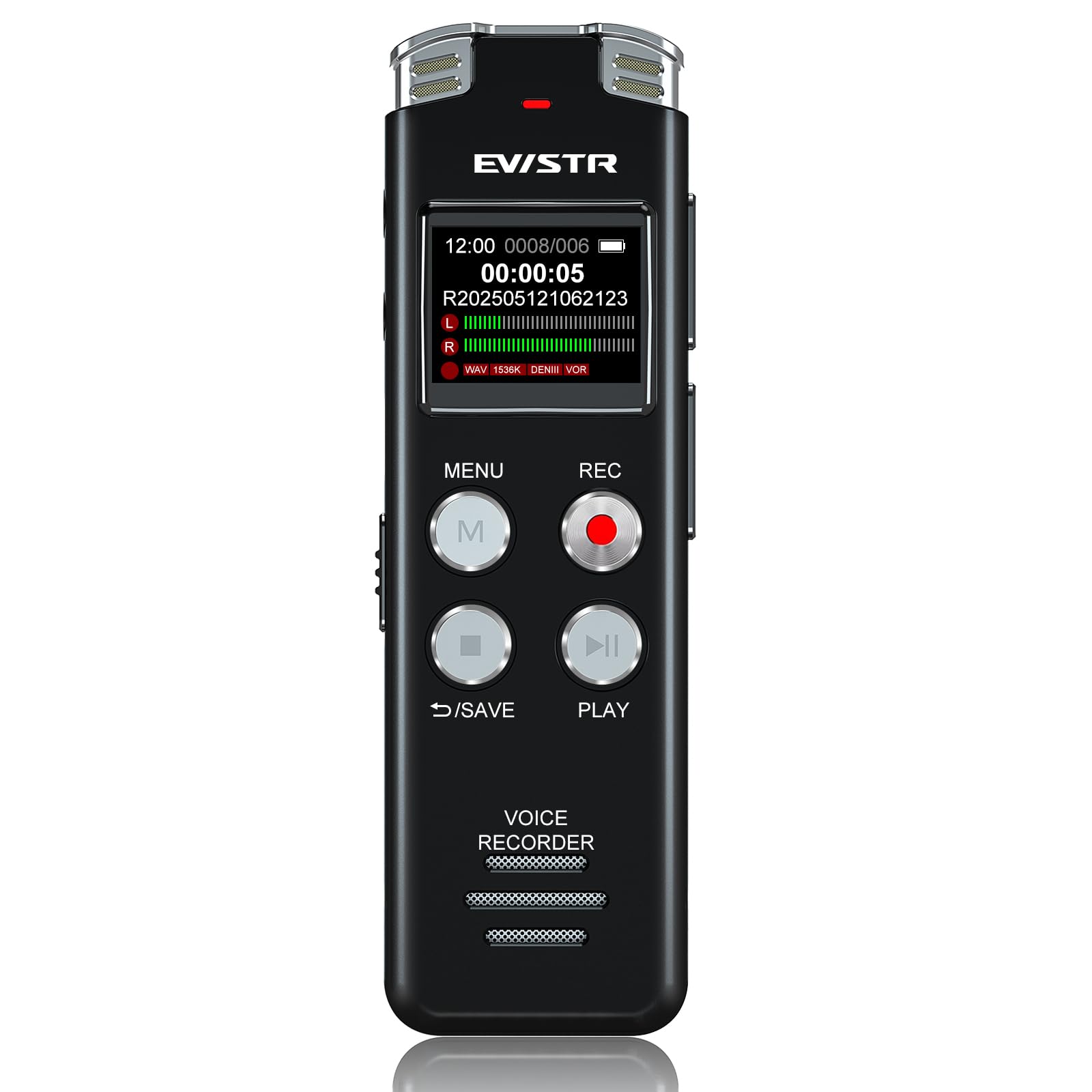
The EVISTR L357 shatters expectations with a metal build and 128GB of internal storage at an entry-level price point. That capacity holds up to 9,320 hours of recording at 32Kbps, making it one of the highest-storage-per-dollar options on the market. The PCM intelligent noise-reduction technology and 360-degree microphone capture, combined with seven adjustable gain levels, give you the ability to pick up faint voices across a room.
Operation is deliberately simple — two buttons handle recording and saving, with A-B repeat and variable-speed playback for review. The voice-activated recording mode with seven sensitivity levels ensures the device only records when sound is present, saving both storage space and playback time. The 500mAh battery charges fully in three hours via USB-C and delivers 32 hours of continuous recording, which is respectable for a unit this compact.
The microphone quality has received mixed feedback — some users find it crystal clear for the price, while others report blown-out audio that makes speech difficult to discern. The small screen and buttons can be challenging to navigate, and the manual is not particularly helpful. For students, journalists, or professionals on a tight budget who prioritize massive storage and reliable voice activation over pristine audio fidelity, the L357 delivers exceptional value.
Why it’s great
- 128GB internal storage holds thousands of hours of recordings
- Metal chassis offers durability beyond its price category
- Voice activation with seven sensitivity levels saves space and battery
Good to know
- Microphone quality is inconsistent; some units have poor clarity
- Small screen and buttons make menu navigation cumbersome
- Manual provides limited troubleshooting guidance
FAQ
Is 32-bit float worth it if I only record voice memos and lectures?
How much does microphone capsule size matter for field recording?
Can I use an audio recorder as a USB microphone for my computer?
What is the difference between XLR and 3.5mm microphone inputs?
Final Thoughts: The Verdict
For most users, the best audio recorder winner is the Zoom H4 Essential because its 19.4mm X/Y capsule, 32-bit float recording, and four-track capability cover everything from podcast interviews to live music capture with room to grow. If you want professional XLR connectivity at the lowest possible entry point, grab the Zoom H1 XLR. And for journalists or students who need offline AI transcription and marathon battery life, nothing beats the iFLYTEK Offline Voice Recorder.