
Our readers keep the lights on and the weekend projects moving. As an Amazon Associate, I earn from qualifying purchases.
A jewelry wax printer that delivers burnout-friendly patterns without delamination or surface pitting is the difference between a smooth casting session and a ruined precious-metal pour. The resin-based printers in this guide produce the ultra-smooth, ash-free burnouts that professional casters demand.
I’m Rikta — the co-founder and writer behind FitlyFast. I’ve spent hundreds of hours analyzing layer resolutions, LCD pixel densities, and resin compatibility to find the machines that actually survive the burnout kiln.
After cross-referencing XY accuracy, build volume, and real casting success rates, this ranked guide to the best 3d wax printer for jewelry focuses on printers that deliver ring-ready precision and vanish cleanly during casting.
How To Choose The Best 3D Wax Printer For Jewelry
Selecting a wax printer for jewelry requires a different lens than general 3D printing. The machine must produce patterns that burn out completely in a kiln, hold fine detail on curved surfaces, and maintain structural integrity during handling.
XY Resolution and Pixel Density
The XY resolution on a resin LCD printer determines the smallest detail it can resolve on a ring shank or pendant. Printers with 28 µm or finer resolution capture stone-setting seats, filigree gaps, and engraved textures without visible stepping. Higher-density LCDs also reduce surface roughness, cutting post-cure sanding time.
Resin Vat Heating
Jewelry-grade wax resins become more viscous in cooler environments, leading to layer separation or failed suction peels. A printer with a heated vat maintains a stable 30 °C resin temperature, improving fluidity and layer adhesion. This is not a luxury feature—it is a reliability requirement for consistent casting results.
Build Volume vs. Detail Trade-off
A build plate large enough for a full suite of rings, earrings, and pendants in a single run is convenient, but larger LCD panels sometimes sacrifice pixel density. The sweet spot for a jewelry-focused printer is a 10-inch monochrome LCD at 8K resolution or higher, providing enough real estate for production batches without losing the sub-30-micron detail critical for stone settings.
Quick Comparison
On smaller screens, swipe sideways to see the full table.
| Model | Category | Best For | Key Spec | Amazon |
|---|---|---|---|---|
| ELEGOO Saturn 4 Ultra 16K | Resin LCD | Batch ring and pendant printing | 16K LCD / 150 mm/h print speed | Amazon |
| ANYCUBIC Photon Mono M7 PRO 14K | Resin LCD | Ultra-fast detailed wax casting | 14K LCD / 170 mm/h speed | Amazon |
| Creality K2 Combo | FDM | Multi-color resin-free prototyping | 260 mm³ build volume / 16-color CFS | Amazon |
| FLASHFORGE AD5X | FDM | Fused filament wax-like patterns | 600 mm/s speed / 300 °C extruder | Amazon |
| FLASHFORGE Adventurer 5M Pro | FDM | Entry-level filament wax alternatives | 600 mm/s / 280 °C direct drive | Amazon |
| ELEGOO Centauri Carbon 2 Combo | FDM | Multi-color prototyping workflows | 500 mm/s / 350 °C nozzle / CANVAS | Amazon |
| Phrozen Sonic Mighty 8K | Resin LCD | Budget high-detail resin wax printing | 28 µm XY resolution / 10″ 8K LCD | Amazon |
In‑Depth Reviews
1. ELEGOO Saturn 4 Ultra 16K
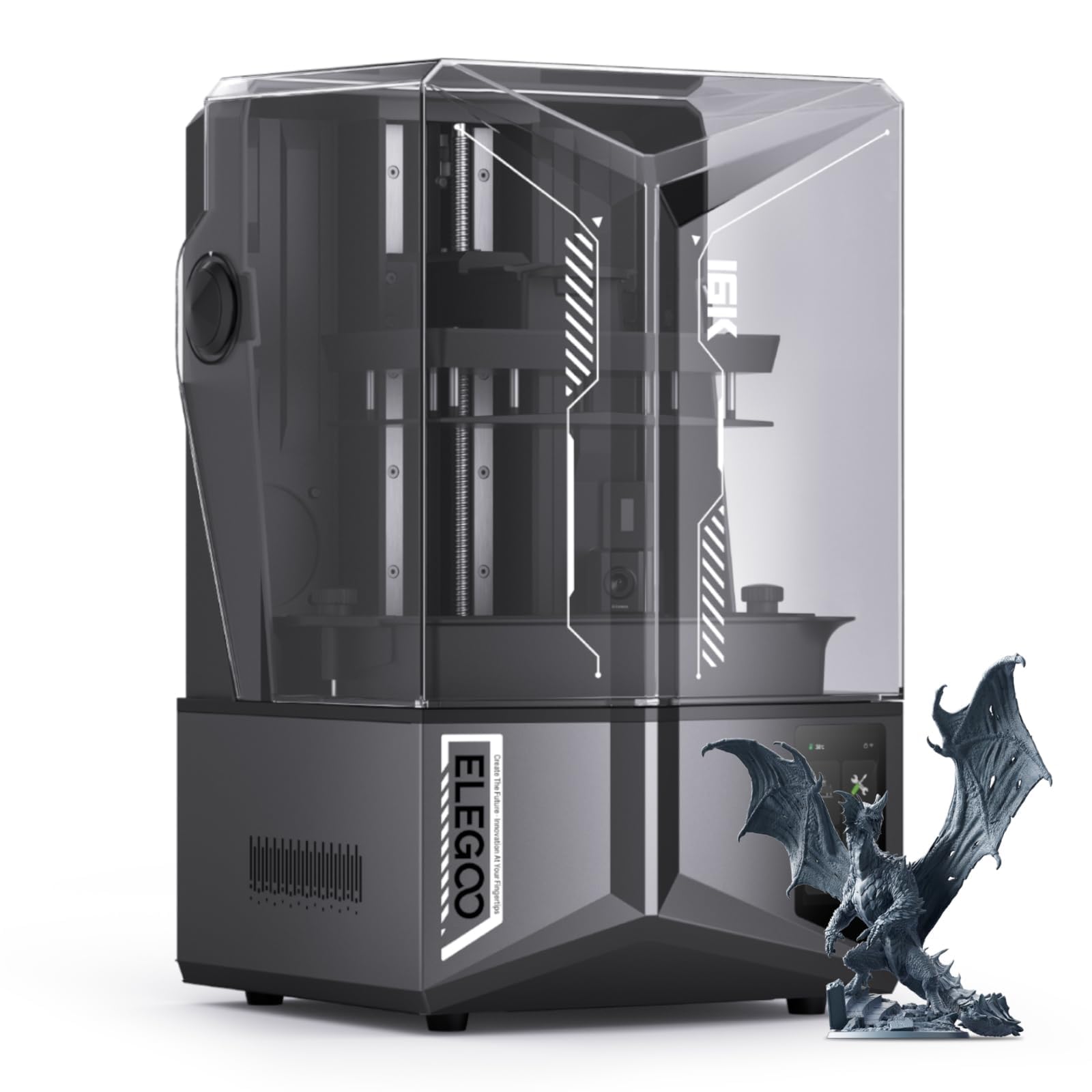
The Saturn 4 Ultra 16K is the strongest overall resin wax printer for jewelry because its tilt-release mechanism reduces suction forces on thin wax patterns, preventing warped bands and broken prongs. The 16K LCD delivers a pixel density that renders filigree scrollwork and micro-grain textures without visible stepping.
The smart tank heating keeps resin at a consistent 30 °C, solving cold-weather delamination failures that plague unheated vat printers. Users consistently report zero-adhesion issues on the build plate after a quick sandpaper treatment, and the AI camera provides real-time monitoring without needing a separate webcam setup.
At 150 mm/h, this printer balances throughput with surface quality, allowing a full suite of rings and earrings in a single overnight run. The included resin and straightforward auto-leveling make it accessible for both bench jewelers upgrading from wax carving and shops scaling up production.
Why it’s great
- 16K resolution captures stone-setting seats and fine engravings
- Heated resin vat eliminates delamination in cold workshops
- Tilt release reduces support density on thin wax walls
Good to know
- Resin pools on build plate after prints; a printed drip bracket is recommended
- WiFi functionality can occasionally require reconnection after firmware updates
2. ANYCUBIC Photon Mono M7 PRO 14K

The Photon Mono M7 PRO prints jewelry wax patterns at 170 mm/h, making it the fastest option for shops that need rapid iteration on ring prototypes. The 14K LCD, with a 16.8 × 24.8 µm XY resolution, produces holes as small as 0.3 mm—a critical spec for capturing bead-set micro-pavé channels.
The dynamic temperature-controlled vat and automatic resin filling pump reduce hands-on time, letting the printer run multiple batches without operator intervention. The COB LighTurbo 3.0 light source achieves over 90% uniformity, ensuring consistent curing across the entire build plate, which prevents under-cured areas on large pendants.
Experienced users report that dialing in light-off delay settings is necessary to avoid false vat blockage errors with certain resins, but once calibrated, the machine matches the quality of printers costing significantly more. The heavy lid is a minor ergonomic issue, though its insulation helps maintain stable vat temperatures.
Why it’s great
- 170 mm/h speed delivers fast turnaround on wax prototypes
- 14K LCD captures sub-millimeter stone-setting details
- Auto resin pump and heated vat reduce manual handling
Good to know
- Requires fine-tuning of light-off delay to avoid false errors
- Top cover is bulky and heavy for frequent access
3. Creality K2 Combo
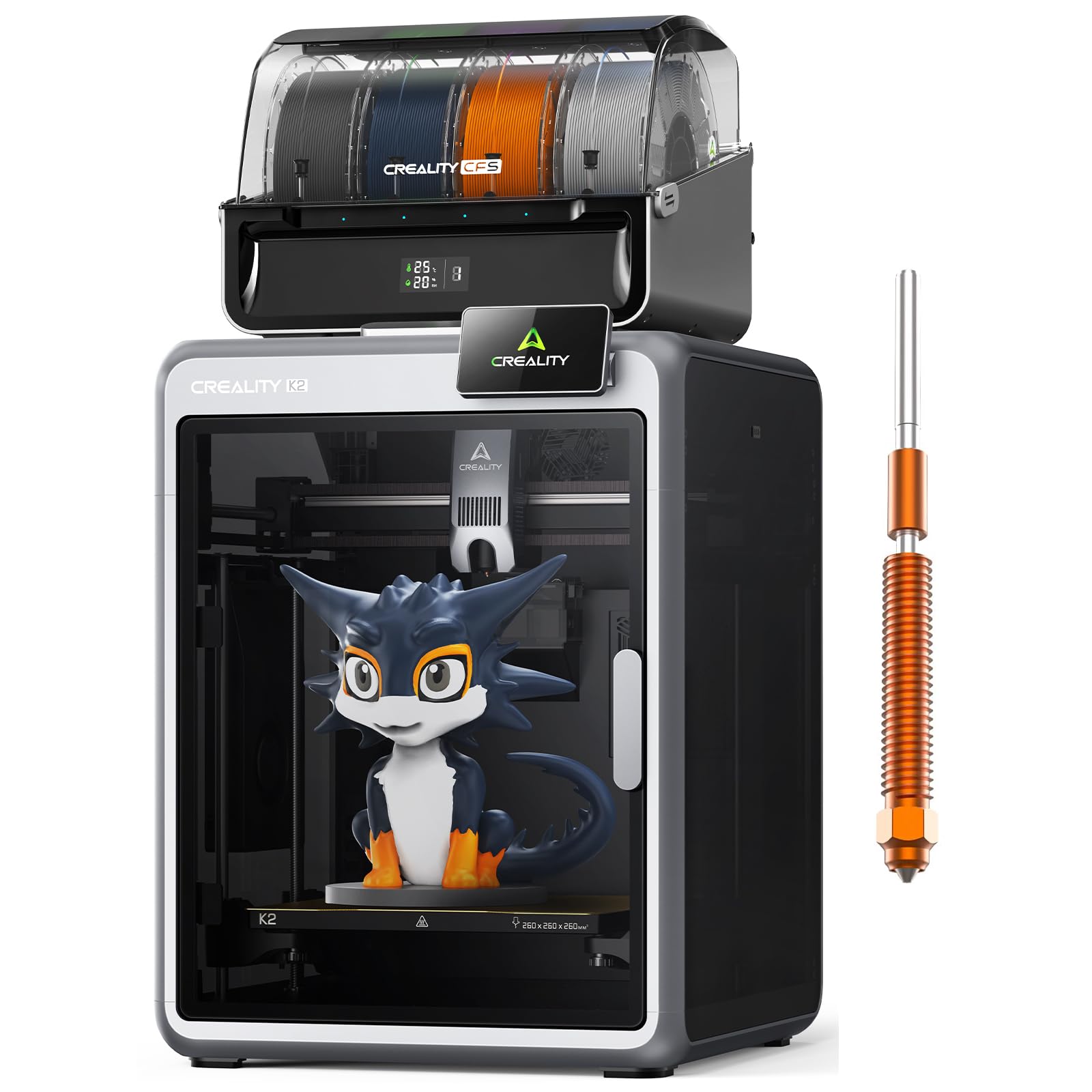
The Creality K2 Combo is a high-end FDM machine that uses its 16-color CFS system to produce multi-material patterns, allowing jewelers to embed soluble supports inside complex ring designs. The 260 mm³ build volume accommodates large-scale models like bracelet blanks and bangles in one piece, reducing assembly time.
The step-servo motors and dynamically balanced fans keep noise low enough for office-adjacent workshops, and the AI camera monitors for print failures during long overnight runs. Setup is straightforward for an FDM printer, taking around one hour to go from unboxing to first multi-color print.
While not a resin-based wax printer, the K2 Combo shines for jewelers who want to prototype designs in multiple colors before committing to a wax-print run. The CFS dry box with humidity display also ensures filament stays brittle-free, which is essential for support materials that dissolve cleanly.
Why it’s great
- 16-color capability for multi-material prototyping
- Large 260 mm³ build fits bracelets and bangles
- Ultra-quiet step-servo motors for in-office use
Good to know
- CFS does not accept standard spools without printed adapters
- WiFi restricted to 2.4 GHz may limit camera functionality
4. Phrozen Sonic Mighty 8K

The Sonic Mighty 8K remains a compelling entry-level resin wax printer because its 28 µm XY resolution produces ring patterns indistinguishable from more expensive 12K and 16K printers, according to users printing 28 mm miniatures. The reinforced dual linear rails ensure consistent Z-layer alignment, which prevents layer shift on tall wax models like long pendant chains.
The 10-inch monochrome LCD provides an 8.6 × 4.8 × 9.3 inch build volume, fitting roughly eight to ten ring blanks in a single batch. Users recommend adding a flexible build plate and a screen protector as inexpensive upgrades that significantly improve part removal and LCD longevity.
Cold-weather printing requires longer UV exposure times, but the printer’s firmware allows easy manual adjustment. The built-in camera has limited functionality, though most jewelers prefer dedicated monitoring solutions anyway. For the price point, the Sonic Mighty 8K delivers professional-grade wax details without the premium-tier markup.
Why it’s great
- 28 µm XY resolution matches 12K quality for wax patterns
- Dual linear Z-rails prevent layer shift on tall prints
- Large 10-inch LCD fits production batches of rings
Good to know
- Cold workshop requires extended UV exposure times
- Camera has limited functionality for monitoring
5. FLASHFORGE AD5X Multi-Color
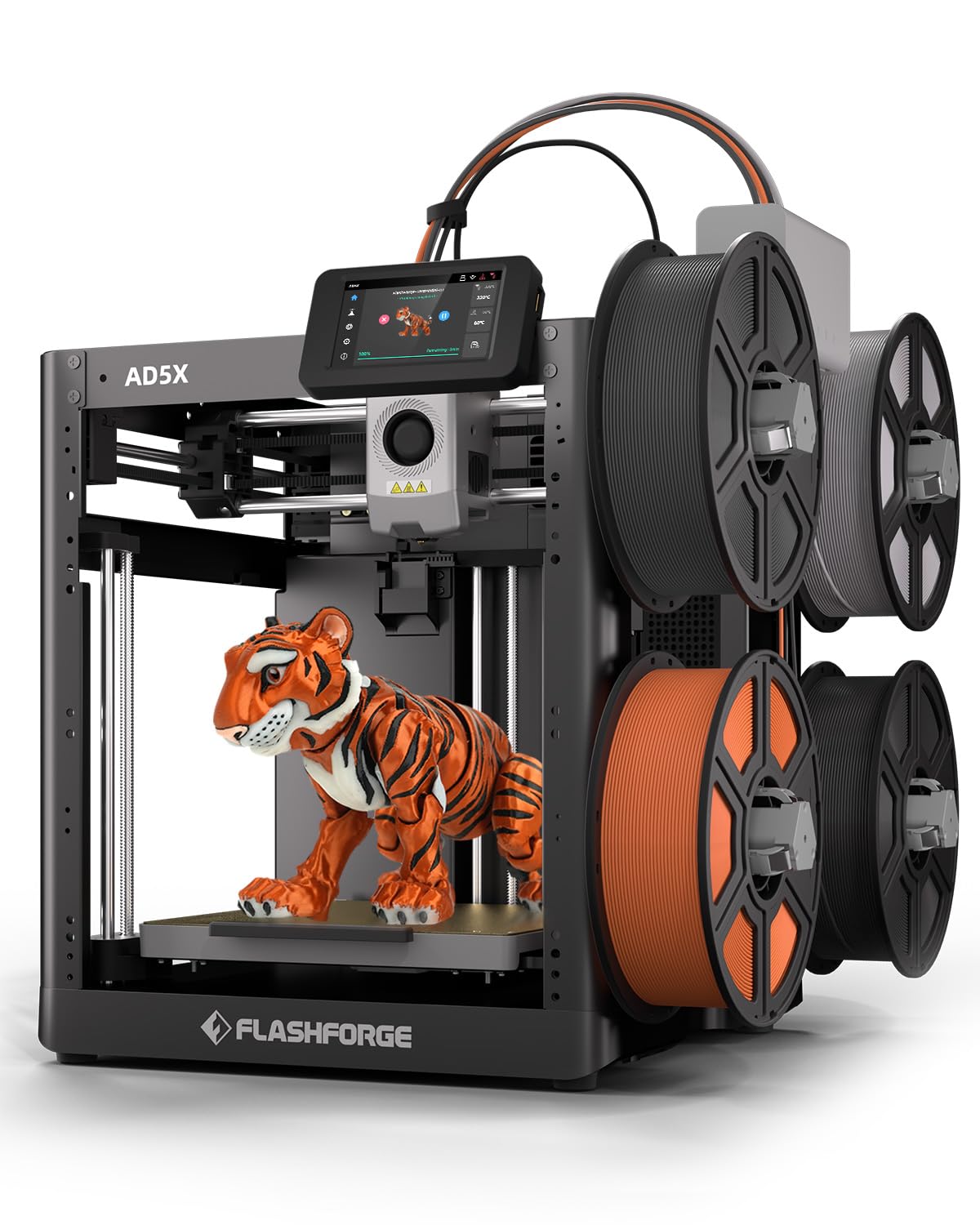
The Flashforge AD5X is a fast CoreXY FDM printer suitable for jewelers who want to test ring designs in colored filaments before final wax printing. Its 600 mm/s speed and 20,000 mm/s² acceleration turn around a basic signet ring prototype in under 90 minutes, allowing rapid iteration on ergonomic shapes.
The 300 °C direct-drive extruder handles PLA-CF and PETG-CF composites that mimic the stiffness of cast wax, and the swappable 0.25 mm nozzle option captures fine text details on pendant backs. Users report excellent first-layer adhesion on the PEI plate and consistent performance across 100+ hours of printing.
The multi-color system increases waste purge volume, and the stock Orca slicer lacks IFS color import, requiring a workaround for seamless color transitions. For a workshop already running resin-based wax production, the AD5X serves as a fast, low-stakes validation tool before committing to a resin print run.
Why it’s great
- 600 mm/s speed enables fast ring prototype iterations
- 0.25 mm nozzle option captures fine text and logos
- 300 °C extruder handles composite filaments
Good to know
- Multi-color system produces significant purge waste
- Stock slicer lacks IFS color import for seamless workflows
6. FLASHFORGE Adventurer 5M Pro

The Adventurer 5M Pro is a compact FDM printer ideal for bench jewelers with limited space who want to experiment with wax-like filament patterns. Its CoreXY all-metal frame maintains stability at 600 mm/s, and the 35-second nozzle heat time to 200 °C gets first layers down quickly on small parts like ring sizing gauges.
The pressure-sensing auto-leveling system requires no manual Z calibration, and the dual-sided PEI plate allows tool-less model removal, reducing turnaround time between prototype iterations. Users report excellent packaging and build quality, with setup taking under ten minutes for a first print.
Reliability concerns appear in a minority of units, with some users experiencing filament feeding failures after the initial test print. Flashforge’s customer support has a mixed reputation, though replacement units generally perform well. For a budget-friendly introduction to jewelry prototyping, the 5M Pro offers solid hardware at a reasonable entry point.
Why it’s great
- 35-second nozzle heat-up for rapid prototyping cycles
- Pressure-sensing auto-leveling eliminates manual calibration
- Compact footprint fits small workshop benches
Good to know
- Some units experience filament feeding issues after initial prints
- HEPA/carbon filtration doors do not seal tightly
7. ELEGOO Centauri Carbon 2 Combo
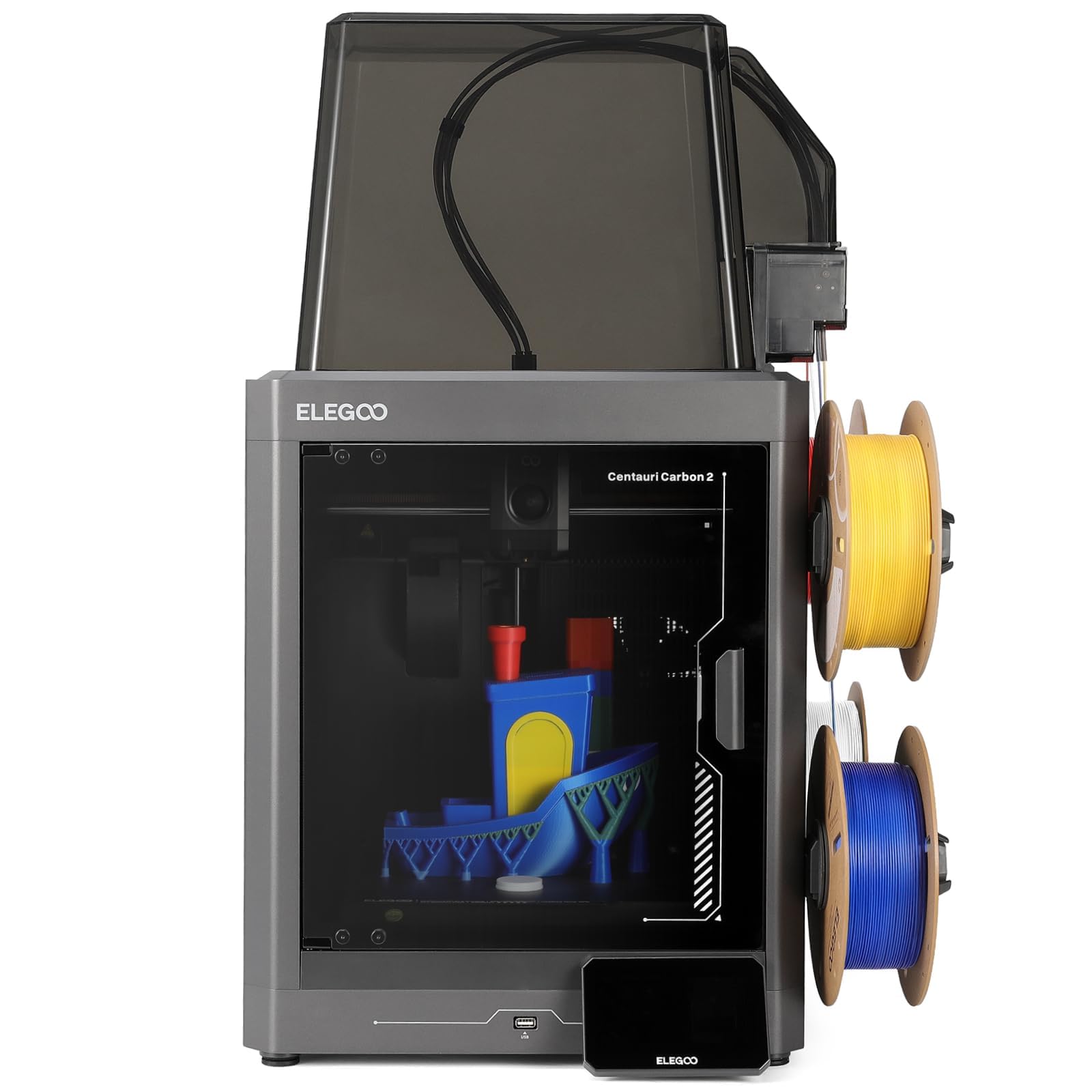
The Centauri Carbon 2 Combo is an enclosed FDM printer with a 350 °C hotend capable of printing high-temperature filaments like PEEK and PEKK, which some jewelers use as master patterns for silicone mold making. The CANVAS system enables four-color automatic switching, allowing multi-material support structures for complex pendant geometries.
With a 256 mm³ build volume, it fits larger jewelry forms such as cuff bracelets and wide shanks in a single piece. The 500 mm/s speed and 20,000 mm/s² acceleration match the pace of more expensive CoreXY machines, and users report excellent out-of-box print quality with minimal calibration.
The closed ecosystem has drawn criticism for limited slicer compatibility and lack of Klipper support, which may frustrate technically inclined users. The camera can fail mid-print, requiring a power cycle to restore, and the CANVAS system adds complexity for single-material workflows. For jewelers exploring high-temp patterns, it offers capabilities not found on standard resin printers.
Why it’s great
- 350 °C nozzle supports high-temp filament master patterns
- CANVAS 4-color system for multi-material supports
- 500 mm/s speed with active vibration compensation
Good to know
- Closed ecosystem limits slicer and firmware flexibility
- Camera reliability varies; may require mid-print power cycles
FAQ
Can I use regular resin for jewelry wax patterns?
What XY resolution do I need for stone setting seats?
Do I need a heated vat for jewelry wax printing?
Final Thoughts: The Verdict
For most users, the 3d wax printer for jewelry winner is the ELEGOO Saturn 4 Ultra 16K because its 16K resolution, heated vat, and tilt-release mechanism deliver ring-ready wax patterns with minimal failure. If you need faster throughput with auto-resin handling, grab the ANYCUBIC Photon Mono M7 PRO 14K. And for a budget-friendly entry point that still produces excellent wax detail, nothing beats the Phrozen Sonic Mighty 8K.