
Our readers keep the lights on and the weekend projects moving. As an Amazon Associate, I earn from qualifying purchases.
Parental sleep has a new name: micro-napping between alarms. That first time you find yourself staring at the crib monitor at 3 a.m., waiting for the tiny chest to rise again, you know the category has changed for you. The sensor beneath the mattress or clipped to the diaper isn’t a gadget — it’s a mechanical anchor for your sanity.
I’m Rikta — the co-founder and writer behind FitlyFast. I’ve spent countless hours dissecting the clinical specs, false-alarm rates, stimulation protocols, and battery reliability metrics that separate a wearable sensor from an under-mattress plate in this guide.
The market is noisy, but the mechanics are simple: motion plate, wearable clip, or camera-based algorithm. Each has a different false-alarm profile and a different intervention speed. This analysis focuses on the best baby breathing monitor to match your nursery’s setup and your family’s anxiety tolerance.
How To Choose The Best Baby Breathing Monitor
The decision starts with one question: do you want a sensor near the skin or under the mattress? Wearable clips measure abdominal movement directly, offering fast detection but they require proper placement on the diaper. Under-mattress plates track micro-movements through the crib base, which works well on firm surfaces but false-alarms on soft mattresses or pack ‘n plays. Camera-based systems track pixel changes to infer breathing — no contact, but they rely on a clear, unobstructed overhead view and robust WiFi connection.
Detection Latency and Stimulation Protocol
The critical spec is the “no-movement window” before the device acts. Most premium monitors wait 15 seconds before initiating a gentle vibration to rouse the baby and re-establish normal breathing. If no movement resumes within another 5 seconds, an audible alarm sounds. Shorter windows reduce false alarms but increase nuisance beeps. Longer windows may miss a real event. The patented Wakeup Technology in the Levana Oma Sense and the Snuza Hero both follow a two-stage protocol: vibration first, then alarm — a design that mimics the clinical stimulation sequence used in neonatal units.
False Alarm Tolerance and Environmental Interference
Under-mattress sensors (Babysense 7) can trigger false alarms if the baby rolls to the edge of the crib between the two sensor pads. Wearable clips false-alarm when the diaper slips or if the sensor is jarred loose during kicking. Camera-based systems false-alarm on ceiling fans, shadows, or a swaddle that shifts. The best unit for your nursery depends on your crib type, mattress firmness, and whether you use a ceiling fan adjacent to the crib.
Quick Comparison
On smaller screens, swipe sideways to see the full table.
| Model | Category | Best For | Key Spec | Amazon |
|---|---|---|---|---|
| Snuza Hero SE | Wearable Clip | Direct abdominal detection | 15s vibration + 5s alarm | Amazon |
| Nanit Pro + Flex Stand | Camera + Band | Overhead video + breathing | 1080p + sensor-free breathing band | Amazon |
| Owlet Dream Duo (Gen 3) | Sock + Camera | Oxygen + heart rate tracking | Pulse oximetry + 2K camera | Amazon |
| Philips Avent Premium Connected | Camera + App | Breathing tracking + cry translation | SenseIQ pixel-based breathing tracking | Amazon |
| Sense-U Pro Baby Monitor | Wearable Clip + App | Multi-sensor (breathing, roll, temp) | BLE 4.0, 7+ day battery | Amazon |
| Levana Oma Sense | Wearable Clip (No WiFi) | Simple, medical-grade materials | Patented Wakeup Technology | Amazon |
| Babysense 7 | Under-Mattress Pads | Full crib coverage, no wearables | 20s no-movement alarm threshold | Amazon |
In‑Depth Reviews
1. Snuza Hero SE

The Snuza Hero SE sits directly on the diaper and uses a direct-touch sensor that tracks abdominal rise and fall with high accuracy. Its patented sensor technology claims a lower false-alarm rate compared to older clip monitors, and the design attaches securely under a swaddle or onesie. The 15-second vibration window followed by a 5-second audible alarm gives you time to respond without startling the baby.
Parents report the green indicator light provides continuous visual reassurance — a small but meaningful comfort during night checks. The Hero SE runs on a replaceable lithium-ion battery that lasts up to six months, and the optional ticking sound lets you hear each breath through a traditional audio monitor. Users who switched from app-based monitors appreciated the zero-WiFi, zero-app simplicity.
The primary caveat is placement: if the diaper slips or the sensor is dislodged during kicking, a false alarm triggers. Some users noted the alarm is loud enough to hear across a hallway but may not wake a heavy-sleeping parent in a closed room. The diaper-clip design works best with snug-fitting onesie-style sleepers over the diaper.
Why it’s great
- Direct abdominal contact provides fast, accurate detection
- Long battery life (6 months) on a single replaceable cell
- No WiFi, no app, no cords — truly portable
Good to know
- False alarms possible if diaper slips
- Alarm may not be loud enough for heavy sleepers in adjacent rooms
2. Nanit Pro Smart Baby Monitor + Flex Stand

The Nanit Pro uses a downward-facing 1080p camera mounted above the crib to track breathing motion without any wearable sensor on the baby. The included Flexible Stand allows placement on a dresser or floor, and the Breathing Band (a simple cloth with printed pattern) is sensor-free — the camera’s computer vision algorithm detects the band’s movement. This design eliminates the false-alarm risk from diaper slips.
The companion app provides real-time 1080p HD video, two-way audio, sound and motion notifications, and detailed sleep insights. The 130-degree room view covers the entire crib, and 256-bit AES encryption with two-factor authentication secures your data. Parents praise the polished app interface, the ability to add multiple caregivers, and the superior alert responsiveness compared to other WiFi cameras.
A subset of users reports occasional WiFi disconnection, which can cause the breathing tracking to pause. The Flex Stand is excellent for travel but may not suit an overhead mount in all crib configurations. The Breathing Band must be placed correctly for the algorithm to work, and the subscription for Insights (advanced sleep data) adds long-term cost.
Why it’s great
- No wearable sensor — zero false alarms from diaper slips
- Crisp 1080p HD video with excellent night vision
- Sensor-free breathing band is simple and safe
Good to know
- Requires reliable WiFi — disconnections pause breathing tracking
- Insights subscription needed for advanced sleep data
3. Owlet Dream Duo (Gen 3)

The Owlet Dream Duo bundles the FDA-cleared Dream Sock — which uses medical-grade pulse oximetry to track oxygen saturation and heart rate — with a 2K HD Dream Sight camera. This is the only system in this list that provides clinical-grade physiological data rather than relying solely on movement detection. The sock fits babies 6-30 lbs and up to 18 months, with four fabric sock sizes included.
The Dream Sight camera delivers sharper-than-1080p video at 2K resolution with a 130-degree wide-angle lens and 4x digital zoom. Real-time alerts for pulse rate and oxygen zones are sent to the Owlet Dream App, and the camera tracks room temperature and humidity. The Predictive Sleep Technology analyzes wake windows to help establish healthier sleep routines.
The system requires a constant 2.4 GHz WiFi connection for the sock, and the base station must remain within 30 feet of the sock sensor. Some users report discomfort from the sock’s sensor poking the baby’s foot, and a few have experienced device failure within months. The sock only monitors up to 18 months, after which the camera functions as a standalone monitor.
Why it’s great
- FDA-cleared pulse oximetry for oxygen and heart rate data
- 2K HD camera with superior video clarity
- Advanced sleep insight and predictive technology
Good to know
- Requires consistent 2.4 GHz WiFi — base station range limits placement
- Sock sensor can cause discomfort and occasional device failure reported
4. Philips Avent Premium Connected Baby Monitor

The Philips Avent monitor uses SenseIQ Technology to analyze millions of pixels per second, tracking sleep and breathing rate without any wearable sensor. The 1080p camera includes both a dedicated 5-inch parent unit with stable long-range connection (up to 1300 feet) and a companion app for smartphone viewing. The Secure Connect System uses multiple encrypted links for private WiFi connection.
The cry detection and translation feature uses a scientifically proven algorithm to categorize five distinct cries — hunger, tired, discomfort, burping, and fussiness. While some reviewers find the cry translation gimmicky and occasionally inaccurate, the two-way talk feature and the 2-in-1 wall and crib mount are genuinely functional. The included mount conceals wires for a tidy nursery setup.
The breathing motion tracking works reliably in a stationary crib but can produce inaccurate readings when used with a moving bassinet like the Snoo. The sleep diary and breathing-rate trends are helpful for identifying patterns, but the cry translation feature feels underdeveloped compared to the core tracking performance. The price point positions it as a strong alternative to the Nanit without a subscription.
Why it’s great
- Wearable-free breathing tracking via pixel analysis
- Dedicated 5-inch parent unit with 1300-foot range
- Secure Connect System with multiple encrypted links
Good to know
- Cry translation feature is unreliable and adds little value
- Breathing tracking inaccurate with moving bassinets like Snoo
5. Sense-U Pro Baby Monitor
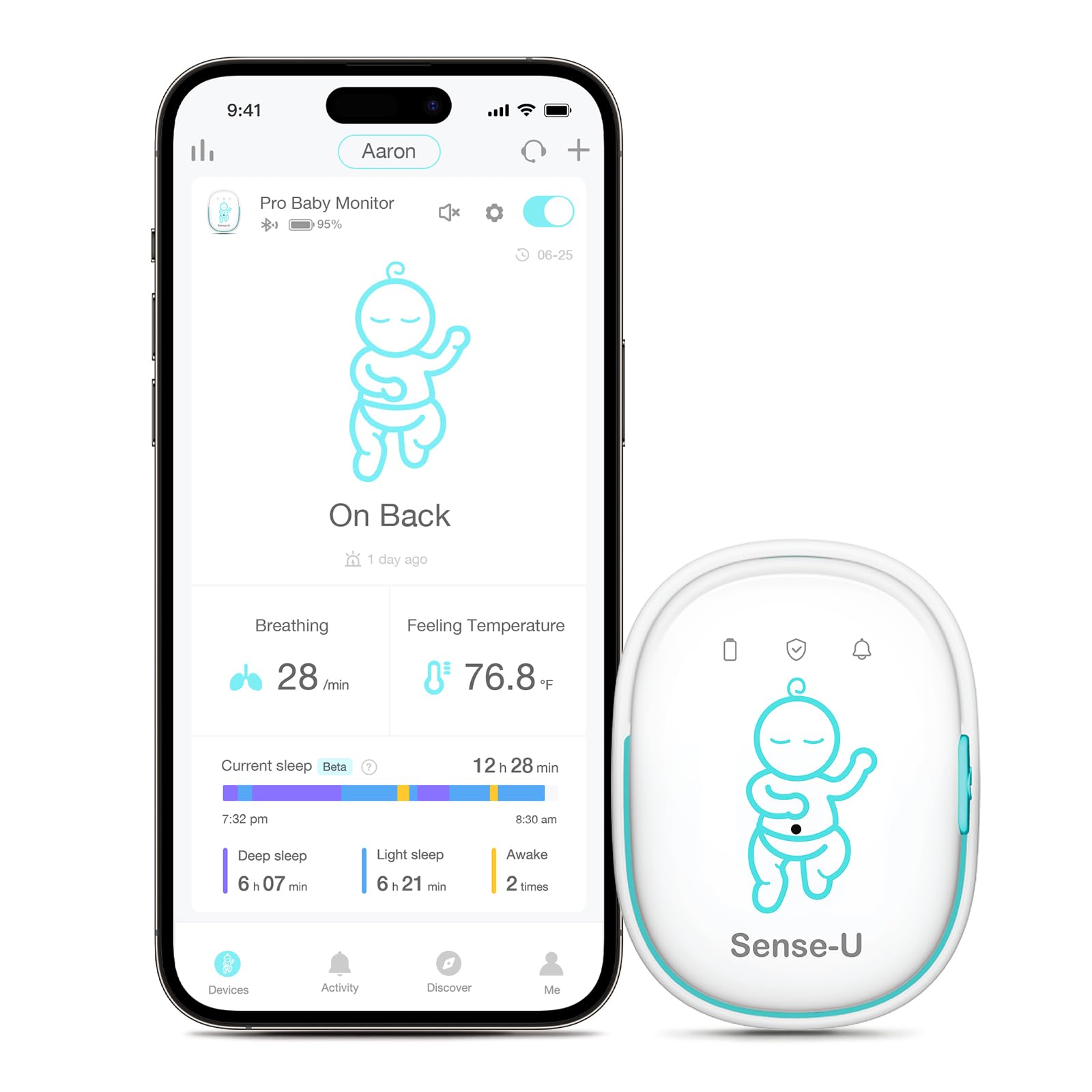
The Sense-U Pro clips onto the diaper and tracks abdominal movement, rollover position, and ambient temperature simultaneously. This multi-sensor approach gives it an edge over single-parameter monitors: it can distinguish between a breathing pause, stomach sleeping, and overheating — each with a different alert priority. The 15-second no-movement window triggers a gentle arousal vibration before escalating to an audible alarm at the 20-second mark.
The Bluetooth Low Energy (BLE 4.0+) communication uses negligible radiation (1/1000 of a smartphone) and works up to 50 feet in open space. The companion Sense-U Baby app provides free in-depth sleep analysis, including deep/light sleep stages, awake time, and personalized notification settings. Battery life exceeds 7 days on a single charge, and the device is FSA/HSA eligible.
The Bluetooth limitation means you must stay within range for the app notifications to work, and the device is not intended as a medical device. Some users report that the vibration alert is gentle enough to not startle the baby but may not wake a parent in a deep sleep. The temperature sensor adds valuable context but the overall reliability depends on correct diaper placement.
Why it’s great
- Tracks breathing, rollover, and temperature in one device
- Free detailed sleep analysis via smartphone app
- Low BLE radiation — safer than traditional WiFi monitors
Good to know
- Bluetooth range limited — parent must stay in same room for app alerts
- Not a medical device — consult a doctor for pre-existing conditions
6. Levana Oma Sense
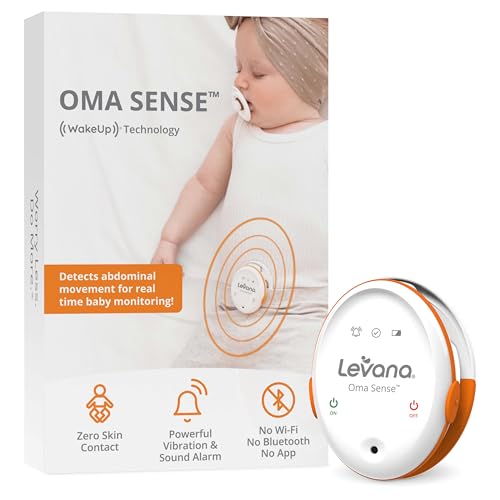
The Levana Oma Sense is a wearable clip that uses patented Wakeup Technology: it monitors abdominal movement and, if none is detected for 15 seconds, initiates a randomized vibration sequence to gently rouse the baby. If movement doesn’t resume within 5 seconds, a loud audible alarm alerts caregivers. Notably, the sensor sits over the diaper without skin contact — reducing irritation risk.
Designed in Canada from medical-grade materials, the Oma Sense slips over the diaper or buttoned-up onesie and requires zero WiFi, radio, or Bluetooth frequencies. The flashing blue light provides a quiet visual reassurance that the sensor is active. Parents who used it in hospital settings or with babies who had periodic breathing appreciated the simple, reliable mechanism.
The alarm volume has been noted as insufficient for heavy sleepers — some parents wish it were louder to wake them from deep sleep. The 0-6 month age range limits its useful life, and the need for a snug fit means it works best with diapers that have a firm waistband. Some users have created a DIY elastic waistband to improve placement stability.
Why it’s great
- Zero radio frequencies — no WiFi or Bluetooth radiation
- Medical-grade materials with no skin contact
- Patented vibration stimulation protocol before alarm
Good to know
- Alarm may not be loud enough for parents who are heavy sleepers
- Limited to 0-6 months of age
7. Babysense 7
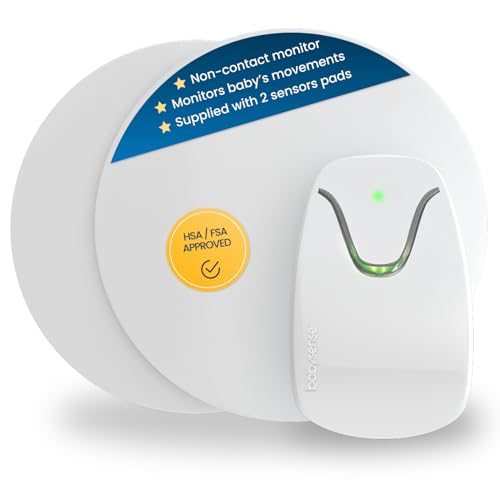
The Babysense 7 uses two under-mattress sensor pads that detect micro-movements through the crib mattress. The system has no contact with the baby, no wearables, and no WiFi — just a passive sensor system that sounds an alarm if no movement is detected for 20 seconds or if movement slows to fewer than 10 micro-movements per minute. HSA/FSA approval makes it a budget-friendly choice for cost-conscious families.
The dual-pad design provides full crib coverage, but the sensors are finicky with soft mattresses. The pads work reliably on standard crib mattresses but false-alarm constantly on pack ‘n plays, bassinets, or any surface that is too plush. Some parents have used a plywood board beneath the mattress to stabilize the sensors, but this adds complexity.
Several user testimonials describe the Babysense waking them when the baby had stopped breathing, with the parent claiming the device possibly saved their child’s life. The alarm is loud and effective. However, false alarms from crib positioning can cause unnecessary stress — the baby must sleep between the two sensor pads for accurate detection.
Why it’s great
- Completely contact-free — no wearables on the baby
- Loud alarm that can potentially wake even deep sleepers
- HSA/FSA approved for insurance use
Good to know
- False alarms common on soft mattresses, pack ‘n plays, or bassinets
- Requires firm, stable crib surface for reliable detection
FAQ
How long should a baby breathing monitor’s detection window be?
Can a breathing monitor prevent SIDS?
Why do under-mattress sensors false-alarm on soft crib mattresses?
Which baby breathing monitor works best for travel?
Final Thoughts: The Verdict
For most users, the best baby breathing monitor is the Nanit Pro because it combines reliable overhead breathing tracking with a high-quality 1080p camera and zero wearable false alarms. If you want a direct-contact monitor with the fastest detection and vibration stimulation, grab the Snuza Hero SE. And for clinical-grade oxygen and heart rate data alongside a top-tier camera, nothing beats the Owlet Dream Duo (Gen 3).