
Our readers keep the lights on and the weekend projects moving. As an Amazon Associate, I earn from qualifying purchases.
A turntable without the right speaker is like a vintage car with a lawnmower engine. You’re spinning a record worth hundreds of dollars, but you’re hearing a compressed, thin version of the audio the grooves actually hold. Most vinyl setups fail at the last step because people grab a cheap soundbar or a Bluetooth speaker that wasn’t designed for the flat, un-equalized signal a turntable outputs. This guide cuts through the noise to find powered speakers with proper inputs — RCA and phono preamp stages — so the speaker is the final link in your signal chain, not a weak one.
I’m Rikta — the co-founder and writer behind FitlyFast. This guide is the result of cross-referencing frequency response curves, amplifier wattage, driver materials, and connectivity protocols across dozens of models to find the speakers that actually make vinyl sound like vinyl should.
Whether you’re building a first-time turntable setup or upgrading from passive speakers and a separate receiver, the right bluetooth speaker for turntable handles both analog RCA inputs and wireless streaming without forcing you to buy a dedicated stereo amplifier.
How To Choose The Best Bluetooth Speaker For Turntable
Selecting the right powered speaker for a turntable involves more than just picking the loudest option. You need to match the speaker’s input capabilities and tonal balance to the specific signal your turntable outputs.
Phono Preamp: Internal or External?
Turntables output a low-level phono signal that requires equalization before it can reach line level. Some speakers, like the Kanto YU4, have a built-in phono preamp, allowing you to connect a turntable directly via RCA without an external box. If your speaker lacks this, your turntable must have a built-in preamp, or you’ll need to buy one separately.
Driver Configuration and Cabinet Design
The size and material of the drivers determine how well a speaker reproduces the mid-range and bass frequencies that vinyl is known for. Woven glass fiber drivers (Fluance Ai41) or Kevlar drivers (Kanto YU4) offer better rigidity and less distortion at higher volumes compared to basic paper cones. MDF wood cabinets reduce unwanted resonance better than plastic enclosures, which is critical for maintaining clarity in a bookshelf setup.
Connectivity and Input Versatility
A dedicated RCA input is non-negotiable for a wired turntable connection. Optical inputs are useful for connecting a TV or CD player, while Bluetooth 5.0 or higher allows you to stream digital audio when you’re not spinning vinyl. Models like the Edifier MR3 offer balanced TRS inputs for studio monitors, which adds flexibility for music production alongside turntable use.
Quick Comparison
On smaller screens, swipe sideways to see the full table.
| Model | Category | Best For | Key Spec | Amazon |
|---|---|---|---|---|
| Fluance Ai41 | Powered Bookshelf | Balanced vinyl sound | 5″ Woven Glass Fiber Driver | Amazon |
| Kanto YU4 | Premium Powered | Built-in phono preamp | 4″ Kevlar Driver | Amazon |
| Marshall Stanmore III | Bluetooth Speaker | Design & loud volume | 5″ Woofer | Amazon |
| Audio-Technica AT-SP3X | Compact Pair | Small footprint | 76mm Full-Range Driver | Amazon |
| Edifier MR3 | Studio Monitor | Near-field accuracy | 52Hz–40kHz Frequency Response | Amazon |
| Edifier R1280T | Entry-Level | Budget vinyl setup | 4″ Full-Range Driver | Amazon |
| Ortizan C7 | Budget Near-Field | Desktop versatility | 3.5″ Carbon Fiber Driver | Amazon |
In‑Depth Reviews
1. Fluance Ai41 Powered Bookshelf Speakers

The Fluance Ai41 is the most well-rounded powered speaker for turntable owners who want a true stereo image without a separate amplifier. The 5-inch woven glass fiber drivers produce a natural midrange that brings vocal presence and acoustic detail out of vinyl’s analog warmth, while the 1-inch neodymium tweeters handle treble extension without sibilance. The integrated 90W amplifier delivers clean headroom for medium to large rooms, and the rear bass port extends low-end response without making the sound boomy.
Connectivity is comprehensive for a turntable-focused system. You get both RCA analog inputs for a direct turntable connection and an optical input for a TV or CD player, plus Bluetooth 5.0 for wireless streaming when you’re not spinning records. The remote control includes bass and treble trim, which is useful for adjusting the tonal balance to match different vinyl pressings. The MDF wood cabinets are internally braced to eliminate resonance, a feature that becomes noticeable at higher volumes where cheaper cabinets would vibrate.
The primary limitation is the DSP-controlled volume scaling, which caps output before the amplifier and drivers are truly pushed. Some users report that the subwoofer out becomes necessary for deep sub-bass extension, especially with modern vinyl releases that have heavy low-end content. Despite this, the Ai41 remains the most cohesive package for someone who wants one speaker pair to serve both a turntable and a digital audio source.
Why it’s great
- 5-inch woven glass fiber drivers deliver detailed, natural midrange perfect for vinyl’s analog warmth
- Remote with bass and treble controls lets you tailor the sound to different pressings
- Optical input adds future-proof connectivity beyond standard RCA
Good to know
- DSP volume scaling limits maximum output before distortion
- Subwoofer out included but a sub adds noticeable cost
2. Kanto YU4 Powered Speakers

The Kanto YU4 is the only speaker on this list with a built-in phono preamp, making it the most turntable-ready out of the box. You can connect any turntable — vintage or modern — directly into the RCA inputs without needing a separate preamp box. The 4-inch Kevlar drivers and 1-inch silk dome tweeters produce a balanced sound signature that leans slightly warm, which complements the natural roll-off of vinyl playback. The handcrafted MDF cabinets with walnut veneer add aesthetic weight that matches high-end turntable designs.
Beyond the phono stage, the YU4 packs impressive versatility. There are two optical inputs for digital sources, a subwoofer out for future expansion, and a USB power output that can run a Chromecast Audio. The included remote controls volume, input switching, tone, and balance — more than most powered speakers at this level. The auto standby and power-up feature senses an incoming signal and wakes the speakers, which is convenient for a living room setup where you don’t want to reach for a switch every time you drop a needle.
Some users note that the 4-inch driver limits low-end extension compared to 5-inch alternatives, and the Bluetooth 4.0 implementation with aptX is functional but not the latest standard. The IR sensor for the remote requires direct line-of-sight, which can be finicky if the speakers are tucked into a shelf. For someone who prioritizes a clean, vinyl-first signal chain without extra boxes, the YU4 is the most elegant solution.
Why it’s great
- Integrated phono preamp eliminates the need for an external box with any turntable
- Dual optical inputs add digital audio flexibility beyond vinyl
- Auto standby and wake-up from signal detection for hands-free use
Good to know
- 4-inch drivers require a subwoofer for deep bass extension
- Remote requires direct line-of-sight due to IR sensor placement
3. Marshall Stanmore III Bluetooth Speaker
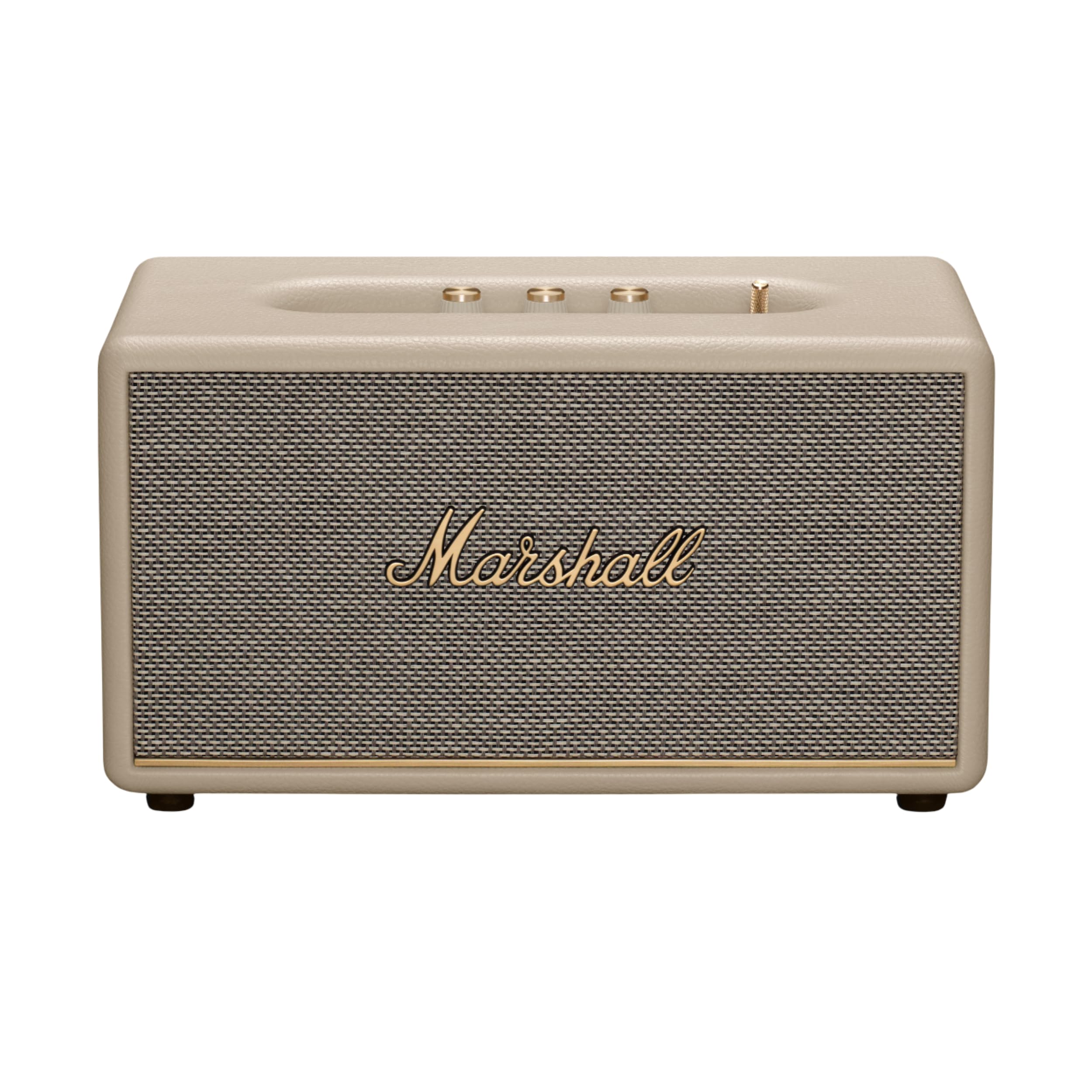
The Marshall Stanmore III is a single-enclosure Bluetooth speaker with the iconic rock ‘n’ roll aesthetic, but it earns its place here because of the dedicated RCA and 3.5mm aux inputs. You can connect your turntable directly via RCA (provided your turntable has a built-in phono preamp or you use an external one), and the front-panel bass, treble, and volume knobs give you tactile control over the sound signature. The 5-inch woofer and dual tweeters produce a surprisingly wide soundstage for a single cabinet, filling a 1300-square-foot room without strain.
The design is the Stanmore’s strongest differentiator. The cream leather finish, gold-toned hardware, and vintage Marshall badge make it a visual anchor in any room, something no other powered speaker on this list can match. Bluetooth 5.2 delivers stable wireless streaming, and the companion app offers additional EQ control. The PVC-free build uses 70% recycled plastic, which matters for buyers prioritizing sustainable materials.
The trade-off is that this is a mono speaker — even though it sounds wide, you don’t get true stereo separation like you do with a pair of bookshelf speakers. It also requires a phono preamp if your turntable doesn’t have one built-in. For someone who values aesthetics and simplicity over absolute channel separation, the Stanmore III is a compelling choice that sounds as good as it looks.
Why it’s great
- RCA input allows direct turntable connection with a built-in preamp
- Front-panel bass, treble, and volume knobs for real-time tone shaping
- Iconic Marshall design with sustainable PVC-free materials
Good to know
- Single-cabinet design lacks true stereo separation
- Requires an external phono preamp if your turntable doesn’t have one
4. Audio-Technica AT-SP3X Bookshelf Speakers

The Audio-Technica AT-SP3X is the smallest footprint option that still delivers full-range audio suitable for a turntable. The 76mm full-range drivers produce a surprisingly robust sound that gets loud without distortion, despite the compact cabinet. The dual RCA jacks accept a line-level input from turntables with built-in preamps, and the multipoint Bluetooth pairing lets you keep a phone connected simultaneously — you can switch from vinyl to digital streaming without re-pairing.
Setup is exceptionally simple: connect the included speaker cable, plug in the AC adapter, and toggle between RCA and Bluetooth with the front-panel button. The volume control dial is responsive and tactile, and the LED indicator clearly shows the active input. For users pairing these with the Audio-Technica AT-LP120 turntable, the aesthetic match and integrated simplicity make this a turnkey solution.
The full-range driver design means you lose some detail in the upper treble and sub-bass compared to multi-driver designs. The plastic enclosure doesn’t resonate as cleanly as MDF wood cabinets at higher volumes. However, for a desktop or small-room vinyl setup where space is the primary constraint, the AT-SP3X delivers satisfying performance without requiring a receiver or preamp.
Why it’s great
- Smallest physical footprint fits tight shelves and small desks
- Multipoint Bluetooth pairs two devices for seamless switching
- Matches Audio-Technica turntables visually and functionally
Good to know
- Single full-range driver sacrifices treble and bass detail
- Plastic cabinet lacks the resonance control of wood enclosures
5. Edifier MR3 Powered Studio Monitor Speakers

The Edifier MR3 is a Hi-Res Audio certified studio monitor that brings near-field accuracy to a turntable setup. The 3.5-inch mid-low drivers and 1-inch tweeters reproduce frequencies from 52Hz up to 40kHz, exceeding the range needed for vinyl playback and ensuring that every harmonic and imperfection in the recording is audible. The flat frequency response is tuned for monitoring — what you hear is what the record contains, without artificial bass boosting.
Connectivity includes balanced TRS inputs (rare at this price), RCA, and AUX, plus Bluetooth 5.4 with multipoint support. The Edifier ConneX app allows you to switch between Music, Monitor, and Custom EQ modes, giving you fine-grained control over the sound signature. For turntable owners who also produce music or edit audio, the MR3 serves dual duty as both a listening speaker and a reference monitor.
Users report that the Bluetooth volume isn’t fully controllable from the paired device, requiring physical knob adjustment or app intervention. The balanced input implementation works well with professional gear but isn’t necessary for most turntable-only setups. The MR3 is best suited for someone who wants analytical sound quality and multi-mode versatility without jumping to premium pricing.
Why it’s great
- Hi-Res Audio certification ensures accurate reproduction across a wide frequency range
- Balanced TRS input connects with professional studio gear
- App-based EQ with Music, Monitor, and Custom modes
Good to know
- Bluetooth volume not fully controllable from the source device
- Near-field design limits optimal listening distance to a few feet
6. Edifier R1280T Powered Bookshelf Speakers

The Edifier R1280T is the entry-point powered speaker that has become a default recommendation for first-time turntable owners. The 13mm silk dome tweeter and 4-inch full-range driver produce a natural, non-fatiguing sound that works well with the warmth of vinyl. The dual AUX inputs let you connect both a turntable and a secondary source like a phone or CD player simultaneously, with no manual switching required.
The classic wood-effect MDF cabinet is one of the best-looking options at this tier, blending into any living room or bookshelf decor. The included remote control covers volume, bass, and treble adjustments, and the side-panel EQ knobs give you analog control over the tonal balance. For a budget setup, the R1280T provides the core features — powered speakers with RCA input and remote control — without any unnecessary complexity.
The main compromise is bass extension. The 4-inch driver doesn’t produce deep low-end, and many users find that adding a subwoofer transforms the system’s overall balance. There is no Bluetooth connectivity, so wireless streaming requires an external adapter. For a straightforward, wired vinyl setup with a turntable that has a built-in preamp, the R1280T delivers reliable performance at a very accessible cost.
Why it’s great
- Dual AUX inputs allow two wired sources without plugging or switching
- Side-panel bass and treble knobs for manual EQ adjustment
- Classic wood cabinet aesthetically matches vinyl setups
Good to know
- No Bluetooth connectivity for wireless streaming
- 4-inch driver lacks deep bass without a subwoofer
7. Ortizan C7 Dual-Mode 2.0 Studio Monitors

The Ortizan C7 is the budget-conscious option that still delivers studio-monitor-level features for a turntable setup. The 3.5-inch carbon fiber mid-bass driver and 0.75-inch silk dome tweeter produce a surprisingly flat frequency response with good transient detail, thanks to the built-in 24-bit DAC that processes digital audio via USB-C. The electronic 2-way crossover provides clean separation between the driver bands, minimizing the muddiness common in ultra-compact speakers.
Input versatility is the C7’s strong suit. You get RCA inputs for a turntable connection, 3.5mm AUX for secondary sources, 6.35mm TRS balanced inputs for professional gear, and Bluetooth 5.3 for wireless streaming. The front-panel headphone output is a welcome addition for late-night listening sessions. The touch controls on the front panel feel modern, and the combination of wood, metal, and ABS materials gives the cabinet decent weight for its size.
The bass extension is limited by the 3.5-inch driver size, and some users report a faint idle hiss when no audio is playing. The volume knob can feel slightly choppy at the lowest settings, making fine adjustments difficult. For someone building a first turntable setup on a tight budget, the C7 offers an unusual amount of connectivity and a sound signature that punches above its size.
Why it’s great
- Multiple inputs (RCA, TRS, AUX, Bluetooth 5.3) for maximum device compatibility
- 24-bit DAC via USB-C reduces signal loss for digital sources
- Front headphone output for private listening
Good to know
- 3.5-inch driver limited bass extension requires careful placement
- Faint idle hiss noticeable in quiet environments
FAQ
Do I need a phono preamp with these speakers?
Can I use a single Bluetooth speaker instead of a pair?
What size drivers do I need for vinyl playback?
Can I connect a subwoofer to these powered speakers?
Final Thoughts: The Verdict
For most users, the bluetooth speaker for turntable winner is the Fluance Ai41 because it pairs a natural, detailed midrange with versatile connectivity and a remote that controls bass and treble — everything a vinyl listener needs in one package. If you want a speaker with a built-in phono preamp for the cleanest signal chain, grab the Kanto YU4. And for a compact, small-footprint setup that matches an Audio-Technica turntable, nothing beats the Audio-Technica AT-SP3X.