
Our readers keep the lights on and the weekend projects moving. As an Amazon Associate, I earn from qualifying purchases.
Dialogue lost under action scenes. Music that sounds hollow. A slim TV that simply cannot move air. These are the problems a dedicated audio system solves, and at the $200 price point, the difference between a soundbar that merely gets loud and one that actually fills a room comes down to a handful of critical specs: driver size, channel count, subwoofer type, and the codecs that govern spatial audio.
I’m Rikta — the co-founder and writer behind FitlyFast. For this guide, I analyzed customer records, spec sheets, and real-world testing feedback across nine soundbar systems to isolate the models that deliver true performance rather than just marketing wattage claims.
Whether you want a 2.1 setup for clear dialogue and deep bass or a virtual surround system with satellite speakers, the right choice hinges on how those speakers handle your room’s dimensions. This is the $200 soundbar.
How To Choose The Best $200 Soundbar
The best soundbar under $200 balances channel count, subwoofer quality, and connectivity in a way that matches your room size and primary use case. A system that works well for a bedroom may feel anemic in a large living room, and a gaming-focused unit may strip out features movie lovers need.
Channel Count and the Surround Question
A 2.1 system (two front channels plus a subwoofer) delivers clear dialogue and solid bass but no rear channel effects. A 3.1 system adds a dedicated center channel for clearer speech. Virtual surround processing (Dolby Atmos or DTS Virtual:X) can mimic height and rear cues, but models with physical satellite speakers, even if wired, produce a more convincing soundstage for the home theater enthusiast.
Subwoofer: Wireless vs. Wired and Driver Size
Wireless subwoofers simplify placement because you can tuck them in a corner without running a cable from the soundbar. However, wired subs generally offer tighter, more controlled bass at a lower price. A 5.25-inch driver will produce adequate bass for a small room, while a 6.5-inch driver like the one found in the JBL Bar 2.1 Deep Bass delivers noticeably deeper extension that can fill a medium-sized living space.
Connectivity: HDMI eARC Matters
HDMI eARC (or ARC) carries Dolby Atmos metadata and lets you control volume with a single TV remote. Optical connections are fine for basic stereo but cannot carry object-based audio. If your TV lacks HDMI ARC, a soundbar with Bluetooth or AUX is essential. Also check whether the soundbar supports the TV brand’s proprietary setup — several models are Roku TV Ready or LG WOW Interface compatible, which simplifies pairing.
Quick Comparison
On smaller screens, swipe sideways to see the full table.
| Model | Category | Best For | Key Spec | Amazon |
|---|---|---|---|---|
| JBL Bar 2.1 Deep Bass (MK2) | 2.1 Channel | Deep bass and music fidelity | 6.5″ wireless subwoofer | Amazon |
| Samsung HW-B550F | 2.1 Channel | Adaptive sound and dialogue clarity | DTS Virtual:X processing | Amazon |
| ULTIMEA Aura A40 | 7.1 Virtual | Virtual surround with satellite speakers | 4 surround speakers included | Amazon |
| TCL S55H | 2.1 Channel | AI room calibration and app control | Dolby Atmos + DTS Virtual:X | Amazon |
| Polk Audio Signa S2 | 2.1 Channel | Voice clarity and slim design | Polk VoiceAdjust technology | Amazon |
| Philips B5306 | 2.1 Channel | Roku TV integration | Wireless subwoofer included | Amazon |
| LG S20A | 2.0 Channel | LG TV synergy and slim profile | AI Sound Pro + WOW Orchestra | Amazon |
| Westinghouse 2.0 Compact | 2.0 Channel | Dolby Atmos at entry level | Dolby Atmos + Dolby Digital Plus | Amazon |
| MEREDO G38 | 3.1 Channel | RGB gaming aesthetics | 160W peak + RGB lighting sync | Amazon |
In‑Depth Reviews
1. JBL Bar 2.1 Deep Bass (MK2)

The JBL Bar 2.1 Deep Bass (MK2) tops this list because its 6.5-inch wireless subwoofer delivers genuinely room-filling low end at a price where most competitors use smaller 5.25-inch drivers. The 300W peak power rating is not just marketing language — the system stays clean and distortion-free up to high volumes, making it viable for medium living rooms. Dolby Digital decoding ensures that movie mixes translate well, and the included optical and HDMI cables make setup a five-minute affair.
Musicians and audiophiles will appreciate the three selectable bass levels (Low, Mid, High) that let you dial in the subwoofer’s output without muddying the mids and highs. The JBL Surround Sound processing creates a noticeably wider soundstage than standard stereo, though it remains a virtual effect rather than true multi-channel audio. Bluetooth streaming from a phone or tablet is stable at 10 meters and works as a secondary use case for music playback.
Some early units shipped with insufficient packaging padding, leading to a small number of DOA reports. JBL’s warranty and return process handle that adequately, but it is worth checking the unit immediately upon arrival. For any buyer wanting the deepest bass available under $200, this is the clear choice.
Why it’s great
- Largest subwoofer driver in its price bracket (6.5″)
- Three adjustable bass levels for fine control
- Clean, distortion-free output at high volume
Good to know
- No HDMI eARC passthrough for multiple sources
- Occasional packaging damage reported during shipping
2. Samsung B-Series HW-B550F

Samsung’s HW-B550F leverages DTS Virtual:X processing to create convincing height and surround cues from a 2.1 layout, and the adaptive sound engine actively analyzes what you are watching to adjust equalization in real time. The wireless subwoofer integrates seamlessly — reviewers consistently highlight the immediate pairing and the absence of syncing issues. The Voice Enhance Mode is particularly useful for spoken-word content, as it amplifies dialogue frequencies without making the overall mix sound unnatural.
Setup is straightforward whether you use HDMI ARC or optical. Buyers with Samsung TVs benefit from automatic source switching and power sync, and the system recognizes content types (movies, sports, gaming) and tweaks the response curve accordingly. The bass is punchy enough for action scenes, though some users wish the sub could dig a few hertz deeper — this is a tradeoff of its smaller subwoofer driver compared to the JBL entry.
The built-in remote is functional but minimal, and the soundbar lacks a dedicated graphic equalizer. Still, for buyers who value automated convenience over manual tuning, the B550F delivers a polished, fuss-free experience that adapts to whatever you throw at it.
Why it’s great
- Adaptive Sound auto-calibrates for content type
- DTS Virtual:X creates wide soundstage from 2.1 layout
- Works seamlessly with Samsung TVs via HDMI ARC
Good to know
- Subwoofer bass could go deeper for dedicated bassheads
- No customizable graphic EQ on the remote
3. ULTIMEA 7.1ch Aura A40

The ULTIMEA Aura A40 is the only system in this guide that ships with four dedicated satellite speakers (two front, two rear) to create a genuine 7.1 virtual surround sound field. The rear satellites connect wirelessly to the soundbar for signal but do require power cords, which slightly complicates placement. However, once positioned correctly, the spatial separation is noticeably wider than any 2.1-based virtualizer can produce — you can hear footsteps panning from front to back in gaming and distinct rear channel effects in movie mixes.
The Ultimea Smart App includes a 10-band equalizer and 121 preset EQ matrices, giving you granular control over the frequency response that is rare at this price. The subwoofer is wired, which keeps the bass tight and eliminates pairing dropouts, but also anchors the sub to the soundbar’s location. BassMX Technology helps the sub produce present low end, though it cannot match the deep extension of a larger 6.5-inch driver on its own. The system supports optical, AUX, Bluetooth 5.3, and USB but lacks HDMI ARC, so you may need to use optical for TV audio.
Some users report infrequent Bluetooth cutouts over long listening sessions, and the rear satellite volume at default levels is subtle — you will want to adjust it via the app. For the price, however, this is the only way to get a true multi-speaker surround experience without jumping to a receiver-based system.
Why it’s great
- Includes 4 physical satellite speakers for real surround
- 10-band EQ and 121 presets via Ultimea app
- Wired subwoofer produces tight, present bass
Good to know
- No HDMI ARC input for Dolby Atmos metadata
- Rear satellites require AC power, not wireless battery
4. TCL S55H 2.1

TCL’s S55H offers Dolby Atmos and DTS Virtual:X decoding in a 2.1 configuration at a price that undercuts most competitors with similar codec support. The standout feature is AI Sonic Auto Room Calibration — the soundbar uses a built-in microphone (via the TCL app) to analyze your room’s dimensions and furniture placement, then adjusts EQ and delay settings automatically. This one-time setup eliminates the guesswork that typically accompanies soundbar placement, especially in asymmetrical rooms.
The wireless subwoofer pairs instantly and delivers adequate bass for small to medium rooms, though audiophiles may find it lacking in low-end authority compared to models with larger drivers. The soundbar itself is low-profile at 2.36 inches tall, making it easy to slide under most TV stands without blocking the IR sensor. The included wall mount kit and long HDMI cable add convenience, but the app control is where the S55H really differentiates itself — you can adjust EQ, recalibrate, and select sound modes without the remote.
Dialogue clarity is good at default settings, and the Voice mode further boosts the center frequency range. The primary limitation is the subwoofer’s output ceiling; if you want chest-thumping bass, you will need to look at the JBL or add an external sub. For balanced, easy-to-setup audio calibration, the S55H is the smart play.
Why it’s great
- AI room calibration simplifies placement in irregular rooms
- Dual codec support (Dolby Atmos + DTS Virtual:X)
- Slim 2.36″ profile fits under most TVs
Good to know
- Subwoofer bass output is moderate, not room-shaking
- App required for full calibration features
5. Polk Audio Signa S2

The Polk Audio Signa S2 has been on the market for years, and its longevity is a testament to its reliability. The proprietary VoiceAdjust technology operates independently of the main volume — you boost dialogue frequencies by one of three levels without affecting the overall loudness of the surround mix. This is a game-changer for viewers who struggle with muffled speech in movie mixes, especially in rooms where the TV is placed off-axis from the listening position.
The soundbar itself measures just over 2 inches tall, making it one of the most discrete options for low-clearance TV cabinets. Five full-range drivers handle the audio, paired with a wireless subwoofer that connects automatically on power-up. Dolby Digital decoding is included, and HDMI ARC with CEC support means the soundbar powers on and off with the TV. For music, Bluetooth streaming from Spotify or Pandora is straightforward, but the lack of Wi-Fi or multi-room support limits it to simple music playback.
The subwoofer is squarely aimed at enhancing rather than dominating — it provides solid low-end presence for movies but lacks the punch needed for electronic music or action-heavy soundtracks. Some users also note the lack of visual feedback on the remote when adjusting subwoofer levels. For spoken-word content clarity at an affordable price, the Signa S2 remains a benchmark.
Why it’s great
- VoiceAdjust enhances dialogue without raising volume
- Ultra-slim profile fits under tight TV stands
- Proven long-term reliability (years on the market)
Good to know
- Subwoofer bass is moderate, not deep or punchy
- No visual feedback on remote for sub level tweaks
6. Philips B5306 2.1

The Philips B5306 is a 2.1 system designed specifically to integrate with Roku TV. The certification means the soundbar appears in the Roku TV settings menu, and you can control volume and power directly from the Roku remote without additional programming. The wireless subwoofer frees up placement options, though it still needs a nearby power outlet. The main soundbar is compact enough for small media consoles and includes integrated wall brackets that do not require additional hardware.
Audio performance is well-balanced for its size — the 140W system produces clear dialogue and present bass that works well in bedrooms and small living rooms. The subwoofer is not as deep as larger options, but it fills the lower frequencies adequately for most TV shows and streaming movies. Bluetooth pairing is quick, and HDMI ARC provides the most seamless connection. The remote is simple and includes dedicated buttons for treble and bass adjustments.
Some users note that the Bluetooth connection can become unstable if the soundbar enters standby mode, and the subwoofer’s bass presence could be more pronounced. For Roku TV owners who want a streamlined one-remote experience, the B5306 removes a major friction point from the setup process.
Why it’s great
- Roku TV Ready for seamless remote integration
- Compact size with integrated wall brackets
- Balanced 140W audio with clear dialogue
Good to know
- Bluetooth can be unstable during standby
- Subwoofer output lacks deep bass extension
7. LG S20A 2.0
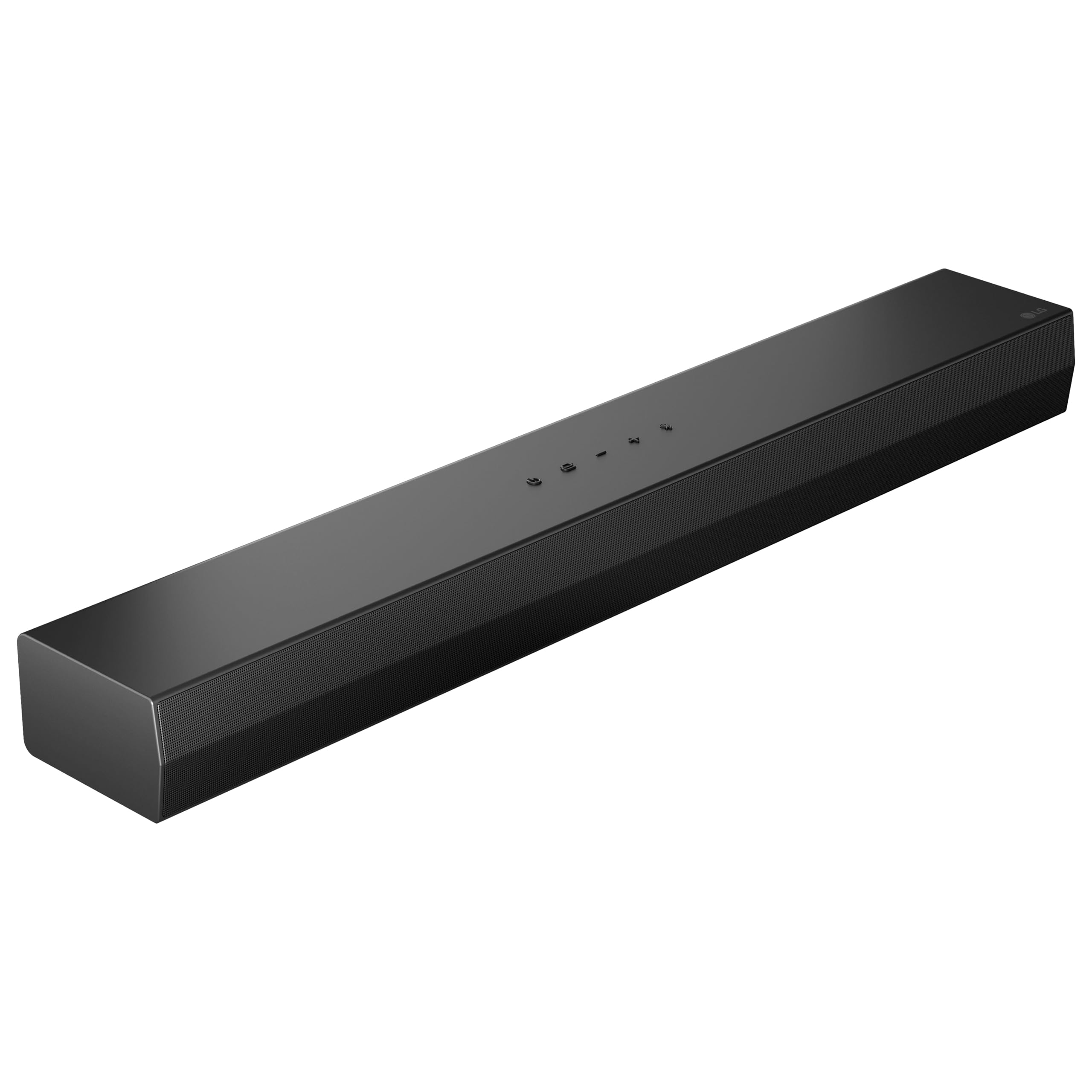
The LG S20A is a 2.0 soundbar (no separate subwoofer) that relies on a built-in passive radiator to produce bass. It is optimized for owners of recent LG TVs: WOW Orchestra mode lets you use the TV’s own speakers in tandem with the soundbar for a fuller soundstage, and the WOW Interface displays soundbar settings on the TV screen. AI Sound Pro analyzes the incoming audio in real time and adjusts the EQ curve to emphasize vocals in dialogue-heavy scenes or boost bass during action sequences.
The metal grille design adds a premium tactile feel, and the slim profile sits low enough to avoid blocking TV IR sensors. HDMI ARC is the primary connection — notably, there is no optical input, which limits compatibility with older TVs. Setup with a compatible LG TV is essentially plug-and-play: the soundbar is detected automatically, and volume control passes to the TV remote. The LG ThinQ app provides a three-band EQ for manual tuning, though the auto mode handles most content well.
The absence of a subwoofer is the obvious tradeoff — the passive radiator provides decent low-end for a soundbar of this size, but it cannot match the physical impact of a dedicated sub. If you have a newer LG TV and prioritize clean looks and TV-Soundbar synergy over deep bass, the S20A is a refined choice.
Why it’s great
- WOW Orchestra combines TV and soundbar speakers
- AI Sound Pro auto-adjusts EQ per content type
- Sleek metal grille design with dust protection
Good to know
- No optical input; requires HDMI ARC
- Built-in passive radiator cannot match subwoofer bass
8. Westinghouse 2.0 Compact
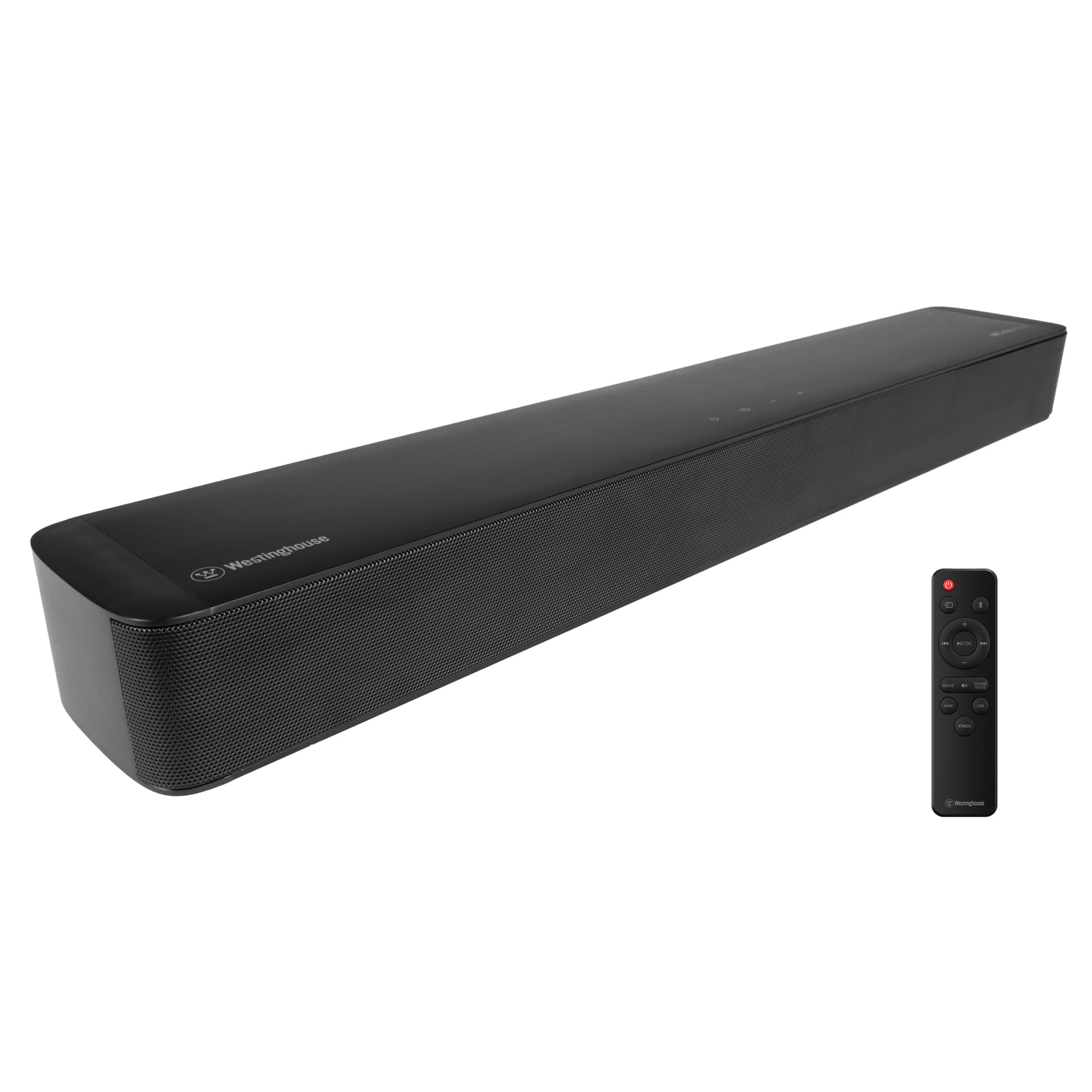
The Westinghouse 2.0 Compact is one of the few soundbars under that includes Dolby Atmos and Dolby Digital Plus processing. It is a 2.0 system with 120W of total power, and the spatial audio processing creates a wider, more immersive soundstage than a basic stereo bar. It is also Roku TV Ready, which integrates volume and power control into the Roku remote for a cleaner cable management experience.
Dialogue clarity is notably improved over built-in TV speakers, and the soundbar stays clean at moderate listening levels. Connectivity includes HDMI, optical, USB, and AUX, with Bluetooth 5.3 for wireless streaming. The setup process is simple: connect HDMI ARC to the TV and the soundbar is recognized instantly. The slim profile is compatible with most TV stands, and the included wall mount kit adds placement flexibility.
The audio quality is decent for the price, but there is no subwoofer and the low-end roll-off is noticeable — bass-heavy content will sound thin. The system performs best for news, talk shows, and casual music listening. For buyers on a strict budget who still want Atmos processing capability, the Westinghouse delivers.
Why it’s great
- Dolby Atmos processing at entry-level price
- Roku TV Ready for one-remote operation
- Multiple connectivity options (HDMI, optical, AUX)
Good to know
- No subwoofer included; bass extension is limited
- Not compatible with non-smart TVs without HDMI
9. MEREDO G38 3.1
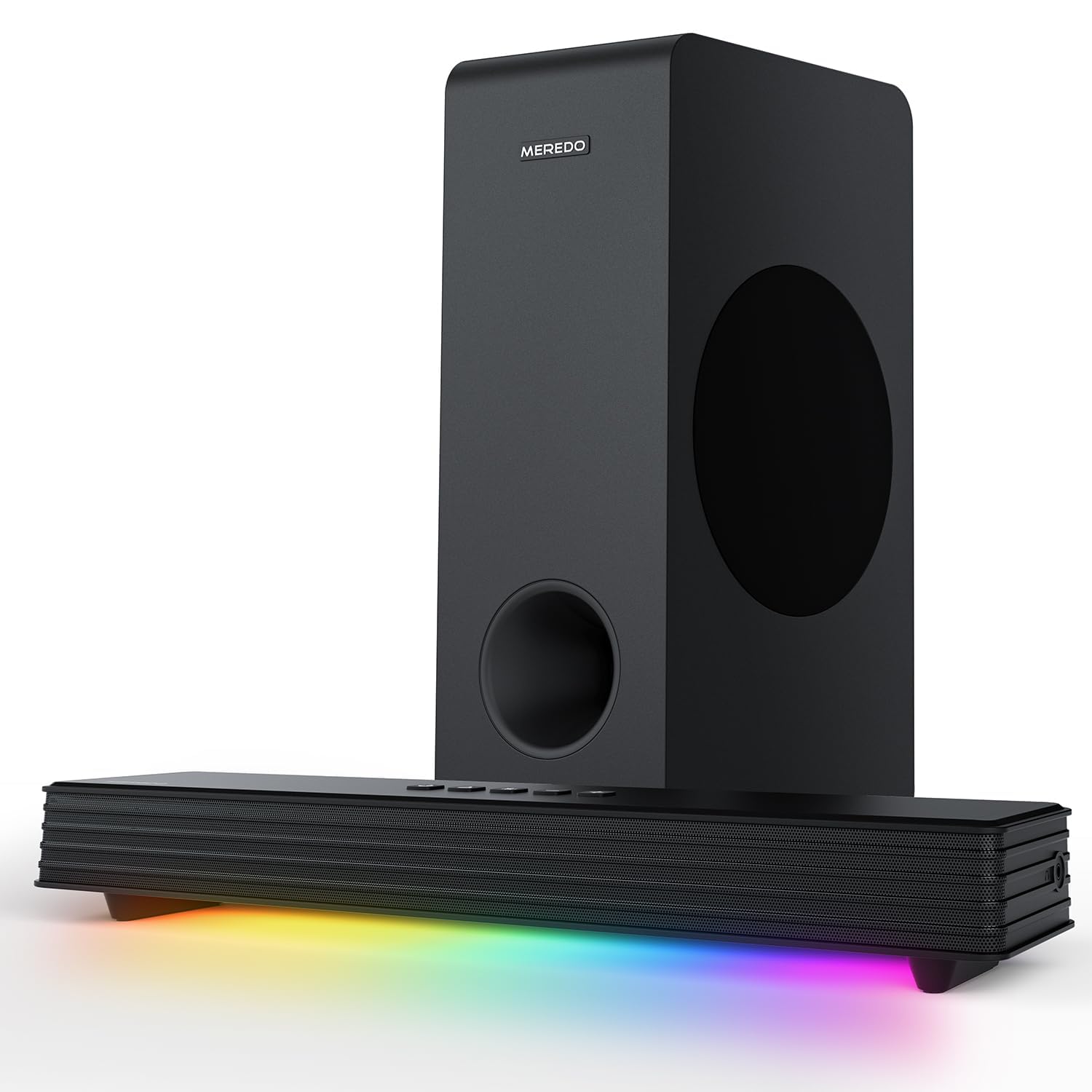
The MEREDO G38 is a 3.1-channel soundbar with a wired subwoofer and addressable RGB lighting that syncs with the audio. It is designed primarily for PC gaming setups and desktop use, though it works with TVs via HDMI ARC or optical. The 160W peak power output is adequate for a desk environment, and the dedicated center channel improves dialogue clarity compared to a 2.0 system. RGB lighting modes include six colors, flow patterns, and four rhythm modes that respond to the audio signal.
Gamers will appreciate the dedicated Game EQ mode and the headphone jack on the soundbar for quick switching between speakers and a gaming headset. The subwoofer is a 5-inch wired unit that provides present bass, though it can sound muddy at higher volumes if the bass is maxed out. Connectivity is robust with Bluetooth 5.3, HD-ARC, optical, AUX, and USB. The slim 39.9mm profile fits easily under a monitor or TV.
Customer support has been highly responsive, with several reports of swift warranty replacements when units failed. The RGB lighting is the main differentiator — it is a visual aesthetic choice rather than a performance feature. For desktop gamers who want immersive lighting and solid 3.1 audio in a compact form factor, the G38 fits the bill.
Why it’s great
- 3.1 channel with dedicated center for clear dialogue
- RGB lighting syncs with music and game audio
- Headphone jack for quick headset switching
Good to know
- Bass can sound muddy at high volumes
- Wired subwoofer limits placement flexibility
FAQ
Does a $200 soundbar really need HDMI eARC?
How do I know if my room needs a soundbar with satellite speakers?
Can I use a $200 soundbar for music, or is it just for movies?
Final Thoughts: The Verdict
For most users, the $200 soundbar winner is the JBL Bar 2.1 Deep Bass (MK2) because its 6.5-inch subwoofer delivers the deepest, most room-filling bass in this price bracket, and the three-level bass control lets you tune the low end to your room. If you want adaptive sound that automatically calibrates to your content, grab the Samsung HW-B550F and its DTS Virtual:X processing. And for a true multi-speaker surround setup without leaving the $200 range, nothing beats the ULTIMEA Aura A40 with its four dedicated satellite speakers and app-based equalizer.