
Our readers keep the lights on and the weekend projects moving. As an Amazon Associate, I earn from qualifying purchases.
A birding telescope lives or dies by its glass. You haul it into marshes, forests, and shorelines to pull distant warblers and raptors into sharp focus, and every ounce of weight, every millimeter of objective lens, and every coating on the prism either rewards or punishes that decision. The right spotting scope turns a smudge on a ridgeline into a species you can count pinfeathers on; the wrong one leaves you with chromatic fringing, dim images at dawn, and a sore shoulder by midday.
I’m Rikta — the co-founder and writer behind FitlyFast. I’ve spent hundreds of hours cross-referencing optical specifications, decoding marketing claims like “fully multi-coated” and “ED glass,” and mapping real customer field reports to the technical specs that actually matter for birders who glass for hours in changing light.
Whether you are a backyard birder upgrading from binoculars or a dedicated lister heading into the field with a tripod, this guide cuts through the jargon to help you confidently choose the best birding telescope for your specific observing style and budget.
How To Choose The Best Birding Telescope
Selecting a spotting scope for birding is different from buying one for target shooting or astronomy. You need a balance of light-gathering ability, overall portability, and optical clarity that lets you separate a downy woodpecker from a hairy woodpecker at 150 yards. Here are the four specifications that define your experience in the field.
Objective Lens Diameter: The Light Bucket
The number after the magnification (e.g., 80 in 20-60×80) is the diameter of the objective lens in millimeters. More millimeters mean more light enters the scope, which directly translates to brighter images in low-light conditions like dawn, dusk, or deep shade. An 80mm or 85mm objective is the standard for serious birders who want to extend their viewing window. A 65mm objective saves weight and is easier to pack, but you sacrifice some brightness at the edges of the day.
Glass Type: ED vs. Standard
Extra-low Dispersion (ED) glass is the single most important optical upgrade you can make. ED glass dramatically reduces chromatic aberration — the purple or green fringing you see along high-contrast edges like a white egret against a dark sky. Standard glass (often called “HD” or “fully multi-coated” without the ED label) will still show some fringing at high magnification. If you plan to push your scope to 60x, ED glass is not a luxury; it is a necessity for clear feather detail.
Angled vs. Straight Eyepiece
An angled eyepiece (usually 45 degrees) lets you look down into the scope when mounted on a full-height tripod, which is far more comfortable for long viewing sessions. It also makes sharing the scope with others easier because everyone uses the same eyepiece height. A straight eyepiece is faster to acquire targets on the ground or from a car window mount, but it often forces you to crouch or strain your neck. For dedicated tripod birding, angled is the clear winner.
Build Quality and Environmental Sealing
A birding scope will face morning dew, light rain, dust, and temperature swings. Nitrogen or argon purging prevents internal fogging, and O-ring sealing keeps out moisture. Rubber armor protects the body from bumps on rocks and branches. A scope that saves money by skipping these seals will eventually develop internal haze or fungus, ruining the optics permanently. Always look for waterproof and fogproof claims backed by actual gas purging.
Quick Comparison
On smaller screens, swipe sideways to see the full table.
| Model | Category | Best For | Key Spec | Amazon |
|---|---|---|---|---|
| Vortex Diamondback HD | Mid-Range | All-around field use with VIP warranty | HD optics, 85mm objective | Amazon |
| Nikon Prostaff 5 Proscope 82mm | Mid-Range | Detailed feather identification | 82mm fully multi-coated optics | Amazon |
| Leupold SX-4 Pro Guide HD | Premium | Dawn/dusk observation in wet climates | 85mm, DiamondCoat 2, argon purged | Amazon |
| Maven CS.1 15-45x65mm | Premium | Packable backcountry or hike-in birding | ED glass, 65mm objective, 40.4 oz | Amazon |
| Celestron Regal M2 80ED | Premium | Optical purity with ED glass | 80mm ED objective, dual focus | Amazon |
| Celestron Regal M2 100ED | Premium | Maximum light gathering in heavy cover | 100mm ED objective, 22-67x zoom | Amazon |
| Athlon Argos HD 20-60×85 | Mid-Range | Budget-friendly entry into large objective | 85mm, HD glass, argon purged | Amazon |
| Athlon Talos 20-60×80 | Budget | First-time scope buyer or casual birder | 80mm, fully multi-coated, nitrogen purged | Amazon |
| Bushnell Trophy Xtreme | Budget | Entry-level value with carrying cases | 20-60x, fully multi-coated | Amazon |
In‑Depth Reviews
1. Vortex Optics Diamondback HD Spotting Scopes

The Vortex Diamondback HD strikes the most versatile balance in the mid-range tier. Its HD optical system delivers exceptional resolution and cuts chromatic aberration noticeably better than budget scopes, though it is not quite ED-glass free of fringing. The 85mm objective gathers enough light for confident viewing until the last moments of dusk, and the built-in helical focus wheel allows fast, precise adjustments even with gloved hands.
Field reports consistently praise the crisp image across the zoom range and the solid, weather-sealed build. The Arca-Swiss compatible tripod foot is a thoughtful upgrade for users who already have a quality tripod head. At just 3.1 pounds, it is light enough for moderate hiking without sacrificing the larger objective diameter that serious birders need.
The biggest differentiator here is the Vortex VIP warranty — unconditional, unlimited, and fully transferable. This removes long-term risk from the purchase and makes the Diamondback HD a smart investment for the birder who wants one scope to cover everything from marsh boardwalks to mountain ridges.
Why it’s great
- HD optics deliver sharp, bright images with low chromatic aberration.
- Arca-Swiss compatible foot improves tripod mounting flexibility.
- Backed by Vortex’s unconditional lifetime VIP warranty.
Good to know
- Not ED glass; some color fringing visible at maximum zoom on high-contrast subjects.
- Eyepiece can feel stiff on some units during break-in.
2. Nikon Prostaff 5 Proscope 82mm Angled Body with 20-60x Zoom

Nikon’s Prostaff 5 Proscope has earned a dedicated following among birders who prioritize contrast and color fidelity. The 82mm fully multi-coated optics produce a notably bright and high-contrast image, with internal surface texturing that minimizes reflective light loss. Users consistently report that this scope rivals optics at nearly twice the price when it comes to resolving feather detail at ranges of 100-200 yards.
The 20-60x zoom range covers typical birding distances well, and the built-in sliding sunshade is genuinely useful for reducing glare on bright marsh or shoreline mornings. One common observation is that the scope does not hold focus when you zoom — you will need to re-focus after changing magnification, which slows down the process of tracking a moving bird.
At 4.1 pounds, it is heavier than the Vortex Diamondback, so it is better suited to setups where the tripod stays in one place for a session. The angled body makes extended viewing comfortable, but the neoprene sleeve and fussy objective lens cover have drawn mild criticism from long-term users. The Nikon warranty covers defects well, though some users have reported water ingress issues that were resolved through the warranty process.
Why it’s great
- Excellent contrast and color rendition for detailed feather identification.
- Sliding sunshade effectively cuts glare in bright outdoor conditions.
- Bright 82mm objective extends usable viewing into low light.
Good to know
- Does not hold focus when changing magnification; requires re-focusing.
- Heavier build (4.1 lbs) and long length reduce packability for hiking.
3. Leupold SX-4 Pro Guide HD 20-60x85mm Spotting Scope

The Leupold SX-4 Pro Guide HD represents a genuine step up in light transmission and overall image clarity. Its DiamondCoat 2 ion-assist lens coating maximizes light throughput while providing the highest level of abrasion resistance in this class. Birders who glass in the first and last hours of light will notice a real advantage — colors remain vibrant and details stay sharp when lesser scopes have already gone dim.
Build quality is excellent across the board: the rubber armor provides a secure grip in wet conditions, and the argon purging ensures fogproof performance even when moving between cold air and warm wetlands. The 85mm objective pairs well with the 20-60x zoom, and the fast focus mechanism allows you to track birds in flight without losing the image. Ample eye relief makes this scope comfortable for eyeglass wearers.
The main caveats are size and weight — this is a scope designed for a stable tripod, not for packing miles into the backcountry. The premium pricing also means it competes directly with other high-end options, though most users agree the optical quality justifies the investment for serious birders who spend long hours behind the glass.
Why it’s great
- DiamondCoat 2 coating delivers superior light transmission and scratch resistance.
- Argon purged and fully waterproof for reliable use in all weather.
- Bright, crisp image quality at high magnification even in low light.
Good to know
- Large and heavy design is not ideal for long hikes or travel packing.
- Premium price point represents a significant investment for casual birders.
4. Maven CS.1 Spotting Scope – 15-45x65mm with ED Glass

The Maven CS.1 is built for the birder who hikes to their viewing spot. At 40.4 ounces with a 65mm objective, it is significantly lighter and more compact than the 80mm-plus scopes, while still incorporating genuine ED glass that virtually eliminates chromatic aberration. The 15-45x magnification range is slightly less aggressive at the top end, but the image clarity at 45x with ED glass often outperforms a standard-glass scope pushed to 60x.
Users consistently remark on the clarity and color accuracy at distances from 800 yards to 2 miles — well beyond typical birding ranges, which speaks to the quality of the optical design. The angled body improves viewing comfort on a tripod, and the spinning mounting ring adds flexibility for finding the best eyepiece position. The build feels rugged and well-sealed against the elements.
The trade-off for the weight savings is a 65mm objective that gathers less light than an 80mm scope at dawn and dusk. If you plan to glass primarily in full daylight or early morning, this is a non-issue, but hardcore dawn patrol birders may want the extra light of a larger objective. The magnification adjustment is also reported to be slightly stiff on some units.
Why it’s great
- Genuine ED glass delivers sharp, color-accurate images with no fringing.
- Lightweight (40.4 oz) and compact for easy backpack carry.
- Excellent build quality and weatherproof sealing.
Good to know
- 65mm objective limits low-light performance compared to larger scopes.
- Magnification ring can feel stiff and lacks a rubber grip surface.
5. Celestron Regal M2 80ED Spotting Scope
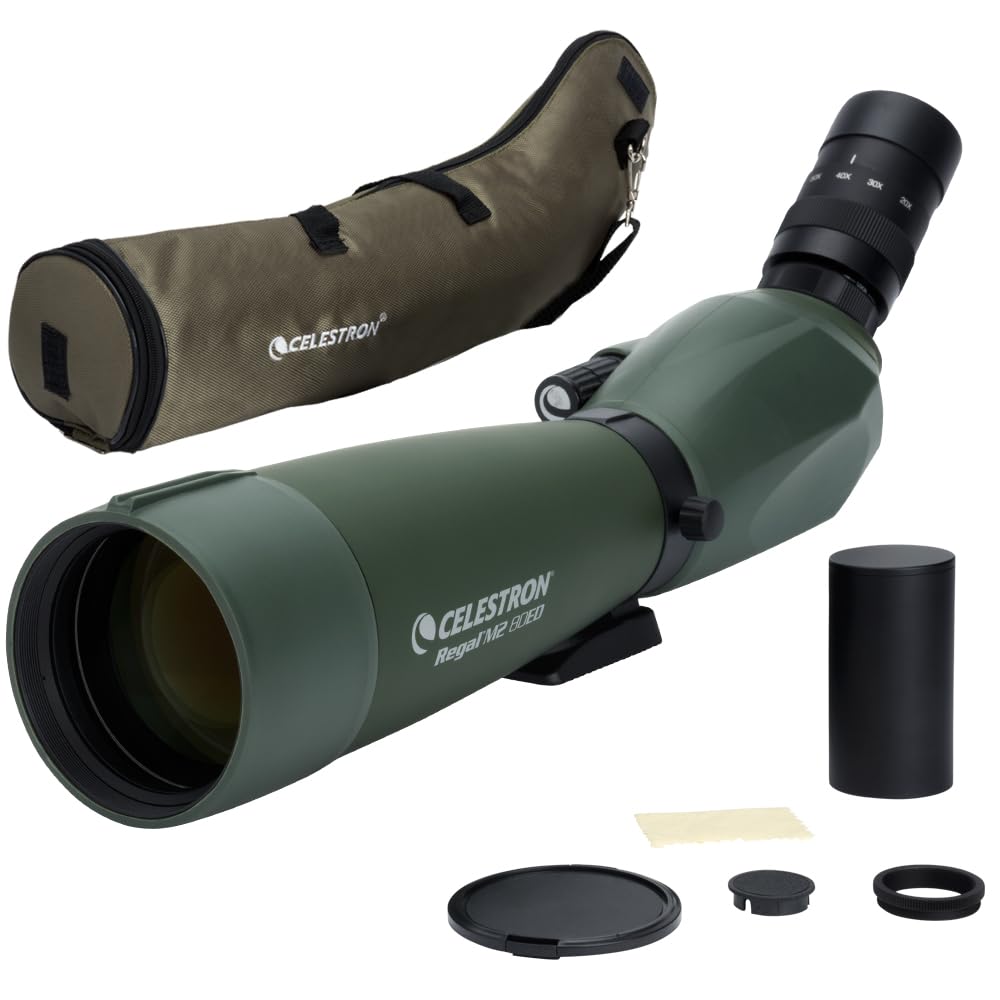
The Celestron Regal M2 80ED is the entry point to true ED glass performance without jumping to flagship pricing. The extra-low dispersion objective lens virtually eliminates chromatic aberration, producing razor-sharp images with superb color correction that standard HD glass cannot match. Celestron’s XLT coatings, borrowed from their observatory telescopes, maximize light transmission for noticeably brighter images.
The dual-focus mechanism is a standout feature for birders: a coarse focus wheel gets you in the ballpark quickly, while a fine focus ring lets you dial in precise sharpness on fine feather details. The rotating tripod mount with click stops allows comfortable viewing at any angle, and the included T-mount adapter makes digiscoping with a DSLR straightforward. The 20-60x zoom eyepiece is generous in its range.
At 4.5 pounds, the 80ED is noticeably tail-heavy, which means your tripod head needs to be up to the task of balancing it. Some users have also noted that the tripod mounting plate cannot be reversed to shift the center of gravity. The focus knob placement takes a day or two to become intuitive, but the optical payoff is well worth the minor ergonomic adjustment.
Why it’s great
- True ED glass eliminates color fringing for crisp, pure feather detail.
- Dual focus mechanism (coarse and fine) enables precise sharpness tuning.
- Includes T-mount adapter for easy digiscoping with a DSLR.
Good to know
- Tail-heavy design requires a strong tripod head for proper balance.
- Focus knob placement feels awkward for the first few field sessions.
6. Celestron Regal M2 100ED Spotting Scope
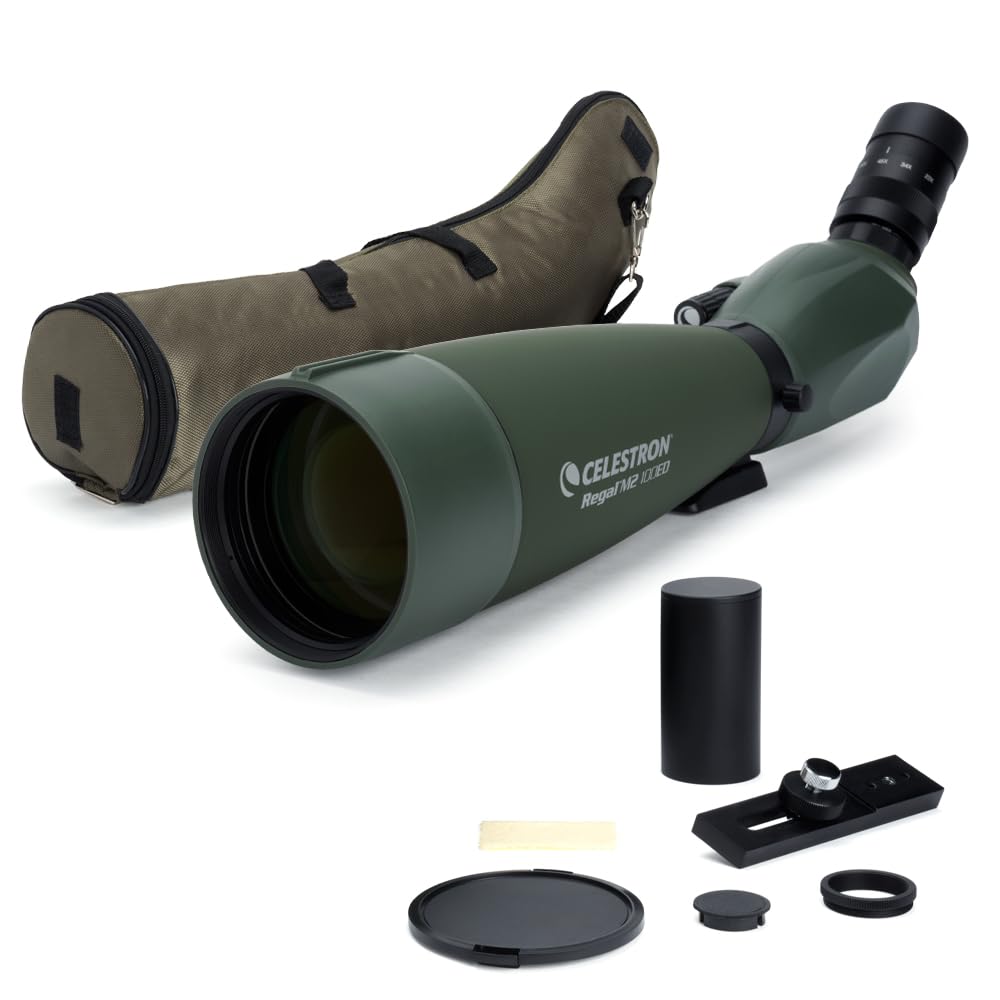
The Celestron Regal M2 100ED takes everything the 80ED does well and scales it up for maximum low-light performance. The 100mm objective gathers dramatically more light than any 65mm or 80mm scope, making it the top choice for birders who operate in heavy forest canopy, overcast conditions, or the deepest twilight hours. The ED glass and XLT coatings remain the same excellent optical foundation.
The 22-67x zoom eyepiece gives you slightly more reach than the 80ED model, and the image remains clear and color-true across the entire range thanks to the ED glass. The rotating tripod mount and dual-focus mechanism carry over, providing the same flexible viewing angles and fine-tuning capability. The magnesium alloy body keeps the weight manageable for this class, though it is still 5 pounds.
The size and weight are the main considerations — this is a scope that stays on a sturdy tripod rather than going in a daypack. The tail-heavy balance issue is even more pronounced here than on the 80ED. For the birder who can set up a fixed observation post or works from a vehicle, the 100ED delivers an image quality that rivals much more expensive alpha-tier scopes.
Why it’s great
- 100mm objective provides unmatched brightness in low-light conditions.
- ED glass and XLT coatings produce excellent color correction and clarity.
- Generous 22-67x zoom range with comfortable viewing angles.
Good to know
- Heavy and bulky; requires a robust tripod and is not hike-friendly.
- Tail-heavy balance makes tripod head selection critical.
7. Athlon Optics Argos HD 20-60×85 Spotting Scope

The Athlon Argos HD provides an 85mm objective and HD glass at a price point that undercuts many 80mm scopes. For the birder on a mid-range budget who wants a larger objective without moving to premium pricing, this is a compelling option. The argon purging and waterproof seals mean it holds up in wet field conditions, and the 45-degree angled eyepiece makes tripod use comfortable.
Image quality is good in bright light, with the HD glass providing reasonable color accuracy and sharpness. However, the glass is not ED, so chromatic aberration becomes visible at magnifications above 40x on high-contrast subjects like white birds against blue sky. The 20-60x zoom range is present on paper, but real-world useful clarity tops out around 40x for critical feather detail.
The rubber-armored polycarbonate body keeps weight manageable at 68 ounces, and the included soft case provides basic protection. The eye relief is tight for eyeglass users, and phone digiscoping is challenging due to the short eye relief. For the birder who uses a scope primarily in good light and values a large objective above premium glass coatings, the Argos HD delivers remarkable value.
Why it’s great
- Large 85mm objective at a very accessible price point.
- Argon purged and waterproof for reliable field use in wet weather.
- Angled eyepiece and rotating tripod ring enhance viewing comfort.
Good to know
- Non-ED glass shows chromatic aberration above 40x magnification.
- Short eye relief makes phone digiscoping and glasses use difficult.
8. Athlon Optics Talos 20-60×80 Spotter Scope

The Athlon Talos is the scope that proves you do not need to spend heavily to get into birding with a spotting scope. The 80mm objective and fully multi-coated lenses deliver surprisingly bright images for the price point, and the nitrogen purging provides genuine waterproof and fogproof performance that many budget scopes skip entirely. For the birder trying a spotting scope for the first time, this removes significant financial risk.
Users report clear glass out to ranges typical for birding, with good contrast and minimal distortion at magnifications up to 40x. The scope is lightweight and quick to set up, and the included tripod — while basic — is sufficient for getting started. The 20-60x zoom range gives you room to grow as you learn what distances and species you prefer to observe.
The limitations are predictable at this tier: image quality degrades noticeably above 40x, with reduced brightness and increased softness. The included tripod is not sturdy enough for stable viewing at high magnification, so upgrading to a better tripod should be considered part of the overall investment. Eye relief is adequate but not generous, and the straight eyepiece design requires a lower tripod height or a stool for comfortable use.
Why it’s great
- 80mm objective provides a bright image for the price.
- Nitrogen purged for reliable waterproof and fogproof performance.
- Lightweight build and easy setup for new spotting scope users.
Good to know
- Image clarity drops significantly above 40x magnification.
- Included tripod is too lightweight for stable high-magnification use.
9. Bushnell Trophy Xtreme Spotting Scope

The Bushnell Trophy Xtreme is the entry-level kit that gives you everything needed to start birding with a scope immediately. The fully multi-coated optics provide decent brightness for daytime use, and the included hard case, soft case, and tabletop tripod mean you have protection and a mounting solution out of the box. The 20-60x zoom range is standard for the class.
In practical use, the scope performs best at 20-30x magnification where the image remains clear and colors hold well. At 40x and above, color washout and clarity loss become apparent, and at 60x the image is dim and soft even in good light. The included tabletop tripod is adequate for sitting at a table or ground-level use but is not tall enough for standing observation with a straight eyepiece.
The window mount is a thoughtful inclusion that adds versatility for car-based birding. The rotating mount with click stops is functional and the sunshade helps reduce glare. The hard case is genuinely robust and provides good protection during transport. For the birder who wants to try a spotting scope without a large investment and learn what they need from an upgrade later, this kit serves that purpose well.
Why it’s great
- Complete kit with hard case, soft case, tripod, and window mount.
- Fully multi-coated optics provide decent brightness for daytime viewing.
- Includes rotating mount with click stops for easy positioning.
Good to know
- Image quality degrades significantly above 30x magnification.
- Included tripod is too short and unstable for serious field use.
FAQ
What is the ideal magnification range for a birding telescope?
Should I choose an angled or straight spotting scope for birding?
How important is a tripod for birding with a spotting scope?
Final Thoughts: The Verdict
For most users, the best birding telescope winner is the Vortex Diamondback HD because it combines excellent HD optics with an 85mm objective and an unconditional lifetime warranty at a fair price. If you want true ED glass that eliminates chromatic aberration for the sharpest feather detail, grab the Celestron Regal M2 80ED. And for a packable scope that you can actually carry into the backcountry, nothing beats the Maven CS.1 with its ED glass and 40.4-ounce weight.