
Our readers keep the lights on and the weekend projects moving. As an Amazon Associate, I earn from qualifying purchases.
Scanning 120 medium format film presents a unique challenge: you need a sensor and optical system capable of resolving the subtle tonal gradations and fine grain structure of a negative nearly three times larger than 35mm. A flatbed scanner that handles 35mm slides adequately often falls apart when asked to capture the full dynamic range and edge-to-edge sharpness of a 6×6 or 6×7 frame. The wrong choice leaves you with soft corners, visible Newton rings, or a dynamic range that clips your shadow detail.
I’m Rikta — the co-founder and writer behind FitlyFast. I’ve spent countless hours analyzing sensor types (CCD vs CIS), Dmax ratings, optical resolution figures, and film holder designs across dozens of scanner models to understand exactly which specs matter when digitizing medium format film.
This guide breaks down the best options for scanning your 120 negatives, from pro-level flatbeds to dedicated film scanners. After thorough research, here is my definitive take on the best 120 film scanner for preserving the richness of medium format photography.
How To Choose A 120 Film Scanner
Selecting a film scanner for medium format is different from buying a standard document flatbed. The larger film area demands higher optical resolution at the scan head and a holder that keeps the film perfectly flat. You also need software that can handle the color inversion and dust removal without destroying the detail you worked hard to capture.
Optical Resolution and Sensor Type
A 120 negative holds a lot of information, but a scanner’s optical resolution is what determines how much of that information makes it into your digital file. Look for a true optical resolution of at least 3200 dpi for acceptable 6×6 scans — many budget units quote interpolated numbers that are meaningless. CCD sensors are the gold standard for medium format because they offer deeper color depth and better dynamic range than CIS sensors, which tend to struggle with the dense shadow areas of film.
Dmax and Dynamic Range
The Dmax value represents the scanner’s ability to see into the darkest parts of your negative. A scanner with a Dmax of 3.6 or lower will block up shadow detail, turning subtle texture into solid black. For serious 120 work, look for a Dmax of 4.0 or higher — this is where the Epson Perfection V800 and similar premium flatbeds shine. A high Dmax also helps when scanning overexposed or high-contrast slides that have deep shadows alongside bright highlights.
Film Holders and Anti-Newton Ring Glass
Film flatness is critical. A curved 120 negative will produce out-of-focus edges and inconsistent sharpness across the frame. Many budget scanners ship with flimsy plastic holders that let the film buckle. Better options include adjustable-height holders or optional anti-Newton ring glass inserts that press the film flat without introducing the concentric ring artifacts that can ruin a scan. For the best results, consider a scanner that accepts third-party fluid-mount accessories.
Quick Comparison
On smaller screens, swipe sideways to see the full table.
| Model | Category | Best For | Key Spec | Amazon |
|---|---|---|---|---|
| Epson Perfection V800 | Premium Flatbed | High-end 120/35mm scanning | 6400 dpi Optical, Dmax 4.0 | Amazon |
| Pacific Image PowerSlide X Plus | Dedicated Slide | Batch 35mm slide archiving | 10000 dpi, 4.2 Dmax | Amazon |
| Plustek OpticFilm 135i | Dedicated 35mm | Precision 35mm batch scanning | 7200 dpi, IR Dust Removal | Amazon |
| CZUR ET24 Pro | Book & Document | Digitizing books & documents | 24MP, 320 DPI, OCR | Amazon |
| Epson FastFoto FF-680W | Photo Sheetfeed | Fast batch photo scanning | 600 dpi, 36-photo ADF | Amazon |
| Fujitsu fi-8170 | Document ADF | High-volume document scanning | 600 dpi, 10k daily vol. | Amazon |
| ScanSnap iX2500 | Photo & Doc Sheetfeed | Quick photo & document digitizing | 600 dpi, Wi-Fi 6 | Amazon |
| Plustek OpticFilm 8100 | Dedicated 35mm | Entry-level 35mm film scanning | 7200 dpi, CCD | Amazon |
| Canon imageFORMULA RS40 | Photo Sheetfeed | Mixed photo/document scanning | 600 dpi, 40 ppm | Amazon |
| CanoScan 8600F | Flatbed Photo/Film | Budget 35mm & 120 scanning | 4800 dpi Optical | Amazon |
| KODAK REELS | 8mm Film Digitizer | Converting 8mm film to digital | 8MP, 1080p | Amazon |
In‑Depth Reviews
1. Epson Perfection V800 Photo Scanner

The Epson Perfection V800 is the flatbed most serious medium format shooters end up with, and for good reason. Its dual-lens system switches between a high-resolution lens for 35mm and a dedicated lens optimized for the larger 120 format, ensuring edge-to-edge sharpness across a 6×9 frame. At 6400 dpi optical resolution with a 4.0 Dmax, it delivers shadow detail that budget flatbeds simply cannot match — those dense areas of a Portra 400 negative hold texture instead of turning into featureless black.
The included film holders are a mixed bag: the 120 holder holds two 6×7 frames or three 6×6 frames, which is efficient for a production run, but the plastic construction can allow slightly curled negatives to bow. Many dedicated users replace it with an aftermarket anti-Newton ring glass holder for the flattest possible scans. The Epson Scan software is capable in professional mode, offering full control over exposure, curve adjustments, and multiple pass scanning for grain reduction.
Scanning six 6×6 frames at 2400 dpi takes roughly 8-10 minutes, which is competitive for a flatbed in this class. The V800 also handles 35mm strips, mounted slides, and reflective prints up to 8.5×11.7 inches, making it a versatile studio tool. The main drawbacks are the weight (over 20 pounds) and the absence of built-in Digital ICE for film — you will need to spot-heal dust in post-processing.
Why it’s great
- Dual-lens system optimizes sharpness for both 35mm and 120 formats.
- 4.0 Dmax preserves shadow detail in high-contrast negatives.
- High 6400 dpi optical resolution captures fine grain structure.
Good to know
- Film holders are basic; an upgrade to glass holders is recommended for perfectly flat film.
- Lacks built-in infrared dust removal (ICE) for film.
- Heavy unit at 20.9 pounds, not ideal for portable setups.
2. Pacific Image PowerSlide X Plus

The PowerSlide X Plus is a dedicated 35mm slide scanner that excels at high-volume batch work, automatically feeding up to 50 mounted slides in a single run. Its true CCD linear array — not a CMOS Bayer sensor — delivers honest 10,000 dpi resolution with a 4.2 Dmax, which means deep, noise-free shadows and accurate color reproduction from dense Kodachrome slides. The unit outputs DNG raw files alongside standard JPGs, giving you maximum flexibility for post-processing.
In practice, the auto-feeder handles slides reliably with roughly one jam per 1000 scans, which is excellent for continuous operation. Each scan produces a 4000×6000 pixel file at around 15MB, suitable for large prints. The software interface has a learning curve — the manual is sparse and you need to order an extra magazine tray to keep the workflow smooth — but once configured, the speed is transformative for archiving large slide collections.
Keep in mind that this scanner is limited to 35mm mounted slides only; it cannot scan 120 medium format film or unmounted strips. The build quality is solid, though some users report software compatibility hiccups on newer MacOS versions, requiring a dedicated Windows machine for guaranteed stability. At this price point, it is a targeted tool for the slide archivist, not a general-purpose film scanner.
Why it’s great
- Auto-feeder handles 50 slides per batch with low jam rate.
- True CCD linear array delivers honest 10,000 dpi without Bayer interpolation.
- Outputs DNG raw files for professional post-processing.
Good to know
- Strictly for 35mm mounted slides — no 120 or strip support.
- Software setup is unintuitive and the manual is thin.
- Requires extra magazines for uninterrupted batch scanning.
3. Plustek OpticFilm 135i

The Plustek OpticFilm 135i is a dedicated 35mm scanner that brings professional-grade optics to the desktop. Its new 5-element lens design minimizes light refraction and improves infrared detection for dust and scratch removal, boosting modulation transfer function by up to 200% compared to earlier generations. At 7200 dpi optical resolution, it resolves the grain of even the finest-grained films without introducing the softness typical of flatbed scanners at similar magnification.
Batch scanning is a genuine productivity gain here: the 135i ships with two film holders that accommodate four mounted slides or six frames from a single 35mm strip in one pass. The SilverFast SE Plus 9 software provides ICC profile management with over 50 film profiles, though it has a steep learning curve and Auto Exposure can blow out dense negatives if you don’t switch to custom mode. The infrared dust removal works well on most emulsions but can struggle with Kodachrome’s metallic dyes.
Scan speeds are the trade-off — expect 2-3 minutes per frame at 3600 dpi, and longer at full resolution. The 135i is also limited strictly to 35mm; medium format shooters will need a separate solution. For those with a large 35mm archive, the combination of optical precision and batch capability makes this a focused, high-quality tool.
Why it’s great
- 5-element lens with enhanced IR performance for better dust removal.
- Batch scans up to 6 frames or 4 slides in one pass.
- Extensive ICC film profile library for accurate color reproduction.
Good to know
- Slow scanning: 2-3 minutes per frame at moderate DPI settings.
- Software can be unintuitive, with Auto Exposure prone to blowing out negatives.
- No 120 medium format support — 35mm only.
4. CZUR ET24 Pro

The CZUR ET24 Pro is not a film scanner — it is a high-resolution book and document camera system designed to digitize bound materials without damaging spines. Its 24-megapixel CMOS sensor captures up to A3-size pages at 320 DPI, and the third-generation auto-flattening technology corrects page curvature in real time. The included foot pedal and fast capture speed make it a powerful tool for digitizing magazines, textbooks, and reference sheets.
For film scanning, this unit is not the right tool — it lacks a transparency adapter, LED backlight, and the dynamic range needed to capture the full tonal spectrum of a negative. The side supplement lights help reduce glare on glossy paper, but highly reflective surfaces remain problematic. CZUR’s bundled software includes ABBYY OCR for converting images to editable text across 180 languages, which is excellent for document workflows.
The ET24 Pro connects via USB and also supports HDMI output for live projection during presentations. Build quality is robust, and the setup is straightforward for Mac, Windows, and Linux systems. If your primary need is digitizing books and documents, this is a capable and fast option, but it should not be considered for any serious film or negative scanning.
Why it’s great
- Fast capture with auto-flattening and deskew for bound documents.
- 24MP resolution with A3 scan area covers oversized materials.
- Foot pedal allows hands-free operation for efficient workflows.
Good to know
- Not suitable for scanning film negatives or slides — no transparency backlight.
- Struggles with highly glossy or reflective paper surfaces.
- OCR and software features are focused on text, not photo editing.
5. Epson FastFoto FF-680W
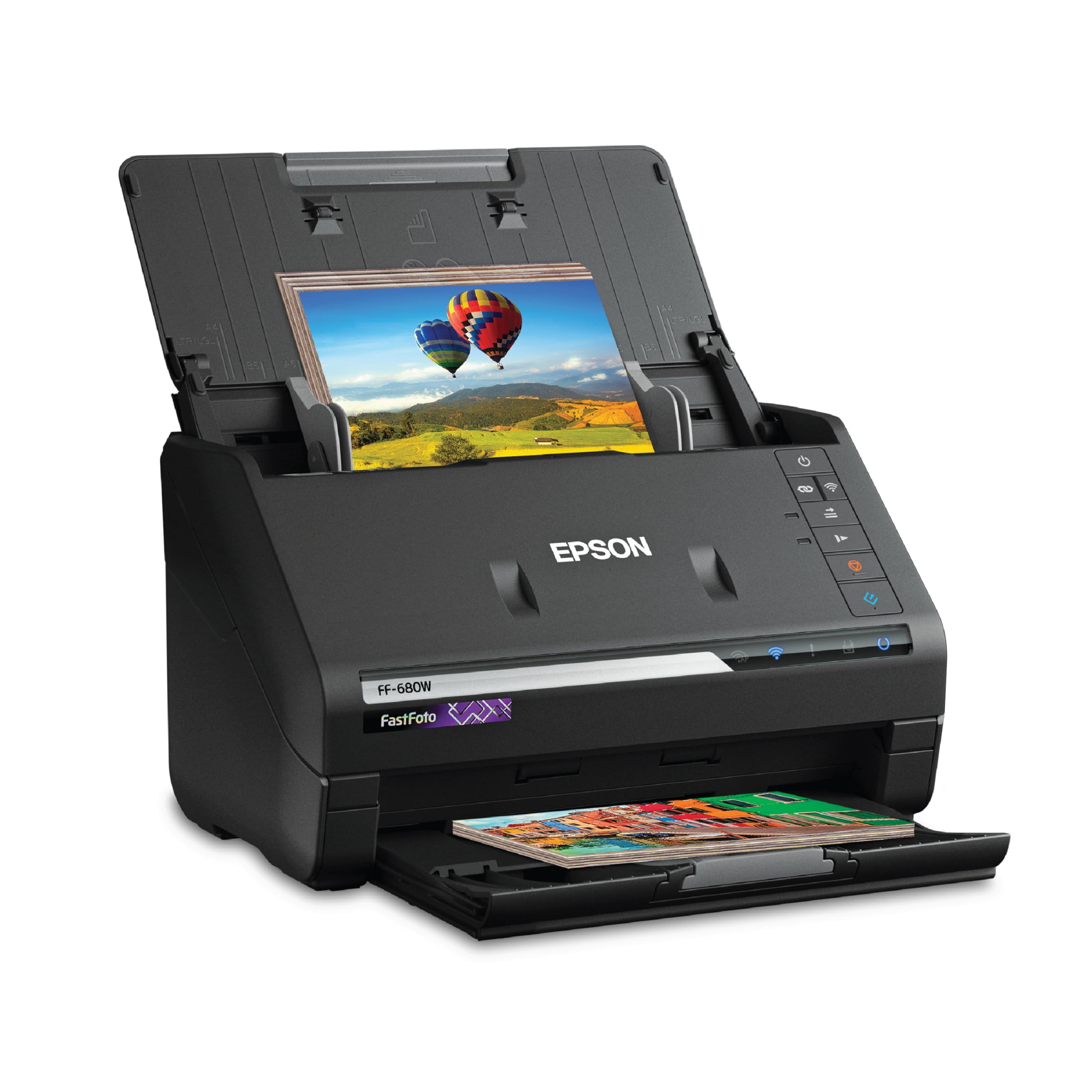
The Epson FastFoto FF-680W is engineered for one specific job: digitizing large stacks of printed photographs at extreme speed. Its automatic document feeder accepts up to 36 photos at once and scans both sides simultaneously at up to one photo per second at 300 dpi. This is a sheet-feed scanner, not a flatbed, so it cannot handle film negatives, slides, or thick cardstock that doesn’t flex through the rollers.
The bundled software auto-enhances faded colors, corrects red-eye, and can rotate images based on orientation detection. In practice, the auto-enhancement is impressive for restoring 1970s-era prints but can over-sharpen and introduce graininess on well-preserved photos. The double-sided scanning is a standout feature for capturing handwritten dates or notes on the back of prints without a second pass. Wi-Fi connectivity allows direct upload to cloud services like Google Drive and Dropbox.
Where the FF-680W falls short is build complexity — glued or taped photos can jam, and the auto-feed occasionally misaligns mixed-size stacks. It is also strictly for paper photos; if you need to scan medium format film alongside your prints, you will need a separate flatbed. For pure high-volume photo digitizing, it is the fastest consumer option available, but its narrow use case limits its versatility.
Why it’s great
- Blazing speed: up to 1 photo per second at 300 dpi.
- Duplex scanning captures both sides of photos in a single pass.
- Wi-Fi and cloud integration for direct backup to Google Drive.
Good to know
- Cannot scan film negatives, slides, or medium format — photo paper only.
- Auto-enhancement can over-process and introduce grain on high-quality prints.
- Prone to jams with taped, glued, or irregularly shaped photos.
6. Fujitsu fi-8170 Document Scanner

The Fujitsu fi-8170 is a heavy-duty document scanner built for offices that process thousands of sheets daily. With a recommended daily volume of 10,000 scans and a 100-sheet automatic document feeder, it is designed for throughput, not image quality. Its CIS sensor and 600 dpi optical resolution are adequate for text documents and receipts but lack the tonal range and sharpness required for film scanning.
Network connectivity via LAN and USB gives flexibility in shared office environments, and the simplex/duplex scanning speeds are excellent for batch processing. However, this scanner has no transparency adapter, no film holder, and no backlight — it simply cannot scan negatives or slides. The build quality is robust, with metal internal components designed for high-cycle use.
For users who need a reliable office scanner for invoices, contracts, and forms, the fi-8170 is a top-tier choice. But it has absolutely no place in a medium format film workflow. If you see this listed as a film scanner alternative, ignore it — it is a document tool through and through.
Why it’s great
- High daily duty cycle of 10,000 scans for demanding office environments.
- LAN and USB connectivity for flexible network deployment.
- Robust build quality with metal components for longevity.
Good to know
- CIS sensor and 600 dpi are insufficient for quality film scanning.
- No transparency adapter or film holder — cannot scan negatives or slides.
- Software configuration can be cumbersome for non-standard workflows.
7. ScanSnap iX2500 Photo Edition
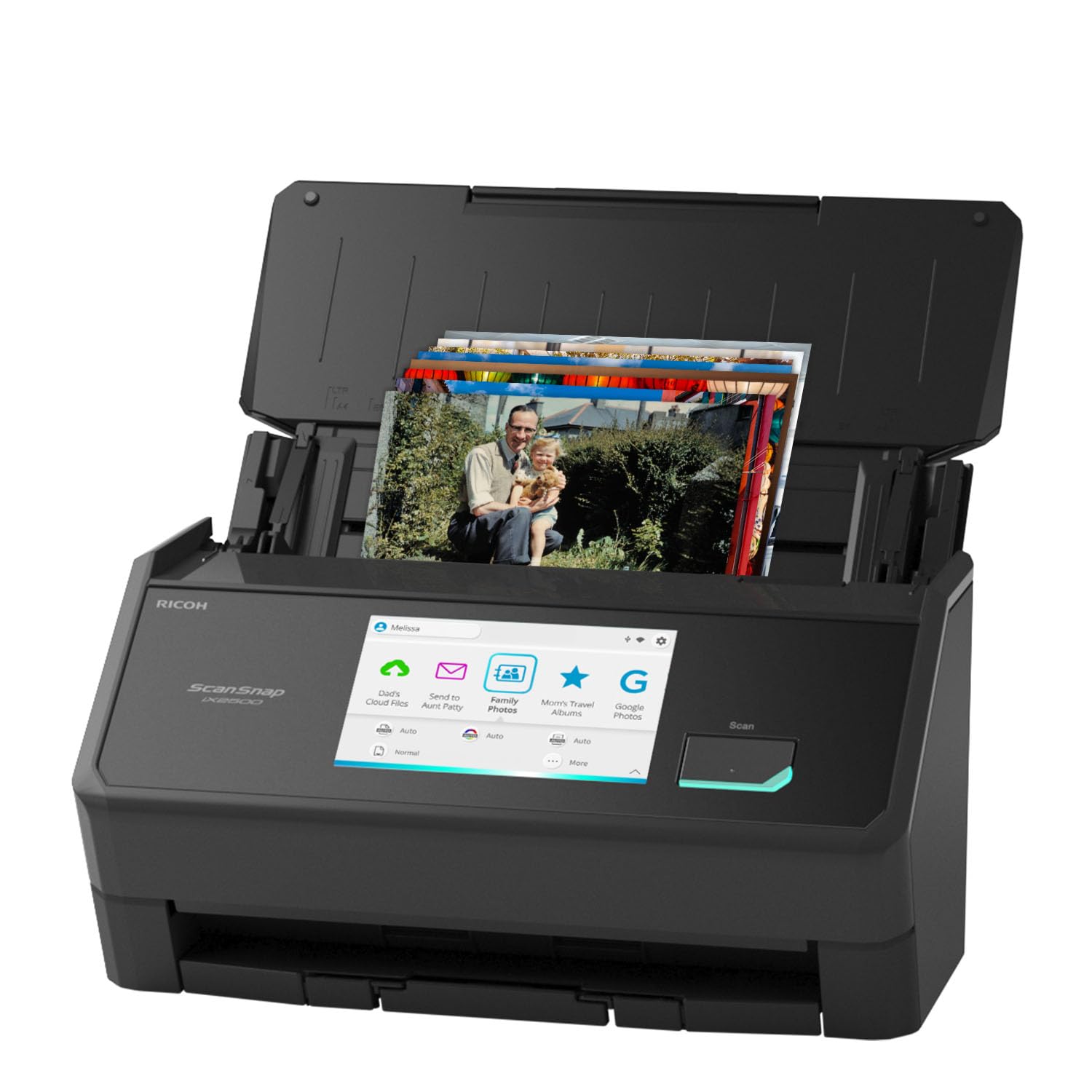
The ScanSnap iX2500 Photo Edition is a sheet-feed scanner that excels at digitizing both documents and printed photos with convenience features like a large 5-inch touchscreen and Wi-Fi 6 connectivity. Its 600 dpi optical resolution is fine for text and 4×6 prints, but the CIS sensor and lack of a transparency backlight mean it cannot handle film negatives or slides of any format — 35mm or 120.
The Photo Edition includes three carrier sheets for delicate or curled prints, and the automatic document feeder holds up to 100 sheets or 36 photos. Scan speeds are impressive at up to 100 photos per minute, and the software suite offers auto-optimization, color correction, and direct cloud upload. However, the software interface is often criticized for poor UI design and unreliable auto-rotation of images.
For a mixed office workflow that involves receipts, business cards, and occasional photo digitizing, the iX2500 is a solid mid-range option. It is not a film scanner, and its 600 dpi ceiling means it cannot compete with dedicated film scanners for archival quality. If your primary need is scanning 120 negatives, this is not the right device.
Why it’s great
- Fast scanning with a 100-sheet ADF and Wi-Fi 6 connectivity.
- Large 5-inch touchscreen for easy profile selection and scanning control.
- Carrier sheets protect delicate or curled photos during feeding.
Good to know
- 600 dpi and CIS sensor are insufficient for quality film or slide scanning.
- Software interface has a poor UI and unreliable auto-rotation.
- Cannot scan negatives or slides — strictly for paper photos and documents.
8. Plustek OpticFilm 8100

The Plustek OpticFilm 8100 is an entry-level dedicated 35mm film scanner that punches above its price class in optical quality. Its CCD sensor and 7200 dpi resolution produce scans with genuine sharpness and color depth that can rival more expensive units for 35mm work. At 3600 dpi — a practical setting for most uses — scan quality easily surpasses what a mid-range flatbed like the Epson V600 can deliver for the same format.
The bundled SilverFast SE Plus 8 software is powerful but has a steep learning curve. It offers multi-pass scanning for reduced noise, ICE dust removal using infrared, and a wide range of output formats. The negative carrier system works well for strips up to 6 frames, but loading each frame individually can be tedious for large batches. Scan times at 3600 dpi average 2-3 minutes per frame, and the small 4.7 x 4.7 inch footprint makes it easy to keep on a desk.
The 8100 is strictly a 35mm scanner — it has no support for 120 medium format film whatsoever. The software occasionally exhibits glitches such as resetting filenames after auto-framing, requiring manual correction. For photographers focused exclusively on 35mm who want better quality than a flatbed at a moderate price, the OpticFilm 8100 is a strong contender.
Why it’s great
- CCD sensor and 7200 dpi deliver superior sharpness for 35mm scans.
- SilverFast SE Plus 8 includes professional tools like ICE and multi-pass scanning.
- Compact footprint fits easily on any desk or workspace.
Good to know
- No support for 120 medium format — limited to 35mm film only.
- Software has a steep learning curve and occasional bugs like filename resets.
- Slow scan speeds: 2-3 minutes per frame at 3600 dpi.
9. Canon imageFORMULA RS40

The Canon imageFORMULA RS40 is a versatile sheet-feed scanner designed for mixed media including photos, receipts, business cards, and ID cards. Its 600 dpi CIS sensor and 40-page-per-minute duplex speed make it efficient for document-heavy workflows, but these specs are far below what is required for quality film scanning. The RS40 cannot scan negatives or slides because it has no transparency backlight or film holder.
The bundled CaptureOnTouch software allows for customizable job presets and offers basic photo enhancement like red-eye correction and face smoothing. However, the software is clunky compared to dedicated photo scanning suites, and users report that default scan settings lose detail in dark areas of photos. The RS40’s feeder handles mixed sizes reasonably well but can misalign postcards and thicker media when stacked together.
For its target audience — home office users looking to digitize documents and the occasional printed photo — the RS40 delivers acceptable results. But for anyone scanning 120 film or requiring archival-quality image capture, this scanner is not a viable option. It is a capable multi-purpose tool for a different job entirely.
Why it’s great
- Duplex scanning at 40 ppm for efficient document digitization.
- Handles mixed media sizes including receipts, cards, and photos.
- Customizable job presets streamline different document types.
Good to know
- 600 dpi and CIS sensor are insufficient for film or slide scanning.
- Software is clunky and default settings lose shadow detail in photos.
- Feeder can misalign mixed sizes and jam with thicker or glued items.
10. CanoScan 8600F

The CanoScan 8600F is an older flatbed scanner that offers a decent entry point for both 35mm and 120 medium format film at a budget-friendly price. Its 4800 x 4800 dpi optical resolution with a CCD sensor is capable of resolving 120 film grain at moderate enlargement sizes, though scans show noticeable softness in the corners compared to higher-end flatbeds. The bundled ArcSoft PhotoStudio provides basic editing but feels outdated against modern alternatives.
The film holders are the weakest link here — the 35mm slide carrier is cumbersome, and the 120 holder offers minimal support for keeping the film flat. Users report that the backing plate latch is fragile and prone to breaking with repeated use. At higher DPI settings, scan times become very long, and the unit produces a noticeable high-pitched noise during operation. The scanner also lacks modern driver support for Windows 10 and MacOS, requiring third-party software like VueScan to function on current systems.
Despite these limitations, the 8600F can produce usable 120 scans at 1200-2400 dpi for web sharing or small prints. For someone testing the waters of medium format scanning on a tight budget, it offers a functional introduction. However, the lack of software support, fragile film carriers, and image quality ceiling make it hard to recommend for serious archival work.
Why it’s great
- CCD sensor with 4800 dpi optical resolution handles 120 film at moderate sizes.
- Budget-friendly entry point for scanning both 35mm and medium format.
- Auto correction features for photos and basic film scan adjustments.
Good to know
- Flimsy film holders with fragile latches prone to breaking.
- No native driver support for Windows 10 or modern MacOS — requires VueScan.
- Slow scan speeds at high DPI and noticeable noise during operation.
11. KODAK REELS 8mm Film Digitizer

The KODAK REELS is a specialized device for converting 8mm and Super 8 motion picture film into digital MP4 files, not for scanning still negatives. It uses an 8-megapixel sensor to capture frames at roughly 2 frames per second, producing 1080p video output. The large 5-inch LCD screen provides a clear preview and touch-button controls for adjusting exposure, sharpness, and tint without a computer.
For scanning 120 still film, this device is completely unsuitable — it has no transparency stage, no high-resolution flatbed, and no capability to capture individual 6×6 or 6×7 frames. The KODAK REELS is designed exclusively for old home movie reels (3-inch to 9-inch spools) and saves directly to an SD card. The output quality is acceptable for nostalgic family footage but suffers from auto white balance shifts, graininess in low light, and occasional flicker between frames.
If you have a collection of 8mm films you want to digitize without paying for a service, this device offers a simple, standalone solution. But it has no intersection with the 120 film scanner market and is included here only to clarify its narrow use case. For medium format scanning, look elsewhere in this guide.
Why it’s great
- Standalone operation digitizes 8mm film without a computer or software.
- 5-inch LCD screen with touch controls for real-time adjustments.
- Compact and portable design with included reel adapters for various spool sizes.
Good to know
- Not a still film scanner — cannot scan 120, 35mm, or any negatives.
- Slow 2 fps capture rate means long conversion times for full reels.
- Image quality suffers from auto white balance shifts and occasional flicker.
FAQ
Can I use a 35mm film scanner to scan 120 medium format negatives?
What is the minimum DPI for a good 120 film scan to make an 11×14 print?
Do I need anti-Newton ring glass for scanning 120 film?
Final Thoughts: The Verdict
For most users, the best 120 film scanner winner is the Epson Perfection V800 Photo because its dual-lens system and 4.0 Dmax provide the sharpest, most detailed scans of medium format negatives in a flatbed form factor. If you need a dedicated 35mm batch solution, grab the Pacific Image PowerSlide X Plus for its auto-feeder and raw DNG output. And for budget-conscious beginners exploring 120 film for the first time, nothing beats the overall value of the CanoScan 8600F as a starting point before committing to a premium flatbed.