
Our readers keep the lights on and the weekend projects moving. As an Amazon Associate, I earn from qualifying purchases.
A quiet home during a storm blackout is a luxury—until the food in the fridge thaws and the sump pump stops. A backup generator bridges that gap, converting fuel into the steady electrical flow that keeps your furnace running, your modem online, and your chest freezer humming. Choosing the right unit means weighing portable weight against whole-home wattage, inverter clean power against open-frame raw output, and dual-fuel flexibility against gasoline simplicity.
I’m Rikta — the co-founder and writer behind FitlyFast. I spent weeks dissecting engine displacements, surge-to-rated wattage ratios, decibel ratings, CO sensor compliance, and real-world customer break-in experiences across eleven distinct models to separate the units that deliver on their promise from those that ship with trouble.
Real buyers need a machine that starts when the lights go out and runs long enough for the utility crew to fix the line. This guide breaks down every meaningful spec so you can confidently pick the best backup generator for your home, RV, or workshop needs without wasting money on undersized or underspecced hardware.
How To Choose The Best Backup Generator
Start by listing everything you want to power during an outage. A few lights and a fridge need only 1500–2000 running watts. A furnace blower, well pump, and window AC push that number to 4000–5000 watts. Whole-home setups with central AC, a water heater, and a dryer require 10,000 watts or more. Match the unit’s rated (continuous) wattage to your critical load, then check surge wattage to cover startup spikes from motors and compressors.
Portable generators with inverter technology produce clean sine-wave power with total harmonic distortion (THD) under 3%, which is safe for phones, laptops, and medical devices. Open-frame conventional generators deliver higher raw wattage per dollar but often produce dirtier power and more noise. If you plan to power electronics, prioritize inverter models or those with a THD spec listed below 3%.
Fuel choice affects run time, storage, and availability. Gasoline is easy to find but degrades over months. Propane stores indefinitely and burns cleaner with less maintenance. Natural gas offers unlimited run time during a buried-line outage but requires a permanent connection kit. Dual-fuel and tri-fuel generators let you switch between fuels, giving you flexibility when one supply runs short.
Safety features have become standard. CO sensors automatically shut down the engine when dangerous carbon monoxide levels accumulate. Low-oil shutdown protects the engine from internal damage. Overload protection prevents the generator from frying connected appliances. These three protections should be non-negotiable on any modern unit.
Quick Comparison
On smaller screens, swipe sideways to see the full table.
| Model | Category | Best For | Key Spec | Amazon |
|---|---|---|---|---|
| Westinghouse 12500 | Premium Open Frame | Whole home backup | 12500 surge / 9500 run watts (gas) | Amazon |
| DuroMax XP13000HXT | Premium Tri-Fuel | Whole home with natural gas | 13000 surge / 10500 run watts (gas) | Amazon |
| WEN DF480iX | Mid Inverter Dual Fuel | Quiet RV / home backup | 4800 surge / 4000 run watts (gas) | Amazon |
| Champion 4000 Dual Fuel | Mid Inverter Dual Fuel | Lightweight propane camping | 4000 surge / 3000 run watts (gas) | Amazon |
| AMERISUN 5000W Inverter | Mid Inverter | Home backup + electronics | 5000 surge / 4000 run watts | Amazon |
| A-iPower GXS5000D | Mid Open Frame Dual Fuel | Jobsite + home backup | 5000 surge / 4000 run watts (gas) | Amazon |
| PowerSmart PS5046CE | Mid Inverter | Quiet electric start | 4800 surge / 4000 run watts | Amazon |
| ERAYAK 4500W | Mid Inverter | Compact + USB-C charging | 4500 surge / 3500 run watts | Amazon |
| WEN 56477i | Mid Inverter | Quiet home backup | 4800 surge / 4000 run watts | Amazon |
| PowerSmart MB5040DC | Mid Inverter Dual Fuel | Ultra-portable propane/gas | 4400 surge / 3600 run watts (gas) | Amazon |
| Aceup Energy 4000W | Entry Inverter | Budget RV use | 4000 surge / 3200 run watts | Amazon |
In‑Depth Reviews
1. Westinghouse 12500 Peak Watt Dual Fuel

This 457cc cast-iron-sleeve powerhouse delivers 12,500 surge watts and 9,500 running watts on gasoline, with dual-fuel capability that lets you run on propane for 1,200 fewer peak watts. The remote start key fob means you can fire it up from the porch during a storm, and the 6.6-gallon tank provides up to 12 hours of runtime at half load. It includes a 50-amp 14-50R outlet ready to plug directly into a transfer switch, making whole-home coverage realistic for a 2,000-square-foot house with central AC, well pump, and major appliances.
Owners consistently report assembly in under 5 minutes with included oil, battery, and tools. The unit rolls easily on its wheel kit despite a 212-pound curb weight. Multiple real-world storm reviews confirm it powers fridges, furnaces, sump pumps, and entertainment systems without voltage sag. The CO sensor auto shutdown and automatic low-oil shutdown provide critical safety margins during extended unattended operation.
Noise is the trade-off — this is an open-frame conventional generator, not an inverter, so expect conversation-level sound at 23 feet. Some users report a slight frequency drift (up to 62.5 Hz) that can trip sensitive APC UPS units, though Tripp Lite models handle it fine. The three-year warranty and nationwide service network back up the investment.
Why it’s great
- Remote start works from 100+ feet
- 50-amp RV/transfer switch outlet included
- 12-hour runtime on a single tank
- 3-year warranty with parts/labor coverage
Good to know
- Very heavy at 212 pounds
- Open frame is loud (not inverter-quiet)
- High-altitude kit needed above 5,000 feet
2. DuroMax XP13000HXT Tri Fuel
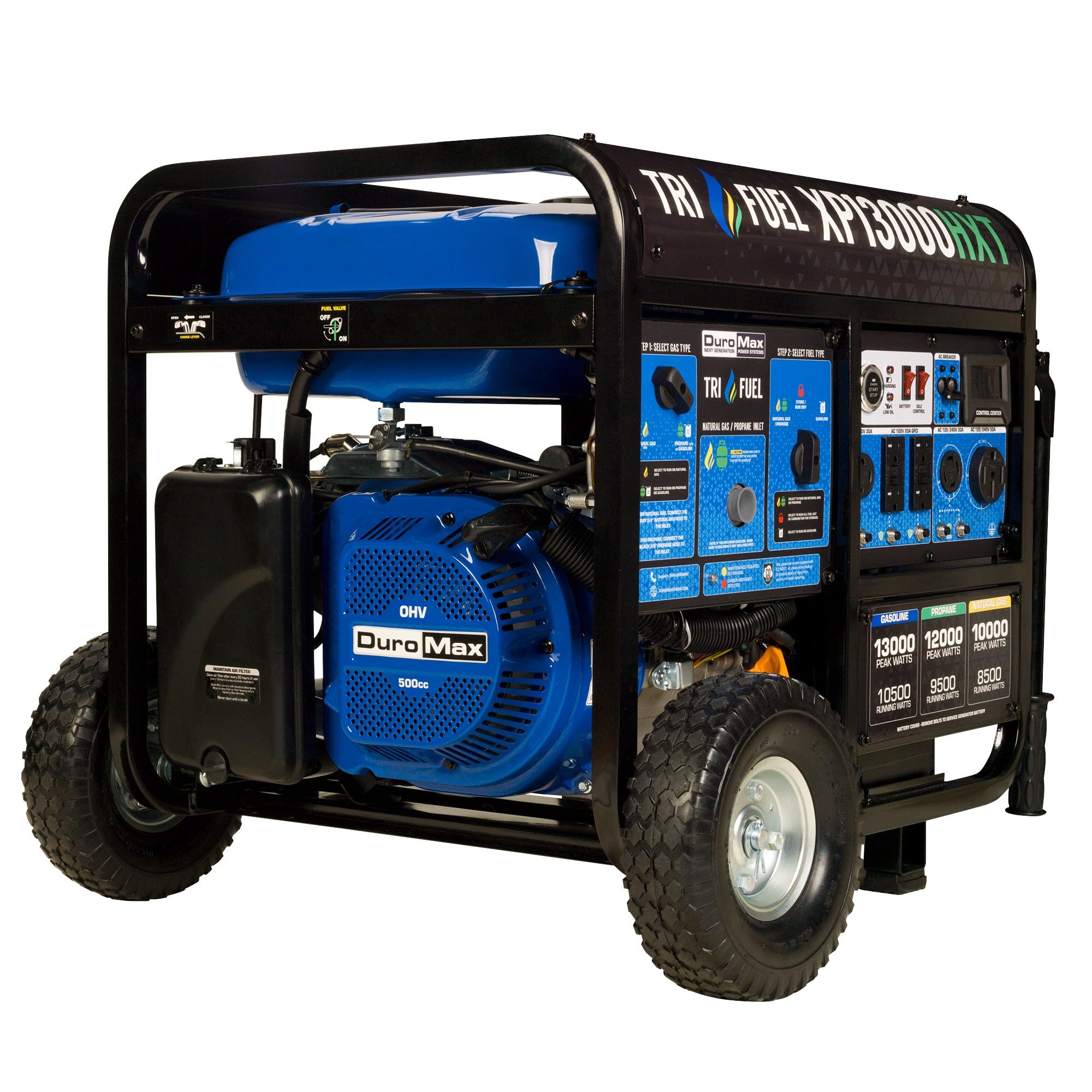
The XP13000HXT is the only tri-fuel generator in this roundup, burning gasoline, propane, or natural gas via a 500cc OHV engine. On natural gas — the holy grail for whole-home backup — it delivers roughly 10,500 running watts, which is enough to start a 3.5-ton central AC and still power a 50-amp transfer switch load. The 13,000 surge rating handles the locked-rotor amp spike of a well pump without breaking a sweat. Push-button start and a remote fob add convenience for bad-weather startups.
Real-world owners in ice storms report running four refrigerators, a furnace, security cameras, and lights simultaneously at just 25-30% load — a testament to the raw capacity. The CO Alert system adds automatic shutdown protection. The included natural gas hose and propane regulator mean zero additional purchases, though the fuel selector knob is stiff and requires a firm twist. The 240-pound curb weight demands two people or a ramp for unloading.
Noise is significant — this is an industrial-grade open-frame unit, not a quiet inverter. The battery tender needs to be kept on a maintainer during long stints between outages. Customer service responds quickly for missing parts or battery replacements. For homeowners with existing natural gas lines who want a single-machine solution that doesn’t rely on stored gasoline, this is the definitive choice.
Why it’s great
- Runs on natural gas, propane, or gasoline
- 50-amp outlet for full transfer switch
- 500cc engine handles 3.5-ton AC loads
- Remote start key fob included
Good to know
- Very loud during operation
- Heavy — 240 pounds with minimal wheels
- Natural gas line needs 225K BTU/hr capacity
3. WEN DF480iX 4800W Dual Fuel Inverter
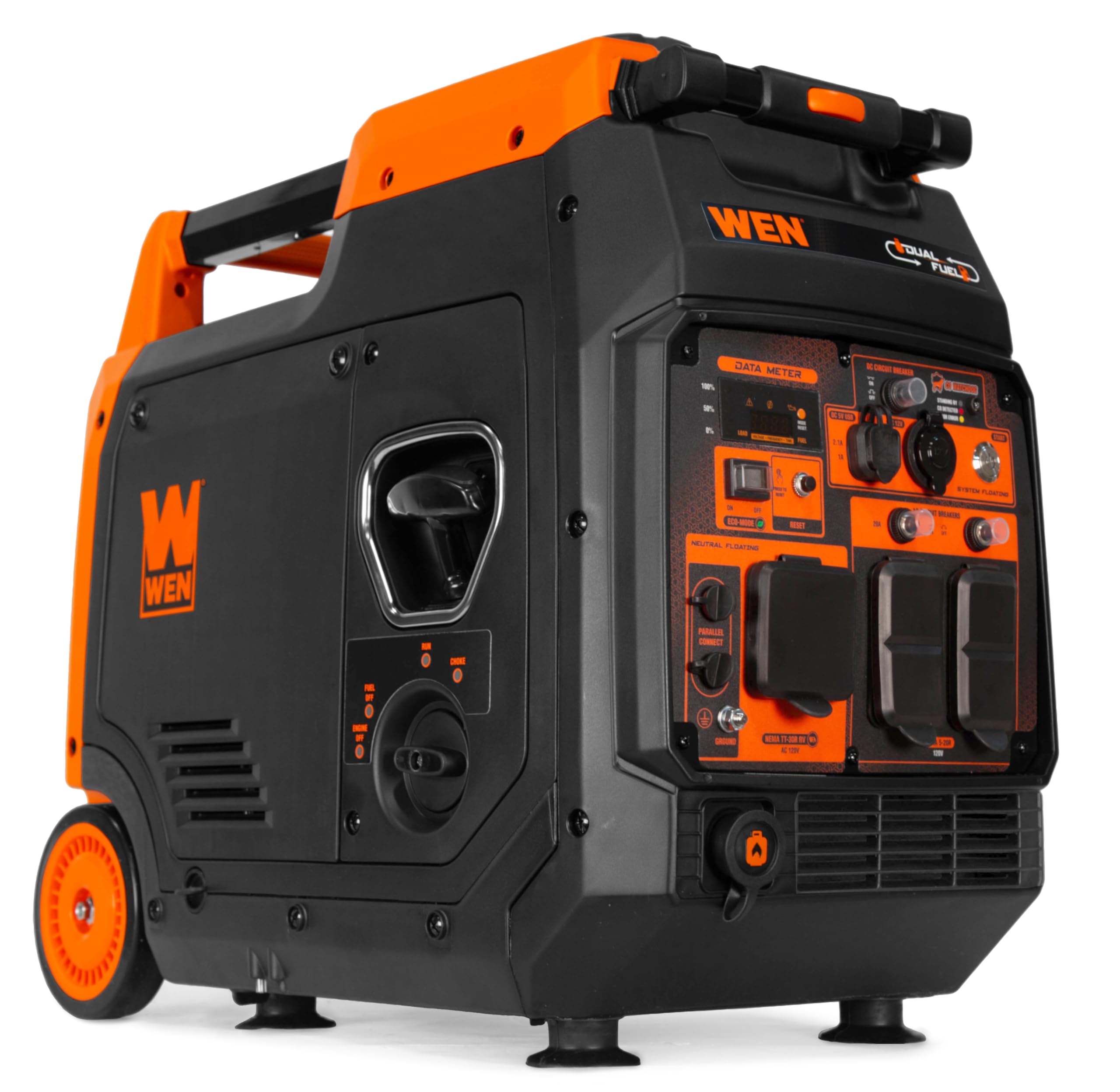
The DF480iX pairs a 224cc dual-fuel engine with inverter technology to deliver 4,800 surge watts and 4,000 rated watts on gasoline, with nearly identical output on propane. The sound level is low enough for a normal conversation, making it ideal for RV parks, suburban neighborhoods, and overnight camping. The electric start combined with a recoil backup means no struggling with pull cords in the dark. A telescoping handle and onboard wheels make the 78.5-pound unit easy to roll.
The WEN Watchdog CO shutdown sensor automatically kills the engine if carbon monoxide accumulates, a critical safety feature for tent camping or garage-adjacent placement. The fuel shut-off solenoid runs the carburetor dry before shutdown, extending engine life by preventing gummed fuel deposits. The tool-free LPG quick-connector simplifies propane hookup. The magnetic dip stick doubles as a debris catcher during break-in. Owners consistently highlight the dual-fuel flexibility as the top reason for purchase, especially those who store propane long-term.
There is no automatic fuel-switching — you must manually select gas or propane before startup. The wheels produce a slight rattle on rough terrain, and the battery access panel is fiddly to reinstall. Three-year warranty provides solid protection. For anyone who wants quiet, clean inverter power with fuel-choice freedom, this is a strong mid-range winner.
Why it’s great
- Dual fuel with quick-connect LPG hose
- Inverter clean power for electronics
- Electric start plus recoil backup
- CO Watchdog safety sensor
Good to know
- No auto fuel switchover between tanks
- Wheels rattle on uneven ground
- 78.5 pounds is heavy for a single carry
4. Champion Power Equipment 4000W Dual Fuel Inverter

This 149cc inverter generator focuses on portability and fuel efficiency. At roughly 53 pounds, it is one of the lightest dual-fuel inverter models available, and the 64 dBA noise rating — barely louder than a library — makes it a top pick for campgrounds with quiet hours. On gasoline it produces 4,000 surge and 3,000 running watts; on propane you get 3,000 surge and 2,700 running watts, still enough to run a small RV AC, a fridge, and lights simultaneously. The CO Shield auto shutoff sensor monitors the exhaust envelope and kills the engine before CO levels become dangerous.
Owners confirm the unit handles a 15,000 BTU RV air conditioner plus interior lights without bogging. Run time on propane stretches up to 25 hours at 25% load — essentially a full weekend on one 20-pound tank. The parallel-ready outlets let you double output with a second Champion inverter, though the kit is sold separately. The included oil, funnel, and propane hose mean zero extra purchases out of the box.
A small minority report engine failure after 3 months of occasional use, with long hold times on Champion support lines. The TT-30R outlet is RV standard rather than a 50-amp twist-lock, limiting whole-home transfer switch compatibility. The three-year warranty covers parts and labor but requires original purchase receipt. For weight-conscious RVers and campers who want quiet dual-fuel power, this is an excellent fit.
Why it’s great
- Very light at 53 pounds
- 64 dBA whisper-quiet operation
- 25-hour propane runtime at low load
- 3-year warranty + lifetime tech support
Good to know
- Some units have early engine failures
- Customer support wait times can be long
- No 50-amp / L14-30R outlet
5. AMERISUN 5000W Inverter Generator
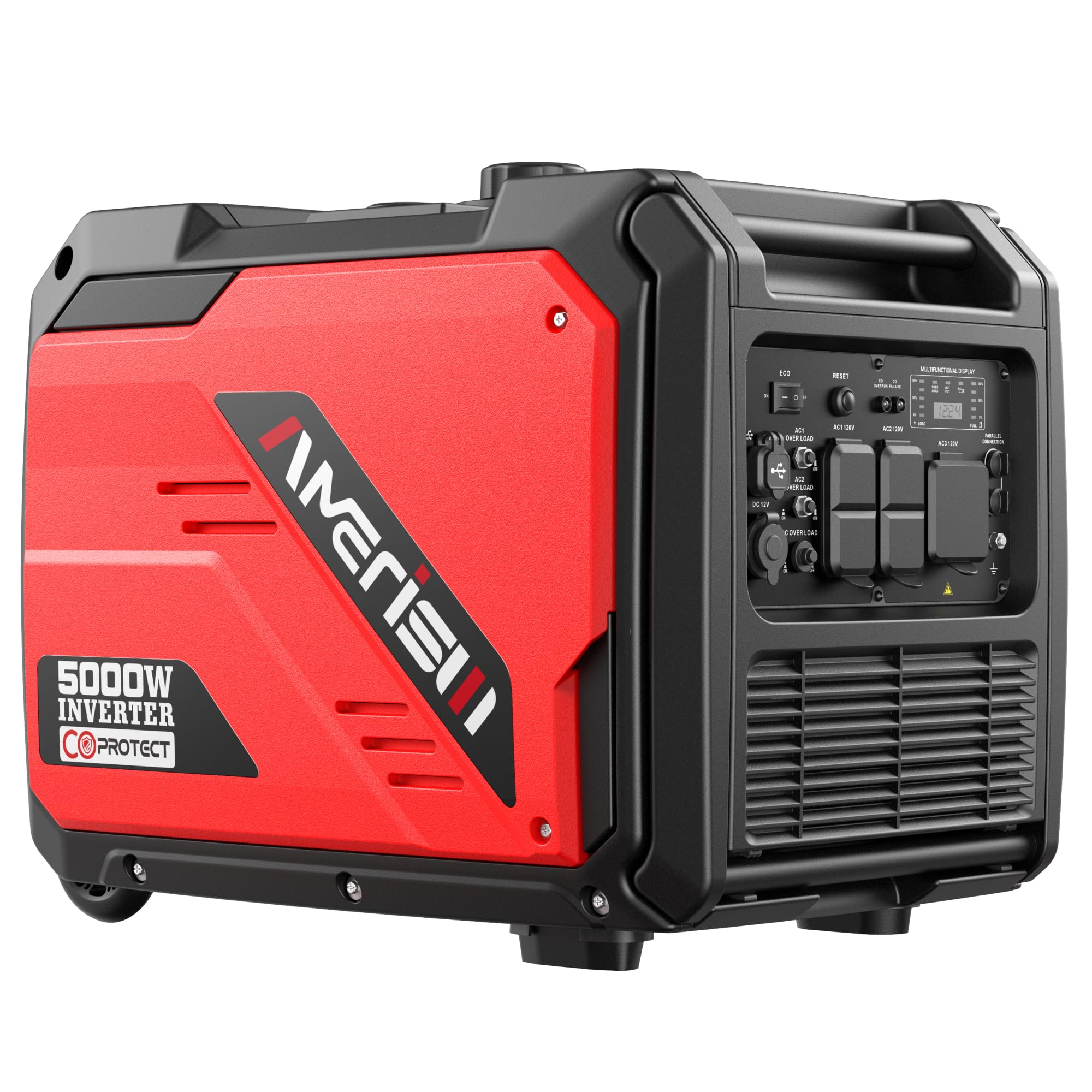
The AMERISUN 5000W uses a 223cc engine inside an inverter frame to produce 5,000 surge and 4,000 running watts, with a 3.43-gallon tank delivering up to 10 hours of runtime at 50% load. The four 120V 20A outlets plus a dedicated 30A TT-30R RV receptacle cover most home and campground needs. The 70 dBA noise level at 23 feet is tolerable for suburban use, and the built-in wheel kit with a carrying handle makes solo movement manageable despite the 68-pound curb weight.
Real-world users report starting on the first pull every time, even after months of storage. One owner ran a fridge, TV, PS5, CPAP machine, and washer simultaneously on a single gallon of 90 octane fuel for 11 hours — excellent efficiency. The upgraded CO alarm light provides both a visual alert and automatic engine shutdown if CO builds up, adding a critical safety layer for placements near windows or doors. The parallel-ready terminals allow a second unit to double capacity to 8,000 running watts.
The primary complaint involves the CO sensor tripping too easily in windy conditions, causing nuisance shutdowns. A few users report the sensor failing entirely within weeks, with customer service unresponsive. EPA and CARB compliance means it ships to all 50 states. For buyers who want inverter clean power at a 5,000-watt rating without jumping to premium pricing, this is a compelling middle ground.
Why it’s great
- Five outlets including RV 30A and USB
- Easy one-pull start from cold storage
- Very fuel efficient at low loads
- EPA and CARB compliant
Good to know
- CO sensor may nuisance-trip in wind
- Customer service is difficult to reach
- Sensor failure reported within weeks
6. A-iPower GXS5000D 5000W Dual Fuel
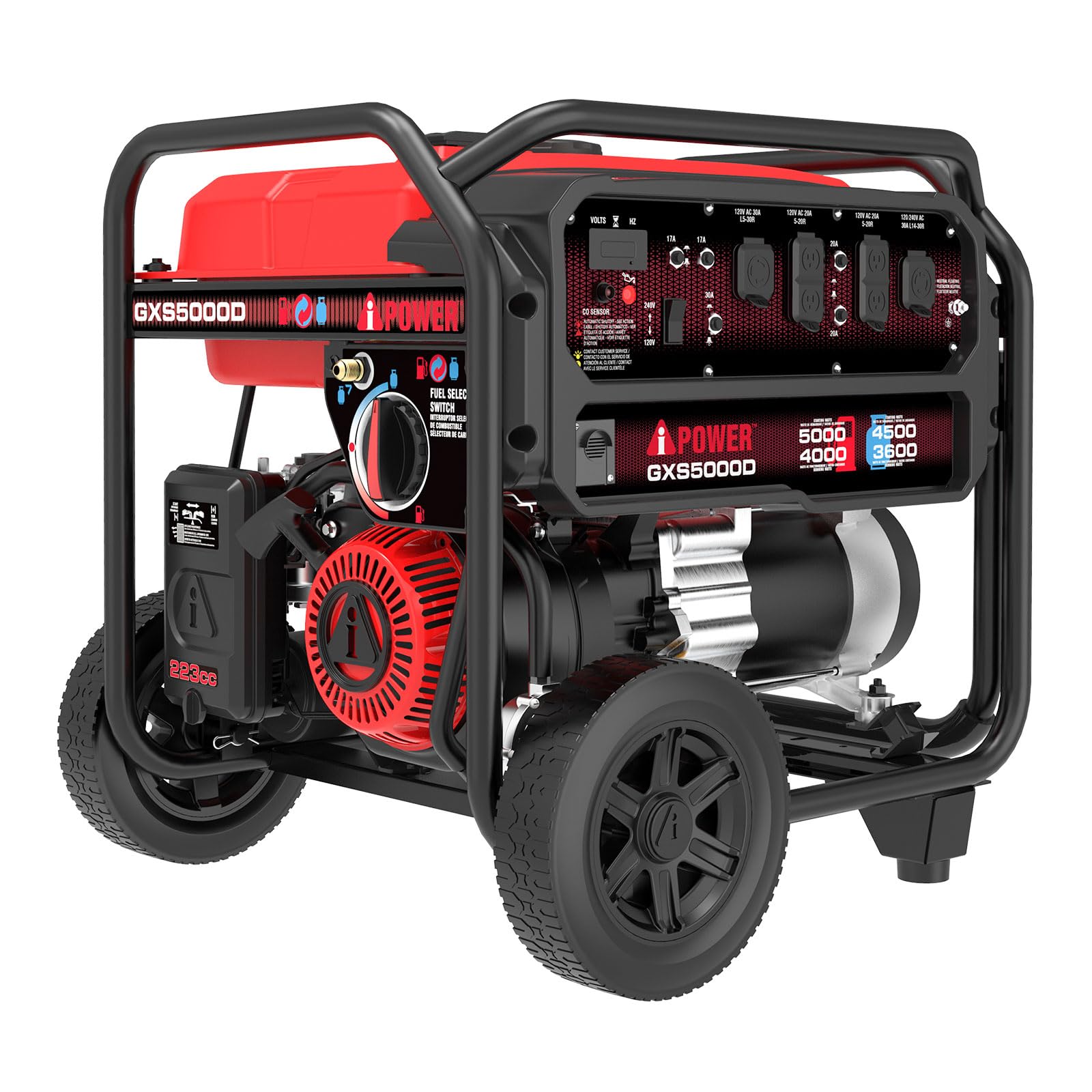
The GXS5000D combines a 223cc cast-iron-sleeve engine with dual-fuel capability for 5,000 starting and 4,000 running watts on gasoline. The 114-pound unit is an open-frame conventional generator, not an inverter, so expect diesel-level durability rather than whisper-quiet operation. The control panel includes a 30-amp L5-30R twist-lock, a 50-amp L14-30R transfer switch outlet, and duplex household receptacles, giving serious whole-home wiring flexibility. Run time hits 20 hours at 25% load on a 6.3-gallon tank.
Owners report this unit powers a 3.5-ton AC alongside a 2-horsepower well pump without voltage sag, with the cast-iron sleeve providing superior heat dissipation during long runs. The CO sensor and low-oil shutdown are standard. Push-button electric start (12V battery included) plus recoil backup prevents failure scenarios. Real-world hurricane reviews report 80 consecutive hours of operation with only periodic refueling, powering full-size fridges, AC units, and entertainment systems simultaneously.
The open-frame design is loud — 68 dBA at 23 feet is tolerable but not neighbor-friendly. The fuel selector requires manual switching between gas and propane, and the THD is not specified as inverter-class clean. Some users report a frequency drift up to 62.5 Hz that can confuse UPS units. Three-year warranty covers parts and labor. For jobsite and whole-home backup where noise isn’t the primary concern, this delivers exceptional value.
Why it’s great
- L14-30R 240V outlet for transfer switch
- 20-hour runtime on gas at low load
- Cast iron sleeve for long engine life
- Electric start plus recoil backup
Good to know
- Open frame is loud (68 dBA)
- THD not specified for sensitive electronics
- 114 pounds — not a lightweight carry
7. PowerSmart PS5046CE 4800W Inverter
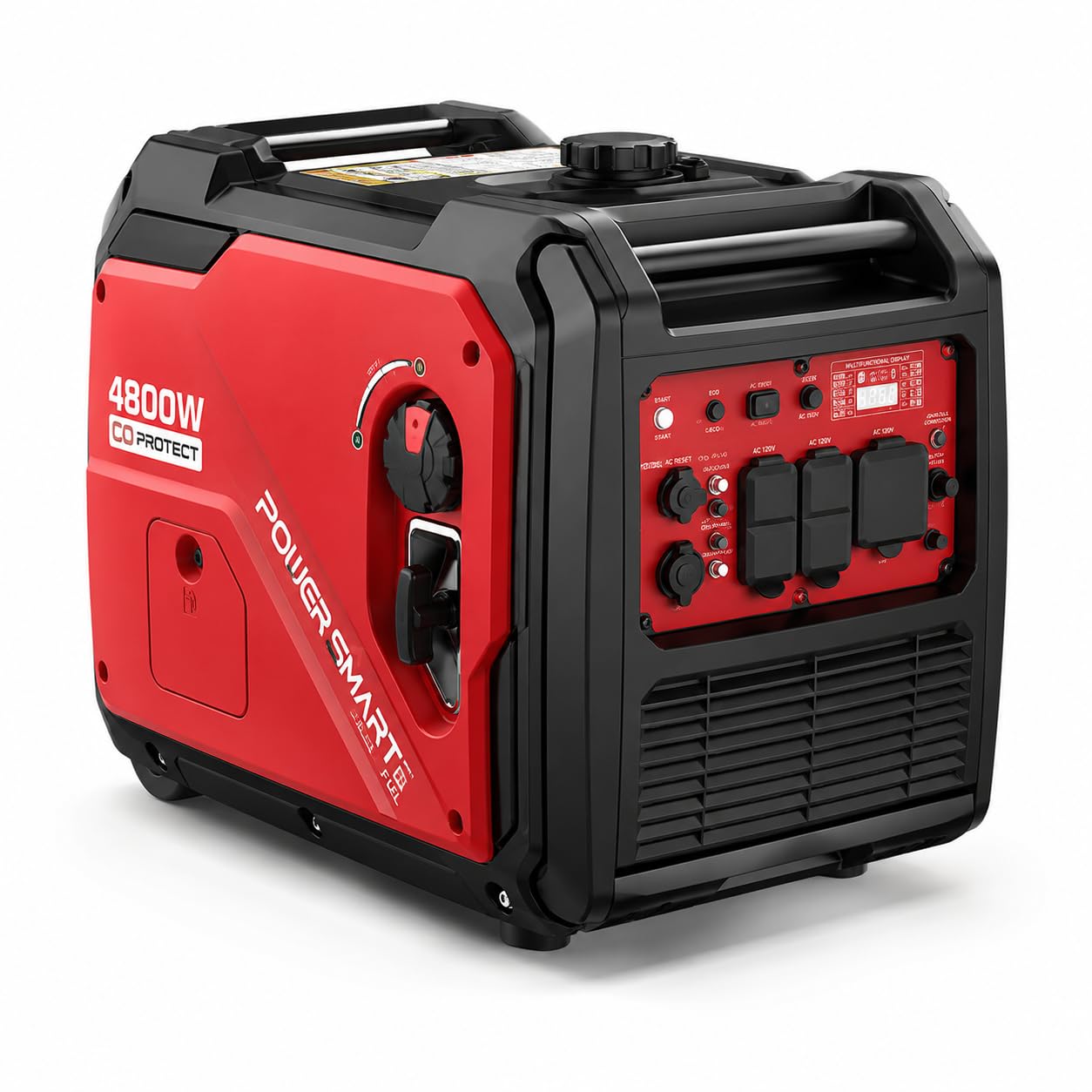
The PS5046CE leverages a 223cc 4-stroke OHV engine within an inverter frame to deliver 4,800 surge and 4,000 rated watts. The stand-out feature is the one-touch electric start — press a button and the generator fires up in any weather, backed by a recoil rope if the battery is flat. The sound level of 67 dBA at 23 feet puts it in the quiet category, suitable for suburban overnights. The 3.43-gallon tank provides up to 10 hours of runtime at 50% load.
The control panel includes a TT-30R RV outlet, two 120V 20A household receptacles, and a 12V DC port plus dual USB ports. Pure sine wave output with THD below 3% makes it safe for laptops, CPAP machines, and medical equipment. The integrated CO Guard alarm shuts down the engine when carbon monoxide reaches dangerous levels. Owners report a real-world dB reading around 59 dB with eco mode on, which is genuinely neighbor-friendly.
The unit lacks an hour meter, making oil-change intervals a guesswork exercise. The 89-pound weight with wheels is manageable but heavy for a single person. The engine is essentially a Yamaha MZ80 clone, which translates to decent reliability but requires quality synthetic oil and regular maintenance. Two-year limited warranty. For buyers who want push-button convenience in a quiet inverter package, this is a solid pick.
Why it’s great
- One-touch electric start every time
- Genuinely quiet at 59 dB in eco mode
- CO Guard safety auto shutdown
- Pure sine wave for sensitive electronics
Good to know
- No built-in hour meter
- 89 pounds is heavy to lift
- Engine is a clone — requires quality oil
8. ERAYAK 4500W Portable Inverter

The ERAYAK 4500W packs a 208cc engine into the lightest and most compact inverter frame in this list at just 54 pounds. Peak output is 4,500 watts with 3,500 running watts — the lowest in the mid-range tier but enough for a fridge, lights, a CPAP machine, and device charging. The 0.2-1.2% THD rating is exceptionally clean, safer for sensitive electronics than many budget inverter generators. The unit features a built-in 30A L5-30R outlet, two household 5-20R receptacles, and both USB-A and USB-C ports for direct device charging.
Eco mode dynamically adjusts engine speed, consuming as little as 0.21 gallons per hour at 25% load. Owners report running demolition hammers on job sites without bogging — surprising from such a light unit. Two units can be paralleled for 7,000 running watts with 50A output. The three-year warranty and lifetime technical support provide decent peace of mind.
Multiple users report the unit failing after 3-4 uses, with the pull cord breaking and the engine refusing to stay on under load. Customer service is essentially unreachable for those experiencing failures, and the unit is flagged as non-returnable on Amazon after 30 days. The absence of electric start means every startup is a manual pull. For buyers on a tighter budget who prioritize clean power and light weight, this works — but the quality control variance is a real risk.
Why it’s great
- Very light at 54 pounds
- Ultra-clean 0.2-1.2% THD power
- USB-A and USB-C for device charging
- Parallel kit doubles output to 7KW
Good to know
- Frequent early failure reports
- Customer support is hard to reach
- No electric start — recoil only
9. WEN 56477i 4800W Inverter

The WEN 56477i runs a 224cc engine inside an enclosed inverter frame to produce 4,800 surge and 4,000 rated watts. It is gasoline-only, but the fuel shut-off valve lets you run the carburetor dry before storage, which dramatically reduces gumming and extends engine life. The unit is exceptionally quiet — owners consistently describe it as quieter than expected for its output class, suitable for overnight use in residential neighborhoods. The telescoping handle and onboard wheels make the 72.7-pound unit easy to move.
The control panel includes four 120V 20A household outlets, one TT-30R RV receptacle, a 12V DC port, and two 5V USB ports. The CO Watchdog sensor automatically shuts the engine down if carbon monoxide builds up. Real-world users report powering a full fridge, freezer, WiFi, TV, and lights for nine consecutive days during a storm, with only 8-hour intervals between refills. The three-year warranty is one of the strongest in this tier.
Gasoline-only means no propane flexibility for those who want indefinite storage capability. The 72.7-pound weight is manageable but heavy for a single person to lift into a truck bed. Some owners wish for a 240V outlet for well pump or water heater support. For those who already store gasoline and want a quiet, proven inverter generator with excellent warranty coverage, the WEN 56477i is a safe choice.
Why it’s great
- Fuel shut-off prolongs engine life
- Quiet enough for overnight use
- Three-year warranty coverage
- Proven reliability in storms
Good to know
- Gasoline only — no dual fuel
- 73 pounds, requires a dolly for truck loading
- No 240V twist-lock outlet
10. PowerSmart MB5040DC 4400W Dual Fuel Inverter
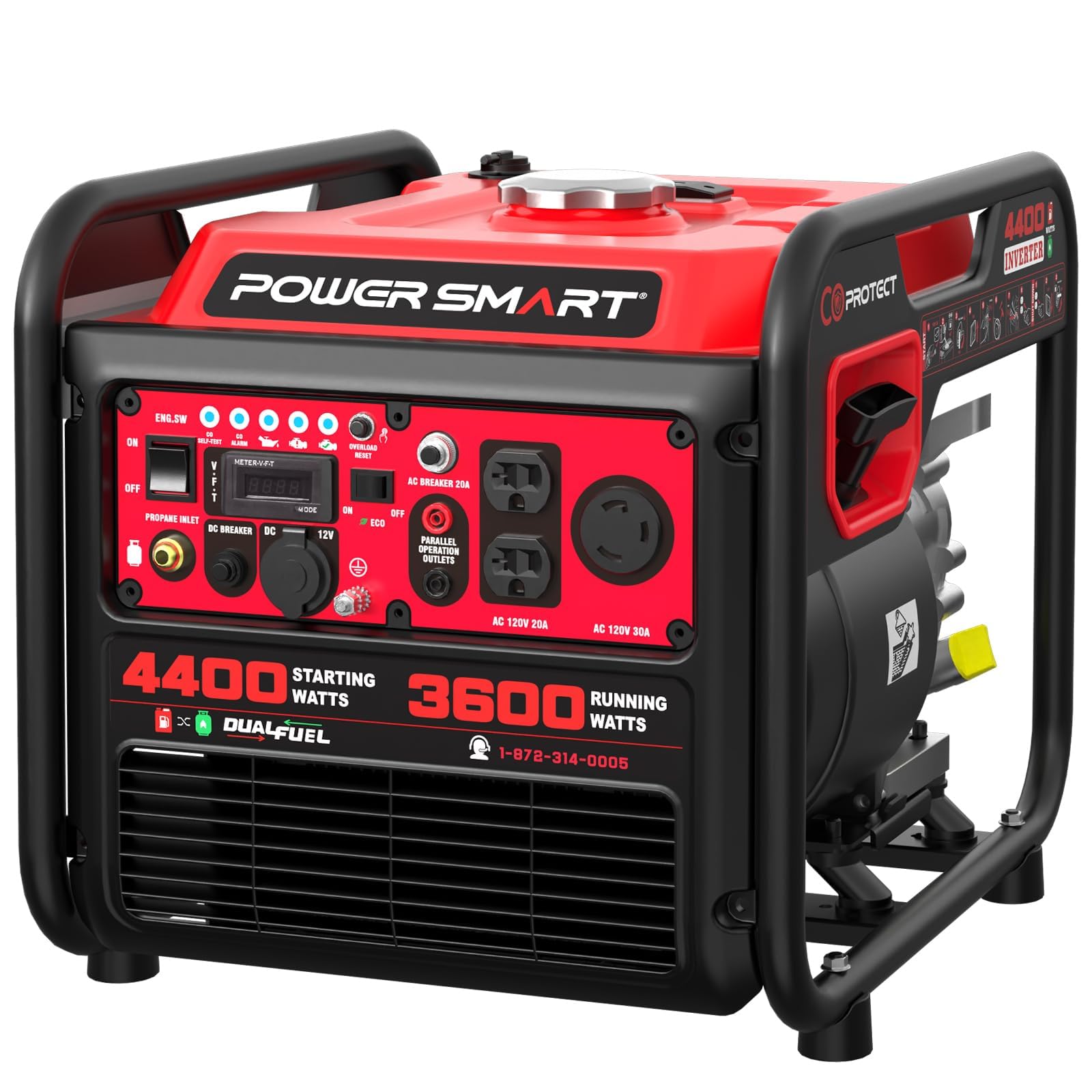
The PowerSmart MB5040DC weighs just 61.3 pounds and runs on gasoline or propane, making it one of the lightest dual-fuel inverter options in its wattage class. The 223cc engine produces 4,400 surge and 3,600 running watts on gas, with a 1.6-gallon tank yielding up to 11 hours of runtime at 25% load. The 76 dBA noise rating is louder than premium inverters but still quieter than an open-frame conventional unit. A CO sensor, low-oil shutdown, and overload protection provide baseline safety.
Owners report it powers a fridge and two refrigerators simultaneously during outages, with easy lifting into truck beds thanks to the low weight. Running on propane is slightly quieter than gas, and the dual-fuel flexibility is appreciated for camping trips where open flames are restricted. Multiple five-star reviews confirm the unit starts on the first or second pull and runs cleanly with proper break-in oil changes at 20-hour intervals.
Quality control is inconsistent — some units arrive with defective main control modules that prevent starting, and Amazon may deny returns after the initial window. The manufacturer’s technical support is not always helpful for defective units. The 11-hour runtime figure assumes 25% load; higher loads cut runtime significantly. For budget-conscious buyers who need dual-fuel flexibility and light portability, this is a valid option, but the risk of a dead-on-arrival unit is higher than with well-established brands.
Why it’s great
- Light at 61 pounds — easy to move
- Dual fuel gas/propane flexibility
- 11-hour runtime at low load
- CO sensor and low-oil shutdown
Good to know
- Higher failure rate than premium brands
- 76 dBA is louder than inverter peers
- Return denials reported for defects
11. Aceup Energy 4000W Inverter
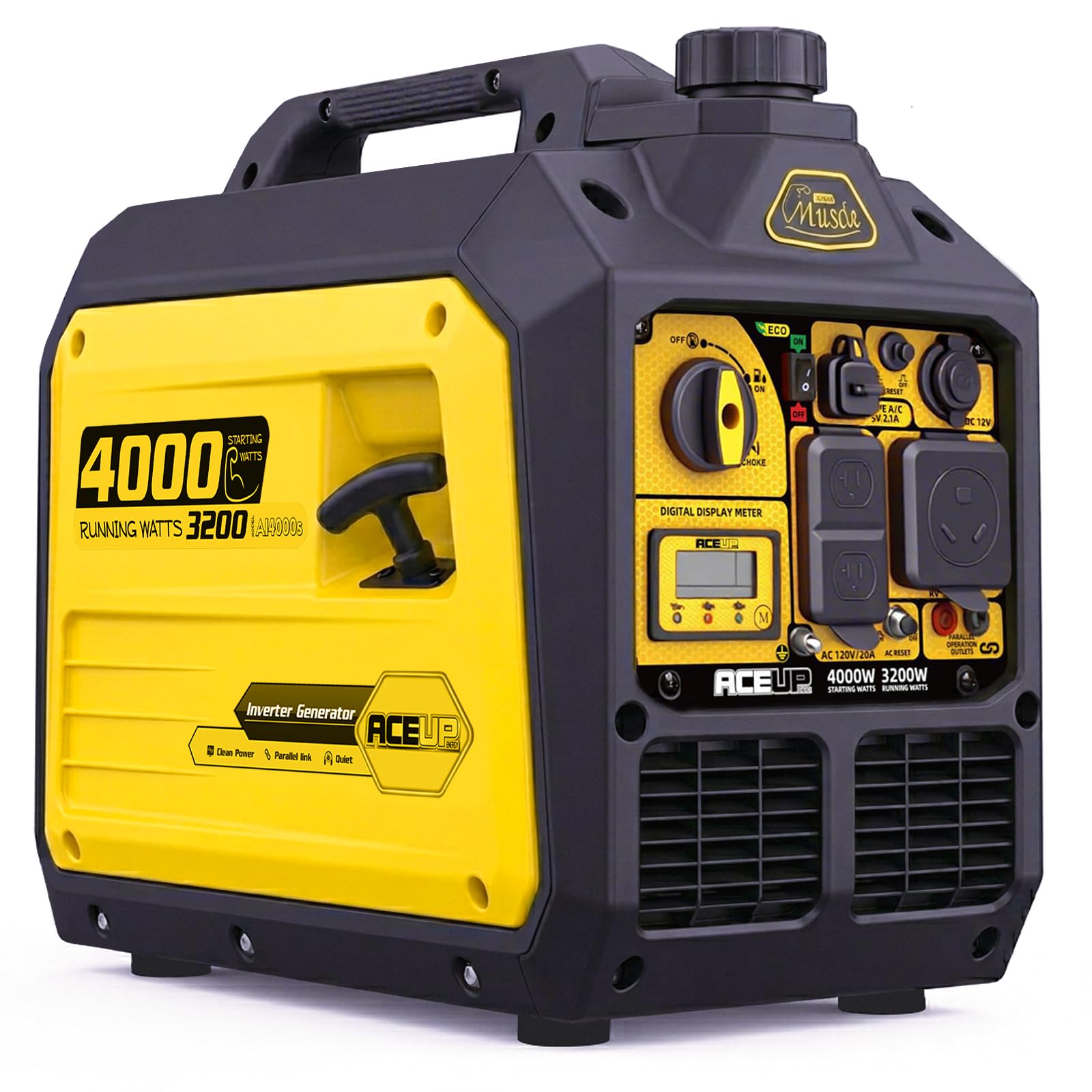
The Aceup Energy 4000W is the entry-level option in this roundup, with a 149cc engine producing 4,000 peak and 3,200 rated watts. At 48 pounds, it is the lightest generator on this list — genuinely one-hand carryable for an average adult. The unit is gasoline-only but includes a 5-in-1 knob that simultaneously controls fuel shut-off, engine on/off, and choke, simplifying the startup sequence. The digital display tracks voltage, runtime, fuel level, hertz, and power output — a useful feature at this price tier.
The inverter output keeps THD below 1.5%, safe for phones, laptops, and TVs. The 60 dBA rating in eco mode at 23 feet is the quietest in this entire list, making it the best choice for campgrounds with strict noise ordinances. Owners upgrading from 2,000-watt units report the Aceup runs a 15,000 BTU RV air conditioner plus all interior lights without breaking a sweat. The parallel-ready terminals allow doubling capacity with a second unit.
The 1.32-gallon tank limits runtime to roughly 5 hours at half load — the shortest in this roundup. The plastic fuel tank feels less durable than steel tanks on competitors. A two-year warranty and lifetime technical support are included, but some owners report slightly higher price perception relative to the wattage output. For lightweight RVers and tent campers who want the quietest, most portable inverter generator available, this is a strong entry-level pick — just pack extra fuel cans.
Why it’s great
- Extremely light at 48 pounds
- 60 dBA — the quietest in this list
- Digital display with voltage/fuel gauge
- THD below 1.5% for electronics
Good to know
- Short 5-hour runtime at half load
- Gasoline only — no dual-fuel option
- Fuel tank is plastic, not steel
FAQ
What size generator do I need for a 2,000-square-foot house?
Can I run a generator on propane indefinitely?
What is the difference between an inverter and an open-frame generator?
How often should I change the oil in a backup generator?
Final Thoughts: The Verdict
For most users, the best backup generator winner is the Westinghouse 12500 because its remote start, 50-amp outlet, and 12-hour gasoline runtime cover a whole home without requiring a second unit. If you want clean inverter power with dual-fuel flexibility at a lower weight, grab the WEN DF480iX for quiet suburban and RV use. And for whole-home tri-fuel capability with natural gas connection, nothing beats the DuroMax XP13000HXT.