
Our readers keep the lights on and the weekend projects moving. As an Amazon Associate, I earn from qualifying purchases.
Distributing a single 4K or HD source to every television in a house, hotel, or commercial building without running new HDMI cables demands a dedicated piece of hardware: an RF modulator. The challenge is that standard consumer-grade modulators often fail to lock a stable signal, introduce visible artifacts, or lack the necessary output gain to push a clean channel through a legacy coax distribution network. Finding the right unit means balancing output power, encoding standards, and resolution support to ensure every connected display receives a watchable signal.
I’m Rikta — the co-founder and writer behind FitlyFast. I’ve spent hundreds of hours analyzing the technical specifications, customer-reported real-world performance data, and compatibility matrices of RF modulators to understand exactly which builds deliver reliable signal distribution in multi-TV environments.
This guide provides a focused, spec-driven breakdown of the top hardware options on the market today for achieving a stable, high-resolution video feed across an entire property using existing coaxial cable. Whether you are outfitting a home theater system, a sports bar, or a commercial AV installation, these selections will help you identify the best 4k rf modulator for smart tv distribution.
How To Choose The Best 4K RF Modulator For Smart TV Distribution
Selecting the right RF modulator for distributing video over coax involves more than just checking for an HDMI input. The hardware must match the modulation standard your televisions use, the physical distance the signal must travel, and the number of splits in your coax network. Overlooking any of these factors often results in a weak, unstable, or unwatchable signal at the end of the line.
Modulation Standard Compatibility
The most critical spec is the output standard your displays expect. North American televisions typically scan for ATSC (8-VSB) over-the-air channels, while cable-ready sets often look for QAM (J.83B) channels. ATSC 3.0 is the emerging standard supporting 4K broadcasts, but most current TVs still require ATSC 1.0. Ensure the modulator outputs the exact standard your TV tuners detect, otherwise a channel scan will come up empty.
Output Signal Strength and Gain
A modulator’s output power, measured in dBuV, determines how far the signal can travel before degrading. A unit with a 25 dB output is adequate for a short run to a single splitter, but a large house or commercial building with multiple splitters and long coax cable runs requires an adjustable output (70-100 dBuV) to maintain clean reception at every connected TV. Low output is the most common cause of grainy pictures and missed channels.
Resolution and Audio Encoding
While true uncompressed 4K over coax is rare in consumer modulators, the unit must at least support 1080p with proper encoding to avoid compression artifacts. For audio, AC3 (Dolby Digital) support preserves surround sound signals, while basic stereo-only modulators can introduce audio buzz or de-sync. If you plan to distribute a source with 5.1 audio, verify the modulator’s audio codec support before purchase.
Quick Comparison
On smaller screens, swipe sideways to see the full table.
| Model | Category | Best For | Key Spec | Amazon |
|---|---|---|---|---|
| MINIMOD 2 Vecoax | HDMI-to-Coax | Whole-home HD distribution | 1080p / Dolby Audio via coax | Amazon |
| Thor Broadcast Coax Modulator | HDMI-to-RF | Versatile multi-standard output | 1080p / DVB-C/T/ATSC/ISDB-T | Amazon |
| Yinker 8×8 HDMI Matrix Switch | Matrix Switcher | 4K@30Hz multi-room routing | 4K@30Hz / 8×8 HDMI 1.4b | Amazon |
| SatLink ST-7000 | HD Digital Modulator | Long coax runs with adjustable gain | 1080p / ATSC/QAM 70-100 dBuV | Amazon |
| Blackmagic SDI Distribution 4K | SDI Distribution | Broadcast-grade 6G-SDI split | 1-to-8 / 6G-SDI Reclocking | Amazon |
| SiliconDust HDHomeRun Flex 4K | Network Tuner | IP-based whole-home OTA | 2x ATSC 3.0 / 4x ATSC 1.0 | Amazon |
| HMM-10H Micro Modulator | Entry-Level RF | Single-source budget distribution | 470-860MHz / Analog RF | Amazon |
In‑Depth Reviews
1. MINIMOD 2 Vecoax

The MINIMOD 2 is widely considered the gold standard for distributing an HDMI source over existing TV coax cables. It encodes a 1080p video signal with Dolby Audio and outputs it as a standard ATSC or QAM channel that any modern television can scan and tune into. The color display and front-panel controls make channel assignment straightforward without requiring a connected PC for initial setup.
Users report excellent picture quality in real-world applications, from RVs and motorhomes to church buildings and multi-room home theaters. The unit combines cleanly with existing antenna or cable signals, allowing the coax infrastructure to carry both the modulated source and the original broadcast content simultaneously. The adjustable gain feature helps balance signal strength when the output must travel through multiple splitters.
Some installations experience compression artifacts on high-resolution Blu-ray sources, and the ~600ms latency makes live camera feeds less ideal. However, for its core purpose—sending a single HD source to every TV in a building—the MINIMOD 2 delivers the most reliable and user-friendly performance in its class. It is a premium-priced unit, but the consistent signal lock and support justify the investment.
Why it’s great
- Reliable ATSC/QAM encoding with Dolby Audio support.
- Easy front-panel channel setup and naming.
- Combines cleanly with existing antenna/cable signals.
Good to know
- Compression artifacts noticeable on Blu-ray sources.
- Higher latency (~600ms) not ideal for real-time camera feeds.
2. Thor Broadcast HDMI to Coax Modulator
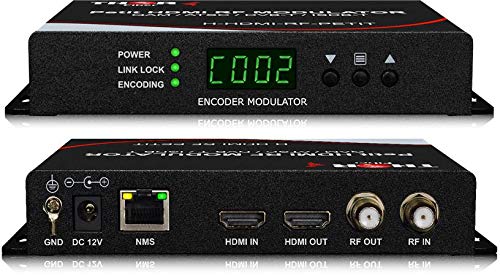
The Thor Broadcast modulator stands out for its support of multiple international modulation standards, including DVB-C/T, ATSC, and ISDB-T. This makes it one of the most flexible units on the market for users who may need to switch between broadcast regions or who are setting up a distribution system with legacy cable TV infrastructure. The compact metal enclosure includes both HDMI and F-type output connectors, and all configuration is handled via a proprietary web GUI accessible over Ethernet.
Customer feedback consistently highlights the excellent picture quality and low latency compared to other HDMI-to-RF modulators, with several users noting a noticeable improvement over older PVI units. The unit handles a variety of HDMI sources—set-top boxes, cameras, DVD players—and converts them into a clean HD channel that can be tuned on any TV in the network. The Ethernet port allows for remote management, which is useful in commercial or distributed AV setups.
The main trade-off is the setup process, which requires a PC or network connection for the initial configuration—there is no front-panel channel selection. Some users also report a latency of around 600ms rather than the expected sub-100ms, which is a consideration for live video applications. For general content distribution, however, this unit offers an excellent balance of output flexibility and picture fidelity.
Why it’s great
- Supports DVB-C/T, ATSC, and ISDB-T for global compatibility.
- Excellent HD picture quality with low noise floor.
- Remote configuration via Ethernet web GUI.
Good to know
- Requires PC or network for initial setup.
- Latency higher than expected for real-time feeds.
3. Yinker 8×8 HDMI Matrix Switch
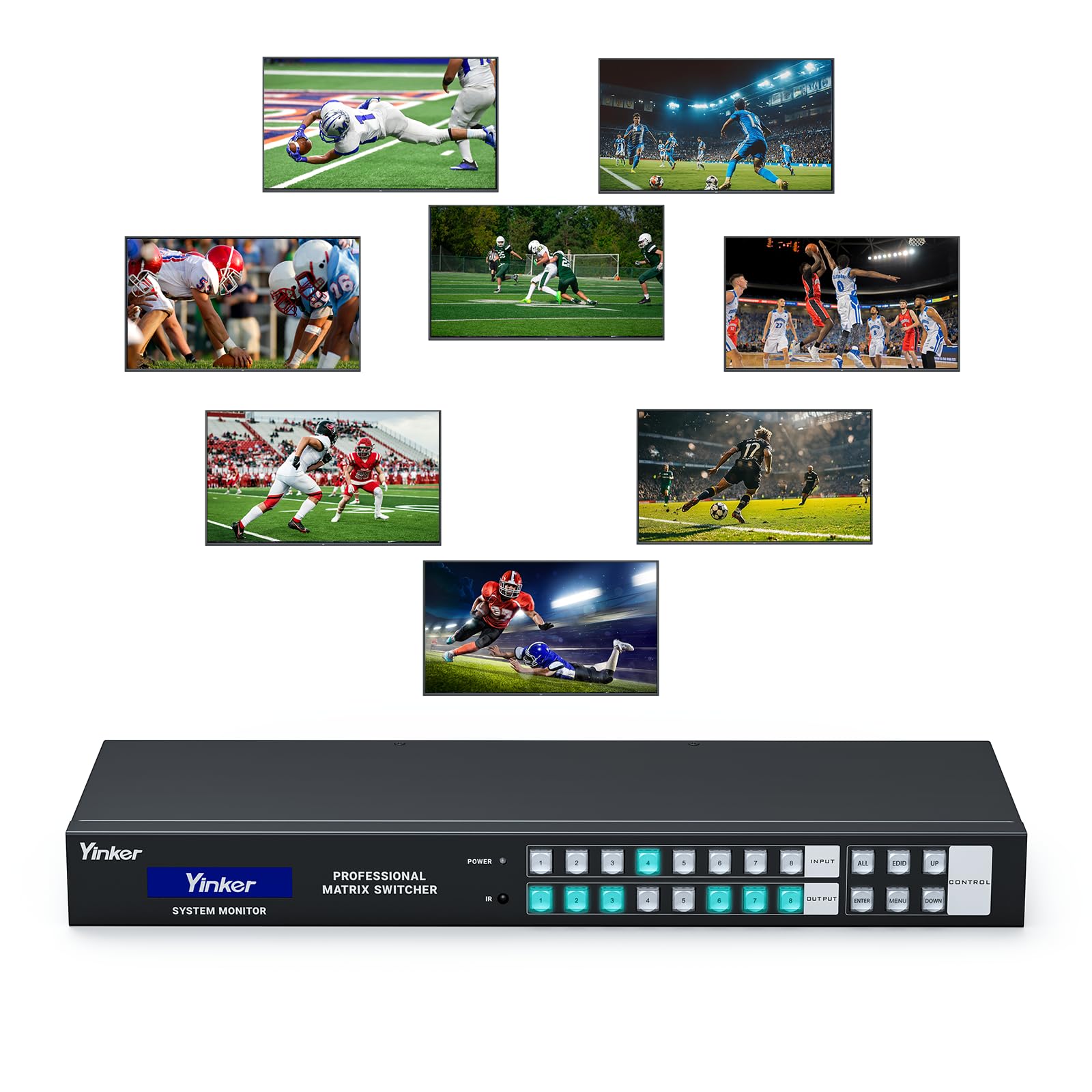
The Yinker 8×8 HDMI Matrix Switch takes a different approach to multi-room distribution by routing HDMI signals directly to displays rather than modulating to RF. It supports 4K at 30Hz across eight inputs and eight outputs, making it suitable for installations where short HDMI runs are feasible and native 4K resolution is a priority. The unit includes a web GUI, RS232, and IR remote control for flexible operation in conference rooms, lecture halls, and home theaters.
Users report stable operation after an initial setup period, with the broadcast-grade chipset providing clean switching and reliable EDID management. The all-metal housing and 8kV ESD protection support 24/7 continuous operation in commercial environments. The ability to create 16 scene presets allows for one-touch recall of specific input-output configurations, which is valuable in multi-purpose rooms.
The primary limitation is that this is not an RF modulator—it requires a separate HDMI cable to each display, which may not be practical in buildings with existing coax infrastructure. Additionally, the 4K ceiling is 30Hz, which is fine for video playback but not ideal for high-refresh-rate gaming or PC desktop use. For users who can run HDMI cable, this unit provides a robust 4K distribution solution without the compression inherent in RF modulation.
Why it’s great
- Native 4K@30Hz distribution without video compression.
- 8×8 matrix routing with web GUI, RS232, and IR control.
- All-metal chassis designed for 24/7 commercial operation.
Good to know
- Requires dedicated HDMI cables to each display.
- 4K limited to 30Hz; not ideal for high-refresh video.
4. SatLink ST-7000

The SatLink ST-7000 is a solid mid-range option that delivers 1080p video over coax using either ATSC or QAM (J.83B) modulation. Its standout feature is the adjustable output power, ranging from 70 to 100 dBuV, which gives installers the ability to fine-tune signal strength for long-distance coax runs or heavily split networks. The unit accepts both HDMI and RCA inputs, providing backward compatibility with older video sources.
Users who have set up the ST-7000 appreciate the straightforward IP-based configuration and the excellent picture quality at 1080p, especially when used for distributing security camera feeds or satellite TV signals to multiple rooms. The output stability is praised for maintaining a clean signal over long distances, a common pain point with weaker modulators. The ability to dial in the exact output level makes it a favorite among DIY installers and AV integrators.
On the downside, the unit lacks an overscan adjustment, which can result in the image edges being slightly cut off on some displays. A few users have reported issues with the RF IN port attenuating the incoming antenna signal, which can block lower channels when the modulator is inline. For a dedicated distribution setup where the modulator is the sole source, these issues are less impactful, and the unit represents excellent value for the performance it provides.
Why it’s great
- Adjustable output power (70-100 dBuV) for long cable runs.
- Accepts HDMI and RCA inputs for versatile source compatibility.
- Clean, stable 1080p signal with ATSC or QAM output.
Good to know
- No overscan adjustment can crop image edges.
- RF IN port may attenuate incoming antenna signal.
5. Blackmagic Design Mini Converter SDI Distribution 4K

This unit from Blackmagic Design is a 1-to-8 SDI distribution amplifier, not a traditional RF modulator, but it is essential for professional video workflows that require reliable multi-destination signal splitting. It auto-detects SD, HD, and 6G-SDI inputs and reclockers the output to maintain signal integrity over long cable runs. The compact metal enclosure is designed for rack-mount environments and 24/7 continuous operation, a hallmark of Blackmagic pro gear.
Users in broadcast and live event production environments report that the Mini Converter locks to the input signal consistently and redistributes it without introducing jitter or sync issues. The 8 outputs allow for feeding multiple monitors, recorders, or downstream converters from a single source. The automatic input detection means no configuration is needed—plug in the SDI source and the eight outputs are active instantly.
The clear limitation is that this device only distributes SDI signals. For smart TV distribution over coax, you would need an additional SDI-to-HDMI or SDI-to-RF converter downstream. This makes it a specialist tool for pro AV setups rather than a consumer-friendly whole-home distribution solution. If your signal chain is already SDI-based, this unit offers unmatched reliability and signal purity.
Why it’s great
- Auto-detects and reclockers SD, HD, and 6G-SDI signals.
- Provides 8 identical outputs from one source.
- Rock-solid 24/7 operation in professional environments.
Good to know
- SDI only; requires converters for HDMI or coax distribution.
- No integrated modulation or encoding for TV tuners.
6. SiliconDust HDHomeRun Flex 4K

The HDHomeRun Flex 4K takes a fundamentally different approach by using a network-based tuner to stream live OTA TV over your home Ethernet or Wi-Fi, rather than modulating an HDMI source to RF. It includes 2 ATSC 3.0 tuners and 4 ATSC 1.0 tuners, allowing simultaneous viewing or recording of different channels on multiple devices. This is a strong choice for cord-cutters who want to distribute antenna TV to every smart device in the house without touching coax wiring.
Users consistently praise the HDHomeRun for its excellent picture quality and ability to pull in a large number of clear channels, even in challenging reception areas near airports or in multipath environments. The integration with Plex, HDHomeRun’s own app, and third-party DVR software makes it a flexible core for a whole-home TV solution. The one-time hardware cost plus a nominal yearly guide subscription provides a cable-TV-like experience without monthly fees.
However, this is not an RF modulator—it does not convert an external HDMI source (like a satellite box or camera) into a TV channel. It is purely an OTA broadcast tuner. Additionally, the Roku app experience is reported as problematic, with freezing and broken FF/rewind functions, requiring an alternative streaming device for best results. For distributing broadcast TV over IP, it is excellent, but it does not replace an HDMI-to-RF modulator.
Why it’s great
- Distributes OTA TV to any device on the network without coax.
- Supports both ATSC 3.0 (NextGen TV) and ATSC 1.0.
- Works with Plex and other DVR software for whole-home recording.
Good to know
- Not an HDMI-to-RF modulator; only handles OTA broadcast signals.
- Roku app has reported stability and control issues.
7. HMM-10H Commercial Grade RF TV Micro Modulator

The HMM-10H is an entry-level, analog RF modulator designed for basic single-channel distribution. It accepts a composite video source and pushes it out over coax at a selectable channel within the 470-860 MHz UHF range. The push-button programming and LED front panel make channel selection simple, and the non-volatile memory retains settings after power loss. The unit is compact and lightweight, suitable for small, low-complexity setups.
Reviewers are divided on this unit. Some find it works adequately for basic applications, delivering a color picture to older TVs without digital tuners. Others report significant issues, including black-and-white grainy output, audio buzz, and a general lack of signal stability. The analog output means this unit is not compatible with modern ATSC or QAM digital tuners found in smart TVs, limiting its application to very specific retro or analog-only setups.
The primary advantage of the HMM-10H is its low cost, making it an accessible option for testing or temporary installations. However, the lack of digital encoding, the mixed reliability reports, and the absence of included setup instructions make it a risky choice for a permanent smart TV distribution system. For any installation involving modern televisions, a digital modulator is strongly recommended instead.
Why it’s great
- Very low cost for basic single-channel analog distribution.
- Simple push-button channel programming and LED display.
- Compact and lightweight for small setups.
Good to know
- Analog output only; not compatible with digital ATSC/QAM TV tuners.
- Mixed reliability reports including grainy or black-and-white picture.
FAQ
Can a 4K RF modulator send a true 4K signal over coax?
Why does my TV not find the channel after I connect the modulator?
What is the difference between an RF modulator and an HDMI matrix switch?
How much output gain do I need for a large building?
Final Thoughts: The Verdict
For most users, the 4k rf modulator for smart tv distribution winner is the MINIMOD 2 Vecoax because it delivers the most reliable ATSC/QAM signal lock with Dolby Audio, a straightforward setup process, and the ability to coexist with existing antenna or cable signals. If you need global modulation standard support and remote web-based configuration, grab the Thor Broadcast. And for a native 4K distribution path without RF compression, the Yinker 8×8 Matrix Switch is the ideal choice when HDMI runs are feasible.