
Our readers keep the lights on and the weekend projects moving. As an Amazon Associate, I earn from qualifying purchases.
Maintaining a thriving aquarium demands more than just feeding your fish; it requires precise control over the invisible chemistry of the water. Inaccurate test results can lead to stressed livestock, algae blooms, and even sudden die-offs, making a reliable testing system the single most important tool in your maintenance arsenal.
I’m Rikta — the co-founder and writer behind FitlyFast. This guide is built on countless hours of cross-referencing customer benchmarks, lab-grade reagent specifications, and real-world user feedback to separate kits that deliver repeatable, actionable data from those that leave you guessing.
After evaluating market leaders and niche specialists, we have assembled a definitive ranking of the best aquarium test kit options for both freshwater and saltwater aquarists seeking lab-level confidence in their water parameter readings.
How To Choose The Best Aquarium Test Kit
Choosing a test kit means matching your tank’s specific demands—freshwater community, planted, or reef—against the kit’s parameter coverage, resolution, and ease of reading. A mismatch here leads to either wasted money on tests you don’t need or dangerous blind spots in your water chemistry.
Parameter Coverage
At minimum, every kit should handle the nitrogen cycle: ammonia, nitrite, and nitrate. A quality master kit will also cover pH and high-range pH. Reef aquarists must add alkalinity (KH), calcium, and magnesium to that list. Determine what your specific bioload and inhabitants require before you buy.
Reagent Type and Resolution
Liquid reagent test kits are the industry standard for accuracy. The quality of the color chart is critical—look for fine gradations between colors rather than large jumps. Kits that use a slide comparator or a reference sample system, like the NYOS series, deliver more consistent readings than basic test tube comparisons alone.
Test Count and Value
Consider the total number of tests per bottle. A kit offering 800 tests may seem like a better value, but if the reagents expire before you use them or the chart is difficult to read, the cost per test is irrelevant. For dedicated reef keepers, titration-based pro kits offer higher precision despite fewer tests per bottle.
Quick Comparison
On smaller screens, swipe sideways to see the full table.
| Model | Category | Best For | Key Spec | Amazon |
|---|---|---|---|---|
| NYOS Nitrate Reefer | Saltwater | Precise nitrate monitoring | Slide comparator & glass vials | Amazon |
| Red Sea Marine Care | Saltwater | All-in-one marine monitoring | Alkalinity & 0.02 ppm ammonia accuracy | Amazon |
| API Freshwater Master | Freshwater | Best value freshwater coverage | 800 tests for 5 parameters | Amazon |
| API Saltwater Master | Saltwater | Entry-level saltwater monitoring | 550 tests for 4 marine parameters | Amazon |
| Fluval Master Test Kit | Dual | Freshwater & saltwater versatility | Includes convenient storage tray | Amazon |
| Gold Label Pet Care Master | Dual | Budget-friendly full kit | 950+ tests with gloves & safety glasses | Amazon |
| Red Sea Reef Foundation Pro | Saltwater Reef | Reef calcium, alkalinity & magnesium titration | Titration: 5 ppm calcium resolution | Amazon |
In‑Depth Reviews
1. NYOS Nitrate Reefer Test Kit

The NYOS Nitrate Reefer kit addresses the single most frustrating aspect of nitrate testing: ambiguous color matching. Instead of a flat card, it uses a precision slide comparator and two glass vials for a side-by-side comparison, which dramatically reduces the guesswork. The reagent is formulated to detect a wide 1–160 mg/l NO3 range, and each of the 40 tests is manufactured to EN ISO 9001 standards in Germany.
Users consistently report that the color chart offers wider, more differentiated gradations than typical API or Salifert nitrate tests, making it far easier to pinpoint your actual value. The glass vials feel premium compared to plastic alternatives and resist scratching that can distort readings over time. The included foam comparator block holds either one or two vials steady, providing a stable platform for matching against the slide.
The main trade-off is the reagent dropper, which some users find delivers drops a bit too quickly, requiring a careful tilt to slow the flow. The small powder vial could also be more secure when opening and closing. However, for a saltwater aquarist who requires consistent, low-hassle nitrate tracking, this level of design thought justifies the premium over basic liquid kits.
Why it’s great
- Slide comparator eliminates color chart ambiguity
- German-manufactured reagents for repeatable accuracy
- Glass vials resist scratches that distort readings
Good to know
- Reagent dropper can run fast if not carefully tilted
- Only tests for nitrate—not a multi-parameter kit
2. Red Sea Marine Care Test Kit

Red Sea’s Marine Care kit is a complete solution for saltwater aquariums, covering nitrate, nitrite, ammonia, pH, and—critically—alkalinity. The ammonia test offers an impressive 0.02 ppm resolution, while the nitrate tests span both a high-range and low-range format for maximum precision. Each test uses a unique color wheel system that rotates to find the exact match, a design that many users report is clearer than the gradient strips found in other kits.
Compared directly to the API Saltwater Master, the Red Sea kit consistently earns praise for delivering more nuanced color breaks, making it easier to differentiate between, say, 0.25 and 0.50 ppm ammonia. The kit includes a hard plastic storage case to keep all reagents organized. Multiple reviewers note that the instructions, while thorough, use a very small font that can be tough to read without a magnifier.
The trade-off is that some tests use a combination of powders and liquids, adding an extra step compared to simple liquid-drop tests. Ambient lighting can occasionally affect the color matching, but the overall accuracy and included KH test make this a clear step up from entry-level saltwater kits. It is a strong mid-range choice for the dedicated marine aquarist.
Why it’s great
- Color wheel system is much easier to read than standard charts
- Includes alkalinity (KH) test essential for reef tanks
- Ammonia test accurate to 0.02 ppm
Good to know
- Some tests require mixing powders and liquids
- Instruction booklet uses extremely small font
3. API Freshwater Master Test Kit

The API Freshwater Master Test Kit has been the cornerstone of freshwater aquarium care for good reason. It measures the five core parameters—pH, high-range pH, ammonia, nitrite, and nitrate—with liquid reagents that deliver far superior accuracy to test strips. With the capacity for approximately 800 tests, the value proposition is immediate for anyone maintaining multiple tanks or a high-bioload setup.
Real user feedback highlights its consistent and reliable results, especially when monitoring the nitrogen cycle during tank cycling. The clear instructions and straightforward drop-counting method make it accessible even for absolute beginners. Many users emphasize that mastering the nitrate test (which requires shaking reagents for a full minute) is key to avoiding false negatives—a common rookie mistake.
On the downside, the kit only includes four test tubes for five tests, meaning you will need to rinse and reuse between tests. The color charts can be tricky to read under dim or yellow household lighting, which is why many experienced aquarists recommend using natural daylight or a white LED for matching. Despite these minor quirks, it remains the gold standard for freshwater reliability and sheer test volume.
Why it’s great
- Extremely reliable liquid reagent chemistry
- Excellent value with roughly 800 total tests
- Clear, beginner-friendly instructions for each parameter
Good to know
- Only 4 test tubes for 5 parameter tests
- Color matching requires consistent, bright lighting
4. API Saltwater Master Test Kit

For saltwater aquarists who want a reliable baseline without jumping straight to professional-grade pricing, the API Saltwater Master Test Kit covers high-range pH, ammonia, nitrite, and nitrate with the same trusted liquid reagent chemistry as its freshwater sibling. The 550-test capacity is generous, and the reagents are manufactured in the United States, offering a standard of quality that hobbyists have relied on for nearly two decades.
Users praise the kit for its consistency compared to test strips and its ease of use; the drop-count and shake methodology is identical to the freshwater version, meaning anyone familiar with API products will feel at home. Many reef keepers use this as their weekly monitoring tool between more sophisticated lab tests. The four included test tubes handle the four parameters with a logical workflow, though the nitrate test still requires the vigorous 1-minute shake that can be an arm workout.
The main limitation is that it does not include alkalinity (KH) or calcium tests, which are non-negotiable for reef tanks with stony corals. The color chart can also feel imprecise for trace-level ammonia readings below 0.25 ppm. However, for fish-only saltwater systems or as a secondary check alongside a KH kit, it offers unbeatable simplicity and cost efficiency.
Why it’s great
- Simple drop-and-read method familiar to most aquarists
- High test count provides months of regular monitoring
- Consistent, reliable results for standard marine parameters
Good to know
- No alkalinity or calcium tests for reef tank management
- Color chart lacks fine gradations for trace ammonia levels
5. Fluval Master Test Kit

The Fluval Master Test Kit stands out for its dual freshwater and saltwater compatibility, making it a flexible option for aquarists managing both types of tanks. It tests pH, ammonia, nitrite, and nitrate, and includes a molded tray that keeps the four reagent bottles and two test tubes organized. The packaging is compact, ideal for hobbyists with limited storage space.
User experiences are mixed but instructive: when used strictly according to the manual—including the recommended 20-minute ammonia test—the kit delivers results that align with reference lab tests. The science behind the ammonia test factors in pH interaction, which some enthusiasts appreciate as a more holistic approach. For those patient enough to follow the letter of the instructions, the accuracy is solid.
The main frustration is the hard limit of only two test tubes. Running a full panel of four tests means you will be washing and drying tubes constantly, and the ammonia test’s long duration can slow down the process. Some users also report variability in nitrate readings compared to local fish store equipment. While its design is thoughtful, the Fluval kit feels more like a portable backup or travel companion than a primary day-to-day testing solution for serious tanks.
Why it’s great
- Works for both freshwater and saltwater aquariums
- Compact stored case with bottle organizers and a tray
- Ammonia test accounts for pH interaction for more accurate results
Good to know
- Only 2 test tubes included, requiring constant washing
- Ammonia test takes 20 minutes per run
6. Gold Label Pet Care Freshwater Master Test Kit
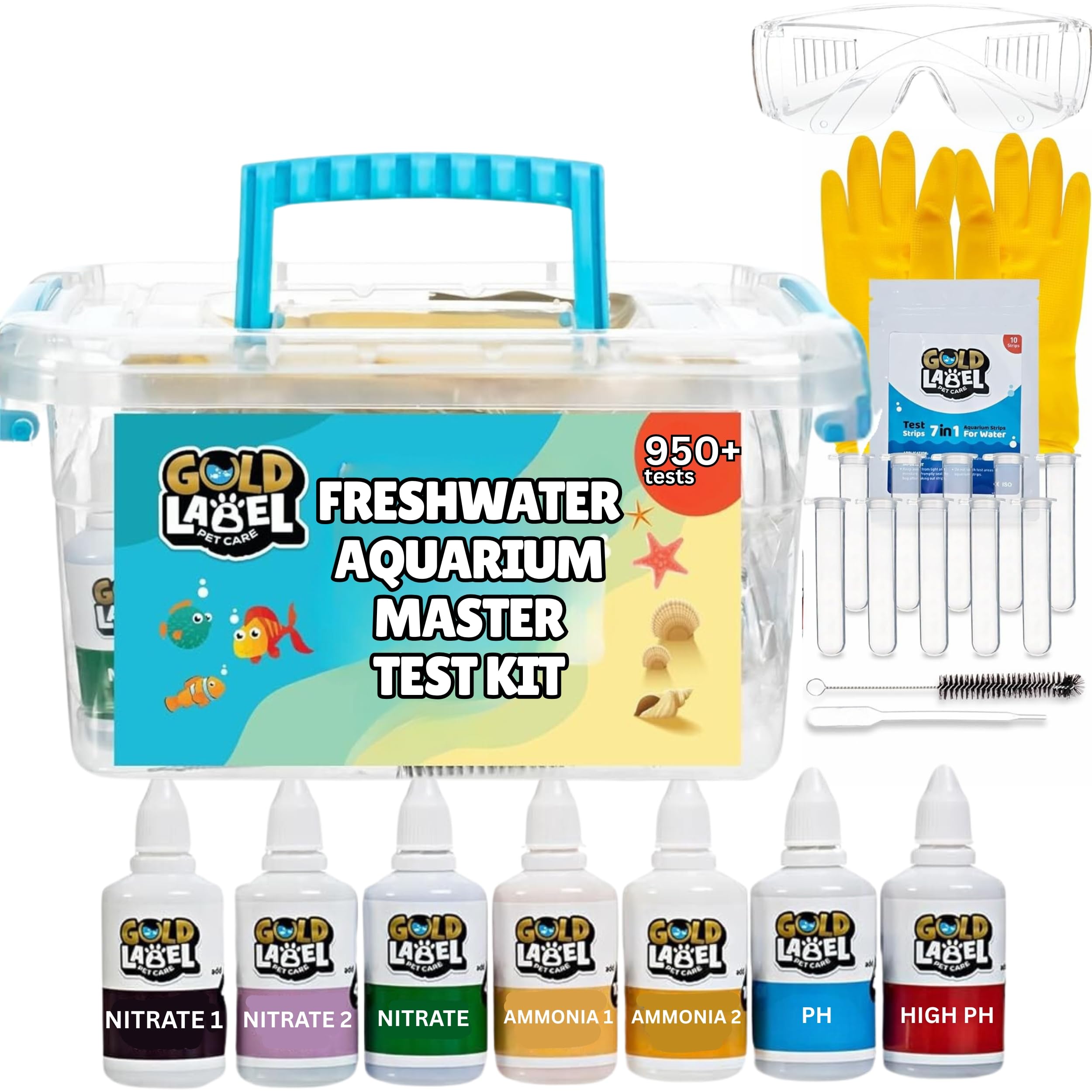
The Gold Label Pet Care Master Test Kit enters the market as a comprehensive, budget-friendly alternative to the dominant API kit. It covers pH, high-range pH, ammonia, nitrite, and nitrate, and adds extras like safety glasses, gloves, a cleaning brush, 10 test tubes, and 10 bonus water test strips. With a headline count of over 950 tests, it aims to be a one-stop package for beginner and intermediate freshwater keepers.
Early adopters note that the kit is fast and easy to use for routine checks, with clear test results for ammonia and nitrate that catch issues before they escalate. The inclusion of safety glasses and gloves is a thoughtful touch for those new to handling liquid reagents, and the extra test tubes mean you can run tests back-to-back without constant cleanup. The bonus test strips work well as a quick spot-check between full liquid panels.
However, quality control has been a concern. Several reports mention dropper tips getting stuck inside the cap and detaching from the bottle, making it difficult to dispense consistent drops. More critically, a small number of users have found the nitrite test read pink instead of the expected blue or purple, and the included strips showing zero readings where they expected detectable levels. This variability means the kit is best viewed as a backup or starter kit rather than a primary diagnostic tool for sensitive livestock like axolotls.
Why it’s great
- Very high test count with bonus strips for quick checks
- Includes safety glasses, gloves, brush, and 10 test tubes
- Affordable entry point for new freshwater aquarists
Good to know
- Dropper tips have a tendency to detach from bottles
- Inconsistent color development reported for nitrite test
7. Red Sea Reef Foundation Pro Test Kit

The Red Sea Reef Foundation Pro Test Kit is the definitive choice for the serious reef aquarist. It uses professional titration methods to measure calcium, magnesium, and alkalinity (KH) with exceptional precision—calcium down to 5 ppm resolution, alkalinity to 0.05 meq/L, and magnesium to 20 ppm. This level of accuracy is essential when dosing supplements to maintain balanced coral growth in a mature reef system.
Users consistently rank this kit above competitor products from Salifert and API for its consistent readings and robust design. The hard plastic case with glass reagent containers and color-coded labels keeps everything organized, and the dedicated titrator simplifies the drop-counting process. Many reviewers report that the kit reveals subtle parameter shifts that generic color-comparison kits miss, preventing dosing mistakes that could crash a delicate system.
The learning curve is real: the instructions demand careful reading and clean technique—rinsing the syringe with RO water and pre-rinsing with the sample before each test. The plastic case itself is a tight fit, making it difficult to store all pieces properly after use. However, for the reef keeper who views water chemistry as the foundation of their hobby, this investigation is not a cost; it is an investment in livestock survival and coral coloration.
Why it’s great
- Titration method provides lab-grade precision for reef parameters
- High resolution calcium (5 ppm) and alkalinity (0.05 meq/L) tests
- Sturdy hard case with color-coded glass containers
Good to know
- Requires careful reading of instructions for accurate dosing
- Case is a tight fit; hard to store all components cleanly
FAQ
How often should I test my aquarium water with a test kit?
What is the difference between using a master test kit and individual test kits?
Why do my test strip readings disagree with my liquid test kit readings?
Final Thoughts: The Verdict
For most freshwater hobbyists, the aquarium test kit list winner is the API Freshwater Master Test Kit because it offers the best balance of reliability, test volume, and beginner-friendly instructions. If you run a saltwater tank and want precise nitrate readings, grab the NYOS Nitrate Reefer Kit. And for dedicated reef keepers who need titration-level precision for calcium, alkalinity, and magnesium, nothing beats the Red Sea Reef Foundation Pro Test Kit.