
Our readers keep the lights on and the weekend projects moving. As an Amazon Associate, I earn from qualifying purchases.
Watching your infant splash in the pool is pure joy — until you realize that most baby pool floats are built with flimsy PVC, shallow seats, and zero stability engineering. A single lean forward can tip the whole thing, sending panicked parents lunging for their child. The best models in this category use reinforced seams, wide bases, and smart harness systems to keep your baby centered and upright, no matter how much they wiggle or kick.
I’m Rikta — the co-founder and writer behind FitlyFast. For this guide, I spent hours analyzing PVC thickness specs, canopy UPF ratings, seat depth measurements, and stability claims across dozens of inflatable floats to separate the genuinely safe designs from the marketing hype.
Whether you need a simple pool lounger for your 6‑month‑old or a full travel‑ready system for a busy toddler, this breakdown of the best baby pool float options will help you choose a float built around real‑world safety, not just cute graphics.
How To Choose The Best Baby Pool Float
A baby pool float is not a life jacket — it’s a supervised water‑introduction tool. Picking the wrong one means risking tip‑overs, sunburn, or a popped seam mid‑session. Focus on these four factors to match the float to your child’s age, weight, and your environment.
Stability Geometry: Seat Depth & Side Width
The single most important safety spec is how deep the seat sits relative to the outer ring. Floats with a wide side ratio (31″ × 24″ or wider) and a deepened center seat keep the baby’s center of gravity low and centered. A shallow seat lets a child lean out of the float — the exact motion that causes rollovers. Look for designs that specifically call out “no flip over” or “widened side” engineering.
Material Grade: PVC Thickness vs. Closed‑Cell Foam
Most inflatable floats use PVC between 0.18 mm and 0.35 mm. The thicker the PVC, the slower the air loss and the better the puncture resistance. Floats labeled “0.35 mm” or “triple‑layered” are summer‑long durable; anything under 0.25 mm risks failing after a few uses. Closed‑cell foam floats, like the self‑inflating Mambobaby, eliminate leak risk entirely — but they cost more and require manual air squeeze to compress for travel.
Sun Canopy: UPF Rating & Adjustability
An infant’s skin burns faster than an adult’s, making sun protection a real safety concern, not a luxury. Canopies should be rated UPF 50+ and attach securely to the float frame — not just sit on top. Detachable or adjustable canopies let you dial coverage as the sun moves, and mesh side windows let your baby see you while staying shaded.
Harness & Buckle Systems
A well‑designed harness keeps a baby from sliding out or tipping sideways. The safest floats use a 5‑point buckle system (similar to a car seat) or a deep center seat with soft shoulder straps. Simpler floats rely only on leg holes — fine for older toddlers who sit upright, but risky for infants under 12 months who don’t have the core strength to self‑correct.
Quick Comparison
On smaller screens, swipe sideways to see the full table.
| Model | Category | Best For | Key Spec | Amazon |
|---|---|---|---|---|
| SwimWays Infant Spring Float | Premium Spring Float | Infants 3‑9 months | Hyper‑Flate valve; anti‑stick fabric | Amazon |
| Mambobaby Self‑Inflating Float | Premium Foam Float | Backstroke & breaststroke positions | Closed‑cell foam; 5‑point harness | Amazon |
| WYRIAZA Float w/ Balance Ball | Mid‑Range Inflatable | 6‑36 months, extra balance | 0.35 mm PVC; 5 independent air bags | Amazon |
| SwimWays Baby Spring Float | Mid‑Range Spring Float | Toddlers 9‑24 months | Hyper‑Flate valve; sun canopy included | Amazon |
| Swimbobo Toddler Float w/ Canopy | Budget‑Value Inflatable | Ages 3‑8, splash play | 0.3 mm PVC; includes pump & canopy | Amazon |
| BOffer 3D Car Float | Budget‑Fun Option | 12‑24 months, imaginative play | 0.35 mm PVC; steering wheel with horn | Amazon |
| GLOPUS Float w/ Toy Console | Budget‑Interactive Float | 6‑36 months, sensory engagement | UPF 50+ canopy; dual air chambers | Amazon |
In‑Depth Reviews
1. SwimWays Infant Spring Float (3‑9 Months)

This is the most intelligently engineered float for very young infants who haven’t yet learned to sit upright. SwimWays uses an inner spring system — essentially a tensioned ring inside the PVC — that creates a stable platform even when a 3‑month‑old kicks or shifts weight. The fabric is a soft anti‑stick polyester, not raw plastic, so sensitive skin doesn’t chafe as the baby splashes. The Hyper‑Flate valve really does cut inflation time drastically, which matters when you’re juggling a squirmy baby and a pump.
The seat includes a harness buckle that keeps the baby upright and centered, and the adjustable canopy provides solid shade coverage. Water does enter the float — owners report the baby’s lower back gets wet — but that’s intentional design for cooling, not a leak. The float is compact when deflated and packs easily for beach trips.
SwimWays uses a specific age range (3‑9 months) because after that, most babies have enough torso strength to lean forward beyond the float’s balance point. For the newborn‑to‑first‑summer window, this is the most secure, parent‑friendly option on the market.
Why it’s great
- Inner spring technology provides unmatched stability for non‑sitting infants
- Hyper‑Flate valve inflates roughly 3× faster than standard valves
- Removable canopy offers genuine sun protection without blocking the baby’s view
Good to know
- Water pools inside the seat — baby’s lower body gets wet
- Refolding into the original carrying case is tricky
- Only suitable for infants under 9 months
2. Mambobaby Self‑Inflating Pool Float

The Mambobaby is the only float in this lineup that doesn’t rely on air — it uses compressible closed‑cell foam that self‑inflates when you release the compression strap. This completely eliminates the risk of a slow leak mid‑session or a seam failing after a few inflations. The 5‑point harness adjusts to fit babies from 13‑40 lb and the float supports two swimming positions: backstroke (3‑6 months) and breaststroke (3‑24 months), which extends its usable life considerably.
The UPF 50+ canopy is removable and the entire unit compresses into a travel bag that fits into a suitcase. Because the foam is solid, there’s no need to carry a pump — you just open the valve, let air in, and the foam expands. It takes about 30‑60 seconds. The harness buckle is sturdy and the seat angle (40°) keeps the baby in a semi‑reclined position that’s comfortable for both splashing and lounging.
At this price point, the Mambobaby is an investment, but you’re paying for zero‑leak reliability and a harness system that rivals a car seat in adjustability. The foam is also more durable than any inflatable PVC — owners use it across multiple children without degradation.
Why it’s great
- Self‑inflating foam — no leaks, no pump needed, instant setup
- 5‑point harness with 40° angle prevents tipping in both positions
- Compresses small for airline travel; comes with a carry bag
Good to know
- Higher initial cost than inflatable floats
- Bulkier when stored — doesn’t flatten like deflated PVC
- Backstroke position is only for infants under 6 months
3. WYRIAZA Baby Float with Canopy & Balance Ball
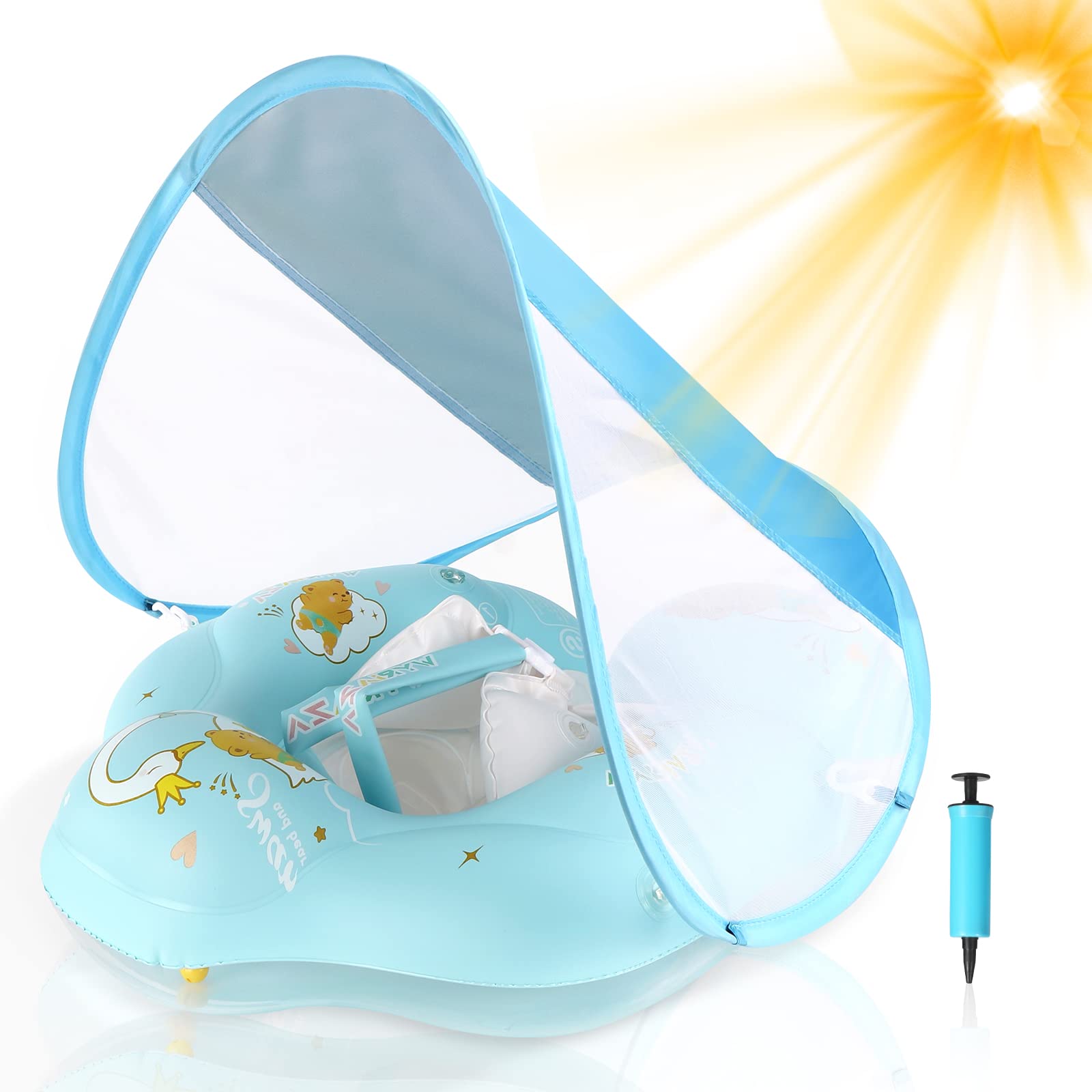
WYRIAZA’s standout feature is the oversized balance tail ball at the rear — a small inflatable bulb that acts as a counterweight to prevent backward or sideways rolling. Combined with five independent air chambers, this float provides redundancy: if one chamber loses air, the others still keep the baby afloat. The PVC is 0.35 mm thickened material, which puts it at the high end of durability for inflatable floats.
The double‑layer soft shoulder straps are a subtle but important detail — many budget floats use stiff PVC edges that dig into a baby’s neck or shoulders. WYRIAZA covers the straps with a secondary soft layer to eliminate that friction. The canopy snaps on and off easily and provides SPF 50+ coverage, though owners note the canopy is smaller than the one on the SwimWays models.
Inflation is straightforward — the included manual pump works, though you should inflate the small air bag first, then the large bags, to get even pressure. The float supports babies from 6‑36 months, but the balance ball is most effective for younger, lighter infants. For parents who want inflatable‑category safety without paying premium price, this is the sweet spot.
Why it’s great
- Balance tail ball adds an extra layer of roll prevention
- 5 independent air chambers provide redundancy
- Soft shoulder straps prevent skin irritation
Good to know
- Canopy is smaller than premium competitors
- Inflation sequence requires following instructions carefully
- Some owners report the seatbelt buckle feels less robust than on foam floats
4. SwimWays Baby Spring Float (9‑24 Months)
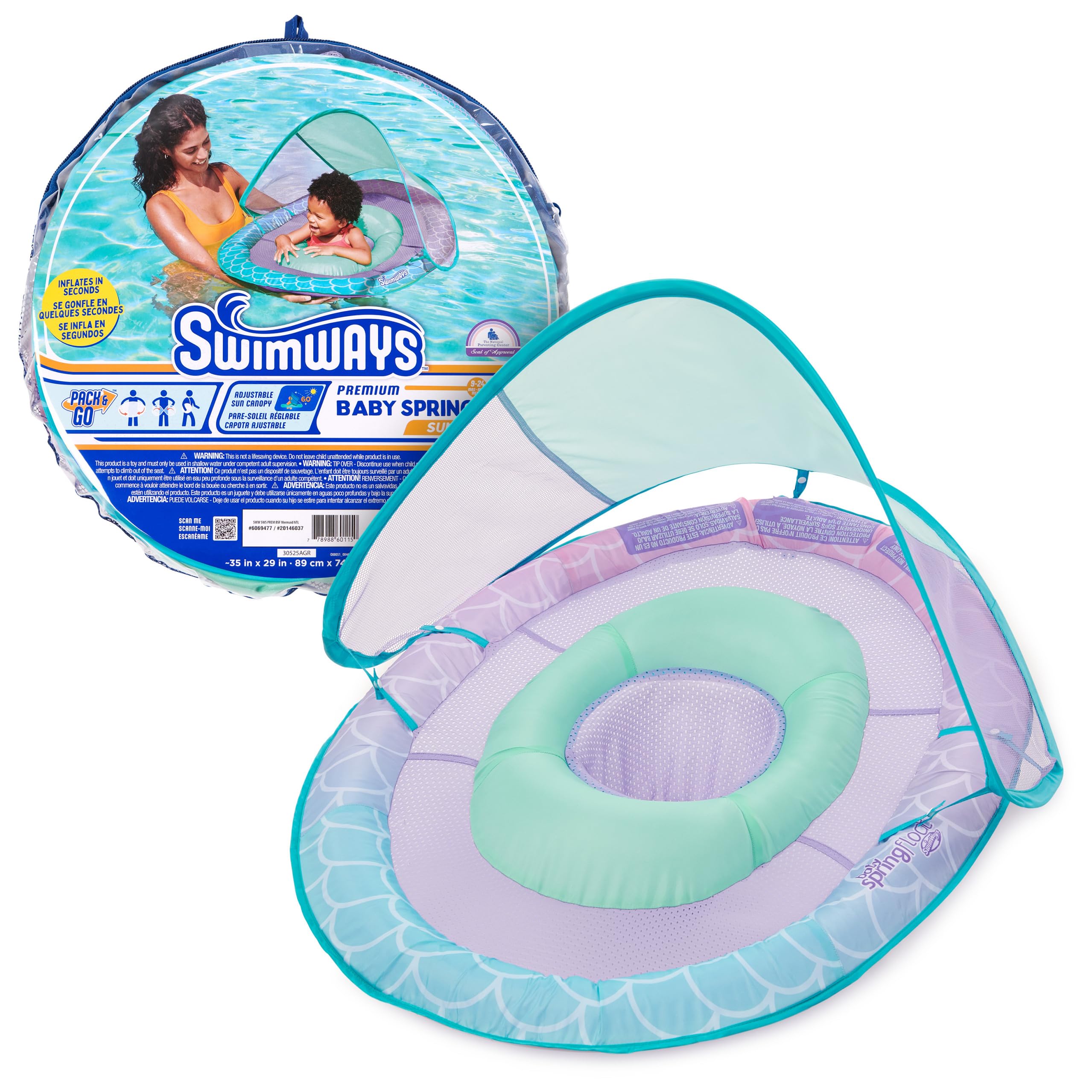
This is the older‑sibling version of our Best Overall pick, scaled for toddlers who can sit upright (9‑24 months). It retains the same inner‑spring technology and Hyper‑Flate valve that made the infant version so easy to inflate, but the seat is wider and the leg openings are larger to accommodate a growing child. The fabric is still that anti‑stick polyester that feels soft against the skin and doesn’t trap heat.
The Mermaid design is genuinely cute — the tail graphic wraps around the float and the canopy has a scalloped edge that provides roughly 60 degrees of shade. The canopy is adjustable and fully removable, and the entire float deflates flat for storage. Owners consistently mention how fast the Hyper‑Flate valve works: about 10‑15 seconds to full inflation.
Stability is excellent for a toddler float because the spring‑loaded ring keeps the structure taut even if the outer PVC ring flexes. The float does not have a harness — it relies on the deep seat and leg holes to keep the child positioned. For toddlers who are already walking and have good trunk control, this is a very comfortable, secure float for pool play.
Why it’s great
- Hyper‑Flate valve makes inflation nearly effortless
- Spring technology holds shape even with active toddlers
- Soft fabric feels comfortable and doesn’t stick to wet skin
Good to know
- No harness — relies on seat depth and leg holes for positioning
- May be too small for children approaching 24 months at the upper weight limit
- Canopy shade coverage is decent but not full 360‑degree protection
5. Swimbobo Toddler Pool Float with Canopy & Pump

The Swimbobo float is a budget‑friendly inflatable that manages to include a sun canopy and a hand pump in the box — something many entry‑level floats skip. The PVC is 0.3 mm thick, which is a solid middle ground: more durable than the cheapest 0.18 mm options but not as robust as the 0.35 mm premium models. The car‑shaped design includes a front steering wheel that squeaks, which younger toddlers find hilarious.
The canopy attaches with simple hooks and provides decent shade coverage, though owners note it’s not as effective at blocking lower‑angle sun as the UPF‑rated canopies on the SwimWays units. Stability is acceptable for toddlers aged 3‑8 (the float supports up to 50 lb), but the seat isn’t as deep as the SwimWays spring float — some owners report that very active toddlers can tilt the float side‑to‑side when leaning to one side.
For occasional pool use or as a backup float for grandparents’ house, the Swimbobo is perfectly fine. The pump that comes with it is small and takes a bit of work to get full inflation, but it’s functional. Just inflate it fully the night before — the 0.3 mm PVC holds air well overnight.
Why it’s great
- Includes both a pump and a sun canopy at a very accessible price point
- 0.3 mm triple‑layered PVC resists punctures better than entry‑level options
- Steering wheel with squeak function adds play value
Good to know
- Shade canopy provides minimal coverage at certain angles
- Side‑to‑side stability is moderate — active toddlers can tilt it
- Included hand pump is small and requires more pumps to inflate fully
6. BOffer 3D Car Baby Pool Float

BOffer took the standard ring‑style baby float and turned it into a 3D car — complete with a molded hood, a steering wheel that actually spins, and a rubber horn that makes a “BEBE” sound when squeezed. Kids absolutely love it, and parents love that the design naturally encourages the child to sit forward (toward the steering wheel), which keeps their weight centered and reduces tipping risk.
The PVC is 0.35 mm, which is the same thickness as premium models, and the float includes a deepened seat with a non‑detachable back cushion that supports the baby’s neck and spine. The leg openings are roomy enough for babies wearing swim diapers. The float is rated for 12‑55 lb, but the sweet spot seems to be 18‑24 months — old enough to understand the steering wheel, young enough to fit comfortably in the seat.
One limitation: because the car shape is molded, the float doesn’t deflate as flat as a simple ring. It still fits in a large beach bag, but it takes up more space. Also, the horn squeaker is fun, but it’s not replaceable if it gets waterlogged. For a one‑summer‑wonder that creates big smiles, the BOffer car float is a fantastic buy.
Why it’s great
- 0.35 mm thick PVC ensures all‑summer durability
- Deepened seat with back cushion prevents forward tipping
- Interactive steering wheel and horn provide hours of pool entertainment
Good to know
- Molded car shape doesn’t deflate completely flat for storage
- Horn squeaker can fail if water gets inside
- Not suitable for infants under 12 months who lack trunk support
7. GLOPUS Baby Pool Float with Toy Console
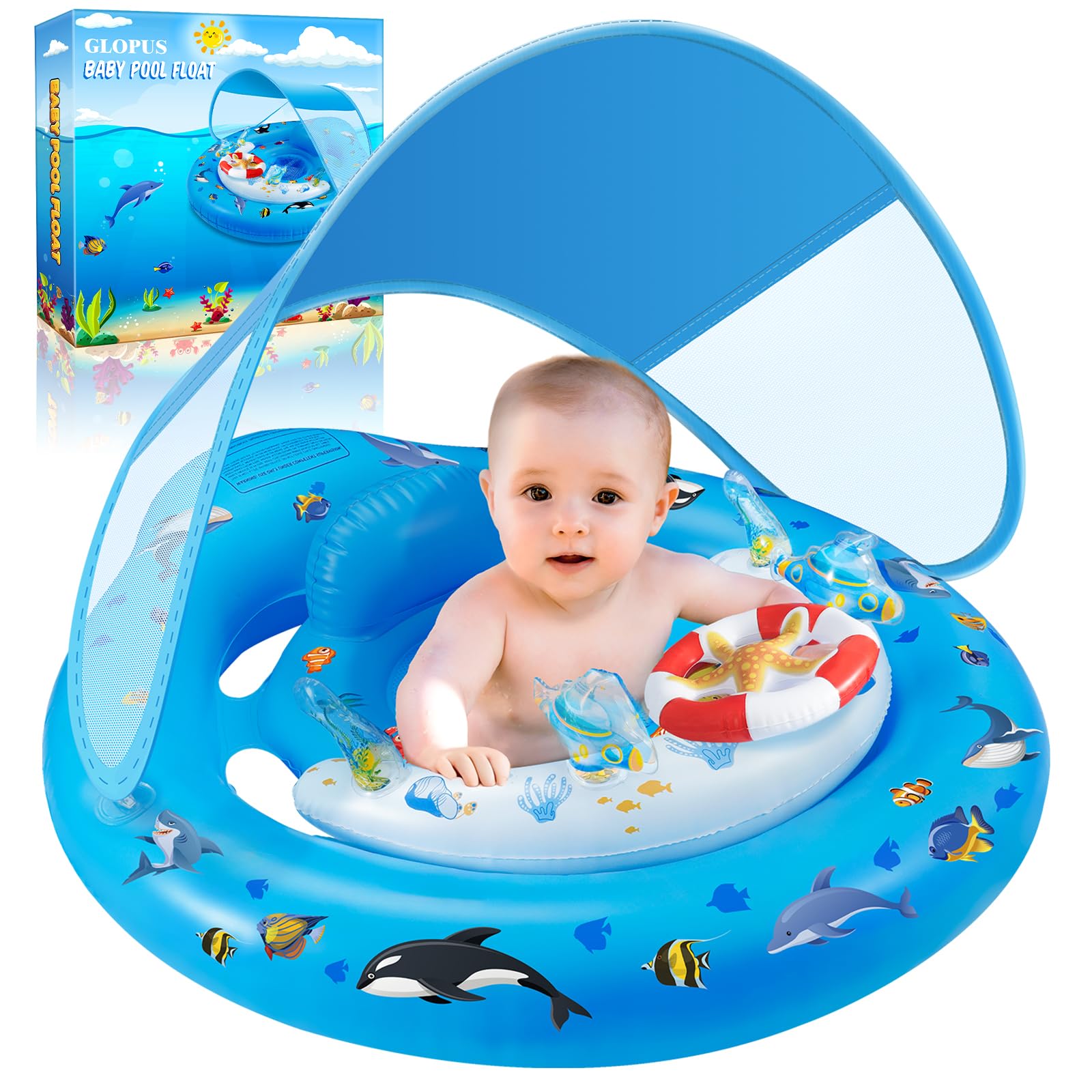
GLOPUS took a different approach to engagement: instead of a steering wheel, the front of this float has a “toy play console” — a starfish that squeaks, two submarines with sequined hulls, and two small bells. It’s a sensory‑rich design that keeps a baby’s hands busy while their body stays safely positioned in the deep center seat. The float uses dual air chambers with a space between them that creates a secure play area.
The UPF 50+ canopy is detachable and features mesh side windows so your baby can see you while staying shaded. The adjustable safety seat at the bottom is made from a super‑soft mesh material that doesn’t rub against the baby’s legs or diaper area. The float is rated for 6‑36 months and supports up to 15 kg (33 lb). It comes in a colorful box that makes it easy to store and transport.
On the downside, the PVC is not as thick as the BOffer or WYRIAZA floats — owners don’t specify the exact thickness, but it feels closer to 0.25 mm. This means you should avoid rough pool edges or abrasive surfaces. For calm pool days where the baby stays in the float for 20‑30 minutes, the GLOPUS is a charming, affordable option that prioritizes sensory play over rugged construction.
Why it’s great
- Multiple sensory toys (squeaker, sequins, bells) keep babies engaged
- UPF 50+ canopy with mesh windows offers excellent sun protection
- Adjustable safety seat with soft mesh is gentle on sensitive skin
Good to know
- PVC feels thinner than premium floats — handle with care near rough surfaces
- Canopy can be tricky to re‑attach after removal
- Toys are attached to the float and can’t be replaced individually
FAQ
At what age can my baby start using a pool float?
Can a baby flip over in a pool float?
Is a sun canopy necessary on a baby pool float?
Final Thoughts: The Verdict
For most users, the best baby pool float winner is the SwimWays Infant Spring Float because it combines spring‑based stability, a fast‑inflating valve, and a soft harness system that keeps even pre‑sitting infants secure and comfortable. If you want zero‑leak peace of mind and a float that works for multiple positions, grab the Mambobaby Self‑Inflating Float. And for budget‑minded families who still want 0.35 mm PVC thickness and a canopy, nothing beats the WYRIAZA Float with Balance Ball.