
Our readers keep the lights on and the weekend projects moving. As an Amazon Associate, I earn from qualifying purchases.
A mediocre blade turns a precision cut into a splintered mess, wastes expensive hardwood, and burns through material on every board you feed. A great 10 inch table saw blade is the difference between reaching for sandpaper or moving straight to assembly, between fighting the saw and letting it work. This guide separates the real performers from the hype so you know exactly what to buy for your next project.
I’m Rikta — the co-founder and writer behind FitlyFast. I’ve spent countless hours analyzing tooth geometry, carbide grades, kerf widths, and anti-vibration slot designs to understand what actually delivers a clean, durable cut across different materials and saw types.
Whether you are ripping dense hardwoods, crosscutting plywood, or building fine furniture, the right blade transforms your workflow. This roundup helps you find the best 10 inch table saw blade for your specific mix of cuts and budget.
How To Choose The Best 10 Inch Table Saw Blade
Choosing a blade isn’t about picking the most expensive one. It’s about matching tooth geometry, kerf thickness, and coating to the materials you cut most often. A general-purpose 40-tooth blade covers most workshop work, but dedicated rip or finish blades deliver better results if you focus on one type of cut.
Tooth Count and Geometry
Fewer teeth (24 to 30) rip faster but leave rougher edges. More teeth (60 to 80) produce smoother crosscuts and finish work but cut slower and can burn if fed too fast. The Alternate Top Bevel (ATB) grind is the most versatile for crosscuts and general use. Triple Chip Grind (TCG) handles abrasive materials and leaves a flat-bottom kerf for dados.
Kerf Width: Thin vs Full
Thin kerf blades (.091 inch or less) remove less material, waste less wood, and put less strain on underpowered saws. Full kerf blades (.125 inch) are more stable, resist deflection during heavy rips, and produce straighter cuts on high-horsepower cabinet saws. Your saw’s motor power should guide this choice.
Carbide Quality and Coatings
TiCo (Titanium Cobalt) carbide holds an edge longer than standard carbide and resists chipping on tough hardwoods. Perma-Shield non-stick coatings reduce friction, heat buildup, and resin buildup, extending sharpness between sharpenings. Laser-cut anti-vibration slots dampen chatter for smoother cuts.
Quick Comparison
On smaller screens, swipe sideways to see the full table.
| Model | Category | Best For | Key Spec | Amazon |
|---|---|---|---|---|
| Forrest WW10407125 | Premium | Lifetime resharpening & fine woodworking | 40T ATB, .125″ full kerf | Amazon |
| Freud LM74R010 | Premium | Glue-line ripping in hardwoods | 30T TCG, thick kerf | Amazon |
| Freud LM75R010 | Mid-Range | Thin kerf glue-line ripping | 30T TCG, .091″ thin kerf | Amazon |
| Diablo D1080X | Mid-Range | Ultra-fine finish crosscuts | 80T Hi-ATB, .098″ kerf | Amazon |
| Diablo D1040X | Mid-Range | All-purpose cuts & value | 40T ATB, .098″ thin kerf | Amazon |
| DEWALT DW3114 | Budget | Homeowner general use | 40T ATB, thin kerf | Amazon |
| Makita B-66977 | Mid-Range | Splinter-free crosscuts on plywood | 80T ATAFR, thin kerf | Amazon |
In‑Depth Reviews
1. Forrest WW10407125 Woodworker II 10-Inch 40 Tooth ATB .125 Kerf

Forrest is the gold standard for woodworkers who want a single combination blade that does everything well. The 40-tooth ATB grind produces silky crosscuts and clean rips, and the full .125-inch kerf provides exceptional stability on cabinet saws. Users consistently report cuts that feel sanded right off the blade.
The real differentiator is Forrest’s lifetime resharpening service. You buy this blade once and send it back for factory resharpening, which amortizes the upfront cost over years of use. Professional carpenters and serious hobbyists consider this the final blade purchase for their saw.
It requires a saw with enough power to drive the full kerf, and the initial cost is notably higher than mid-range options. But for those who value cut quality and long-term value over budget, this blade is unmatched.
Why it’s great
- Lifetime resharpening makes it a long-term investment
- Exceptional cut quality on both crosscuts and rips
- Thick kerf provides superior stability and straight cuts
Good to know
- High upfront cost; requires a powerful saw for best results
- Heavier than thin kerf alternatives
2. Freud LM74R010 10″ 30 Tooth TCG Glue Line Ripping Saw Blade
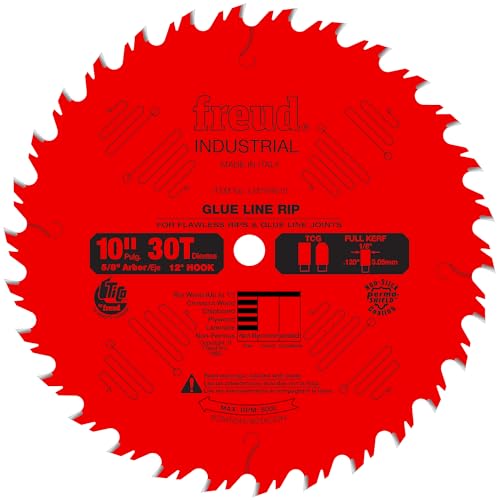
The LM74R010 is built for serious ripping. The 30-tooth Triple Chip Grind leaves a flat-bottom kerf that is ready for glue-up right off the saw, eliminating jointing passes on hardwoods like white oak and hickory. The thick kerf and reinforced plate keep the blade flat and stable under heavy feed rates.
Reviewers note zero burn marks even when ripping dense stock, and the TiCo carbide holds its edge impressively against abrasive materials. The Perma-Shield coating prevents resin buildup, which means you spend less time cleaning and more time cutting.
This is a dedicated rip blade, not a general-purpose option. It excels when you need glue-ready edges but is not ideal for crosscuts or sheet goods. Budget-conscious woodworkers say it performs at a fraction of the cost of premium brands like Forrest.
Why it’s great
- Glue-ready rip cuts straight off the saw with no burn marks
- Thick kerf and anti-vibration slots for stable heavy ripping
- TiCo carbide holds edge exceptionally well on hardwoods
Good to know
- Dedicated rip blade; not suitable for crosscuts or finish work
- Heavier construction requires a saw with adequate power
3. Freud LM75R010 10″ Industrial Thin Kerf Glue Line Ripping Blade
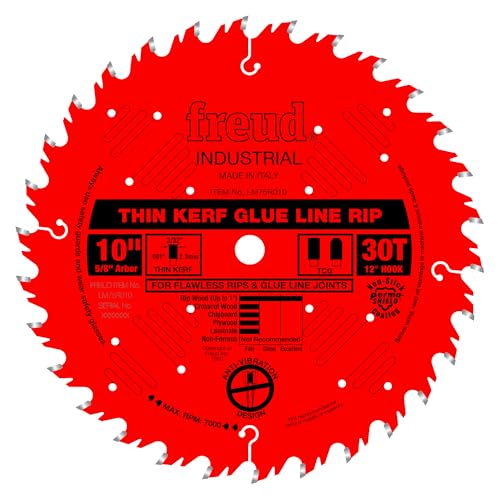
If you run a mid-range or contractor saw, the LM75R010 is the thin kerf alternative to the LM74. The .091-inch kerf removes less material and puts less strain on smaller motors while still delivering glue-line quality rips. The TiCO carbide and Perma-Shield coating mirror the premium build of its thicker sibling.
Users highlight how smoothly it cuts plywood and hardwoods with no burning or binding, even when feeding aggressively. The laser-cut anti-vibration slots keep the cut stable despite the thin profile. Weekend warriors and small shop owners appreciate the narrower kerf saving wood on every cut.
Alignment is critical with thin kerf blades — any misalignment in your saw produces wander or saw marks. It is not the right blade for heavy production ripping where full kerf stability matters more.
Why it’s great
- Glue-line quality rips with less motor strain
- Thin kerf reduces waste and feeds faster on contractor saws
- Anti-vibration slots keep cuts stable at high feed rates
Good to know
- Requires precise saw alignment to avoid wander marks
- Not as durable for high-volume production as full kerf
4. Diablo D1080X 10″ 80 Tooth Ultra Finish Saw Blade
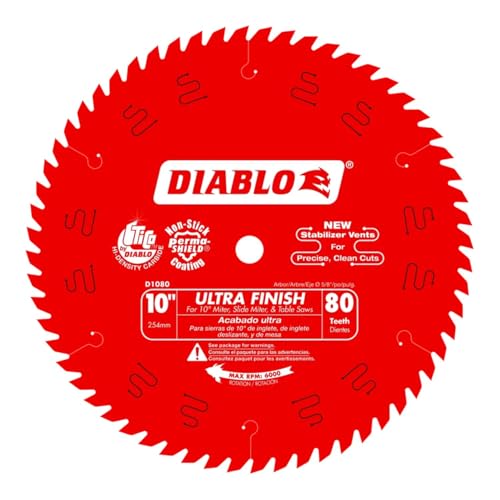
When you need a crosscut so clean that it looks sanded, the D1080X delivers. The 80-tooth Hi-ATB geometry produces virtually no tear-out on veneer plywood, hard maple, and even fragile melamine. Cabinetmakers and trim carpenters reach for this blade when the cut face becomes the finished edge.
The Perma-Shield coating and laser-cut stabilizer slots minimize vibration and heat buildup, allowing the blade to maintain its sharpness through many projects. Users note that glue-edge finishes come out ready for assembly without sanding or jointing.
An 80-tooth blade cuts slower than lower-count options and can burn if you push feed rates too fast on thick material. It is strictly a finish blade — not suited for ripping or heavy stock removal.
Why it’s great
- Near-zero tear-out on plywood and veneers
- Produces finish-ready edges that need no sanding
- Perma-Shield coating resists pitch and gumming
Good to know
- Slow feed required on thick hardwoods to avoid burning
- Not designed for ripping or heavy-duty work
5. Diablo D1040X 10-Inch 40-Tooth ATB General Purpose Saw Blade

The D1040X is the most recommended general-purpose blade on the market for a reason. The 40-tooth ATB design handles both rip cuts and crosscuts with noticeably smoother finishes than stock blades. Users frequently report that it cuts pressure-treated lumber, plywood, and hardwoods cleanly without the burning or tear-out they experienced with factory blades.
The TiCo carbide tips hold their edge surprisingly well, even through demanding jobs like cutting nearly 200 pressure-treated boards on a miter saw. The Perma-Shield non-stick coating keeps resin from building up on the blade, which extends time between cleanings and helps maintain cut quality.
It is not the best choice for ultra-fine finish work or heavy production ripping. But for the vast majority of workshop tasks — from framing to cabinets — this blade balances speed, smoothness, and durability better than anything near its price tier.
Why it’s great
- Exceptional balance of rip speed and crosscut smoothness
- Thin kerf reduces motor strain and wood waste
- TiCo carbide holds edge well for a mid-range blade
Good to know
- Not the best choice for ultra-fine finish crosscuts
- Some users note red coating can rub off early on
7. DEWALT DW3114 10-Inch 40 Tooth ATB Thin Kerf Saw Blade

The DW3114 punches above its price tier, especially for occasional home use. The 40-tooth ATB design delivers clean enough cuts for framing, decking, and general renovation work, and the thin kerf keeps your saw running smoothly without bogging down on 2x4s or pressure-treated 4x4s.
Users are consistently surprised by how well it performs on hardwoods like Brazilian walnut, with no burning or vibration even after months of moderate table saw use. It is also sharpenable — you can have it professionally sharpened for a couple of dollars, extending its life far beyond what you would expect from a budget blade.
It does not match the edge retention or cut smoothness of premium blades for fine woodworking, and the alloy steel body is less durable than carbide-steel composites. But for its price, this is a reliable everyday blade that outperforms most stock saw blades.
Why it’s great
- Remarkably good cut quality for a budget-friendly blade
- Sharpenable design extends usable life
- Thin kerf works well on underpowered saws
Good to know
- Edge retention not as strong as higher-end options
- Alloy steel body less durable on heavy production cuts
6. Makita B-66977 10″ 80T Carbide-Tipped Max Efficiency Miter Saw Blade
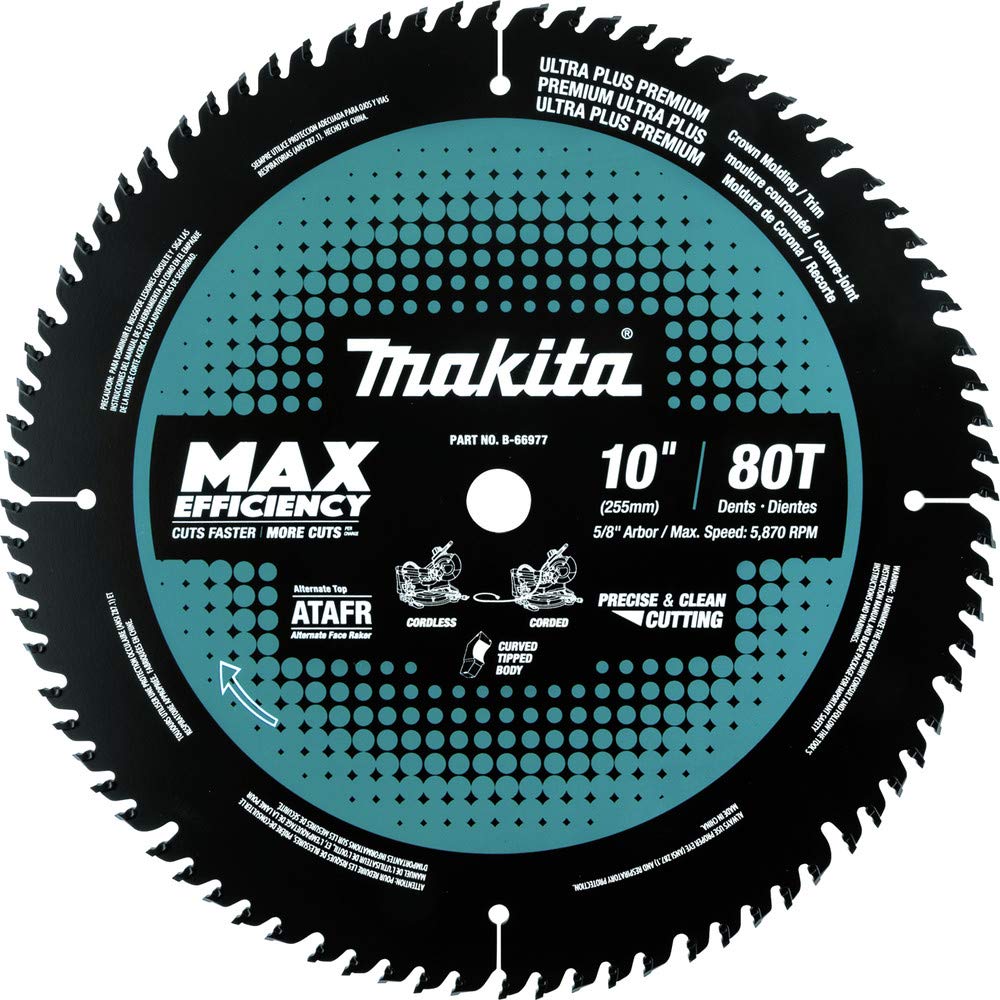
The Makita B-66977 uses a specialized ATAFR (alternate top alternate face with raker) tooth design that delivers exceptionally smooth crosscuts with minimal tear-out. Cabinet installers and finish carpenters praise it for eliminating the need for painter’s tape on veneer plywood, saving setup time on every job.
Users report it outperforms higher-tooth-count Diablo blades on hard maple, with far less gumming and noticeably cleaner edges. The thin kerf carbide-tipped design reduces drag on the motor, and the specially engineered teeth produce up to 100% faster cutting compared to standard blades on compatible saws.
This is a dedicated miter saw blade, and while it fits a table saw arbor, its tooth geometry is optimized for crosscuts. It is not suitable for ripping operations and the 80-tooth count means you must feed slower on thicker material to avoid burning.
Why it’s great
- Eliminates veneer splintering without painter’s tape
- ATAFR geometry outperforms standard Hi-ATB on clean cuts
- Thin kerf reduces motor drag and increases cutting speed
Good to know
- Designed primarily for miter saw crosscuts, not ripping
- High tooth count requires deliberate feed rate on thick stock
FAQ
What tooth count should I pick for general woodworking?
Can I use a thin kerf blade on a cabinet saw?
How often should I sharpen or replace a table saw blade?
Final Thoughts: The Verdict
For most users, the best 10 inch table saw blade winner is the Diablo D1040X because its 40-tooth ATB design delivers the best balance of clean crosscuts, fast ripping, and long edge life at a price that works for both hobbyists and pros. If you need glue-ready rip cuts that skip the jointer, grab the Freud LM74R010. And for splinter-free finish crosscuts on plywood, nothing beats the Makita B-66977.