
Our readers keep the lights on and the weekend projects moving. As an Amazon Associate, I earn from qualifying purchases.
Getting into 3D printing on a tight budget often means accepting slow speeds, manual leveling, and constant print failures that waste filament. The challenge is finding a machine that balances low upfront cost with reliable, fast results that actually encourage learning rather than frustration.
I’m Rikta — the co-founder and writer behind FitlyFast. After spending countless hours digging into the hardware specifications, customer feedback, and real-world performance data across dozens of affordable 3D printers, I’ve separated the real performers from the frustrating time-sinks.
The key to a smart entry is knowing which features translate to dependable prints without breaking the bank, and this guide to the best budget 3d printer options cuts through the noise to deliver actionable advice for makers on a tight budget.
How To Choose The Best Budget 3D Printer
Choosing a budget 3D printer requires a careful look at what features are essential for reliable printing versus which are nice-to-have upgrades. When funds are limited, every dollar should go toward hardware that reduces failure and frustration.
Auto-Leveling: The Beginner’s Best Friend
A machine that requires manual bed leveling using a piece of paper is a recipe for failed first layers and wasted time. Auto-leveling uses a sensor to map the bed and adjust the nozzle height automatically. In the budget category, this feature separates a pleasant experience from a constant headache.
Direct Drive vs. Bowden Extruders
Direct drive extruders mount the motor directly above the nozzle, giving you precise control over filament flow and the ability to print flexible materials like TPU. Bowden setups, common on older budget printers, push filament through a long tube, which can cause stringing and clogs. For a beginner on a budget, direct drive offers far greater material versatility.
Print Speed and Acceleration
Budget printers once topped out at around 50-80 mm/s. Today, many entry-level machines achieve 250-500 mm/s thanks to improved motion systems and firmware. Faster speeds reduce the wait time for test prints and functional parts, but raw speed without good acceleration control can cause ringing and ghosting. Look for machines that also mention acceleration values and vibration compensation.
Quick Comparison
On smaller screens, swipe sideways to see the full table.
| Model | Category | Best For | Key Spec | Amazon |
|---|---|---|---|---|
| Flashforge Adventurer 5M | CoreXY | Plug-and-play beginners | 600mm/s speed, 32mm³/s flow | Amazon |
| ELEGOO Centauri Carbon | CoreXY | Advanced materials & reliability | 320°C nozzle, enclosed chamber | Amazon |
| Creality Ender 3 V3 KE | Bedslinger | Speed and modding potential | 500mm/s, 8000mm/s² accel | Amazon |
| Sovol T300 | Bedslinger | Large prints on a budget | 11.8″ cubes build volume | Amazon |
| Creality Ender 3 V3 SE | Bedslinger | Reliable upgrades from classic Ender | 250mm/s, CR Touch leveling | Amazon |
| Entina Tina2C | Mini FDM | Kids and STEM classrooms | WiFi/app control, 8-min setup | Amazon |
| Geeetech M1 | Mini FDM | Safe enclosed printing for kids | 250mm/s, knob operation | Amazon |
| Entina Tina2 Basic | Mini FDM | Ultra-simple first printer | Auto-leveling, dual Z-axis | Amazon |
| Creality Ender 3 (Classic) | Bedslinger | Tinkering and learning the hard way | 8.66″ cube, open-source | Amazon |
In‑Depth Reviews
1. Flashforge Adventurer 5M

The Flashforge Adventurer 5M delivers CoreXY speed and reliability that rivals printers costing significantly more. With a maximum speed of 600mm/s and a 20000mm/s² acceleration, this machine prints a standard benchy in under 20 minutes while maintaining excellent surface quality thanks to its built-in vibration compensation.
Setup is genuinely beginner-friendly — the printer arrives mostly assembled, and the one-click auto-leveling system calibrates the bed before the first print. The dual-sided PEI-coated build plate offers strong adhesion for PLA and PETG, and prints pop off easily once the plate cools. The 280°C all-metal hotend handles a wide range of filaments without issues.
The included filament run-out sensor and power-loss recovery add peace of mind for long prints. Some users report occasional firmware freezes, and the 5G-only WiFi can be finicky, but the overall package is remarkably polished for a machine in this tier. It is the gold standard for anyone wanting a fast, reliable print experience without manual tuning.
Why it’s great
- True plug-and-play with full auto-leveling
- Ultra-fast CoreXY motion system with vibration compensation
- Dual-sided PEI plate for outstanding bed adhesion
Good to know
- WiFi only supports 5GHz networks
- Small 220mm cubed build volume
- Occasional firmware freezes reported
2. ELEGOO Centauri Carbon
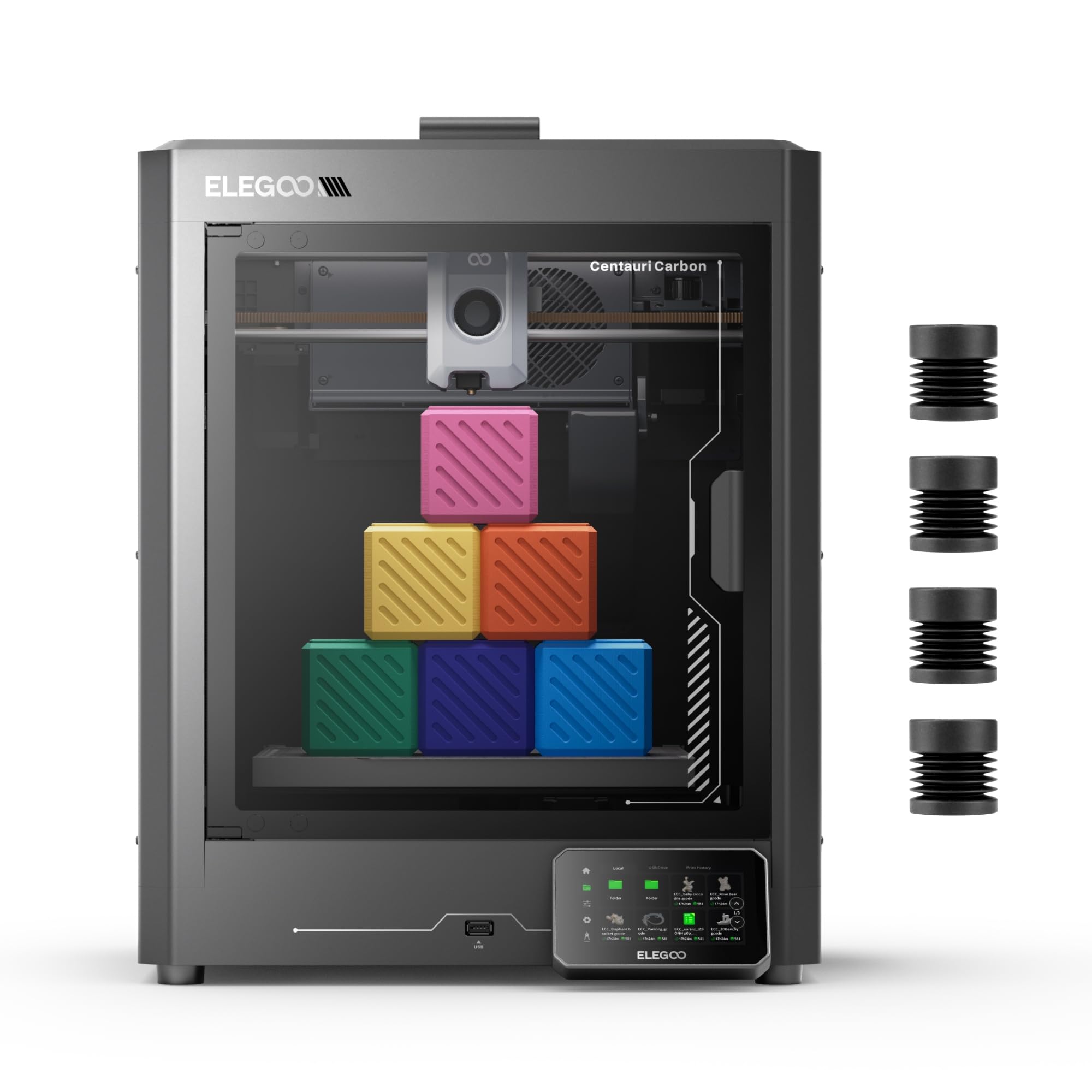
The ELEGOO Centauri Carbon pushes the budget category into new territory with its enclosed CoreXY design and a 320°C brass-hardened steel nozzle. This machine prints standard PLA at 500mm/s but also handles carbon fiber-reinforced filaments and other advanced materials without the need for upgrades, making it ideal for functional parts.
Assembly is essentially zero — the unit arrives fully assembled and pre-calibrated. The 256mm cubed build volume is generous for a machine in this class, and the die-cast aluminum frame minimizes vibration at high speeds. The built-in chamber camera with time-lapse recording is a rare luxury at this price point.
Centauri Carbon also features a dual-sided build plate with a specific PLA surface that provides excellent adhesion even at lower bed temperatures. Some users experienced early hotend communication errors, but replacements have been reliable for hundreds of hours. The ElegooSlicer software works well over WiFi, though complex STL files can cause the slicer to stutter on older computers.
Why it’s great
- Fully assembled and pre-calibrated out of the box
- 320°C nozzle handles advanced materials
- Built-in camera with time-lapse monitoring
Good to know
- First-unit failure rate appears higher than average
- Heavy and large footprint at 38.5 pounds
- Slicer can struggle with large models on low-end PCs
3. Creality Ender 3 V3 KE

The Creality Ender-3 V3 KE takes the classic Ender platform and supercharges it with a 500mm/s print speed and 8000mm/s² acceleration. The Sprite direct extruder with a 60W ceramic heater and bi-metal heatbreak allows reliable printing up to 300°C, supporting PLA, PETG, ABS, TPU, and ASA filaments right out of the box.
Setup takes about 10 minutes thanks to the all-in-one design, and the CR Touch sensor handles auto-leveling with multiple points for a consistent first layer. The X-axis carriage slides on ball bearings for exceptionally smooth motion, and the vibration compensation algorithms reduce ringing even at high speeds. The dual cooling fans ensure crisp overhangs and bridges.
Users consistently praise the print quality and reliability, though the stock fans are noticeably loud. Some units have experienced extruder issues after extended use, and firmware updates require a hidden C connector on the screen control board. The community support is vast, so most problems have documented fixes. This is the best choice for speed-focused makers who want a solid upgrade path.
Why it’s great
- Very fast 500mm/s with excellent motion stability
- Sprite direct extruder handles flexible materials
- Strong community and upgrade ecosystem
Good to know
- Stock fans are loud during operation
- Firmware updates are unintuitive
- Some units develop extruder issues over time
4. Sovol T300

The Sovol T300 is a budget-friendly machine that doesn’t skimp on size or speed. With an 11.8-inch cubic build volume, it prints objects that many compact printers simply cannot accommodate. The Klipper-based firmware enables 600mm/s print speeds and 12000mm/s² acceleration, making it one of the fastest large-format machines available at a low price.
The all-metal body and industrial-grade linear rails provide the rigidity needed to maintain quality at high speeds. The all-in-one hotend reaches 200°C in just 30 seconds, drastically reducing preheat times. The 81-point auto-leveling system ensures a perfect first layer, though some units have required gantry adjustments out of the box.
Filament versatility is a strong point, with the 300°C hotend supporting ABS and other high-temperature materials. The 6.5:1 gear ratio dual-gear extruder provides excellent grip for flexible filaments. Some users report component failures like tensioner breakage and stepper motor overheating, but the robust community and active Facebook group help troubleshoot most issues. It is the top choice if you need to print large parts on a tight budget.
Why it’s great
- Generous 11.8-inch cubic build volume
- 30-second nozzle preheat time
- Klipper firmware with 81-point auto-leveling
Good to know
- Quality control issues reported on some units
- Loud servos and fans during operation
- Magnetic build plate can be easily damaged
5. Creality Ender 3 V3 SE

The Creality Ender 3 V3 SE is a thoughtfully upgraded version of the classic Ender 3 design, addressing the biggest pain points of its predecessor. It includes CR Touch auto-leveling, a strain sensor for automatic Z-offset, and a Sprite direct extruder that handles PLA, TPU, and PETG without slipping or jamming.
Print speed reaches 250mm/s with 2500mm/s² acceleration, a significant improvement over older Ender models. The dual Z-axis lead screws reduce wobble and improve layer alignment, while the Y-axis uses two 8mm linear shafts for stable motion. Assembly takes about 20 minutes with only three steps, making it accessible for beginners.
Automatic filament loading and unloading simplifies material changes. The printer is quieter than earlier Enders, though the stock cooling fans are still audible. Users report consistent print quality and reliability, with most complaints centered on the Creality Cloud app rather than the hardware itself. The V3 SE offers the most balanced blend of price, features, and print quality in the mid-range.
Why it’s great
- CR Touch auto-leveling with automatic Z-offset
- Sprite direct extruder for flexible filaments
- Fast 20-minute assembly process
Good to know
- Creality Cloud app has connectivity issues
- Stock cooling fans are slightly underpowered
- SD card slot is mounted upside down
6. Entina Tina2C
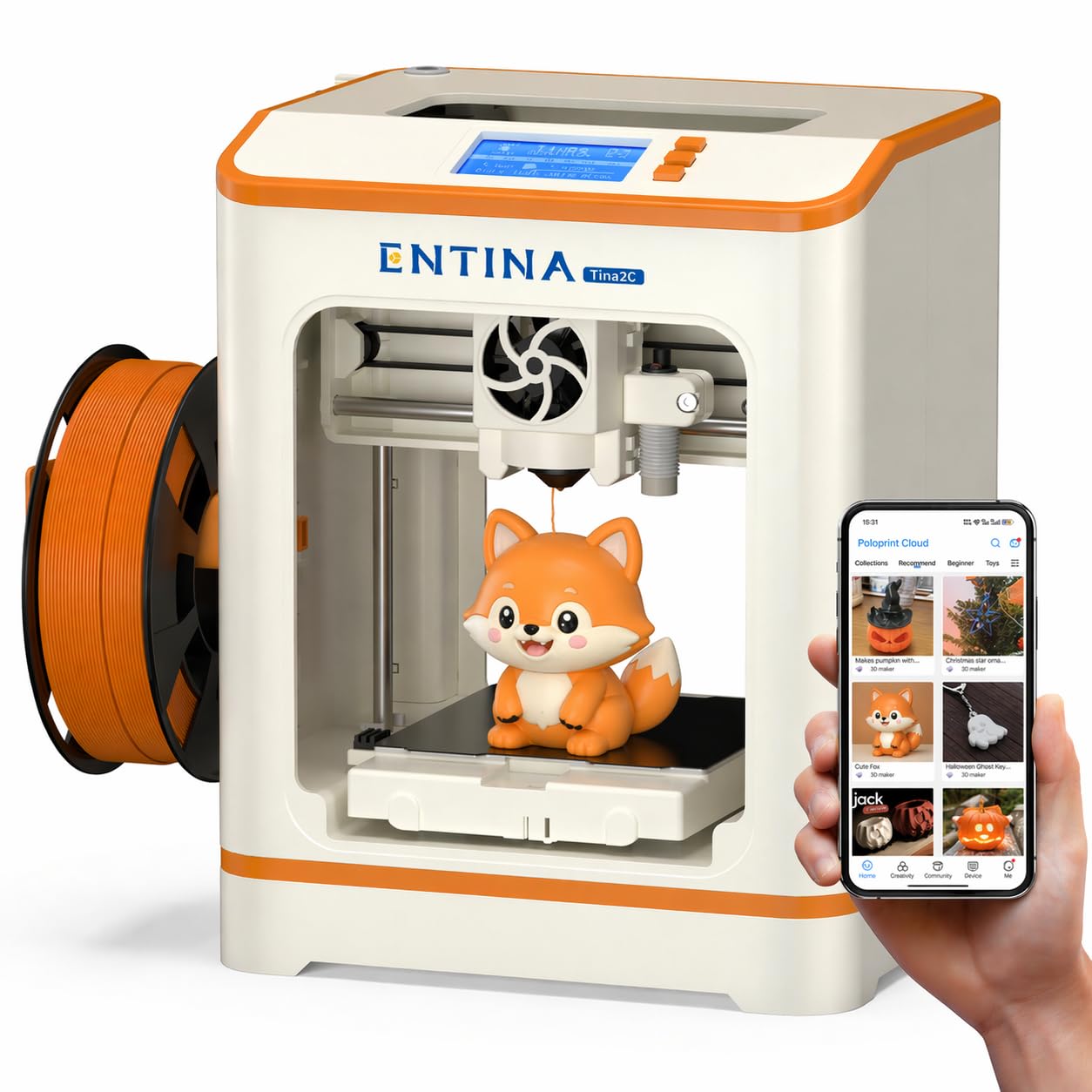
The Entina Tina2C is purpose-built for children and absolute beginners, with a guided setup process through the Poloprint Cloud app. Users can go from unboxing to their first print in about 8 minutes, a remarkable achievement for any 3D printer. The AI-powered search and photo-to-print features allow kids to turn simple pictures into 3D objects without learning complex slicing software.
The printer supports both 2.4G WiFi printing and TF card offline mode, giving flexibility for different learning environments. The self-cleaning nozzle design and quick-swap printhead structure make maintenance simple enough for a 10-year-old to handle. The 3.9-inch cubic build volume is small, but sufficient for keychains, toys, and STEM project components.
Auto-leveling and power-loss recovery improve print success rates, while the compact, rounded design with low-noise operation makes it safe for home and classroom environments. With over 20 creative DIY modules and regularly updated STEM courses, the Tina2C transforms 3D printing into an engaging educational tool. It is the best choice for families introducing young makers to additive manufacturing.
Why it’s great
- 8-minute setup from box to first print
- AI-powered photo-to-print for kids
- Self-cleaning nozzle reduces maintenance
Good to know
- Small 3.9-inch cubic build volume
- Requires smartphone or tablet for full app features
- Limited to small decorative objects and parts
7. Geeetech M1
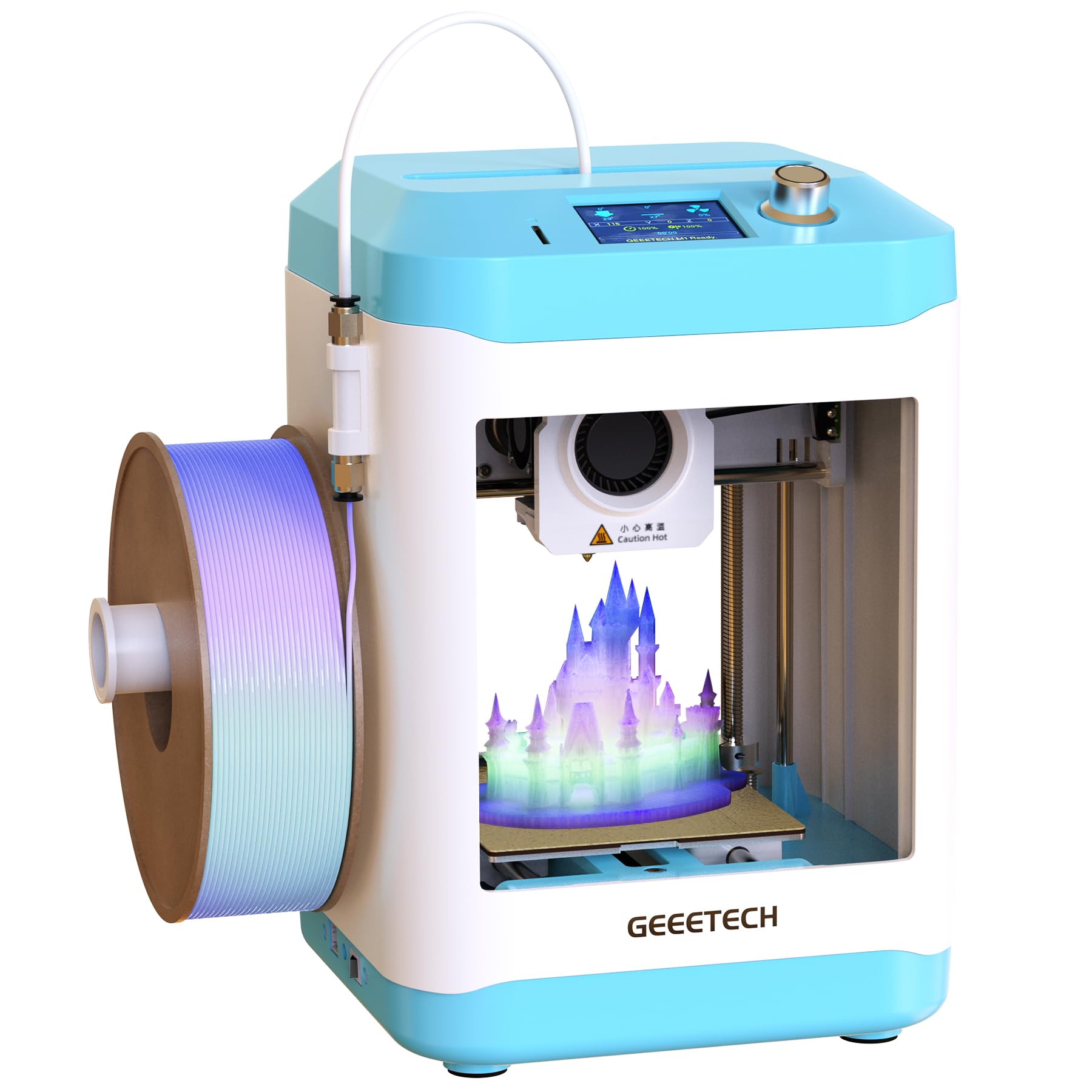
The Geeetech M1 is designed as an enclosed, safe 3D printer for children and beginners. The fully assembled machine features a 2.4-inch color LCD screen with high-brightness lighting, illuminated build area, and knob-based operation that eliminates the need for complex menus. The enclosure keeps curious hands away from moving parts and hot components.
Print speed reaches 250mm/s thanks to a 50W heating rod and advanced nozzle design. The direct drive extruder with a 1:5 gear ratio provides enough torque to handle TPU flexible filaments, though the tiny 3.94-inch cubic build volume limits what you can produce. The 16-point full-auto leveling and heated flexible magnetic build plate minimize warping and simplify model removal.
Some users report that the filament holder positioning can cause feeding issues with 1kg spools, and a few units have experienced clogs or layer skips. However, the overall build quality and print speed are impressive for a machine that prioritizes safety. The 30-day return policy and 12-month free repair warranty provide solid peace of mind for cautious buyers.
Why it’s great
- Fully enclosed design for child safety
- Simple knob-based operation
- Heated bed with flexible magnetic build plate
Good to know
- Very small 3.94-inch cubic build volume
- Filament holder may require modification for 1kg spools
- Some units report clogs and layer shifting
8. Entina Tina2 Basic

The Entina Tina2 Basic is one of the most accessible entry points into 3D printing. It arrives fully assembled, and the included TF card contains test models and slicing software so users can start printing within 5 minutes. The 2.4-inch LCD screen and knob interface make navigation simple enough for a 10-year-old to operate independently.
Auto-leveling eliminates the most common beginner frustration of manual bed calibration. The magnetic build platform allows prints to be removed easily with a flex of the plate, and the dual Z-axis rails ensure consistent layer alignment. The 100x105x100mm build volume is tiny, but sufficient for small toys, keychains, and basic educational projects.
Print quality is notably good for the price point, with sharp details and minimal stringing when using the recommended profiles. The printer supports offline printing via MicroSD card, so no computer is needed once the model is loaded. Noise levels are low, making it suitable for a bedroom or classroom. The only real limitation is the small size, which will frustrate users who want to print larger functional parts.
Why it’s great
- Fully assembled and ready in 5 minutes
- Dual Z-axis rails for stable precision
- Quiet operation suitable for shared spaces
Good to know
- Very small 100x105x100mm build volume
- No WiFi connectivity, only SD card
- Limited material options compared to larger printers
9. Creality Ender 3 (Classic)

The original Creality Ender 3 remains the standard for makers who want to learn every aspect of 3D printing through hands-on assembly and tuning. It arrives as a kit requiring about 2 to 4 hours of assembly, and every adjustment — from bed leveling to extruder calibration — is a manual process that teaches the fundamentals of the technology.
The open-source design means unlimited upgrade potential. Users can add a glass bed, metal extruder, Capricorn PTFE tube, BLTouch auto-leveling, and even a direct drive conversion over time. The 8.66-inch cubic build volume is generous for a budget printer, and the resume printing function prevents total loss during power outages.
However, this machine demands patience and technical interest. Out of the box, it lacks auto-leveling, has a Bowden extruder prone to clogs, and the stock build surface is a sticker that wears out quickly. Successful prints require careful calibration of retraction, temperature, and bed adhesion. For a buyer who sees 3D printing as a hobby to be mastered, the Ender 3 is still a fantastic learning tool. For anyone who just wants to print, the modern alternatives are far less frustrating.
Why it’s great
- Unmatched community support and upgrade ecosystem
- Teaches every aspect of 3D printing mechanics
- Large 8.66-inch cubic build volume
Good to know
- Requires 2-4 hours of assembly
- No auto-leveling or strain sensor
- Prone to clogs, stringing, and bed adhesion issues without upgrades
FAQ
What is the most important feature for a beginner buying a budget 3D printer?
Can budget 3D printers print with flexible TPU filament?
Is the classic Creality Ender 3 still worth buying in the current market?
Final Thoughts: The Verdict
For most users, the best budget 3d printer winner is the Flashforge Adventurer 5M because it combines true plug-and-play simplicity with CoreXY speed and reliable print quality. If you want an enclosed machine for advanced materials, grab the ELEGOO Centauri Carbon. And for a fast, mod-friendly machine that grows with your skills, nothing beats the Creality Ender 3 V3 KE.