
Our readers keep the lights on and the weekend projects moving. As an Amazon Associate, I earn from qualifying purchases.
The air inside your car can be up to five times more polluted than the air outside, trapping exhaust fumes, VOCs from plastics, pet dander, and lingering smoke in a sealed metal box you spend hours in every week. Most drivers try to mask the problem with scented trees, but the real solution requires addressing the particles and odors themselves with a dedicated device that fits your dashboard or cup holder.
I’m Rikta — the co-founder and writer behind FitlyFast. I’ve spent months analyzing the technical specs and real-world feedback across dozens of compact air purifier models to separate the truly effective units from those that simply spin a fan.
This guide cuts through the marketing noise to deliver a practical, spec-focused breakdown of the air purifier for car market, covering filter types, ionizer safety, and placement strategies that actually work.
How To Choose The Best Air Purifier For Car
Car cabins are small, closed environments with limited power and ventilation options, so not every full-sized home purifier strategy translates well. The key decisions boil down to three factors: filtration method, placement, and power source.
Filtration Method: HEPA vs. Ionizer vs. Plasma
A True H13 HEPA filter mechanically traps 99.97% of particles down to 0.3 microns, making it the gold standard for dust, pollen, and pet dander in a car. Ionic and bipolar plasma units release charged particles to clump airborne contaminants but produce trace amounts of ozone and do not physically remove particles from the air — they simply settle them onto surfaces. For allergy sufferers, a HEPA-based unit is the safer bet. For odor-only concerns, a well-reviewed ionizer can work without the recurring cost of filter replacements.
Power and Placement: USB vs. Hardwire
Most compact car purifiers run on USB power, plugging directly into your vehicle’s 12V adapter. This is simple but means the unit only runs when the car is on, unless your cigarette lighter stays live. Premium models may include an internal battery or hardwiring options for continuous operation. Placement also matters: vent-clip units rely on your car’s HVAC airflow to circulate ions, while cup-holder and dash-top models have their own fans and can be positioned independently of the climate controls.
Noise, Maintenance, and Sensor Feedback
A good car purifier should operate quietly enough to not interfere with phone calls or music at highway speeds. Look for units with a decibel rating under 30 dB on low settings. If you choose a HEPA model, factor in filter replacement costs every 3–6 months. Some units include a PM2.5 sensor or a filter-replacement indicator, which can be a helpful reassurance that the device is actually working rather than just spinning air around.
Quick Comparison
On smaller screens, swipe sideways to see the full table.
| Model | Category | Best For | Key Spec | Amazon |
|---|---|---|---|---|
| GoveeLife H7126 | Smart HEPA | App control & aromatherapy | 24 dB sleep mode | Amazon |
| LUFTRUM C401A | Premium HEPA | VOCs, exhaust & PM2.5 sensor | 5300 RPM fan | Amazon |
| Aucleia KQ-20 | H13 HEPA Cup | Pet owners & aromatherapy | 22 dB operation | Amazon |
| Yakry B0GM53PNC9 | Plasma Ionizer | Odors without filter cost | 3.2 oz weight | Amazon |
| Yakry B0FF9SLGT6 | Filterless | Budget odor control | 7.83 oz weight | Amazon |
| Conair AP03 | HEPA 10 Portable | Cordless & rechargeable use | 22-hour battery | Amazon |
| Portable H13 MB-032 | Compact HEPA | Multi-room & car versatility | 16 dB low speed | Amazon |
In‑Depth Reviews
1. GoveeLife H7126 Smart Mini Air Purifier

The GoveeLife H7126 brings smart-home integration to the car and small-room category with Wi-Fi connectivity, Alexa voice commands, and a companion app that lets you schedule fan speeds and monitor filter life from your phone. Its dual-channel 360° intake pulls air from all sides, and the included HEPA filter captures pet dander, dust, and pollen effectively.
In a car setting, the 2.5-pound unit sits best on a passenger seat or floorboard due to its 6.2 x 10.7-inch footprint. Sleep mode drops noise to 24 dB, making it acceptable for overnight use in a parked vehicle or hotel room. The aromatherapy pad below the outlet adds a subtle scent when you drop in essential oils.
One limitation: it requires AC power via the included adapter, so you will need an inverter or a USB-to-AC plug for car use. The auto mode feature only works with GoveeLife’s separate air quality monitor, adding cost if you want fully automatic response to PM2.5 changes. Overall, it is the most feature-dense unit here for those who want app control and a proven HEPA platform.
Why it’s great
- Full smart-home integration with app, Alexa, and IFTTT support
- Quiet sleep mode at 24 dB and effective 360° air intake
- Built-in aromatherapy pad for optional scent customization
Good to know
- No internal battery — requires AC power or inverter for car use
- Auto mode requires separate GoveeLife monitor to function
2. LUFTRUM C401A H13 HEPA Car Air Purifier

The LUFTRUM C401A is the only unit in this roundup that includes a built-in PM2.5 particle sensor, giving you real-time feedback on air quality inside the cabin. It uses a four-stage filtration system with a True H13 HEPA layer that captures 99.9% of particles down to 0.1 microns, including exhaust fumes, VOCs, toluene, and formaldehyde.
Its dual-rotating duct design pulls air efficiently, and the 5300 RPM fan can cycle the cabin volume up to ten times per hour. The unit turns on and off automatically with the car’s ignition, which is convenient for daily commutes. At 2.2 pounds and roughly the size of a thick tablet, it sits securely on the dashboard or between front seats.
The 3-meter power cord offers flexible placement, though some users report the cord is still too short for rear-seat mounting in larger SUVs. The highest fan speed is noticeably loud, but the unit is virtually silent on standby. CARB and ETL certifications confirm ozone-free operation, making this a safe choice for extended use during long drives.
Why it’s great
- Built-in PM2.5 sensor displays real-time air quality
- Four-stage filtration captures VOCs, exhaust, and formaldehyde
- Auto start/stop with car ignition for hands-free use
Good to know
- Highest fan speed produces noticeable fan noise
- Power cord length may limit rear-seat placement in larger vehicles
3. Aucleia KQ-20 Portable H13 HEPA Air Purifier
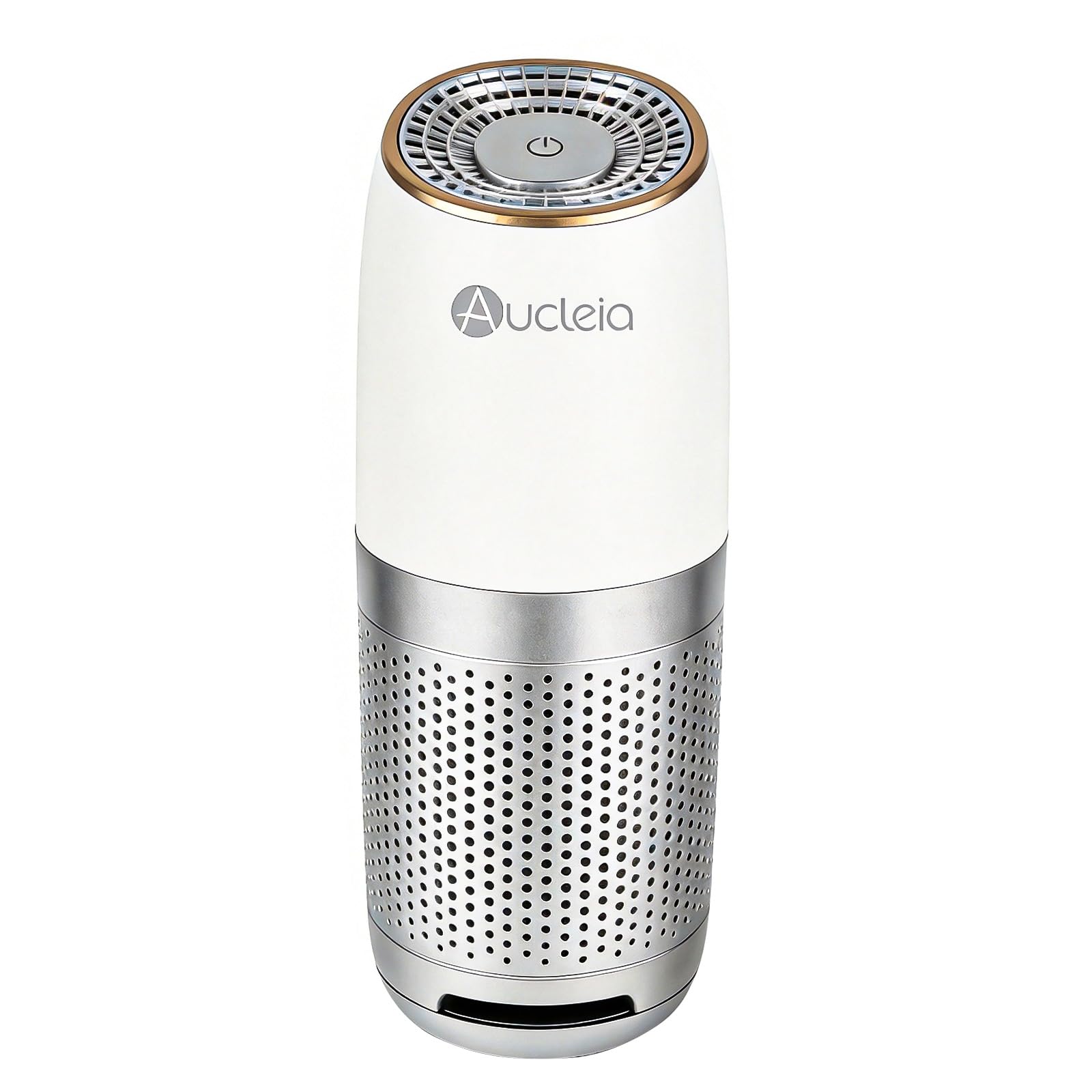
The Aucleia KQ-20 is a cup-holder-sized unit that brings True H13 HEPA filtration into a form factor designed specifically for car use. It captures 99.97% of allergens, dust, and pet dander, and its three-speed touch control lets you choose between standard, fast, and boost modes depending on the odor level.
Noise output at 22 dB on low speed is library-quiet, and the white noise on higher settings remains unobtrusive. The integrated aromatherapy pad accepts a few drops of essential oil, a feature that pet owners and daily commuters appreciate for maintaining a fresh-smelling cabin without chemical air fresheners.
A filter replacement indicator beeps and flashes red after 360 hours of use, removing the guesswork from maintenance. The unit is USB-powered and has no internal battery, so it runs only when the car is on (or when connected to a portable power bank). Some users note the bottom intake design limits airflow if placed on soft surfaces, but it works well in standard cup holders.
Why it’s great
- True H13 HEPA filter fits a compact cup-holder design
- Ultra-quiet 22 dB operation on low speed
- Built-in aromatherapy pad and three-speed control for different needs
Good to know
- No internal battery — requires USB power to operate
- Bottom intake can be restricted on soft or uneven surfaces
4. Yakry Mini Car Air Purifier Ionizer
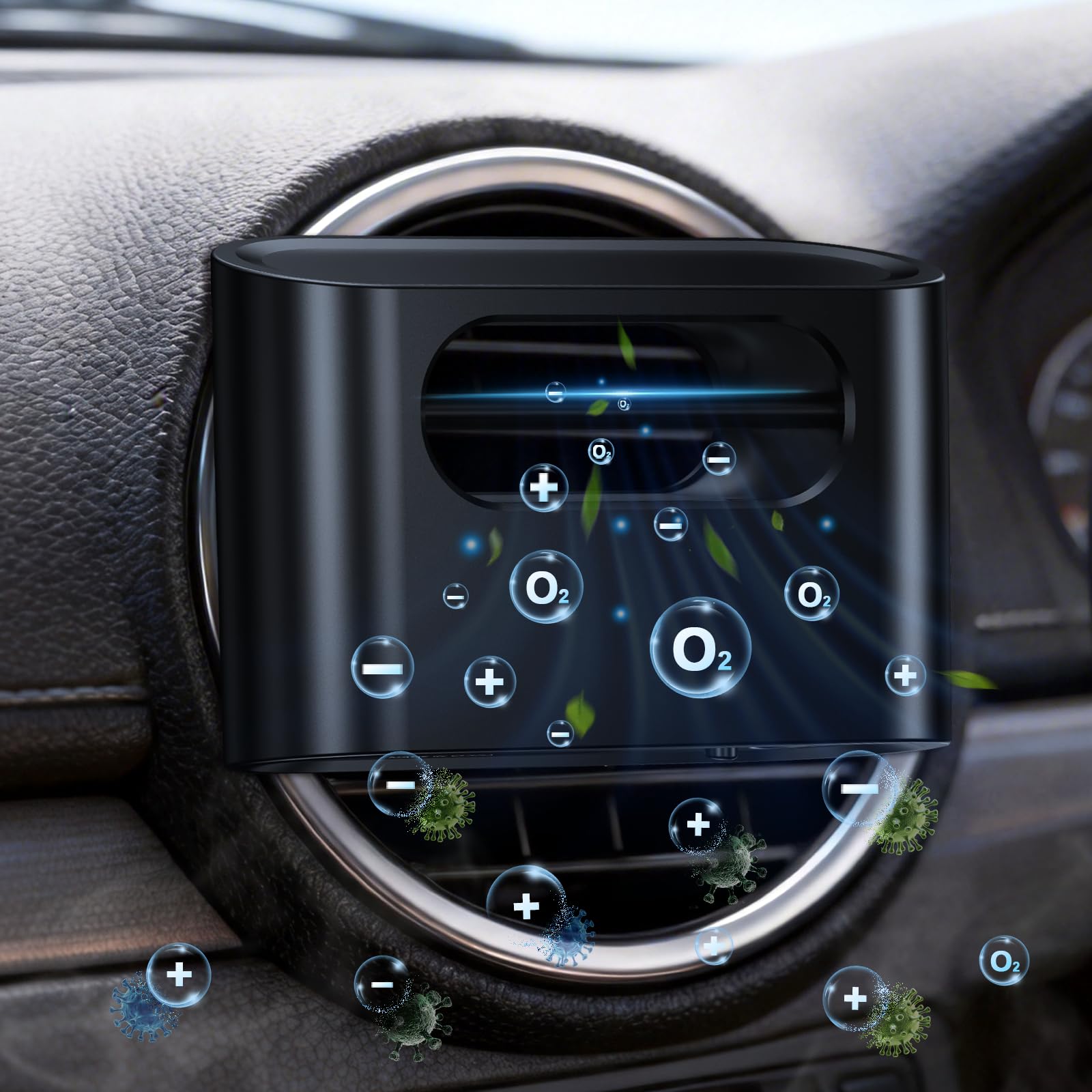
This Yakry unit uses bipolar plasma ion technology to release both positive and negative ions that neutralize odor molecules without filters, fans, or recurring costs. At just 3.2 ounces and small enough to clip onto any air vent, it is the most discreet option on the list — ideal for drivers who want clean-smelling air without a visible device.
User reports consistently describe the effect as a “spring thunderstorm” freshness, not a chemical cover-up. It is ozone-safe and produces no noise since it relies on the car’s HVAC airflow to circulate ions. The included USB-C cable plugs into any standard adapter, and the 2-year warranty adds peace of mind for a filter-free system.
The trade-off is clear: it does not capture particles like dust or pollen, so allergy sufferers may still experience symptoms. The unit also requires the car’s fan to be running to function, which may not be ideal in all climates or driving conditions.
Why it’s great
- Zero filter cost and no maintenance required
- Whisper-quiet operation with no moving parts
- Ultra-compact vent-clip design stays out of the way
Good to know
- Relies on car vent airflow — ineffective with HVAC off
- Does not remove dust, pollen, or other particulate allergens
5. Yakry Compact Car Air Purifier B0FF9SLGT6
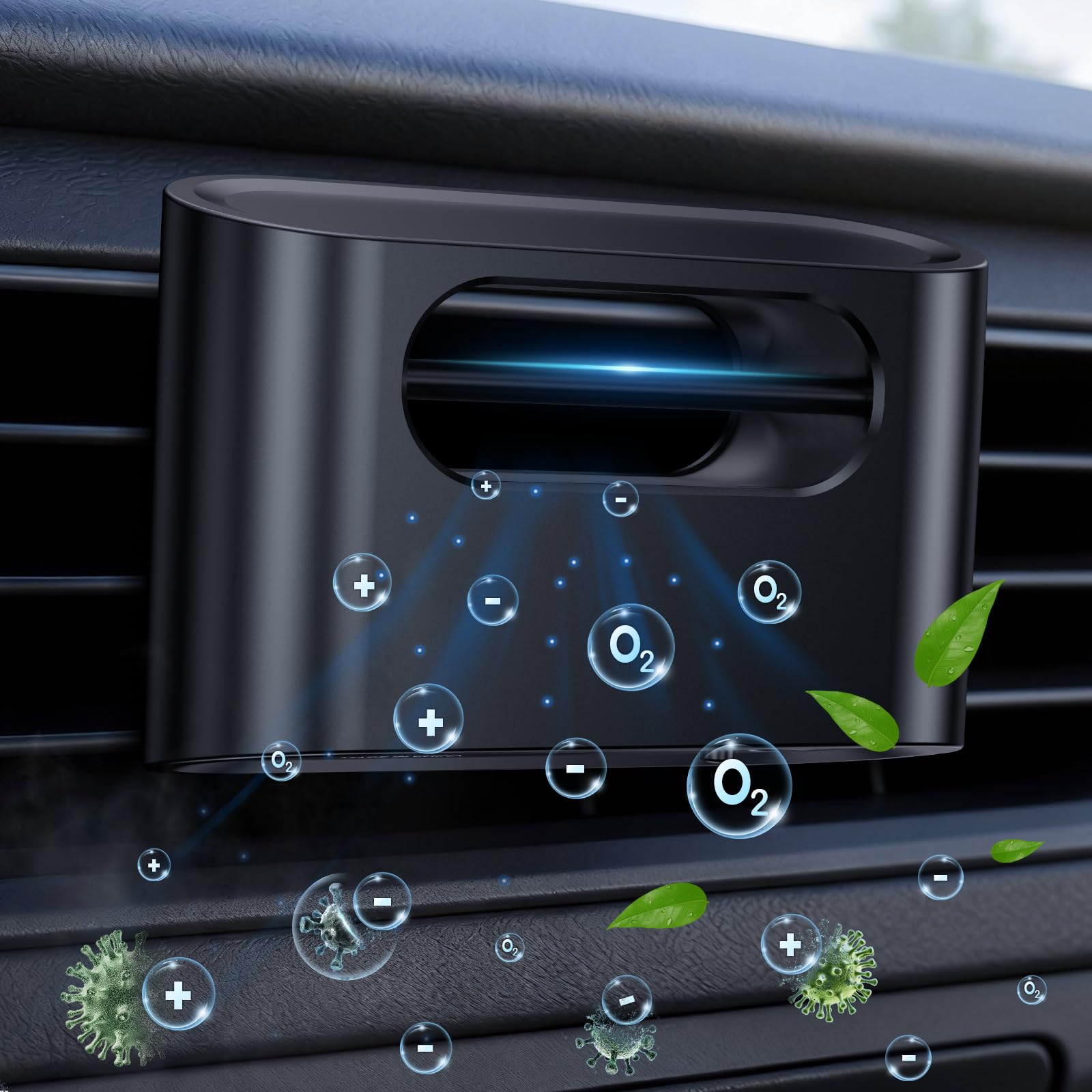
The Yakry B0FF9SLGT6 is an entry-level filter-free odor eliminator that clips onto car vents and uses ionization to combat smoke, pet, and food smells. Its claim to fame is simplicity: no replacement filters, no complicated controls — just a USB plug and a blue indicator light that confirms it is working.
Multiple verified reviews report that it eliminated vape and musty odors within 24 hours, and pet owners noted the car smelled “like new” after trips with dogs. The 7.83-ounce unit is lightweight and unobtrusive, fitting both horizontal and vertical vents, and can also sit on a desk for home office use.
Quality control appears inconsistent — a small number of users received units that would not power on, which suggests batch variability. Like other passive ionizers, it does not trap particulate matter, so it is strictly an odor-control tool rather than an allergy relief device.
Why it’s great
- No filter replacements — zero recurring cost
- Compact, light, and easy to install on any vent
- Effective for pet odors, smoke, and musty smells
Good to know
- Some units reported as non-functional out of the box
- No particulate filtration — not effective for allergies
6. Conair AP03 Portable HEPA Air Purifier

The Conair AP03 stands out as the only rechargeable unit in this lineup, offering up to 22 hours of cordless runtime on low speed. Its HEPA 10 filter captures dust and pollen, and the built-in plasma ion generator works alongside the fan to provide an extra layer of odor control for small spaces up to 15 square feet.
At 1.08 pounds and measuring 6 x 4 x 4.6 inches, it is designed for desktops and small rooms as much as for cars. Users report it effectively removes cooking smells and pet odors in enclosed spaces like mudrooms and vans, and several note that the battery holds charge well over months of regular use. Two fan speeds give basic control, and the noise level peaks at 55 dB on high — noticeable but not disruptive.
For car use, the cordless aspect is a major advantage: you can keep it running in a parked vehicle without draining the battery. The trade-off is that it is larger than vent-clip units, so it needs a flat surface or cup-holder spot. It also uses a standard AC adapter for charging, meaning you will need an inverter to recharge it on the road.
Why it’s great
- Rechargeable battery delivers up to 22 hours of cordless operation
- HEPA 10 filter plus plasma ion for particle and odor control
- Compact size works in cars, small rooms, and travel bags
Good to know
- Requires AC adapter for recharging — not USB-C compatible for fast car top-ups
- Larger than vent-clip ionizers; needs flat surface placement
7. Portable H13 MB-032 Air Purifier
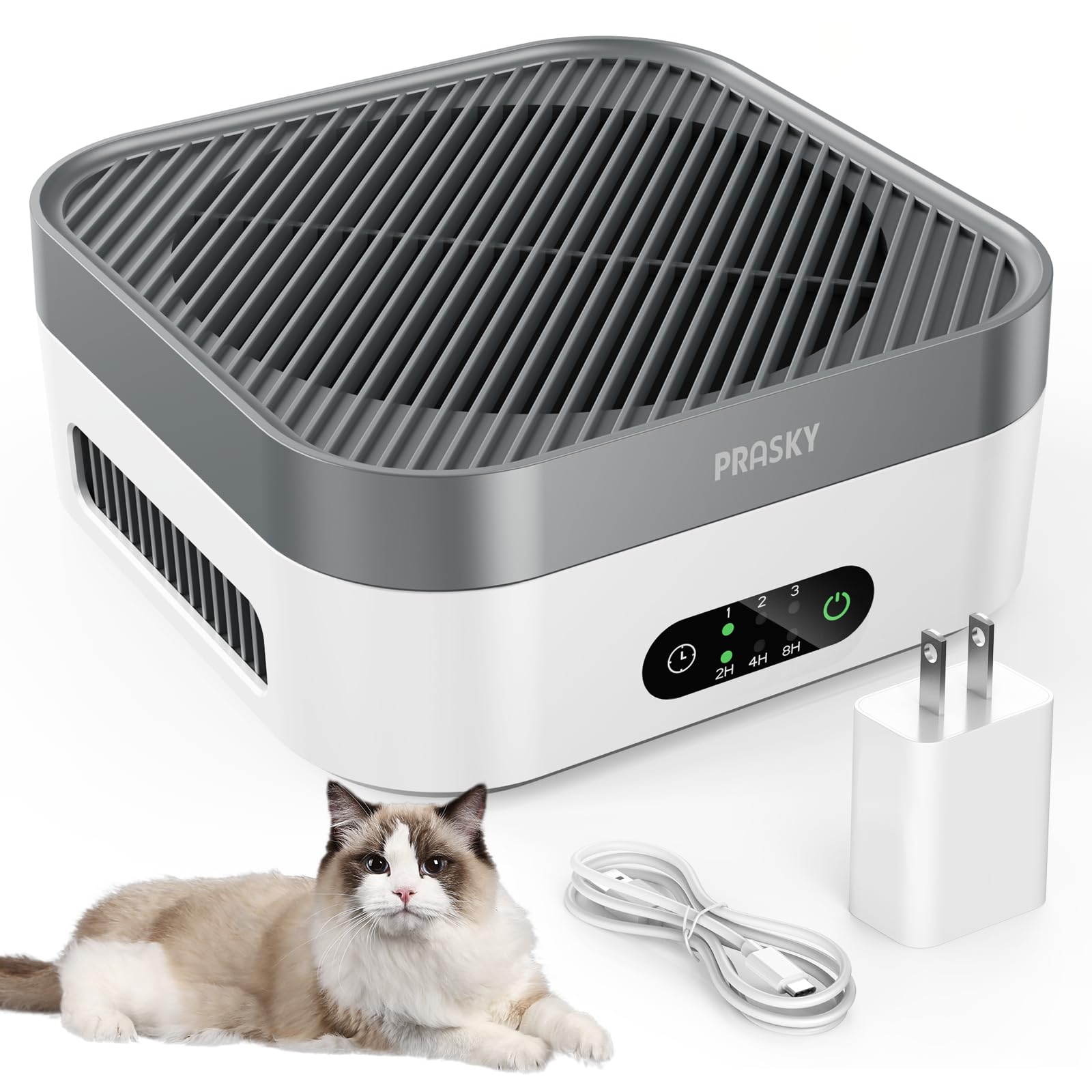
The MB-032 uses a three-stage filtration system with a pre-filter, H13 True HEPA layer, and activated carbon filter to trap dust, smoke, cooking grease, and pet dander. It covers up to 600 square feet in 40 minutes and refreshes air four times per hour in a 230-square-foot room, making it the most powerful compact unit here in terms of CADR for its size.
Its big selling point for car use is the 16 dB noise floor on low speed — genuinely silent, which is rare for a fan-based purifier. The magnetic top cover makes filter swaps tool-free, and the Type-C charging port works with standard phone adapters and cables, adding convenience for travel. Three timer settings (2H/4H/8H) let you automate operation in a bedroom or overnight in a parked vehicle.
There is no internal battery, so it must be plugged into a USB port or adapter at all times. Some users note the touch-sensitive power button requires a deliberate press to activate, which can be slightly finicky. At 1.8 pounds and 7.4 x 7.4 x 3.1 inches, it is more compact than the GoveeLife but less portable than the Conair due to the cord requirement.
Why it’s great
- Near-silent 16 dB operation on low speed for undisturbed sleep
- Three-stage H13 HEPA + carbon filtration captures a wide range of contaminants
- Magnetic top cover and Type-C charging simplify maintenance and power
Good to know
- No internal battery — must be plugged in for continuous use
- Touch-sensitive power button can be unresponsive on first press
FAQ
Do car air purifiers actually remove cigarette smoke odor?
Is ozone from ionizer purifiers safe in a small car cabin?
How often should I replace the filter in a car HEPA purifier?
Final Thoughts: The Verdict
For most users, the air purifier for car winner is the LUFTRUM C401A because it combines True H13 HEPA filtration with a real-time PM2.5 sensor and auto ignition start, offering the most comprehensive protection against exhaust fumes, VOCs, and particulates in a car cabin. If you want smart-home integration and app control in a proven HEPA platform, grab the GoveeLife H7126. And for budget-friendly, filter-free odor control with zero maintenance, nothing beats the compact Yakry Plasma Ionizer.