
Our readers keep the lights on and the weekend projects moving. As an Amazon Associate, I earn from qualifying purchases.
That magnet you just glued to the back of a cabinet fell off again, didn’t it? The problem isn’t the magnet — it’s the gap between the magnet’s surface and the material you’re bonding it to. Most adhesives fail on magnets because they can’t handle the shear stress of a magnetic pull, or they leave a gap that ruins the bond. The right choice isn’t just about stickiness; it’s about gap-filling ability, cure speed, and chemical compatibility with the metal plating on the magnet.
I’m Rikta — the co-founder and writer behind FitlyFast. I’ve spent countless hours analyzing the formulation chemistry, working times, and real-world shear strength data of these adhesives to separate the genuine solutions from the quick-fail options.
This guide breaks down the cure times, viscosity grades, and substrate compatibility you need to permanently fix magnets to metal, wood, plastic, and concrete. Read on to find the right adhesive for magnets.
How To Choose The Best Adhesive For Magnets
Not all glues can handle a magnet. The nickel or zinc plating on most magnets creates a low-energy surface that many standard adhesives can’t grip. Add the constant pulling force of the magnetic field, and you need a formula with specific properties. Here are the three factors that separate a permanent fix from a frustrating redo.
Viscosity and Gap-Filling Ability
Thin cyanoacrylate (CA) glue seeps into the micro-pores of the magnet’s plating through capillary action, creating an incredibly intimate bond. This works perfectly for flush mounting a magnet to a flat surface. For uneven surfaces or when there’s a gap between the magnet and the substrate, a high-tack epoxy paste fills the void. If you use thin CA on a rough surface, the glue wicks away and leaves a starved joint that breaks under the first pull.
Working Time vs. Cure Speed
Setting a magnet is often tricky — you need time to position it exactly or the magnetic pull will yank it out of alignment. Fast-setting CA glues (2–10 seconds) are ideal when you can hold the magnet in place immediately. Epoxies with a 5-minute working time let you press the magnet into position, make small adjustments, and then let go. The trade-off: faster cure means less margin for error, but also less time spent holding a magnet in place.
Shear Strength and Flexibility
The force exerted by a magnet isn’t just pull; it’s shear stress when you slide the magnet across a surface. Look for adhesives with high lap shear ratings (over 2,000 psi). Also critical is flexibility — a rigid bond that can’t absorb vibration will shatter if the magnet is knocked. Toughened epoxies that remain slightly flexible after curing (like Starbond’s flexible formula) survive more abuse than hard, brittle cyanoacrylate.
Quick Comparison
On smaller screens, swipe sideways to see the full table.
| Model | Category | Best For | Key Spec | Amazon |
|---|---|---|---|---|
| Starbond Super Fast Thin CA Glue Pro Kit | Cyanoacrylate | Micro-fracture wicking & precision magnet placement | 2–3 second set time, 2 oz bottle | Amazon |
| Starbond 5 Minute Epoxy Pro Kit 8 oz | Flexible Epoxy | Vibration-prone mounts & high shear applications | 2,600 lb shear strength, flexible cure | Amazon |
| Gorilla Micro Precise Super Glue Gel | Gel CA | Controlled gel application on vertical surfaces | 10–45 sec set, anti-clog cap, pack of 2 | Amazon |
| GDDP 5 Minute Epoxy Glue 8.45 fl oz | Epoxy Resin | Heat-resistant setups up to 300°F | Heat resistant to 300°F, 1:1 mix | Amazon |
| Bob Smith Industries BSI-201 Quik-Cure Epoxy | Fast Epoxy | Visible joints requiring crystal-clear finish | 5 min working time, 15 min full cure | Amazon |
| PC-11 Epoxy Adhesive Paste Marine Grade | Marine Epoxy | Underwater magnet bonding & wet environments | Underwater application, 7 day full cure | Amazon |
| PC-7 Epoxy Adhesive Paste Heavy Duty | Heavy Duty Epoxy | Structural fills & vertical magnetic mounts | Non-sag paste, 1-hour working time | Amazon |
In-Depth Reviews
1. Starbond Super Fast Thin CA Glue Pro Kit
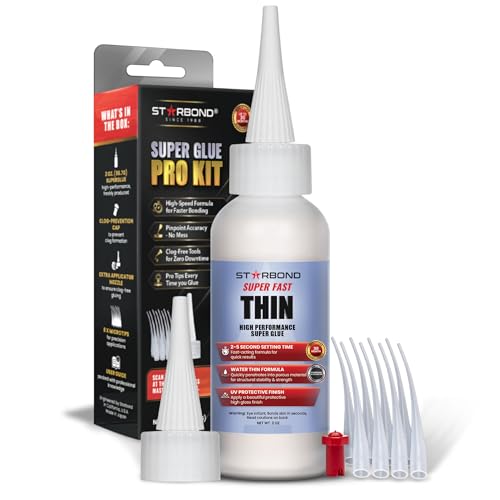
This is the top choice for bonding magnets because of its ultra-low viscosity — it behaves almost like alcohol, wicking into the micro-pores of the magnet’s nickel plating and the substrate simultaneously. The 2–3 second set time means you can align a small magnet, press it down, and release almost instantly. This is critical when the magnet itself wants to snap out of position.
The Pro Kit includes eight precision microtips that extend the nozzle into tight corners, plus a pin cap that prevents clogging. The thin formula is perfect for stabilizing micro-fractures in the magnet coating, which prevents the bond from weakening over time. Users report success bonding magnetized aquascaping rocks and even sealing sutures with this product, proving its versatility across porous and non-porous surfaces alike.
A word of caution: this glue is extremely runny. It will wick into any gap, including the threads of the bottle cap if you’re not careful. Use it in a well-ventilated area — the fumes can cause eye irritation and headaches. On the upside, a 2 oz bottle provides numerous micro-applications, making it more economical than single-use tubes.
Why it’s great
- Wicks into microscopic gaps for intimate magnet-to-surface contact
- Pro kit includes microtips, pin cap, and user guide for precision
- 30-month shelf life warranty for long-term storage
Good to know
- Extremely runny — not suitable for vertical surfaces or gap filling
- Fumes require ventilation, and it bonds skin instantly
2. Starbond 5 Minute Epoxy Pro Kit 8 oz

This is the go-to when your magnet mount will experience vibration or repeated contact. The flexible toughened formula absorbs stress without brittle cracking — a common failure point when a glued magnet is bumped or when the magnetic pull cycles on and off. The 5-minute working time gives you just enough room to seat a magnet precisely before the material sets.
The 8 oz kit offers significant volume for the price, and the 1:1 mix ratio by volume simplifies measurement. It includes reusable mixing trays and a spatula, so you don’t need to buy tools separately. Users have used it to restore tombstones, reseal basement cracks, and bond crown molding, consistently praising its durability.
One user noted that in a controlled butt-joint test for crown molding, a competitor’s epoxy held while this one failed on that specific joint. However, that’s a niche furniture application — for the vast majority of magnetic bonding scenarios (metal to wood, ceramic to glass), this epoxy outperforms rigid alternatives by absorbing the shear stress that would shatter a brittle CA bond.
Why it’s great
- Toughened formula withstands vibration without cracking
- Generous 8 oz kit includes mixing tools for clean application
- Cures clear, making it ideal for visible magnet mounts
Good to know
- Butt-joint strength is lower than some rigid epoxies
- Once hardened, adjustments are impossible — use a test fit first
3. Gorilla Micro Precise Super Glue Gel (Pack of 2)

The gel formulation here is a significant advantage when mounting magnets onto vertical surfaces. Unlike thin CA glue that drips and runs, this gel stays exactly where you put it. The dispensing tool fits comfortably in your hand and allows controlled, blob-free application. The 10–45 second set time is slower than the thin Starbond, giving you a few extra moments to reposition a small magnet before the bond locks.
This two-pack is excellent value for household use — the anti-clog cap genuinely works, and the screw cap keeps the glue fresh between uses. The gel has been tested in aquarium hardscaping (underwater) and holds plastic, ceramic, and metal securely. Users consistently praise the applicator design for model-making and small repairs, where precise dot placement is critical.
The main limitation is the small 5.5g tube size. While the anti-clog cap prevents waste, you’ll burn through a tube quickly if you’re bonding multiple large magnets. The gel also doesn’t wick into pores the way thin CA does, so it performs best when the magnet and substrate surfaces are both smooth and clean. For rough surfaces, a thicker epoxy would be more reliable.
Why it’s great
- No-run gel formula prevents messy drips on vertical magnet mounts
- Precision dispensing tool fits comfortably for controlled micro-application
- Two tubes in pack with anti-clog cap for extended usability
Good to know
- Small tube size depletes quickly for larger projects
- Gel does not wick into porous surfaces like thin CA does
4. GDDP 5 Minute Epoxy Glue 8.45 fl oz
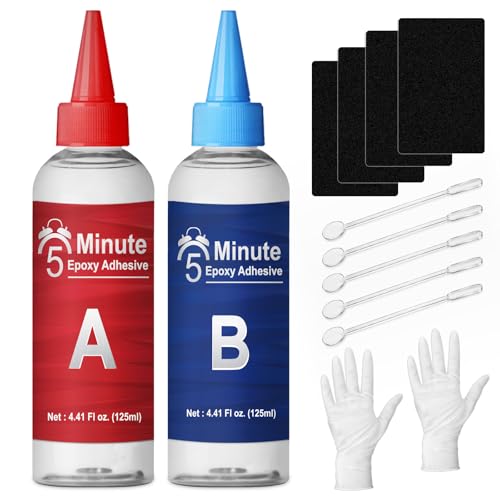
If you’re mounting a magnet near a heat source — on a metal tool rest, inside an engine bay, or on a cooking surface — this epoxy’s 300°F temperature resistance is a must. Standard epoxies soften above 150°F, causing your magnet to slide off. The GDDP formula maintains structural integrity up to 300°F, which is roughly equivalent to a hot engine block or a stovetop surface.
The kit includes not just the resin and hardener, but also gloves, mixing trays, and wooden sticks for stirring. The two-color bottle caps prevent you from mixing up the resin and hardener, a small but helpful detail. Users report that the formula is lower in odor than competitor epoxies, and one user successfully switched to this from a popular brand for gemcutting because it hardened completely without leaving stones loose.
The 5-minute working time shrinks noticeably in warmer environments. If you’re working in a 90°F garage, you’ll have more like 3 minutes to position your magnet. Also, while it cures clear, it isn’t as optically transparent as some dedicated craft epoxies — fine for most magnetic mounts, but not for art pieces where clarity matters most.
Why it’s great
- Withstands up to 300°F, critical for high-heat magnet applications
- Comes with gloves, mixing trays, and sticks for a complete kit
- Low odor compared to standard epoxy formulas
Good to know
- Working time shortens significantly in warm environments
- Not optically clear, may look slightly hazy on transparent projects
5. Bob Smith Industries BSI-201 Quik-Cure Epoxy
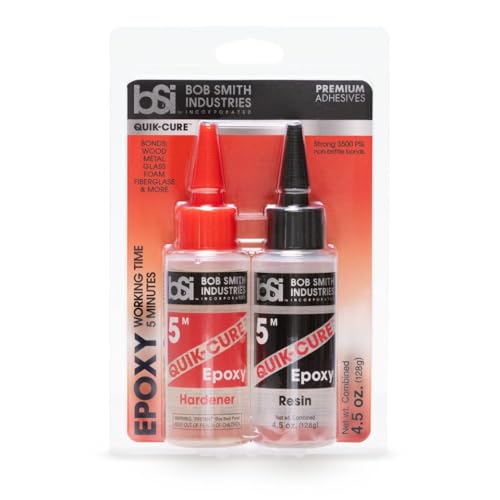
This two-part epoxy delivers a true crystal-clear finish that makes it the first choice for visible magnet mounts — like a glass door with a magnetic latch where the glue line is exposed. The 5-minute working time is long enough to align a small flat magnet, and the full cure in 15 minutes means you can test the bond quickly. It bonds to wood, metal, glass, ceramics, and fiberglass without yellowing over time.
The syringe-less packaging is a welcome departure from the sticky, hard-to-depress syringes of other brands. The two tubes allow easy small-batch mixing — just squeeze equal lengths onto your mixing surface and stir. Users praise its “rock hard” durability, and one user reported excellent results gluing shoe to hooves for a satyr costume, a high-stress application that the epoxy survived without cracking.
The 4.5 oz combined volume is modest. For bonding dozens of magnets, you’ll go through it quickly. Also, it sets hard with minimal flexibility, so it’s less suitable for magnets that will experience vibration or repeated impacts. On smooth, clean surfaces, though, the adhesion is exceptional and the clear result is aesthetically superior to most alternatives.
Why it’s great
- Truly crystal-clear cure with no yellowing for visible magnet joints
- Quick 15-minute full cure allows fast project turnaround
- Easy squeeze tube packaging avoids sticky syringe problems
Good to know
- Sets rigid — not ideal for vibration-prone magnet installations
- Small volume depletes quickly when bonding many magnets
6. PC-11 Epoxy Adhesive Paste Marine Grade

This is the adhesive for extreme environments — it bonds, cures, and stays strong underwater. If you’re attaching a magnet to a bilge pump bracket, a boat hull, or any location exposed to constant moisture, the PC-11’s marine-grade formulation resists fresh and salt water, detergents, gasoline, and mild acids. The paste consistency means it won’t wash away before curing, even in a wet environment.
The two-part paste requires thorough mixing but offers an immense 7-day full cure time that results in a bond often stronger than the parent material. Users report repairing concrete, ceramic, and metal items that outlasted their original construction. The temperature range is broad — application from 35°F to 115°F, with service temperatures from -20°F to +200°F — making it suitable for outdoor installations year-round.
The main trade-off is the slow cure speed. You need to support the magnet for hours, not minutes. If you’re working on a vertical surface, the high-tack paste will hold its shape without sagging, but the magnet still needs external support. Once cured, the off-white color may not match all materials — consider painting over it for a uniform appearance.
Why it’s great
- Bonds and cures underwater — unmatched for wet magnet installations
- Resists gasoline, salt water, and mild chemicals
- High-tack paste stays put on vertical surfaces without sagging
Good to know
- Full cure takes 7 days — requires extended support for magnets
- Off-white color may require painting for aesthetic projects
7. PC-7 Epoxy Adhesive Paste Heavy Duty

When your magnet needs to hold something heavy or you’re filling a structural gap before mounting, the PC-7’s non-sag paste formula is your solution. This epoxy acts as both a bonding agent and a filler — you can build up a pedestal of epoxy on a surface, then embed a magnet into it. The 1-hour working time is the longest in this lineup, giving you ample room to shape the epoxy around the magnet for a custom fit.
The charcoal gray color is particularly useful for automotive repairs — it blends seamlessly with metal surfaces and is paintable. Users have successfully used it to repair gas tanks, seal oil leaks, and patch auto body panels. It sands easily once cured, so you can contour the epoxy to match the surrounding surface perfectly.
The slow cure speed is both a strength and a weakness. You can work the material for an hour, but you must wait 24 hours for full cure before applying any load to the magnet. Some users reported that a gas tank repair failed after 1.5 months because gas bubbled under the patch, suggesting it’s less ideal for constant liquid immersion than the PC-11. For dry, heavy-duty structural fills, though, this is a superior option.
Why it’s great
- Non-sag paste builds up and fills gaps for flush magnet installations
- 1-hour working time allows custom shaping around magnet bodies
- Sands and paints easily for a finished look on structural repairs
Good to know
- 24-hour full cure delays load-bearing use
- Charcoal gray color may not suit all aesthetic applications
FAQ
Will super glue hold a magnet to painted metal?
Can I use epoxy to attach a magnet to glass?
How do I prevent the magnet from snapping out of position while the glue sets?
What is the best adhesive for mounting neodymium magnets to wood?
Final Thoughts: The Verdict
For most users, the adhesive for magnets winner is the Starbond Super Fast Thin CA Glue Pro Kit because its ultra-low viscosity wicks into the micro-pores of magnet plating for the most intimate, permanent bond available. If you need a flexible bond that absorbs vibration without cracking, grab the Starbond 5 Minute Epoxy Pro Kit. And for heavy structural fills or underwater installations, nothing beats the PC-11 Marine Grade Epoxy.