
Our readers keep the lights on and the weekend projects moving. As an Amazon Associate, I earn from qualifying purchases.
A five-year-old’s attention span is a precious, fleeting window — too long for a complex ruleset and too short for a pure luck-fest. You need a game that hits the sweet spot: simple enough to grasp on the first go, but with enough decision-making to keep them engaged past round two. The wrong pick leads to a flipped board and tears. The right one sparks a family game night tradition that lasts years.
I’m Rikta — the co-founder and writer behind FitlyFast. I’ve spent many hours analyzing the mechanical depth, component durability, and age-appropriateness of children’s board games to help you find the perfect fit for your preschooler.
After sorting through dozens of options, I’ve narrowed down the top contenders that balance educational value, replayability, and pure fun to give you the definitive list of the best board games for 5 year olds.
How To Choose The Best Board Games For 5 Year Olds
Picking a game for a five-year-old isn’t just about the theme or character on the box. At this age, children are developing crucial social, cognitive, and motor skills. The right game reinforces turn-taking, basic counting, and strategic thinking without causing frustration. Prioritize games with a 15-20 minute playtime, simple rules explained in under a minute, and components designed for small hands.
Cooperative vs. Competitive Gameplay
Cooperative games, where everyone works toward a common goal, are often the best starting point for five-year-olds. They eliminate the sting of losing and encourage teamwork and communication. Competitive games are fine too, but look for ones that reward effort and participation, not just a single winner — games with multiple paths to victory or elimination-free play are ideal.
Educational Value Hidden in Mechanics
The best games for this age teach without feeling like a lesson. Look for mechanics that naturally reinforce counting spaces, matching patterns, recognizing numbers, or simple addition/subtraction. Games that require reading are generally a no-go at age five; image-based cards and color-coded pieces are far more accessible and keep the game moving.
Component Durability and Safety
Five-year-olds aren’t gentle on game pieces. Thick cardboard tokens, sturdy dice, and chunky plastic figures survive dropped games and enthusiastic play. Avoid games with many small parts that pose a choking hazard. Check that the game board lies flat and that cards are laminated or on thick stock. A game that falls apart after two plays is a wasted investment.
Quick Comparison
On smaller screens, swipe sideways to see the full table.
| Model | Category | Best For | Key Spec | Amazon |
|---|---|---|---|---|
| Educational Insights Sophie’s Seashell Scramble | Pattern Matching | Fine motor skills + pattern recognition | Includes Sophie the Otter Squeezer tongs | Amazon |
| Baby Dinosaur Rescue | Cooperative | Teamwork and communication | No reading required; image-based cards | Amazon |
| Monopoly Junior | 2-in-1 | Growing with your child | 2-sided board; Level 1 & Level 2 gameplay | Amazon |
| My First Dragon Adventure | Fantasy Adventure | Imaginative storytelling | 20-minute playtime; image-based movement cards | Amazon |
| Don’t Break The Ice | Classic Action | Fine motor skill and suspense | 30-minute playtime; 2 mallets included | Amazon |
| Clever Fox Play Number Hunter | Math Adventure | Addition and subtraction practice | 50 challenge cards; 2 number dice + operation die | Amazon |
| eeBoo Build a Robot Spinner Game | Number Matching | Early number recognition and creativity | 15-minute playtime; FSC-certified paper pieces | Amazon |
In‑Depth Reviews
1. Educational Insights Sophie’s Seashell Scramble

Sophie’s Seashell Scramble is a masterclass in hiding skill-building inside pure fun. The game uses a spinner and the adorable Sophie the Otter Squeezer (tongs) to have kids collect shells in five different patterns. The fine motor control required to operate the tongs and pick up the shells is outstanding for developing hand strength and coordination — a precursor to writing skills. The pattern matching element is a step above simple color matching, challenging kids to recognize stripes, dots, and other designs.
The game board cleverly doubles as the storage box, making setup and cleanup quick — a major plus for tired parents. The shells are chunky and durable, easily surviving enthusiastic play. For a group of 2-4 players ages 3 and up, the playtime is just right for short attention spans. The cooperative element of racing to collect five shells first teaches turn-taking and graceful winning and losing.
Parents of speech therapy clients have noted how this game encourages communication and hand-eye coordination work. The only minor assembly required is attaching the spinner. This is the kind of game that stays in the rotation for years, as the pattern complexity remains engaging even as the child ages.
Why it’s great
- Excellent fine motor skill development via the squeezer tongs
- Pattern matching is more cognitively engaging than color matching
- Game board doubles as storage box for easy cleanup
Good to know
- Requires some adult assembly for the spinner
- Small shells could be a choking hazard if not supervised
2. Baby Dinosaur Rescue Board Game

Baby Dinosaur Rescue is the quintessential cooperative game for this age group. Instead of competing against each other, players work as a team to guide baby dinosaurs across the valley to Dinosaur Island before lava fills the path. The image-based cards mean no reading is required, so your five-year-old can play independently from the first round. The cooperative mechanic eliminates the emotional rollercoaster of losing — everyone wins together or loses together, promoting communication and shared problem-solving.
The components are sturdy, with a colorful game board and chunky dinosaur tokens. The gameplay loop is simple: draw a card, match the image, move your dinosaur, and advance the lava. The tension builds as the lava token creeps closer, which keeps kids engaged and strategizing. The estimated 20-minute playtime is ideal for a pre-bedtime game session. Parents and teachers love that it teaches matching, turn-taking, and communication without any academic pressure.
Some families have noted that frequent “lava” cards can cause frustration if drawn repeatedly, but this is easily mitigated by shuffling the deck more thoroughly. The theme of saving baby dinosaurs from lava may be a bit intense for extremely sensitive children — consider discussing the cooperative “rescue” angle. For a family-owned small business creation, the quality and thoughtfulness are impressive.
Why it’s great
- Fully cooperative gameplay builds teamwork and eliminates losing meltdowns
- No reading required — image-based cards for independent play
- Short, engaging playtime perfect for short attention spans
Good to know
- Lava cards can feel repetitive and frustrating if not shuffled well
- The “losing” scenario of baby dinosaurs in lava may upset sensitive kids
3. Hasbro Gaming Monopoly Junior Board Game

Monopoly Junior is a brilliant introduction to the classic franchise, designed specifically for the attention span and cognitive abilities of a five-year-old. The double-sided game board is the star feature: Level 1 (ages 4-5) focuses on counting spaces and matching pictures to properties, while Level 2 (ages 6+) introduces simple reading and math. This means the game genuinely grows with your child, offering years of replayability. The included 6 adorable animal tokens are a hit with the preschool crowd.
The gameplay is fast-paced, with a typical round lasting 20-25 minutes — perfect for a weeknight game. Kids practice counting, matching, and basic money handling without feeling like they’re doing schoolwork. The property tokens (little signs that mark ownership) are a tactile, visual way for kids to understand the concept of owning something. Hasbro quality ensures the board and cards withstand repeated play, though the paper money can tear if handled roughly.
Customer reviews consistently highlight how much families love the two-level approach, with many noting that even adults find the Level 2 game genuinely fun. The Bluey theme on some editions also adds extra appeal. For a child who is ready to move beyond simple matching games and into a more structured board game experience, Monopoly Junior is an easy recommendation. Just be prepared for a slightly longer game than the simplest preschool games.
Why it’s great
- Two-level game board grows with your child from ages 4 to 6+
- Teaches counting, matching, and basic money skills through play
- Quick 20-25 minute playtime ideal for young attention spans
Good to know
- Paper money can tear with rough handling by small hands
- Level 1 is quite simple; some five-year-olds may be ready for Level 2
4. My First Dragon Adventure Board Game

My First Dragon Adventure taps into the rich fantasy world that captivates five-year-olds. The premise — racing through enchanted lands to convince a dragon to re-light the castle’s magical s’mores fire — is pure storytelling gold. Players use numbered and image-based cards to move through colorful lands, practicing basic counting and strategic decision-making along the way. The detailed board and themed cards create a cohesive narrative that keeps kids invested in the outcome.
The game is designed for 2-4 players ages 5 and up, with an ideal 20-minute playtime. The rules are simple enough to explain in under a minute, and the image-based movement means no reading is required. Kids develop communication, basic counting, and strategic thinking as they decide which cards to play and which path to take. The fantasy theme encourages creativity and imaginative storytelling well beyond the actual game rules.
Both customers and reviewers note that this game is surprisingly fun for adults too — the varied scoring system and the “race” element keep it engaging for older players. The components are sturdy and the artwork is vibrant and charming. The only potential downside is that once the base rules are exhausted, some families may want to invent their own house rules to extend replayability. This game is perfect for kids who love dragons, knights, and magical adventures.
Why it’s great
- Engaging fantasy narrative that sparks imagination and creativity
- Image-based cards allow independent play for non-readers
- Varied scoring keeps it fun for adults playing alongside kids
Good to know
- May require house rules for long-term replayability
- Theme may not appeal to kids who aren’t into fantasy
5. Hasbro Don’t Break The Ice

Don’t Break The Ice is a timeless classic that needs no introduction — and for good reason. The premise is brilliantly simple: players take turns tapping out ice blocks with a mallet, trying to keep Phillip the Penguin on top. The suspense builds with every tap, and the moment the penguin falls through is pure toddler adrenaline. The game requires no reading, no counting, and no complex rules — just fine motor control and a bit of risk assessment.
The set includes 2 mallets, an ice tray frame, 32 small ice blocks, and the Phillip the Penguin figure. Setup takes about 30 seconds, and a typical game runs for about 30 minutes. The action is tactile and engaging, making it perfect for kids ages 3 and up who may not be ready for traditional board games. Parents report that their 3- and 5-year-olds become “obsessed” with the suspense, and it works great for indoor recess or playdates.
The build quality is decent but not as heavy-duty as some vintage versions. The ice blocks can be a bit finicky to set perfectly, and very aggressive tapping can cause the whole structure to collapse prematurely. That said, the sheer joy and excitement it generates is unmatched by more “educational” games. For a pure, screen-free, laugh-filled game that teaches cause and effect and fine motor skills, this is a winner.
Why it’s great
- Instant setup and simple rules — no reading or math required
- Builds suspense and develops fine motor control through tapping
- High replayability; kids ask to play again and again
Good to know
- Ice blocks can be tricky to set up perfectly each time
- Build quality is lighter than older versions of the game
6. Clever Fox Play Number Hunter Math Board Game
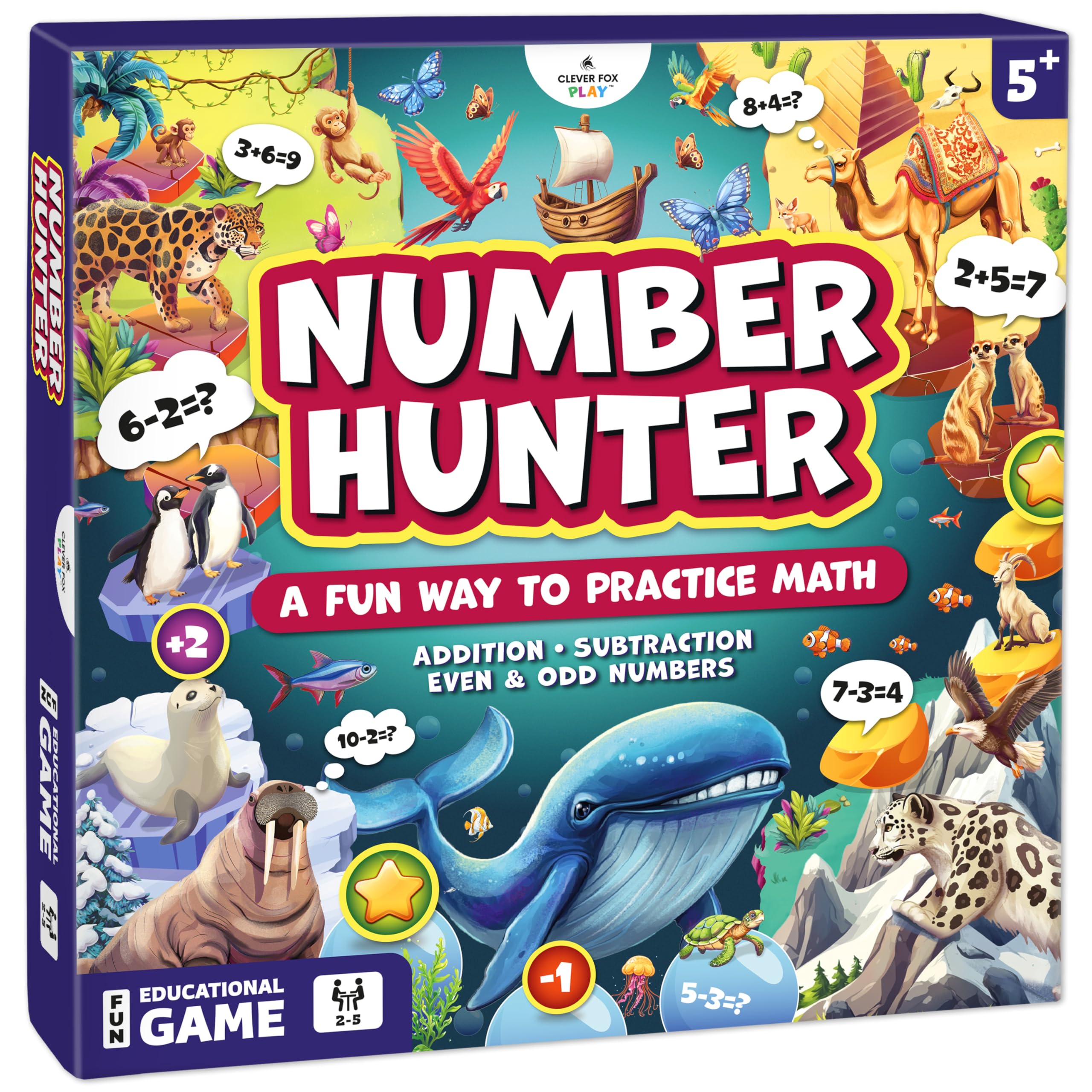
Number Hunter turns math practice into an adventure around the world. Players roll dice, add or subtract the numbers, and move their piece forward. Land on a star tile, and you draw a challenge card that might ask you to solve a math problem, hop on one leg, or balance like a flamingo. This active element is genius — it keeps kinetic learners engaged even when they hit a tough math question. The game is designed for kids ages 5-7 (kindergarten through 3rd grade).
The components are high quality: a sturdy game board, 5 game pieces, 2 number dice, 1 operation die (determines addition or subtraction), and 50 challenge cards. The challenge cards are laminated and durable. The game reinforces addition, subtraction, and even/odd number recognition without feeling like a worksheet. Parents report that their kids play it daily and are improving their quick math facts as a result. The inclusion of physical actions makes it a great choice for homeschool or rainy-day activity.
The only consideration is that younger five-year-olds may need an adult to read the challenge cards — some challenges require reading comprehension. The game is best suited for a child who already has basic number sense (recognizing numbers 1-10) and is ready to start adding and subtracting small numbers. For families looking to sneak in academic practice during game night, this is a fantastic, screen-free option.
Why it’s great
- Active gameplay with physical challenges keeps kids moving and engaged
- Teaches addition, subtraction, and even/odd numbers in a fun context
- High-quality, durable components built for repeated play
Good to know
- Younger 5-year-olds may need adult help reading challenge cards
- Best for kids who already know numbers 1-10 and basic counting
7. eeBoo Build a Robot Spinner Game

eeBoo’s Build a Robot Spinner Game is a delightful hybrid of a game and a puzzle. Players take turns spinning the spinner to collect robot parts — heads, bodies, arms, and legs — using simple numbers 1-5 to match pieces. The satisfaction of choosing and combining parts to build a unique robot is genuinely exciting for young children. The game naturally teaches number recognition, counting, turn-taking, and patience, all while encouraging creativity.
The components are eco-friendly and sustainably sourced, made from FSC-certified paper and printed with vegetable-based inks. The pieces are sturdy and colorful, designed to withstand the enthusiastic handling of a 3-year-old. The 15-minute playtime is perfect for quick game sessions, and the game can also be played as a solo puzzle activity — kids love just building robots for fun. The award-winning design shows thoughtful attention to developmental milestones.
That’s not necessarily a bad thing — a game that sparks creative construction is a win. For a screen-free, educationally rich, and environmentally conscious choice, eeBoo delivers. It’s a wonderful first game for preschoolers who love robots and building.
Why it’s great
- Teaches number recognition (1-5) and turn-taking through robot building
- Eco-friendly materials: FSC-certified paper and vegetable-based inks
- Can also be used as a creative puzzle activity outside of game rules
Good to know
- Punch-out tools may tear or bend with repeated heavy use
- Some kids enjoy the building more than the game mechanic itself
FAQ
What is the ideal playtime for a board game for a 5-year-old?
Should I choose a cooperative or competitive game for my 5-year-old?
How many players should the game support for a 5-year-old?
What educational benefits should I look for in board games for this age?
Are there any safety concerns with board games for 5-year-olds?
Final Thoughts: The Verdict
For most users, the best board games for 5 year olds winner is the Educational Insights Sophie’s Seashell Scramble because it perfectly blends fine motor skill development, pattern recognition, and pure fun in a compact, durable package. If you want a game that grows with your child and teaches foundational life skills, grab the Monopoly Junior for its two-in-one design. And for a cooperative, team-building experience that eliminates losing meltdowns, nothing beats the Baby Dinosaur Rescue Board Game.