
Our readers keep the lights on and the weekend projects moving. As an Amazon Associate, I earn from qualifying purchases.
Three is the trickiest player count in card games. Two feels like a duel, four or more feels like a party, but three? That’s where most games break — either one player gets excluded, the alliances feel lopsided, or the game just wasn’t designed for your odd-numbered gaming group. The right card game turns this awkward count into the most engaging and strategic experience at the table.
I’m Rikta — the co-founder and writer behind FitlyFast. My buying guides are built on hundreds of hours spent cross-referencing player counts, rule complexity, and replay value across the most popular card game releases on the market to find what truly works for your group.
Whether you need a quick filler for a coffee shop, a cooperative challenge for a quiet evening, or a raucous party staple, this guide breaks down the best 3 player card games that actually shine with exactly three people at the table.
How To Choose The Best 3 Player Card Games
Finding a card game that works perfectly for three players isn’t just about reading the “3-6 players” line on the box. You need to think about how the game actually plays at that specific count. Many titles feel great with four but drag or become unbalanced with three. Focus on these three criteria before buying.
Mechanic Fit: Co-op, Trick-Taking, or Party?
Three players is the sweet spot for cooperative games like The Crew — the limited communication dynamic feels tight, and every player’s contribution matters. Trick-taking games also excel here because there’s no need for a fourth to balance the hands. Party games with heavy social deduction, on the other hand, often rely on a larger group to hide identities, so look for those that specifically accommodate smaller groups or have team modes.
Play Time and Replayability
A 20-minute game is perfect for a casual weeknight, while a 45-minute deeper experience suits a dedicated game night. For three players, games with mission-based or scenario-driven structures (like The Gang or The Crew) offer the highest replayability because the challenges change each time. Simpler circle-draw games like SKYJO rely on random card draws, keeping them fresh through sheer unpredictability rather than scenarios.
Scaling and Player Elimination
At three players, a game that eliminates a player early creates a miserable experience for the person sitting out. Prioritize games where all players remain engaged until the final score is tallied — or where elimination is fast enough that the round restarts quickly. Also check if the game’s difficulty or balance scales properly; some games are designed for higher player counts and become too easy or too deterministic with three.
Quick Comparison
On smaller screens, swipe sideways to see the full table.
| Model | Category | Best For | Key Spec | Amazon |
|---|---|---|---|---|
| The Crew: Quest for Planet Nine | Cooperative Trick-Taking | Strategic co-op nights | 50 progressive missions | Amazon |
| The Gang | Cooperative Poker | Quick, team-based rounds | 20-minute play time | Amazon |
| SKYJO | Low-Point Scoring | Learning math & strategy | 150 game cards | Amazon |
| Happy Camper – Trio | Memory & Luck | Family travel games | 3-of-a-kind mechanics | Amazon |
| First to Worst | Ranking & Guessing | Getting to know others | 300 ranking cards | Amazon |
| SAVANA Traitors Aboard | Secret Identity | Bluffing & betrayal fans | 15-minute fast rounds | Amazon |
| Exploding Kittens: The Board Game | Party & Strategy | Action-packed family fun | Flipping game board | Amazon |
In‑Depth Reviews
1. The Crew: Quest for Planet Nine

The Crew is the most awarded cooperative trick-taking game for a reason. The core loop is simple — win specific tricks as a team across 50 progressively difficult missions — but the twist is that you cannot talk about your hand except to reveal one card as your highest, lowest, or only card in a suit. This limited communication mechanic forces deep strategic reading of your teammates’ plays, and it works brilliantly with three players because every player’s contribution is essential and no one feels left out.
Each mission takes about 5-10 minutes, so you can breeze through several in a single session. The difficulty scales naturally as you move through the solar system, and the 50 missions ensure you’ll get dozens of hours of play before seeing a repeat challenge. The components are high quality with clear card text, though the space theme is fairly abstract and doesn’t drive the narrative as much as some thematic games.
For three players, this is the gold standard. The trick-taking foundation is accessible to anyone who knows Hearts or Spades, and the cooperative structure keeps everyone engaged until the last trick is played. The 2-player variant exists but is clunky — this game is truly built for three to five.
Why it’s great
- Endless replayability with 50 unique missions
- Limited communication creates genuine tense teamwork
- Perfectly balanced for exactly three players
Good to know
- Colorblind players may struggle with suit colors
- Theme is thin and doesn’t drive gameplay
2. The Gang

The Gang reinvents Texas Hold ’em as a fully cooperative experience. You are all working together to beat the vaults — there is no betting, no bluffing against each other, and no individual winner. Instead, you must signal the strength of your hand by claiming numbered poker chips and watching how your teammates move theirs around the table. You cannot speak about your hand, so the entire game is nonverbal deduction.
It takes about 20 minutes per round and comes with four difficulty modes plus 20 challenge and specialist cards that keep the game from getting stale. The hand-ranking card included means no poker experience is necessary, making it accessible to total beginners. The box is compact, and the 90 cards plus 24 chips fit easily into a bag for travel to a coffee shop or brewery.
With three players, the game feels tense and collaborative in a way that standard poker never does. Each player’s chip claim sends a ripple through the table, and figuring out who actually has the strongest hand becomes a team puzzle. The 3-6 player range works well, but three is where the communication signals are clearest and the co-op puzzle is most rewarding.
Why it’s great
- No poker experience required — includes hand-ranking card
- Truly cooperative with no player elimination
- Compact and portable for travel
Good to know
- Cards have slightly dull print but good weight
- Difficulty spikes significantly with more than 4 players
3. SKYJO

SKYJO is a simple, addictive card game where the goal is to have the fewest points after several rounds. Each player starts with 12 face-down cards in a grid, and you take turns either drawing from the deck or from a discard pile, strategically swapping cards to reduce your score. The twist is that negative numbers exist, so a well-timed swap can turn a bad hand into a great one.
The game supports 2-8 players, but three is a fantastic count because the round moves quickly and you can keep a mental map of what everyone has revealed. The scoring system (adding up to 100 two-digit numbers) also has a subtle educational benefit for younger players, helping them practice math and estimation. Each round takes about 30 minutes, and the game pad included makes it easy to track scores across multiple sessions.
One of the best features for a trio is that the game is round-based, so even if one player is far behind, they stay engaged because any single round can dramatically swing the scores. The cards are thick and high quality, and the box is small enough to toss in a bag. The instructions come in multiple languages, but English is clearly included in the standard box.
Why it’s great
- Very easy to learn — anyone can play in minutes
- Round-based design keeps all players engaged
- Compact carrying case for travel
Good to know
- Luck factor is high; strategy takes a backseat sometimes
- Game pad runs out eventually; need a notepad for long term
4. Happy Camper – Trio

Trio is a game of memory, luck, and intuition. On your turn, you reveal two cards — either from the middle of the table or by asking any player for their lowest or highest card. If the two cards match in number, you collect the trio. But if the numbers don’t match, the cards go back, and you have to remember where they were for your next turn. The first player or team to collect three trios wins.
The game plays 3-6 players, and with three people the memory aspect becomes a tight contest. Since you can ask each other for cards, there’s a light social deduction element — you need to figure out who holds the card you need without revealing too much about your own hand. The cards are beautifully illustrated and the box is compact, making it a perfect travel game for families.
A portion of sales from Happy Camper games goes toward camp scholarships, adding a feel-good layer to your purchase. The game has two modes of play plus rules for teams, giving you variety in a single box. It’s a fantastic filler game that takes about 15 minutes per round, so you can play multiple rounds in a single sitting.
Why it’s great
- Beautiful card art and compact travel box
- Memory element makes each round feel different
- Supports team play for larger groups
Good to know
- Some luck in which cards you draw from the middle
- Rules can take one game to fully grasp
5. First to Worst

First to Worst is a collaborative party game where one player secretly ranks five items from best to worst, and the rest of the group works together to guess the exact order. The topics range from silly (Pineapple on Pizza) to cultural (Country Music) to universally relatable (Cat Videos), with nearly 300 total topics ensuring you’ll rarely see the same card twice in a single evening.
The game takes about 45 minutes and supports 2+ players, making it a great fit for a trio. The collaborative scoring system means no one is eliminated, and the conversations that erupt when someone ranks something unexpectedly are the real source of entertainment. It’s a fantastic way to learn surprising things about people you thought you knew well.
The included score pad and rules are straightforward, and the box is compact enough for travel. The cards are well-printed and durable. The game has several expansion decks available, including an after-dark version for adult groups, so you can extend the life of the game beyond the base 300 cards.
Why it’s great
- Low-stakes, low-stress gameplay for any group
- Very easy to learn and teach in under 3 minutes
- Expansion decks add variety
Good to know
- Requires players to be comfortable sharing opinions
- Some topics may not resonate with all age groups
6. SAVANA Traitors Aboard

Traitors Aboard mixes secret identity with light strategy. Good Pirates work together to fill a treasure chest with gold, while Mutineers secretly try to sabotage the chest’s value. Unlike most hidden role games, no one closes their eyes — everyone can see the actions being taken, so the deduction is based on behavior and card plays rather than night-phase revelations.
The game plays 3-8 players, and with three players the dynamic is tight: one Mutineer versus two Pirates. Each round takes about 15 minutes, and the travel-friendly box (about the size of a smartphone) makes it easy to throw in a bag. The rules are simple enough for ages 10 and up, though younger players may need some help reading cards.
The biggest draw is the fast pace and high engagement — no one is ever sitting out for long. Player elimination is possible but extremely quick (the game lasts only 15 minutes), so the eliminated player is back in the game almost immediately. The pirate theme is charming and well-executed, and the card quality is solid for the price point.
Why it’s great
- Extremely portable — small box fits in a pocket
- Fast 15-minute rounds keep the energy up
- Bluffing works well even with just 3 players
Good to know
- Some players may want more special ability cards
- Player elimination possible, though rounds are short
7. Exploding Kittens: The Board Game
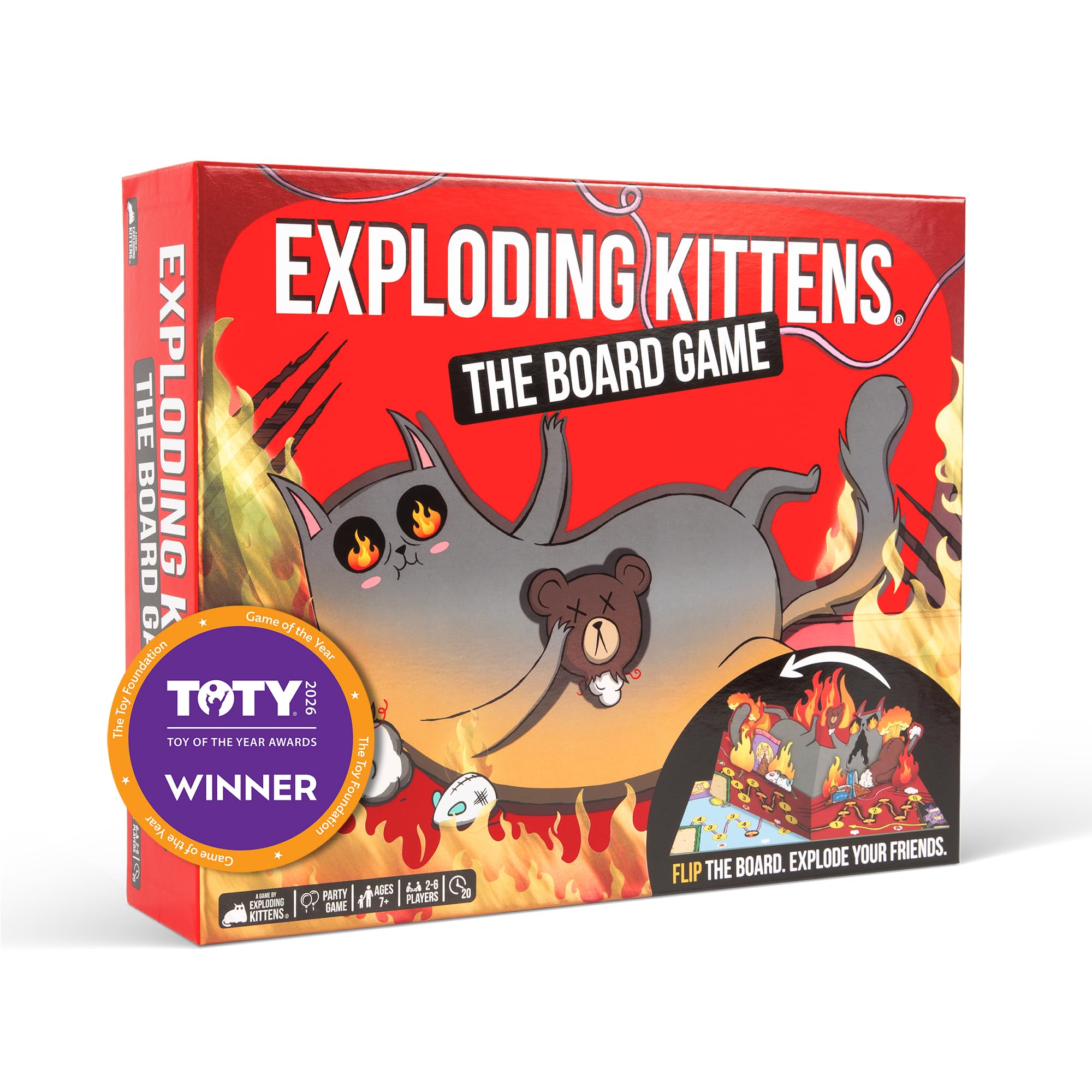
This is the board game version of the massively popular Exploding Kittens franchise, celebrating its 10th anniversary with a physical board that flips to reveal an entirely new path. Your goal is to reach the end of the board without exploding, but a wrong move can cause the board to flip mid-game, turning a safe route into a deadly one. It’s chaotic, hilarious, and designed for 2-6 players ages 7 and up.
With three players, the game feels more strategic than the original card game. The action cards include powerful abilities like Meatpants and Butterfly Punch, and the character standees add a fun visual element. Game length varies from about 30 minutes for experienced groups to over an hour for new players figuring out the board-flipping mechanic. The pop-up board is sturdy and engaging, and the card quality is decent — thin but durable enough for repeated use.
The game is a Toy of the Year finalist for good reason: it’s genuinely funny and accessible. The flip mechanic keeps the board fresh each time, and the variable game length means you can squeeze in a quick round or commit to a longer session. It’s a solid choice for groups that want action and humor over pure strategy.
Why it’s great
- Innovative flipping board creates dynamic gameplay
- Funny and engaging for all ages
- High-quality pop-up board and artwork
Good to know
- Board fold is stiff at first; needs breaking in
- Game length can vary widely (30 mins – 2 hours)
FAQ
What is the best cooperative card game for exactly three players?
Are these card games suitable for children?
Final Thoughts: The Verdict
For most users, the 3 player card games winner is the The Crew: Quest for Planet Nine because it offers unmatched replayability and strategic depth for a trio without ever eliminating a player. If you want fast, cooperative fun in under 20 minutes, grab the The Gang. And for a light, all-ages experience that works for family game night, nothing beats the SKYJO.