
Our readers keep the lights on and the weekend projects moving. As an Amazon Associate, I earn from qualifying purchases.
Walking a client through a property, campus, or venue remotely demands more than just a wide lens — it requires a camera that can stitch two hemispheres into one flawless, navigable sphere. The difference between a professional virtual tour and a disorienting fisheye headache comes down to sensor quality, software integration, and the precision of the in-camera stitching algorithm. The wrong choice produces visible seam lines, mismatched exposures, and a broken sense of place that kills engagement within seconds.
I’m Rikta — the co-founder and writer behind FitlyFast. For this guide, I’ve spent dozens of hours breaking down sensor specs, real-world stitching quality, low-light performance, and software ecosystems across every major 360 camera that can genuinely handle the demands of virtual tour creation — from real estate walkthroughs to immersive travel experiences.
The market is split between action-oriented omnidirectional shooters and dedicated 360 cameras built for still-floorplan stitching, but finding the best 360 camera for virtual tour work hinges on how well the hardware captures detail in mixed lighting and how polished the final reframed output looks on a screen.
How To Choose The Best 360 Camera For Virtual Tour
Virtual tour creation places unique demands on a 360 camera that everyday action shooting does not. You need seamless stitching, reliable HDR to handle windows and shadows simultaneously, and enough resolution so that when the viewer zooms into a detail on a listing platform, the image doesn’t break into pixel blocks. Start by evaluating three critical areas: sensor and lens quality, software and export workflow, and physical design for on-location speed.
Sensor Size and Stitching Precision
The dual-sensor configuration defines the ceiling of your image quality. A 1-inch sensor equivalent, like those in the DJI Osmo 360 and Ricoh Theta Z1, gathers significantly more light than smaller 1/2.3-inch sensors, which translates to cleaner shadows and better highlight retention in high-contrast rooms. For virtual tours, you also need a camera that stitches the two hemispheres cleanly at the seam — look for models with on-device stitching that produces a unified EXIF-compatible equirectangular image, not just raw dual fisheye frames that require heavy desktop correction.
Software Ecosystem and Export Speed
The best camera hardware is useless if the software pipeline creates friction. For real estate tours, you typically need to export a flat 2:1 equirectangular image or a reframed wide-angle video that a tour platform like Matterport, Kuula, or Tour Creator can ingest. Cameras like the Ricoh Theta series embed GPS data natively, enabling automatic Google Street View blue-line creation. Others, like the Insta360 X5, rely on smartphone apps for AI-assisted reframing. Consider whether you need built-in GPS for location tagging or if manual alignment is acceptable.
Durability and Power on Location
A virtual tour shoot often involves moving through multiple rooms, floors, and sometimes outdoor spaces in a single session. A camera with hot-swappable batteries, durable lens covers, and a standard 1/4-20 tripod mount makes the difference between a 30-minute capture and a frustrating hour of troubleshooting. Waterproofing is less critical for interior work, but replaceable or scratch-resistant lenses are a major plus when the camera is constantly being repositioned on a tripod or selfie stick.
Quick Comparison
On smaller screens, swipe sideways to see the full table.
| Model | Category | Best For | Key Spec | Amazon |
|---|---|---|---|---|
| DJI Osmo 360 Essential Combo | Premium | Professional tours & high dynamic range | 1-inch sensors, 8K/30fps, 105GB internal | Amazon |
| Insta360 X5 Essentials | Premium | AI-assisted reframing & outdoor tours | Dual 1/1.28″ sensors, 8K/30fps, 3hr battery | Amazon |
| Ricoh Theta Z1 51GB | Premium Still | Highest still image quality & low light | Dual 1-inch BSI CMOS, 23MP, 51GB internal | Amazon |
| Matterport Pro2 3D | Pro Survey | 3D digital twins & spatial mapping | 1.5M depth-points/scan, 4K, <30s scan | Amazon |
| Ricoh Theta X | Mid-Range Still | Budget-friendly stills & GPS tour creation | 11K photo, 5.7K video, built-in GPS | Amazon |
| GoPro MAX2 | Mid-Range Action | Waterproof tours & action reframing | True 8K 360, 29MP, 6-mic audio | Amazon |
| Xtra 360 Edge | Mid-Range | High-res panoramas & built-in storage | 1-inch sensor, 100MP pano, 105GB | Amazon |
| GoPro MAX 360 (2025) | Mid-Range | In-camera stitch & accessory bundles | 5.6K/30fps, 1/4-20 mount, Voice Control | Amazon |
| DJI Osmo 360 Motorcycle POV | Mid-Range Action | Handlebar POV & outdoor tour capture | 1-inch sensors, 8K/50fps, 190min battery | Amazon |
| Insta360 X5 Bundle | Entry Premium | All-in-one kit with 128GB card | 8K/30fps, 49ft waterproof, 2400mAh | Amazon |
| Meeting Owl 4+ | Pro Conference | Office virtual tours & hybrid meetings | 4K 360°, 18ft audio, AI speaker focus | Amazon |
In‑Depth Reviews
1. DJI Osmo 360 Essential Combo
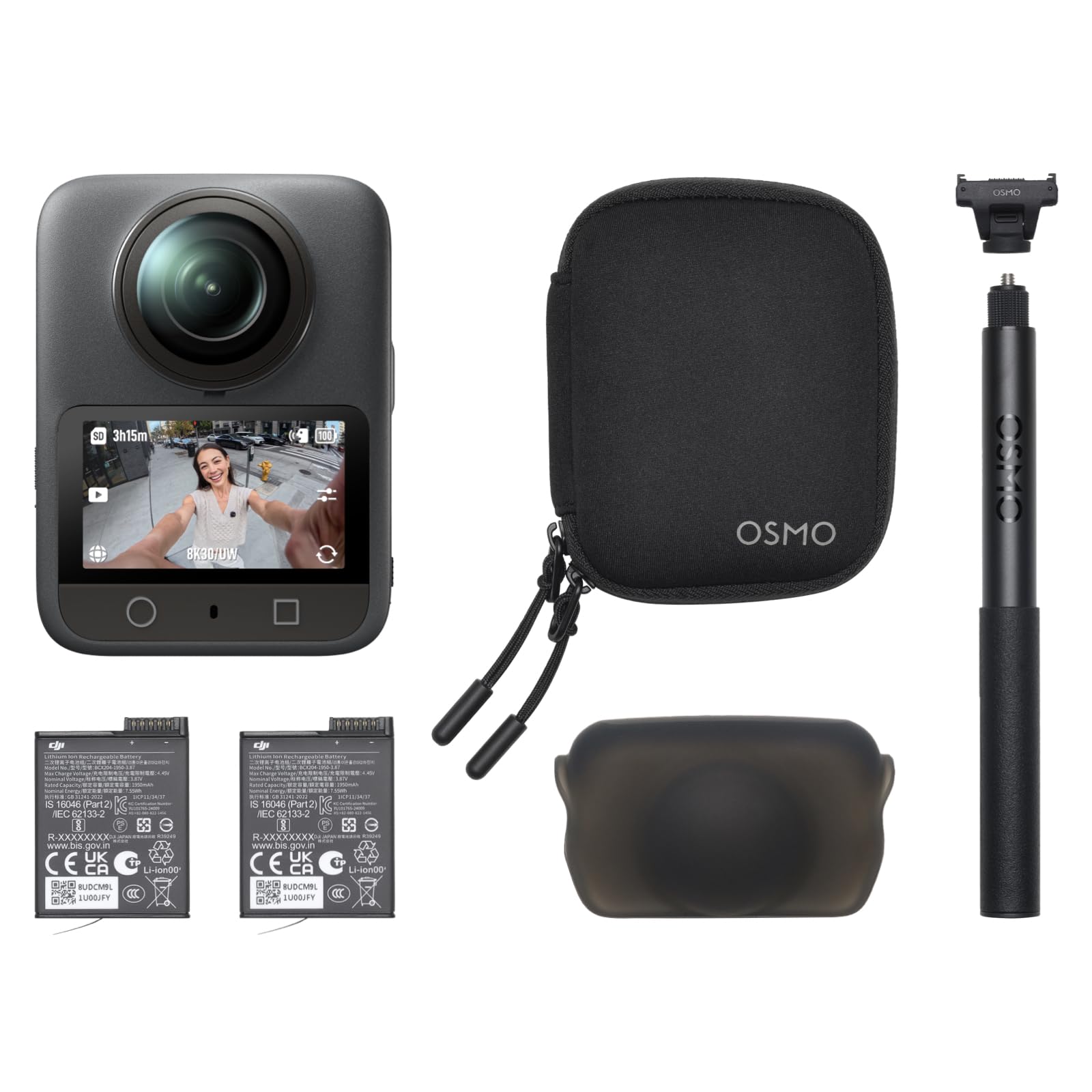
The DJI Osmo 360 delivers a genuine breakthrough for virtual tour work with its dual 1-inch sensors that capture 8K/30fps 360 video with 13.5 stops of dynamic range. In practical terms, this means a sunlit window doesn’t blow out to pure white while the corners of a room remain visible — a critical advantage when shooting interiors with strong ambient light contrast. The 120MP 360 photo mode gives you enough resolution to crop into details during post-production without losing clarity, which is essential when creating high-resolution floorplan stills for listing platforms.
The 1.2m Invisible Selfie Stick included in the Essential Combo lets you achieve clean third-person drone-like overhead shots without visible hardware in the frame, useful for capturing the full layout of a room without tripod legs breaking the illusion. The magnetic quick-release system snaps the camera onto standard 1/4-inch tripod mounts in seconds, speeding up multi-room shoots. Built-in 105GB storage means you can shoot an entire property walkthrough without swapping memory cards, and the 190-minute battery life with the included extra battery covers back-to-back appointments without a recharge stop.
On the software side, the DJI Mimo app provides Pano Dewarp and Pro Color Grading specifically designed to flatten 360 footage into cinematic virtual tour sequences without requiring a desktop editor. The four-microphone array with direct DJI Mic 2 connectivity also means clean voiceover capture on location, which is valuable for narrated walkthroughs. The only trade-off is that the app was removed from Google Play, requiring a direct download from DJI’s site, which adds one extra step to the setup process.
Why it’s great
- Exceptional dynamic range handles bright windows and dark corners
- 120MP stills provide crop-safe resolution for virtual tour platforms
- Built-in 105GB storage eliminates card swaps during shoots
Good to know
- DJI Mimo requires direct download from DJI website
- 360 editing has a learning curve for beginners
2. Insta360 X5 Essentials Bundle

The Insta360 X5 packs dual 1/1.28-inch sensors and a triple AI chip architecture that processes noise reduction in real-time, making it one of the few 360 cameras that can shoot usable virtual tour footage in dimly lit rooms without introducing grain. The 8K30fps 360 video produces a clean equirectangular file that can be directly uploaded to tour platforms or reframed in the Insta360 app. The AI-assisted reframing is particularly strong — InstaFrame Mode lets you auto-track a subject or lock a fixed angle, which is useful for walkthroughs where you want the camera perspective to follow the guide naturally.
The invisible selfie stick effect functions identically to DJI’s implementation, allowing tripod-free overhead room shots. The new replaceable lens guards are a practical upgrade for virtual tour shooters who frequently pack and unpack gear on location — a scratched lens ruins a tour, and swapping a guard in seconds beats sending the whole unit for repair. The 208-minute battery life is the longest in this class, and the fast charging to 80% in 20 minutes means even a short coffee break can replenish enough power for a full property shoot.
The 4-mic array with an integrated wind guard captures clear voice audio even in breezy outdoor environments, and the waterproofing to 49ft means this camera can handle exterior pool and garden shots without a housing. The main difference from the DJI Osmo 360 is that the Insta360 sensors are slightly smaller at 1/1.28-inch, so dynamic range in extreme contrast scenes like a sunset window is marginally less forgiving. The app-based workflow is polished, but you do need a microSD card separately — the Essentials bundle does not include internal storage.
Why it’s great
- Triple AI chip delivers clean low-light footage for evening tours
- Replaceable lens guards protect against location-based scratches
- Fast charging to 80% in 20 minutes for rapid turnaround
Good to know
- No internal storage — requires a microSD card
- Sensor falls short in extreme high-contrast scenes vs 1-inch models
3. Ricoh Theta Z1 51GB

The Ricoh Theta Z1 remains the gold standard for 360 still image quality among virtual tour professionals, and for good reason. Its dual 1-inch back-illuminated CMOS sensors produce 23MP equirectangular images with true low-noise performance that smaller-sensor cameras cannot match. When photographing a room with a combination of bright daylight windows and shaded corners, the Z1’s dynamic range captures detail in both areas simultaneously, delivering a final stitch that requires far less post-processing than competing models. The HDR processing is particularly refined for architectural interiors, where smooth transitions across exposure zones matter more than action-oriented frame rates.
The 51GB internal memory is enough for approximately 900 RAW+JPEG images, covering an entire multi-property shoot without needing to offload. The magnesium alloy body feels dense and premium, though the non-replaceable battery is a notable limitation — expect roughly one hour of active shooting per charge, meaning you will need a USB power bank for extended sessions. The compact form factor and soft case make the Z1 highly portable, and the USB 3.0 Type-C connection transfers large files quickly to a laptop for tour assembly.
Direct GPS tagging is a major advantage for real estate virtual tours because it enables automatic Google Street View blue-line creation when paired with the Ricoh Desktop Stitcher. The camera supports HDR-DNG 16-bit RAW format, which gives you the same editing latitude as DSLR files in Adobe Lightroom, critical for color grading across an entire property tour. The video side maxes out at 4K/30fps, which is sufficient for highlight reels but not competitive with the 8K action cameras for dynamic reframing. This is a tool built for still-frame tour capture first, video second.
Why it’s great
- Superior still image quality with low noise and wide dynamic range
- Built-in GPS enables direct Google Street View tour creation
- 16-bit RAW support for professional color grading
Good to know
- Non-replaceable battery limits continuous shooting sessions
- Video limited to 4K/30fps, not suitable for high-frame-rate reframing
4. Matterport Pro2 3D Camera Professional Kit

The Matterport Pro2 is not a standard 360 camera — it is a dedicated spatial capture device that creates fully measured 3D digital twins with depth accuracy down to 50mm. For professional virtual tour operations, especially in real estate and commercial surveying, this level of precision changes the workflow entirely. Each scan captures 1.5 million depth points and a 134-megapixel 4K image in under 30 seconds, producing a photorealistic 3D model that automatically generates floor plans, dollhouse views, and dimension measurements. The included rolling hard case, tripod, and quick-release clamp make this a complete on-location kit that sets up in minutes.
The Pro2 requires a Matterport professional or business subscription to unlock the full capture, processing, and hosting ecosystem. This is an ongoing cost that adds up — the camera itself is a significant investment, and the subscription is mandatory for accessing the 3D model output. For agencies and property photographers who produce hundreds of tours per month, this model pays for itself through the efficiency of automated 3D model generation. For occasional tour creators, the subscription wall may feel restrictive, as noted by some users who described the requirement as a dealbreaker.
The depth accuracy of 50mm per scan means that doorways, hallways, and room dimensions are captured with enough fidelity to generate reliable floor plans automatically. The 8-hour battery life supports long shoot days across large properties. However, the Pro2 is not an action camera — there is no video mode, no waterproofing, and no invisible selfie stick effect. It is a pure tool for spatial mapping and high-resolution 360 still capture within the Matterport ecosystem. The limited autofocus and fixed exposure settings mean lighting control during the shoot is critical for consistent results.
Why it’s great
- Generates accurate 3D digital twins with floor plans automatically
- Fast sub-30 second scans speed up multi-room property capture
- Complete hard case kit is ready for professional travel
Good to know
- Requires an ongoing Matterport subscription for full use
- No video or action-mode flexibility; dedicated to still spatial capture
5. Ricoh Theta X

The Ricoh Theta X strikes a practical balance for virtual tour creators who need high-resolution stills and native GPS tagging without stepping up to the Z1’s premium tier. The 11K still resolution (60MP) captures enough detail that zooming into a property image on a listing site remains sharp, and the 5.7K/30fps video is serviceable for walkthrough clips. The built-in GPS and A-GPS support embed location data directly into image files, which is the fastest path to creating Google Blue Line tours — the camera processes the GPX track automatically, saving significant post-production time compared to manual geotagging.
The large OLED touchscreen makes this the easiest Ricoh model to operate standalone without a smartphone. You can preview the scene before capture, adjust exposure settings, and review images directly on the camera — a real convenience when you are walking through a property alone and do not want to juggle a phone. The interchangeable battery and external memory card support also fix the biggest pain point of the Z1: you can swap batteries and cards to extend a shoot indefinitely, which is critical for all-day property photography sessions.
The image quality is very good for the price point, though it does not match the Z1’s low-light performance or dynamic range. Reviewers noted that stitching can show a slight blur along the seam in certain lighting conditions, and the auto-exposure can struggle in mixed shade scenarios. The app and software ecosystem from Ricoh is functional but less polished than DJI’s Mimo or Insta360’s app. For virtual tour creators who prioritize GPS-embedded stills and long battery-swappable sessions over absolute video frame rates, the Theta X delivers solid value.
Why it’s great
- Built-in GPS streamlines Google Street View tour creation
- OLED touchscreen allows standalone operation without a phone
- Interchangeable battery and memory card for all-day sessions
Good to know
- Stitching seam can show minor blur in certain lighting
- App and software ecosystem less refined than DJI and Insta360
6. GoPro MAX2
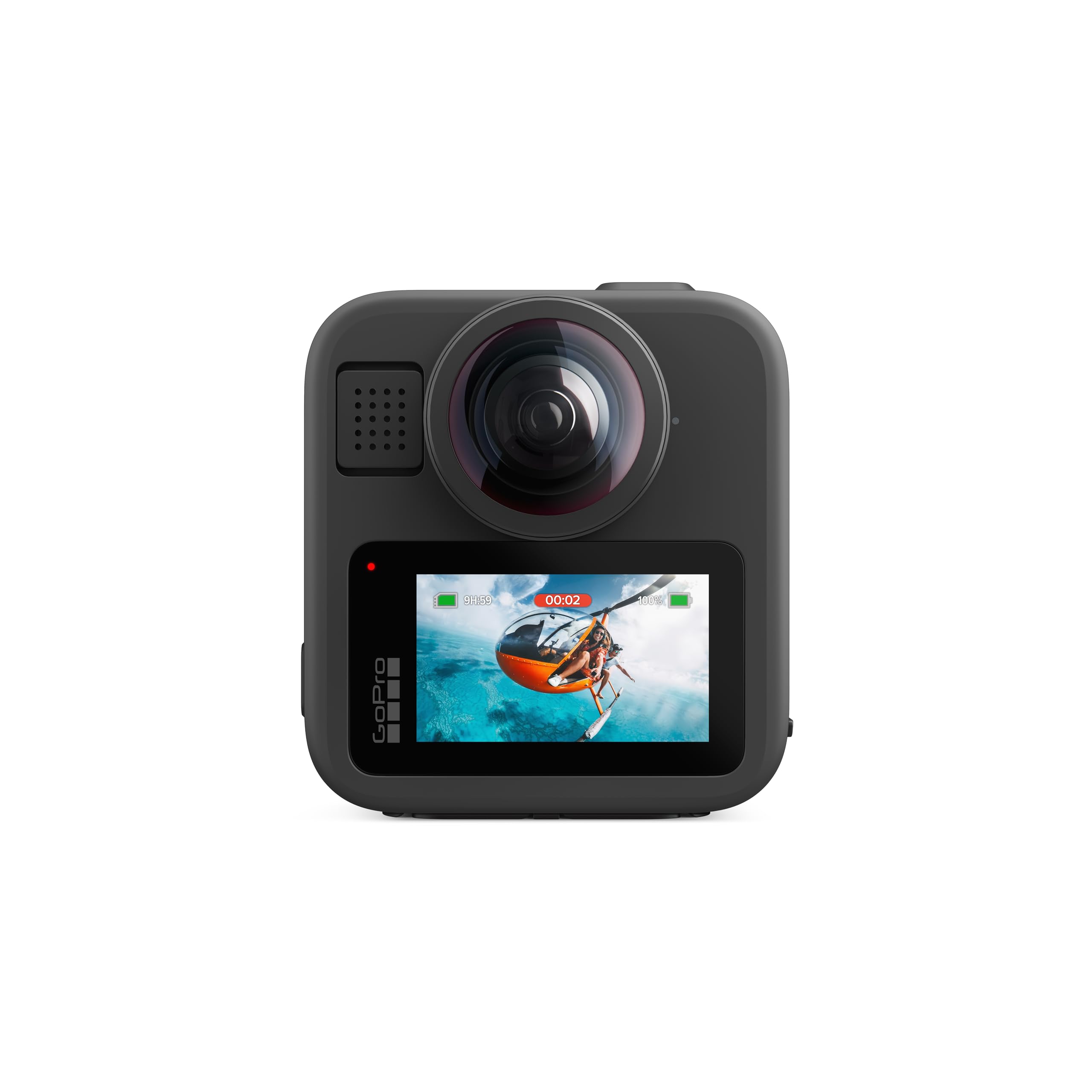
The GoPro MAX2 brings a 21% resolution boost over its predecessor with True 8K 360 video, and for virtual tour shooters who also need an action camera, this hybrid design eliminates the need to carry two devices. The spherical 8K footage reframes to clean 4K output in the Quik app, and the HyperSmooth stabilization combined with Horizon Lock means you can shoot handheld walkthroughs without a gimbal. The 29MP 360 photos provide enough resolution for property stills, though the dynamic range in high-contrast rooms is not as forgiving as the 1-inch sensor models from DJI and Ricoh.
The replaceable glass lenses are a standout feature for virtual tour applications — scratched lenses are a common hazard when moving a camera between tripod, selfie stick, and tight spaces, and being able to swap a lens without replacing the entire camera is a smart design choice. The 1/4-20 mounting thread on the bottom opens up compatibility with standard tripods and photography gear, which is essential for stable tour capture. The six-microphone array with ambisonic audio capture adjusts the sound perspective to match the viewing angle, creating a more immersive experience when the viewer rotates through the tour.
Waterproofing without a housing simplifies outdoor shots like garden tours or pool areas. However, the MAX2 has been reported by some users to run hot during extended 8K recording, which could be a concern for longer continuous walkthroughs. The battery consumption is roughly 50% per hour of 360 time-lapse, so carrying spare batteries is advisable for multi-property sessions. The GoPro Quik app is user-friendly for reframing, but lacks the advanced AI auto-tracking and color grading tools found in the DJI Mimo or Insta360 apps.
Why it’s great
- Replaceable glass lenses protect against scratches on location
- Waterproof without housing for seamless indoor-outdoor tours
- 6-mic ambisonic audio syncs with viewer perspective
Good to know
- Can run hot during extended 8K recording sessions
- Dynamic range doesn’t match 1-inch sensor competitors
7. Xtra 360 Camera, 8K Panoramic Video
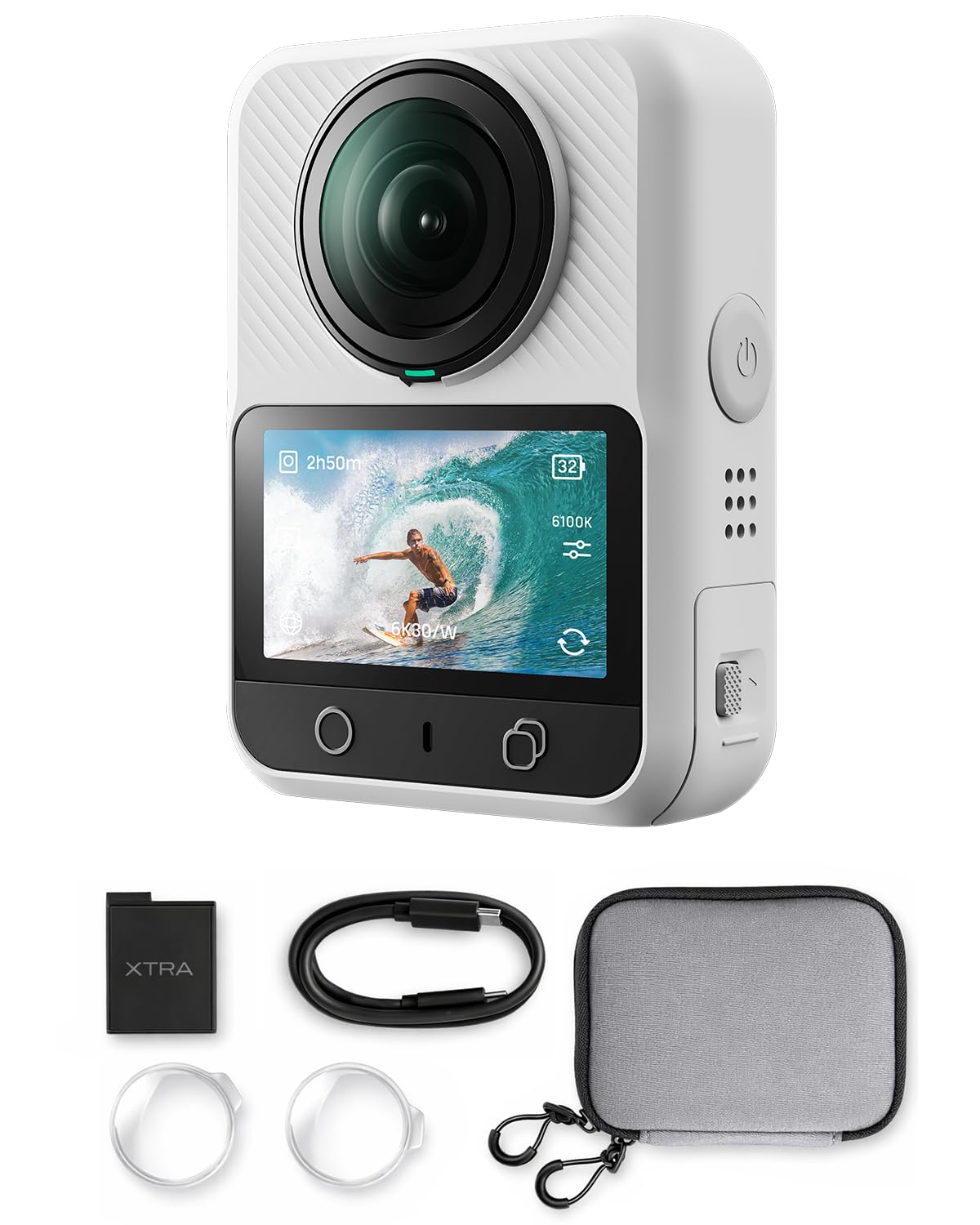
The Xtra 360 Camera brings a true 1-inch sensor equivalent to a mid-range price point, delivering cinema-grade depth and color reproduction that rivals cameras costing significantly more. The 8K 360 video and 100MP panoramic photo mode provide the resolution headroom needed for professional virtual tours where viewers zoom into architectural details. The low-light performance is genuinely impressive for this class — noise remains controlled even during dusk shoots, making it a strong option for evening property tours or interior shots with limited natural light.
The 105GB built-in storage is one of the most user-friendly features for virtual tour workflows. You never need to worry about forgetting a memory card or running out of space mid-shoot. The magnetic quick-release system works with standard action camera mounts and selfie sticks, allowing fast transitions between tripod and handheld shooting. The waterproof design adds durability for exterior environments, and the Bullet Time mode offers creative flexibility for dynamic walkthrough clips.
The software ecosystem is where the Xtra 360 falls behind the market leaders. As of early 2026, it does not support exporting individual 360 clips for editing in desktop software like Final Cut Pro, which limits the post-production workflow for professional editors. The app receives firmware updates that have added DJI Mic 2 support, but the overall software polish and update frequency lag behind Insta360 and DJI. For users who can work within the app’s current limitations, the hardware value is exceptional.
Why it’s great
- 1-inch sensor delivers near-premium image quality at a lower entry point
- 105GB built-in storage eliminates card management during shoots
- Strong low-light performance for evening and interior tours
Good to know
- Cannot export individual 360 clips for desktop video editing software
- Software ecosystem and update frequency trail leading brands
8. GoPro MAX 360 (2025) with 50-Piece Accessory Kit

The GoPro MAX 360 (2025) iteration upgrades the mounting system to the universal 1/4-20 standard, which is a welcome change for virtual tour shooters who rely on standard photography tripods and gimbals. The 5.6K/30fps spherical video captures immersive 360 footage with in-camera stitching, so the equirectangular file is ready for tour platforms immediately without desktop processing. The HERO mode allows you to switch to a single-lens wide-angle camera for standard video clips, effectively giving you two cameras in one body.
The 50-piece accessory bundle includes a suction cup mount, floating handle grip, flexible tripod, helmet mounts, and a carrying bag. While this provides a huge volume of mounting options, buyer reviews consistently note that the accessory quality is below the camera’s standard — selfie sticks broke on first use, and plastic fittings failed to tighten properly. For virtual tour use, you would likely only use a few of these accessories (tripod, case, adhesive mounts), so the value of the kit depends on whether you need a starter set of action mounts alongside the camera.
The six-microphone array with advanced wind-noise reduction captures clean audio in outdoor environments, and the waterproofing to 16ft means the camera handles exterior shots in rain or near water features without a housing. Voice control with 12 commands allows hands-free operation when the camera is mounted high on a tripod. The 5.6K resolution is lower than the 8K offered by DJI and Insta360, which means less cropping headroom when reframing video, but for standard virtual tour output at 4K, the resolution is sufficient for most use cases.
Why it’s great
- 1/4-20 mounting thread works with standard photography tripods
- In-camera stitching eliminates desktop processing step
- Voice control for hands-free operation during solo shoots
Good to know
- Bundled accessories are lower quality than the camera itself
- 5.6K resolution offers less reframing headroom than 8K models
9. DJI Osmo 360 Motorcycle Handlebar POV Combo
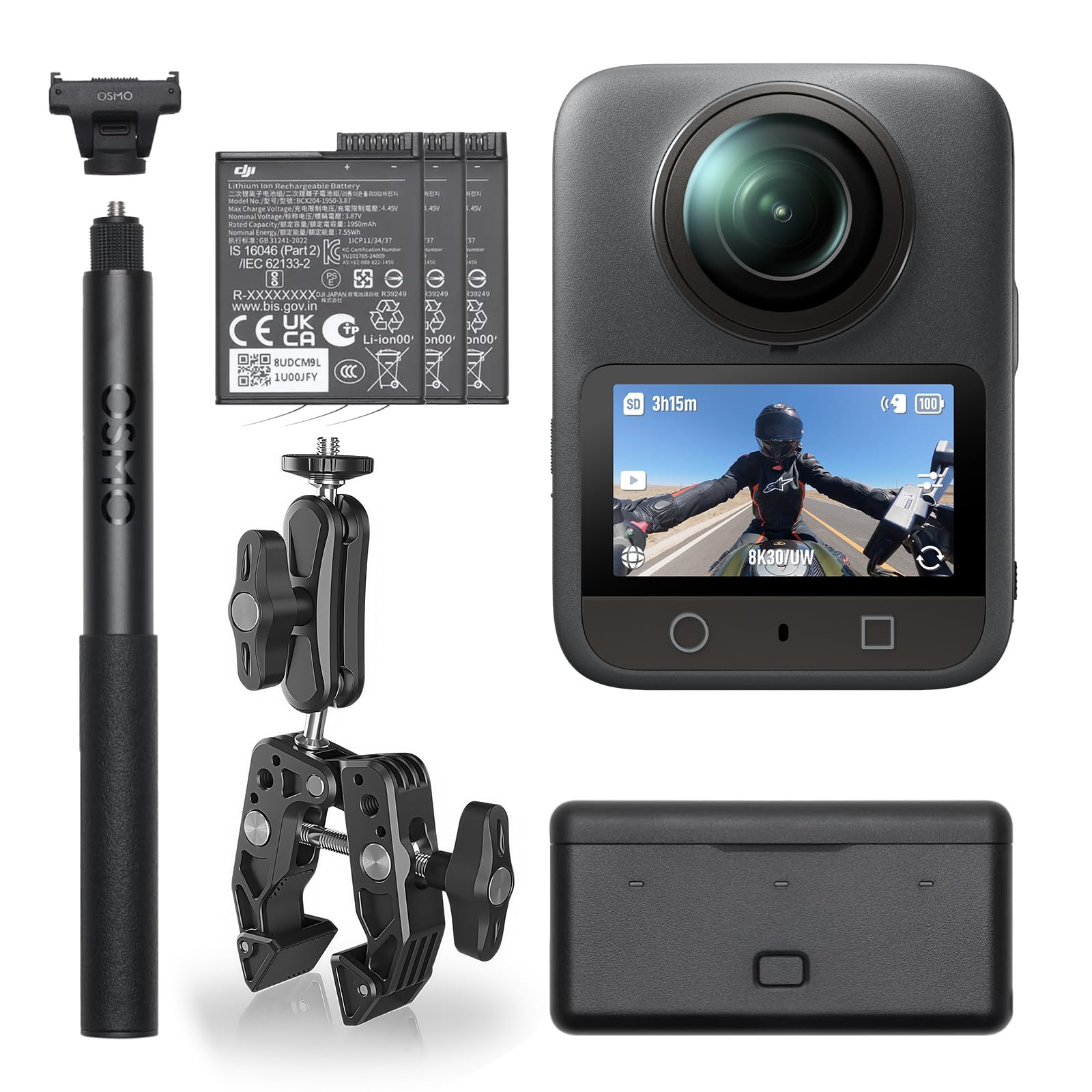
The DJI Osmo 360 Motorcycle Handlebar POV Combo is essentially the same core camera as the Essential Combo but packaged specifically for riders who want to capture POV tour footage from a motorcycle, bicycle, or helmet mount. The dual 1-inch sensors remain the highlight, delivering native 8K/50fps 360 video with the same 13.5 stops of dynamic range that makes the DJI platform so capable for mixed-lighting scenes. The super night mode with f/1.9 aperture further extends usability into evening rides, making it possible to capture twilight city tours with clean detail.
The combo includes three extended-life batteries and a multifunctional battery case that provides up to 190 minutes of total recording time in 6K mode, which is generous for a full day of tour capture. The heavy-duty handlebar mount with a camera super clip ensures the camera stays secure during vibration-heavy rides. Gesture and voice control allow hands-free operation while riding, and the HorizonSteady stabilization keeps footage level even through turns and bumps — critical for producing smooth virtual tour segments from vehicle-mounted footage.
For virtual tour creation, this combo is best used for exterior property approaches, scenic drives, or campus perimeter capture where you want to stitch together a driving tour. The magnetic quick-release system makes it easy to detach the camera for interior hand-held shots, so you can transition between vehicle and walking tours without switching gear. The professional D-Log M color mode preserves 10-bit color depth for grading flexibility in post-production. The main limitation is that the handlebar mount is specialized — if you do not ride, the Essential Combo is a better value.
Why it’s great
- 190-minute total battery life with three included batteries
- HorizonSteady stabilization keeps mounted footage level on rough roads
- 10-bit D-Log M color grading for professional post-production
Good to know
- Handlebar mount is specialized for riders, not general tour shooters
- App software update cycle less frequent than Insta360’s ecosystem
10. Bundle It Better Insta360 X5 with 50-in-1 Accessory Kit
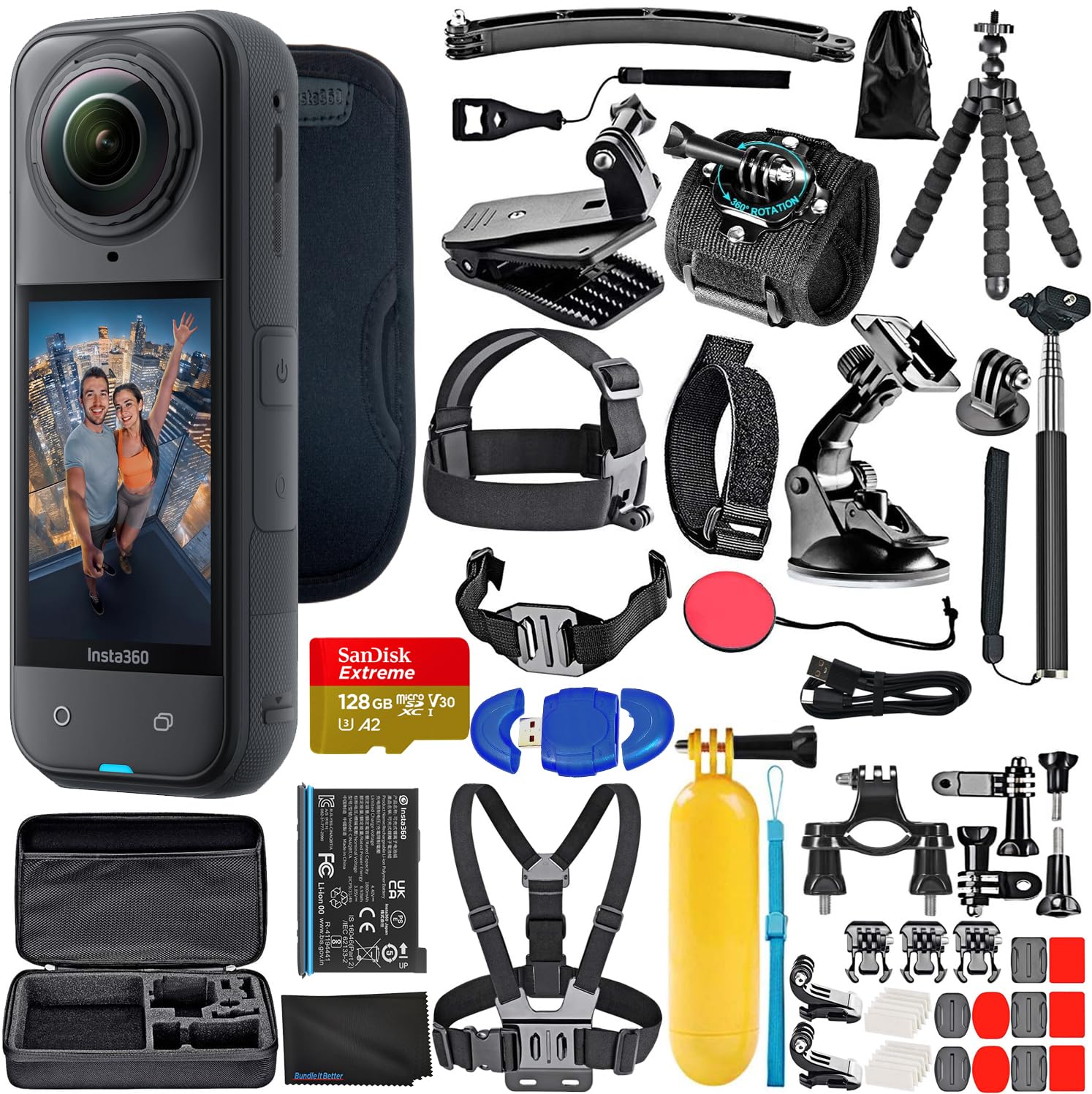
This bundle packages the Insta360 X5 camera with a 50-in-1 accessory kit and a 128GB SanDisk Extreme microSD card, providing everything you need to start shooting virtual tours on day one. The X5 camera itself is identical to the standalone model — dual 1/1.28-inch sensors, 8K30fps 360 video, PureVideo low-light mode, and the triple AI chip for noise reduction.
The accessory bundle includes a suction cup mount, floating grip, flexible tripod, chest strap, head strap, helmet mounts, and multiple adhesive bases. As with the GoPro bundle, buyer reviews consistently report that the accessory quality is low — the selfie stick broke on first use for multiple users, and plastic components generally lack durability. The practical takeaway is that the camera itself is a 5-star device, but the accessories should be considered disposable extras. You would want to invest in a quality selfie stick and tripod separately for serious virtual tour work.
The included 128GB memory card is a genuine value add, saving you a separate purchase before your first shoot. The X5’s native waterproofing to 49ft means exterior shots in rain or near pools require no housing. However, the bundle’s included accessories inflate the total package cost compared to buying the camera alone, and the return policy for bundled items can be restrictive. For the camera and memory card alone, this is a fair deal — just factor in the cost of replacing the low-end accessories with professional-grade gear if you plan to use them regularly.
Why it’s great
- Includes a 128GB microSD card, saving an immediate purchase
- Camera offers strong low-light PureVideo mode for evening tours
- Waterproof to 49ft for exterior and pool-area shoots
Good to know
- Bundled accessory quality is poor — selfie stick and mounts break easily
- Bundle cost is higher than camera alone; accessories are not return-friendly
11. Meeting Owl 4+ 360-Degree 4K Smart Video Conference Camera

The Meeting Owl 4+ serves a very different purpose than the other cameras on this list — it is designed for real-time hybrid meeting collaboration, not for producing exportable 360 tour files. The 4K 360-degree video feed is processed through the proprietary Owl Intelligence System, which automatically focuses the camera view and zooms in on whoever is speaking. For virtual tours that include a live guided component, such as a remote real estate agent walking a buyer through a property via video call, the Owl 4+ provides an engaging all-in-one experience: camera, microphone, and speaker in a single device that covers rooms up to 18 feet.
Setup takes approximately six minutes from unboxing to first meeting, and the device is universally compatible with Zoom, Teams, Google Meet, and other platforms without proprietary drivers. The 4K video upgrade over the previous Owl 3 provides noticeably sharper detail for remote participants when viewing a room. The device can be paired with a second Owl or an Expansion Mic to cover larger spaces, and enterprise features like WiFi connectivity, a Kensington lock, and Power over Ethernet make it deployable in professional managed environments.
For virtual tour creation specifically, the Owl 4+ is not a good fit if you need to export equirectangular images or video files for editing into a tour platform like Matterport or Kuula. The camera’s output is optimized for real-time streaming, not for producing standalone 360 media files. The audio switching between speakers has a slight lag, as noted by reviewers, which can feel abrupt during rapid conversation. This device belongs in a conference room for live hybrid tours and meetings, not in a photographer’s bag for property capture. Its inclusion here is for the niche case where a live guided 360 virtual tour is the deliverable itself.
Why it’s great
- All-in-one 360 camera, microphone, and speaker for live tours
- 6-minute setup with universal platform compatibility
- Enterprise features include WiFi, Kensington lock, and PoE support
Good to know
- Cannot export 360 files for post-production tour editing
- Speaker switching has a slight lag during rapid conversation
FAQ
What resolution do I need for professional real estate virtual tours?
Can I use an action 360 camera like GoPro MAX for virtual tours?
Do I need a camera with built-in GPS for virtual tours?
What is the advantage of a 1-inch sensor in a 360 camera?
Does the Matterport Pro2 require a subscription?
Final Thoughts: The Verdict
For most users, the 360 camera for virtual tour winner is the DJI Osmo 360 Essential Combo because its dual 1-inch sensors deliver the best balance of dynamic range, 8K resolution, and 105GB internal storage for professional still and video tours. If you need the absolute best still image quality for high-end real estate or low-light interiors, grab the Ricoh Theta Z1 51GB — its 23MP 16-bit RAW output and native GPS tagging remain unmatched for photography-focused virtual tour workflows. And for AI-assisted reframing and the most polished smartphone editing experience, nothing beats the Insta360 X5 Essentials Bundle , especially if you value fast turnaround on social-ready tour clips and the security of replaceable lens protectors on location.